A dumbbell full body workout can train the major muscles of your legs, hips, back, chest, shoulders, arms, and core in one session. The key is choosing exercises that cover several movement patterns instead of filling the workout with small isolation exercises.
This complete routine combines a squat, hip hinge, chest press, row, reverse lunge, overhead press, and loaded carry. You will also learn how to choose your dumbbell weight, organize your sets, correct common mistakes, and progress the workout safely.
Dumbbell Full Body Workout at a Glance
| Training detail | Recommendation |
|---|---|
| Main goal | Full-body strength and muscle development |
| Experience level | Beginner to intermediate |
| Equipment | One or two dumbbells; stable bench or chair optional |
| Number of exercises | 7 |
| Working sets | 2–3 per exercise |
| Repetition range | Mostly 8–12 repetitions |
| Rest between sets | 60–120 seconds |
| Suggested effort | Finish with about 2–3 controlled repetitions remaining |
| Weekly frequency | 2–3 nonconsecutive days |
| Estimated duration | Approximately 35–50 minutes |
Beginners can start with one or two sets per exercise. Add more volume only after you can complete the workout with controlled technique and recover comfortably before the next session.
Can You Train Your Full Body With Dumbbells?
Dumbbells can provide enough resistance for squatting, hinging, pressing, rowing, lunging, carrying, and many single-leg or single-arm movements. They also allow each side of the body to work independently, which can make it easier to notice differences in strength or control.
The 2026 American College of Sports Medicine resistance-training guidance emphasizes that consistency and regular training of all major muscle groups matter more for most healthy adults than complicated programs or specialized equipment. The review also found that home-based routines and different forms of resistance can improve strength, muscle size, and physical function.
The CDC muscle-strengthening guidelines recommend training all major muscle groups on at least two days each week. The CDC also notes that 8–12 repetitions count as one set and that completing two or three sets may provide additional benefits beyond one set.
Dumbbells do have one limitation: the same weight may not challenge every exercise equally. Your legs and back can usually handle more resistance than your shoulders, for example. Adjustable dumbbells or several pairs make progression easier, but one moderate pair can still support an effective routine.
Muscles Worked in a Full-Body Dumbbell Workout
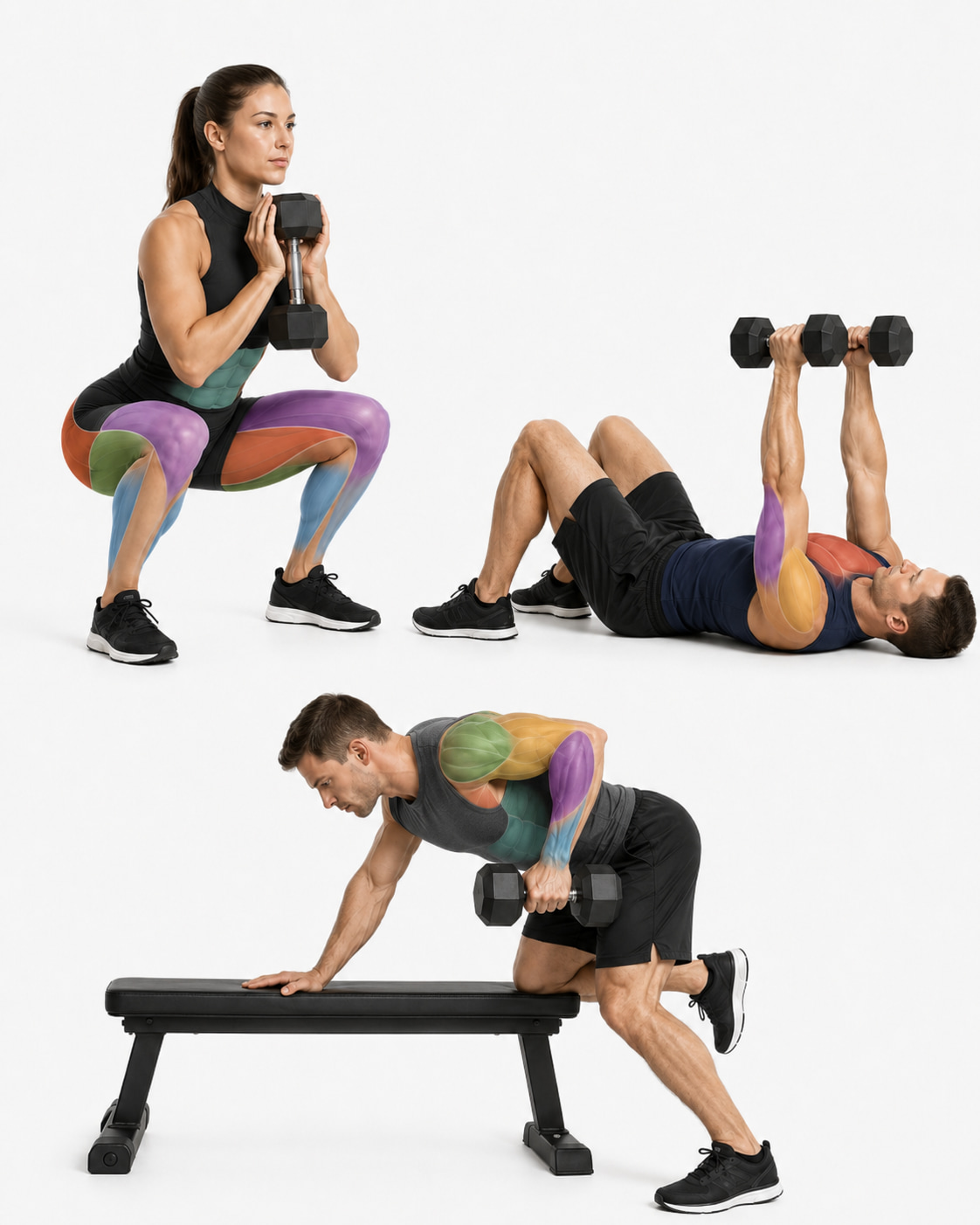
This routine trains several muscle groups together rather than attempting to isolate one muscle at a time.
1. Lower Body
The goblet squat and reverse lunge primarily train the:
- Quadriceps
- Gluteus maximus
- Adductors
- Hamstrings
- Calves and other lower-leg stabilizers
The Romanian deadlift places greater emphasis on the hamstrings, glutes, and muscles that stabilize the spine.
2. Chest, Shoulders, and Triceps
The dumbbell floor press trains the chest, triceps, and front of the shoulders.
The overhead press shifts more work toward the deltoids and triceps while requiring the trunk to remain stable under an overhead load.
3. Back and Biceps
The supported one-arm row trains the:
- Latissimus dorsi
- Rhomboids
- Middle and lower trapezius
- Posterior deltoids
- Biceps and other elbow flexors
4. Core and Grip
Your abdominal, oblique, and back muscles stabilize your torso during nearly every exercise. Farmer’s carries add direct grip, forearm, shoulder, and trunk-stability work.
Equipment You Need
The basic workout requires:
- One or two dumbbells
- Enough floor space to lie down and perform lunges
- A clear area for loaded carries
- A stable bench, chair, or countertop for supported rows
- An exercise mat if the floor is uncomfortable
Make sure any chair or bench used for support is stable and cannot slide or roll.
How to Choose the Right Dumbbell Weight
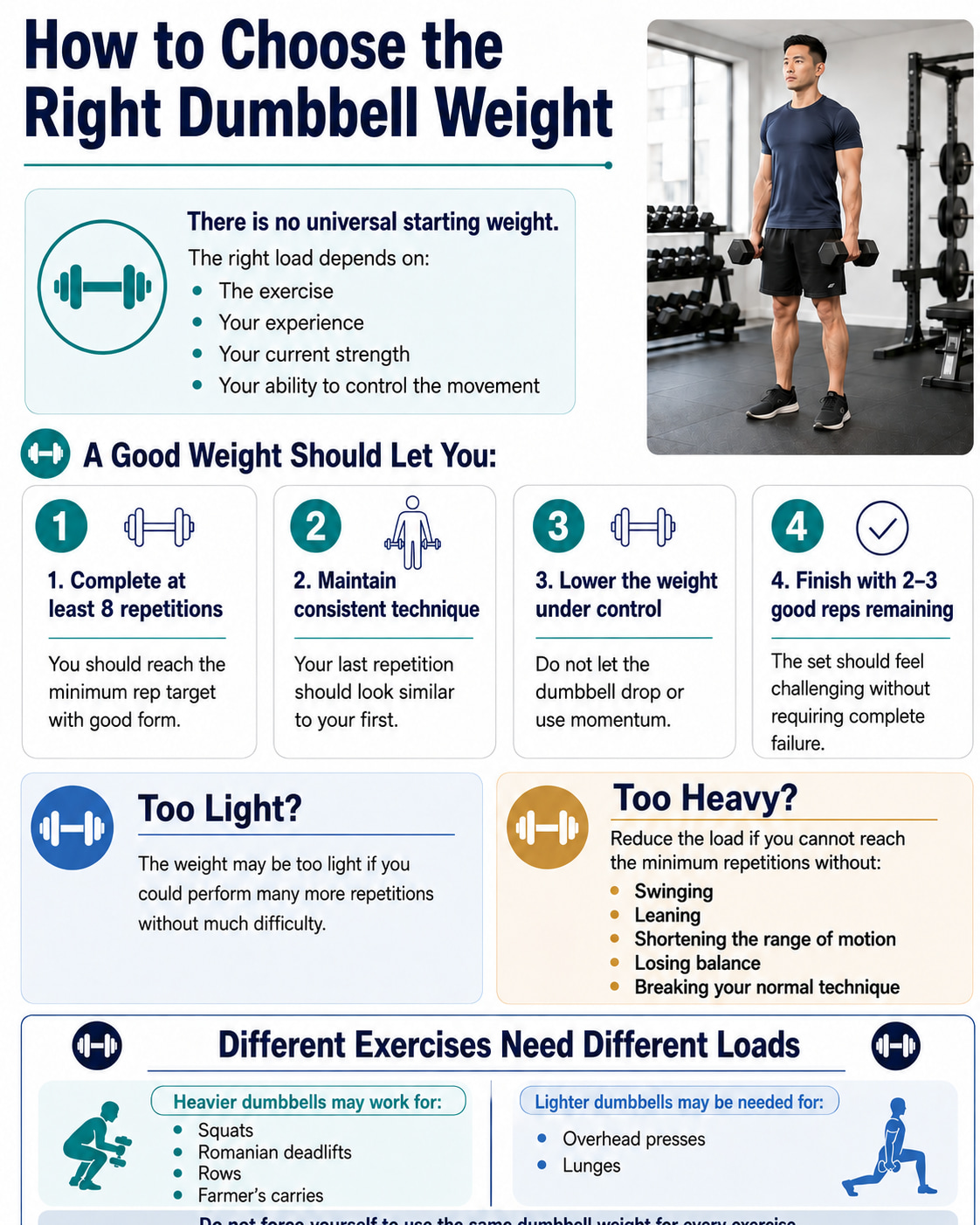
There is no universal starting weight. The correct load depends on the exercise, your experience, your current strength, and how well you can control the movement.
Choose a weight that allows you to:
- Complete at least 8 repetitions
- Maintain the same technique from the first repetition to the last
- Lower the weight under control
- Finish with approximately 2–3 good repetitions still possible
If you could perform many more repetitions, the weight may be too light for your current goal. If you cannot reach the minimum repetitions without swinging, leaning, shortening the range of motion, or losing balance, reduce the load.
You may need heavier dumbbells for squats, Romanian deadlifts, rows, and carries than for overhead presses or lunges. Do not force yourself to use the same load for every movement.
Warm-Up Before the Dumbbell Full Body Workout
Spend approximately 5–8 minutes increasing your body temperature and practicing the movements you will use.
The American Academy of Orthopaedic Surgeons commonly recommends 5–10 minutes of low-impact activity before strengthening exercises.
Try the following warm-up:
- March or walk briskly for 2–3 minutes.
- Perform 8–10 controlled bodyweight squats.
- Practice 8–10 unloaded hip hinges.
- Complete 5 reverse lunges per side while holding a support if needed.
- Perform 8–10 arm circles in each direction.
- Complete one light practice set of the goblet squat and floor press.
The warm-up should prepare you for the session without making you tired.
Complete Dumbbell Full Body Workout
Perform the exercises in the order shown. Beginners should complete all sets of one exercise before moving to the next exercise.
| Order | Exercise | Sets | Repetitions or time | Rest |
|---|---|---|---|---|
| 1 | Dumbbell Goblet Squat | 2–3 | 8–12 | 90–120 sec |
| 2 | Dumbbell Romanian Deadlift | 2–3 | 8–12 | 90–120 sec |
| 3 | Dumbbell Floor Press | 2–3 | 8–12 | 60–90 sec |
| 4 | Supported One-Arm Dumbbell Row | 2–3 | 8–12 per side | 60–90 sec |
| 5 | Dumbbell Reverse Lunge | 2–3 | 8–10 per side | 60–90 sec |
| 6 | Dumbbell Overhead Press | 2–3 | 8–12 | 60–90 sec |
| 7 | Dumbbell Farmer’s Carry | 2–3 | 20–40 sec | 60 sec |
For one-arm or one-leg exercises, complete both sides before taking the full rest period.
1. Dumbbell Goblet Squat
Best for: Building lower-body strength while learning a controlled squat pattern.
Muscles worked: Quadriceps, gluteus maximus, adductors, hamstrings, calves, and core.
Equipment needed: One dumbbell.
Sets, reps, and rest: Perform 2–3 sets of 8–12 repetitions. Rest for 90–120 seconds.
How to Do It
- Hold one dumbbell vertically against your chest, supporting the upper end with both hands.
- Stand with your feet approximately shoulder-width apart and your toes turned slightly outward.
- Brace your trunk and bend your knees and hips together.
- Lower between your hips while keeping your whole foot in contact with the floor.
- Allow your knees to travel in the same direction as your toes.
- Descend only as far as you can without your heels lifting or your lower back rounding.
- Push the floor away and stand tall without leaning backward.
These basic setup points are consistent with the ACE goblet squat demonstration.
Common mistakes: Avoid allowing the knees to collapse inward, lifting the heels, dropping the chest excessively, or holding the dumbbell away from your body. Do not force a deeper squat than you can control.
Regression: Squat to a stable chair or bench while holding a light dumbbell at your chest.
Progression: Increase the dumbbell weight or use two dumbbells in a front-rack position.
Coaching cue: Keep pressure under your heel, the base of your big toe, and the base of your little toe.
2. Dumbbell Romanian Deadlift
Best for: Strengthening the hamstrings and glutes while practicing a hip-hinge pattern.
Muscles worked: Hamstrings, gluteus maximus, adductors, spinal stabilizers, upper back, forearms, and grip.
Equipment needed: Two dumbbells, although one dumbbell can also be used.
Sets, reps, and rest: Perform 2–3 sets of 8–12 repetitions. Rest for 90–120 seconds.
How to Do It
- Stand with your feet approximately hip-width apart and hold the dumbbells in front of your thighs.
- Keep your knees slightly bent rather than completely straight.
- Brace your trunk and push your hips backward.
- Keep the dumbbells close to your legs as your torso inclines forward.
- Lower until you feel strong hamstring tension or can no longer move your hips backward without rounding your back.
- Push through your feet and drive your hips forward to return to standing.
- Finish tall without leaning backward or forcing your hips excessively forward.
The NASM dumbbell Romanian deadlift guide similarly emphasizes a neutral spine, slight knee bend, backward hip movement, and controlled return to standing.
Common mistakes: Do not turn the exercise into a squat by bending the knees excessively. Other common errors include rounding the back, letting the weights drift away from the legs, jerking the dumbbells, and lowering farther than your available hip motion allows.
Regression: Hold one dumbbell with both hands and use a shorter range of motion. Practicing an unloaded wall hip hinge can also help you learn to move the hips backward.
Progression: Use heavier dumbbells or perform a staggered-stance Romanian deadlift.
Coaching cue: Close an imaginary car door behind you with your hips.
3. Dumbbell Floor Press
Best for: Training the chest and triceps without requiring a bench.
Muscles worked: Pectoralis major, triceps, anterior deltoids, and shoulder stabilizers.
Equipment needed: Two dumbbells and an exercise mat if desired.
Sets, reps, and rest: Perform 2–3 sets of 8–12 repetitions. Rest for 60–90 seconds.
How to Do It
- Sit on the floor with the dumbbells close to your thighs.
- Carefully roll onto your back while bringing the dumbbells into position.
- Bend your knees and place your feet flat on the floor.
- Position your upper arms approximately 30–45 degrees away from your torso.
- Keep your forearms vertical and your wrists stacked over your elbows.
- Press the dumbbells upward over your chest without allowing them to collide.
- Lower slowly until your upper arms make gentle contact with the floor.
- Pause briefly and press into the next repetition.
The floor limits how far the upper arms can travel behind the torso, which is one reason the dumbbell floor press is a useful no-bench pressing option. The National Strength and Conditioning Association specifically notes that the floor limits horizontal movement behind the body during this exercise.
Common mistakes: Avoid bending the wrists backward, flaring the elbows directly out to the sides, bouncing the arms against the floor, or arching the lower back excessively.
Regression: Use lighter dumbbells or perform an incline push-up against a stable bench or countertop.
Progression: Perform a dumbbell bench press for a longer range of motion or use an alternating floor press.
Coaching cue: Keep your knuckles above your elbows throughout the press.
4. Supported One-Arm Dumbbell Row
Best for: Strengthening the back while reducing the balance and lower-back demands of an unsupported row.
Muscles worked: Latissimus dorsi, rhomboids, trapezius, posterior deltoids, biceps, forearms, and grip.
Equipment needed: One dumbbell and a stable bench, chair, or countertop.
Sets, reps, and rest: Perform 2–3 sets of 8–12 repetitions per side. Rest for 60–90 seconds after both sides.
How to Do It
- Place one hand on a stable support and step the opposite foot slightly backward.
- Hinge at your hips until your torso is comfortably inclined.
- Keep your spine neutral and allow the dumbbell arm to hang toward the floor.
- Pull your elbow back toward your hip.
- Stop before your shoulder rolls forward or your torso begins to rotate.
- Pause briefly at the top.
- Lower the dumbbell until your arm is extended while keeping your trunk still.
- Complete the set and switch sides.
The ACE single-arm row guide emphasizes maintaining a flat back, keeping the arm near the body, and avoiding trunk rotation.
Common mistakes: Avoid twisting the torso, shrugging the working shoulder, jerking the weight upward, or pulling the dumbbell so high that the shoulder rolls forward.
Regression: Use a lighter dumbbell and support more of your body weight with the nonworking arm.
Progression: Increase the load or use a less-supported three-point stance when you can prevent your torso from rotating.
Coaching cue: Pull your elbow toward your back pocket.
5. Dumbbell Reverse Lunge
Best for: Developing single-leg strength, balance, and control.
Muscles worked: Quadriceps, gluteus maximus, adductors, hamstrings, calves, and core.
Equipment needed: Two dumbbells. One dumbbell can be used when additional balance support is needed.
Sets, reps, and rest: Perform 2–3 sets of 8–10 repetitions per leg. Rest for 60–90 seconds.
How to Do It
- Stand tall with a dumbbell at each side.
- Keep your feet approximately hip-width apart rather than standing on a narrow line.
- Step one leg backward and land on the ball of the rear foot.
- Bend both knees and lower under control.
- Keep the front heel grounded and the front knee tracking in the direction of the toes.
- Descend only as far as you can maintain balance and trunk control.
- Push through the front foot to return to standing.
- Alternate legs or complete all repetitions on one side before switching.
Common mistakes: Avoid stepping directly behind the front foot, taking a step that is too short, allowing the front knee to collapse inward, pushing excessively from the rear leg, or dropping quickly into the bottom position.
Regression: Perform a bodyweight reverse lunge while holding a stable support. A stationary split squat is another useful option because the feet remain planted.
Progression: Increase the dumbbell weight or hold the dumbbells at shoulder height.
Coaching cue: Use the front leg to pull yourself back to standing.
6. Dumbbell Overhead Press
Best for: Building shoulder and triceps strength.
Muscles worked: Anterior and middle deltoids, triceps, upper chest, upper-back stabilizers, and core.
Equipment needed: Two dumbbells. A bench or chair with back support is optional.
Sets, reps, and rest: Perform 2–3 sets of 8–12 repetitions. Rest for 60–90 seconds.
How to Do It
- Stand with your feet approximately hip-width apart or sit against a stable backrest.
- Hold the dumbbells at shoulder height with your wrists straight.
- Position your elbows slightly in front of your torso rather than directly out to the sides.
- Brace your abdominal and glute muscles and keep your ribs controlled.
- Press the dumbbells upward and slightly inward.
- Allow your shoulder blades to rotate naturally as your arms rise.
- Finish with the weights over your shoulders without leaning backward.
- Lower the dumbbells slowly to the starting position.
The ACE seated overhead press guide also emphasizes neutral wrists, a stable torso, controlled lowering, and avoiding excessive lower-back arching.
Common mistakes: Avoid leaning backward, flaring the ribs, bending the wrists, using leg drive, or lowering the dumbbells faster than you can control.
Regression: Use lighter dumbbells and perform the press while seated against a backrest.
Progression: Use heavier dumbbells or perform a standing alternating overhead press.
Coaching cue: Press up while keeping your ribs stacked over your pelvis.
7. Dumbbell Farmer’s Carry
Best for: Improving grip strength, loaded posture, and trunk stability.
Muscles worked: Forearms, grip muscles, trapezius, shoulders, abdominal muscles, obliques, spinal stabilizers, glutes, and legs.
Equipment needed: Two dumbbells and a clear walking area.
Sets, reps, and rest: Perform 2–3 carries lasting 20–40 seconds. Rest for approximately 60 seconds.
How to Do It
- Place the dumbbells beside your feet.
- Squat or hinge down and grip both weights securely.
- Stand tall with the dumbbells hanging beside your hips.
- Keep your head neutral, ribs controlled, and shoulders level.
- Walk using short, controlled steps.
- Avoid allowing the weights to swing or your body to lean from side to side.
- Turn carefully rather than pivoting quickly.
- Set the dumbbells down using a controlled squat or hip hinge.
The ACE farmer’s carry demonstration classifies the movement as a full-body exercise and emphasizes a firm grip, upright back position, and controlled walking.
Common mistakes: Avoid shrugging the shoulders aggressively, rushing, leaning forward, holding your breath, or continuing after your grip has become unreliable.
Regression: Use lighter dumbbells, shorten the carry, or perform a stationary dumbbell hold.
Progression: Increase either the weight or duration gradually. Avoid increasing both at the same time.
Coaching cue: Walk tall as though you are carrying two full buckets of water.
How to Perform the Routine
Beginner Option
Use this setup when you are learning the exercises:
- Perform the workout twice per week.
- Leave at least one rest day between sessions.
- Complete 1–2 sets of each exercise.
- Begin near the lower end of each repetition range.
- Finish each set with approximately 3 controlled repetitions remaining.
- Rest for 90–120 seconds whenever you need more time to recover.
Complete all sets of one exercise before moving to the next. This makes it easier to focus on technique and track your repetitions.
Standard Strength Option
After you are comfortable with the movements:
- Train two or three nonconsecutive days per week.
- Complete 2–3 sets per exercise.
- Use the full recommended repetition ranges.
- Finish most sets with approximately 2 repetitions remaining.
- Rest long enough to repeat the exercise with similar technique.
A practical two-day schedule is Monday and Thursday. A three-day schedule could be Monday, Wednesday, and Friday.
When training three days per week, two sets per exercise may be enough initially. You do not need to complete three sets of every movement during every session.
Time-Saving Paired-Set Option
More experienced readers can alternate two exercises that train different areas:
- Goblet squat and floor press
- Romanian deadlift and overhead press
- Reverse lunge and one-arm row
- Finish with farmer’s carries
Perform one set of the first exercise, move to the second exercise, and then rest for 60–90 seconds. Repeat until all sets are complete.
Paired sets can reduce workout time, but they should not turn the routine into a race. Take additional rest when your breathing, grip, or balance would otherwise affect your form.
How Often Should You Do a Full-Body Dumbbell Workout?
Most beginners can start with two full-body sessions per week. This provides regular practice while leaving several recovery days.
A third weekly workout can be added when:
- Your soreness is manageable
- Your technique remains consistent
- Your performance is stable or improving
- You are sleeping and recovering adequately
- The additional session does not cause persistent fatigue
Avoid performing hard full-body sessions on consecutive days when you are starting. Walking, mobility work, recreational activities, and lighter aerobic exercise can be performed between strength sessions as tolerated.
How to Progress the Workout
Use a simple double-progression method.
Suppose an exercise is programmed for 8–12 repetitions:
- Choose a weight you can control for approximately 8 repetitions.
- Add one repetition to one or more sets over future workouts.
- Continue until you can complete 12 repetitions in every set.
- Confirm that your technique remains stable and that you are not reaching complete failure.
- Increase to the next available dumbbell weight.
- Return to approximately 8 repetitions and begin building upward again.
The 2026 ACSM guidance indicates that many resistance-training approaches can produce results and that training to momentary failure is not consistently necessary for the average healthy adult.
Record your dumbbell weight, sets, and repetitions after each workout. Without a written record, it is difficult to know whether you are actually progressing.
What to Do When Your Dumbbells Feel Too Light
Limited equipment does not mean the workout has stopped being useful. You can make an exercise more challenging by:
- Adding repetitions, usually up to approximately 15 per set
- Slowing the lowering phase to three seconds
- Pausing for one second in the hardest position
- Increasing the controlled range of motion
- Adding one set
- Using a single-leg or staggered-stance variation
- Reducing assistance from the nonworking side
Change one variable at a time. Adding repetitions, sets, pauses, and slower tempo simultaneously can create more fatigue than you need.
These methods can extend the usefulness of a dumbbell, but they are not always a complete replacement for adding resistance. A heavier load may eventually be needed for continued strength progression.
Common Dumbbell Full-Body Workout Mistakes
Using the Same Weight for Every Exercise
Your lower body and back will often require more resistance than your shoulders. Use different weights when possible. When you only have one pair, adjust the repetitions, tempo, or exercise variation.
Rushing the Repetitions
Moving faster is not automatically better. Lower each weight under control and avoid using momentum to escape the most challenging part of an exercise.
Turning Every Session Into a Cardio Circuit
Short rest periods may make the workout feel harder, but they can reduce the weight and repetition quality you can maintain. Rest longer when your goal is strength and technique.
Taking Every Set to Failure
Stop the set when your form begins to change or when only one or two controlled repetitions remain. Complete failure is not required during every set.
Ignoring the Lowering Phase
Do not simply let gravity return the dumbbells to the starting position. A controlled lowering phase improves consistency and helps you maintain joint position.
Holding Your Breath
Inhale during the easier or lowering portion and exhale through the lifting portion. Brief bracing is useful, but prolonged breath-holding can cause dizziness in some people.
Training Hard on Consecutive Days
More sessions do not always produce faster results. Your muscles and connective tissues need time to recover from challenging strength training.
Failing to Track Progress
Repeating the same weight and repetitions indefinitely may eventually stop providing enough challenge. Record each session and aim for gradual improvement.
Safety Tips
Use these basic precautions during the routine:
- Begin with lighter dumbbells while learning the movements.
- Keep the training area clear of loose objects.
- Use a stable, non-rolling chair or bench.
- Wear footwear that provides secure contact with the floor.
- Pick dumbbells up and set them down with a controlled squat or hinge.
- Do not sacrifice balance or joint position to complete another repetition.
- Younger lifters should prioritize technique and use age-appropriate resistance with qualified adult supervision.
- Speak with a qualified healthcare professional before beginning if you have an injury, medical condition, significant movement limitation, or concerns about whether resistance training is appropriate for you.
Stop the workout and seek professional help if you experience sharp pain, numbness, dizziness, chest pain, faintness, or other unusual symptoms.
Frequently Asked Questions
Can You Build Strength Using Only Dumbbells?
Yes. Dumbbells can provide progressive resistance for the major movement patterns used in a full-body routine. Continued progress depends on selecting challenging loads, using controlled technique, recovering between sessions, and gradually increasing the training demand.
How Many Days Per Week Should You Do This Workout?
Start with two nonconsecutive days per week. You can progress to three days when you recover well and your performance remains consistent.
What Dumbbell Weight Should a Beginner Use?
Use a weight that allows at least 8 controlled repetitions while leaving approximately 2–3 good repetitions available. There is no single weight that is appropriate for every beginner or every exercise.
Can You Do the Workout With One Dumbbell?
Yes. Use one dumbbell for goblet squats and Romanian deadlifts. Perform floor presses, rows, overhead presses, and carries one side at a time. For reverse lunges, hold the dumbbell at your chest or in one hand and complete equal repetitions on both sides.
Do You Need a Bench?
No. The floor press replaces the bench press, and the row can be supported using a stable chair or countertop. The overhead press can be performed standing.
Should You Perform the Workout as a Circuit?
Regular sets are generally easier for learning form and building strength because they provide more recovery. Paired sets are a good time-saving option. A faster circuit can be used for conditioning, but not when fatigue causes your technique to deteriorate.
How Long Should the Workout Take?
Two sets of each exercise will usually take approximately 30–40 minutes. Three sets with longer rest periods may take 45–60 minutes. The exact duration depends on your setup, fitness level, unilateral exercises, and rest needs.
Conclusion
A complete dumbbell full body workout does not need dozens of exercises. A goblet squat, Romanian deadlift, floor press, row, reverse lunge, overhead press, and farmer’s carry cover the major muscles and movement patterns with minimal equipment.
Start with two weekly sessions and one or two sets per exercise. Learn the movements, record your results, and add repetitions or weight gradually. Consistent, controlled training will be more useful than making every workout as long or exhausting as possible.
References
- American College of Sports Medicine: 2026 Resistance Training Guidelines
- Centers for Disease Control and Prevention: Muscle-Strengthening Activity for Adults
- American Academy of Orthopaedic Surgeons: Knee Conditioning and Warm-Up Guidance
- American Council on Exercise: Goblet Squat
- National Academy of Sports Medicine: Dumbbell Romanian Deadlift
- American Council on Exercise: Single-Arm Row
- American Council on Exercise: Farmer’s Carry
This content is for informational purposes only and is not a substitute for medical advice.