
Neck exercises can support strength, mobility, and head control, but they have not been shown reliably to tighten loose neck skin. When searching for neck exercises for saggy neck, it helps to separate the benefits of muscle training from claims about changing skin appearance.
The useful goal is comfortable movement and better muscular control—not meeting a particular appearance standard. Below, you’ll find what the research supports, five gentle exercises, and a manageable way to practice them.
Do Neck Exercises for Saggy Neck Actually Work?
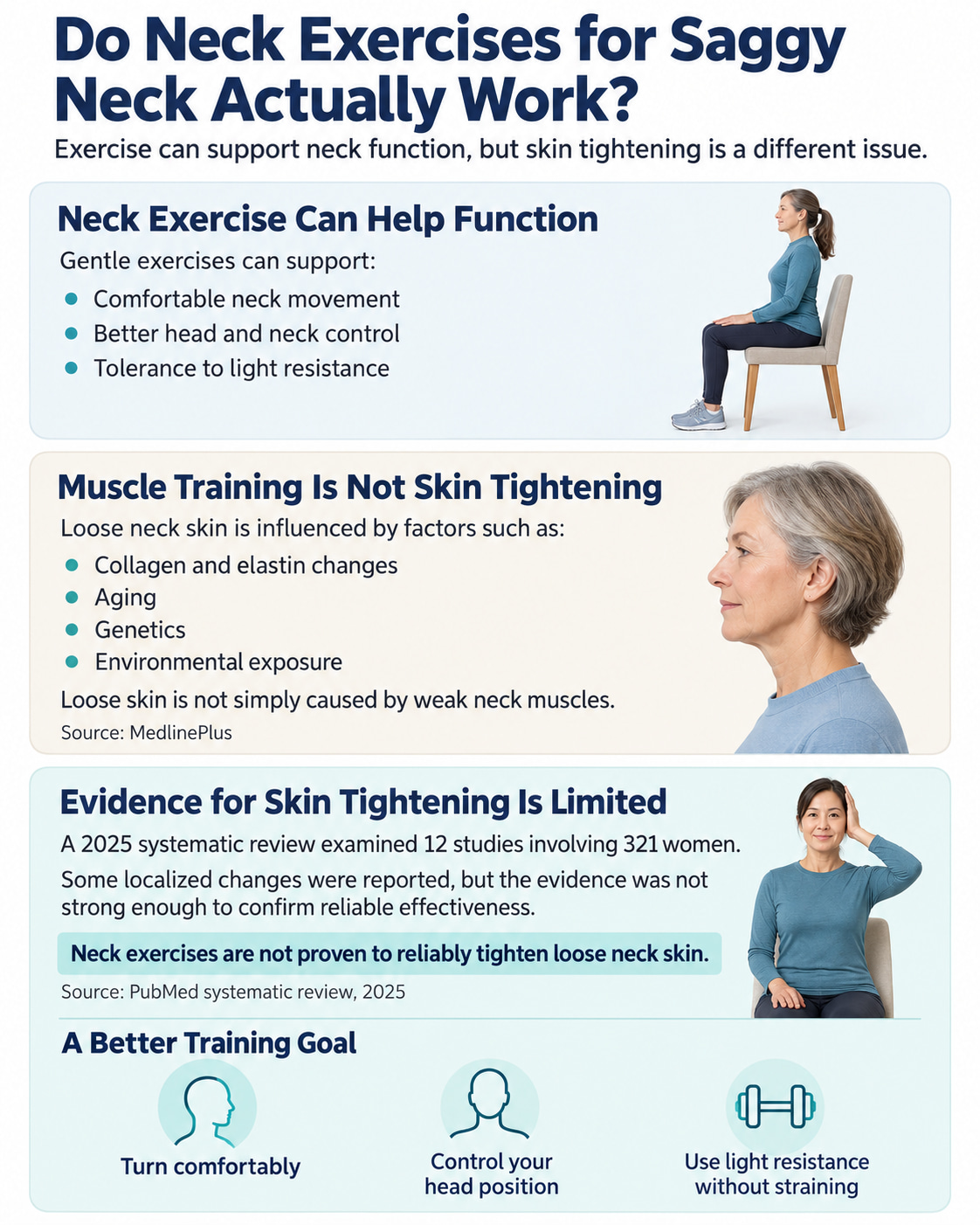
They can be useful for neck function, but that is different from treating skin laxity.
As MedlinePlus explains, skin contains collagen and elastin fibers that contribute to its support and flexibility. Aging, genetics, and environmental exposure influence changes in these tissues. Loose skin is therefore not simply a sign of weak neck muscles.
A 2025 systematic review indexed by PubMed included 12 studies involving 321 women and examined facial exercise and related techniques. Some studies reported localized appearance changes, but the reviewers found insufficient evidence to establish effectiveness confidently. Small samples and differences between study methods limited the conclusions.
These findings do not establish a reliable neck-skin-tightening routine.
For training purposes, focus instead on three practical goals: turning your head comfortably, controlling its position, and tolerating gentle resistance without straining.
Before You Start
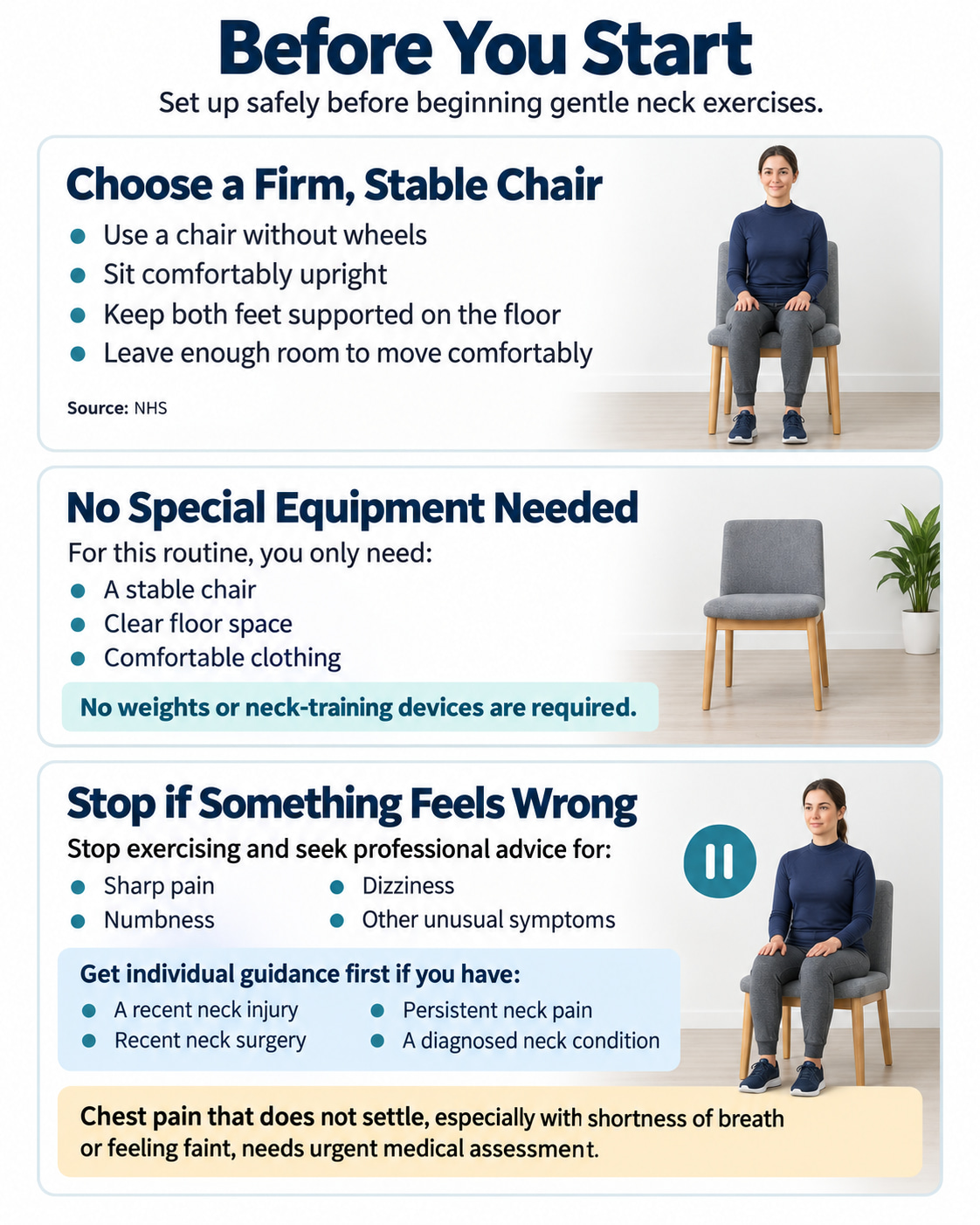
You need a stable chair and enough room to sit comfortably. The NHS recommends a firm chair without wheels, with your feet supported on the floor.
No weights or special neck-training equipment are needed for the movements below.
Get individual advice before starting if you have a recent neck injury or surgery, persistent neck pain, or a diagnosed neck condition.
Stop and seek professional advice if an exercise causes sharp pain, numbness, dizziness, or other unusual symptoms. Stop for chest pain as well; chest pain that does not settle, or occurs with shortness of breath or feeling faint, needs emergency assessment.
5 Gentle Exercises for Neck Strength and Mobility
These exercises focus on movement and muscle control, not skin tightening. Use the sample routine after the exercise instructions for suggested repetitions, holds, and rest.
1. Gentle Seated Chin Tuck
Best for: Practicing controlled head positioning without a large neck movement.
Muscles worked: Deep neck flexors and other muscles that help control the cervical spine. This is a coordination exercise rather than an attempt to isolate one muscle.
How to do it:
- Sit comfortably upright with your shoulders relaxed and eyes looking forward.
- Gently slide your head backward a small distance, allowing your chin to draw inward.
- Keep your gaze approximately level rather than looking toward your lap.
- Pause briefly, then release to a comfortable starting position.
Common mistakes: Bending the chin toward the chest, pushing forcefully with your fingers, or leaning your whole body backward. Cambridge University Hospitals advises keeping the neck and back straight during chin-retraction exercises rather than tipping the head forward.
Make it easier: Use a smaller movement and skip the hold initially.
2. Comfortable Neck Rotation
Best for: Practicing comfortable turning range and smooth movement.
Muscles involved: Neck rotators, including the sternocleidomastoid and splenius muscles. Without added resistance, this is primarily a mobility exercise.
How to do it:
- Sit facing forward with your shoulders relaxed.
- Slowly turn your head to the right, keeping your torso facing ahead.
- Stop at a comfortable point, pause briefly, and return to the middle.
- Repeat to the left without forcing both sides to reach the same distance.
Common mistakes: Twisting the torso to create extra range, lifting the chin, or using a hand to pull the head farther.
Make it easier: Turn through a smaller range and return to the center without holding.
3. Light Isometric Neck Flexion
Best for: Introducing gentle resistance while keeping the head still.
Muscles worked: Front-neck flexors, including the sternocleidomastoid, with other neck muscles assisting stabilization.
Isometric means the muscles produce force without visible movement at the joint.
How to do it:
- Sit upright and place your palm against your forehead.
- Gently press your forehead into your hand while your hand provides matching resistance.
- Keep your head still, your jaw relaxed, and your breathing steady.
- Hold briefly, then release the pressure gradually.
Common mistakes: Pushing hard enough to move the head, looking upward, or holding your breath.
Make it easier: Reduce the pressure and shorten the hold.
The no-movement setup is described in Bexley MSK isometric neck-exercise guidance. Its rehabilitation dosage should not be treated as a requirement for this general routine.
4. Light Isometric Side Press
Best for: Practicing side-to-side neck control against gentle hand resistance.
Muscles worked: Side-bending neck muscles, including the sternocleidomastoid and scalenes, with other stabilizers assisting.
How to do it:
- Sit facing forward and place your right palm against the side of your head, above the ear.
- Gently press your head sideways into your hand while preventing any movement.
- Hold briefly, keeping your nose facing forward and your shoulders relaxed.
- Release slowly, then repeat on the left.
Common mistakes: Tilting or rotating into the pressure, leaning sideways, or turning the exercise into a maximum-strength effort.
Make it easier: Use less pressure. Your hand provides resistance, but it should not push your head out of position.
5. Seated Shoulder-Blade Squeeze
Best for: Practicing upper-back and shoulder-blade control alongside the neck exercises.
Muscles worked: Primarily the rhomboids and middle trapezius. The American Council on Exercise identifies these as important muscles involved in drawing the shoulder blades toward each other.
How to do it:
- Sit comfortably with your hands resting on your thighs.
- Gently move your shoulder blades toward each other.
- Keep your head facing forward without lifting your chest excessively.
- Pause briefly, then let your shoulder blades return to their resting position.
Common mistakes: Shrugging, arching the lower back, or squeezing as hard as possible.
Make it easier: Reduce the movement and release immediately rather than holding.
This seated movement also appears in NHS Dynamic Health neck-exercise guidance. It is an upper-back exercise, not a direct neck-skin exercise.
A Simple Beginner Neck Routine
The following is a conservative starting example for comfortable, general exercise—not an individualized rehabilitation prescription.
Begin with the neck rotation, chin tuck, and shoulder-blade squeeze. After several comfortable sessions, add one of the two isometric exercises rather than adding everything at once.
| Exercise | Sets | Starting Amount | Hold |
|---|---|---|---|
| Comfortable neck rotation | 1 | 3 repetitions each way | Up to 5 seconds at a comfortable endpoint |
| Gentle seated chin tuck | 1 | 5 repetitions | About 3 seconds |
| Seated shoulder-blade squeeze | 1 | 6 repetitions | About 3 seconds |
| Light isometric neck flexion—optional | 1 | 3 holds | About 3 seconds |
| Light isometric side press—optional | 1 | 3 holds each side | About 3 seconds |
Frequency: Try two or three nonconsecutive days per week initially.
Rest: Allow roughly 5–10 seconds between holds and 20–30 seconds between exercises. Take longer whenever you need it.
Effort: Keep the hand presses light—around 2–3 out of 10 effort. You should be able to breathe normally without straining.
These amounts are suggested starting points, not targets you must complete.
The general principle is to introduce manageable exercise gradually and allow recovery rather than repeatedly working the neck to fatigue.
How to Progress Without Overdoing It
Keep the starting amount unchanged until you can complete several sessions with comfortable movement and steady control.
Then make one small change:
- Add one or two repetitions, or
- Increase a three-second hold toward five seconds.
Do not increase repetitions, hold time, and pressure together.
Reducing range, repetitions, or exercise difficulty is appropriate if an exercise starts causing symptoms or becomes difficult to control.
There is no need to add weights, forceful pressure, or long endurance holds to this introductory routine. For a more demanding neck-strength program, have a qualified professional check your technique and help choose suitable loading.
Also, do not hold a chin tuck or keep your shoulder blades squeezed throughout the day. Release after each repetition and change positions regularly.
Common Mistakes to Avoid
Using Maximum Effort
More pressure does not automatically make neck isometrics more useful. For a beginner routine, gentle resistance that allows normal breathing and steady head position is enough.
Forcing Your Range of Motion
You do not need to turn, tilt, or retract your neck as far as physically possible. Use a comfortable range that you can control without pulling on your head.
Moving the Torso Instead of the Neck
During rotation, keep your chest facing forward instead of rotating your entire upper body to create extra range.
Holding Your Breath
Continue breathing normally during chin tucks and isometric holds. If you need to strain or hold your breath to maintain the position, reduce the effort.
Treating More Repetitions as Better
The neck does not need extremely high-repetition exercise challenges. Controlled repetitions with appropriate recovery are more useful than repeatedly working until your form deteriorates.
Expecting Exercise to Tighten Skin
Muscle training and skin changes are different processes. Avoid judging the routine by whether the skin around your neck looks different after a specific number of days or weeks.
Frequently Asked Questions
Can Chin Tucks Tighten Loose Neck Skin?
Chin tucks are used to practice neck positioning and muscular control. That purpose should not be confused with changing the skin covering the neck.
They have not been established as a treatment for loose neck skin.
What About Face Yoga?
The evidence remains preliminary.
A small 2018 study published in JAMA Dermatology reported changes in cheek fullness after a 20-week facial-exercise program, but the neck-volume rating did not show a statistically significant change.
The study also lacked a control group and had substantial participant dropout. It does not demonstrate that facial exercises reliably tighten neck skin.
Does Strengthening the Platysma Tighten the Neck?
The platysma is a superficial muscle involved in movement of the lower face and tensioning the skin over parts of the neck. Anatomical information available through the NCBI Bookshelf helps explain its role.
However, knowing what a muscle does anatomically does not prove that repeatedly contracting it will produce lasting tightening of loose skin.
Research has not established a dependable platysma exercise protocol for that result.
Should I Exercise My Neck Every Day?
A gentle mobility movement may be appropriate more often for some people, but strengthening exercises do not need to be performed constantly.
For this beginner routine, starting two or three nonconsecutive days per week is a practical way to see how your neck responds before doing more.
How Hard Should Isometric Neck Exercises Be?
Keep them light at first. Around 2–3 out of 10 effort is enough for this introductory routine.
Your head should remain still, your shoulders should stay relaxed, and you should be able to breathe normally.
How Should I Judge Progress?
Use movement-based goals rather than appearance-based ones.
Useful signs include:
- Completing a chin tuck without looking down.
- Turning your head smoothly through your comfortable range.
- Keeping your head still during a light hand press.
- Maintaining relaxed shoulders during neck movements.
- Performing the routine with consistent control.
A simple record of repetitions, comfort, and control gives you more relevant information than checking for skin changes after every session.
The Takeaway
Neck exercises for saggy neck are better viewed as neck-strength and mobility exercises, not as a proven method for tightening loose skin.
Start with two or three gentle movements, keep resistance light, and progress only when your current routine feels controlled and comfortable. Judge success by how well you can perform the exercises and how comfortably your neck moves rather than expecting a specific cosmetic result.
This content is for informational purposes only and is not a substitute for medical advice.
References
- PubMed – Efficacy of Conservative Techniques for Mechanical Facial Rejuvenation: A Systematic Review
- JAMA Dermatology – Association of Facial Exercise With the Appearance of Aging
- MedlinePlus – Aging Changes in Skin
- NHS Dynamic Health – Neck Pain and Neck Exercises
- NHS – Sitting Exercises and Neck Rotation
- NCBI Bookshelf – Anatomy, Head and Neck, Neck Movements