
Gentle neck pain exercises can help support comfortable movement, flexibility, and muscle control. Start with slow movements and light effort—not forceful stretching or pushing through pain. The American Physical Therapy Association explains that exercise selection for neck pain may include mobility, flexibility, strength, and endurance work based on the individual.
Below are seven seated options, clear form instructions, and a small starter routine. You do not need to perform every exercise to get started.
Before You Start
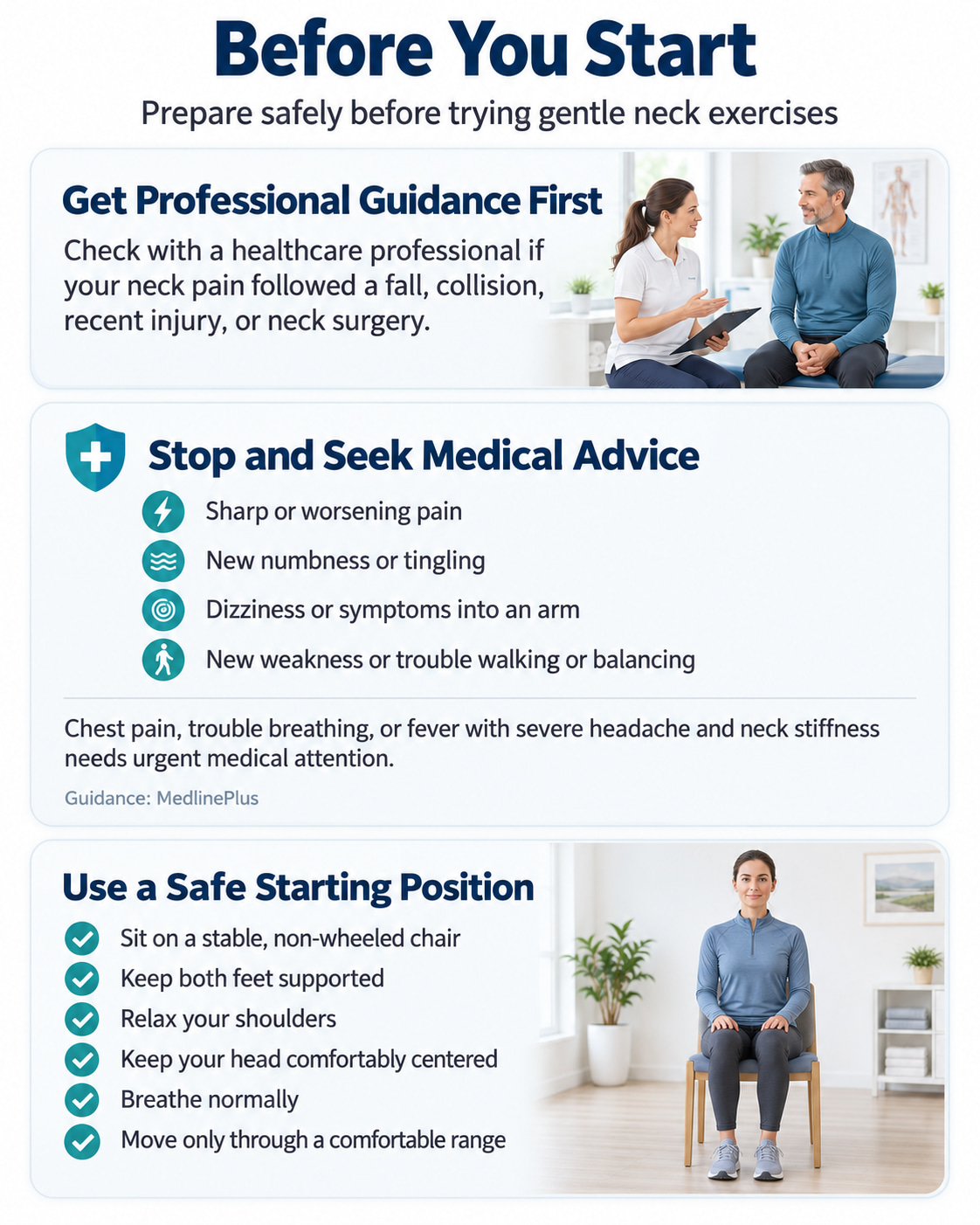
These exercises are intended for gentle movement, not for diagnosing neck pain or managing a recent injury. Get professional guidance first if your pain followed a fall, collision, or other injury, or you have had neck surgery.
Stop exercising and seek medical advice for sharp pain, new numbness or tingling, dizziness, or symptoms spreading into an arm. New weakness or difficulty walking or balancing needs urgent assessment. Neck pain with chest pain, trouble breathing, or a fever and severe headache requires immediate medical attention. MedlinePlus provides guidance on neck pain symptoms that warrant prompt medical attention.
Use a stable chair with your feet supported. Keep your shoulders comfortable and breathe normally throughout the movements.
7 Neck Pain Exercises and Stretches
The exercises below include mobility, stretching, and light muscle-control work. A stretch should feel mild; a stronger pulling sensation is not the goal.
The suggested repetitions and holds are small starting examples, not fixed targets. Perform one set of your selected exercises, relaxing for about 5–10 seconds between efforts, or longer as needed.
1. Seated Chin Tuck — Cervical Retraction
Best for: Practicing a controlled backward head movement without looking down.
Muscles involved: The neck muscles that control head position; you may also feel a mild stretch behind the neck.
Starting amount: 2–3 repetitions, holding for 3–5 seconds.
How to do it:
- Sit comfortably upright, with your eyes looking straight ahead.
- Slowly glide your head backward, bringing your chin slightly inward.
- Keep your eyes level and your shoulders still. The movement should be small.
- Hold briefly, then return to your relaxed starting position.
Common mistakes: Lowering your chin toward your chest, tipping your head backward, or moving your whole torso. A chin tuck is a backward glide, not a deep downward nod.
Make it easier: Use a smaller movement and skip the hold initially.
Cambridge University Hospitals distinguishes chin retraction from tipping the head forward and also provides guidance for several gentle neck movements and stretches.
2. Gentle Neck Rotation
Best for: Practicing comfortable turning movement.
Muscles involved: The neck muscles that rotate and stabilize the head.
Starting amount: 2–3 repetitions per side, with a brief pause at your comfortable stopping point.
How to do it:
- Sit with your shoulders relaxed and your gaze forward.
- Slowly turn your head to the right while keeping your chin at approximately the same height.
- Stop before you need to strain, tilt your head, or turn your chest.
- Return to the center, then repeat to the left.
Common mistakes: Twisting the torso to turn farther, lifting the chin, or repeatedly pushing against a restricted movement.
Make it easier: Turn through a smaller range. Your two sides do not have to reach the same distance.
Arthritis UK recommends maintaining the chin at approximately the same height during controlled head turns.
3. Seated Side-Neck Stretch
Best for: Gently stretching the side of the neck.
Area stretched: Side-neck tissues, including the upper trapezius region.
Starting amount: 2 repetitions per side, holding for about 5 seconds.
How to do it:
- Sit facing forward, with your hands resting comfortably in your lap.
- Slowly bring your right ear toward your right shoulder.
- Keep your nose pointing forward and your left shoulder relaxed. Stop when you feel a mild stretch on the left.
- Return to the center and repeat on the other side.
Common mistakes: Raising the shoulder to meet the ear, rotating the face, or using a hand to pull the head farther.
Make it easier: Reduce the tilt or move gently in and out without holding. There is no need for your ear to reach your shoulder.
NHS Ayrshire & Arran includes gentle neck movement exercises that can be adapted to a comfortable range.
4. Levator Scapulae Stretch
Best for: Exploring a gentle diagonal stretch rather than a straight sideways tilt.
Area stretched: The levator scapulae region, running between the neck and the upper part of the shoulder blade.
Starting amount: 2 repetitions per side, holding for about 5 seconds.
How to do it:
- To stretch the right side, sit comfortably and let your right shoulder relax.
- Turn your head slightly to the left.
- Slowly angle your chin downward toward your left armpit. Stop at a mild stretch along the back-right side of your neck.
- Return slowly to the center, then reverse the directions for the left side.
Common mistakes: Pulling on the head, forcing the shoulder downward, or combining a large turn with a deep forward bend.
Make it easier: Use less rotation and less downward movement. Keep both hands in your lap rather than using them to deepen the stretch.
This is a hands-free variation. Avoid pulling on your head to force a larger range.
5. Gentle Forward Neck Bend
Best for: Practicing comfortable downward movement.
Area stretched: The muscles and tissues behind the neck.
Starting amount: 2–3 repetitions, holding for 3–5 seconds if comfortable.
How to do it:
- Sit upright without stiffening your back or squeezing your shoulders together.
- Slowly lower your chin toward your chest.
- Stop at a comfortable point while keeping the rest of your body still.
- Pause briefly, then lift your head back to its starting position.
Common mistakes: Pulling the head down with both hands, rounding the whole upper body, or trying to make the chin touch the chest.
Make it easier: Use a small downward movement and return immediately rather than holding.
Unlike the chin tuck, this exercise deliberately involves looking down. NHS Dynamic Health includes controlled forward bending among its neck-mobility exercises and recommends adjusting exercise range or repetitions when symptoms increase.
6. Seated Shoulder Blade Squeeze
Best for: Practicing upper-back muscle control while keeping the neck relaxed.
Muscles worked: The shoulder-blade retractors, including the rhomboids and middle trapezius.
Starting amount: 3–5 repetitions, holding for 3–5 seconds.
How to do it:
- Sit comfortably, with your arms relaxed beside you or your hands resting on your thighs.
- Gently bring your shoulder blades slightly closer together.
- Keep your chin level and avoid lifting your shoulders toward your ears.
- Hold briefly, then release completely.
Common mistakes: Squeezing as hard as possible, arching the lower back, pushing the chest forward, or holding the shoulders tightly back afterward.
Make it easier: Use a smaller squeeze or shorten the hold.
The Mayo Clinic demonstrates a seated shoulder blade squeeze using controlled shoulder-blade movement and a brief hold.
7. Gentle Isometric Neck Flexion — Forehead Press
Best for: Introducing light neck-muscle effort without visible movement.
Muscles worked: The muscles at the front of the neck.
An isometric exercise creates muscle tension while the position stays still. Unlike the previous stretches, this is a light strengthening exercise. HealthLink BC describes an isometric head-against-hand exercise using resistance without allowing the head to move.
Starting amount: 2–3 gentle holds of 3–5 seconds. Rest at least 10 seconds between holds.
How to do it:
- Sit comfortably upright, with your head facing forward.
- Place one palm against the center of your forehead.
- Gently press your forehead into your hand while your hand provides equal resistance. Do not let your head move forward or backward.
- Keep breathing, then release the pressure fully.
Common mistakes: Pressing hard, holding your breath, clenching your jaw, or allowing the hand to push the head backward.
Make it easier: Use barely noticeable pressure and a shorter hold. Skip this exercise when even light resistance increases symptoms.
For this introductory version, use light effort—not maximum force or repeated holds to exhaustion.
A Gentle Starter Routine
Begin with two or three comfortable movements rather than the complete list. NHS inform recommends beginning new neck exercises with small amounts, such as two or three repetitions at a time, and monitoring how symptoms respond afterward.
Choose from this low-volume example:
| Exercise | Starting amount |
|---|---|
| Seated chin tuck | 2–3 repetitions, holding 3–5 seconds |
| Gentle neck rotation | 2–3 repetitions per side |
| Side-neck or levator scapulae stretch | 2 holds of 5 seconds per side |
| Shoulder blade squeeze | 3–5 repetitions, holding 3–5 seconds |
The forward neck bend can replace another mobility movement when it feels more comfortable; it does not need to be added automatically.
Frequency: Start with one short session on a day when symptoms allow. Gentle mobility can be practiced daily when it remains comfortable. As a conservative starting schedule, keep the optional forehead press to two nonconsecutive days per week rather than adding resistance to every movement break.
Effort and rest: Keep the session easy enough to breathe normally and relax between repetitions. Take additional rest whenever you begin to tense your shoulders or jaw. These amounts are a starting example, not a prescribed rehabilitation program.
How to Adjust and Progress
Check how you feel afterward, not only during the exercise. Any mild exercise-related discomfort should settle rather than progressively worsen, and your neck should not consistently feel worse the following morning.
After several comfortable sessions, try adding one repetition to one exercise. Do not increase repetitions, hold time, and resistance together. There is no requirement to reach a large range or perform every exercise.
When a movement leaves you more uncomfortable, shorten the range, reduce repetitions, or leave that exercise out. Repeated or lasting aggravation deserves professional guidance rather than increasingly forceful stretching.
For longer-term training, stretching may be only one part of the plan. An individualized program can also include mobility, flexibility, strength, and endurance work. A physical therapist can help determine which elements you actually need.
Frequently Asked Questions
What is the best exercise for neck pain?
There is no single exercise that suits every cause or pattern of neck pain. A useful starting movement is one you can perform comfortably and control well. Persistent or recurring symptoms are a reason to get an individualized assessment rather than keep searching for a stronger stretch.
Can I do neck pain exercises every day?
Small amounts of comfortable mobility may fit into a daily routine. That does not mean you need to perform all seven exercises, repeat long stretching sessions, or strengthen the neck every day. Use your response during the session and the following morning to guide the amount.
Should a neck stretch hurt?
No. Aim for a mild stretch, not sharp pain or an increasing ache. New tingling, numbness, dizziness, or symptoms traveling into an arm are reasons to stop and seek advice. Do not pull farther to try to “release” the sensation.
Are chin tucks the same as looking down?
No. In the seated chin tuck described here, your head glides backward while your eyes stay level. During the forward neck bend, your chin lowers and your gaze moves downward. Keeping the movements separate makes them easier to control.
When should I see a healthcare professional?
Seek advice when pain is worsening, repeatedly returns, disrupts sleep or daily activities, or is not improving with appropriate self-care. Do not wait when you have an injury or any of the warning signs listed above. A physical therapist can assess your movement and tailor an exercise plan.
Conclusion
Start with a few comfortable movements, keep the effort light, and avoid chasing a deeper stretch. Choose two or three exercises, use small starting amounts, and check your response afterward. The goal is easier, better-controlled movement—not completing every repetition regardless of symptoms.
This content is for informational purposes only and is not a substitute for medical advice.
2 thoughts on “7 Neck Pain Exercises and Stretches for Gentle Relief”