
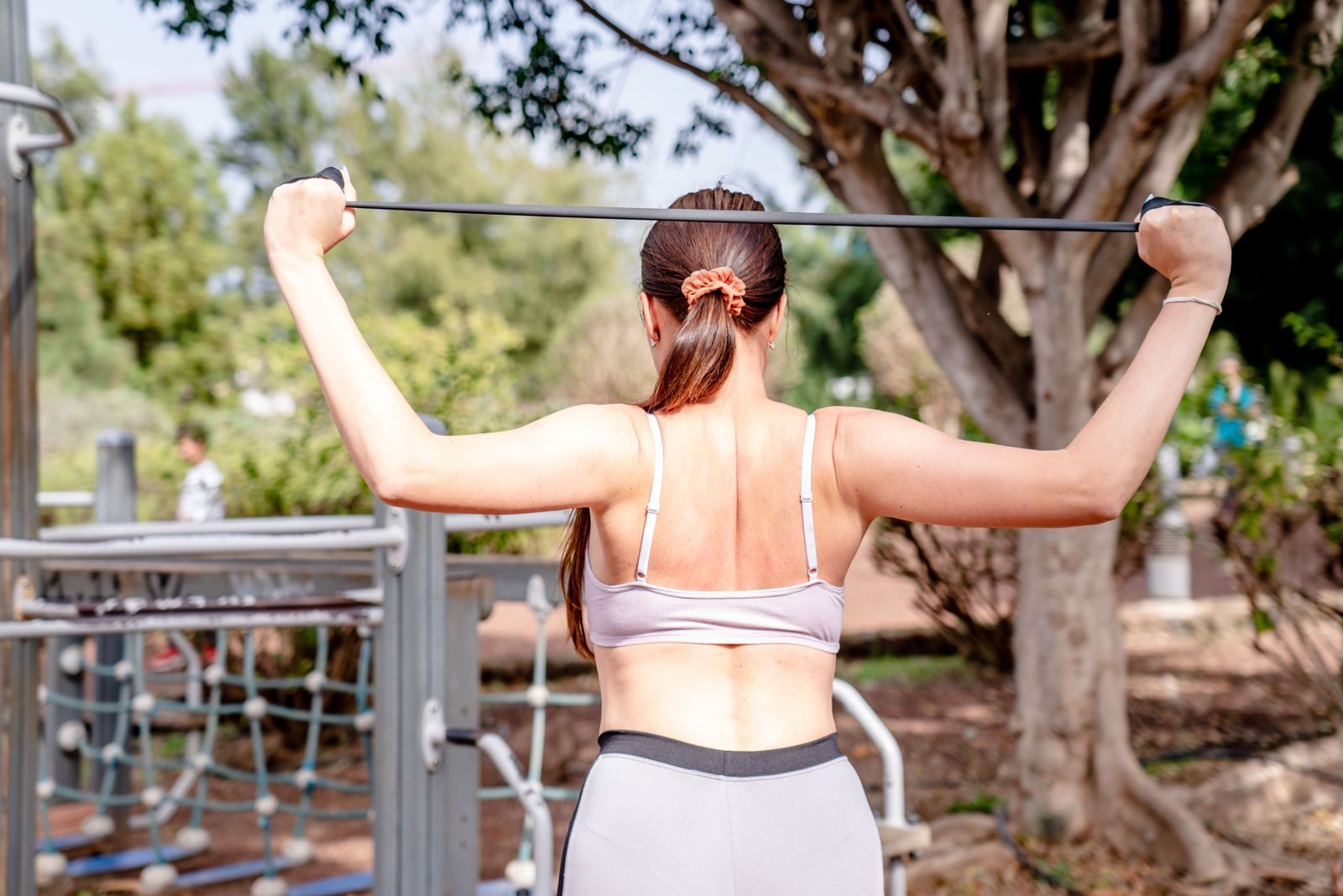
Resistance band back exercises can strengthen your lats, the muscles around your shoulder blades, and the muscles that support your torso. Rows, pulldowns, and lighter shoulder exercises give you several ways to train at home.
Choose three or four exercises for a session. You do not need to perform all nine to get a useful workout.
Before You Start
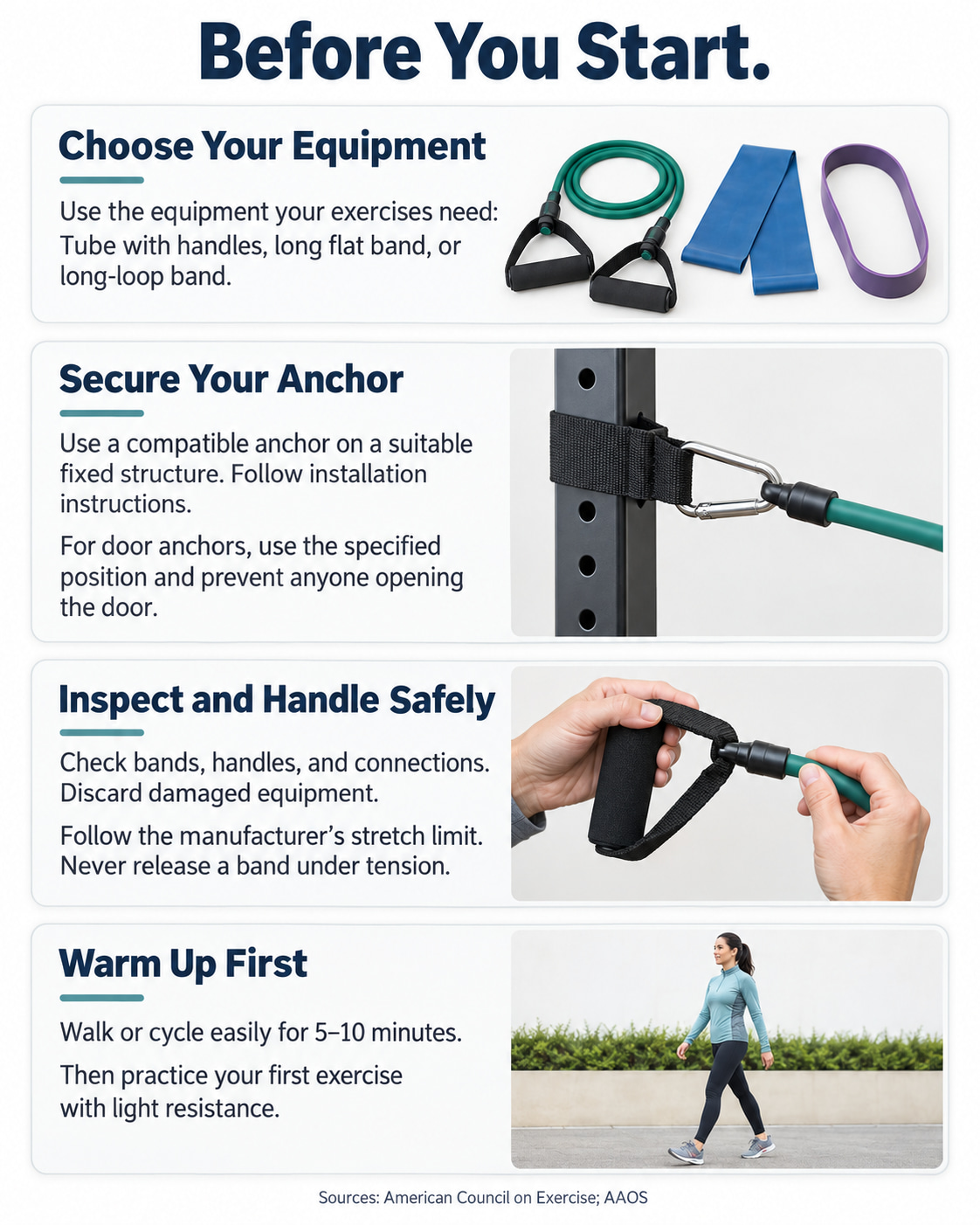
You only need the equipment for your chosen exercises: a resistance tube with handles, a long flat band, or a long-loop band. Anchored exercises also require a compatible anchor secured to a suitable fixed structure according to the manufacturer’s instructions. For a door anchor, use the specified door position and make sure nobody can open the door during your set.
The American Council on Exercise recommends checking bands, handles, and connections before use. Discard damaged equipment, stay within the band’s stretch limit, and never release it under tension.
Warm up with five to ten minutes of easy walking or cycling, as recommended by the American Academy of Orthopaedic Surgeons. Then practice your first exercise with light resistance.
The 9 Best Resistance Band Back Exercises
The exercises below cover pulling toward your body, pulling from overhead, and training the back of your shoulders. The Romanian deadlift adds hip strength while challenging your back muscles to hold your torso steady.
Start with two sets per chosen exercise. Rest 60–120 seconds between sets, using the longer end when needed. Choose resistance that leaves approximately two or three good repetitions still possible.
1. Resistance Band Bent-Over Row
Best for: General pulling strength without an external anchor.
Muscles worked: Lats, rhomboids, middle trapezius, rear deltoids, and biceps.
Equipment: Resistance tube with handles.
Reps: 8–15.
How to Do It
- Stand on the middle of the tube with your feet about shoulder-width apart. Hold one handle in each hand, palms facing each other.
- Bend your knees slightly and push your hips backward. Keep your spine neutral and let your arms hang beneath your shoulders.
- Pull the handles toward your lower ribs, keeping your elbows near your sides. Finish when your upper arms are approximately in line with your torso.
- Slowly straighten your elbows and lower the handles while keeping your torso still.
Common mistakes: Standing up to finish the pull, rounding your back, or jerking the handles. The Mayo Clinic emphasizes a neutral back, elbows close to the body, and smooth movement.
2. Seated Resistance Band Row
Best for: Practicing a row from a seated position.
Muscles worked: Lats, rhomboids, middle trapezius, rear deltoids, and biceps.
Equipment: Long flat resistance band.
Reps: 8–15.
How to Do It
- Sit on the floor with your legs in front of you and knees slightly bent. Position the middle of the band around the middle of both shoe soles, away from the toe tips.
- Hold one end in each hand with your palms facing each other. Sit tall, keep your heels supported, and point your toes upward.
- Pull your hands toward your waist, moving your elbows backward close to your sides. Stop before you need to lean back.
- Extend your arms slowly. Let your shoulder blades move forward naturally without rounding your lower back.
Common mistakes: Rocking your torso, locking your knees, or letting the band slide toward your toes. Stop and reset if the band moves on your shoes.
3. Standing Single-Arm Resistance Band Row
Best for: Training each side separately while keeping your torso steady.
Muscles worked: Lats, rhomboids, middle trapezius, rear deltoids, and biceps; the core helps resist rotation.
Equipment: Long-loop band and a compatible anchor at lower-chest height.
Reps: 8–15 per side.
How to Do It
- Secure the band at lower-chest height. Face the anchor and hold the free end in your right hand, palm facing inward.
- Step your left foot forward and right foot back. Move far enough from the anchor to create light tension with your right arm extended.
- Keep your chest and hips facing forward as you pull your hand toward your right lower ribs. Keep your elbow close to your side.
- Stop with your upper arm beside your torso, then slowly reach forward again. Complete the repetitions before switching sides.
Common mistakes: Twisting to increase the pull, leaning backward, or lifting the shoulder toward the ear. Use a lighter band if your torso keeps moving.
4. Kneeling Resistance Band Lat Pulldown
Best for: Training the lats with an overhead pulling movement.
Muscles worked: Lats, teres major, and biceps, with assistance from the muscles controlling your shoulder blades.
Equipment: Resistance tube with handles, a secure high anchor, and a mat.
Reps: 8–15.
How to Do It
- Secure the tube above head height. Kneel on both knees facing the anchor, with your hips above your knees.
- Hold the handles with palms facing forward and hands slightly wider than your shoulders. Begin with your arms reaching upward and slightly forward under light tension.
- Bend your elbows and draw them downward toward your sides. Bring the handles toward shoulder height while keeping your ribs over your pelvis.
- Slowly reach upward again through a comfortable range. Allow your shoulder blades to move with your arms.
Common mistakes: Leaning far backward, arching the lower back, or pulling behind the head. Use less resistance if you cannot reach overhead comfortably while keeping your torso controlled.
5. Resistance Band Straight-Arm Pulldown
Best for: Training shoulder extension with little movement at the elbows.
Muscles worked: Primarily the lats, with assistance from the teres major and triceps.
Equipment: Resistance tube with handles and a secure high anchor.
Reps: 10–15.
How to Do It
- Face the high anchor with your feet hip-width apart. Hold a handle in each hand with palms facing downward.
- Step back, soften your knees, and hinge slightly at your hips. Start with your arms reaching forward and upward, hands around forehead height.
- Keep a small, consistent bend in your elbows as you sweep the handles down toward the fronts of your thighs.
- Stop when your arms are beside your torso. Slowly return to the starting position without lifting your ribs or changing your trunk angle.
Common mistakes: Bending and straightening the elbows to move the band, swinging your body, or pushing your hands behind your hips. Reduce resistance if the movement stops coming mainly from your shoulders.
6. Resistance Band Pull-Apart
Best for: Simple upper-back and rear-shoulder work without an anchor.
Muscles worked: Rear deltoids, rhomboids, and trapezius, with assistance from the rotator cuff.
Equipment: Light, long flat band.
Reps: 12–20.
How to Do It
- Stand tall and hold the band in front of your chest with palms facing down. Start with your hands approximately shoulder-width apart and your elbows comfortably straight.
- Move your hands apart in a wide arc while keeping them at chest height.
- Stop when your arms are approximately in line with your torso, or earlier if needed for comfort. Let your shoulder blades move toward each other.
- Slowly bring your hands forward again without letting the band snap back.
Common mistakes: Shrugging, bending your elbows into a row, or lifting your ribs. Hinge Health recommends maintaining chest-height arms and avoiding shoulder elevation during the movement.
7. Resistance Band Face Pull
Best for: Training the upper back and rear shoulders with an elevated row.
Muscles worked: Rear deltoids, rhomboids, and middle trapezius.
Equipment: Light resistance tube with handles and a secure anchor at face height.
Reps: 12–20.
How to Do It
- Face the anchor and hold one handle in each hand, palms facing each other. Use a stable staggered stance.
- Step back until your arms are extended in front of you with light band tension. Keep your head aligned over your torso.
- Pull the handles toward either side of your face, moving your elbows outward and backward. Keep your upper arms around shoulder height or slightly below it.
- Finish with your hands beside your cheeks and upper arms approximately in line with your torso. Slowly extend your arms again.
Common mistakes: Reaching your head forward, leaning backward, or forcing your elbows far behind you. Start light enough to control the entire movement.
8. Bent-Over Resistance Band Reverse Fly
Best for: Rear-shoulder and upper-back work from a hip hinge.
Muscles worked: Rear deltoids, rhomboids, and middle trapezius; the trunk muscles stabilize your torso.
Equipment: Light resistance tube with handles.
Reps: 10–15.
How to Do It
- Stand on the middle of the tube with both feet about hip-width apart. Hold the handles with your palms facing each other.
- Soften your knees and hinge until your torso is nearly parallel to the floor, keeping your spine neutral. Let your arms hang with a slight elbow bend.
- Maintain that elbow angle as you lift your arms outward in a wide arc. Stop when your upper arms are approximately level with your torso.
- Lower the handles slowly while holding the same body position.
Common mistakes: Standing up during the lift, bending the elbows into a row, or forcing the arms higher. Choose a sufficiently long, light tube; a band that works for rows may be too demanding here.
9. Resistance Band Romanian Deadlift
Best for: Building hip strength while training the back muscles to stabilize the spine.
Muscles worked: Primarily the glutes and hamstrings; the spinal erectors work to hold the torso steady.
Equipment: Long-loop resistance band.
Reps: 8–15.
How to Do It
- Stand on the bottom of the loop with feet about hip-width apart. Bend through your hips and knees to grip the upper part with both hands, then stand tall with palms facing your thighs.
- Keep your arms long and knees slightly bent. Push your hips backward, allowing your hands to travel close to your legs.
- Lower until you feel tension in your hamstrings while maintaining your spinal position. Your hands do not need to reach the floor.
- Drive through your feet and bring your hips forward to stand tall. Finish without leaning backward.
Common mistakes: Squatting progressively deeper, rounding the back, or bending the elbows. The National Strength and Conditioning Association emphasizes moving the hips backward and limiting depth to preserve a neutral spine in its RDL guidance.
A Simple Resistance Band Back Workout
Try this starting routine on two nonconsecutive days per week. If you are new to strength training, begin with one set of each exercise and add a second as you become comfortable.
| Exercise | Sets | Repetitions |
|---|---|---|
| Bent-over row | 2 | 8–15 |
| Kneeling lat pulldown | 2 | 8–15 |
| Pull-apart | 2 | 12–20 |
| Romanian deadlift | 2 | 8–15 |
Rest 60–120 seconds between sets. Breathe throughout each repetition, generally breathing out during the pull or lift and in during the return.
If you have no external anchor, begin with the bent-over row, pull-apart, and Romanian deadlift. The seated row is another option for your main rowing exercise.
This is a back-focused session. Include exercises for your other major muscle groups elsewhere in your weekly routine.
How to Choose Resistance and Make Progress
Use a band that lets you complete the full intended movement without swinging, shrugging, or changing your body position. You will usually need lighter resistance for pull-aparts, face pulls, and reverse flies than for rows.
When you can reach the top of the repetition range on every set for two consecutive sessions, with good form and a few repetitions still possible, try a small increase in resistance. Return toward the lower end of the range and build up again.
Record the band used, grip position, and distance from the anchor so your workouts are comparable. Follow the manufacturer’s stretch limit whenever you adjust your setup.
Can Resistance Bands Build Back Strength?
Yes. Bands can provide a meaningful strength-training challenge when the resistance is demanding enough and you progress over time. In its 2026 position stand, the American College of Sports Medicine found that resistance training improved strength and muscle size, and that equipment type did not consistently determine results across the reviewed evidence.
The practical priorities are regular training, enough effort, and controlled movement. A band that feels easy throughout every set will eventually need to be replaced with a greater challenge.
If an exercise causes sharp pain, tingling, numbness, or dizziness, stop. Persistent symptoms, a recent injury, or surgery call for individual guidance before continuing. These exercises are general strength options and are not a treatment plan for back pain.
This content is for informational and educational purposes only and is not intended as a substitute for professional medical advice, diagnosis, or treatment.