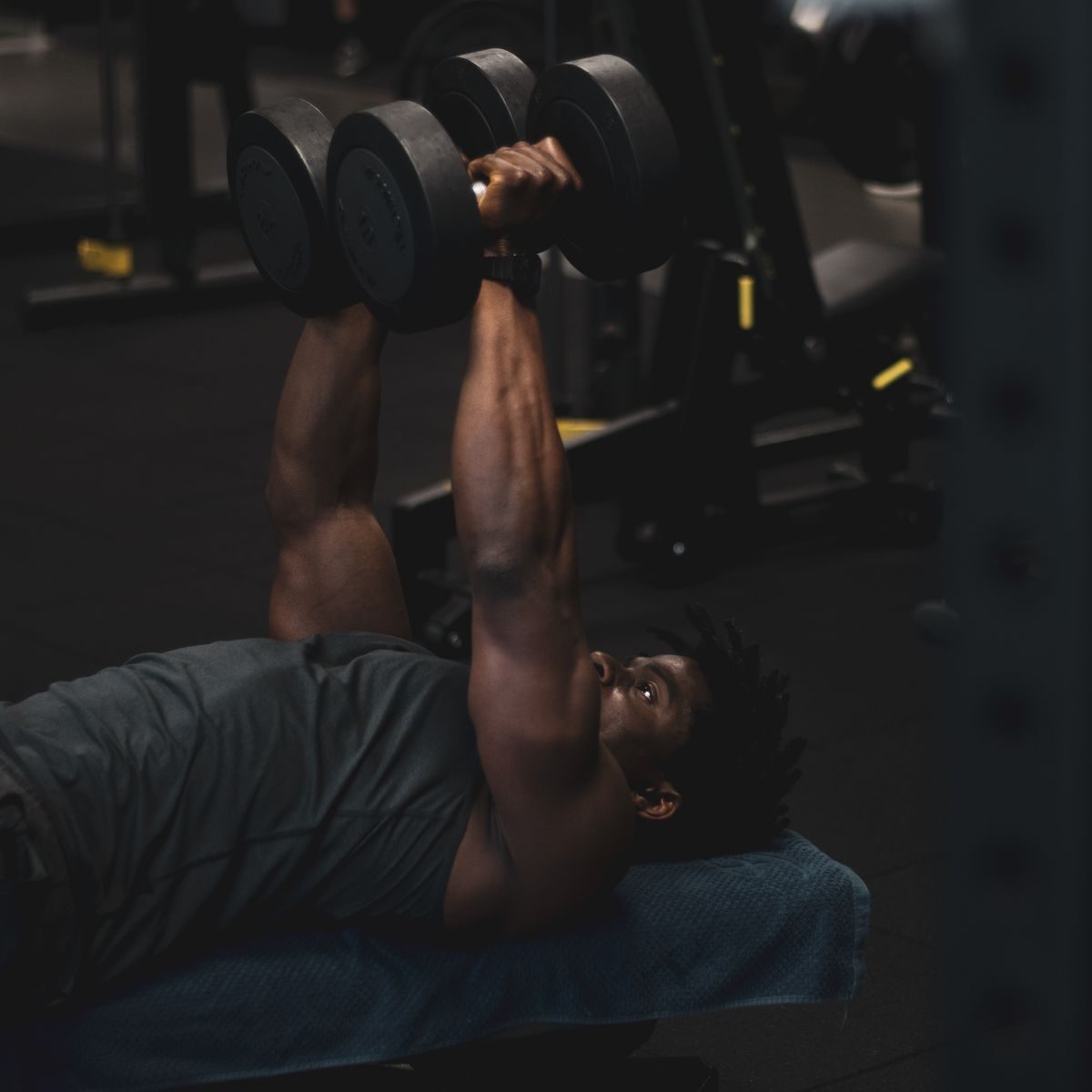
The dumbbell hex press is a chest-focused exercise performed by squeezing two matching hex dumbbells together while pressing them above your chest. The neutral grip and continuous inward pressure can help beginners feel their chest working while also training the triceps and front shoulders.
The movement is also called the dumbbell squeeze press or crush press. It works best as a controlled accessory exercise rather than a replacement for every other chest press.
This guide explains proper dumbbell hex press form, muscles worked, benefits, mistakes, weight selection, programming, beginner modifications, and safe ways to progress.
Dumbbell Hex Press at a Glance
| Category | Details |
|---|---|
| Best for | Chest tension, pressing control, and accessory training |
| Primary muscle | Pectoralis major |
| Assisting muscles | Triceps and anterior deltoids |
| Equipment needed | Flat bench and two matching hex dumbbells |
| Grip | Neutral, with palms facing each other |
| Difficulty | Beginner |
| Suggested sets and reps | 2–3 sets of 8–15 repetitions |
| Rest | 60–120 seconds |
| Recommended effort | Finish with 1–3 good repetitions remaining |
| Workout placement | After your main chest press or as a chest finisher |
What Is a Dumbbell Hex Press?
The dumbbell hex press is a close-grip dumbbell press performed with the flat sides of two hexagonal dumbbells held firmly together.
Unlike a regular dumbbell bench press, the dumbbells do not move apart as you lower them. You actively squeeze them toward one another during both the lowering and pressing phases.
This creates two simultaneous actions:
- You press the dumbbells away from your chest.
- You apply continuous inward pressure between the dumbbells.
The pressing action trains the chest, shoulders, and triceps. The inward squeeze creates an isometric horizontal-adduction effort, meaning the chest produces force without the dumbbells visibly moving farther toward the body’s midline.
Flat-sided hex dumbbells are especially useful because they provide a stable contact surface. Round dumbbells are more likely to roll or separate when pressed together.
How to Do the Dumbbell Hex Press With Proper Form
Best for: Learning controlled chest tension and adding moderate-repetition chest work
Muscles worked: Pectoralis major, triceps, anterior deltoids, and shoulder stabilizers
Equipment needed: A stable flat bench and two matching hex dumbbells
Sets, reps, and rest: Start with 2–3 sets of 8–15 repetitions and rest for 60–120 seconds
Setup
- Place two matching hex dumbbells upright on your thighs while sitting at the end of a flat bench.
- Hold each dumbbell with a full grip and wrap your thumbs securely around the handles.
- Use your thighs to help guide the dumbbells upward as you lie back on the bench.
- Plant your feet firmly on the floor.
- Keep your head, upper back, and glutes supported by the bench.
- Bring the dumbbells together above the center of your chest.
- Turn your palms toward each other and press the flat sides of the dumbbells firmly together.
- Keep your wrists straight and aligned with your forearms.
- Gently draw your shoulder blades down and back without forcing an exaggerated arch.
The American Council on Exercise chest-press instructions also emphasize stable foot placement, controlled shoulder-blade positioning, a full grip, and consistent contact with the bench.
How to Perform the Press
- Begin with the dumbbells together above the middle of your chest and your arms extended.
- Inhale as you slowly lower the dumbbells toward your chest.
- Keep squeezing the weights together throughout the descent.
- Allow your elbows to travel close to your sides without pinning them tightly against your ribs.
- Lower until the dumbbells are just above or lightly touch your chest, provided your wrists remain straight and your shoulders feel comfortable.
- Exhale and press the dumbbells upward.
- Continue applying inward pressure as you straighten your arms.
- Finish with the weights above the center of your chest without snapping your elbows into a hard lockout.
- Repeat while maintaining the same controlled path.
Breathing and Tempo
Use a controlled tempo rather than rushing:
- Lower the dumbbells for approximately two to three seconds.
- Pause briefly near the bottom without relaxing.
- Press upward smoothly in approximately one second.
- Exhale during the press and inhale during the lowering phase.
Beginners should avoid holding their breath through an entire set.
Coaching Cue
“Crush the dumbbells together as you press them away from your chest.”
Dumbbell Hex Press Muscles Worked
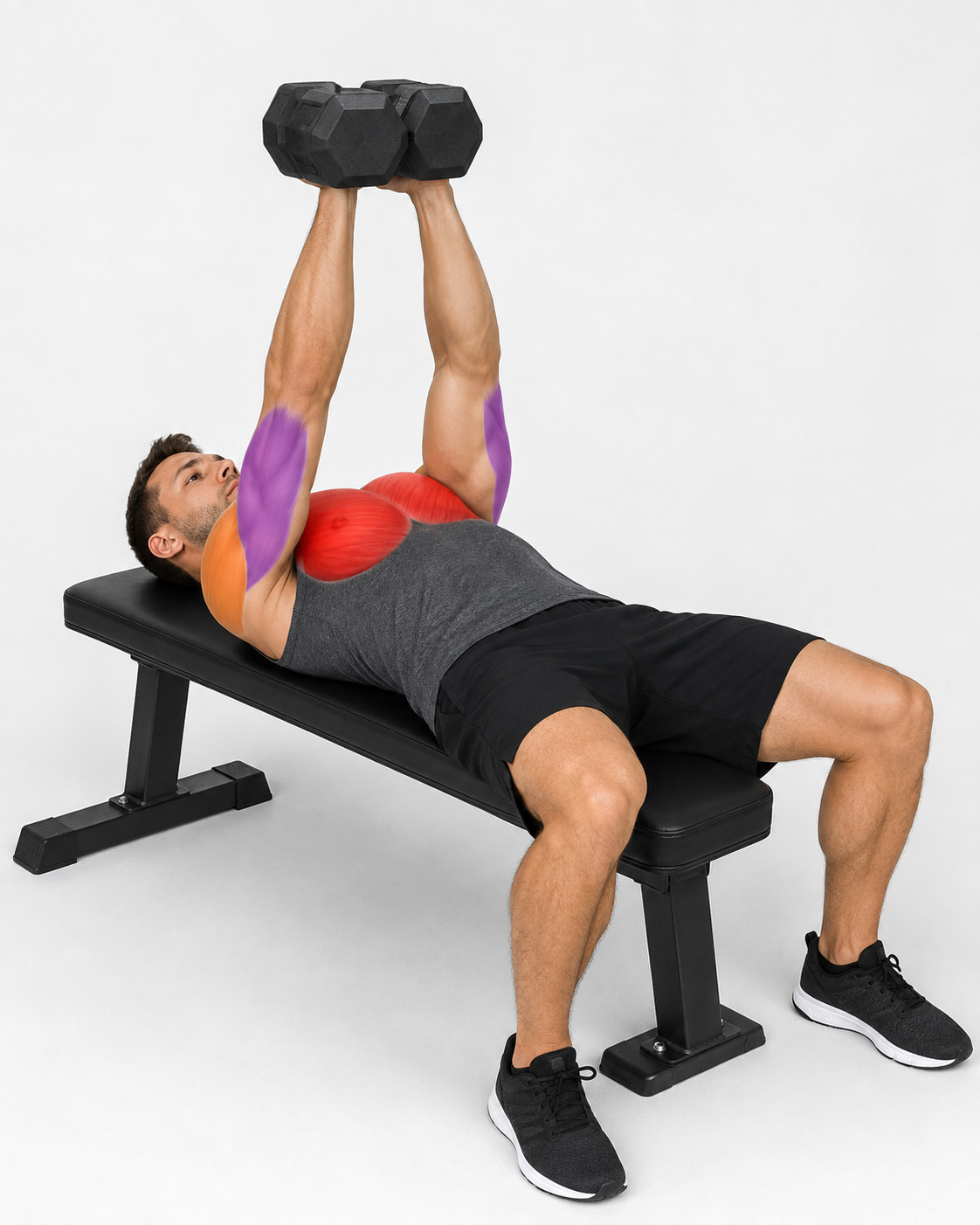
The dumbbell hex press is a compound upper-body exercise. Several muscles work together to press and stabilize the weights.
Pectoralis Major
The pectoralis major is the primary muscle targeted by the dumbbell hex press.
It helps move the upper arm forward and toward the center of the body. According to the NCBI Bookshelf overview of pectoralis major anatomy, its main functions include flexion, adduction, and internal rotation of the upper arm.
During the hex press, the pectoralis major contributes to:
- Pressing the dumbbells upward
- Controlling the weights as they lower
- Maintaining inward pressure between the dumbbells
The squeeze may make chest tension easier to notice, but a stronger sensation does not automatically mean the exercise produces more muscle growth than a regular dumbbell press.
Triceps Brachii
The triceps straighten the elbows as you press the dumbbells upward.
Because the dumbbells and elbows remain relatively close to the torso, the triceps can make a substantial contribution. Bench-press research has found that narrower pressing positions increase elbow-extension demands and triceps involvement compared with wider positions. That study used a barbell rather than a dumbbell hex press, so it provides useful context rather than direct proof about this specific exercise.
Anterior Deltoids
The anterior deltoids are the front portions of the shoulder muscles.
They assist with moving the upper arms forward during the press. The NCBI Bookshelf overview of shoulder anatomy identifies arm flexion as one of the anterior deltoid’s primary functions.
Your shoulders should assist the movement without shrugging toward your ears or rolling forward at the top.
Stabilizing Muscles
The rotator-cuff muscles, upper back, forearms, grip muscles, and trunk help keep the dumbbells, wrists, shoulders, and torso stable.
Each arm must control its own dumbbell, so you may need to use less total weight than you would with a barbell or fixed chest-press machine. Research comparing dumbbell, barbell, and Smith-machine chest presses found that the dumbbell version allowed less maximal load while still producing meaningful chest and shoulder activity.
Common Dumbbell Hex Press Mistakes
| Mistake | Why it is a problem | How to correct it |
|---|---|---|
| Using too much weight | The dumbbells separate and the movement becomes difficult to control | Reduce the load until you can maintain contact for every repetition |
| Allowing the dumbbells to separate | Removes the exercise’s defining inward-pressure component | Apply steady pressure through the flat sides of the dumbbells |
| Bending the wrists backward | Places the wrists in a weaker, less stable position | Stack the wrists directly over the forearms |
| Flaring the elbows widely | Makes it harder to keep the weights together and may create an uncomfortable shoulder position | Keep the elbows closer to the torso without forcing them against the ribs |
| Shrugging the shoulders | Shifts tension toward the upper traps and reduces shoulder control | Keep your shoulders relaxed away from your ears |
| Bouncing off the chest | Uses momentum and reduces muscular control | Lower gently and reverse the movement without bouncing |
| Pressing toward the face | Creates an inefficient and unstable pressing path | Keep the dumbbells traveling above the middle of your chest |
| Excessively arching the back | Reduces torso control and may turn the exercise into a full-body effort | Keep your glutes supported and your ribs controlled |
Benefits of the Dumbbell Hex Press
Helps Beginners Feel Chest Tension
Some beginners have difficulty understanding how the chest contributes during pressing exercises.
Squeezing the dumbbells together provides an immediate physical cue. Instead of only thinking about moving the weights upward, you also actively try to push them toward one another.
This does not prove that the hex press activates the chest more than every other press. It simply makes deliberate chest tension easier for some lifters to recognize and maintain.
Trains Several Upper-Body Muscles Together
The hex press trains the chest, triceps, and front shoulders within one movement.
That makes it more time-efficient than performing separate isolation exercises for each muscle. The chest produces force at the shoulder while the triceps extend the elbows and the shoulder muscles stabilize the upper arms.
Works Well With Moderate Weights
You generally cannot use as much weight on the hex press as on a conventional dumbbell press because you must keep the dumbbells firmly together.
This makes it useful for:
- Controlled accessory training
- Moderate- and higher-repetition sets
- Home workouts with limited weight
- Chest finishers after heavier presses
- Practicing stable wrist and elbow positioning
Lighter weight is not automatically better, but it can make it easier for beginners to learn the movement without relying on momentum.
Uses a Neutral Grip
The palms face each other during the hex press.
Some people find this neutral grip more comfortable than a fully palms-forward grip. The elbows also remain closer to the torso than they typically would during a wider dumbbell press.
However, individual shoulder structure and training history differ. A neutral grip does not guarantee that the exercise will be comfortable or appropriate for everyone.
Adds Variety Without Requiring New Equipment
Anyone with a bench and matching hex dumbbells can add the movement to a chest workout.
It can be used after dumbbell presses, machine presses, push-ups, or other exercises that allow more loading and a larger comfortable range of motion.
Does the Dumbbell Hex Press Work the Inner Chest?
The hex press trains the pectoralis major, but it does not isolate a separate “inner-chest” muscle.
The pectoralis major has clavicular and sternocostal portions. Its fibers originate from areas including the clavicle, sternum, and ribs before attaching to the upper arm. There is no separate inner-chest muscle positioned beside the sternum.
The continuous inward squeeze may make you feel strong tension near the center of your chest. That sensation is real, but it does not establish that the exercise selectively grows only the fibers closest to the sternum.
Different pressing angles and arm positions can change how much certain regions contribute. However, there is currently limited direct research comparing hex-press muscle activity or long-term growth with other dumbbell presses.
Use the exercise to train the chest as a whole rather than expecting it to reshape one narrow section independently.
Limitations of the Dumbbell Hex Press
It Provides Less Bottom-Position Stretch
Because the dumbbells remain together, the upper arms cannot move as far outward as they can during a regular dumbbell press.
This usually creates a shorter range of motion and less chest stretch near the bottom. For that reason, the hex press works well alongside—not necessarily instead of—a regular press performed through a comfortable range.
Heavy Loads Can Disrupt the Squeeze
As the dumbbells become heavier, maintaining inward pressure becomes more difficult.
If the weights separate, the wrists bend, or the elbows move unpredictably, the load is too heavy for the intended technique.
Inward Resistance Is Self-Generated
There is no external cable or band pulling the dumbbells apart. The inward resistance comes from how hard you choose to press the weights together.
That makes the squeeze difficult to measure precisely from one workout to another. Concentrate on using consistent pressure instead of trying to create an uncontrolled maximal squeeze.
It Is Not the Best Choice for Maximal Pressing Strength
The hex press is not normally the best exercise for very heavy sets of one to five repetitions.
A standard dumbbell press, barbell bench press, or stable chest-press machine usually allows greater loading. Use the hex press primarily for controlled accessory work, muscle-building sets, or technique practice.
How Much Weight Should a Beginner Use?
Begin with a lighter pair of dumbbells than you think you need.
Choose a weight that allows you to complete at least 10 controlled repetitions while:
- Keeping the dumbbells together
- Maintaining straight wrists
- Controlling the lowering phase
- Avoiding shoulder shrugging
- Keeping your glutes on the bench
- Finishing with two or three good repetitions still possible
A simple weight-selection test is:
- Perform 10 repetitions with a light pair of dumbbells.
- Check whether the weights remained firmly together.
- Check whether your wrists and elbows stayed stable.
- Decide whether you could have performed two or three additional clean repetitions.
- Increase the weight only when all four conditions are met.
Reduce the weight if the dumbbells repeatedly separate or you need to bounce, arch, or rush to complete the set.
Dumbbell Hex Press Sets, Reps, and Rest
For Beginners
- Sets: 2–3
- Repetitions: 8–15
- Rest: 60–120 seconds
- Effort: Stop with 2–3 repetitions remaining
- Frequency: One or two times per week
For Muscle-Building Accessory Work
- Sets: 3–4
- Repetitions: 10–15
- Rest: 60–90 seconds
- Effort: Stop with 1–3 repetitions remaining
As a Chest Finisher
- Sets: 2
- Repetitions: 12–20
- Rest: 45–75 seconds
- Effort: Use a light weight and maintain technique
You do not need to take every set to complete muscular failure. The 2026 American College of Sports Medicine resistance-training guidance emphasizes consistency, individualization, appropriate weekly volume, and regular training of major muscle groups. It also notes that complicated programming is not required for most healthy adults to make progress.
How to Progress the Dumbbell Hex Press
Use a double-progression method rather than increasing weight every workout.
For example, choose a target of 8–12 repetitions:
- Begin with a weight you can perform for 8 controlled repetitions.
- Keep the same weight until you can complete 12 repetitions on every set.
- Maintain one to three repetitions in reserve.
- Confirm that the dumbbells stay together and your wrists remain straight.
- Increase to the next available pair of dumbbells.
- Return to the lower end of the repetition range.
When the next dumbbell increase is too large, progress by:
- Adding one repetition per set
- Slowing the lowering phase
- Adding a one-second pause near the chest
- Improving the consistency of the squeeze
- Adding one set, provided you recover well
Do not increase difficulty by sacrificing range of motion or allowing the weights to separate.
Beginner Dumbbell Chest Workout With the Hex Press
Perform this workout once or twice per week with at least one recovery day between chest-focused sessions.
Warm-Up
- 5–10 minutes of easy walking, cycling, or another low-impact activity
- One set of 10 controlled arm circles in each direction
- Two light warm-up sets of dumbbell presses
The American Academy of Orthopaedic Surgeons recommends warming up with 5–10 minutes of low-impact activity before strengthening exercise.
Workout
| Exercise | Sets and reps | Rest | Effort |
|---|---|---|---|
| Dumbbell bench press | 3 sets of 8–10 | 90–120 seconds | Finish with 2–3 reps remaining |
| Dumbbell hex press | 2–3 sets of 10–15 | 60–90 seconds | Finish with approximately 2 reps remaining |
| Incline push-up | 2 sets of 8–15 | 60 seconds | Stop before form breaks down |
Place the regular dumbbell press first because it allows more load and range of motion. Use the hex press second for controlled chest and triceps work.
Progression
When you reach the top of the repetition range for every set with stable technique, add the smallest available amount of weight.
Increase only one training variable at a time. Avoid adding more weight, sets, and repetitions simultaneously.
Dumbbell Hex Press Regressions
Lighter Dumbbell Hex Press
The simplest regression is to use lighter dumbbells.
This allows you to practice the inward squeeze, wrist position, breathing, and pressing path without fighting an excessive load.
Dumbbell Floor Hex Press
Lie on the floor instead of a bench and perform the same squeeze press.
The floor stops the upper arms before they travel far behind the torso, creating a shorter and more predictable bottom position.
Best for: Beginners who want additional support or have difficulty controlling the bottom of a bench press.
Neutral-Grip Dumbbell Floor Press
Hold the dumbbells with palms facing each other but do not press them together.
This lets you learn the neutral-grip pressing pattern before adding the continuous inward squeeze.
Best for: Beginners who cannot yet keep two dumbbells securely aligned.
Dumbbell Hex Press Progressions and Variations
Paused Dumbbell Hex Press
Pause for one or two seconds near the bottom while continuing to squeeze the dumbbells together.
Do not rest the weights heavily on your chest.
Best for: Improving control and reducing momentum.
Slow-Eccentric Hex Press
Lower the dumbbells for three to four seconds before pressing them upward normally.
Best for: Increasing difficulty without immediately adding more weight.
Incline Dumbbell Hex Press
Set an adjustable bench to a low incline and perform the same movement.
The incline changes the pressing angle and generally increases the contribution of the front shoulders as the bench becomes steeper. Use a low incline and a lighter starting load. Research on bench angles shows that changing the incline alters the relative activity of the chest and anterior deltoids.
Best for: Adding pressing-angle variety after mastering the flat version.
Top-Pause Hex Press
Pause for one or two seconds at the top while maintaining inward pressure.
Keep the shoulders supported rather than reaching them away from the bench.
Best for: Practicing consistent chest tension.
Dumbbell Hex Press vs. Regular Dumbbell Press
| Feature | Dumbbell hex press | Regular dumbbell press |
|---|---|---|
| Dumbbell position | Held together throughout the repetition | Held separately |
| Grip | Neutral | Usually palms forward or slightly angled |
| Elbow position | Relatively close to the torso | Usually farther from the torso |
| Range of motion | Generally shorter | Generally larger |
| Bottom-position chest stretch | Lower | Greater when performed comfortably |
| Loading potential | Moderate | Usually heavier |
| Main training use | Accessory work and chest-tension practice | Primary strength and muscle-building press |
| Triceps contribution | Often noticeable | Moderate |
| Best workout placement | After a main press | Early in the workout |
Neither exercise is automatically better.
Use the regular dumbbell press when your priority is progressive loading through a larger comfortable range. Use the hex press when you want a controlled neutral-grip accessory that emphasizes continuous inward pressure.
Dumbbell Hex Press Safety Tips
- Use two matching dumbbells with flat, stable sides.
- Check that the bench is secure before lying down.
- Wrap your thumbs around the dumbbell handles.
- Start with a conservative load.
- Keep your wrists straight.
- Do not bounce the dumbbells off your chest.
- Avoid forcing a deeper range than you can control.
- Keep the dumbbells over your chest rather than allowing them to drift toward your face.
- Ask for a spotter when the weights are difficult to move safely into or out of position.
- End the set when the dumbbells repeatedly separate or your wrists begin to bend.
The Mayo Clinic weight-training guidance recommends warming up, controlling the weight rather than rushing, and stopping an exercise when it causes pain.
Stop exercising and seek appropriate professional help if you experience sharp pain, numbness, dizziness, chest pain, faintness, unusual shortness of breath, or other unexpected symptoms.
Frequently Asked Questions
Is the dumbbell hex press good for beginners?
Yes. The movement can be beginner-friendly when performed with light dumbbells and a stable bench.
The continuous squeeze gives beginners a clear technique cue, but the exercise still requires wrist and shoulder control. Learn the movement slowly before increasing weight.
Does the dumbbell hex press build the inner chest?
It trains the pectoralis major and may create a strong sensation near the center of the chest, but it does not isolate a separate inner-chest muscle.
Use it as one part of a balanced chest program rather than relying on it to reshape a specific narrow area.
Should the dumbbells touch my chest?
They may lightly touch the middle of your chest if you can reach that position without wrist bending, shoulder discomfort, or loss of control.
Do not bounce the weights or rest them heavily on your chest. Stop slightly above the chest when that position feels more stable.
Can I perform a hex press with round dumbbells?
Flat-sided hex dumbbells are the preferred equipment because they remain more stable when pressed together.
Round dumbbells can be used for a careful squeeze-press variation, but their curved surfaces may roll or separate. Use a lighter load and do not force unstable weights together.
How heavy should a dumbbell hex press be?
Use a weight that allows at least 8–15 controlled repetitions while keeping the dumbbells together.
The correct load is usually lighter than the weight used for a regular dumbbell bench press. Technique quality matters more than matching your normal pressing weight.
Is the hex press better than a regular dumbbell press?
Not generally. The exercises serve different purposes.
A regular dumbbell press usually allows more load and range of motion, making it better suited to primary strength and muscle-building work. The hex press is useful for controlled accessory training and practicing deliberate chest tension.
Where should the hex press go in a workout?
Place it after your main chest press in most workouts.
For example, perform a dumbbell bench press first and the hex press second. It can also be used as a lighter finisher near the end of a chest or upper-body session.
Conclusion
The dumbbell hex press is a practical chest accessory for beginners who want to improve pressing control and learn how to maintain deliberate chest tension.
Use two matching hex dumbbells, keep your palms facing each other, maintain straight wrists, and squeeze the weights together through every repetition. Start light, work mostly within 8–15 repetitions, and increase weight only when the dumbbells remain stable from start to finish.
For balanced chest development, combine the hex press with a regular press, push-up, or another exercise that allows comfortable progressive loading through a larger range of motion.
References
- American College of Sports Medicine: Updated Resistance Training Guidelines
- American Council on Exercise: Chest Press Exercise Guide
- NCBI Bookshelf: Pectoralis Major Anatomy
- NCBI Bookshelf: Shoulder Anatomy and Muscle Functions
- PubMed: Understanding Bench Press Biomechanics
- PubMed: Comparison of Dumbbell, Barbell, and Smith-Machine Chest Presses
- American Academy of Orthopaedic Surgeons: Shoulder Conditioning and Warm-Up Guidance
This content is for informational purposes only and is not a substitute for medical advice.