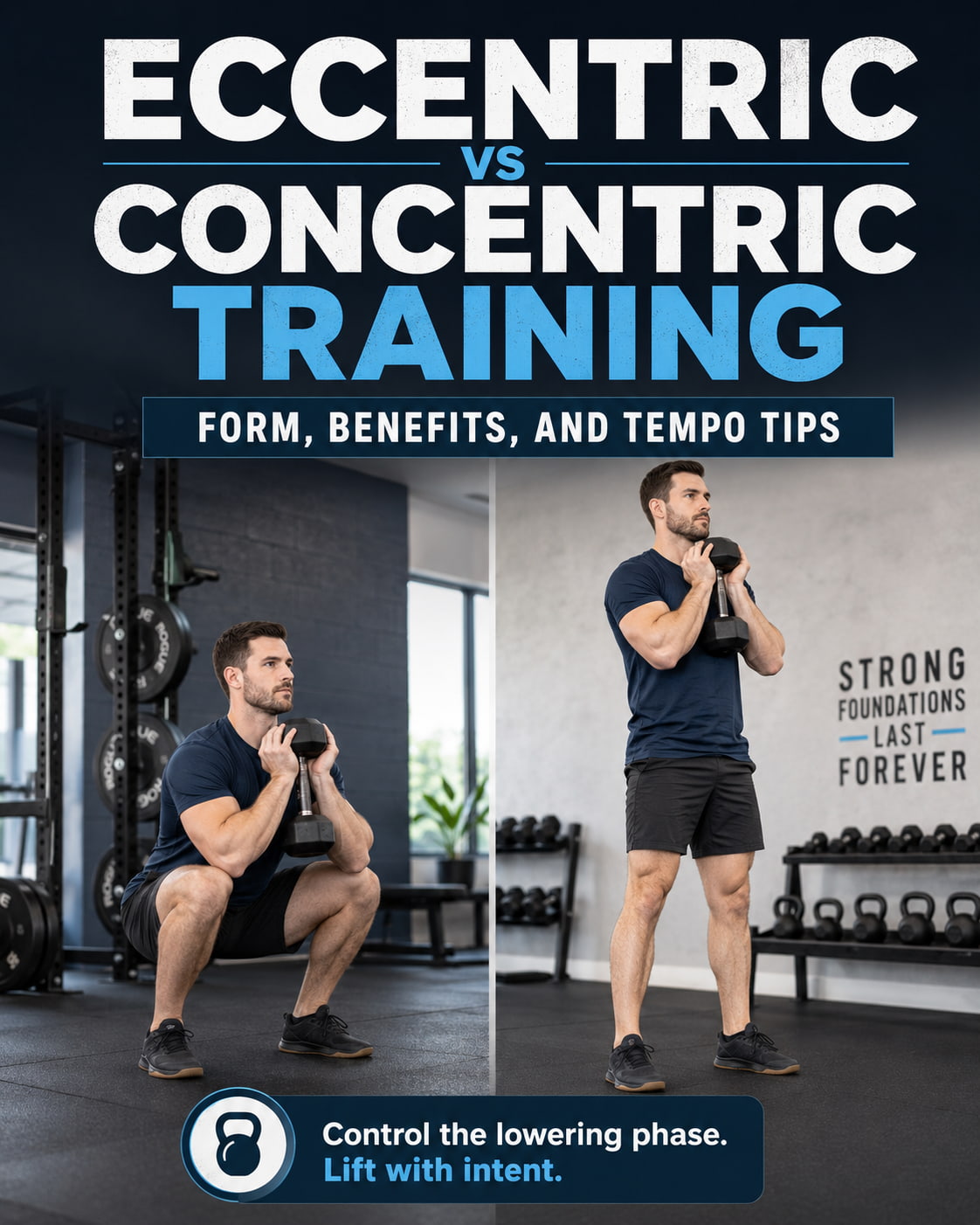
Eccentric vs concentric training is the difference between controlling the lowering phase of an exercise and producing the lifting phase. In simple terms, eccentric means the working muscle lengthens under tension, while concentric means it shortens under tension.
Both phases matter. If you only think about “lifting the weight,” you miss half of the rep. A better training approach is to lower with control, lift with intent, and use tempo in a way that supports your goal.
This guide explains what eccentric and concentric mean, how they work in common exercises, which muscles are involved, how to use tempo training, common mistakes to avoid, and how to build both phases into a real workout.
Eccentric vs Concentric: What Do They Mean?
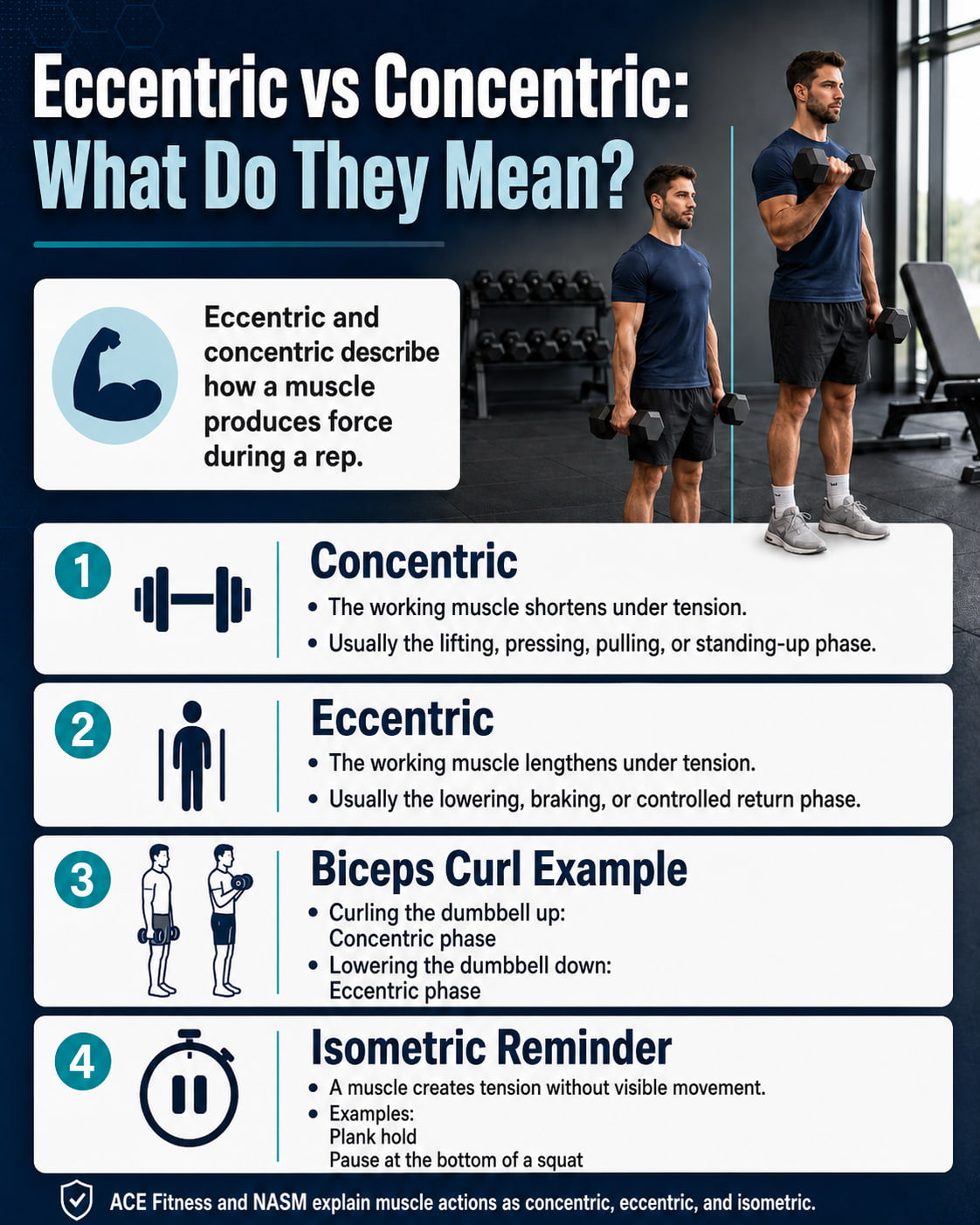
Eccentric and concentric describe how a muscle produces force during a rep.
A concentric muscle action happens when the working muscle shortens under tension. This is usually the lifting, pressing, pulling, or standing-up part of an exercise.
An eccentric muscle action happens when the working muscle lengthens under tension. This is usually the lowering, braking, or controlled return part of an exercise.
For example, during a biceps curl, curling the dumbbell up is the concentric phase for the biceps. Lowering the dumbbell back down is the eccentric phase. ACE Fitness explains this same basic difference as muscle shortening versus muscle lengthening under tension.
NASM also explains that muscle actions are commonly grouped into concentric, eccentric, and isometric actions. Concentric and eccentric involve movement. Isometric means the muscle creates tension without visible movement, such as holding a plank or pausing at the bottom of a squat.
Eccentric vs Concentric Quick Comparison
| Training phase | What the muscle does | Simple example | Main training focus |
|---|---|---|---|
| Eccentric | Lengthens under tension | Lowering into a squat | Control, braking, tension, deceleration |
| Concentric | Shortens under tension | Standing up from a squat | Lifting, pressing, pulling, force output |
| Isometric | Holds tension without changing length | Pausing at the bottom of a squat | Stability, position strength, control |
Think of it this way: the eccentric phase controls the weight, and the concentric phase moves the weight.
Are Eccentric and Concentric Different Muscles?
No. Eccentric and concentric are not separate muscles. They are different actions performed by the same working muscles.
The muscles worked depend on the exercise.
In a squat, the quads, glutes, adductors, hamstrings, core, and spinal erectors all contribute. In a push-up, the chest, shoulders, triceps, serratus anterior, and core are involved. In a pull-up, the lats, upper back, biceps, forearms, and core all help.
The contraction type tells you what the muscle is doing during that part of the rep.
How Eccentric and Concentric Training Works in Common Exercises
1. Squat
Best for: Learning the difference between lowering with control and standing up with strength.
Muscles worked: Quadriceps, glutes, adductors, hamstrings, calves, core, and spinal erectors.
Equipment needed: Body weight, dumbbell, kettlebell, barbell, or machine depending on the variation.
Why it stands out: The squat is one of the easiest ways to feel eccentric vs concentric training. Lowering into the squat is the eccentric phase. Standing back up is the concentric phase.
Suggested sets and reps: Use 2–4 sets of 6–12 reps. For tempo work, try a 3-second lower and a controlled lift.
Beginners: Start with a bodyweight box squat or goblet squat. Use a comfortable range of motion and focus on control before adding load.
Intermediate: Use a goblet squat, front squat, or back squat with a 3-second lowering phase.
Advanced: Use heavier loads, pauses, or controlled eccentric overload only when technique is consistent.
Rest: Rest 60–120 seconds between sets depending on the load and effort level.
How to do it:
- Stand with your feet about shoulder-width apart.
- Brace your core and keep your chest controlled, not flared.
- Lower by bending your knees and hips together.
- Keep your feet flat and knees tracking in line with your toes.
- Pause briefly if needed.
- Drive through the floor to stand tall again.
Common mistakes: Dropping quickly into the bottom, bouncing out of the squat, letting the knees collapse inward, rounding the back, or turning every rep into an overly slow grind.
Expert tip: Think “control down, drive up.” The lowering phase should stay smooth, but the lifting phase should not become sloppy.
Exercise variations: Bodyweight squat, box squat, goblet squat, front squat, back squat, split squat, leg press.
Easier variation: Box squat or assisted squat.
Harder variation: Pause squat, tempo squat, front squat, or heavy back squat.
2. Push-Up
Best for: Building upper-body control while learning how the chest, shoulders, and triceps work during lowering and pressing.
Muscles worked: Chest, triceps, front delts, serratus anterior, core, glutes, and upper back stabilizers.
Equipment needed: None. A bench or box can be used for an easier incline push-up.
Why it stands out: Lowering toward the floor is the eccentric phase. Pressing away from the floor is the concentric phase. This makes the push-up a simple bodyweight example of both actions.
Suggested sets and reps: Use 2–4 sets of 6–15 reps. For control, lower for 2–3 seconds and press up smoothly.
Beginners: Start with incline push-ups on a bench or countertop. Keep your body in a straight line.
Intermediate: Use standard push-ups with a controlled lower and steady press.
Advanced: Use deficit push-ups, weighted push-ups, ring push-ups, or slow eccentric push-ups.
Rest: Rest 60–90 seconds between sets.
How to do it:
- Set your hands slightly wider than shoulder-width.
- Keep your body in a straight line from head to heels.
- Brace your abs and squeeze your glutes lightly.
- Lower your chest toward the floor under control.
- Keep your elbows at a comfortable angle, not flared straight out.
- Press the floor away until your arms are straight.
Common mistakes: Sagging the hips, flaring the elbows too wide, dropping the chest quickly, shrugging the shoulders, or cutting the range of motion short.
Expert tip: If the lowering phase is controlled but the press is weak, use an incline variation instead of forcing sloppy reps.
Exercise variations: Incline push-up, standard push-up, deficit push-up, close-grip push-up, dumbbell bench press.
Easier variation: Incline push-up.
Harder variation: Feet-elevated push-up or weighted push-up.
3. Dumbbell Biceps Curl
Best for: Clearly feeling the muscle shorten and lengthen during one simple joint movement.
Muscles worked: Biceps brachii, brachialis, brachioradialis, forearms, and grip muscles.
Equipment needed: Dumbbells, cable machine, resistance band, or barbell.
Why it stands out: The curl is a clear example of concentric and eccentric training. Curling up is concentric for the biceps. Lowering the weight is eccentric.
Suggested sets and reps: Use 2–4 sets of 8–15 reps. For eccentric emphasis, lower the weight for 3 seconds.
Beginners: Use light dumbbells and keep the elbows close to your sides.
Intermediate: Use a controlled lower and avoid swinging the weight.
Advanced: Use slow eccentrics, cable curls, incline curls, or heavier loads with strict form.
Rest: Rest 45–90 seconds between sets.
How to do it:
- Stand tall with a dumbbell in each hand.
- Keep your elbows close to your sides.
- Curl the weights up without swinging your torso.
- Squeeze briefly at the top.
- Lower the dumbbells under control until your arms are straight.
- Keep your wrists neutral and controlled.
Common mistakes: Swinging the hips, leaning back, letting the elbows drift too far forward, dropping the weight, or using a load that ruins control.
Expert tip: The lowering phase should feel like your biceps are resisting the dumbbells, not relaxing.
Exercise variations: Dumbbell curl, cable curl, incline curl, hammer curl, preacher curl.
Easier variation: Seated dumbbell curl with lighter weight.
Harder variation: Incline dumbbell curl with a slow eccentric.
4. Pull-Up or Assisted Pull-Up
Best for: Building pulling strength, upper-back control, and strong eccentric lowering.
Muscles worked: Latissimus dorsi, teres major, rhomboids, trapezius, rear delts, biceps, brachialis, forearms, grip, and core.
Equipment needed: Pull-up bar, assisted pull-up machine, or resistance band.
Why it stands out: Pulling your body up is the concentric phase. Lowering yourself back down is the eccentric phase. Many lifters use controlled negatives to build toward full pull-ups.
Suggested sets and reps: Use 2–4 sets of 3–8 reps for pull-ups or 5–10 controlled reps for assisted pull-ups.
Beginners: Use an assisted pull-up machine, band assistance, or slow lowering from a box.
Intermediate: Perform full pull-ups with a 2–3 second lower.
Advanced: Use weighted pull-ups, pause reps, or controlled eccentric-only work with careful volume.
Rest: Rest 90–180 seconds between sets because pull-ups are demanding.
How to do it:
- Grip the bar with your hands about shoulder-width or slightly wider.
- Brace your core and avoid swinging.
- Pull your chest toward the bar by driving your elbows down.
- Keep your shoulders controlled at the top.
- Lower your body under control.
- Reset before the next rep if needed.
Common mistakes: Kicking the legs, shrugging into the neck, dropping from the top, losing shoulder control, or using too many negatives too soon.
Expert tip: A good eccentric pull-up should look smooth. If you drop suddenly halfway down, use more assistance.
Exercise variations: Assisted pull-up, chin-up, banded pull-up, neutral-grip pull-up, negative pull-up, lat pulldown.
Easier variation: Assisted pull-up or lat pulldown.
Harder variation: Weighted pull-up or slow eccentric pull-up.
Benefits of Eccentric Training
Eccentric training is useful because it teaches you to control the part of the rep many people rush.
A controlled eccentric phase may help improve body awareness, position strength, joint control, and the ability to decelerate load. In the gym, that means you are not just lifting the weight; you are also controlling where it goes.
The American College of Sports Medicine notes that skeletal muscle can produce more force during maximal eccentric actions than concentric actions. This is one reason advanced athletes sometimes use eccentric overload. However, that does not mean beginners should jump into heavy negatives. Higher force also means higher recovery demand.
Practical benefits of eccentric training include better lowering control, improved technique, stronger positions, more time under tension, and better awareness of range of motion.
Eccentric work can also be useful when learning exercises like pull-ups, push-ups, squats, step-downs, Romanian deadlifts, and split squats because it slows the movement down and exposes weak positions.
Benefits of Concentric Training
Concentric training is the lifting, pressing, pulling, standing, or driving part of the rep.
This phase is essential for strength and performance because it teaches you to produce force. When you stand up from a squat, press a dumbbell overhead, pull your chest toward a bar, or row a weight toward your ribs, you are using concentric action.
Concentric training is especially important when the goal is to move with intent. You still need control, but you should not make every lifting phase slow on purpose. For many strength exercises, a good cue is to lower under control and lift with strong, smooth effort.
Concentric-focused work can support strength, power, coordination, and confidence with the main lifting phase of an exercise.
Is Eccentric or Concentric Better for Muscle Growth?
Neither phase should be ignored.
Eccentric training often gets attention because it can create high tension and more soreness. But soreness is not the same as better results. A recent systematic review listed on PubMed found broadly similar hypertrophy outcomes between eccentric and concentric muscle actions in apparently healthy adults, although some results may vary based on the muscle group, training setup, and study design.
For most lifters, the best answer is simple: use both.
Muscle growth is influenced by total training volume, effort, range of motion, exercise selection, load, consistency, recovery, and nutrition. Eccentric control helps you own the lowering phase. Concentric strength helps you move the weight. Together, they create better reps.
How to Use Tempo Training
Tempo training means controlling how fast each part of the rep happens.
A simple tempo might look like this:
3-1-1
That means:
- 3 seconds lowering
- 1 second pause
- 1 second lifting
For a squat, that would mean lowering for 3 seconds, pausing briefly at the bottom, then standing up in about 1 second with control.
For most beginners and intermediate lifters, tempo should improve technique, not make the workout unnecessarily complicated.
Best Tempo Options for Eccentric vs Concentric Training
| Goal | Tempo idea | How to use it |
|---|---|---|
| General strength | 2 seconds down, controlled up | Use for most normal lifting sets |
| Better control | 3 seconds down, 1 second up | Use on squats, push-ups, rows, curls |
| Technique practice | 3 seconds down, 1-second pause, controlled lift | Use when learning positions |
| Muscle-building accessory work | 3–4 seconds down, steady lift | Use on curls, leg curls, rows, presses |
| Power training | Controlled lower, fast but safe lift | Use only when technique is solid |
The Exercise is Medicine eccentric resistance exercise guide describes traditional eccentric resistance training as often using about 2 seconds to lift and about 4–6 seconds to lower. That can be useful, but it is not necessary for every set or every exercise.
How Often Should You Use Eccentric Training?
For most people, 1–2 eccentric-focused exercises per workout is enough.
You do not need to make every rep a slow negative. That can create too much soreness and reduce your ability to train well later in the week.
A good starting point:
| Training level | Eccentric focus |
|---|---|
| Beginner | Use normal control on every rep; avoid extreme slow negatives |
| Intermediate | Add 3-second eccentrics to 1–2 exercises per workout |
| Advanced | Use eccentric overload carefully in planned blocks |
The CDC recommends muscle-strengthening activity at least 2 days per week for all major muscle groups. Eccentric tempo work can fit inside that plan, but it should not replace balanced training.
Common Eccentric vs Concentric Mistakes
Dropping the Weight
If you let gravity take over, you are missing the eccentric phase. Lower the weight with control instead of letting it fall.
Going Too Slow on Everything
Slow reps can help, but every exercise does not need a 5-second lower. Use slow eccentrics for specific goals, not as a rule for every movement.
Using Too Much Weight
Many people can handle more load eccentrically than concentrically, but that does not mean they should overload the lowering phase right away. Start lighter when adding tempo.
Bouncing Out of the Bottom
Bouncing may hide weak control. A controlled lower and brief pause can teach better position strength.
Confusing Soreness With Progress
Eccentric training can create more soreness, especially when new. More soreness does not always mean a better workout. Good training should be challenging and repeatable.
Forgetting the Concentric Phase
Some lifters focus so much on slow lowering that they lose intent on the lift. Control the eccentric, then complete the concentric with strong technique.
Ignoring Recovery
Hard eccentric work can require more recovery. If performance drops sharply or soreness lasts too long, reduce volume, load, or tempo.
Beginner, Intermediate, and Advanced Training Tips
Beginner Tips
Start with basic control. Lower the weight smoothly, lift it with good form, and stop each set before your technique breaks down.
Good beginner exercises include goblet squats, incline push-ups, dumbbell rows, Romanian deadlifts, step-ups, and machine exercises.
Use a simple tempo such as 2 seconds down and 1 second up. Keep 2–3 reps in reserve on most sets.
Intermediate Tips
Add tempo to exercises where you want better control.
For example, use a 3-second lower on goblet squats, push-ups, rows, curls, split squats, and Romanian deadlifts. You can also add a short pause at the bottom of a squat or push-up.
Use 1–3 reps in reserve on most sets. Increase load only when you can keep the same control through the full range of motion.
Advanced Tips
Advanced lifters can use more specific methods, such as slow eccentrics, pause reps, 1.5 reps, eccentric-only pull-ups, or careful eccentric overload.
These methods should be programmed, not randomly added to every workout. Use them in short phases, track soreness, and avoid max-effort eccentric work without proper setup or supervision.
Sample Eccentric vs Concentric Workout
Use this full-body workout 1–2 times per week when you want to improve control, strength, and rep quality.
Warm up for 5–10 minutes first. Then perform 1–2 lighter ramp-up sets for your first main exercise.
| Exercise | Sets | Reps | Tempo | Rest |
|---|---|---|---|---|
| Goblet squat | 3 | 8–10 | 3 seconds down, controlled up | 90 sec |
| Incline push-up or push-up | 3 | 8–12 | 2–3 seconds down, controlled up | 60–90 sec |
| Dumbbell Romanian deadlift | 3 | 8–10 | 3 seconds down, 1 second up | 90–120 sec |
| One-arm dumbbell row | 3 | 10–12 per side | 2 seconds reach, strong pull | 60–90 sec |
| Split squat | 2 | 8 per side | 3 seconds down, controlled up | 90 sec |
| Plank | 2–3 | 20–40 sec | Hold steady | 45–60 sec |
Effort level: Stop most sets with 1–3 reps in reserve.
Frequency: Use this workout 1–2 times per week, or add 1–2 tempo exercises into your normal strength routine.
Progression: When you can complete every set with clean control, add 1–2 reps per set or increase the weight slightly. Do not increase load if the eccentric phase becomes rushed or sloppy.
How to Add Eccentric Training Without Overdoing It
Start small.
A good first step is to choose one lower-body exercise and one upper-body exercise per workout. Add a 3-second lowering phase to each one.
For example:
- Goblet squat: 3 seconds down
- Push-up: 3 seconds down
- Dumbbell row: 2 seconds forward reach
- Biceps curl: 3 seconds down
Keep the rest of your workout normal. This gives you the benefit of tempo control without turning the entire session into slow-rep fatigue.
Safety Tips for Eccentric and Concentric Training
Eccentric training can be effective, but it should be added gradually.
Use these safety rules:
- Warm up before lifting.
- Start with lighter loads when adding slower eccentrics.
- Keep technique smooth through the full range of motion.
- Avoid heavy negative reps without experience or a spotter.
- Do not use maximal eccentric work often.
- Give sore muscles enough time to recover.
- Stop if you feel sharp pain, numbness, dizziness, chest pain, or unusual symptoms.
If you are recovering from an injury, dealing with joint pain, or unsure whether eccentric loading is appropriate for you, get guidance from a qualified healthcare or fitness professional.
FAQs About Eccentric vs Concentric Training
What is the simplest example of eccentric vs concentric training?
A squat is the easiest example. Lowering into the squat is the eccentric phase. Standing back up is the concentric phase.
Is eccentric training better than concentric training?
Not automatically. Eccentric training is useful for control, tension, and deceleration. Concentric training is essential for lifting, pressing, pulling, and producing force. Most people should train both.
Why does eccentric training make me sore?
Eccentric work can create higher muscle tension and more muscle disruption, especially when it is new or done with too much volume. Some soreness is common, but heavy soreness is not required for progress.
How slow should the eccentric phase be?
For most exercises, 2–3 seconds down is enough. For specific tempo work, 3–4 seconds can be useful. Very slow eccentrics should be used carefully because they increase fatigue.
Should beginners do eccentric training?
Yes, but beginners should start with controlled reps, not extreme slow negatives. A simple 2-second lower is a good starting point.
Is the lowering phase always eccentric?
Usually, but it depends on the exercise and the working muscle. In most common strength exercises, the lowering phase is eccentric for the main target muscles.
What is the difference between eccentric, concentric, and isometric?
Eccentric means the muscle lengthens under tension. Concentric means it shortens under tension. Isometric means the muscle creates tension without visible movement.
Conclusion
Eccentric vs concentric training is not about choosing one phase and ignoring the other. The best reps use both.
Lower with control during the eccentric phase. Lift with intent during the concentric phase. Add tempo work when it helps your form, strength, or muscle-building goal, but keep the plan repeatable.
Start with simple control, progress slowly, and let better reps drive better training.
This content is for informational purposes only and is not a substitute for professional medical advice.
References
- Cleveland Clinic: Understanding the Difference Between Eccentric and Concentric Exercises
- ACE Fitness: Muscles in Motion
- NASM: What Is Muscle Action? Concentric, Eccentric, and Isometric
- ACSM: Focus on Eccentric Loading for Enhancing Muscular Adaptation to Training
- PubMed: Comparison Between Eccentric vs. Concentric Muscle Actions on Hypertrophy