The Captain Morgan exercise is a single-leg hip stability drill that helps strengthen the gluteus medius, improve balance, and teach better control through the hips, pelvis, and stance leg. It is usually performed beside a wall by lifting one knee and pressing it into the wall while the standing leg stays stable.
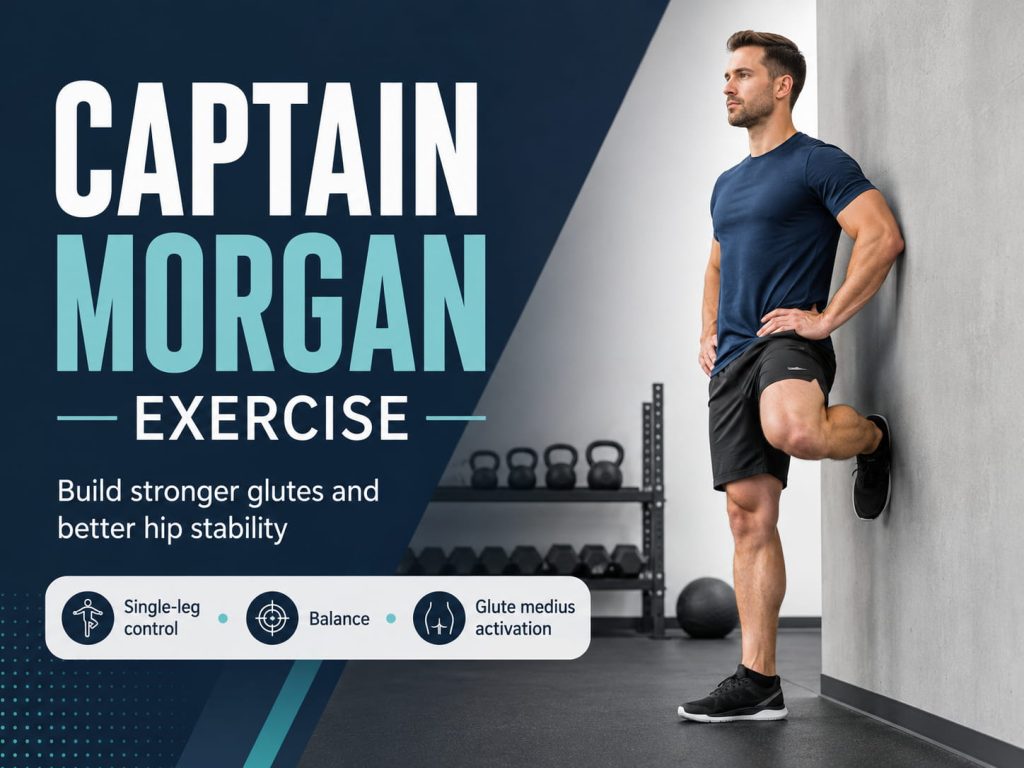
This Captain Morgan Exercise guide explains how to do the movement correctly, which muscles it works, why it is useful, common mistakes to avoid, and how to use it in a warm-up or lower-body workout.
What Is the Captain Morgan Exercise?
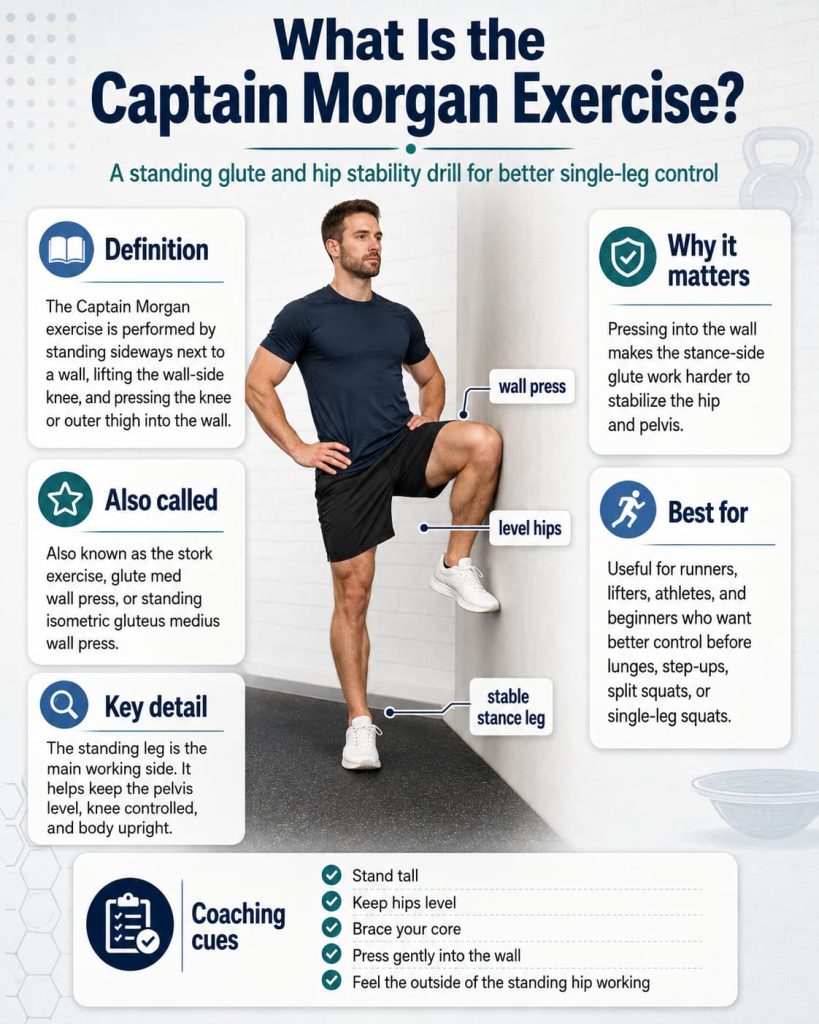
The Captain Morgan exercise is a standing glute and hip stability exercise. You stand sideways next to a wall, lift the knee closest to the wall, and press that knee or outer thigh into the wall while balancing on the opposite leg.
The name comes from the “one leg up” position, which looks similar to the Captain Morgan pose. In training and physical therapy settings, it may also be called the stork exercise, glute med wall press, or standing isometric gluteus medius wall press.
The key detail is that the standing leg is usually the main working side. When you press the lifted leg into the wall, your stance-side glute has to work hard to keep your pelvis level, knee controlled, and body upright. E3 Rehab describes the Captain Morgan as standing on one leg with the opposite hip flexed while pushing into the wall and maintaining stability.
This makes the exercise useful for runners, lifters, athletes, and beginners who want better single-leg control before progressing to lunges, step-ups, split squats, or single-leg squats.
Captain Morgan Exercise Muscles Worked
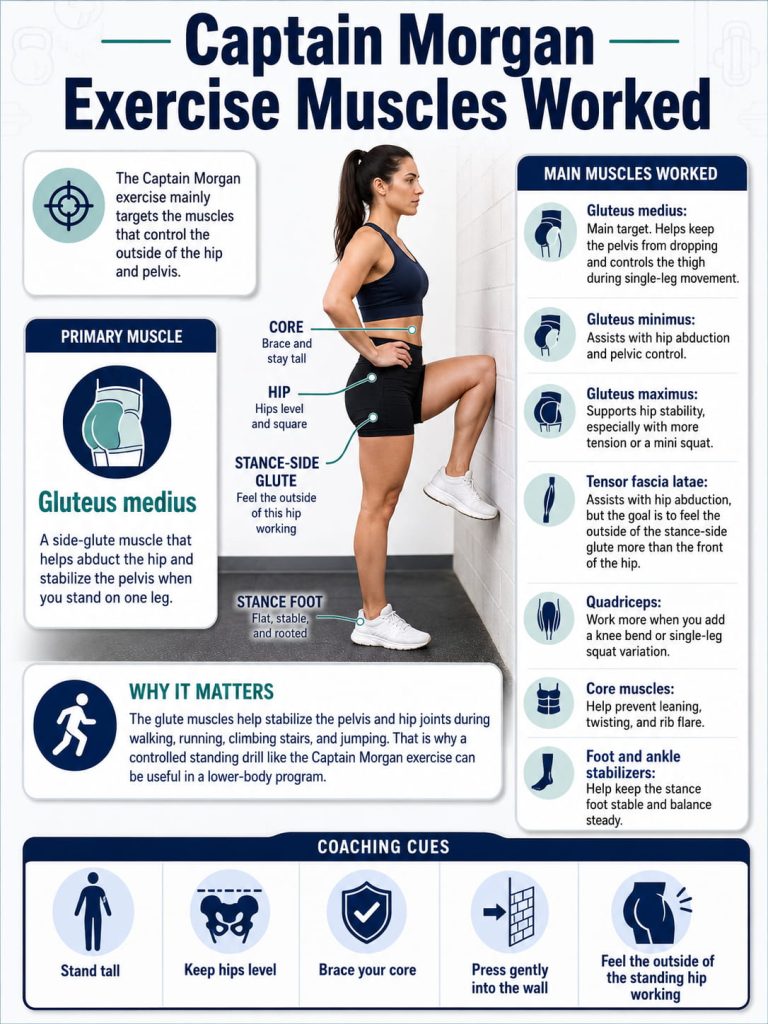
The Captain Morgan exercise mainly targets the muscles that control the outside of the hip and pelvis.
The primary muscle is the gluteus medius, a side-glute muscle that helps abduct the hip and stabilize the pelvis when you stand on one leg. NCBI Bookshelf explains that the gluteus medius and minimus help with hip abduction and help keep the pelvis controlled during single-leg support.
The main muscles worked include:
Gluteus medius: This is the main target. It helps keep the pelvis from dropping and helps control the thigh during single-leg movement.
Gluteus minimus: This smaller hip muscle assists the gluteus medius with hip abduction and pelvic control.
Gluteus maximus: The larger glute muscle helps support hip stability, especially when you add a mini squat or more tension.
Tensor fascia latae: This muscle can assist with hip abduction, but the goal is to feel the outside of the stance-side glute more than the front of the hip.
Quadriceps: The quads work more when you add a knee bend or single-leg squat variation.
Core muscles: Your abs, obliques, and trunk stabilizers help prevent leaning, twisting, and rib flare.
Foot and ankle stabilizers: The stance foot works to grip the floor and keep your balance steady.
According to Cleveland Clinic, the glute muscles help stabilize the pelvis and hip joints while supporting movements such as walking, running, climbing stairs, and jumping. That is why a controlled standing drill like the Captain Morgan exercise can be useful in a lower-body program.
Benefits of the Captain Morgan Exercise
The Captain Morgan exercise is simple, but it teaches an important skill: controlling your body on one leg.
1. Builds Gluteus Medius Strength
Many lower-body exercises depend on the gluteus medius for control. When this muscle is not doing its job well, you may notice your hips shifting, your pelvis dropping, or your knee drifting inward during single-leg movements.
The Captain Morgan exercise trains the stance-side glute medius in a weight-bearing position. That means it has carryover to movements where one leg must support your body.
2. Improves Hip Stability
Hip stability is not just about having strong glutes. It is also about being able to control the hip, pelvis, knee, and trunk together.
This exercise teaches you to create tension without moving too much. You press into the wall while keeping your posture tall, your stance foot stable, and your pelvis level.
3. Supports Better Single-Leg Control
Walking, running, climbing stairs, lunging, stepping up, and changing direction all include moments where one leg supports most of your body weight.
The Captain Morgan exercise helps you practice that position in a controlled way before adding more speed, depth, or load.
4. Helps Improve Knee Tracking Awareness
The exercise does not “fix” knee problems by itself, but it can help you become more aware of knee position. In the standing leg, the knee should generally track in line with the toes rather than collapsing inward.
This is especially useful before split squats, lateral step-ups, reverse lunges, and single-leg squat variations.
5. Works Well as a Warm-Up Drill
Because the Captain Morgan exercise is low-impact and easy to set up, it works well before lower-body strength training, running drills, or athletic movement work.
Use it to wake up the side glutes and improve body awareness before heavier or faster exercises.
How to Do the Captain Morgan Exercise
Equipment needed: You only need a wall. A small towel or pad can be placed between your knee and the wall for comfort.
Suggested sets and reps: Start with 2–3 sets of 20–30 seconds per side. As your control improves, build toward 30–45 seconds per side. For a harder version, use 2–3 sets of 6–10 slow single-leg squat reps per side.
Beginners: Use light wall pressure and fingertip support on a rack, chair, or wall if balance is difficult. Keep the hold short and focus on feeling the outside of the standing hip.
Intermediate: Use a stronger wall press, hold for 30–45 seconds, and add a small bend in the stance knee while keeping the pelvis level.
Advanced: Progress to a stability ball version, a slow single-leg squat version, or a longer isometric hold while maintaining clean posture and knee alignment.
Rest: Rest 30–60 seconds between sides or sets. If you use it in a warm-up, keep the effort moderate so your glutes feel active but not fatigued.
How to do it:
- Stand sideways next to a wall with your feet about hip-width apart.
- Lift the knee closest to the wall to about hip height, or slightly lower if that feels more controlled.
- Bend the lifted knee and place the outside of that knee or thigh against the wall.
- Root the standing foot into the floor and keep your toes, knee, and hip facing forward.
- Press the lifted knee gently into the wall while keeping your body tall.
- Keep your pelvis level and avoid letting your hip drop or rotate.
- Hold the position while breathing slowly and keeping tension in the outside of the standing hip.
- Relax, switch sides, and repeat for the same amount of time.
Common mistakes: The most common mistake is leaning your torso into the wall instead of using your glutes to create pressure. Other mistakes include letting the stance knee cave inward, shifting the pelvis, arching the lower back, pressing too hard too soon, or feeling all the work in the lifted leg instead of the standing hip.
Expert tip: Think, “stand tall, push the wall away, and keep the standing hip strong.” The goal is not maximum force. The goal is clean tension, level hips, and steady balance.
Exercise variations: Useful variations include the supported Captain Morgan hold, towel wall press, stability ball Captain Morgan, Captain Morgan mini squat, and Captain Morgan single-leg squat.
Easier variation: Use fingertip support and lower the lifted knee so the position is easier to control. You can also start with 10–15 second holds.
Harder variation: Place a stability ball between your outer thigh and the wall, maintain pressure into the ball, and perform a slow single-leg squat. Rehab Hero describes this dynamic version as a hip abductor exercise that uses a stability ball and a single-leg squat pattern.
Common Captain Morgan Exercise Mistakes
Leaning Into the Wall
If your shoulder, ribs, or hip drift toward the wall, you reduce the work on the stance-side glute. Stay tall and press through the lifted knee without dumping your weight sideways.
Letting the Stance Knee Collapse Inward
The knee of the standing leg should stay controlled and generally track in line with the toes. If it caves inward, reduce the pressure into the wall, use support, or shorten the hold.
Rotating the Pelvis
Your hips should stay square. If one side twists forward or drops, the drill becomes less effective. Imagine your belt buckle pointing straight ahead.
Pressing Too Hard
More pressure is not always better. If you push so hard that your form breaks, you are no longer training clean hip control. Use enough pressure to feel the standing glute, but not so much that you lean or twist.
Holding Your Breath
You should be able to breathe while holding the position. If you brace so hard that you cannot breathe, reduce the effort slightly.
Feeling Only the Wall-Side Leg
The lifted leg presses into the wall, but the standing leg should feel like the main worker. You should feel tension on the outside of the stance-side hip.
Captain Morgan Exercise Variations and Progressions
Supported Captain Morgan Hold
This is the best starting point for beginners. Stand next to the wall and use one or two fingers on a chair, rack, or countertop for balance. Keep the hold short and controlled.
Use this version if you are new to single-leg training, struggle with balance, or cannot keep your hips level yet.
Towel Wall Press
Place a folded towel between your knee and the wall. This makes the exercise more comfortable and gives you a clear target to press into.
This is a good option if direct pressure on the knee feels uncomfortable.
Captain Morgan Mini Squat
Once you can hold the basic position, add a small knee bend on the standing leg. Lower only a few inches, pause, then stand tall again.
This variation increases the challenge to the glute medius, quads, and foot stabilizers.
Stability Ball Captain Morgan
Place a stability ball between your outer thigh and the wall. Press into the ball while standing on the opposite leg.
The ball adds a balance challenge because it can move if you lose control. Start with a light press before progressing.
Captain Morgan Single-Leg Squat
This is the most advanced version for most people. Keep pressure into the wall or ball while performing a slow single-leg squat on the stance leg.
Use a small range of motion at first. Only go deeper if your standing knee stays controlled and your pelvis stays level.
How to Use the Captain Morgan Exercise in a Workout
The Captain Morgan exercise can fit into several parts of your training.
As a Warm-Up
Use it before lower-body strength sessions, running, or athletic drills. Keep the effort moderate and focus on activation.
A good warm-up option is 2 sets of 20–30 seconds per side.
As an Accessory Exercise
Use it after squats, deadlifts, lunges, or step-ups to add focused hip stability work.
A good accessory option is 2–3 sets of 30–45 seconds per side.
As a Balance Drill
Use it on a separate day or during movement prep if your goal is better single-leg control.
A good balance option is 2–3 rounds per side with slow breathing and strict posture.
Before Single-Leg Strength Exercises
The Captain Morgan exercise pairs well with split squats, step-ups, lateral lunges, single-leg Romanian deadlifts, and reverse lunges.
Use a short hold first, then move into the main exercise while your side glutes feel active.
Sample Captain Morgan Exercise Routine
Beginner Hip Stability Routine
Use this routine 2–3 times per week before lower-body training or as a short accessory session.
Warm-up: March in place for 1–2 minutes, then perform gentle bodyweight squats and hip circles.
Captain Morgan wall press: Perform 2 sets of 20 seconds per side. Rest 30 seconds between sides.
Bodyweight split squat: Perform 2 sets of 8 reps per side. Use support if needed. Rest 60 seconds.
Glute bridge: Perform 2 sets of 10–12 reps. Pause briefly at the top.
Side-lying hip abduction: Perform 2 sets of 10–15 reps per side with slow control.
Effort level: Keep most sets around a 6–7 out of 10 effort. You should feel your muscles working without losing form.
Progression: Add 5 seconds to each Captain Morgan hold each week until you can hold 30–45 seconds with steady hips. After that, progress to a mini squat or stability ball version.
How Often Should You Do the Captain Morgan Exercise?
Most people can use the Captain Morgan exercise 2–4 times per week, depending on training goals and recovery.
For general strength training, the CDC recommends muscle-strengthening activities on 2 or more days per week. The Captain Morgan exercise can be one small part of that plan, especially for hip and glute accessory work.
Use it more often if you are practicing low-intensity activation holds. Use it less often if you are doing harder single-leg squat progressions that create more fatigue.
A simple weekly setup looks like this:
Warm-up use: 1–2 sets per side before lower-body workouts.
Accessory use: 2–3 sets per side after strength training.
Balance practice: 2–3 short sessions per week with easy holds.
Who Should Try the Captain Morgan Exercise?
The Captain Morgan exercise can be useful for many people, including:
Beginners who want to learn single-leg balance with a simple wall-supported drill.
Runners who want better hip control during single-leg stance.
Lifters who want stronger glute medius engagement before squats, lunges, or split squats.
Athletes who need better control during cutting, landing, and lateral movement.
People returning to training who need a low-impact way to rebuild hip awareness and stability.
This exercise should feel controlled, not painful. If you have current hip, knee, ankle, or back concerns, get guidance from a qualified healthcare or fitness professional before using it as part of a rehab-style program.
Safety Tips
Start with light pressure into the wall. Your goal is clean tension, not maximum force.
Keep the stance foot flat and stable. Avoid rolling onto the outside or inside edge of the foot.
Keep the knee of the standing leg aligned with the toes. If the knee caves inward, reduce the difficulty.
Keep your hips level. Do not let the pelvis drop, rotate, or shift sideways.
Use support if balance is limiting your form. A supported version is better than an unstable version done poorly.
Stop the exercise if you feel sharp pain, numbness, dizziness, chest pain, or unusual symptoms. Seek professional help if discomfort does not improve or if the movement feels unsafe.
FAQ
What is the Captain Morgan exercise good for?
The Captain Morgan exercise is good for training the gluteus medius, hip stability, single-leg balance, pelvic control, and knee tracking awareness. It is often used as a warm-up, activation drill, or accessory exercise before lower-body training.
Which leg works during the Captain Morgan exercise?
The standing leg usually does most of the work. The lifted leg presses into the wall, but the stance-side glute has to stabilize your hip and pelvis.
Is the Captain Morgan exercise the same as the stork exercise?
Yes, many coaches and physical therapy sources use the names Captain Morgan exercise and stork exercise for a similar wall-press gluteus medius drill. The Prehab Guys describe the stork exercise as another name for the Captain Morgan exercise.
Should I feel the Captain Morgan exercise in my glutes?
Yes. You should mainly feel it in the outside of the standing hip. Some work in the lifted side is normal, but if you only feel the wall-side leg, check your posture and reduce how hard you press.
How long should I hold the Captain Morgan exercise?
Start with 20–30 seconds per side. As your control improves, build toward 30–45 seconds per side. If your form breaks before that, shorten the hold and focus on better alignment.
Can beginners do the Captain Morgan exercise?
Yes. Beginners can do the Captain Morgan exercise with light wall pressure, a lower knee position, and fingertip support for balance. Start with short holds and progress slowly.
Can I do the Captain Morgan exercise every day?
You can do low-intensity holds often if they do not cause discomfort or fatigue, but most people only need it 2–4 times per week. Harder versions with squats should be treated like strength work and given more recovery.
Conclusion
The Captain Morgan exercise is a simple but effective drill for building stronger glutes, better hip stability, and cleaner single-leg control. Start with the basic wall press, keep your hips level, feel the stance-side glute working, and progress only when your form stays steady.
Choose 2–3 sets per side, use it before lower-body training or as an accessory exercise, and build toward longer holds or controlled mini-squat variations over time.
This content is for informational purposes only and is not a substitute for professional medical advice.