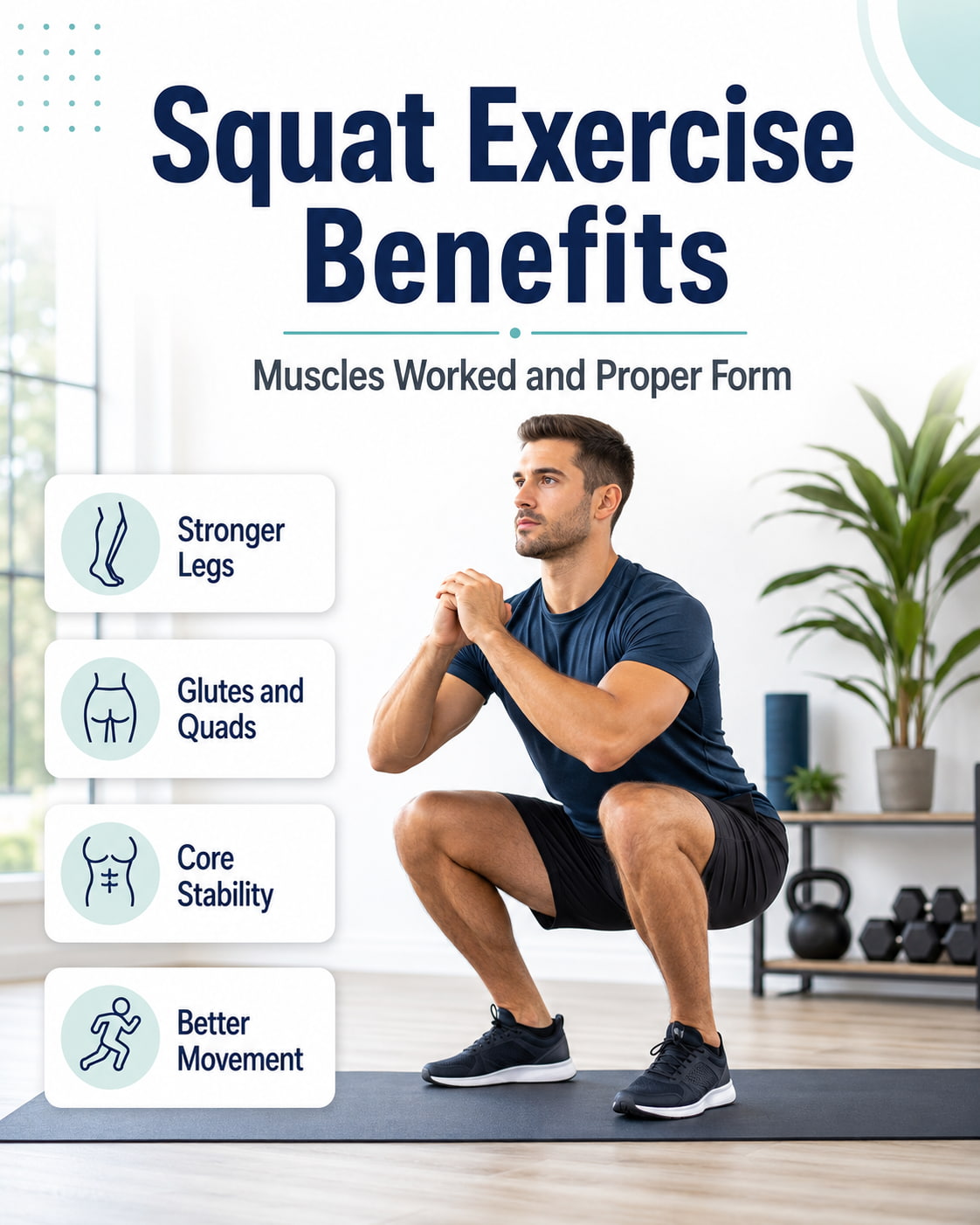
Squat exercise benefits include stronger legs, more powerful glutes, better lower-body control, improved core stability, and a movement pattern that carries over to daily tasks like sitting, standing, lifting, and climbing stairs. The squat is one of the most useful strength exercises because it trains several major muscle groups at the same time while teaching your hips, knees, ankles, and core to work together.
In this guide, you will learn the main squat exercise benefits, which muscles squats work, how to do a squat with proper form, common mistakes to avoid, and how to use squats in a safe, effective workout routine.
What Is a Squat?
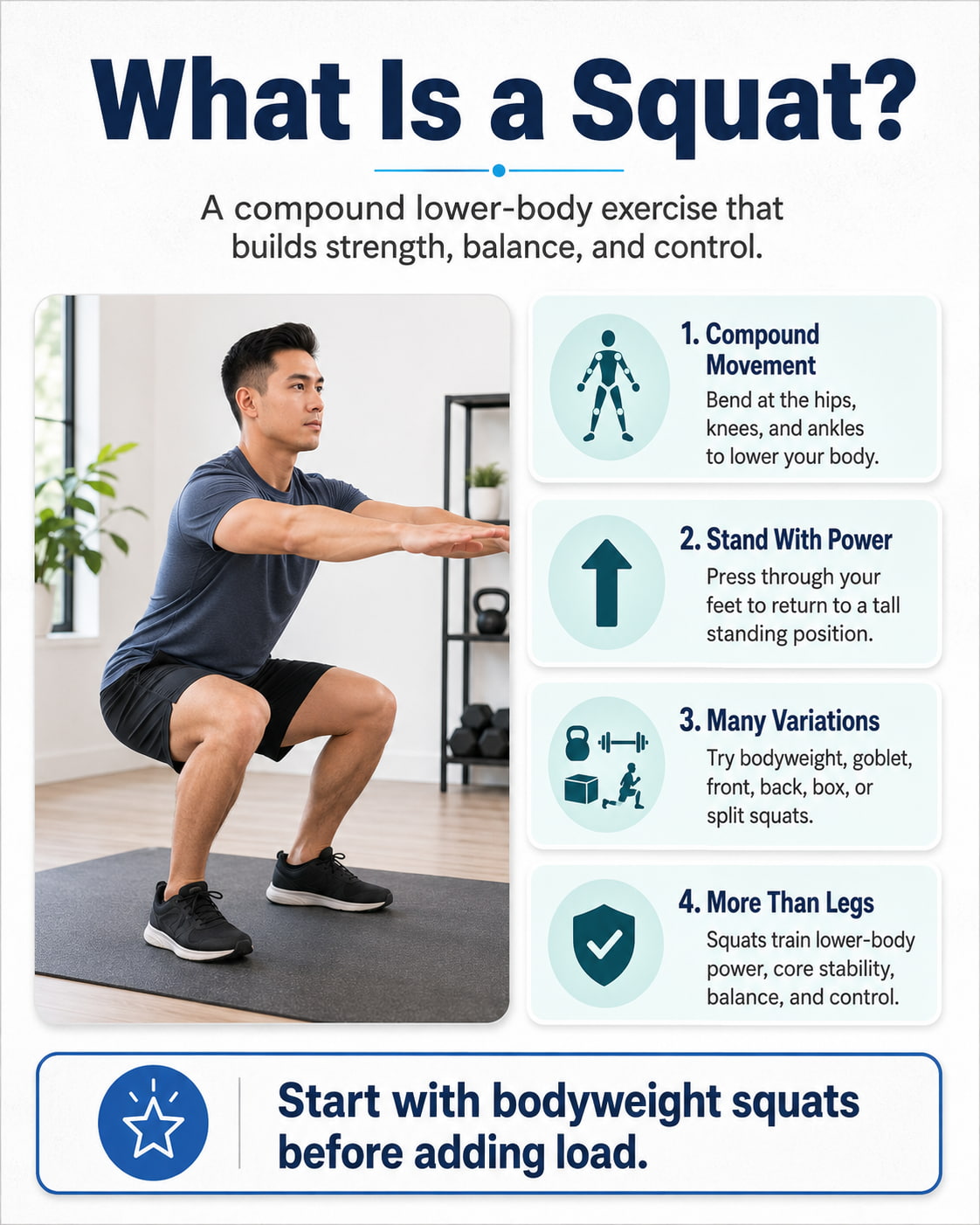
A squat is a compound lower-body exercise where you bend at the hips, knees, and ankles to lower your body, then press through your feet to stand back up.
You can do squats with bodyweight, dumbbells, kettlebells, barbells, resistance bands, or machines. The most basic version is the bodyweight squat, but the movement pattern also appears in goblet squats, front squats, back squats, box squats, split squats, and many other variations.
A squat is not just a “leg exercise.” It is a full-body strength movement that requires lower-body power, trunk stability, balance, and control. That is why squats are used in beginner fitness, athletic training, muscle-building programs, and general strength workouts.
Squat Exercise Benefits
Squats are popular because they are simple, scalable, and effective. You can use them to build strength, improve movement quality, or add structure to a lower-body workout.
1. Builds Lower-Body Strength
One of the biggest squat exercise benefits is stronger legs. Squats train the quadriceps, glutes, hamstrings, adductors, and calves together.
This makes them more efficient than many isolation exercises because one movement challenges several major muscle groups. A well-performed squat can help improve your ability to stand from a chair, climb stairs, walk uphill, lift objects from the floor, and perform athletic movements with better control.
2. Strengthens the Glutes and Quads
Squats are especially useful for training the glutes and quadriceps.
The quadriceps help extend the knees as you stand up. The glutes help extend the hips and drive your body upward. The exact muscle emphasis can change depending on your stance, depth, torso angle, and loading style. For example, a more upright squat often places more demand on the quads, while a squat with more hip hinge can increase hip-extensor demand.
The NASM squat biomechanics guide explains that squats involve coordinated movement at the hips, knees, and ankles, with the glutes and quadriceps playing major roles.
3. Trains a Functional Movement Pattern
Squatting is part of everyday life. You squat when you sit down, stand up, pick something up, lower yourself toward the floor, or get into a low position.
Practicing squats can help you build strength in a pattern your body already uses. That does not mean squats magically fix every movement problem, but they can be a practical way to train better control through the hips, knees, ankles, and trunk.
4. Improves Core Stability
Squats require your core to brace and stabilize your spine while your legs move. Your abdominal muscles, obliques, deep core muscles, and spinal stabilizers all help keep your torso controlled.
This is especially important during loaded squats. If your core relaxes, your torso may collapse forward, your lower back may round, or your ribs may flare. Good squat form teaches you to create tension through your trunk while still moving smoothly.
5. Supports Balance and Coordination
A squat teaches your feet, ankles, knees, hips, and torso to work together. This can improve lower-body coordination and balance, especially for beginners who are learning how to control their bodyweight.
Squats also help you practice foot pressure. Instead of shifting onto your toes or heels, you learn to keep your weight balanced through the whole foot.
6. Builds Muscle With Many Equipment Options
Squats can be adapted to almost any training setup.
You can start with bodyweight squats, then progress to goblet squats, dumbbell squats, kettlebell squats, barbell squats, or machine variations. This makes squats useful for home workouts, gym training, beginner programs, and advanced strength routines.
The American College of Sports Medicine notes that resistance training can improve strength, muscle size, and physical function across many formats, including bodyweight, bands, home-based training, and traditional gym training.
7. Helps Build Workout Efficiency
Because squats train multiple muscle groups at once, they are a time-efficient exercise. Instead of training the quads, glutes, core, and calves separately, squats let you train them together.
This makes squats useful when you want a simple workout that still delivers strong lower-body training value.
Muscles Worked During Squats
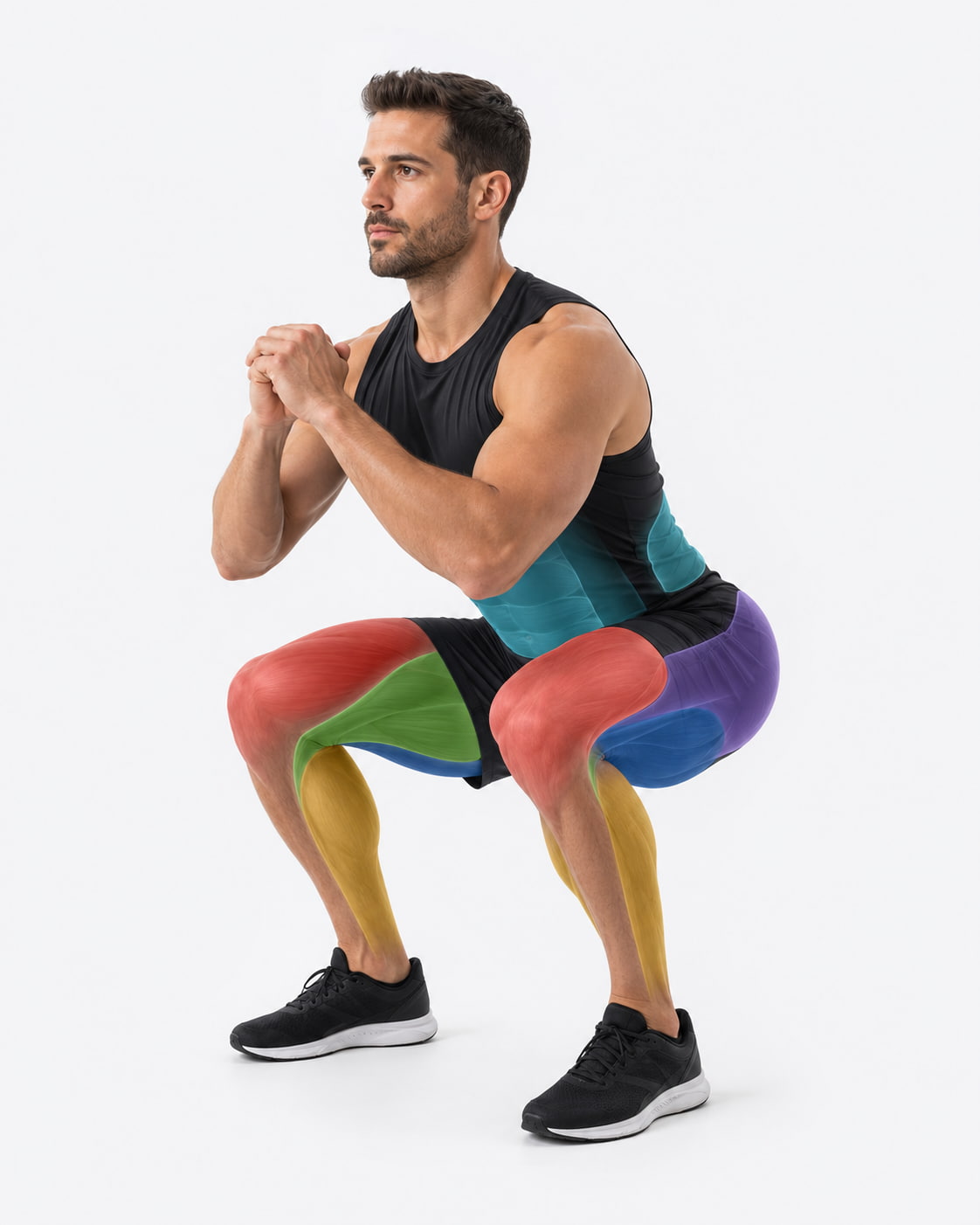
Squats work many muscles, but not all of them do the same job. Some muscles drive the movement, while others stabilize your joints and posture.
Quadriceps
The quadriceps are the large muscles on the front of your thighs. They help straighten your knees as you stand up from the bottom of the squat.
If your goal is stronger thighs, squats can be a valuable part of your routine. More knee bend and a more upright torso often make the quads work harder.
Gluteus Maximus
The gluteus maximus is the large muscle of the buttocks. It helps extend the hips as you rise from the squat.
The deeper you squat with control, the more your glutes often have to contribute. However, depth should always match your mobility, strength, and ability to maintain good form.
Hamstrings
The hamstrings are on the back of your thighs. During squats, they assist with hip extension and help stabilize the knee.
Squats train the hamstrings, but they usually do not load them as directly as hip-hinge exercises such as Romanian deadlifts, hip thrusts, or leg curls. For balanced lower-body training, it is smart to include both squat patterns and hinge patterns.
Adductors
The adductors are the inner-thigh muscles. They help control hip position and assist during the standing phase of the squat.
The adductor magnus can contribute strongly during hip extension, especially in deeper squat positions.
Calves
The calves help stabilize the ankles and control foot pressure during the squat. They are not usually the main target, but they support the movement by helping you stay balanced and grounded.
Core and Lower Back
Your core muscles help brace your trunk. Your lower-back muscles help keep your spine stable and your torso controlled.
The Cleveland Clinic squat guide lists the core, back, glutes, hamstrings, hip flexors, quadriceps, adductors, and calves as muscles involved in squats.
How to Do a Squat With Proper Form
Start with a bodyweight squat before adding weight. Good form matters more than depth, speed, or load.
Bodyweight Squat
Best for: Learning squat form, building beginner lower-body strength, improving control, and warming up before loaded squats.
Muscles worked: Quadriceps, glutes, hamstrings, adductors, calves, core, and spinal stabilizers.
Why it stands out: The bodyweight squat is the easiest place to learn the pattern. It lets you practice stance, depth, balance, and knee tracking without worrying about holding a weight.
Suggested sets and reps: Perform 2–4 sets of 8–15 reps.
Beginners: Start with 2 sets of 8–10 reps. Use a chair, wall, or countertop for support if needed.
Intermediate: Use 3–4 sets of 10–15 controlled reps. Add a pause at the bottom to improve control.
Advanced: Use slow tempo reps, pause reps, jump squats, or loaded variations once bodyweight form is easy.
Rest: Rest 60–90 seconds between sets for general fitness. Rest longer if you are using harder variations.
How to do it:
- Stand with your feet about shoulder-width apart.
- Turn your toes slightly outward if that feels more natural.
- Brace your core and keep your chest tall.
- Bend your hips and knees at the same time.
- Lower your body under control.
- Keep your knees tracking in the same direction as your toes.
- Keep your heels down and your weight balanced through the whole foot.
- Lower as far as you can while keeping a neutral spine and steady control.
- Push through your feet to stand tall.
- Squeeze your glutes at the top without leaning backward.
Common mistakes: Letting the knees collapse inward, lifting the heels, rounding the back, dropping too fast, relaxing the core, or forcing depth you cannot control.
Expert tip: Think “sit between your heels” instead of only “sit back.” This helps you use your hips and knees together instead of turning every squat into a hinge.
Exercise variations: Chair squat, box squat, goblet squat, dumbbell squat, tempo squat, pause squat, jump squat, front squat, and back squat.
Easier variation: Use a chair squat. Sit back to a chair, lightly touch it, then stand back up.
Harder variation: Use a goblet squat with a dumbbell or kettlebell held at chest height.
The Mayo Clinic squat demonstration recommends lowering smoothly through the hips, knees, and ankles while keeping the movement controlled.
Proper Squat Form Cues
Good squat form should feel strong, balanced, and controlled. Use these cues to make each rep cleaner.
Keep Your Feet Stable
Keep your whole foot connected to the floor. Your big toe, little toe, and heel should all stay grounded.
If your heels lift, you may be shifting too far forward, squatting deeper than your current mobility allows, or using a stance that does not fit your body.
Brace Before You Move
Take a breath and gently brace your core before you descend. You do not need to hold your breath aggressively for a basic bodyweight squat, but you should avoid relaxing your midsection.
A stable trunk helps protect your form and keeps your movement smoother.
Let the Knees Track With the Toes
Your knees should generally move in the same direction as your toes. They do not need to stay perfectly still, and they may travel forward naturally.
The bigger issue is control. Avoid letting the knees cave inward or wobble as you descend and stand.
Keep a Neutral Spine
A neutral spine means your back keeps its natural curve without excessive rounding or over-arching.
Do not force your chest straight up if it causes your lower back to arch. Do not collapse your chest so much that your back rounds. Aim for a strong, natural torso angle.
Control the Bottom Position
Do not bounce into the bottom of the squat. Lower smoothly, pause briefly if needed, then stand with control.
A controlled bottom position helps you build strength through your available range of motion.
How Deep Should You Squat?
Squat depth depends on your body, mobility, strength, goals, and current skill level.
A good rule is simple: squat as low as you can while keeping your heels down, spine neutral, knees controlled, and foot pressure balanced. If your form breaks down, you have gone too low for your current ability.
Some people can squat below parallel with excellent control. Others may do better with a box squat, chair squat, or partial range at first. Depth can improve over time as strength, ankle mobility, hip mobility, and control improve.
A 2024 biomechanical review in the International Journal of Sports Physical Therapy notes that squat performance can be modified by stance width, foot rotation, trunk position, tibia position, load placement, and depth. This supports using squat variations based on the individual instead of forcing one universal style.
Common Squat Mistakes and How to Fix Them
Small technique errors are common, especially when you are learning. The goal is not to make every squat look identical. The goal is to keep the movement controlled, strong, and appropriate for your body.
Knees Caving Inward
Knees collapsing inward can reduce control and make the squat feel unstable.
Fix it by using a slightly wider stance, turning your toes out a little, slowing the rep down, and thinking about guiding your knees in the same direction as your toes.
Heels Lifting Off the Floor
If your heels lift, your weight may be shifting too far forward.
Fix it by reducing depth, widening your stance slightly, using a chair or box target, or practicing ankle mobility. You can also try a goblet squat because holding a weight in front of your chest often helps balance.
Rounding the Lower Back
Lower-back rounding often happens when you squat deeper than your current mobility or control allows.
Fix it by stopping your squat slightly higher, bracing your core, and keeping your ribs and pelvis stacked. Do not force depth at the expense of spinal position.
Leaning Too Far Forward
Some forward torso lean is normal, especially depending on your proportions and squat style. The problem is losing control or turning the squat into a good morning.
Fix it by bracing your core, keeping your chest proud, improving ankle mobility, or using a front-loaded variation such as a goblet squat.
Using Too Much Weight Too Soon
Adding weight before you own the movement can lead to poor reps.
Fix it by earning progression. First, make bodyweight squats smooth. Then add a light goblet squat. Increase weight only when your reps stay controlled.
Moving Too Fast
Fast squats are not automatically bad, but beginners often rush and lose position.
Fix it by using a 2–3 second lowering phase. Control teaches strength.
Best Squat Variations
Different squat variations can help you train the same pattern in slightly different ways.
Chair Squat
A chair squat is best for beginners, seniors, or anyone learning the squat pattern. Sit back to a chair, touch it lightly, then stand back up. It builds confidence and teaches control.
Box Squat
A box squat uses a box or bench as a depth target. It is useful when you want consistent depth, better control, or a squat variation that limits range of motion.
Goblet Squat
A goblet squat uses a dumbbell or kettlebell held at chest height. It is one of the best loaded squat variations for beginners because the front-loaded weight often makes balance easier.
Dumbbell Squat
A dumbbell squat can be done with one dumbbell at the chest or two dumbbells at your sides. It is useful for home workouts and lower-body strength training without a barbell.
Front Squat
A front squat places the load in front of the body. It usually encourages a more upright torso and can increase demand on the quads and core.
Back Squat
A back squat places the barbell across the upper back. It is a strong option for building lower-body strength, but it requires good technique, proper setup, and progressive loading.
Split Squat
A split squat trains one leg more than the other while keeping both feet on the floor. It is helpful for single-leg strength, balance, and addressing side-to-side differences.
How Many Squats Should You Do?
The best number of squats depends on your goal, training level, and whether you are using bodyweight or added load.
For general fitness, start with 2–3 sets of 8–12 reps. Use a pace that lets you control every rep.
For strength, use heavier loaded squats for 3–5 sets of 3–6 reps with longer rest.
For muscle building, use 3–4 sets of 6–12 reps with a challenging weight and controlled tempo.
For endurance, use 2–3 sets of 12–20 reps with bodyweight or light load.
The CDC adult physical activity guidance recommends muscle-strengthening activity at least 2 days per week for all major muscle groups.
Sample Squat Workout
Use this routine 2 days per week with at least one rest day between sessions. Keep the effort around 6–8 out of 10. You should finish most sets with 1–3 good reps left in reserve.
Beginner Squat Workout
- Bodyweight squat: 3 sets of 8–12 reps
- Chair squat: 2 sets of 10 reps
- Glute bridge: 3 sets of 10–15 reps
- Step-up: 2 sets of 8–10 reps per side
- Standing calf raise: 2 sets of 12–15 reps
Rest 60–90 seconds between sets.
Progression: Add 1–2 reps per set each week until you can do the top of the rep range with clean form. Then move to a light goblet squat.
Intermediate Squat Workout
- Goblet squat: 4 sets of 8–12 reps
- Split squat: 3 sets of 8–10 reps per side
- Romanian deadlift: 3 sets of 8–12 reps
- Walking lunge: 2 sets of 10 reps per side
- Plank: 3 sets of 20–40 seconds
Rest 90–120 seconds between harder sets.
Progression: Increase the weight slightly when you can complete every set with solid depth, stable knees, and no loss of torso control.
Advanced Squat Workout
- Back squat or front squat: 4–5 sets of 3–6 reps
- Pause squat: 3 sets of 4–6 reps
- Bulgarian split squat: 3 sets of 6–10 reps per side
- Hip hinge variation: 3 sets of 6–10 reps
- Loaded carry or core brace drill: 3 rounds
Rest 2–3 minutes between heavy sets.
Progression: Add weight gradually while keeping bar speed, depth, bracing, and knee tracking consistent.
How Often Should You Do Squats?
Most people can train squats 2–3 times per week, depending on intensity and recovery.
If squats are light and bodyweight-based, you may use them more often as part of warm-ups or movement practice. If squats are heavy, your legs and nervous system need more recovery between sessions.
A simple weekly structure looks like this:
Monday: Squat-focused lower-body workout
Wednesday: Upper-body or light full-body workout
Friday: Squat variation and accessory lower-body workout
You do not need to squat heavy every day to get results. Consistent, well-planned training usually works better than doing too much too soon.
Safety Tips Before Squatting
Warm up before squats. Use 3–5 minutes of light movement such as marching, cycling, brisk walking, or bodyweight mobility drills. Then perform a few easy squat reps before adding weight.
Use a range of motion you can control. More depth is not better if your back rounds, heels lift, knees collapse, or pain appears.
Choose a load that matches your skill. Beginners should master bodyweight squats before adding external weight. When you do add weight, increase gradually.
Stop the exercise and seek professional help if squats cause sharp pain, numbness, dizziness, chest pain, severe shortness of breath, or unusual symptoms.
If you have current knee, hip, ankle, or back concerns, work with a qualified healthcare professional or fitness professional before using heavy squat variations.
FAQs About Squat Exercise Benefits
What are the main benefits of squats?
The main benefits of squats include stronger legs, stronger glutes, improved lower-body control, better core stability, and a functional movement pattern that supports daily tasks like standing, sitting, lifting, and climbing stairs.
What muscles do squats work the most?
Squats mainly work the quadriceps and glutes. They also train the hamstrings, adductors, calves, core, and lower-back stabilizers.
Are squats good for beginners?
Yes, squats can be good for beginners when the movement is scaled properly. Start with bodyweight squats, chair squats, or box squats. Add weight only after your form is controlled and pain-free.
Do squats build glutes?
Yes, squats can help build the glutes, especially when performed through a controlled range of motion with progressive overload. For more complete glute training, combine squats with hip thrusts, glute bridges, Romanian deadlifts, and split squats.
Should my knees go past my toes during squats?
For many people, the knees may naturally move past the toes during a squat. That is not automatically wrong. The key is control: keep your feet stable, knees tracking with the toes, heels grounded, and movement pain-free.
How deep should I squat?
Squat as deep as you can while maintaining good form. Your heels should stay down, your spine should stay neutral, and your knees should stay controlled. If form breaks down, reduce the depth.
Can I do squats every day?
You can practice light bodyweight squats often if they feel good, but hard squat workouts need recovery. For most people, 2–3 focused squat sessions per week is enough.
Conclusion
Squats are one of the best exercises for building practical lower-body strength because they train the quads, glutes, hamstrings, adductors, calves, and core in one movement. The key is not just doing more reps. The key is using proper form, choosing the right variation, progressing gradually, and stopping when your technique breaks down.
Start with a squat version you can control, train it consistently, and build from there.
References
- National Academy of Sports Medicine: Squat Biomechanics and Muscles Used
- Mayo Clinic: Squat Exercise Demonstration
- Cleveland Clinic: Squats Benefits, Proper Form, and Tips
- International Journal of Sports Physical Therapy: A Biomechanical Review of the Squat Exercise
- CDC: Adult Physical Activity Guidelines