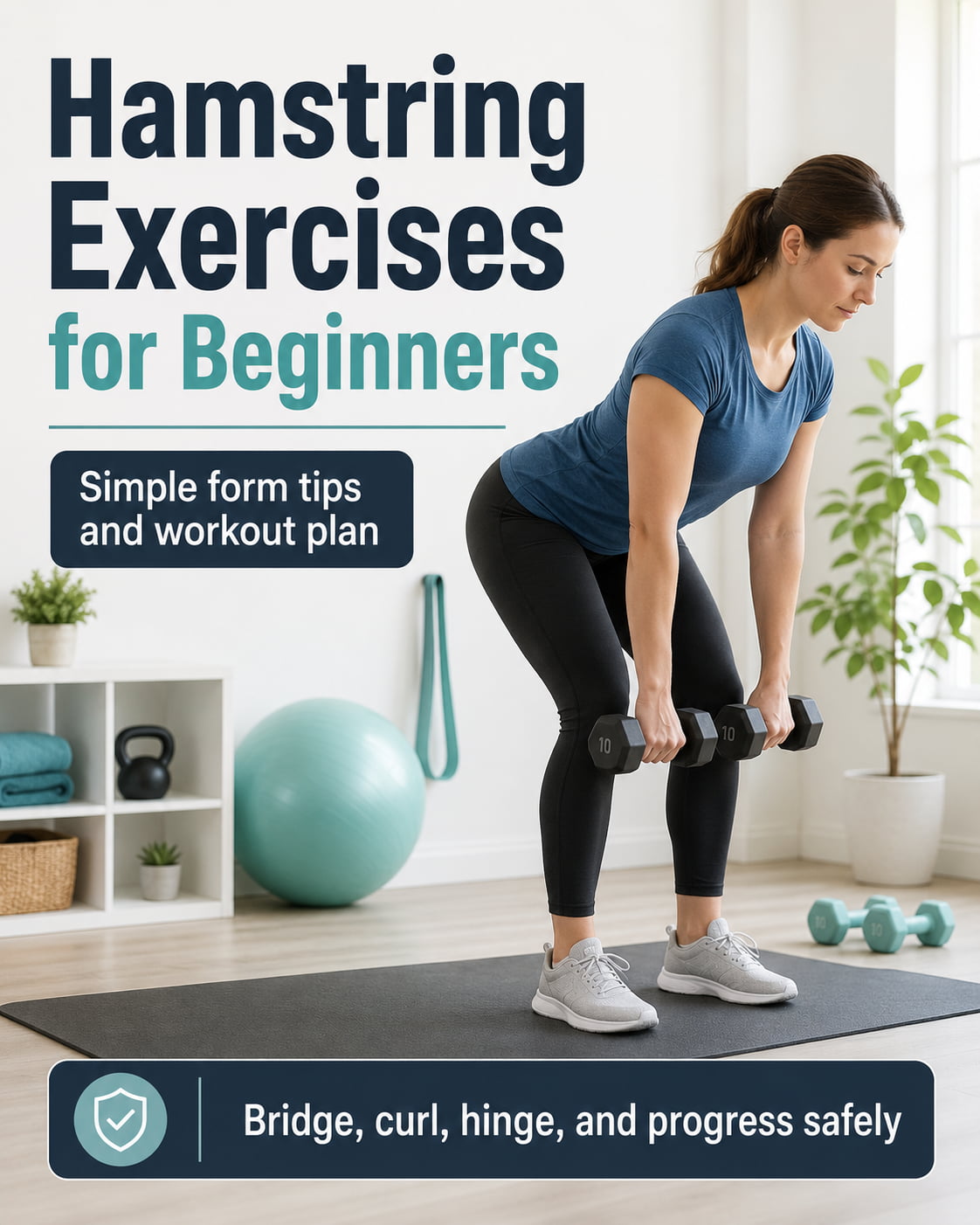
Hamstring exercises for beginners should be simple, controlled, and easy to progress without forcing heavy weights too soon. The best beginner hamstring exercises teach you how to bend your knees, extend your hips, control your posture, and strengthen the back of your thighs safely.
Your hamstrings help with walking, climbing stairs, squatting, hinging, running, and many lower-body movements. In this guide, you will learn the best beginner-friendly hamstring exercises, how to do each one, common mistakes to avoid, and a simple workout plan you can follow at home or in the gym.
What Are the Hamstrings?
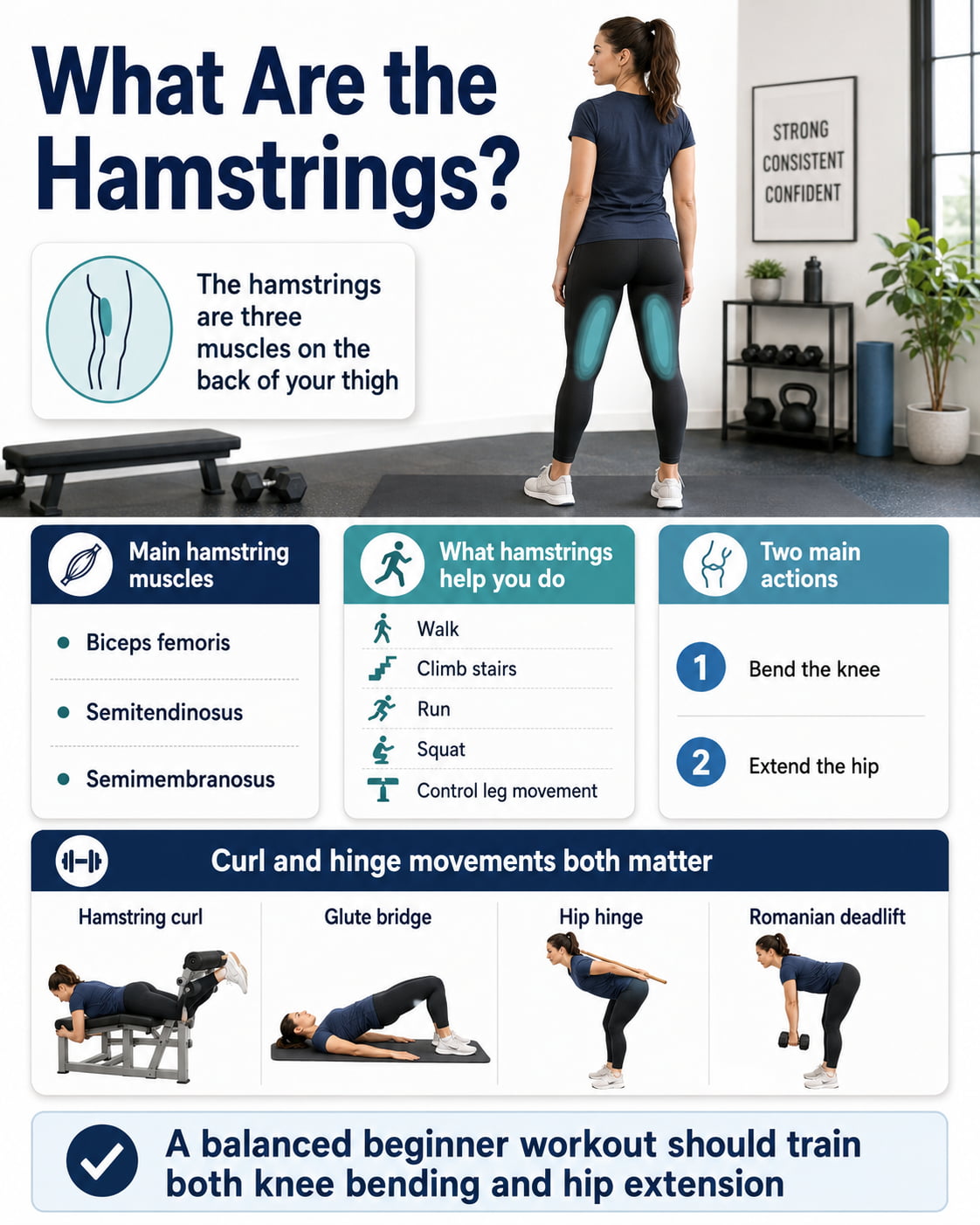
The hamstrings are a group of three muscles on the back of your thigh: the biceps femoris, semitendinosus, and semimembranosus. The Cleveland Clinic explains that these muscles help you walk, climb stairs, run, squat, and perform many other leg movements.
The hamstrings mainly help with two actions.
They bend the knee, such as when you do a hamstring curl.
They extend the hip, such as when you stand up from a hip hinge, glute bridge, or Romanian deadlift.
That is why a good beginner hamstring workout should include both curl-style movements and hinge or bridge-style movements. One type is not enough if your goal is balanced hamstring strength and control.
Why Beginners Should Train Hamstrings
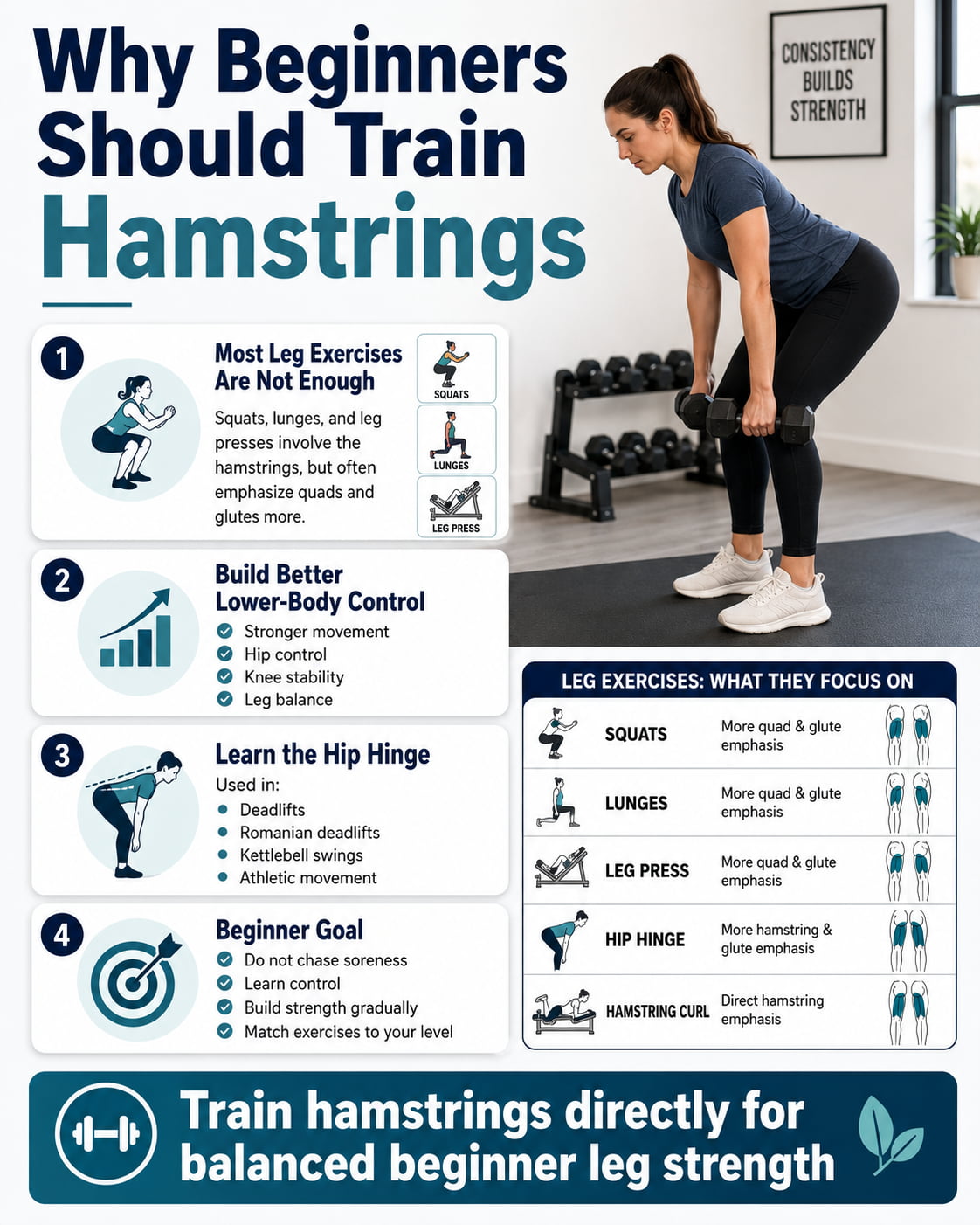
Many beginners train squats, lunges, and leg presses but do not directly train the hamstrings enough. Those exercises can involve the hamstrings, but they often emphasize the quads and glutes more than direct hamstring work.
Training your hamstrings may help support stronger lower-body movement, better hip control, improved knee stability during exercise, and better balance between the front and back of your legs.
Hamstring exercises can also help you learn an important movement pattern: the hip hinge. This is the same basic pattern used in deadlifts, Romanian deadlifts, kettlebell swings, and many athletic movements.
For beginners, the goal is not to chase soreness. The goal is to learn control, build strength gradually, and use exercises that match your current ability.
How to Choose the Best Hamstring Exercises for Beginners
The best hamstring exercises for beginners should be easy to learn, joint-friendly, and simple to adjust. You should be able to feel your hamstrings working without feeling sharp pain in your knees, hips, or lower back.
A smart beginner hamstring plan should include three types of exercises.
The first type is a bridge exercise. Bridges teach hip extension and help you feel the glutes and hamstrings working together.
The second type is a hamstring curl. Curl variations train the hamstrings through knee bending, which is one of their main jobs.
The third type is a hip hinge. Hinge exercises teach you how to move from the hips while keeping your spine controlled.
The Mayo Clinic recommends warming up before strength training, using proper form, and stopping if an exercise causes pain. For beginners, that advice matters more than adding weight quickly.
9 Best Hamstring Exercises for Beginners
The best hamstring exercises for beginners should be simple, controlled, and easy to progress without forcing heavy weights too soon.
These 9 exercises include bridge, curl, and hinge movements so you can train the hamstrings safely at home or in the gym.
1. Glute Bridge
Best for: Learning hip extension, building basic posterior-chain strength, and starting hamstring training with no equipment.
Muscles worked: Hamstrings, glutes, lower back stabilizers, and core.
Equipment needed: Exercise mat only.
Why it stands out: The glute bridge is one of the best first hamstring exercises for beginners because it teaches you to extend the hips without standing, balancing, or holding weights. It is simple, low-impact, and easy to control.
Suggested sets and reps: Start with 2 to 3 sets of 10 to 15 reps.
Beginners: Use both feet flat on the floor and focus on smooth reps. Keep the range of motion comfortable and avoid pushing your hips higher than you can control.
Intermediate: Pause for 2 seconds at the top of each rep or place a light dumbbell across your hips.
Advanced: Progress to single-leg glute bridges or weighted hip thrusts when the basic version feels easy and controlled.
Rest: Rest 45 to 75 seconds between sets.
How to do it:
- Lie on your back with your knees bent and feet flat on the floor.
- Place your feet about hip-width apart.
- Brace your core lightly and keep your ribs down.
- Press through your heels and lift your hips.
- Squeeze your glutes at the top without arching your lower back.
- Lower your hips slowly and repeat.
Common mistakes: Arching the lower back, pushing through the toes, flaring the ribs, lifting too high, or rushing the lowering phase.
Expert tip: Think about pulling your heels gently toward your hips without actually moving your feet. This can help you feel more hamstring tension.
Exercise variations: Glute bridge hold, banded glute bridge, weighted glute bridge, and single-leg glute bridge.
Easier variation: Do a smaller range of motion and pause between reps.
Harder variation: Add a 2 to 3 second pause at the top or use a light dumbbell across your hips.
2. Hamstring Bridge Hold
Best for: Building beginner hamstring awareness and strength without repeated movement.
Muscles worked: Hamstrings, glutes, calves, and core.
Equipment needed: Exercise mat only.
Why it stands out: The hamstring bridge hold is an isometric exercise, which means you hold one position instead of moving through reps. This makes it useful for beginners who need to learn how to feel the hamstrings working before trying harder curl variations.
Suggested sets and reps: Perform 2 to 3 holds of 15 to 30 seconds.
Beginners: Keep your feet closer to your hips and hold for a shorter time.
Intermediate: Move your feet slightly farther away from your hips to increase hamstring demand.
Advanced: Try a single-leg bridge hold after you can hold the two-leg version with steady hips.
Rest: Rest 45 to 75 seconds between holds.
How to do it:
- Lie on your back with your knees bent and feet flat.
- Place your feet slightly farther from your hips than a regular glute bridge.
- Press your heels into the floor.
- Lift your hips until your body forms a straight line from shoulders to knees.
- Hold the position while keeping your hips level.
- Lower slowly when the hold is complete.
Common mistakes: Holding the breath, letting the hips drop, over-arching the back, or placing the feet too far away too soon.
Expert tip: If your calves cramp, bring your feet slightly closer and reduce the hold time.
Exercise variations: Bridge hold, heel-dig bridge, single-leg bridge hold, and elevated bridge hold.
Easier variation: Hold for 10 to 15 seconds with your feet closer to your hips.
Harder variation: Hold for 30 to 45 seconds or progress to a single-leg hold.
3. Hamstring Walkout
Best for: Progressing from bridges to more direct hamstring loading.
Muscles worked: Hamstrings, glutes, calves, and core.
Equipment needed: Exercise mat only.
Why it stands out: The hamstring walkout is a strong beginner-to-intermediate bridge progression. It teaches you to control the hamstrings as your legs move farther away from your body, but it does not require a machine, ball, or weights.
Suggested sets and reps: Start with 2 sets of 4 to 6 controlled walkouts.
Beginners: Take very small steps and stop before your hips drop.
Intermediate: Walk farther out while keeping the hips steady.
Advanced: Slow down the walkout phase or add a longer pause in the extended position.
Rest: Rest 60 to 90 seconds between sets.
How to do it:
- Start in a glute bridge position with your hips lifted.
- Keep your core braced and hips level.
- Take a small step forward with one heel.
- Take a small step forward with the other heel.
- Continue for a few steps while keeping your hips from dropping.
- Walk your heels back toward your body and lower your hips.
Common mistakes: Taking steps that are too big, letting the hips sag, rushing, or turning the movement into a lower-back exercise.
Expert tip: Keep each step small. The exercise should feel controlled, not like you are trying to survive the rep.
Exercise variations: Short-range walkout, full walkout, bridge march, and slider walkout.
Easier variation: Do only one or two steps out before walking back in.
Harder variation: Walk farther out or slow the lowering phase.
4. Standing Hamstring Curl
Best for: Learning knee flexion and training one hamstring at a time.
Muscles worked: Hamstrings and calves, with light glute and core support.
Equipment needed: Body weight, resistance band, cable machine, or ankle weight.
Why it stands out: The standing hamstring curl is simple, beginner-friendly, and easy to do almost anywhere. It helps you train the hamstrings by bending the knee, which is different from bridge and hinge exercises.
Suggested sets and reps: Perform 2 to 3 sets of 10 to 15 reps per leg.
Beginners: Start with body weight and use a wall or chair for balance.
Intermediate: Add a light resistance band or ankle weight.
Advanced: Use a cable machine and control both the lifting and lowering phases.
Rest: Rest 30 to 60 seconds between legs or sets.
How to do it:
- Stand tall and hold a wall, chair, or stable surface for support.
- Shift your weight onto one leg.
- Bend the opposite knee and bring your heel toward your glutes.
- Pause briefly at the top.
- Lower your foot slowly without swinging.
- Complete all reps, then switch sides.
Common mistakes: Swinging the leg, leaning forward, letting the knee drift far in front of the body, or using momentum.
Expert tip: Keep your thighs close together. Only the lower leg should move.
Exercise variations: Bodyweight standing curl, banded standing curl, cable standing curl, and ankle-weight curl.
Easier variation: Use body weight only and hold a support for balance.
Harder variation: Add a slow 3-second lowering phase.
5. Prone Band Hamstring Curl
Best for: Home hamstring training without a machine.
Muscles worked: Hamstrings, calves, and core stabilizers.
Equipment needed: Resistance band and anchor point.
Why it stands out: The prone band hamstring curl gives beginners a direct hamstring curl option at home. Because you are lying down, balance is not a major issue, and you can focus on smooth knee bending.
Suggested sets and reps: Perform 2 to 3 sets of 10 to 15 reps.
Beginners: Use a light band and move through a comfortable range.
Intermediate: Use a slightly stronger band or slow down the lowering phase.
Advanced: Add a pause when your heel is closest to your glutes.
Rest: Rest 45 to 75 seconds between sets.
How to do it:
- Anchor a resistance band low behind you.
- Lie face down on a mat and attach the band around one or both ankles.
- Keep your hips down and core lightly braced.
- Bend your knees and curl your heels toward your glutes.
- Pause briefly at the top.
- Lower slowly until your legs are nearly straight.
Common mistakes: Lifting the hips off the floor, arching the lower back, using a band that is too heavy, or snapping the legs back down.
Expert tip: Control the lowering phase. That is where many beginners lose tension.
Exercise variations: Single-leg prone band curl, double-leg band curl, cable prone curl, and machine lying curl.
Easier variation: Use a lighter band or shorten the range of motion.
Harder variation: Use a stronger band or add a 2-second squeeze at the top.
6. Lying Machine Hamstring Curl
Best for: Gym beginners who want a guided hamstring curl exercise.
Muscles worked: Hamstrings and calves.
Equipment needed: Lying hamstring curl machine.
Why it stands out: The lying machine hamstring curl is useful because the machine guides the path of movement. This can make it easier for beginners to isolate the hamstrings without worrying about balance or complex technique.
Suggested sets and reps: Perform 2 to 3 sets of 10 to 15 reps.
Beginners: Start light and focus on machine setup before adding weight.
Intermediate: Add weight gradually once you can control every rep.
Advanced: Use slower eccentrics, pauses, or single-leg reps if the machine allows.
Rest: Rest 60 to 90 seconds between sets.
How to do it:
- Adjust the machine so your knees line up with the machine’s pivot point.
- Place the pad just above the back of your ankles.
- Lie face down and hold the handles.
- Brace your core and keep your hips down.
- Curl the pad toward your glutes.
- Lower the weight slowly until your knees are almost straight.
Common mistakes: Using too much weight, lifting the hips, arching the lower back, bouncing the pad, or letting the weight stack slam down.
Expert tip: If your hips lift off the pad, the weight is probably too heavy or your setup needs adjusting.
Exercise variations: Seated hamstring curl, single-leg lying curl, slow eccentric curl, and partial-range curl.
Easier variation: Use a lighter weight and stop just before your form breaks.
Harder variation: Add a 2-second pause at the top or lower for 3 seconds.
7. Stability Ball Hamstring Curl
Best for: Building hamstring strength, hip stability, and core control.
Muscles worked: Hamstrings, glutes, calves, and core.
Equipment needed: Stability ball.
Why it stands out: The stability ball hamstring curl combines a bridge with a curl. It challenges the hamstrings while also teaching you to keep your hips lifted and your trunk controlled.
Suggested sets and reps: Start with 2 sets of 6 to 10 reps.
Beginners: Begin with the bridge hold on the ball before adding the curl.
Intermediate: Perform full reps with both legs.
Advanced: Slow the lowering phase or try single-leg eccentrics.
Rest: Rest 60 to 90 seconds between sets.
How to do it:
- Lie on your back with your heels on top of a stability ball.
- Place your arms on the floor for support.
- Brace your core and lift your hips.
- Bend your knees and roll the ball toward your hips.
- Keep your hips lifted as the ball rolls in.
- Slowly roll the ball back out and repeat.
Common mistakes: Letting the hips drop, rushing the curl, using a ball that is too large or unstable, or losing control at the end range.
Expert tip: Master the ball bridge first. If you cannot hold your hips steady, the curl will be too difficult.
Exercise variations: Stability ball bridge, stability ball curl, slow eccentric curl, and single-leg stability ball curl.
Easier variation: Hold the bridge position with your heels on the ball.
Harder variation: Lower the ball away from you for 3 to 4 seconds on each rep.
8. Dumbbell Romanian Deadlift
Best for: Learning the hip hinge and strengthening the hamstrings through hip extension.
Muscles worked: Hamstrings, glutes, spinal erectors, adductors, and core.
Equipment needed: Dumbbells.
Why it stands out: The dumbbell Romanian deadlift is one of the most useful hamstring exercises for beginners once you understand the hip hinge. ACE Fitness describes the Romanian deadlift as a posterior-chain exercise that trains the hamstrings, glutes, erector spinae, and adductors.
Suggested sets and reps: Perform 2 to 3 sets of 8 to 12 reps.
Beginners: Start with very light dumbbells or practice the movement without weight.
Intermediate: Increase the load gradually while keeping the same controlled hinge pattern.
Advanced: Use heavier dumbbells, a barbell, or a slower tempo.
Rest: Rest 60 to 90 seconds between sets.
How to do it:
- Stand tall with your feet about hip-width apart.
- Hold a dumbbell in each hand in front of your thighs.
- Soften your knees slightly.
- Push your hips back as the dumbbells slide down your thighs.
- Stop when you feel a strong stretch in your hamstrings without rounding your back.
- Drive your hips forward to stand tall again.
Common mistakes: Squatting instead of hinging, rounding the back, locking the knees, letting the weights drift away from the body, or going lower than your mobility allows.
Expert tip: Imagine closing a car door with your hips. Your hips move back first, and your knees only bend slightly.
Exercise variations: Bodyweight hip hinge, kettlebell Romanian deadlift, barbell Romanian deadlift, and single-leg Romanian deadlift.
Easier variation: Practice a bodyweight hip hinge with your hands on your hips.
Harder variation: Use a 3-second lowering phase or increase the dumbbell weight gradually.
9. Dumbbell Deadlift From Blocks
Best for: Learning a beginner-friendly deadlift pattern with a shorter range of motion.
Muscles worked: Hamstrings, glutes, quads, back muscles, grip, and core.
Equipment needed: Dumbbells and low blocks, steps, or sturdy risers.
Why it stands out: A dumbbell deadlift from blocks is easier for many beginners than pulling weights from the floor. The raised starting position reduces the range of motion, which can help you keep a better spine position while learning how to push through the floor and stand tall.
Suggested sets and reps: Perform 2 to 3 sets of 8 to 10 reps.
Beginners: Start with light dumbbells and raise the weights higher if you cannot keep your back neutral.
Intermediate: Lower the starting height slightly or add weight.
Advanced: Progress to dumbbell deadlifts from the floor or trap-bar deadlifts.
Rest: Rest 60 to 90 seconds between sets.
How to do it:
- Place two dumbbells on sturdy blocks or low risers.
- Stand with your feet about hip-width to shoulder-width apart.
- Push your hips back and bend your knees slightly.
- Grip the dumbbells while keeping your chest lifted and back neutral.
- Press through your feet and stand tall.
- Lower the dumbbells back to the blocks under control.
Common mistakes: Rounding the back, jerking the weights off the blocks, letting the knees cave inward, or turning the lift into a squat with no hip hinge.
Expert tip: Keep the dumbbells close to your legs. If the weights drift forward, your lower back may take over.
Exercise variations: Kettlebell deadlift from blocks, trap-bar deadlift, dumbbell deadlift from the floor, and rack pull.
Easier variation: Raise the dumbbells higher and use lighter weights.
Harder variation: Lower the starting height or add weight when your form stays solid.
Simple Hamstring Workout Plan for Beginners
Use this beginner hamstring workout two days per week. Leave at least one day between sessions so your muscles can recover.
Before starting, warm up for 5 to 10 minutes with easy cardio, bodyweight squats, hip hinges, or light marching. The Mayo Clinic recommends warming up before weight training and using controlled movement rather than rushing reps.
Beginner Hamstring Workout
Glute Bridge: 2 sets of 12 reps.
Standing Hamstring Curl: 2 sets of 10 to 12 reps per leg.
Dumbbell Romanian Deadlift: 2 sets of 8 to 10 reps.
Hamstring Bridge Hold: 2 holds of 15 to 25 seconds.
Stability Ball Hamstring Curl: 1 to 2 sets of 6 to 10 reps, optional.
Rest 45 to 90 seconds between sets. Use an effort level where you finish each set with about 2 to 3 good reps left in reserve. You should feel challenged, but your form should not break down.
How Often Should Beginners Do Hamstring Exercises?
Most beginners can train hamstrings 2 times per week as part of a lower-body or full-body routine. ACSM’s 2026 resistance training update emphasizes that consistency matters more than complexity and that training major muscle groups at least twice per week is a practical starting point.
A simple weekly setup can look like this.
Monday: Full-body workout with hamstring exercises.
Wednesday: Upper body, walking, mobility, or rest.
Friday: Lower-body workout with hamstring exercises.
You do not need to train hamstrings every day. More is not always better. Beginners usually progress faster when they practice good technique, recover well, and add difficulty gradually.
How to Progress Hamstring Exercises Safely
Start by improving control before adding more resistance. A beginner should earn progress through better form, not heavier weight alone.
First, add reps. For example, move from 10 reps to 12 or 15 reps.
Next, add a set. For example, move from 2 sets to 3 sets.
Then, add resistance. Use a heavier dumbbell, stronger band, or slightly heavier machine setting.
Finally, progress to harder variations. Examples include single-leg bridges, slower Romanian deadlifts, or more controlled stability ball curls.
A good rule is to make an exercise harder only when you can complete all sets with steady breathing, controlled lowering, and no sharp pain.
Common Mistakes Beginners Should Avoid
The first mistake is using too much weight too soon. Hamstring exercises often require control and range of motion. Heavy weight can make beginners round their backs, rush reps, or lose tension.
The second mistake is turning Romanian deadlifts into squats. In a Romanian deadlift, the hips move back and the knees bend only slightly. If your knees bend too much, your quads may take over.
The third mistake is letting the lower back do the work. During bridges, curls, and hinges, keep your ribs down and brace your core lightly.
The fourth mistake is skipping curl movements. Hinges are useful, but hamstrings also need knee-flexion work. Add some type of hamstring curl to your plan.
The fifth mistake is training through pain. Muscle effort and mild fatigue are normal. Sharp pain, numbness, dizziness, chest pain, or unusual symptoms are not. Stop the exercise and seek professional help if those symptoms occur.
Best Hamstring Exercises for Beginners at Home
The best home options are glute bridges, hamstring bridge holds, hamstring walkouts, standing hamstring curls, prone band curls, and stability ball curls.
If you have no equipment, start with glute bridges, bridge holds, and walkouts.
If you have a resistance band, add prone band hamstring curls.
If you have a stability ball, add stability ball hamstring curls once your bridge control improves.
If you have dumbbells, add Romanian deadlifts and dumbbell deadlifts from blocks.
Best Hamstring Exercises for Beginners at the Gym
The best gym options are lying machine hamstring curls, seated hamstring curls, dumbbell Romanian deadlifts, dumbbell deadlifts from blocks, cable standing curls, and hip thrust variations.
For a true beginner, start with the machine curl and a light dumbbell hinge. Machines can help you learn the target muscle, while dumbbells help you build real movement strength.
FAQ
What is the best hamstring exercise for beginners?
The glute bridge is one of the best hamstring exercises for beginners because it is simple, low-impact, and easy to control. After that, add a curl variation such as a standing hamstring curl, prone band curl, or lying machine curl.
Can beginners train hamstrings at home?
Yes. Beginners can train hamstrings at home with glute bridges, bridge holds, hamstring walkouts, standing curls, resistance band curls, and stability ball curls. Dumbbells can also be used for Romanian deadlifts and raised deadlifts.
Are Romanian deadlifts good for beginners?
Romanian deadlifts can be good for beginners once they learn the hip hinge. Start with bodyweight practice or very light dumbbells. Keep your spine neutral, push your hips back, and stop before your back rounds.
Do squats train the hamstrings enough?
Squats can involve the hamstrings, but they are usually not enough as your only hamstring exercise. Beginners should include curl and hinge movements to train the hamstrings more directly.
Should beginners stretch tight hamstrings or strengthen them?
Many beginners benefit from both gentle mobility work and strengthening. If your hamstrings feel tight, do not force deep stretches. Add controlled exercises like bridges, light Romanian deadlifts, and hamstring curls while staying within a comfortable range of motion.
How do I know when to make hamstring exercises harder?
Make an exercise harder when you can complete all sets with smooth reps, steady breathing, no sharp pain, and no loss of posture. Add reps first, then sets, then resistance.
Conclusion
Hamstring exercises for beginners should start with control, not heavy weight. Glute bridges, hamstring curls, bridge holds, walkouts, stability ball curls, and light hinge exercises can help you build a strong foundation.
Start with two hamstring-focused sessions per week, use slow and controlled reps, and progress only when your form stays solid. Over time, these beginner exercises can prepare you for stronger deadlifts, more advanced curls, and better lower-body training overall.
This content is for informational purposes only and is not a substitute for professional medical advice.