Cossack Squat Alternatives help you train lateral leg strength, hip mobility, and single-leg control without forcing the full-depth position of a traditional Cossack squat. These exercises are useful if your hips feel tight, your balance is not ready yet, your ankles limit your depth, or you want similar lower-body benefits with more control.
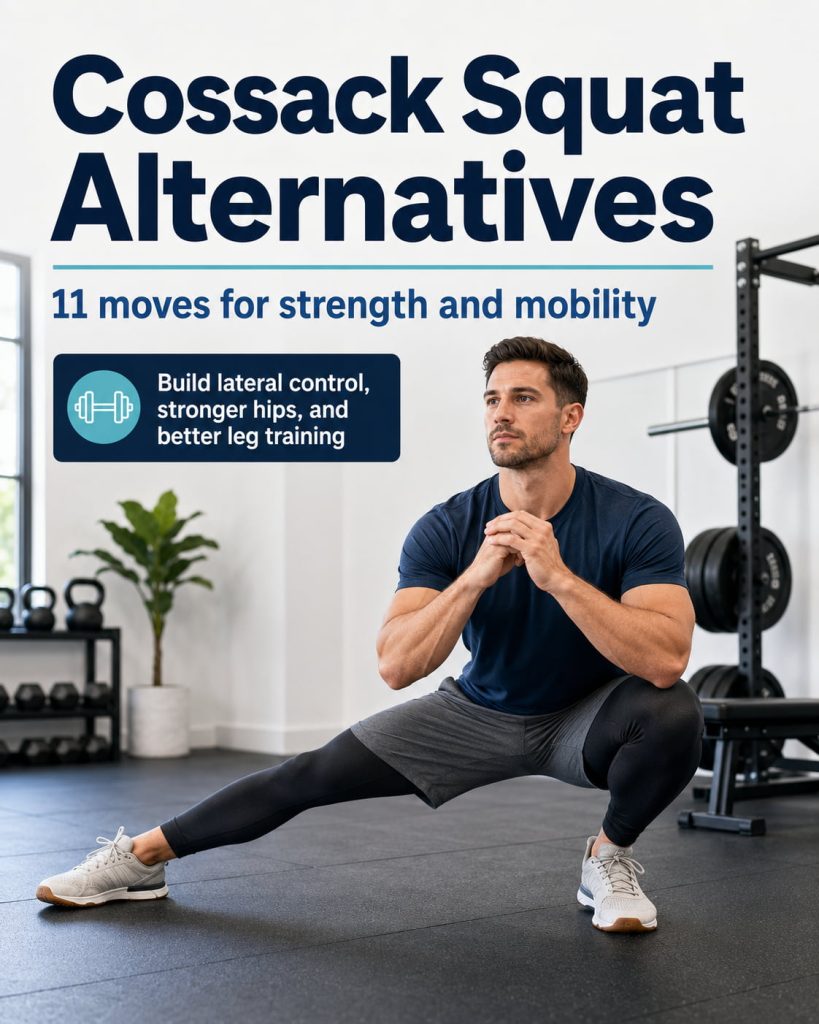
A Cossack squat is demanding because it combines a deep side squat, an extended opposite leg, hip mobility, ankle mobility, adductor flexibility, and balance. The alternatives below help you build those pieces separately so you can train safely, get stronger, and progress over time.
You will learn the best Cossack squat substitutes, how to perform each one, which muscles they work, common mistakes to avoid, and how to use them in a lower-body workout.
What Makes a Good Cossack Squat Alternative?
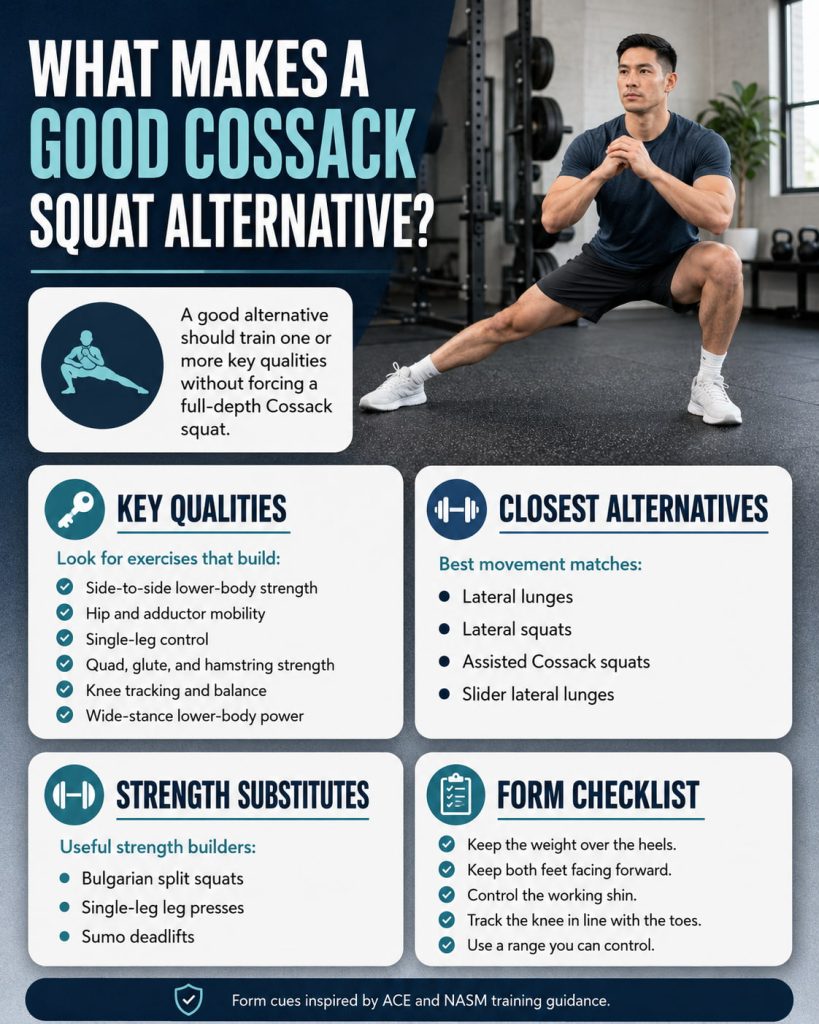
A good Cossack squat alternative should train at least one of these qualities:
- Side-to-side lower-body strength
- Hip and adductor mobility
- Single-leg control
- Quad, glute, and hamstring strength
- Knee tracking and balance
- Wide-stance lower-body power
The closest alternatives are lateral movements such as lateral lunges, lateral squats, assisted Cossack squats, and slider lateral lunges. Strength-focused substitutes like Bulgarian split squats, single-leg leg presses, and sumo deadlifts do not copy the exact movement, but they help build the leg strength needed for better control.
For lateral lunge mechanics, the American Council on Exercise emphasizes keeping the weight over the heels, both feet facing forward, the working shin controlled, and the knee aligned over the second toe. NASM also notes that multiplanar lunges should prioritize hip-knee-ankle alignment and begin in ranges where the lifter feels confident.
Quick Comparison: Best Cossack Squat Alternatives
| Exercise | Best For | Equipment | Difficulty | Main Training Focus |
|---|---|---|---|---|
| TRX-Assisted Cossack Squat | Closest beginner regression | TRX or support | Beginner–Intermediate | Lateral squat pattern |
| Lateral Lunge | Best overall alternative | Bodyweight or weights | Beginner–Intermediate | Side-to-side leg strength |
| Lateral Squat | No-step Cossack substitute | Bodyweight or weights | Beginner | Hip control and adductors |
| Slider Lateral Lunge | Controlled range of motion | Slider/towel | Intermediate | Adductors and glutes |
| Lateral Box Step-Up | Hip stability | Box/step | Beginner–Intermediate | Glutes and balance |
| Bulgarian Split Squat | Single-leg strength | Bench/box, optional weights | Intermediate | Quads and glutes |
| Single-Leg Leg Press | Machine-based strength | Leg press machine | Beginner–Intermediate | Quads and glutes |
| Goblet Sumo Squat | Wide-stance strength | Dumbbell/kettlebell | Beginner–Intermediate | Inner thighs and glutes |
| Sumo Deadlift | Heavy wide-stance strength | Barbell/kettlebell | Intermediate–Advanced | Glutes, hamstrings, adductors |
| Side-Lying Hip Abduction | Glute medius support | Optional mini band | Beginner | Hip stability |
| 90/90 Hip Switch | Hip mobility | Bodyweight | Beginner–Intermediate | Hip rotation and control |
11 Best Cossack Squat Alternatives for Strength and Mobility
These 11 Cossack squat alternatives help you build lateral leg strength, hip mobility, balance, and lower-body control without forcing a deep side squat.
Use them to train your quads, glutes, adductors, hamstrings, and core while choosing the right variation for your current strength and mobility level.
1. TRX-Assisted Cossack Squat
Best for: Learning the Cossack squat pattern with support
Muscles worked: Adductors, quads, glutes, hamstrings, calves, core
Equipment needed: TRX, rings, squat rack, doorframe, or sturdy support
Why It Stands Out
The TRX-assisted Cossack squat is one of the closest Cossack squat alternatives because it keeps the same side-to-side pattern. The support gives you balance help, lets you control depth, and reduces the fear of getting stuck at the bottom.
This is a smart option if you want to eventually perform full Cossack squats but are not ready for the mobility or balance demand yet. TRX describes the suspension trainer as a useful aid for squat mechanics, especially for beginners or people working on range of motion.
Suggested Sets, Reps, and Rest
Do 2–4 sets of 5–8 reps per side. Rest 60–90 seconds between sets.
Use a slow tempo: 3 seconds down, brief pause, controlled return.
How to Do It
- Stand with your feet wider than shoulder-width apart.
- Hold the TRX handles or a sturdy support in front of your body.
- Shift your weight toward one leg.
- Bend that knee and sit your hips back.
- Keep the opposite leg long and lightly rotate the toes up if comfortable.
- Lower only as far as you can control.
- Drive through the working foot to return to the middle.
- Repeat on the other side.
Common Mistakes
- Pulling too hard with the arms instead of using the legs
- Letting the working heel lift
- Dropping into the bottom position too fast
- Forcing depth before the hips are ready
- Letting the working knee collapse inward
Coaching Cue
Use the straps for balance, not as an elevator. Your legs should still do the work.
Variations, Progressions, and Regressions
Regression: Use a higher hand support and shorten the range of motion.
Progression: Use less arm assistance or hold a light kettlebell as a counterbalance.
Advanced progression: Pause for 2–3 seconds at the bottom of each rep.
How to Use It in a Workout
Use this early in your session after a warm-up. It works well as a movement-prep drill before squats, deadlifts, lunges, or athletic lower-body training.
2. Lateral Lunge
Best for: The best overall Cossack squat alternative
Muscles worked: Quads, glutes, adductors, hamstrings, calves, core
Equipment needed: Bodyweight, dumbbells, kettlebell, or medicine ball
Why It Stands Out
The lateral lunge trains the same side-to-side movement pattern but does not require the same deep squat position as a Cossack squat. It is easier to learn, easier to load, and easier to adjust for different mobility levels.
The lateral lunge is especially useful for athletes, lifters, and beginners who want stronger hips and legs in the frontal plane instead of only training forward-and-back movements.
Suggested Sets, Reps, and Rest
Do 2–4 sets of 6–12 reps per side. Rest 60–120 seconds.
Use bodyweight first. Add load when you can keep the foot flat, knee controlled, and torso steady.
How to Do It
- Stand tall with your feet together.
- Step one leg out to the side.
- Plant the foot flat with the toes pointing mostly forward.
- Push your hips back toward the stepping leg.
- Keep the opposite leg straight or nearly straight.
- Lower until you feel controlled tension in the hips and inner thigh.
- Push through the floor to return to standing.
- Repeat all reps on one side or alternate sides.
Common Mistakes
- Taking too narrow of a step
- Letting the knee cave inward
- Shifting onto the toes
- Rounding the back to reach lower
- Bouncing out of the bottom position
Coaching Cue
Step wide, sit back, and keep the working foot heavy on the floor.
Variations, Progressions, and Regressions
Regression: Do a smaller side step and reduce depth.
Progression: Hold a dumbbell or kettlebell in the goblet position.
Advanced progression: Use a front-racked kettlebell or dumbbells at your sides.
How to Use It in a Workout
Use lateral lunges as a main accessory exercise after squats or deadlifts. They also work well in warm-ups with bodyweight only.
3. Lateral Squat
Best for: Practicing side-to-side control without stepping
Muscles worked: Quads, glutes, adductors, hamstrings, core
Equipment needed: Bodyweight, dumbbell, kettlebell, or plate
Why It Stands Out
The lateral squat is like a simplified Cossack squat. Instead of stepping into each rep, you start in a wide stance and shift from side to side. This makes it easier to control your foot position, balance, and range of motion.
It is a strong choice for beginners who feel awkward stepping into lateral lunges or for lifters who want a smooth warm-up before loaded lower-body training.
Suggested Sets, Reps, and Rest
Do 2–3 sets of 6–10 reps per side. Rest 45–90 seconds.
Move slowly and avoid rushing the transition from side to side.
How to Do It
- Stand with your feet wider than shoulder-width apart.
- Keep both feet flat and pointed mostly forward or slightly out.
- Shift your hips toward one side.
- Bend the working knee while the other leg stays long.
- Lower to a comfortable depth.
- Push the floor away and return to the middle.
- Repeat on the other side.
Common Mistakes
- Turning the movement into a regular squat
- Letting both knees bend equally
- Collapsing the arch of the working foot
- Twisting the torso
- Forcing the non-working leg completely straight too soon
Coaching Cue
Move your hips sideways first, then bend the knee.
Variations, Progressions, and Regressions
Regression: Hold a rack, post, or suspension trainer.
Progression: Hold a goblet weight for counterbalance.
Advanced progression: Add a slow eccentric and a pause at the bottom.
How to Use It in a Workout
Use lateral squats as a warm-up, mobility-strength drill, or light accessory exercise. They are not usually the best heavy strength movement, but they are excellent for control.
4. Slider Lateral Lunge
Best for: Controlled adductor loading
Muscles worked: Adductors, glutes, quads, hamstrings, core
Equipment needed: Slider, towel, furniture mover, or sock on a smooth floor
Why It Stands Out
The slider lateral lunge is one of the best Cossack squat alternatives for controlling range of motion. The sliding leg can move only as far as your hips and inner thigh allow, which makes the exercise easier to scale.
It also keeps constant tension on the working leg because you have to control both the lowering and return phases.
Suggested Sets, Reps, and Rest
Do 2–3 sets of 8–12 reps per side. Rest 60–90 seconds.
Use a slow tempo and keep 2–3 reps in reserve.
How to Do It
- Stand tall with one foot on a slider or towel.
- Keep the non-sliding foot planted.
- Slide one leg out to the side as you bend the planted leg.
- Sit the hips back and keep the chest controlled.
- Stop before your pelvis tucks under or your back rounds.
- Pull the sliding foot back in using the inner thigh and planted leg.
- Finish tall before starting the next rep.
Common Mistakes
- Sliding too far too soon
- Letting the planted knee cave inward
- Losing tension at the bottom
- Pulling back with momentum
- Rounding the lower back
Coaching Cue
Push the slider out slowly, then drag it back with control.
Variations, Progressions, and Regressions
Regression: Use a shorter slide and hold a support.
Progression: Hold a goblet weight.
Advanced progression: Pause for 2 seconds at your deepest controlled point.
How to Use It in a Workout
Use this as an accessory exercise after your main squat, deadlift, or lunge pattern. It is especially useful on days when you want inner-thigh and hip control without heavy loading.
5. Lateral Box Step-Up
Best for: Hip stability and single-leg control
Muscles worked: Glutes, quads, hamstrings, calves, gluteus medius, core
Equipment needed: Step, box, bench, or sturdy platform
Why It Stands Out
The lateral box step-up trains one leg at a time while challenging the hip to stay level. It does not require deep hip or ankle mobility, so it is a good choice if Cossack squats feel too aggressive.
It also helps train the gluteus medius, a key hip stabilizer. A Physical Therapy Journal study found that lateral step-ups produced greater gluteus medius activation than forward step-ups in several phases of the movement.
Suggested Sets, Reps, and Rest
Do 2–4 sets of 6–10 reps per side. Rest 60–120 seconds.
Start with a low box. Increase box height only when your knee, hip, and foot stay aligned.
How to Do It
- Stand sideways next to a box or step.
- Place the closest foot fully on the box.
- Keep your ribs down and torso tall.
- Push through the foot on the box.
- Step up until the working leg is straight but not locked hard.
- Control the lowering phase.
- Tap the floor lightly and repeat.
Common Mistakes
- Pushing off too much from the bottom leg
- Letting the working knee cave inward
- Using a box that is too high
- Dropping down without control
- Leaning too far to the side
Coaching Cue
Make the top leg do the work; the floor leg is only a kickstand.
Variations, Progressions, and Regressions
Regression: Use a lower step and hold onto a wall or rack.
Progression: Hold dumbbells at your sides.
Advanced progression: Add a slow 3-second lower.
How to Use It in a Workout
Use lateral step-ups as a lower-body accessory or glute-focused movement. They pair well with squats, Romanian deadlifts, hip thrusts, and lateral lunges.
6. Bulgarian Split Squat
Best for: Building serious single-leg strength
Muscles worked: Quads, glutes, hamstrings, adductors, calves, core
Equipment needed: Bench or box, optional dumbbells or kettlebells
Why It Stands Out
The Bulgarian split squat is not a lateral movement, but it is one of the best strength-building alternatives if your main limitation is leg strength. It trains one leg through a large range of motion while challenging balance, hip control, and knee tracking.
The American Council on Exercise describes the Bulgarian split squat with the rear foot elevated on a knee-height bench or box and a dumbbell held in front of the chest.
Suggested Sets, Reps, and Rest
Do 3–4 sets of 6–10 reps per side. Rest 90–150 seconds.
Use an effort level around RPE 7–9, leaving 1–3 reps in reserve.
How to Do It
- Stand a few feet in front of a bench.
- Place the top of one foot on the bench behind you.
- Keep most of your weight on the front leg.
- Brace your core and lower under control.
- Let the front knee bend while tracking over the toes.
- Stop before your form breaks or your rear knee hits the floor hard.
- Drive through the front foot to stand.
Common Mistakes
- Standing too close to the bench
- Pushing too much through the back foot
- Letting the front knee collapse inward
- Losing balance because the stance is too narrow
- Rushing the bottom position
Coaching Cue
Think “front leg squat,” not “back leg push.”
Variations, Progressions, and Regressions
Regression: Do a regular split squat with both feet on the floor.
Progression: Hold dumbbells at your sides.
Advanced progression: Use a front-rack position or add a 1–2 second pause.
How to Use It in a Workout
Use Bulgarian split squats as a main single-leg strength exercise. They work best after your heaviest bilateral lift or as the main movement in a dumbbell-only lower-body session.
7. Single-Leg Leg Press
Best for: Building leg strength with less balance demand
Muscles worked: Quads, glutes, hamstrings, adductors, calves
Equipment needed: Leg press machine
Why It Stands Out
The single-leg leg press is useful when balance limits your ability to train hard. It lets you load one leg at a time while keeping your torso supported.
This is not a direct Cossack squat replacement because it does not train lateral movement. However, it can help build the quad and glute strength needed for stronger lunges, squats, and assisted Cossack squat progressions.
The American Council on Exercise includes a single-leg press variation and advises controlling the movement, keeping the heels in contact with the plate, and avoiding knee lockout.
Suggested Sets, Reps, and Rest
Do 3–4 sets of 8–12 reps per side. Rest 90–150 seconds.
Use a controlled tempo and stop each set with 1–3 reps in reserve.
How to Do It
- Sit in the leg press with your back supported.
- Place one foot on the platform around hip-width position.
- Keep the heel flat on the plate.
- Unlock the safety handles.
- Lower the platform under control.
- Stop before your hips tuck or your lower back lifts.
- Press through the midfoot and heel.
- Finish without locking the knee aggressively.
Common Mistakes
- Using too much weight
- Letting the knee cave inward
- Lowering so far the pelvis rolls off the pad
- Bouncing out of the bottom
- Locking the knee hard at the top
Coaching Cue
Control the bottom position like you are preparing for a clean single-leg squat.
Variations, Progressions, and Regressions
Regression: Use both legs or reduce range of motion.
Progression: Add reps before adding weight.
Advanced progression: Use a 3-second lowering phase.
How to Use It in a Workout
Use the single-leg leg press after free-weight squats, deadlifts, or lunges. It is also a good option on lower-body days when you want to train hard without challenging balance too much.
8. Goblet Sumo Squat
Best for: Wide-stance strength and inner-thigh emphasis
Muscles worked: Quads, glutes, adductors, hamstrings, core
Equipment needed: Dumbbell or kettlebell
Why It Stands Out
The goblet sumo squat trains a wide stance and helps strengthen the inner thighs and glutes. It does not move side to side like a Cossack squat, but it is useful for building strength in a wider hip position.
The American Council on Exercise notes that the dumbbell sumo squat is a squat variation that can emphasize the inner thighs while still training the legs.
Suggested Sets, Reps, and Rest
Do 3–4 sets of 8–15 reps. Rest 60–120 seconds.
Use moderate load and smooth reps.
How to Do It
- Stand wider than shoulder-width.
- Turn your toes slightly out.
- Hold a dumbbell or kettlebell at chest height.
- Brace your core and keep your chest tall.
- Bend the knees and sit down between your hips.
- Keep the knees tracking in line with the toes.
- Push through the whole foot to stand.
Common Mistakes
- Turning the toes too far out
- Letting the arches collapse
- Letting the knees fall inward
- Rounding the back
- Going deeper than you can control
Coaching Cue
Open the knees in the same direction as the toes while keeping your whole foot planted.
Variations, Progressions, and Regressions
Regression: Do a bodyweight sumo squat.
Progression: Hold a heavier dumbbell or kettlebell.
Advanced progression: Add a pause at the bottom or use a slow eccentric.
How to Use It in a Workout
Use goblet sumo squats as a main beginner lift, a hypertrophy exercise, or a wide-stance accessory after your heavier lower-body work.
9. Sumo Deadlift
Best for: Heavy wide-stance posterior-chain strength
Muscles worked: Glutes, hamstrings, adductors, quads, spinal erectors, traps, core
Equipment needed: Barbell, kettlebell, or dumbbell
Why It Stands Out
The sumo deadlift is not a direct Cossack squat substitute, but it builds strength in a wide stance. It is especially useful for training the hips, glutes, hamstrings, and adductors with heavier loads.
Use this when your goal is strength, not mobility. Pair it with lateral lunges or assisted Cossack squats if you still want to train side-to-side movement.
Suggested Sets, Reps, and Rest
Do 3–5 sets of 3–6 reps for strength or 3–4 sets of 6–10 reps for muscle-building. Rest 2–3 minutes for heavier sets.
Keep 1–3 reps in reserve on most working sets.
How to Do It
- Stand with a wide stance and toes slightly turned out.
- Position the weight over the midfoot.
- Push the hips back and bend the knees.
- Grip the bar or weight with arms straight.
- Brace your core and keep your chest proud.
- Push the floor away to stand.
- Finish tall without leaning back.
- Lower under control.
Common Mistakes
- Squatting too low before the pull
- Letting the knees collapse inward
- Starting with the bar too far away
- Rounding the back
- Leaning back at lockout
Coaching Cue
Push the floor apart and stand tall through the hips.
Variations, Progressions, and Regressions
Regression: Use a kettlebell sumo deadlift from blocks.
Progression: Use a barbell and gradually add load.
Advanced progression: Use paused reps just below the knee.
How to Use It in a Workout
Use sumo deadlifts as a main strength lift. Then add a true lateral movement, such as lateral lunges or slider lateral lunges, to keep the workout closer to the Cossack squat’s training effect.
10. Side-Lying Hip Abduction
Best for: Glute medius strength and hip stability
Muscles worked: Gluteus medius, gluteus minimus, tensor fasciae latae, core stabilizers
Equipment needed: Bodyweight or mini band
Why It Stands Out
Side-lying hip abduction does not replace the Cossack squat by itself. Instead, it supports the movement by strengthening the outer hip muscles that help control the pelvis and knee during single-leg and lateral exercises.
The American Council on Exercise teaches side-lying hip abduction with the hips and shoulders stacked and warns against rolling the hips forward or backward. A study indexed in PubMed Central also found side-lying hip abduction strongly activated the gluteus medius with relatively low activation of the tensor fascia latae and anterior hip flexors.
Suggested Sets, Reps, and Rest
Do 2–3 sets of 12–20 reps per side. Rest 30–60 seconds.
Use a smooth lift, brief squeeze, and slow lower.
How to Do It
- Lie on your side with your bottom leg bent.
- Keep the top leg straight.
- Stack your hips and shoulders.
- Brace lightly through your midsection.
- Lift the top leg without rolling your pelvis.
- Pause briefly at the top.
- Lower slowly.
- Repeat before switching sides.
Common Mistakes
- Rolling the hips backward
- Lifting the leg too high
- Turning the toes upward too much
- Rushing the reps
- Using momentum instead of control
Coaching Cue
Keep your belt buckle facing forward and lift from the side of the hip.
Variations, Progressions, and Regressions
Regression: Use a smaller range of motion.
Progression: Add a mini band above the knees or ankles.
Advanced progression: Add a 2-second hold at the top of each rep.
How to Use It in a Workout
Use this as a warm-up activation drill or accessory exercise. It pairs well with lateral lunges, step-ups, split squats, and assisted Cossack squats.
11. 90/90 Hip Switch
Best for: Hip rotation and mobility control
Muscles worked: Hip rotators, glutes, adductors, deep hip stabilizers, core
Equipment needed: Bodyweight
Why It Stands Out
The 90/90 hip switch helps improve active hip rotation, which can support deeper squat and lateral squat positions. It is not a strength replacement for the Cossack squat, but it can be a useful mobility drill before lateral lower-body training.
Cleveland Clinic describes the 90/90 stretch as a hip mobility drill that places both legs at roughly 90-degree angles and can help maintain flexibility in the hips.
Suggested Sets, Reps, and Rest
Do 1–3 sets of 5–8 slow reps per side. Rest as needed.
Use this before strength training, not as a max-effort exercise.
How to Do It
- Sit on the floor with one leg in front and one leg behind you.
- Bend both knees to about 90 degrees.
- Sit tall and keep your hands on the floor if needed.
- Rotate both knees to switch sides.
- Move slowly and keep the torso controlled.
- Pause on each side.
- Repeat for smooth, controlled reps.
Common Mistakes
- Forcing the knees to the floor
- Moving too quickly
- Rounding the back excessively
- Treating discomfort as a goal
- Holding your breath
Coaching Cue
Move through the hips, not by yanking your knees around.
Variations, Progressions, and Regressions
Regression: Keep your hands behind you for support.
Progression: Sit taller with less hand support.
Advanced progression: Add a hip lift between switches.
How to Use It in a Workout
Use 90/90 hip switches during your warm-up before lateral lunges, assisted Cossack squats, sumo squats, or lower-body mobility work.
How to Choose the Best Cossack Squat Alternatives for Your Goal
Not every alternative does the same job. Choose based on what limits you most.
If Your Hips Feel Tight
Start with:
- TRX-assisted Cossack squat
- Lateral squat
- 90/90 hip switch
- Slider lateral lunge
Keep the range of motion controlled. Do not force depth.
If Your Balance Is the Problem
Start with:
- TRX-assisted Cossack squat
- Lateral box step-up with support
- Single-leg leg press
- Goblet sumo squat
Build control before adding load.
If You Want More Strength
Start with:
- Bulgarian split squat
- Single-leg leg press
- Goblet sumo squat
- Sumo deadlift
Use progressive overload, but keep form clean.
If You Want the Closest Cossack Squat Substitute
Start with:
- TRX-assisted Cossack squat
- Lateral lunge
- Lateral squat
- Slider lateral lunge
These keep the side-to-side training effect that makes Cossack squats unique.
Common Mistakes With Cossack Squat Alternatives
Forcing Too Much Depth
More depth is not better if your heel lifts, knee collapses, or back rounds. Use the deepest position you can control.
Letting the Knee Cave Inward
Keep the working knee tracking in line with the toes. This is especially important during lateral lunges, lateral squats, step-ups, and split squats.
Loading Too Heavy Too Soon
Lateral exercises often feel awkward at first. Add range of motion and control before adding weight.
Turning Every Alternative Into a Regular Squat
Cossack squat alternatives should train side-to-side control when possible. Make sure the hips shift laterally during lateral lunges and lateral squats.
Ignoring the Non-Working Leg
In Cossack-style movements, the extended leg matters. Keep it active, controlled, and positioned comfortably.
Sample Workout Using Cossack Squat Alternatives
Use this routine 1–2 times per week as a lower-body accessory workout or as part of leg day.
Beginner Option
| Exercise | Sets | Reps | Rest |
|---|---|---|---|
| 90/90 Hip Switch | 2 | 5 per side | 30 sec |
| TRX-Assisted Cossack Squat | 3 | 5 per side | 60 sec |
| Lateral Lunge | 3 | 8 per side | 75 sec |
| Lateral Box Step-Up | 2 | 8 per side | 75 sec |
| Side-Lying Hip Abduction | 2 | 15 per side | 45 sec |
Effort level: Keep 2–4 reps in reserve.
Progression: Add reps first, then depth, then light load.
Intermediate Strength and Mobility Option
| Exercise | Sets | Reps | Rest |
|---|---|---|---|
| 90/90 Hip Switch | 2 | 6 per side | 30 sec |
| Goblet Lateral Lunge | 4 | 8 per side | 90 sec |
| Bulgarian Split Squat | 3 | 8 per side | 120 sec |
| Slider Lateral Lunge | 3 | 10 per side | 75 sec |
| Side-Lying Hip Abduction | 2 | 15–20 per side | 45 sec |
Effort level: Work around RPE 7–8.
Progression: Add load when all reps look smooth and controlled.
Advanced Gym Option
| Exercise | Sets | Reps | Rest |
|---|---|---|---|
| Assisted or Loaded Cossack Squat Variation | 3 | 5–6 per side | 90 sec |
| Sumo Deadlift | 4 | 4–6 | 2–3 min |
| Lateral Box Step-Up | 3 | 8 per side | 90 sec |
| Slider Lateral Lunge | 3 | 10 per side | 75 sec |
| Side-Lying Hip Abduction | 2 | 20 per side | 45 sec |
Effort level: Keep heavy lifts at 1–3 reps in reserve.
Progression: Increase load gradually while maintaining range, balance, and knee control.
The American College of Sports Medicine supports matching load and volume to the goal, with heavier loads for strength, higher weekly volume for hypertrophy, and bodyweight or elastic-band options still being useful training tools.
Programming Tips for Better Results
For mobility-focused work, use 1–3 sets of 5–10 slow reps per side.
For strength-focused alternatives, use 3–5 sets of 3–8 reps.
For muscle-building accessories, use 2–4 sets of 8–15 reps.
For glute medius or hip stability work, use 2–3 sets of 12–20 controlled reps.
Progress in this order:
- Better control
- More range of motion
- More reps
- More load
- Harder variations
Do not rush to load lateral exercises heavily. A clean bodyweight lateral lunge is more useful than a heavy one with poor knee tracking and limited control.
FAQ
What is the best Cossack squat alternative?
The lateral lunge is the best overall Cossack squat alternative for most people because it trains side-to-side leg strength with less mobility demand. If you want the closest regression, use a TRX-assisted Cossack squat.
Are lateral lunges the same as Cossack squats?
No. A lateral lunge usually starts from a standing position with a side step, while a Cossack squat is usually performed from a wide stance with a deeper shift to one side. Both train lateral lower-body control, but the Cossack squat usually requires more hip, ankle, and adductor mobility.
What muscles do Cossack squat alternatives work?
Most Cossack squat alternatives train the quads, glutes, adductors, hamstrings, calves, and core. Lateral movements also challenge the hips and inner thighs more than many standard squat variations.
What should I do if Cossack squats bother my knees?
Reduce the range of motion and try lateral squats, assisted Cossack squats, lateral box step-ups, or single-leg leg presses. Focus on keeping the foot flat and the knee tracking in line with the toes. Stop if you feel sharp pain or unusual symptoms.
Can beginners do Cossack squat alternatives?
Yes. Beginners can start with supported lateral squats, TRX-assisted Cossack squats, bodyweight lateral lunges, low lateral step-ups, and 90/90 hip switches. The key is to use a range of motion you can control.
How often should I train Cossack squat alternatives?
Most people can train them 1–3 times per week depending on intensity. Use lighter mobility drills more often and heavier strength variations less often.
Can Cossack squat alternatives help me get a full Cossack squat?
They may help you build the strength, balance, and mobility needed for the full movement. The best path is to combine assisted Cossack squats, lateral lunges, lateral squats, adductor mobility work, and gradual range-of-motion progressions.
Conclusion
Cossack squat alternatives let you train the same key qualities—lateral strength, hip control, adductor mobility, balance, and lower-body power—without forcing a position your body is not ready to own yet.
For the closest replacement, start with TRX-assisted Cossack squats, lateral lunges, lateral squats, and slider lateral lunges. For strength, add Bulgarian split squats, single-leg leg presses, goblet sumo squats, and sumo deadlifts. For support work, use lateral step-ups, side-lying hip abductions, and 90/90 hip switches.
Train the range you can control, progress slowly, and make every rep look strong before adding load.
Stop exercising and seek professional help if you feel sharp pain, numbness, dizziness, chest pain, or unusual symptoms during any exercise.
This content is for informational purposes only and is not a substitute for professional medical advice.
References
- American Council on Exercise: Side Lunge
- NASM: The Lunge — An Effective Lower Body Training Exercise
- Physical Therapy Journal: Gluteus Medius Activation During Step-Up Exercises
- American Council on Exercise: Glute Medius Exercises for Strength and Stability
- Cleveland Clinic: The 90/90 Stretch and Hip Mobility