FUPA exercises for men can strengthen the lower core, hips, glutes, and full body, but they cannot burn fat from only one specific area. The best approach is to use lower-core exercises, full-body strength training, cardio, and consistent healthy habits together.
In this guide, you will learn the best FUPA exercises for men, which muscles they work, how to perform them correctly, common mistakes to avoid, and how to build a simple workout plan for beginner, intermediate, and advanced training levels.
What Are FUPA Exercises for Men?
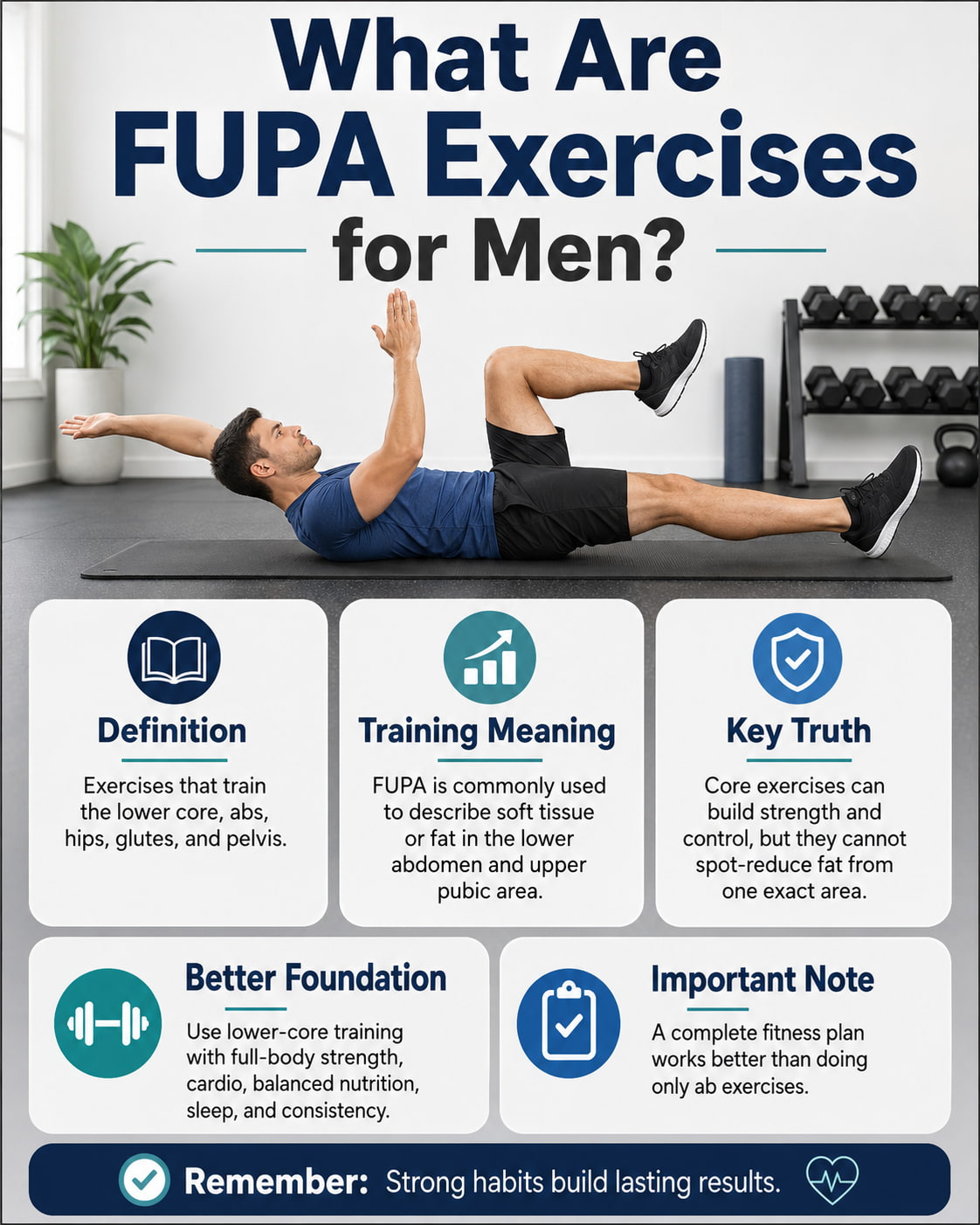
FUPA is commonly used to describe soft tissue or fat in the lower abdomen and upper pubic area. In training terms, “FUPA exercises” usually means lower-core exercises that target the abs, deep core, hips, and pelvis.
The important point is this: you cannot choose one exact fat-loss area by doing exercises for that body part. Core exercises can build strength and improve control around the lower trunk, but visible body composition changes usually require a full plan that includes strength training, aerobic activity, balanced nutrition, sleep, and consistency.
The American Council on Exercise explains that spot reduction is a common fitness myth. The CDC adult physical activity guidelines recommend weekly aerobic activity and muscle-strengthening work for adults, which is a better foundation than doing only ab exercises.
What FUPA Exercises for Men Can and Cannot Do
FUPA exercises can help you train the muscles underneath the lower belly area. They can also improve trunk control, posture, hip stability, and workout performance.
They cannot directly “melt” fat from the lower belly or pubic area by themselves.
A smart plan should include:
- Lower-core exercises for strength and control
- Full-body resistance training to build muscle
- Cardio or conditioning to support fitness
- Progressive overload over time
- Recovery and consistent habits
If your goal is fat loss, think bigger than crunches. Train the whole body, move regularly, and use core exercises to build a stronger base.
Muscles Worked by FUPA Exercises for Men
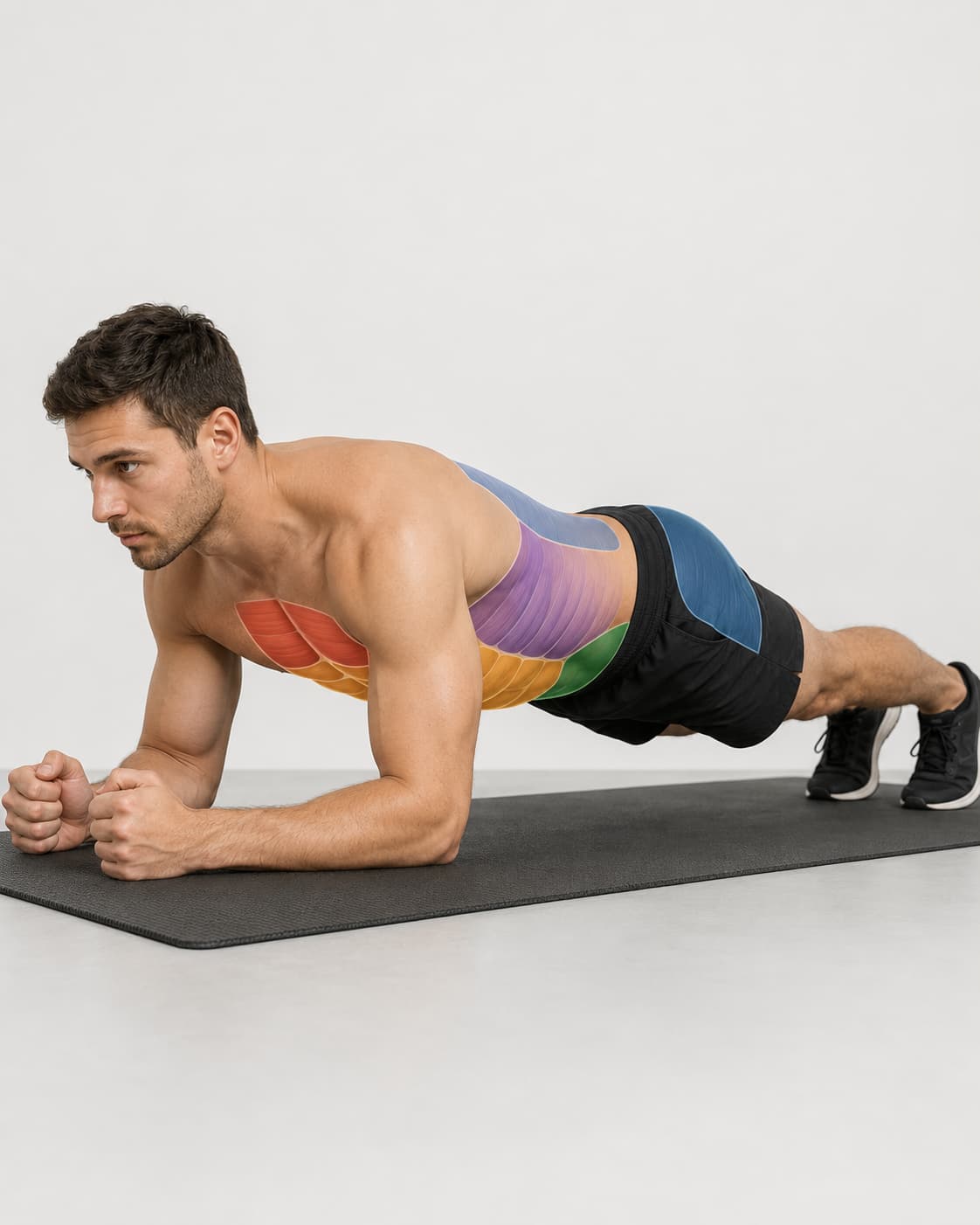
FUPA exercises for men mainly train the core and hip muscles that control the pelvis, spine, and trunk.
Rectus Abdominis
The rectus abdominis is the front abdominal muscle often associated with “six-pack” development. It helps flex the trunk and control pelvic position during exercises such as reverse crunches and knee raises.
Transverse Abdominis
The transverse abdominis is a deep core muscle that helps brace the trunk. It is especially important during dead bugs, planks, bird dogs, carries, and slow leg-lowering movements.
Obliques
The internal and external obliques help rotate, resist rotation, and stabilize the trunk. Side planks, suitcase carries, and mountain climbers train the obliques strongly.
Hip Flexors
The hip flexors lift the thighs toward the torso. They assist during knee raises, mountain climbers, and some reverse crunch variations. Good form matters because overusing the hip flexors can make the lower back arch.
Glutes
The glutes help control the pelvis and hips. Glute bridges, squats, carries, and lunges support better lower-body strength and trunk position.
Erector Spinae
The erector spinae muscles run along the spine and help maintain posture. They should stabilize the spine during core exercises, not take over because of poor form.
The Cleveland Clinic explains that the abdominal muscles and back muscles work together as part of the core to help keep the body stable and balanced.
7 Best FUPA Exercises for Men
The exercises below are selected because they train the lower core, deep core, hips, glutes, and full-body stability. Start with the exercises that match your current fitness level and progress only when you can control your form.
1. Dead Bug
Best for: Beginners who need to learn lower-core control without straining the lower back.
Muscles worked: Transverse abdominis, rectus abdominis, obliques, hip flexors, and deep spinal stabilizers.
Equipment needed: No equipment.
Why it stands out: The dead bug teaches you how to keep your ribs down, brace your core, and move your arms and legs without letting your lower back arch. It is one of the best starting points before harder lower-ab exercises.
Suggested sets and reps: Do 2–4 sets of 6–10 reps per side.
Beginners: Keep both knees bent and move only one heel at a time toward the floor.
Intermediate: Extend the opposite arm and leg slowly while keeping your lower back controlled.
Advanced: Hold a light medicine ball or resistance band while performing slow dead bug reps.
Rest: Rest 30–60 seconds between sets.
How to do it:
- Lie on your back with your knees bent and hips stacked over your body.
- Raise your arms toward the ceiling.
- Brace your core gently and keep your ribs down.
- Slowly lower one arm and the opposite leg away from your body.
- Stop before your lower back arches.
- Return to the starting position and repeat on the other side.
Common mistakes: Arching the lower back, rushing the movement, holding the breath, or reaching the leg too low before you have control.
Expert tip: Move slower than you think you need to. The goal is control, not speed.
Exercise variations: Heel taps, bent-knee dead bug, banded dead bug, and wall-press dead bug.
Easier variation: Dead bug heel taps.
Harder variation: Straight-leg dead bug with a slow 3-second lowering phase.
2. Forearm Plank
Best for: Building basic anti-extension core strength.
Muscles worked: Rectus abdominis, transverse abdominis, obliques, glutes, shoulders, and quads.
Equipment needed: No equipment, but an exercise mat can help.
Why it stands out: The forearm plank teaches your core to resist sagging through the lower back. This skill carries over to push-ups, carries, squats, deadlifts, and athletic movement.
Suggested sets and reps: Do 2–4 sets of 20–45 seconds.
Beginners: Start with a knee plank or incline plank.
Intermediate: Use a standard forearm plank with strong glute tension.
Advanced: Try long-lever planks, weighted planks, or plank shoulder taps.
Rest: Rest 45–75 seconds between sets.
How to do it:
- Set your elbows under your shoulders.
- Step your feet back and form a straight line from head to heels.
- Brace your abs and squeeze your glutes.
- Keep your ribs down and avoid letting your hips sag.
- Hold the position while breathing steadily.
Common mistakes: Letting the hips drop, lifting the hips too high, shrugging the shoulders, or holding the breath.
Expert tip: Think about pulling your elbows lightly toward your toes without actually moving them. This helps create stronger core tension.
Exercise variations: High plank, knee plank, incline plank, long-lever plank, and weighted plank.
Easier variation: Incline plank with your hands on a bench.
Harder variation: Long-lever forearm plank.
3. Side Plank
Best for: Training the obliques and side-body stability.
Muscles worked: Obliques, transverse abdominis, glute medius, shoulders, and deep core muscles.
Equipment needed: No equipment.
Why it stands out: Side planks train your core to resist side bending. This is useful for posture, loaded carries, running mechanics, and general trunk stability.
Suggested sets and reps: Do 2–3 sets of 15–40 seconds per side.
Beginners: Start with a bent-knee side plank.
Intermediate: Use a full side plank with feet stacked or staggered.
Advanced: Add hip dips, top-leg raises, or a light dumbbell reach.
Rest: Rest 30–60 seconds between sides.
How to do it:
- Lie on your side with your elbow under your shoulder.
- Stack or stagger your feet.
- Brace your core and lift your hips off the floor.
- Keep your head, ribs, hips, knees, and ankles aligned.
- Hold while breathing under control.
- Lower slowly and switch sides.
Common mistakes: Letting the hips roll backward, collapsing into the shoulder, twisting the torso, or pushing the head forward.
Expert tip: Imagine your body is between two panes of glass. Keep your chest and hips facing forward.
Exercise variations: Knee side plank, full side plank, side plank hip dip, side plank row, and Copenhagen side plank.
Easier variation: Bent-knee side plank.
Harder variation: Side plank with top-leg raise.
4. Bird Dog
Best for: Core stability, low-back control, and coordination.
Muscles worked: Transverse abdominis, erector spinae, glutes, shoulders, and deep spinal stabilizers.
Equipment needed: No equipment.
Why it stands out: Bird dogs teach you to move your arms and legs while keeping the pelvis and lower back stable. The ACE bird dog guide describes it as an exercise for training lumbar spine stabilization during upper- and lower-body movement.
Suggested sets and reps: Do 2–3 sets of 6–10 reps per side.
Beginners: Extend only one leg at a time.
Intermediate: Extend the opposite arm and leg together.
Advanced: Add a pause, resistance band, or controlled elbow-to-knee return.
Rest: Rest 30–60 seconds between sets.
How to do it:
- Start on your hands and knees.
- Place your hands under your shoulders and knees under your hips.
- Brace your core without rounding your back.
- Extend one arm and the opposite leg.
- Keep your hips level and avoid twisting.
- Pause briefly, then return with control.
- Repeat on the opposite side.
Common mistakes: Rotating the hips, lifting the leg too high, arching the lower back, or rushing through reps.
Expert tip: Keep your belt line facing the floor. That makes the exercise a true core stability drill.
Exercise variations: Leg-only bird dog, full bird dog, bird dog row, and banded bird dog.
Easier variation: Quadruped leg extension.
Harder variation: Bird dog with a 3-second pause.
5. Glute Bridge
Best for: Strengthening the glutes and improving pelvic control.
Muscles worked: Gluteus maximus, hamstrings, core, and hip stabilizers.
Equipment needed: No equipment. A dumbbell, barbell, or resistance band can be added later.
Why it stands out: The glute bridge helps train hip extension without loading the spine heavily. Strong glutes can support better pelvic position during planks, squats, carries, and daily movement. The ACE glute bridge guide emphasizes abdominal bracing and controlled hip lifting.
Suggested sets and reps: Do 2–4 sets of 10–15 reps.
Beginners: Use bodyweight and pause at the top for one second.
Intermediate: Add a mini band around the knees or hold a dumbbell across the hips.
Advanced: Use single-leg glute bridges or barbell hip bridges.
Rest: Rest 45–75 seconds between sets.
How to do it:
- Lie on your back with your knees bent and feet flat.
- Place your feet about hip-width apart.
- Brace your core and keep your ribs down.
- Push through your heels and lift your hips.
- Squeeze your glutes at the top.
- Lower slowly without losing control.
Common mistakes: Overarching the lower back, pushing through the toes, letting the knees cave in, or lifting too high.
Expert tip: Stop when your body forms a straight line from shoulders to knees. Higher is not better if your lower back takes over.
Exercise variations: Bodyweight glute bridge, banded glute bridge, weighted glute bridge, single-leg glute bridge, and hip thrust.
Easier variation: Short-range glute bridge.
Harder variation: Single-leg glute bridge.
6. Reverse Crunch
Best for: Training lower-ab control and posterior pelvic tilt.
Muscles worked: Rectus abdominis, transverse abdominis, obliques, and hip flexors.
Equipment needed: No equipment.
Why it stands out: The reverse crunch trains you to curl the pelvis toward the ribs instead of just swinging the legs. The ACE reverse crunch guide emphasizes using the abdominals to pull the pelvis toward the rib cage.
Suggested sets and reps: Do 2–4 sets of 8–15 reps.
Beginners: Use a small range of motion and keep your knees bent.
Intermediate: Lift the hips slightly at the top of each rep.
Advanced: Use a decline bench or slow eccentric lower.
Rest: Rest 45–75 seconds between sets.
How to do it:
- Lie on your back with your knees bent.
- Place your arms at your sides.
- Brace your core and keep your lower back controlled.
- Bring your knees toward your chest.
- Curl your pelvis slightly off the floor.
- Lower slowly without swinging your legs.
Common mistakes: Swinging the legs, using momentum, pulling on the neck, or letting the lower back slam into the floor.
Expert tip: Think “hips curl up” instead of “knees swing in.”
Exercise variations: Bent-knee reverse crunch, decline reverse crunch, stability ball reverse crunch, and captain’s chair knee raise.
Easier variation: Bent-knee reverse crunch with a small lift.
Harder variation: Slow decline reverse crunch.
7. Mountain Climbers
Best for: Core conditioning and full-body calorie-burning workouts.
Muscles worked: Rectus abdominis, transverse abdominis, obliques, hip flexors, shoulders, chest, quads, and glutes.
Equipment needed: No equipment.
Why it stands out: Mountain climbers combine plank strength with faster knee drive. They are useful when you want a core-focused conditioning exercise that raises your heart rate without needing gym equipment.
Suggested sets and reps: Do 3–5 rounds of 20–40 seconds.
Beginners: Perform slow mountain climbers with your hands on a bench.
Intermediate: Use floor mountain climbers at a controlled pace.
Advanced: Use cross-body mountain climbers or interval sets.
Rest: Rest 30–60 seconds between rounds.
How to do it:
- Start in a high plank position.
- Place your hands under your shoulders.
- Brace your core and keep your body in a straight line.
- Drive one knee toward your chest.
- Return that foot and switch sides.
- Continue alternating while keeping your hips controlled.
Common mistakes: Bouncing the hips, rounding the upper back too much, letting the lower back sag, or moving faster than your core can control.
Expert tip: Quality matters more than speed. Keep your plank position clean before increasing pace.
Exercise variations: Incline mountain climber, slow mountain climber, cross-body mountain climber, and slider mountain climber.
Easier variation: Incline mountain climber.
Harder variation: Slider mountain climber.
Beginner FUPA Workout for Men
Use this plan 2–3 days per week on nonconsecutive days. Keep the effort around 6–7 out of 10. You should finish each set with control and a few good reps left.
| Exercise | Sets | Reps or Time | Rest |
|---|---|---|---|
| Dead Bug | 3 | 6–8 per side | 45 sec |
| Glute Bridge | 3 | 10–12 | 60 sec |
| Forearm Plank | 3 | 20–30 sec | 60 sec |
| Side Plank | 2 | 15–25 sec per side | 45 sec |
| Incline Mountain Climber | 3 | 20–30 sec | 60 sec |
Progress by adding 5 seconds to holds or 1–2 reps per set before making the exercise harder.
Intermediate Gym Workout
Use this plan 2–4 days per week depending on your recovery and other training. Keep the effort around 7–8 out of 10.
| Exercise | Sets | Reps or Time | Rest |
|---|---|---|---|
| Goblet Squat | 4 | 8–12 | 90 sec |
| Farmer’s Carry | 4 | 40–60 feet | 90 sec |
| Reverse Crunch | 3 | 10–15 | 60 sec |
| Hanging Knee Raise | 3 | 6–10 | 75 sec |
| Mountain Climbers | 4 | 30 sec | 45 sec |
Progress by increasing load on the goblet squat and carries, then adding reps to the core exercises.
Advanced Core Finisher
Add this after a full-body strength workout 1–2 times per week.
| Exercise | Sets | Reps or Time | Rest |
|---|---|---|---|
| Hanging Knee Raise | 3 | 8–12 | 60 sec |
| Long-Lever Plank | 3 | 20–30 sec | 60 sec |
| Suitcase Carry | 3 | 40–60 feet per side | 60 sec |
| Cross-Body Mountain Climber | 3 | 30–40 sec | 45 sec |
Do not use this finisher if your form breaks down. Advanced core training should still look controlled.
How Often Should Men Do FUPA Exercises?
Most men can train the core 2–4 times per week. Beginners should start with two days per week and focus on clean movement. Intermediate and advanced trainees can add short core finishers after strength workouts.
A balanced weekly plan may look like this:
| Day | Training Focus |
|---|---|
| Monday | Full-body strength plus core |
| Tuesday | Brisk walking, cycling, or light cardio |
| Wednesday | Lower-body strength plus core |
| Thursday | Rest or mobility |
| Friday | Full-body strength plus carries |
| Saturday | Cardio or conditioning |
| Sunday | Rest |
The CDC recommends adults perform weekly aerobic activity and muscle-strengthening activity. The Mayo Clinic also notes that strength training is recommended at least twice weekly for healthy adults.
Common Mistakes to Avoid
Doing Only Ab Exercises
Ab exercises can strengthen your core, but they are not enough by themselves. Include squats, hinges, rows, presses, carries, and cardio to build a complete plan.
Chasing Spot Fat Loss
Lower-ab exercises do not directly remove fat from only the lower belly area. Use them to build strength and control while your overall training plan supports fitness and body composition.
Arching the Lower Back
If your lower back arches during dead bugs, reverse crunches, or leg raises, the exercise may be too hard. Reduce the range of motion and slow down.
Moving Too Fast
Fast reps often hide poor form. Lower-core exercises usually work better when you move slowly and control the pelvis.
Skipping Progressions
Start with dead bugs, planks, and glute bridges before jumping to hanging leg raises or advanced plank variations.
Ignoring Nutrition and Recovery
Training works best when paired with enough sleep, regular movement, and balanced meals. Avoid extreme diets or crash plans. They are harder to maintain and can hurt training quality.
Safety Tips
Stop the exercise if you feel sharp pain, numbness, dizziness, chest pain, or unusual symptoms. Core fatigue is normal, but pain is not the goal.
Use a smaller range of motion if your lower back arches. Choose incline or bent-knee variations if floor exercises feel too difficult. If you have a hernia, recent surgery, pelvic pain, back pain, or other health concerns, speak with a qualified healthcare professional before starting a new workout plan.
FAQ
Can FUPA exercises for men get rid of lower belly fat?
FUPA exercises can strengthen the lower core and improve muscle control, but they cannot remove fat from only one specific area. For body composition goals, combine strength training, cardio, balanced nutrition, and consistency.
What is the best exercise for FUPA?
There is no single best exercise. Dead bugs, reverse crunches, planks, hanging knee raises, carries, and full-body strength exercises all help in different ways. The best choice depends on your current level and form.
Are lower-ab exercises enough?
No. Lower-ab exercises are useful, but a complete plan should also include full-body resistance training and aerobic activity.
How long does it take to see results?
Strength and control may improve within a few weeks if you train consistently. Visible body composition changes usually take longer and depend on training, nutrition, sleep, stress, genetics, and total activity.
Should beginners do hanging knee raises?
Most beginners should start with dead bugs, planks, glute bridges, and reverse crunches first. Hanging knee raises require more grip, shoulder stability, and core control.
Can men do these exercises at home?
Yes. Dead bugs, planks, side planks, bird dogs, glute bridges, reverse crunches, and mountain climbers can all be done at home without equipment.
Conclusion
FUPA exercises for men are most useful when they are part of a complete training plan. Use lower-core moves to build control, add full-body strength exercises to train larger muscle groups, and include cardio for overall fitness.
Start with clean form, progress slowly, and avoid chasing quick fixes. A stronger core, better movement quality, and consistent training habits will do more for long-term results than endless rushed ab exercises.
This content is for informational purposes only and is not a substitute for professional medical advice.