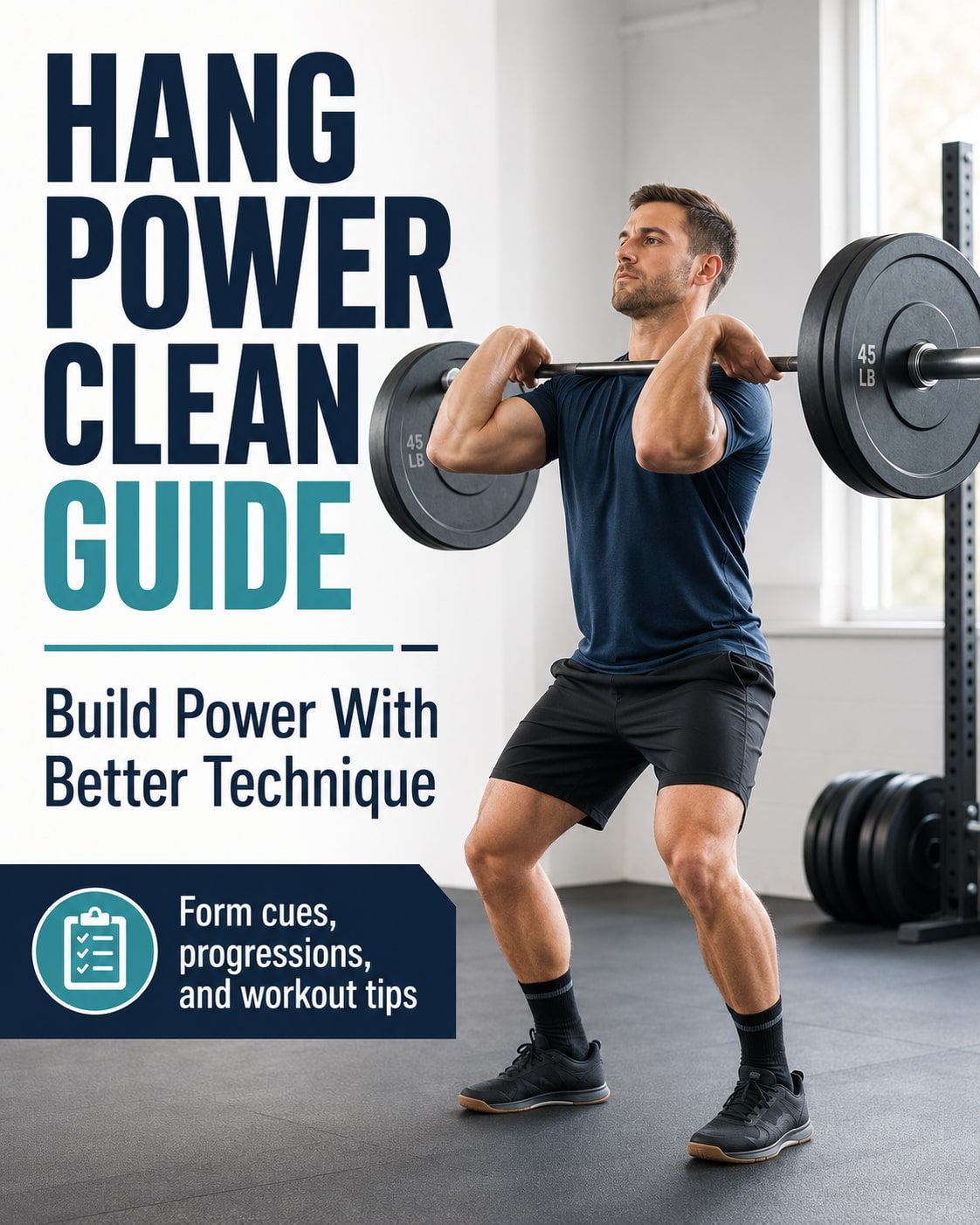
The hang power clean is a technical barbell exercise that helps build explosive strength, full-body coordination, and powerful hip extension. Unlike a full clean from the floor, the hang power clean starts from a standing “hang” position and finishes with the bar caught on the shoulders in a partial squat.
This guide explains how to do the hang power clean with proper form, which muscles it works, the main benefits, common mistakes, beginner-friendly regressions, advanced progressions, and how to use it in a real workout.
What Is the Hang Power Clean?
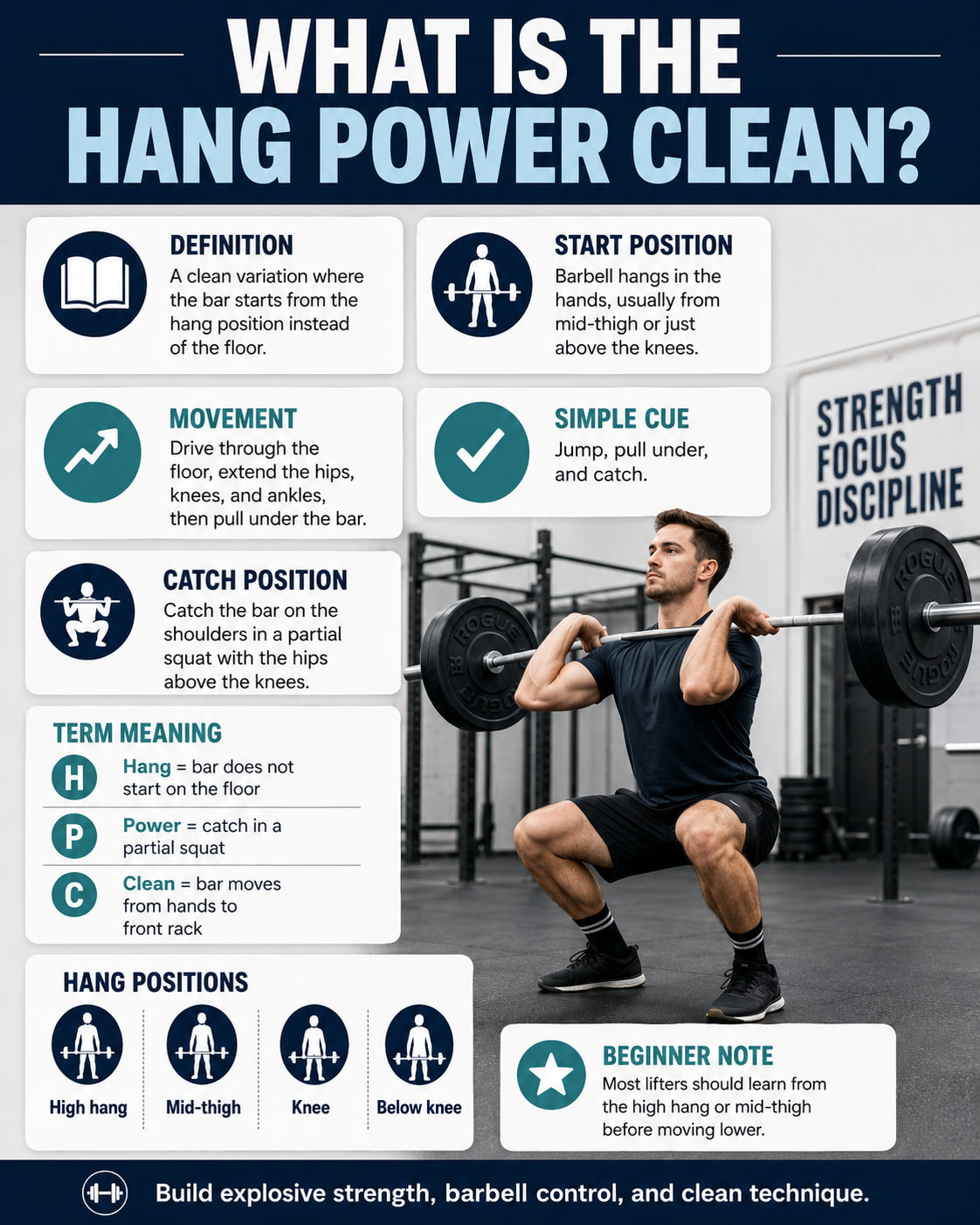
The hang power clean is a clean variation where you start with the barbell hanging in your hands, usually from around mid-thigh or just above the knees. From there, you drive through the floor, extend the hips, knees, and ankles, pull yourself under the bar, and catch it on the shoulders with the hips above the knees.
In simple terms, it is a powerful “jump, pull under, and catch” movement.
The word “hang” means the bar does not start on the floor. The word “power” means you catch the bar in a partial squat instead of a full front squat. The word “clean” means the bar travels from the hands to the front rack position on the shoulders.
The Catalyst Athletics hang power clean exercise library explains that the movement can be performed from different hang positions, including the high hang, mid-thigh, knee, and below-knee positions. For most lifters, learning from the high hang or mid-thigh is easier before moving to lower hang positions.
Hang Power Clean Muscles Worked
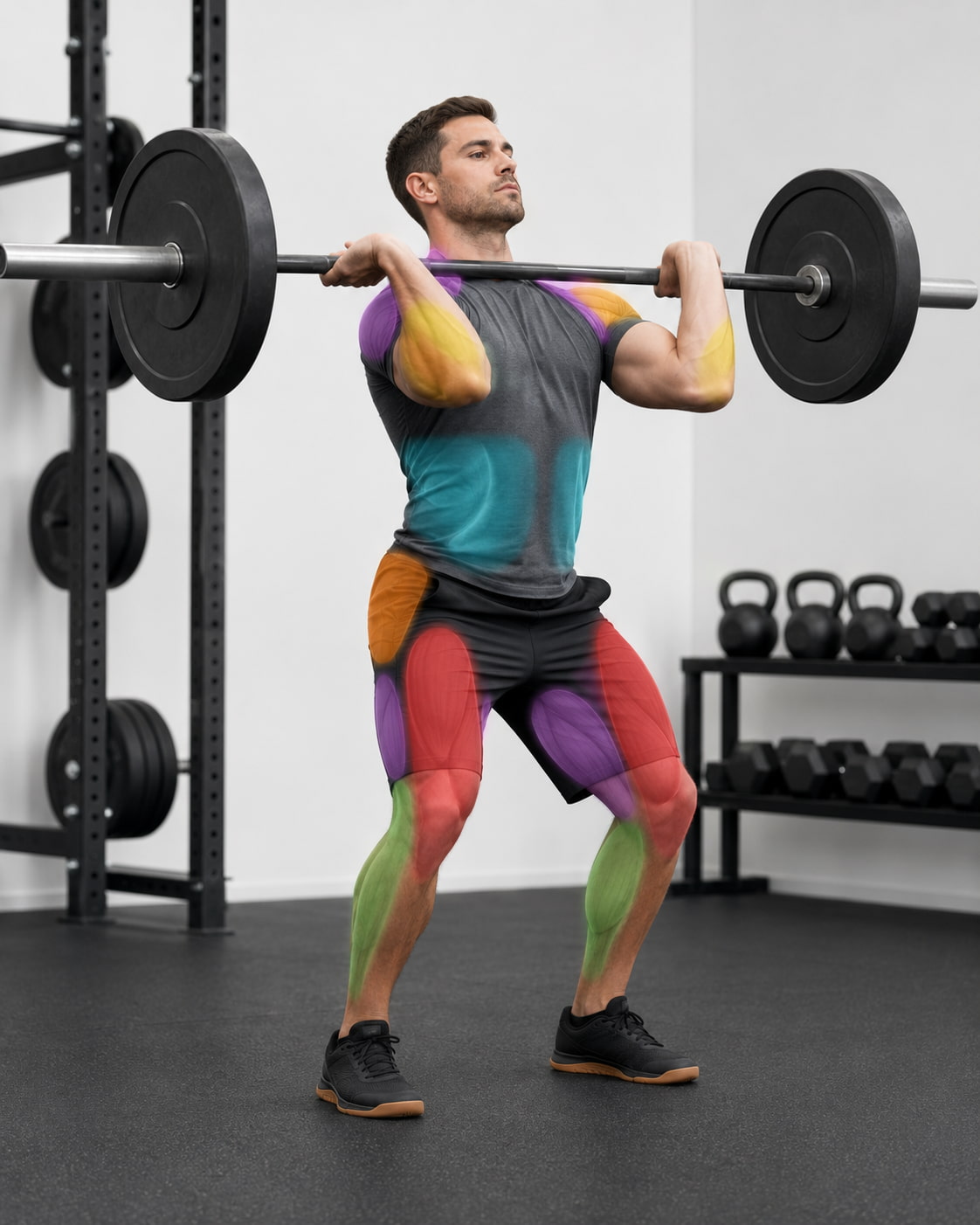
The hang power clean is a full-body power exercise. It does not isolate one muscle group. Instead, it teaches several muscle groups to produce force quickly and transfer that force into the bar.
The glutes help create explosive hip extension. They are especially important as you drive the hips through and finish the pull.
The hamstrings assist the hip hinge and help control the bar as you lower into the hang position. They also support the explosive extension phase.
The quadriceps help extend the knees during the drive and absorb force in the catch. They also help you stand tall after receiving the bar.
The calves contribute to the final extension through the ankles. This is part of the powerful triple-extension action used in the lift.
The traps and upper back help keep the bar close, support the upward pull, and stabilize the rack position.
The shoulders, arms, and forearms help guide the bar and control the front rack, but they should not turn the lift into a reverse curl.
The core muscles brace the trunk so force can transfer from the lower body into the bar. A weak brace often leads to poor bar path, soft catching positions, or lower-back compensation.
The CrossFit hang power clean guide also describes the hang power clean as a movement that places heavy demand on the hips, quads, glutes, hamstrings, trunk, upper back, and grip.
Benefits of the Hang Power Clean
The main benefit of the hang power clean is explosive power. You are not trying to grind the bar slowly. You are trying to produce force fast, move with control, and receive the bar in a strong position.
It also teaches full-body coordination. The lower body starts the movement, the trunk transfers force, the upper body guides the bar, and the feet receive the body in a stable catch.
The hang power clean can improve your clean technique because it removes the first pull from the floor and lets you focus on the most explosive part of the lift. This makes it useful for athletes who struggle to finish the pull, keep the bar close, or turn the elbows through quickly.
It may also help strengthen the posterior chain, especially the glutes, hamstrings, and spinal erectors, because you must hold a strong hinge position before driving upward.
For athletes, the hang power clean is often used to train rate of force development. The ACSM resistance training guideline update notes that power training generally uses moderate loads and emphasizes moving the weight quickly during the lifting phase. That matches the purpose of the hang power clean: clean, fast, powerful reps instead of slow, sloppy reps.
Hang Power Clean Exercise Guide
Equipment needed: You need a barbell, bumper plates, collars, and a safe lifting platform or open lifting area. Beginners can start with a PVC pipe or empty barbell.
Suggested sets and reps: For most lifters, use 3–5 sets of 1–3 reps. Technique work should stay light and crisp. Power work should feel fast, controlled, and repeatable.
Beginners: Start with a PVC pipe, empty bar, hang muscle clean, clean pull, or high-hang power clean. Do not rush heavy loading. Learn how to hinge, brace, extend, and catch before adding weight.
Intermediate: Use 3–5 sets of 2–3 reps at a load that allows fast bar speed and consistent form. Keep 2–4 reps in reserve from a technical standpoint, meaning you should finish each set before form breaks down.
Advanced: Use heavier singles, doubles, paused hang power cleans, or position-specific variations. Advanced lifters can use the hang power clean to improve turnover speed, extension, and confidence receiving the bar.
Rest: Rest 2–3 minutes between working sets when training power. Rest longer if bar speed drops or your catch position becomes inconsistent.
How to do it:
- Stand tall with the bar in your hands, feet about hip-width apart, and hands just outside the legs.
- Brace your core, keep your chest tall, and set your shoulders slightly over the bar.
- Push your hips back and lower the bar to your chosen hang position, usually mid-thigh or just above the knees.
- Keep the bar close to your thighs and maintain balance through the whole foot.
- Drive hard through the floor and extend your hips, knees, and ankles.
- Keep your arms long until the lower body finishes the drive.
- Pull yourself under the bar as it rises, rotating your elbows forward quickly.
- Catch the bar on the shoulders in a partial squat with the elbows high.
- Stand tall to complete the rep, then reset before the next rep.
Common mistakes: The biggest mistakes are pulling with the arms too early, letting the bar swing away, catching with low elbows, jumping forward, landing too wide, losing the brace, and using a weight that is too heavy for clean technique.
Expert tip: Think “legs first, elbows fast.” Your legs and hips create the power, then your elbows rotate through quickly so the bar lands on the shoulders instead of crashing into your hands.
Exercise variations: Useful variations include the high-hang power clean, mid-thigh hang power clean, hang power clean from knee, paused hang power clean, clean pull from hang, hang muscle clean, dumbbell hang power clean, and three-position power clean.
Easier variation: The hang muscle clean is a good easier variation because it teaches the bar path and elbow turnover without requiring a fast drop into the catch.
Harder variation: The paused hang power clean is harder because you must hold a strong hang position before exploding upward, which removes momentum and exposes weak positioning.
How to Set Up the Hang Power Clean Correctly
Start with the bar at mid-thigh while standing tall. Your feet should be around hip-width, similar to a jumping stance. Your hands should grip the bar just outside your legs.
A hook grip is common in Olympic lifting, but beginners can first learn the movement with a regular overhand grip if the goal is technique practice. The hook grip becomes more useful as the load gets heavier and bar speed increases.
Before lowering into the hang, brace your trunk. Then push the hips back while keeping the bar close to the body. Your knees should bend slightly, but this is not a squat. The hang position should feel like a loaded hip hinge with your shoulders slightly over the bar.
The NSCA hang power clean technique guide describes the setup with the bar just above the knees, shoulders over the bar, elbows pointing out, and the head aligned with the spine. Those details are important because a poor starting position usually creates a poor pull.
Key Form Cues for Better Technique
Keep the bar close. If the bar drifts away from your body, the catch becomes harder and the lift becomes less efficient.
Stay balanced over the whole foot. Do not rock onto your toes too early. The powerful extension should come from driving through the floor, not from jumping forward.
Finish the extension before pulling under. Many beginners bend the elbows too soon and turn the lift into an arm pull. Your arms guide the bar, but your legs and hips create the power.
Move the elbows fast. The bar should land on the front of the shoulders with the elbows pointing forward. If your elbows stay low, the bar may crash into your wrists or pull your chest down.
Catch with control. A good catch should feel strong and quiet. Your feet may move slightly from the pulling stance to the receiving stance, but they should not stomp wide or land unevenly.
Common Hang Power Clean Mistakes
Pulling too early with the arms is one of the most common problems. When the elbows bend before the legs and hips finish extending, you lose power and often make the bar loop forward. Fix it by practicing clean pulls and thinking about keeping the arms long until the body finishes the drive.
Letting the bar swing away from the thighs makes the lift harder to control. The bar should travel close to the body. If it swings forward, reduce the weight and focus on a vertical bar path.
Catching with low elbows can stress the wrists and make the rack position unstable. Improve this by practicing front rack mobility, front squats, and tall muscle cleans.
Jumping forward usually means the bar is moving away from you or your balance is shifting too far toward the toes. Practice from the high hang and focus on staying balanced through the middle of the foot.
Using too much weight too soon is another major mistake. The hang power clean is not a slow strength grind. If the bar speed disappears or every rep becomes messy, the weight is too heavy for the goal.
Beginner Regressions Before the Hang Power Clean
Not every lifter should start with the full hang power clean on day one. The movement requires timing, mobility, power, and confidence in the front rack.
A PVC pipe clean is the simplest starting point. It lets you practice the path of the bar, the turnover, and the catch without load.
The hang muscle clean teaches you to guide the bar to the shoulders and rotate the elbows through. Since there is little to no drop under the bar, it is easier to learn.
The clean pull from hang teaches the extension phase. You start in the hang, drive through the floor, extend hard, and keep the arms long. This helps lifters who pull too much with the arms.
The front squat builds comfort in the rack position. If you cannot hold a bar in the front rack with a tall chest and stable elbows, the catch will be difficult.
The dumbbell hang power clean can be a useful option when a barbell is not available, but it still requires control. Keep the weights close and avoid curling them with the arms.
Hang Power Clean Progressions and Variations
The high-hang power clean starts from a taller position near the upper thigh. It is useful for learning fast extension and turnover with less room to create momentum.
The mid-thigh hang power clean is a strong general option because it gives enough space to build power without the complexity of pulling from the floor.
The hang power clean from knee is more demanding. It requires better control, stronger posture, and a more patient pull.
The paused hang power clean builds position strength. Pause in the hang for 1–2 seconds before driving up. This helps prevent rushing and teaches better balance.
The three-position power clean combines different starting points in one sequence. For example, you may clean from the high hang, mid-thigh, and knee in the same set. This is better for lifters who already have solid technique.
The hang clean is the next step if you want to receive the bar lower. Instead of catching in a partial squat, you allow yourself to catch deeper, closer to a full front squat position.
How to Program the Hang Power Clean
The hang power clean works best early in a workout, after your warm-up and before heavy strength work. It requires speed and coordination, so it should not be placed after high-fatigue conditioning or heavy leg work.
For technique, use lighter loads and focus on clean reps. A good starting point is 4–6 sets of 2 reps with plenty of rest.
For power, use moderate loads that still move fast. A practical range is 3–5 sets of 1–3 reps with 2–3 minutes of rest.
For strength-speed work, advanced lifters may use heavier singles or doubles, but only if the bar path and catch position stay sharp.
Avoid high-rep sets when learning. Sets of 8, 10, or 15 reps usually create too much fatigue and make technique break down. The hang power clean should feel explosive, not sloppy.
Sample Hang Power Clean Workout
| Exercise | Sets | Reps | Rest | Effort |
|---|---|---|---|---|
| General warm-up | 5–8 minutes | Easy movement | None | Light |
| Front rack drill | 2 | 20–30 seconds | 30 seconds | Easy |
| Clean pull from hang | 3 | 3 | 90 seconds | Moderate |
| Hang power clean | 5 | 2 | 2–3 minutes | Fast and clean |
| Front squat | 3 | 5 | 2 minutes | Moderate |
| Romanian deadlift | 3 | 8 | 90 seconds | Controlled |
| Plank | 3 | 30–45 seconds | 60 seconds | Stable |
Use this workout 1–2 times per week if you are learning the lift. Progress by improving bar speed, catch quality, and consistency before adding weight. A good rule is to increase the load only when every rep looks similar and feels controlled.
Hang Power Clean vs. Power Clean vs. Hang Clean
| Exercise | Start position | Catch position | Main use |
|---|---|---|---|
| Hang power clean | From the hang | Partial squat | Power, technique, athletic explosiveness |
| Power clean | From the floor | Partial squat | Full clean pull pattern with power catch |
| Hang clean | From the hang | Deeper squat allowed | Clean technique and pulling under the bar |
| Full clean | From the floor | Full front squat | Olympic weightlifting performance |
The hang power clean is often easier to learn than the power clean from the floor because it removes the first pull. However, it is still technical. Beginners should treat it as a skill lift, not just another conditioning movement.
Safety Tips for the Hang Power Clean
Warm up before performing hang power cleans. Use light movement, mobility work, and a few specific warm-up sets with a PVC pipe or empty bar.
Train in a safe space with enough room around you. Bumper plates and a lifting platform are ideal because the bar may need to be dropped safely.
Do not max out while learning. Technique should come before load. If you cannot keep the bar close, catch with high elbows, and land in balance, reduce the weight.
Use coaching when possible. The hang power clean is easier to learn when a qualified coach can watch your timing, bar path, and catch position.
For younger athletes, proper supervision matters. The American Academy of Pediatrics supports resistance training for youth when it is properly supervised, age-appropriate, and focused on good technique.
Stop the exercise and seek professional help if you feel sharp pain, numbness, dizziness, chest pain, or unusual symptoms. The Mayo Clinic weight training guidance also recommends stopping an exercise if it causes pain and trying less weight or returning later when appropriate.
Who Should Use the Hang Power Clean?
The hang power clean is useful for lifters who want to build power, improve athletic performance, or develop Olympic lifting skill. It can fit well into strength programs, sports performance programs, and Olympic lifting practice.
It is especially useful for athletes who need explosive hip extension, such as field sport athletes, jumpers, sprinters, and lifters working on clean technique.
It may not be the best first choice for someone who has never trained with a barbell. In that case, it is better to build a foundation with hinges, squats, loaded carries, front rack drills, and simple pulling variations first.
FAQ
Is the hang power clean good for beginners?
The hang power clean can be useful for beginners only when it is taught carefully with light weight. A true beginner should first learn the hip hinge, front rack position, clean pull, and hang muscle clean before loading the full movement.
How many reps should I do for hang power cleans?
Most lifters should use 1–3 reps per set. Low reps help keep the movement fast and technical. Higher reps often create fatigue and make form break down.
Is the hang power clean better than the power clean?
It depends on the goal. The hang power clean is better for focusing on the explosive second pull and catch. The power clean is better for training the full pull from the floor. Both can be useful.
Should I catch the hang power clean in a squat?
You should catch the hang power clean in a partial squat with the hips above the knees. If you catch deeper than that, it becomes closer to a hang clean.
Why do my wrists hurt during hang power cleans?
Wrist discomfort often comes from catching the bar in the hands instead of letting it rest on the shoulders. Low elbows, poor front rack mobility, or too much weight can also contribute. Reduce the load and practice front rack position before continuing.
How often should I train the hang power clean?
Most lifters can train it 1–2 times per week. Olympic lifters or athletes with coaching may use clean variations more often, but beginners should prioritize quality and recovery.
Conclusion
The hang power clean is one of the best barbell exercises for developing explosive strength, fast hip extension, and full-body coordination. Start light, learn the hang position, keep the bar close, move with speed, and catch the bar with high elbows and stable posture.
Use it early in your workout, keep the reps low, and progress only when your technique stays consistent. When performed well, the hang power clean can become a powerful tool for stronger, faster, more athletic training.