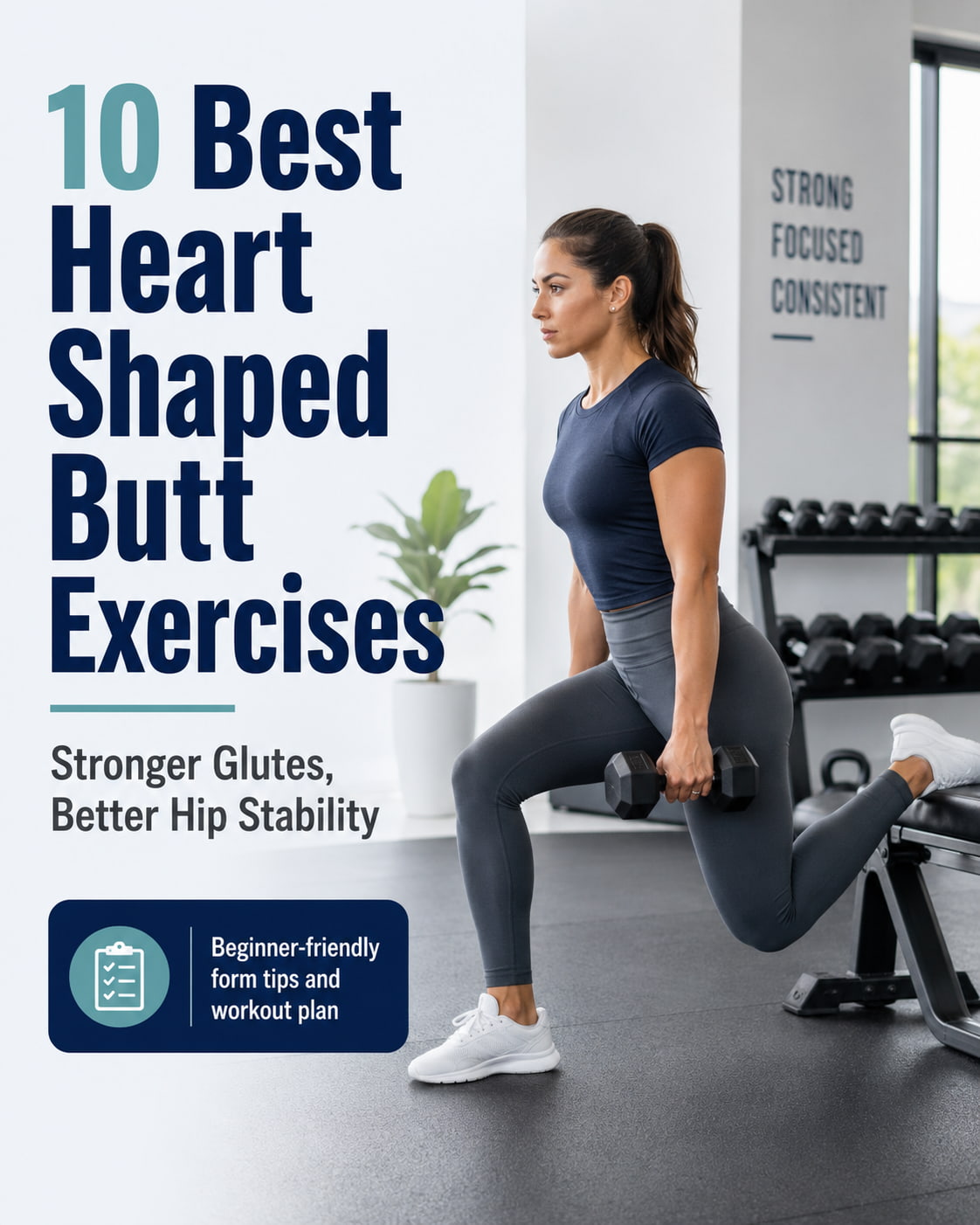
The best heart shaped butt exercises are glute-focused movements that train hip extension, hip abduction, single-leg control, and progressive lower-body strength. No exercise can guarantee one exact body shape because bone structure, genetics, muscle size, and body composition all play a role.
Still, you can train the glutes in a smart, balanced way. This guide shows you the best heart shaped butt exercises for stronger glutes, better hip stability, cleaner form, and a practical workout plan you can use at home or in the gym.
What Heart Shaped Butt Exercises Actually Train
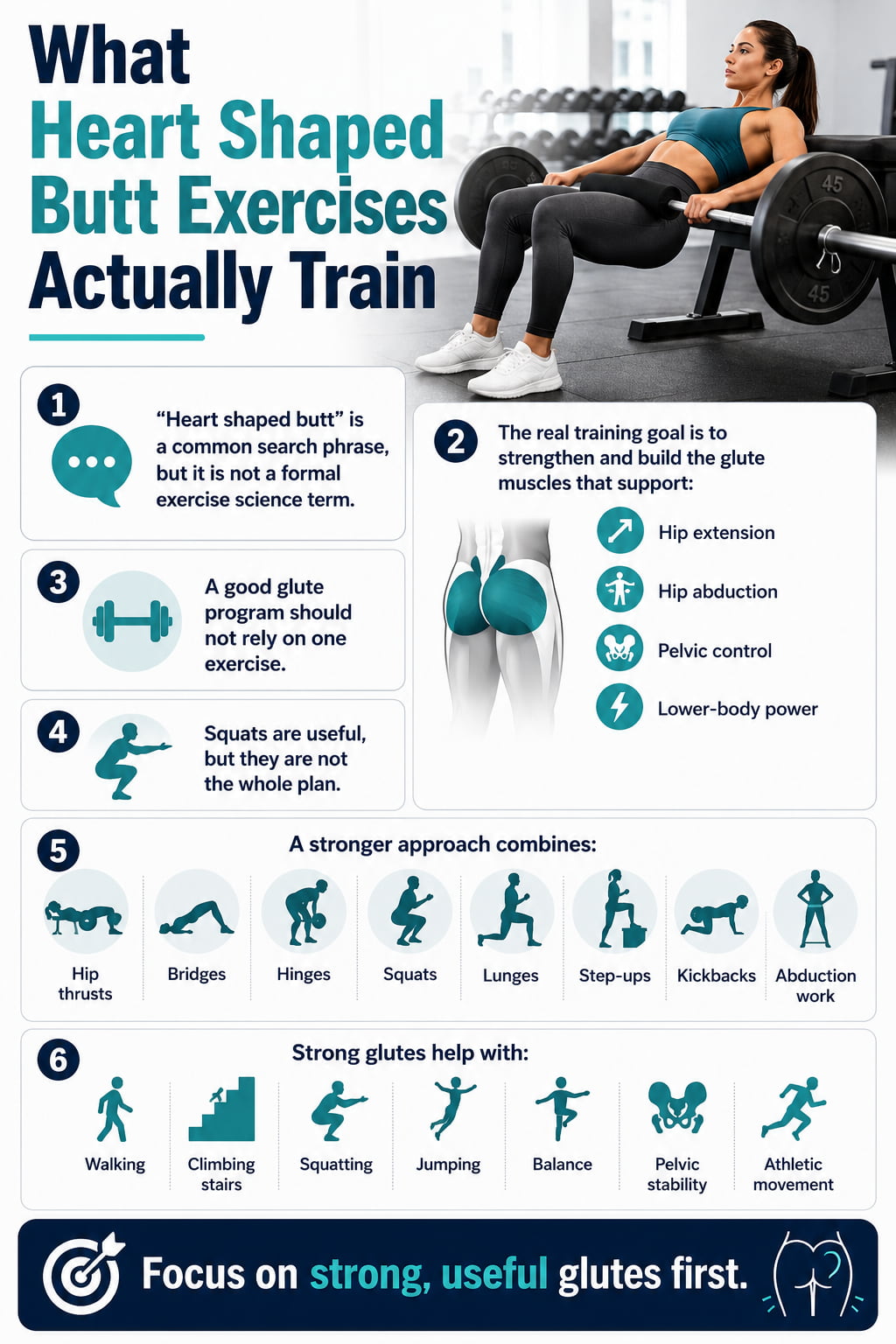
“Heart shaped butt” is a common search phrase, but it is not a formal exercise science term. In training, the goal is to strengthen and build the glute muscles that support hip extension, hip abduction, pelvic control, and lower-body power.
A good glute program should not rely on one exercise. Squats are useful, but they are not the whole plan. The strongest approach combines hip thrusts, bridges, hinges, squats, lunges, step-ups, kickbacks, and abduction work.
The American Council on Exercise notes that the glutes are important for everyday tasks like walking, climbing stairs, squatting, jumping, balance, pelvic stability, and athletic movement. That is why this article focuses on strong, useful glutes first.
Muscles Worked by Heart Shaped Butt Exercises
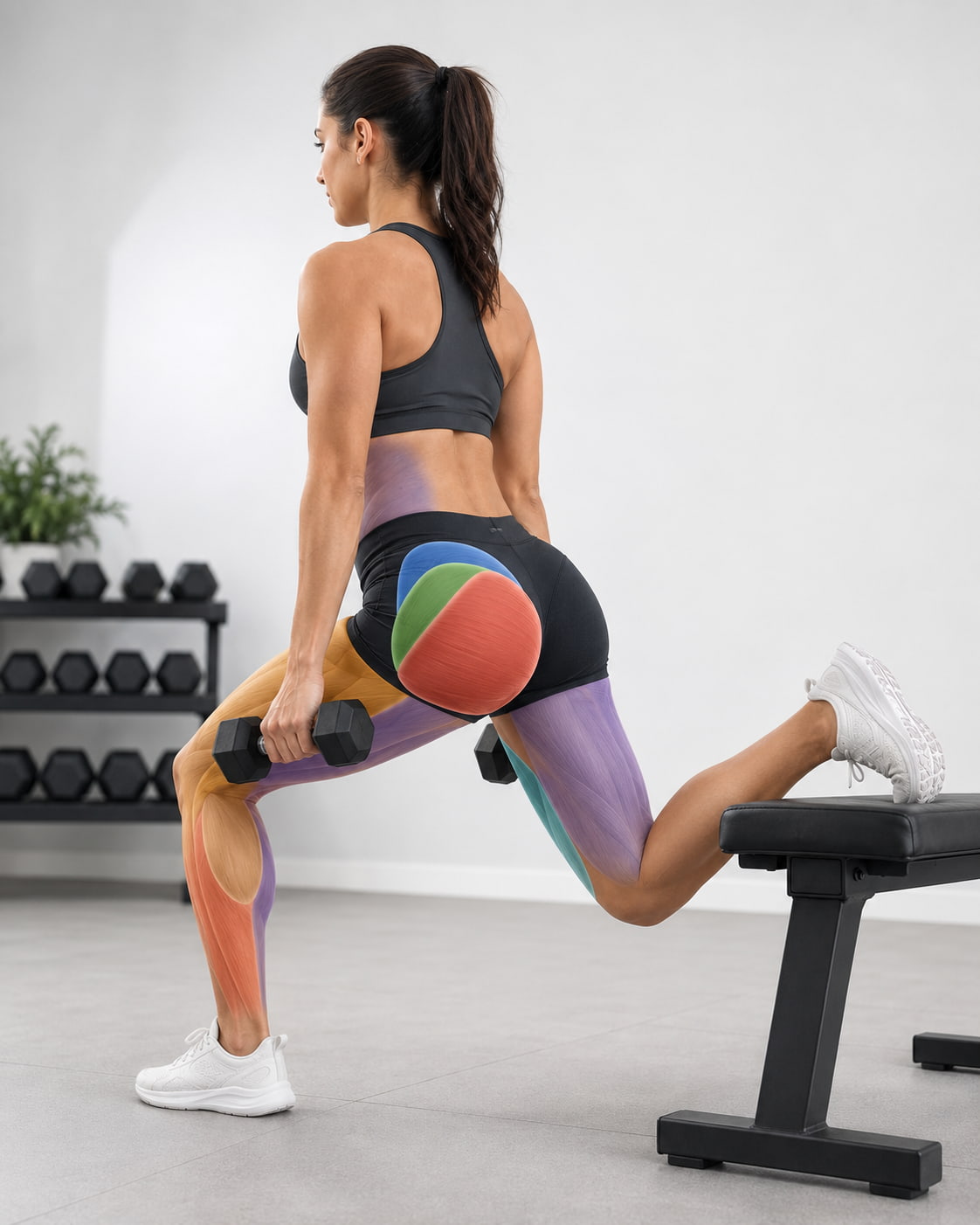
The gluteus maximus is the largest glute muscle and the main driver of hip extension. It works hard during hip thrusts, glute bridges, Romanian deadlifts, squats, lunges, step-ups, and kickbacks.
The gluteus medius and gluteus minimus sit more toward the side of the hip. They help with hip abduction, pelvic stability, and knee control during single-leg exercises. Lateral band walks, hip abductions, step-ups, and split squats are useful for this area.
The hamstrings assist the glutes during hip extension and hinge patterns. The adductors, quadriceps, calves, and core also help stabilize your lower body. The Cleveland Clinic explains that the hip area includes the gluteal muscles, adductors, iliopsoas, quadriceps, and hamstrings, which is why a complete glute plan should train more than one movement pattern.
10 Best Heart Shaped Butt Exercises for Strong Glutes
1. Barbell Hip Thrust
Best for: Heavy glute strength, hip extension, and building the gluteus maximus with progressive overload.
Muscles worked: The gluteus maximus is the main target. The gluteus medius, gluteus minimus, hamstrings, adductors, and core assist with hip and pelvic control.
Equipment needed: Barbell, weight plates, bench, hip pad, or a hip thrust machine.
Why it stands out: The hip thrust allows you to load the glutes directly while the upper back is supported. ACE describes the barbell hip thrust as a loaded bridge-style exercise that focuses on the hip extensor muscles of the gluteal complex.
Suggested sets and reps: Perform 3–4 sets of 6–10 reps for strength or 8–12 reps for muscle growth.
Beginners: Start with a bodyweight glute bridge or dumbbell hip thrust before using a barbell.
Intermediate: Use a barbell with a controlled 2-second lower and a short pause at the top.
Advanced: Use heavier loads, paused reps, 1.5 reps, or single-leg hip thrusts.
Rest: Rest 2–3 minutes for heavy sets and 60–90 seconds for moderate sets.
How to do it:
- Sit on the floor with your upper back against a bench.
- Place your feet flat and about hip-width apart.
- Position the barbell across the front of your hips with padding.
- Brace your core and keep your chin slightly tucked.
- Drive through your heels and lift your hips until your torso and thighs form a straight line.
- Squeeze your glutes at the top without arching your lower back.
- Lower under control and repeat.
Common mistakes: Overarching the lower back, placing the feet too far away, pushing mostly through the toes, using too much weight too soon, and bouncing the bar.
Expert tip: Think about pulling your ribs down toward your pelvis as you finish the rep. This helps you lock out with your glutes instead of your lower back.
2. Romanian Deadlift
Best for: Training the glutes and hamstrings through a hip-hinge pattern.
Muscles worked: Gluteus maximus, hamstrings, adductors, erector spinae, lats, grip, and core.
Equipment needed: Barbell, dumbbells, kettlebells, or resistance bands.
Why it stands out: The Romanian deadlift teaches you to load the posterior chain while keeping the spine stable. The ACE Romanian deadlift guide emphasizes pushing the hips back, keeping a slight knee bend, and lowering until you feel tension through the back of the legs.
Suggested sets and reps: Perform 3–4 sets of 6–10 reps or 2–4 sets of 8–12 reps.
Beginners: Start with a dowel hip hinge or light dumbbells.
Intermediate: Use dumbbells or a barbell and lower with a controlled tempo.
Advanced: Use a barbell, deficit variation, slow eccentric reps, or single-leg Romanian deadlifts.
Rest: Rest 90–180 seconds depending on load.
How to do it:
- Stand tall with the weight in front of your thighs.
- Keep your feet about hip-width apart.
- Soften your knees without turning the movement into a squat.
- Push your hips back as your torso leans forward.
- Keep the weight close to your legs.
- Lower until you feel a strong hamstring stretch while keeping your back neutral.
- Drive your hips forward and stand tall.
Common mistakes: Squatting the weight down, rounding the back, letting the weights drift forward, locking the knees, and rushing the lowering phase.
Expert tip: Imagine closing a car door with your hips. The hips move back first, then the torso follows.
3. Goblet Squat
Best for: Building lower-body strength while training the glutes, quads, and adductors together.
Muscles worked: Glutes, quadriceps, adductors, hamstrings, calves, spinal stabilizers, and core.
Equipment needed: Dumbbell or kettlebell.
Why it stands out: The goblet squat is easier to learn than many barbell squat variations because the weight stays in front of your body. NASM’s squat guidance explains that squats involve hip flexion, knee flexion, ankle dorsiflexion on the way down, then hip extension, knee extension, and ankle plantarflexion on the way up.
Suggested sets and reps: Perform 3–4 sets of 8–12 reps.
Beginners: Use bodyweight squats or squat to a box.
Intermediate: Use a heavier dumbbell and pause briefly at the bottom.
Advanced: Use a slower tempo, heel elevation, or progress to front squats or back squats.
Rest: Rest 90–150 seconds.
How to do it:
- Hold a dumbbell or kettlebell close to your chest.
- Set your feet about shoulder-width apart.
- Brace your core and keep your chest tall.
- Bend your knees and hips together as you lower.
- Keep your knees tracking in line with your toes.
- Lower as far as you can control without rounding your back.
- Push through your full foot and stand tall.
Common mistakes: Knees collapsing inward, heels lifting, rounding the lower back, cutting depth too short without control, and relaxing the core.
Expert tip: Keep your elbows pointed down and let them travel between your knees as you squat.
4. Bulgarian Split Squat
Best for: Single-leg glute strength, balance, hip stability, and fixing side-to-side differences.
Muscles worked: Glutes, quadriceps, adductors, hamstrings, calves, and core.
Equipment needed: Bench or box, plus dumbbells if loading.
Why it stands out: The Bulgarian split squat challenges one leg at a time while the rear foot is elevated. It is useful for glute growth because the front leg must produce force and stabilize the hip.
Suggested sets and reps: Perform 2–4 sets of 8–12 reps per side.
Beginners: Start with a regular split squat before elevating the rear foot.
Intermediate: Use dumbbells and a controlled range of motion.
Advanced: Use heavier dumbbells, a slight forward torso angle, or a deficit setup.
Rest: Rest 90–150 seconds between sets.
How to do it:
- Stand a few feet in front of a bench.
- Place the top of your rear foot on the bench.
- Keep most of your weight on the front leg.
- Brace your core and lower under control.
- Let the front knee track with the toes.
- Drive through the front foot to stand.
- Complete all reps on one side before switching.
Common mistakes: Standing too close to the bench, bouncing at the bottom, pushing too much through the rear leg, letting the front knee cave inward, and losing balance.
Expert tip: Use a slight forward torso lean if you want more glute emphasis, but keep your spine long and your core braced.
5. Step-Up
Best for: Glute strength, single-leg control, hip stability, and functional lower-body training.
Muscles worked: Glutes, quadriceps, hamstrings, adductors, calves, and core.
Equipment needed: Box, bench, or step, plus dumbbells if loading.
Why it stands out: Step-ups train the glutes through a natural climbing pattern. ACE includes step-ups in its evidence-based glute exercise discussion, making them a strong choice for real-world lower-body strength.
Suggested sets and reps: Perform 2–4 sets of 8–12 reps per side.
Beginners: Use a low step and bodyweight.
Intermediate: Use dumbbells and a step height that lets you control the rep.
Advanced: Use heavier dumbbells, a higher step, or a slow lowering phase.
Rest: Rest 60–120 seconds.
How to do it:
- Stand in front of a sturdy box or bench.
- Place one foot fully on the step.
- Brace your core and lean slightly forward from the hips.
- Drive through the foot on the box to stand up.
- Avoid pushing hard off the back foot.
- Lower slowly with control.
- Repeat on one side or alternate legs.
Common mistakes: Pushing off the floor leg, using a step that is too high, letting the knee cave inward, dropping quickly on the way down, and losing foot pressure.
Expert tip: Keep your whole working foot on the box and push through the midfoot and heel.
6. Reverse Lunge
Best for: Glute-focused lunging, balance, lower-body strength, and beginner-friendly single-leg training.
Muscles worked: Glutes, quadriceps, hamstrings, adductors, calves, and core.
Equipment needed: Bodyweight, dumbbells, kettlebells, or barbell.
Why it stands out: The reverse lunge is often easier to control than a forward lunge because you step backward and keep the front leg more stable. This makes it a strong option for glute-focused training.
Suggested sets and reps: Perform 2–4 sets of 8–12 reps per side.
Beginners: Start with bodyweight and hold a wall or rack for balance.
Intermediate: Use dumbbells at your sides.
Advanced: Use front-racked kettlebells, a barbell, or deficit reverse lunges.
Rest: Rest 60–120 seconds.
How to do it:
- Stand tall with your feet hip-width apart.
- Step one leg backward into a long lunge.
- Lower until both knees bend with control.
- Keep the front knee tracking with the toes.
- Push through the front foot to return to standing.
- Repeat on one side or alternate legs.
Common mistakes: Taking too short of a step, pushing off the back leg too much, collapsing the front knee inward, leaning excessively, and rushing the return.
Expert tip: Think about pulling yourself down with control, then pushing the floor away with the front leg.
7. Cable Glute Kickback
Best for: Glute isolation, controlled hip extension, and adding focused work after compound lifts.
Muscles worked: Gluteus maximus, gluteus medius, hamstrings, and core stabilizers.
Equipment needed: Cable machine and ankle strap.
Why it stands out: The cable kickback lets you train hip extension with constant resistance. It works best as an accessory exercise after heavier lifts like hip thrusts, squats, or Romanian deadlifts.
Suggested sets and reps: Perform 2–4 sets of 12–15 reps per side.
Beginners: Use a light cable setting and hold the machine for balance.
Intermediate: Use a moderate load and a short squeeze at the top.
Advanced: Use a slower tempo, higher reps, or a slight diagonal kickback angle.
Rest: Rest 45–90 seconds.
How to do it:
- Attach an ankle strap to a low cable.
- Stand facing the machine and hold the frame.
- Brace your core and keep a soft bend in the working knee.
- Drive the working leg back from the hip.
- Pause briefly when you feel the glute contract.
- Return slowly without letting the weight stack slam.
- Complete all reps before switching sides.
Common mistakes: Arching the lower back, swinging the leg, turning the foot too far outward, using too much weight, and leaning heavily into the machine.
Expert tip: Keep your ribs down and move from the hip, not from your lower back.
8. Hip Abduction Machine
Best for: Training the side glutes, glute medius, glute minimus, and hip abduction strength.
Muscles worked: Gluteus medius, gluteus minimus, upper glute fibers, tensor fasciae latae, and core stabilizers.
Equipment needed: Hip abduction machine.
Why it stands out: Hip abduction work trains the glutes from a different angle than hip thrusts and squats. NASM notes that side-lying hip abduction can isolate the glute medius, and abduction-style work can support better hip control.
Suggested sets and reps: Perform 2–4 sets of 12–20 reps.
Beginners: Use light resistance and control the full range.
Intermediate: Use a moderate load and pause briefly in the open position.
Advanced: Use higher reps, controlled partials after full reps, or tempo work.
Rest: Rest 45–90 seconds.
How to do it:
- Sit tall in the hip abduction machine.
- Place your knees against the pads.
- Brace your core and keep your feet steady.
- Press your knees outward under control.
- Pause briefly when your hips are open.
- Return slowly without letting the plates crash.
- Keep tension through the full set.
Common mistakes: Using momentum, leaning too far back, going too heavy, shortening the range too much, and letting the machine control the return.
Expert tip: Move slowly enough that you feel the side glutes doing the work, not just the machine moving your legs.
9. Lateral Band Walk
Best for: Glute medius activation, hip stability, warm-ups, and beginner-friendly side-glute training.
Muscles worked: Gluteus medius, gluteus minimus, gluteus maximus, hip external rotators, quadriceps, and core.
Equipment needed: Mini band or loop resistance band.
Why it stands out: The lateral band walk is simple, portable, and useful before lower-body workouts. NASM notes that lateral band walks should be done with the knees bent in a semi-squat position to generate more gluteus maximus and gluteus medius activity.
Suggested sets and reps: Perform 2–3 sets of 10–15 steps each direction.
Beginners: Place the band above the knees and use a small range.
Intermediate: Place the band around the ankles or feet.
Advanced: Use a stronger band, longer sets, or add it as a finisher after glute training.
Rest: Rest 30–60 seconds.
How to do it:
- Place a mini band above your knees, around your ankles, or around your feet.
- Stand with your feet about hip-width apart.
- Bend your knees slightly and push your hips back.
- Keep your chest tall and core braced.
- Step sideways without letting your knees collapse inward.
- Bring the other foot in while keeping band tension.
- Continue for the target steps, then switch directions.
Common mistakes: Standing too upright, dragging the feet, letting the knees cave in, taking steps that are too big, and losing band tension.
Expert tip: Keep your toes mostly forward and lead with your heel instead of twisting your whole body.
10. Glute Bridge
Best for: Beginners, home workouts, glute activation, and learning hip extension before hip thrusts.
Muscles worked: Gluteus maximus, hamstrings, transverse abdominis, gluteus medius when banded, and core stabilizers.
Equipment needed: Bodyweight, mini band, dumbbell, or barbell if loaded.
Why it stands out: The glute bridge is easy to set up and useful for teaching controlled hip extension. NASM explains that the glute bridge primarily targets the gluteus maximus, while the hamstrings and core assist.
Suggested sets and reps: Perform 2–4 sets of 10–15 reps.
Beginners: Use bodyweight and focus on feeling the glutes at the top.
Intermediate: Add a mini band above the knees or place a dumbbell across the hips.
Advanced: Use single-leg glute bridges, pause reps, or loaded bridges.
Rest: Rest 45–90 seconds.
How to do it:
- Lie on your back with your knees bent.
- Place your feet flat and about hip-width apart.
- Brace your core and keep your ribs down.
- Push through your heels and lift your hips.
- Stop when your knees, hips, and shoulders form a straight line.
- Squeeze your glutes briefly at the top.
- Lower slowly and repeat.
Common mistakes: Overarching the lower back, placing the feet too far away, pushing through the toes, letting the knees collapse inward, and rushing the reps.
Expert tip: If you feel mostly hamstrings, bring your feet slightly closer and focus on pushing the floor away through your heels.
How to Build a Heart Shaped Butt Workout
A complete glute workout should include one heavy hip extension exercise, one hinge, one squat or lunge pattern, one single-leg movement, and one abduction or side-glute exercise.
For most people, 2–3 glute-focused sessions per week is enough. The American College of Sports Medicine progression model supports progressive resistance training and recommends 2–3 training days per week for novice lifters, with higher frequency used as training level improves.
Use progressive overload, but do not rush it. Add reps first. When you can complete every set with clean form and 1–3 reps in reserve, increase weight slightly. Mayo Clinic’s weight-training technique guidance also recommends controlled movement, warming up, and stopping an exercise if it causes pain.
Sample Heart Shaped Butt Workout
| Exercise | Sets | Reps | Rest |
|---|---|---|---|
| Barbell hip thrust | 4 | 6–10 | 2–3 min |
| Romanian deadlift | 3 | 8–10 | 90–180 sec |
| Bulgarian split squat | 3 | 8–12 each side | 90–150 sec |
| Step-up or reverse lunge | 2–3 | 10 each side | 60–120 sec |
| Hip abduction machine | 3 | 12–20 | 45–90 sec |
| Lateral band walk | 2 | 10–15 steps each way | 30–60 sec |
Train this workout 1–2 times per week as your main glute session. If you train glutes 3 times per week, make one session heavier, one session moderate, and one session lighter with bridges, abductions, lunges, and band work.
A simple weekly plan is lower body on Monday, upper body on Tuesday, glutes and hamstrings on Thursday, and full body or light glutes on Saturday. Keep at least one recovery day between hard glute sessions.
Common Mistakes to Avoid
Relying only on squats: Squats are useful, but they do not train the glutes from every angle. Add hip thrusts, hinges, single-leg work, and abduction exercises.
Training too heavy too soon: Heavier weight only helps if your form stays controlled. Build skill first, then increase load.
Arching the lower back: This often happens during hip thrusts, bridges, and kickbacks. Keep your ribs down and finish reps with your glutes.
Skipping side-glute work: The glute medius and minimus help with hip stability. Include lateral band walks, hip abductions, or side-lying hip abductions.
Using momentum: Fast reps can make the exercise easier but less effective. Control the lowering phase and pause when useful.
Training glutes every day: Muscles need recovery to adapt. Most lifters grow stronger with hard glute training 2–3 times per week, not daily max-effort work.
How Often to Train Glutes
Beginners can start with 2 glute-focused sessions per week. This gives enough practice without overwhelming recovery.
Intermediate lifters can train glutes 2–3 times per week, depending on total sets, soreness, sleep, and overall lower-body volume.
Advanced lifters may use 3 weekly exposures, but not every session should be heavy. A good plan includes heavy hip thrusts or squats on one day, hinge and single-leg work on another day, and lighter abduction or pump-style work on a third day.
As a general target, many people do well with about 10–18 challenging glute sets per week across all exercises. Start lower, recover well, and add volume only when your form, energy, and performance stay strong.
Safety Tips for Glute Training
Warm up before lifting. Use 5–10 minutes of easy cardio, then do light sets of your first exercise. Add glute bridges, bodyweight squats, or lateral band walks if they help you feel more prepared.
Use controlled movement. Do not bounce out of the bottom of squats or split squats. Do not swing kickbacks. Do not slam the hip abduction machine.
Stop the exercise and seek professional help if you feel sharp pain, numbness, dizziness, chest pain, or unusual symptoms. Muscle effort is normal. Joint pain, nerve symptoms, or sudden pain is not something to push through.
FAQs
Can exercises really change butt shape
Exercise can strengthen and grow the glute muscles, which may change how your glutes look and perform over time. However, no workout can guarantee one exact shape because genetics, pelvis structure, body composition, and muscle insertions all matter.
Are squats enough for a heart shaped butt
Squats can help, but they are not enough for most people. A better glute plan includes hip thrusts, Romanian deadlifts, split squats, lunges, step-ups, bridges, kickbacks, and abduction work.
What exercise is best for glute growth
The barbell hip thrust is one of the best choices for loading hip extension directly. Romanian deadlifts, squats, Bulgarian split squats, and step-ups are also excellent when performed with good form and progressive overload.
Can I do these exercises at home
Yes. Good home options include glute bridges, single-leg glute bridges, bodyweight squats, reverse lunges, step-ups, banded lateral walks, banded kickbacks, and banded seated abductions. Add dumbbells or bands when bodyweight becomes too easy.
How long does it take to build stronger glutes
Many people notice better control and strength within a few weeks. Visible muscle changes usually take longer and depend on training consistency, effort, nutrition, sleep, genetics, and recovery.
Should beginners start with hip thrusts or glute bridges
Most beginners should start with glute bridges. Once you can control the bridge without arching your lower back or feeling mostly hamstrings, progress to dumbbell hip thrusts and then barbell hip thrusts.
Conclusion
The best heart shaped butt exercises are not about chasing a perfect shape. They are about training the glutes with smart exercise selection, clean form, progressive overload, and enough recovery.
Start with glute bridges, hip thrusts, squats, Romanian deadlifts, lunges, step-ups, and abduction work. Track your reps, add resistance gradually, and focus on strong, controlled movement every session.
This content is for informational purposes only and is not a substitute for professional medical advice.
References
- American Council on Exercise: Strength Training the Glutes: An Evidence-Based Approach
- American Council on Exercise: Understanding the Barbell Hip Thrust
- American Council on Exercise: Romanian Deadlift Exercise Library
- NASM: The Muscles Used in Squats: Squat Biomechanics
- ACSM: Progression Models in Resistance Training for Healthy Adults