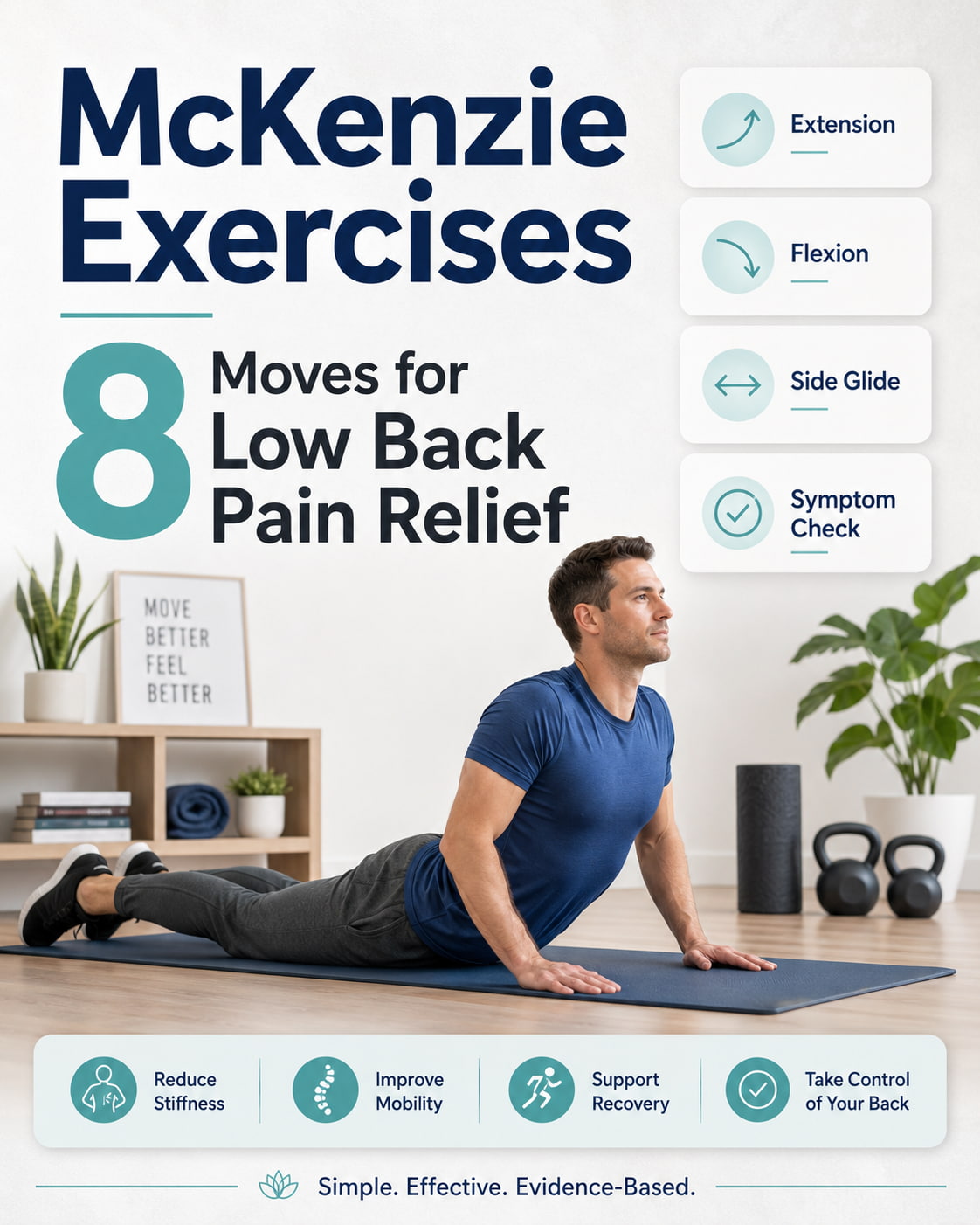
McKenzie exercises may help with low back pain relief when the movement matches your symptom response and is done with control. These exercises are commonly used to test whether repeated back extension, flexion, or side-glide movements reduce pain, improve motion, or move symptoms closer to the lower back.
McKenzie exercises are not a one-size-fits-all stretching routine. They are part of the McKenzie Method, also called Mechanical Diagnosis and Therapy, which focuses on assessment, repeated movement, posture, and self-management. The McKenzie Institute USA describes MDT as an assessment-driven approach that emphasizes patient empowerment and self-treatment.
In this guide, you will learn how McKenzie exercises work, how to monitor symptoms, eight useful movements, common mistakes, and a simple beginner routine for low back pain relief.
What Are McKenzie Exercises?
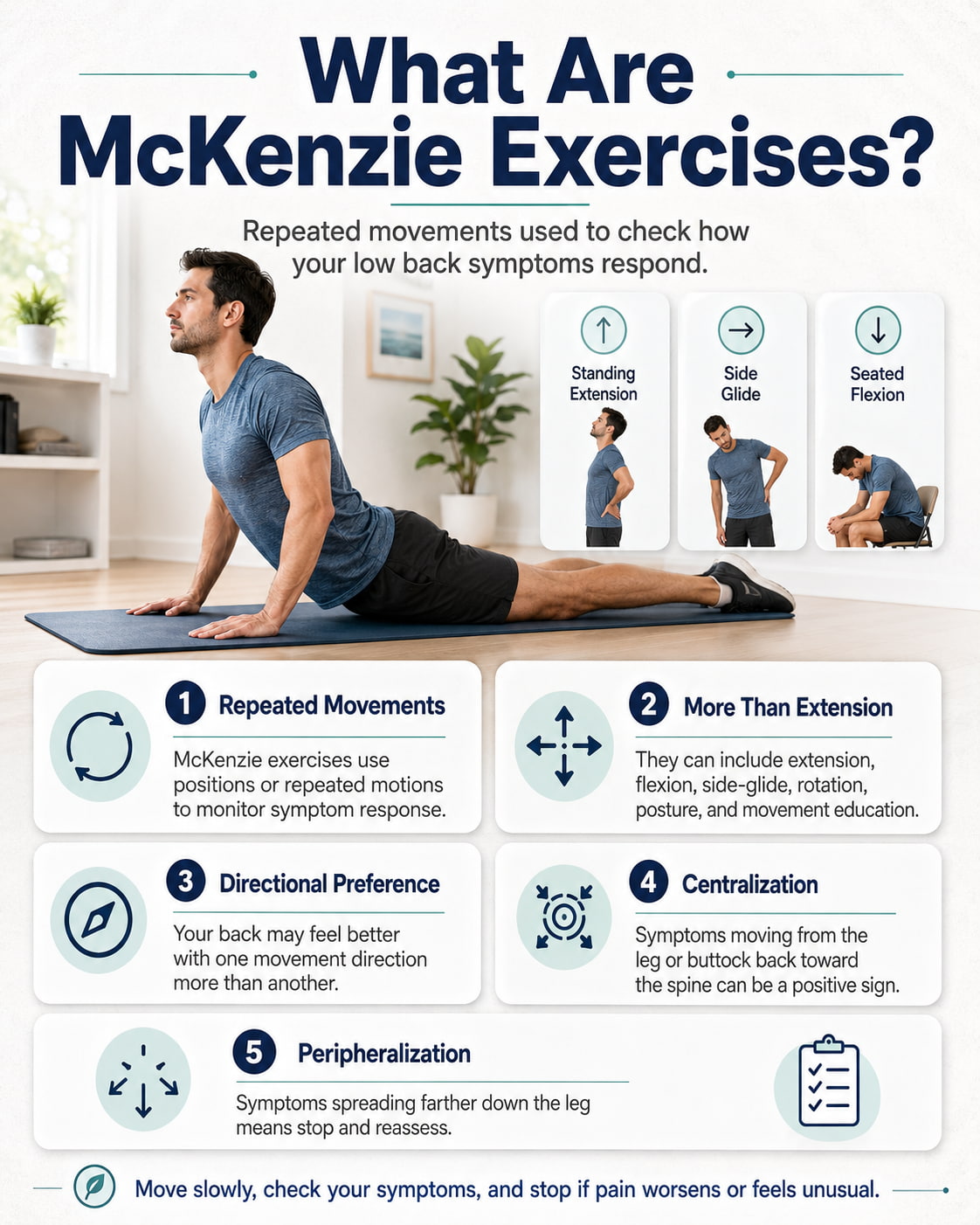
McKenzie exercises are repeated movements or positions used to see how your low back symptoms respond. Many people associate McKenzie work with back extension exercises, such as prone press-ups, but the full method can also include flexion, side-glide, rotation, posture correction, and movement education.
A key idea is directional preference. This means your back may respond better to one movement direction than another. For example, some people feel better with extension-based exercises, while others may respond better to flexion or side-glide work.
Another important concept is centralization. This means pain or symptoms move from farther away, such as the buttock, thigh, calf, or foot, back toward the spine. In the McKenzie approach, this can be a positive sign. The opposite is peripheralization, where symptoms spread farther down the leg or become more intense away from the back. That usually means the movement is not a good choice at that time.
How McKenzie Exercises May Help Low Back Pain Relief
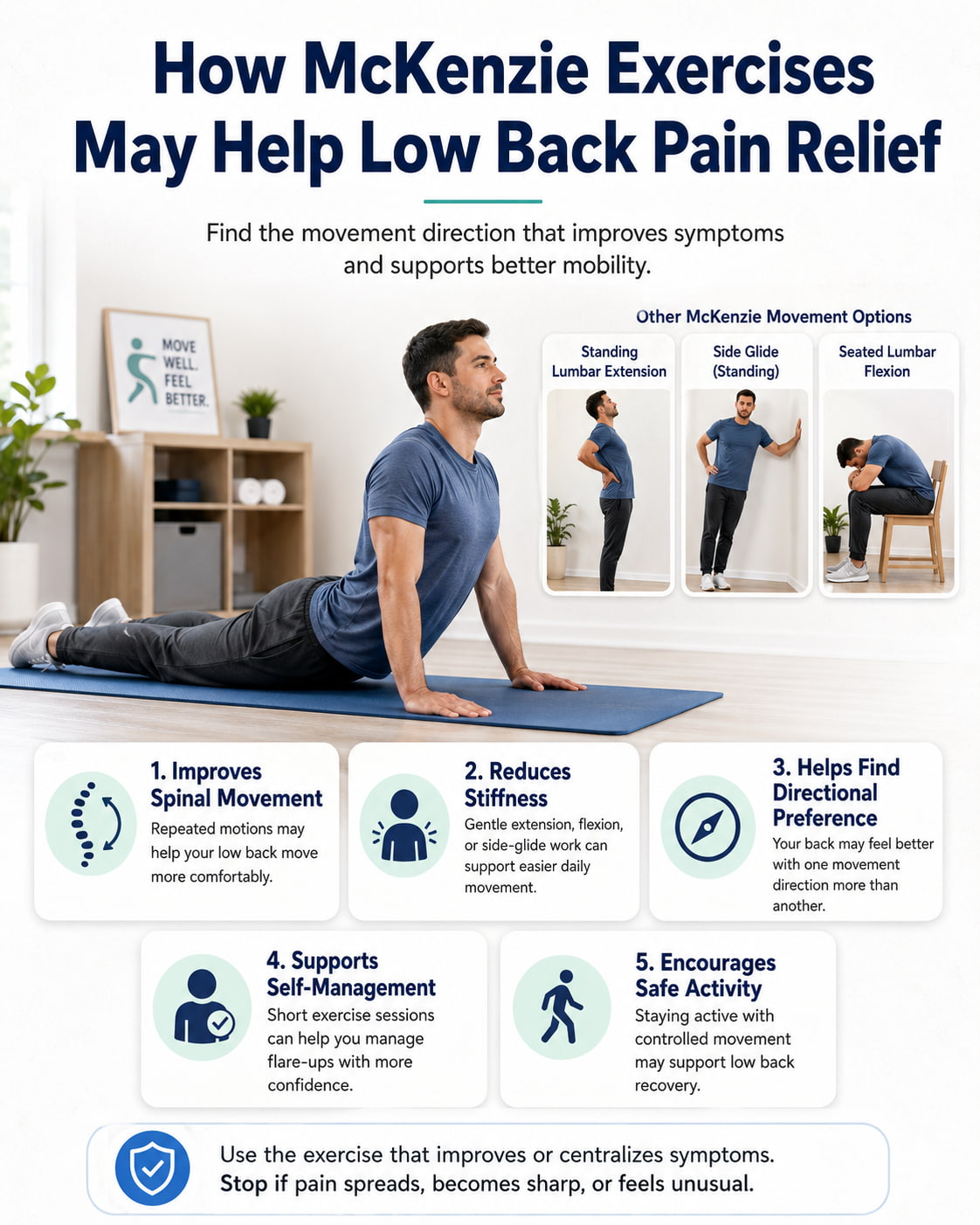
McKenzie exercises may help by improving spinal movement, reducing stiffness, teaching you which direction feels better, and giving you a simple way to manage flare-ups.
They can be especially useful when pain changes with posture, sitting, bending, standing, or repeated movement. However, they should not be treated as a cure or a guaranteed fix. The best exercise is the one that improves or centralizes your symptoms without creating new warning signs.
General low back pain guidance also supports staying active and using exercise based on personal needs, preferences, and ability. NICE recommends advice, self-management, and encouragement to continue normal activities for low back pain with or without sciatica.
Before You Start: How to Know If an Exercise Is Helping
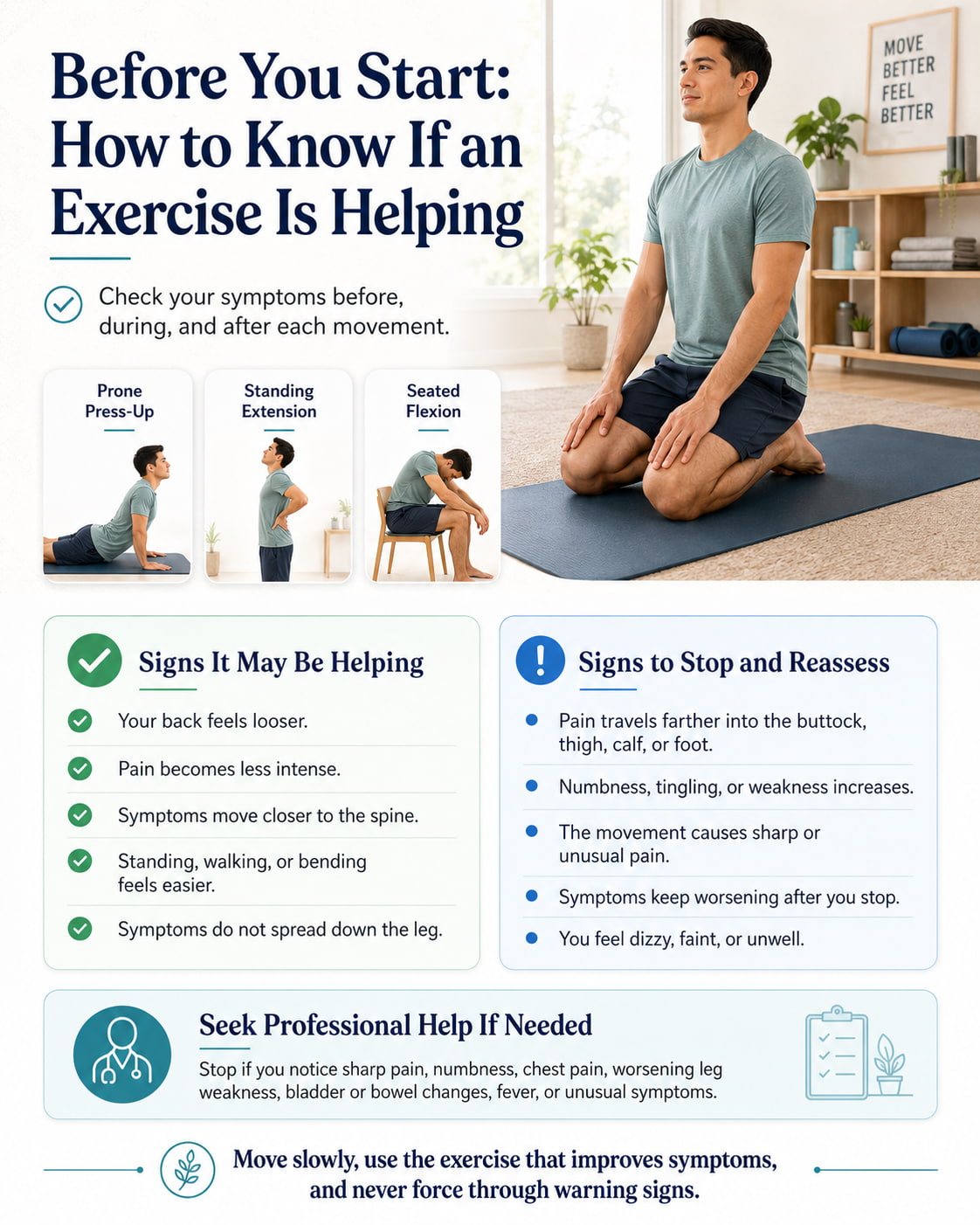
Before doing McKenzie exercises for low back pain relief, check your symptoms before, during, and after each movement.
A movement may be helping if:
Your back feels looser after several reps.
Pain becomes less intense.
Symptoms move closer to the spine.
You can stand, walk, or bend more comfortably afterward.
Symptoms do not spread farther down the leg.
A movement may not be right for you if:
Pain travels farther into the buttock, thigh, calf, or foot.
Numbness, tingling, or weakness increases.
The movement causes sharp or unusual pain.
Symptoms keep worsening after you stop.
You feel dizzy, faint, or unwell.
Stop and seek professional help if an exercise causes sharp pain, numbness, dizziness, chest pain, worsening leg weakness, changes in bladder or bowel control, numbness around the groin or saddle area, fever, unexplained weight loss, or unusual symptoms. NHS guidance lists back pain with symptoms such as numbness or weakness in both legs, bladder or bowel changes, genital or anal numbness, chest pain, or pain after serious trauma as urgent warning signs.
8 McKenzie Exercises for Low Back Pain Relief
These 8 McKenzie exercises include gentle extension, side-glide, and flexion movements commonly used to manage low back stiffness and symptom response. Start with the easiest option, move slowly, and stop if pain spreads, becomes sharp, or causes numbness or unusual symptoms.
1. Prone Lying
Best for: Beginners, acute stiffness, and testing whether gentle extension feels comfortable.
Muscles worked: Low back extensors, deep spinal stabilizers, glutes lightly, and breathing muscles.
Equipment needed: Exercise mat or firm surface.
Why it stands out: Prone lying is the easiest entry point into extension-based McKenzie exercises. It lets the spine settle into a gentle extended position without forcing movement.
Suggested sets and reps: Hold for 2 to 5 minutes. Start with shorter holds if your back is sensitive.
Rest: Rest as needed before moving to the next exercise.
How to do it:
- Lie face down on a firm surface.
- Turn your head to one side or rest your forehead on your hands.
- Keep your legs relaxed and hip-width apart.
- Breathe slowly and allow your low back to relax.
- Stay in the position only if symptoms improve, centralize, or stay tolerable.
Common mistakes: Tensing the glutes, holding the breath, lying on a very soft bed, or forcing the position when symptoms travel farther down the leg.
Expert tip: This should feel like a low-effort starting position, not a hard stretch.
2. Prone on Elbows
Best for: Building tolerance to lumbar extension after prone lying feels comfortable.
Muscles worked: Low back extensors, spinal stabilizers, upper back muscles, shoulders, and glutes lightly.
Equipment needed: Exercise mat or firm surface.
Why it stands out: Prone on elbows increases back extension without requiring a full press-up. It is a common bridge between passive prone lying and repeated press-ups.
Suggested sets and reps: Hold for 30 seconds to 2 minutes. Repeat 1 to 3 times.
Rest: Rest 30 to 60 seconds between holds.
How to do it:
- Lie on your stomach.
- Place your elbows under your shoulders.
- Prop your chest up while keeping your hips and pelvis on the floor.
- Relax your low back, glutes, and legs.
- Breathe slowly and monitor whether symptoms improve or move closer to the spine.
Common mistakes: Shrugging the shoulders, clenching the glutes, lifting the hips, or forcing the back into pain.
Expert tip: Let your arms support you. Your low back should not feel like it is doing all the work.
3. Prone Press-Up
Best for: Extension preference, sitting-related low back stiffness, and symptoms that improve with back bending.
Muscles worked: Low back extensors, deep spinal stabilizers, triceps, shoulders, and upper back stabilizers.
Equipment needed: Exercise mat or firm surface.
Why it stands out: The prone press-up is one of the most recognized McKenzie exercises. It repeatedly moves the low back into extension while allowing the hips and legs to stay relaxed.
Suggested sets and reps: Do 1 to 3 sets of 8 to 10 reps.
Rest: Rest 30 to 60 seconds between sets.
How to do it:
- Lie face down with your hands near your shoulders.
- Keep your hips, pelvis, and legs relaxed on the floor.
- Press through your hands to lift your chest.
- Let your arms do the work while your low back stays relaxed.
- Pause briefly at the top, then lower with control.
- Repeat while checking whether symptoms improve, stay the same, or worsen.
Common mistakes: Lifting the hips, squeezing the glutes hard, pushing into sharp pain, moving too fast, or ignoring symptoms that spread down the leg.
Expert tip: Think “hips heavy, arms push, back relaxes.”
4. Prone Press-Up With Hips Off-Center
Best for: People who feel better with extension but need a slight side-shift adjustment.
Muscles worked: Low back extensors, obliques, deep spinal stabilizers, shoulders, and triceps.
Equipment needed: Exercise mat or firm surface.
Why it stands out: Some low back symptoms do not respond well to straight extension at first. Moving the hips slightly to one side can change the angle of pressure and may feel better for certain directional preferences.
Suggested sets and reps: Do 1 to 2 sets of 6 to 10 reps per side only if symptoms improve.
Rest: Rest 30 to 60 seconds between sets.
How to do it:
- Lie face down with your hands near your shoulders.
- Move your hips a few inches to one side while your chest stays mostly centered.
- Keep both legs relaxed.
- Press your chest up with your arms.
- Lower slowly and repeat.
- Return to the center and reassess your symptoms.
Common mistakes: Shifting too far, twisting aggressively, lifting the pelvis, or using the side that makes leg symptoms worse.
Expert tip: Use the smallest shift that changes symptoms in a helpful direction.
5. Standing Lumbar Extension
Best for: Desk workers, drivers, and people who get stiff after sitting or bending forward.
Muscles worked: Low back extensors, glutes lightly, hip stabilizers, and postural muscles.
Why it stands out: Standing lumbar extension is easy to use during the day. It works well as a movement break after long sitting, repeated bending, or tasks that keep the spine flexed.
Suggested sets and reps: Do 8 to 10 reps, 1 to 3 times daily if helpful.
Rest: Rest as needed between rounds.
How to do it:
- Stand tall with your feet about hip-width apart.
- Place your hands on your low back or hips.
- Gently lean backward from the lower back.
- Keep your knees mostly straight but not locked.
- Pause briefly, then return to standing.
- Repeat while checking that symptoms do not travel farther down the leg.
Common mistakes: Throwing the head back, bending the knees too much, holding the breath, or forcing a large range of motion.
Expert tip: Move smoothly and keep the pressure gentle. This is a reset, not a max backbend.
6. Standing Side Glide
Best for: Low back pain with a visible or felt side shift, or symptoms that respond better to lateral movement than straight extension.
Muscles worked: Obliques, quadratus lumborum, low back stabilizers, glute medius, and hip stabilizers.
Why it stands out: The side glide helps test side-to-side directional preference. It is often used when straight extension is not enough or when the body feels shifted away from the painful side.
Suggested sets and reps: Do 1 to 2 sets of 8 to 10 slow reps on the helpful side.
Rest: Rest 30 to 60 seconds between sets.
How to do it:
- Stand sideways next to a wall.
- Place your shoulder or upper arm lightly against the wall.
- Keep your feet a short step away from the wall.
- Move your hips sideways toward the wall while keeping your shoulders steady.
- Return to the starting position.
- Repeat slowly and monitor your symptoms.
Common mistakes: Twisting instead of gliding, moving too aggressively, letting the feet slide, or continuing if symptoms travel farther down the leg.
Expert tip: Think of your hips sliding sideways under your ribs, not your whole body leaning.
7. Flexion in Lying
Best for: People whose symptoms feel better with gentle forward bending or knees-to-chest positions.
Muscles worked: Abdominals, hip flexors, spinal stabilizers, and low back tissues through gentle flexion.
Equipment needed: Exercise mat or firm surface.
Why it stands out: Not everyone feels better with extension. Flexion in lying gives a controlled way to test whether bringing the knees toward the chest improves low back comfort.
Suggested sets and reps: Do 1 to 3 sets of 8 to 10 slow reps.
Rest: Rest 30 to 60 seconds between sets.
How to do it:
- Lie on your back with your knees bent and feet flat.
- Bring one knee, then the other knee, toward your chest.
- Hold behind your thighs or over your shins.
- Gently pull the knees closer until you feel a comfortable stretch.
- Lower one foot at a time back to the floor.
- Repeat slowly.
Common mistakes: Pulling too hard, lifting the head aggressively, holding the breath, or using flexion when it clearly worsens leg symptoms.
Expert tip: Keep the stretch comfortable. More range is not better if your symptoms spread.
8. Seated Lumbar Flexion
Best for: Flexion preference, gentle low back mobility, and people who feel better bending forward while supported.
Muscles worked: Abdominals, spinal stabilizers, low back extensors through a stretch, and hip flexors.
Equipment needed: Chair.
Why it stands out: Seated lumbar flexion is easier to control than standing forward bending. It can be useful when lying on the floor is uncomfortable or impractical.
Suggested sets and reps: Do 1 to 2 sets of 6 to 10 reps.
Rest: Rest 30 to 60 seconds between sets.
How to do it:
- Sit near the front of a sturdy chair.
- Place your feet flat and wider than hip-width.
- Slowly round forward from your upper back and low back.
- Let your hands move toward the floor between your feet.
- Pause briefly if comfortable.
- Return to sitting tall with control.
Common mistakes: Dropping quickly, forcing end range, holding the breath, or using the movement when it increases leg symptoms.
Expert tip: Move like you are slowly rolling down and slowly stacking back up.
Beginner McKenzie Exercise Routine for Low Back Pain Relief
Use this routine only if extension-based movements improve your symptoms, centralize pain, or feel tolerable.
Prone lying: 2 to 3 minutes
Prone on elbows: 1 to 2 minutes
Prone press-up: 1 to 2 sets of 8 to 10 reps
Standing lumbar extension: 8 to 10 reps after long sitting
Rest: 30 to 60 seconds as needed
Frequency: 1 to 3 times daily if symptoms improve or stay tolerable
Effort level: Easy to moderate, around 2 to 4 out of 10 effort
Progression: Increase range or reps only when symptoms improve, centralize, or remain stable
If flexion feels better than extension, use a simpler flexion-based routine:
Flexion in lying: 1 to 2 sets of 8 to 10 reps
Seated lumbar flexion: 1 set of 6 to 10 reps
Easy walking: 5 to 10 minutes
Frequency: Once daily at first
Progression: Add reps slowly only if symptoms do not spread or worsen
Do not randomly combine every McKenzie exercise in one session. Choose the movement direction that gives the best response.
How Often Should You Do McKenzie Exercises?
For many people, McKenzie exercises are done in short sessions rather than one long workout. A common starting point is 1 to 3 short sessions per day, especially after sitting, bending, or waking up stiff.
Start with fewer reps and check your response. If symptoms improve, you may repeat the helpful movement more often during the day. If symptoms worsen or spread, stop that movement and choose a gentler option or ask a physical therapist for guidance.
Common Mistakes to Avoid
Doing Every Exercise Instead of the Right Exercise
McKenzie training is based on symptom response. You do not need all eight exercises. You need the movement direction that helps.
Ignoring Leg Symptoms
Pain that moves farther down the leg is not something to push through. That is a sign to stop and reassess.
Forcing End Range Too Soon
Repeated movement matters, but it should be controlled. Do not force a deep backbend or aggressive forward bend during a flare-up.
Holding Your Breath
Slow breathing helps reduce tension and makes it easier to monitor symptoms.
Using a Soft Bed
A soft mattress can change the position of your spine. Floor-based exercises usually work best on a firm mat or carpeted surface.
Skipping Professional Help When Symptoms Are Unusual
McKenzie exercises can be useful, but they are not a replacement for medical care when symptoms are severe, changing, or linked with warning signs.
Who Should Be Careful With McKenzie Exercises?
Be cautious if you have severe pain, recent trauma, osteoporosis, known spinal fracture, cancer history, infection symptoms, unexplained weight loss, progressive leg weakness, major numbness, or bladder or bowel changes.
You should also get guidance if your pain is persistent, keeps returning, or does not improve with simple movement changes. NICE recommends considering alternative diagnoses and excluding serious causes when people with low back pain develop new or changed symptoms.
FAQ
Are McKenzie exercises good for sciatica?
McKenzie exercises may help some people with sciatica-like symptoms, especially when the right movement centralizes pain from the leg toward the back. However, if pain, numbness, or tingling travels farther down the leg during an exercise, stop and seek professional guidance.
Should McKenzie exercises hurt?
They should not cause sharp, intense, or worsening symptoms. Mild discomfort may happen during movement, but symptoms should improve, centralize, or return to baseline after you stop.
How long does it take for McKenzie exercises to work?
Some people notice a change within one session, while others need repeated practice and professional assessment. The key is not speed. The key is whether symptoms move in the right direction and function improves over time.
Are McKenzie exercises just back extensions?
No. Extension exercises are common, but the McKenzie Method can also include flexion, side-glide, posture correction, and other direction-specific strategies.
Can I do McKenzie exercises every day?
Yes, many people use them daily when the movement is helpful and symptoms stay stable. Start with short sessions and stop if symptoms worsen or spread.
What is the best McKenzie exercise for low back pain?
The best exercise is the one that improves your symptoms. For many people, that may be prone press-ups or standing extension. For others, flexion or side-glide movements may feel better.
Conclusion
McKenzie exercises for low back pain relief work best when you choose the movement that matches your symptom response. Start gently, watch for centralization, avoid pushing through worsening leg symptoms, and use short sessions instead of forcing long workouts.
If one movement clearly helps, build your routine around it. If symptoms worsen, spread, or feel unusual, stop and get professional guidance.
References
- McKenzie Institute USA: The McKenzie Method of Mechanical Diagnosis and Therapy
- NCBI Bookshelf: McKenzie Back Exercises
- NICE Guideline NG59: Low Back Pain and Sciatica in Over 16s
- APTA/JOSPT Clinical Practice Guideline: Interventions for Acute and Chronic Low Back Pain
- PMC: McKenzie Method for Chronic Low Back Pain With Directional Preference
- NHS: Back Pain