
The best warm-up exercises before running gradually raise your heart rate, move the ankles and hips, activate the main running muscles, and prepare you for your planned pace without causing fatigue. A short routine may be enough before an easy jog, while intervals, hills, and races usually benefit from a longer, more running-specific warm-up.
This guide explains 10 practical pre-run exercises, how to perform them correctly, and how to adjust your warm-up for easy runs, long runs, speed workouts, and different experience levels.
Why Warm Up Before Running?
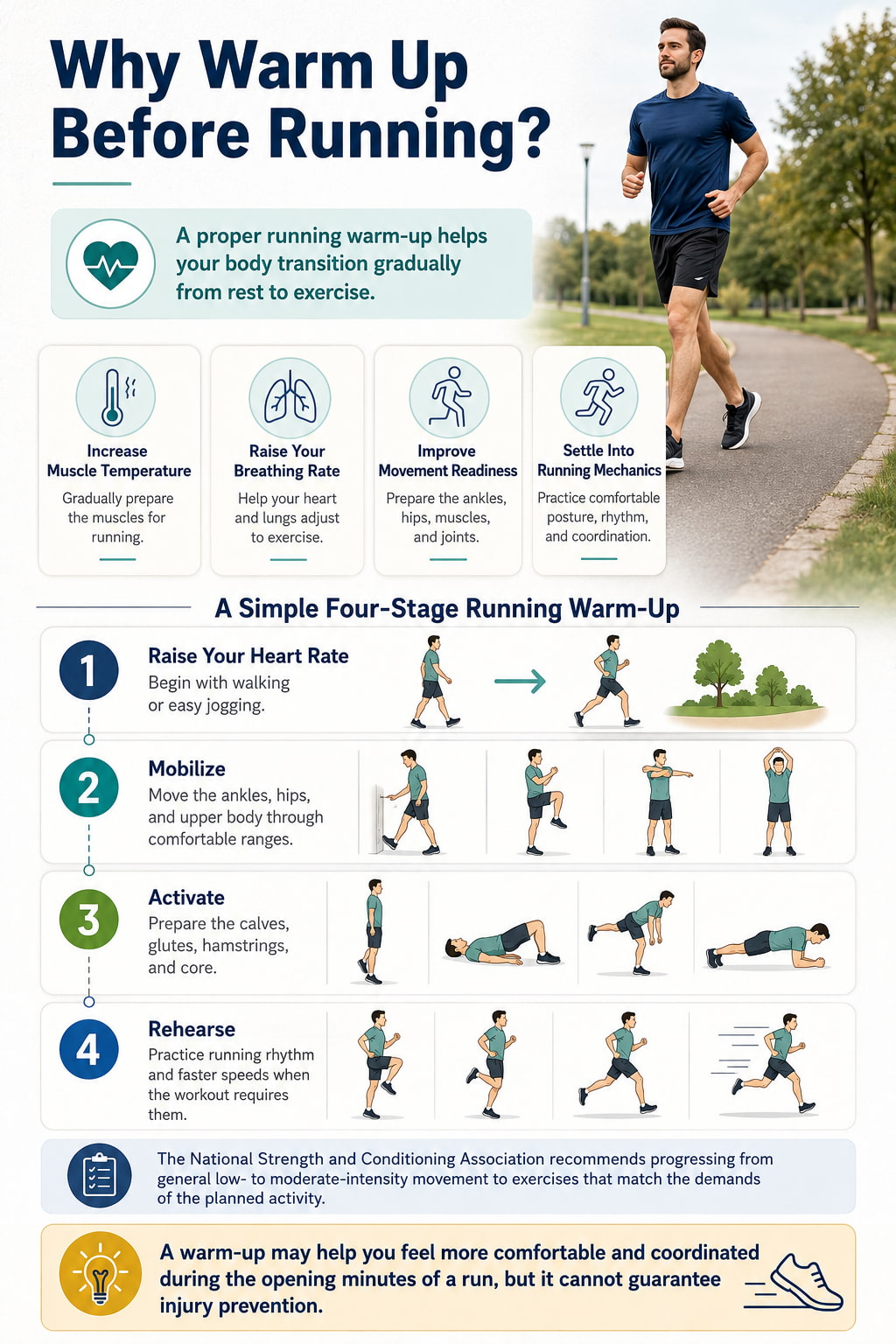
A warm-up helps your body shift gradually from rest to running. It raises your heart rate, prepares the ankles and hips, activates the main running muscles, and helps you settle into a smoother rhythm.
A simple running warm-up usually includes:
- Walking or easy jogging
- Ankle and hip mobility
- Calf, glute, hamstring, and core activation
- Running drills or strides before faster workouts
A warm-up may help you feel more comfortable and coordinated at the start of a run, but it cannot guarantee that you will avoid injury.
How Long Should You Warm Up Before Running?
The right length depends on the type of run:
| Type of run | Suggested warm-up | What to do |
|---|---|---|
| Easy or recovery run | 5–8 minutes | Walk or jog easily, then add a few mobility exercises |
| Long or steady run | 5–10 minutes | Easy movement, ankle and hip mobility, and light activation |
| Tempo run | 10–15 minutes | Easy jogging, dynamic exercises, running drills, and short strides |
| Intervals or hill repeats | 10–20 minutes | Gradual jogging, mobility drills, and 2–4 progressive strides |
| Beginner run-walk workout | About 5 minutes | Start with brisk walking and simple supported movements |
The NHS Couch to 5K program begins each workout with a five-minute walk, which is a practical starting point for beginners.
You may need a little more time in cold weather, early in the morning, or before faster running.
Dynamic Versus Static Stretching Before Running
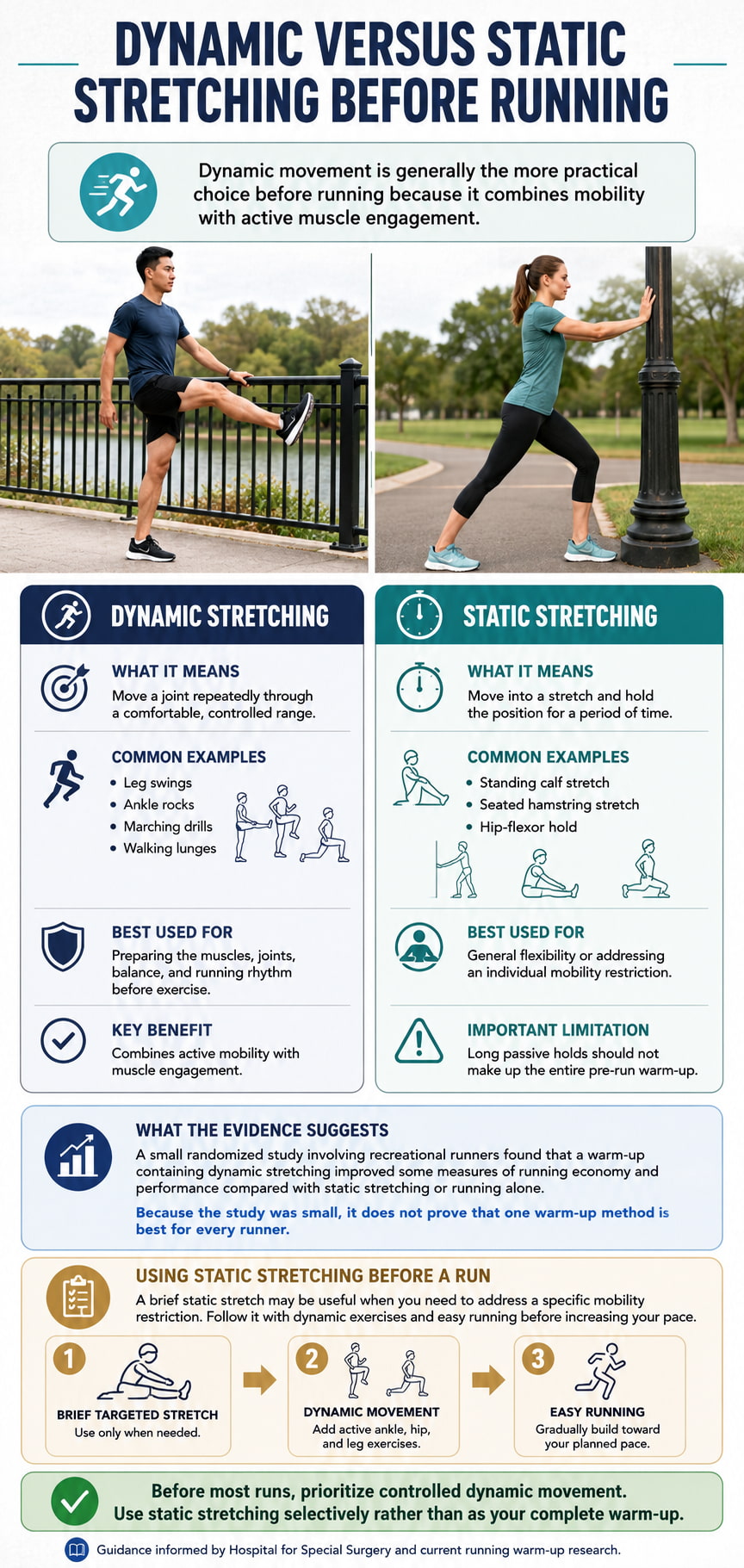
Dynamic stretching uses controlled movement through a comfortable range. Leg swings, ankle rocks, marching drills, and walking lunges are good examples.
Static stretching means holding one position for a period of time. It may be useful for flexibility, but long passive holds should not be your entire pre-run warm-up.
Hospital for Special Surgery generally recommends dynamic movement before athletic activity because it combines mobility with muscle engagement.
When you use a brief static stretch for a tight area, follow it with dynamic exercises and easy running before increasing your pace.
Warm-Up Exercises Before Running at a Glance
| Exercise | Main purpose | Suggested amount | |
|---|---|---|---|
| 1 | Brisk walk to easy jog | Raise heart rate and body temperature | 2–5 minutes |
| 2 | Ankle rocks | Improve ankle movement | 8–12 per side |
| 3 | Calf raises | Activate the calves and ankles | 10–15 reps |
| 4 | Front-to-back leg swings | Prepare the hip flexors and hamstrings | 8–12 per side |
| 5 | Side-to-side leg swings | Prepare the inner thighs and outer hips | 8–12 per side |
| 6 | Standing hip openers | Mobilize the hips | 6–10 per direction |
| 7 | Walking lunge with rotation | Activate the legs, hips, and trunk | 5–8 per side |
| 8 | Hamstring sweeps | Prepare the hamstrings and calves | 6–10 per side |
| 9 | A-march to A-skip | Practice running posture and rhythm | 20–30 seconds |
| 10 | Progressive running strides | Prepare for faster running | 2–4 rounds |
You do not need to perform all 10 exercises before every run. Use a shorter selection before easy runs and add running drills and strides before tempo runs, intervals, hills, or races.
10 Best Warm-Up Exercises Before Running
You do not need to complete all 10 exercises before every run. Choose the movements that match your experience, available time, and planned pace.
1. Brisk Walk to Easy Jog
Best for: Every runner, especially beginners, early-morning runners, and anyone who feels stiff at the start of a workout.
Muscles worked: Calves, quadriceps, hamstrings, glutes, hip flexors, and core.
Suggested sets and reps: Walk briskly for 2–3 minutes, then jog easily for another 2–5 minutes when appropriate.
Rest: No separate rest is needed. Progress continuously from walking to jogging.
How to do it:
- Begin at a comfortable walking pace.
- Gradually increase your stride rhythm without overstriding.
- Keep your posture tall and your shoulders relaxed.
- Allow your arms to swing naturally beside your body.
- Transition into an easy jog when your body begins to feel warmer.
- Keep the effort conversational rather than immediately running at workout pace.
Common mistakes: Starting too fast, taking exaggerated strides, leaning forward from the waist, or treating the opening jog as part of the hard workout.
Expert tip: The first minutes should feel easier than your normal easy-running pace. The goal is preparation, not fitness testing.
2. Ankle Rocks
Best for: Runners who feel stiff through the ankles or calves, especially before hills, faster running, or longer sessions.
Muscles worked: Calves, tibialis anterior, and muscles supporting the foot and ankle.
Suggested sets and reps: Perform 8–12 controlled repetitions per side.
Rest: Switch sides without resting.
How to do it:
- Stand facing a wall with one foot slightly in front of the other.
- Keep the front heel and the base of the big toe on the floor.
- Slowly move the front knee forward over the middle toes.
- Stop before the heel lifts or the arch collapses.
- Return to the starting position.
- Repeat smoothly before changing sides.
Common mistakes: Allowing the knee to collapse inward, lifting the heel, rolling onto the outside of the foot, or forcing a painful range.
Expert tip: Think about moving the knee forward while keeping the entire foot connected to the ground.
3. Calf Raises
Best for: Preparing the calves and ankles before any running workout.
Muscles worked: Gastrocnemius, soleus, and foot-and-ankle stabilizers.
Suggested sets and reps: Perform 10–15 controlled repetitions.
Rest: Rest only long enough to maintain balance, usually 10–20 seconds.
How to do it:
- Stand tall with your feet approximately hip-width apart.
- Keep your toes pointing forward or slightly outward.
- Press through the balls of your feet.
- Lift both heels as high as you can without rolling the ankles outward.
- Pause briefly at the top.
- Lower your heels under control.
Common mistakes: Bouncing, rushing the lowering phase, allowing the ankles to roll outward, or shifting all pressure toward the little toes.
Expert tip: Keep pressure through the base of the big toe as your heels rise.
4. Front-to-Back Leg Swings
Best for: Preparing the hips before easy running, long runs, speed sessions, and races.
Muscles worked: Hip flexors, hamstrings, glutes, quadriceps, and core stabilizers.
Suggested sets and reps: Perform 8–12 swings per leg.
Rest: Change legs without resting.
How to do it:
- Stand beside a wall, fence, or stable post.
- Place one hand on the support.
- Keep the supporting knee softly bent.
- Swing the opposite leg forward and backward from the hip.
- Keep your torso tall and your pelvis facing forward.
- Start with a small range and gradually increase it.
- Repeat before switching legs.
Common mistakes: Kicking aggressively, arching the lower back, rotating the pelvis, locking the supporting knee, or chasing a higher swing.
Expert tip: Let the leg swing like a controlled pendulum while the upper body remains quiet.
5. Side-to-Side Leg Swings
Best for: Activating the outer hips and preparing for running on uneven surfaces, trails, or curved tracks.
Muscles worked: Gluteus medius, gluteus minimus, adductors, hip flexors, and core.
Suggested sets and reps: Perform 8–12 swings per leg.
Rest: Switch sides without resting.
How to do it:
- Face a wall or stable support.
- Place both hands on the support if needed.
- Shift your weight onto one leg.
- Swing the opposite leg gently across the front of your body.
- Reverse the movement and swing the leg outward.
- Keep the pelvis level and the supporting foot stable.
- Complete all repetitions before changing sides.
Common mistakes: Twisting the whole torso, swinging too forcefully, collapsing the supporting knee inward, or allowing the foot to scrape the ground.
Expert tip: Create movement from the hip rather than rotating your entire body.
6. Standing Hip Openers
Best for: Runners who feel restricted through the hips after prolonged sitting.
Muscles worked: Hip flexors, glutes, adductors, abductors, and deep hip rotators.
Suggested sets and reps: Perform 6–10 repetitions in each direction per leg.
Rest: Pause briefly between sides if balance becomes difficult.
How to do it:
- Stand tall beside a wall or stable support.
- Lift one knee toward hip height or as high as comfortable.
- Move the knee gently out to the side.
- Lower the foot back to the floor.
- Reverse the pattern by lifting from the side and bringing the knee forward.
- Keep your pelvis facing forward and avoid leaning.
- Repeat before switching legs.
Common mistakes: Forcing the knee too high, rotating the entire torso, leaning away from the lifted leg, or rushing through the movement.
Expert tip: Imagine drawing a controlled circle with the knee while keeping your belt buckle facing forward.
7. Walking Lunge With Torso Rotation
Best for: Long runs, tempo sessions, hills, and workouts requiring a larger range of motion.
Muscles worked: Quadriceps, glutes, hamstrings, hip flexors, calves, obliques, and trunk stabilizers.
Suggested sets and reps: Perform 5–8 lunges per side.
How to do it:
- Stand tall with your feet approximately hip-width apart.
- Step forward into a comfortable lunge.
- Bend both knees while keeping the front foot flat.
- Maintain an upright torso.
- Rotate gently toward the front leg.
- Return your torso to the center.
- Push through the front foot and step into the next lunge.
Common mistakes: Taking an excessively long step, allowing the front knee to collapse inward, twisting aggressively, losing balance, or dropping quickly into the lunge.
Expert tip: Keep the rotation small. The goal is controlled preparation, not maximum spinal range.
8. Hamstring Sweeps
Best for: Runners who feel stiffness along the back of the thighs or calves before running.
Muscles worked: Hamstrings, calves, glutes, and hip flexors.
Suggested sets and reps: Perform 6–10 repetitions per side.
How to do it:
- Stand tall and step one foot slightly forward.
- Place the front heel on the ground with the toes lifted.
- Keep a small bend in the supporting knee.
- Push your hips backward.
- Sweep both hands toward the front foot.
- Return to standing without forcing the stretch.
- Step forward and repeat on the opposite side.
Common mistakes: Rounding the lower back, locking the knee forcefully, reaching beyond a comfortable range, or turning the movement into a long static hold.
Expert tip: Move your hips backward instead of trying to touch your toes.
9. A-March to A-Skip
Best for: Preparing running posture, knee drive, arm action, and foot placement before faster workouts.
Muscles worked: Hip flexors, calves, glutes, hamstrings, quadriceps, shoulders, and core.
Suggested sets and reps: Perform 15–20 meters or 20–30 seconds of marching. Advanced runners may add one or two rounds of skipping.
How to do it:
- Stand tall with your ribs stacked over your pelvis.
- Drive one knee upward while moving the opposite arm forward.
- Keep the ankle of the lifted leg flexed.
- Place the foot down beneath your body.
- Alternate sides using a steady marching rhythm.
- Progress to a light skip only when you can maintain posture and coordination.
- Keep ground contact quick and controlled.
Common mistakes: Leaning backward, reaching the foot too far forward, slamming the foot down, lifting the knees excessively, or moving the arms across the body.
Expert tip: Focus on placing the foot under your hips rather than reaching it out in front.
10. Progressive Running Strides
Best for: Tempo runs, intervals, hill sessions, track workouts, and shorter races.
Muscles worked: Calves, hamstrings, glutes, quadriceps, hip flexors, core, and upper-body running muscles.
Suggested sets and reps: Perform 2–4 strides lasting approximately 15–20 seconds.
How to do it:
- Begin from an easy jog.
- Gradually increase your speed over several seconds.
- Run fast but relaxed through the middle of the stride.
- Keep your shoulders, hands, and face relaxed.
- Avoid sprinting at maximum effort.
- Gradually slow down rather than stopping suddenly.
- Walk or jog until your breathing settles before repeating.
Common mistakes: Sprinting all-out, accelerating too suddenly, overstriding, creating fatigue, or using strides before the body is properly warm.
Expert tip: Finish each stride feeling fast, smooth, and capable of completing another repetition.
5-Minute Warm-Up Before an Easy Run
Use this routine when the opening portion of your run will be relaxed:
| Exercise | Amount |
|---|---|
| Brisk walk | 2 minutes |
| Ankle rocks | 8 per side |
| Calf raises | 10 reps |
| Front-to-back leg swings | 8 per side |
| Standing hip openers | 6 per side |
Begin the run at an easy conversational effort. Allow the first five minutes of running to remain gradual rather than immediately chasing your normal pace.
10- to 15-Minute Warm-Up Before Tempo Runs or Intervals
Use this routine before faster or more demanding running:
| Exercise | Amount |
|---|---|
| Easy jog | 5–8 minutes |
| Ankle rocks | 10 per side |
| Front-to-back leg swings | 10 per side |
| Side-to-side leg swings | 10 per side |
| Walking lunge with rotation | 6 per side |
| Hamstring sweeps | 6 per side |
| A-march or A-skip | 2 rounds |
| Progressive strides | 2–4 × 15–20 seconds |
Keep the drills controlled. The warm-up should improve readiness without reducing the energy available for the main workout.
A study published in the Journal of Sports Science and Medicine found that a higher-intensity warm-up produced a small improvement in 5K performance among trained male runners. Because the study was small and involved trained runners, recreational runners should use progressive strides rather than copying an aggressive race warm-up.
Common Running Warm-Up Mistakes
Starting the run too fast
Your opening pace should usually be easier than your planned average pace. Beginning too aggressively can make the first part of the run feel unnecessarily difficult.
Performing long passive stretches only
Static stretching may improve flexibility, but it does not gradually raise your heart rate or rehearse running rhythm. Follow any brief targeted stretch with active movement.
Forcing the range of motion
Leg swings and lunges should remain controlled. Higher kicks, deeper lunges, and larger movements are not automatically better.
Turning the warm-up into a workout
Too many drills, jumps, or hard accelerations can create fatigue. Finish feeling more prepared, not exhausted.
Using advanced drills without control
A-marches are often more useful than poorly performed A-skips. Master posture, balance, and foot placement before adding speed.
Using the same routine for every run
An easy jog may require only a few minutes of gradual movement. Intervals and races benefit from more specific preparation.
Trying to run through pain
A warm-up is not a treatment for an injury. Do not use drills to force a painful joint or muscle to tolerate running.
How to Know When You Are Warmed Up
You are likely ready to begin when:
- Your body feels warmer.
- Your breathing is slightly elevated but controlled.
- Your ankles and hips move comfortably.
- Your running stride feels smoother.
- Your arms and legs coordinate naturally.
- You feel alert without feeling tired.
You do not need to sweat heavily or complete every exercise on the list.
Safety Tips
Move through a comfortable range and increase speed gradually. Use a wall, railing, or stable chair when balance is limited.
Stop the warm-up or run if you experience sharp pain, numbness, dizziness, chest pain, unusual shortness of breath, or symptoms that do not feel like normal exercise effort.
Current research does not support claiming that one warm-up routine prevents every running injury. A 2024 systematic review found insufficient overall evidence that exercise-based programs consistently reduce running-related injury risk, although supervised programs may be more promising.
Frequently Asked Questions
Do you need to warm up before every run?
Some form of gradual preparation is useful before most runs. Before an easy run, the first few minutes of walking or slow jogging may provide much of the warm-up. Faster sessions usually require additional mobility drills, running exercises, and strides.
Is walking enough to warm up before running?
Walking may be enough for beginners, run-walk sessions, and short easy runs. Before intervals, hills, or races, add dynamic mobility and several controlled accelerations.
Should you stretch before or after running?
Use dynamic movements before running. Longer static stretches can be performed after training or during a separate flexibility session when the muscles are warm.
Are high knees and butt kicks good before running?
They can be useful when performed with control. However, aggressive high knees and exaggerated butt kicks may create unnecessary fatigue and do not replace gradual jogging, mobility, or running-specific preparation.
Should you do strides before every run?
No. Strides are most useful before tempo runs, intervals, hill sessions, track workouts, and shorter races. They are optional before easy or recovery runs.
Can you warm up indoors before running outside?
Yes. Marching in place, calf raises, ankle rocks, leg swings, hip openers, reverse lunges, and A-marches require very little space.
What should you do if you still feel stiff after warming up?
Extend the easy walking or jogging phase and keep the movements gentle. If stiffness becomes painful, changes your running form, or continues to worsen, stop and seek appropriate professional guidance.
Conclusion
The best warm-up exercises before running progress from simple movement to mobility, activation, and pace-specific preparation. Use a short routine before an easy run and add running drills and progressive strides before faster workouts.
Choose a few exercises that address your needs, perform them consistently, and finish the warm-up feeling smooth, mobile, and ready to run—not tired.
This content is for informational purposes only and is not a substitute for medical advice.
References
- National Strength and Conditioning Association: Introduction to Dynamic Warm-Up
- Hospital for Special Surgery: Static Versus Dynamic Stretching
- NHS: Couch to 5K Running Plan
- PubMed: Dynamic Stretching and Recreational Running Performance
- Journal of Sports Science and Medicine: Warm-Up Intensity and 5K Performance
- Frontiers in Physiology: Stretching and Running Performance Review
- Sports Medicine: Running-Related Injury Prevention Review