Chest exercises with machines can absolutely build size and strength when you choose the right presses and fly variations, train them with enough effort, and organize them into a smart routine. Current ACSM guidance emphasizes that consistency, progressive overload, and goal-specific load and volume matter more than obsessing over one equipment type.
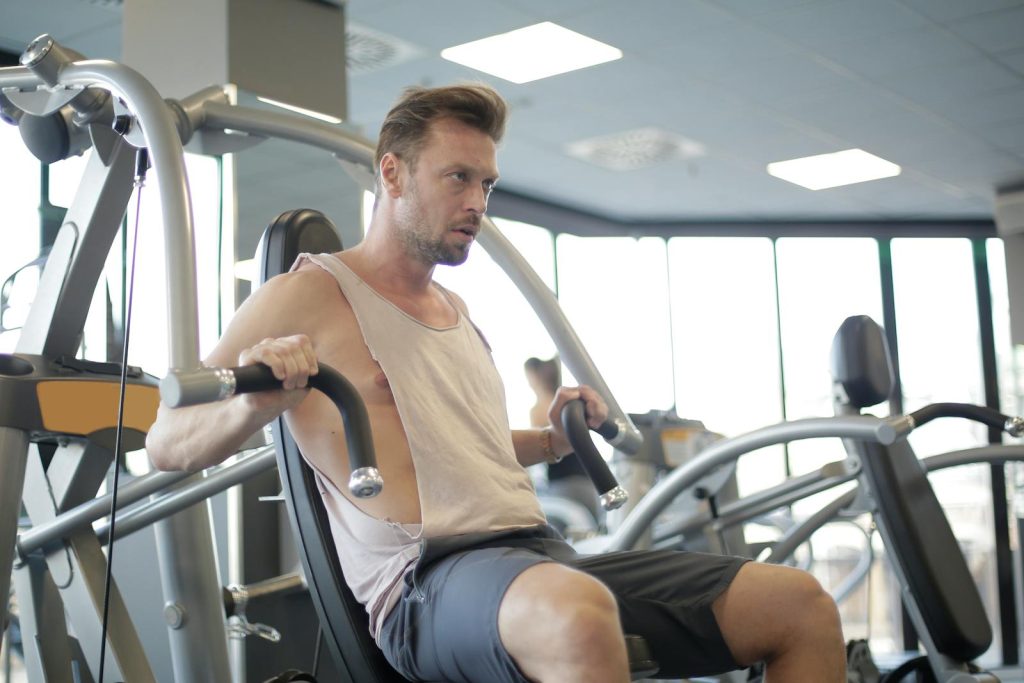
This guide covers the best chest machine exercises for overall chest development, upper-chest emphasis, lower-chest emphasis, safer progression, and more efficient workout planning. You will also learn proper form, muscles worked, common mistakes, and how to turn these exercises into a practical chest workout.
Why Chest Exercises With Machines Work for Size and Strength
Machine-based chest training works because it makes it easier to train hard with a repeatable path of motion, stable body position, and simple load progression. The latest ACSM update notes that equipment choice does not consistently change outcomes for the average healthy adult, while strength tends to respond best to heavier loading and hypertrophy benefits from enough total weekly volume, around 10 sets per muscle group. If you want a science-based overview, the ACSM resistance training guidelines update is a strong place to start.
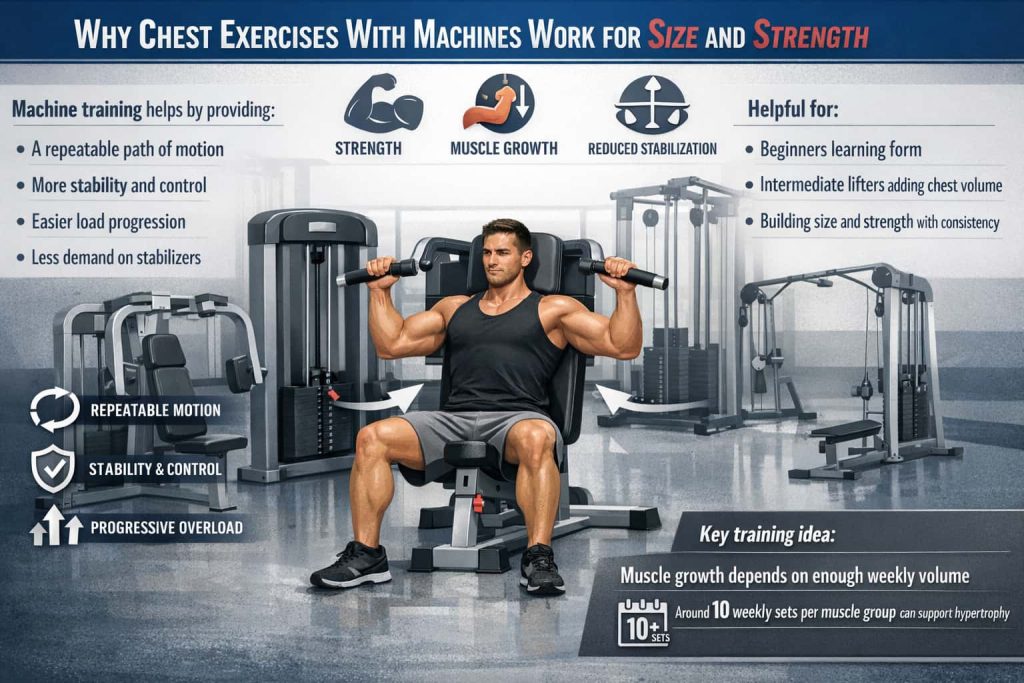
That is especially useful for chest training. The seated chest press reduces some of the stabilization demands seen in a bench press, which can help beginners learn the pattern and help intermediate lifters add more chest volume without as much extra fatigue. ACE chest research also found that the pec deck and cable crossover produced chest activation close to the barbell bench press, while the chest press machine still performed well enough to remain a staple option. The ACE chest exercise research summary is worth linking naturally in this section.
10 Best Chest Exercises With Machines
Build a bigger, stronger chest with these machine-based exercises that make it easier to train with control, consistency, and progressive overload. Below, you’ll find 10 of the best chest exercises with machines for muscle growth, better form, and more effective workouts.
1. Seated Chest Press Machine
Best for: Building foundational chest strength, learning pressing mechanics, and adding reliable chest volume with a stable setup. This is usually the best first machine chest exercise for beginners and still a great primary press for more advanced lifters.
Muscles worked: The pectorals do the main work, with help from the anterior deltoids and triceps.
Equipment needed: Seated chest press machine.
Why it stands out: The seated chest press is simple to set up, easy to progress, and beginner-friendly. It also lets you push hard without worrying about balancing a barbell or dumbbells, as explained by Verywell Fit.
Suggested sets and reps:
- Beginners: 2 to 3 sets of 8 to 12 reps.
- Intermediate: 3 to 4 sets of 6 to 10 reps.
- Advanced: 4 to 5 sets of 5 to 8 reps, plus one lighter back-off set of 10 to 12 reps if needed.
- Rest: 90 to 150 seconds.
How to do it:
- Adjust the seat so the handles line up around mid-chest.
- Sit tall with your feet flat and your back against the pad.
- Grip the handles with neutral wrists and keep your shoulder blades pulled back and down.
- Press the handles forward until your arms are straight but not locked.
- Pause briefly, then lower with control until the handles return close to your chest.
Common mistakes: Letting the elbows drift too far behind the body, arching the lower back, slamming the weight forward, and using more weight than you can control are the biggest problems here.
Coaching cue: Drive your hands straight forward and keep your chest tall against the pad.
Exercise variations: Single-arm machine chest press, neutral-grip chest press, or slightly higher-rep chest press for hypertrophy-focused work.
How to use in a workout: Put this first in your session when size and strength are both goals. It works especially well as your main chest press on a machine-only chest day.
2. Converging Chest Press Machine
Best for: Lifters who want a pressing pattern that feels more natural through the finish and like training each side evenly.
Muscles worked: Pectorals, front delts, and triceps.
Equipment needed: Converging chest press machine.
Why it stands out: A converging chest press lets the arms move inward slightly as you press, which often feels smoother and more natural than a fully fixed straight path. It is also useful for spotting left-right imbalances when the machine has independent arms, which is a point highlighted by Matrix Fitness.
Suggested sets and reps:
- Beginners: 2 to 3 sets of 8 to 10 reps.
- Intermediate: 3 to 4 sets of 6 to 10 reps.
- Advanced: 4 sets of 5 to 8 reps, then 1 set of 10 to 12 reps.
- Rest: 90 to 150 seconds.
How to do it:
- Set the seat so the handles start around mid-chest.
- Brace your torso and keep both feet planted.
- Press the handles up and slightly inward along the machine’s path.
- Finish with a strong chest contraction without shrugging.
- Lower slowly until you feel a controlled stretch in the chest.
Common mistakes: Pressing unevenly, letting one arm finish before the other, shrugging the shoulders, and bouncing out of the bottom.
Coaching cue: Press evenly with both arms and finish by squeezing the chest, not by rounding the shoulders.
Exercise variations: Single-arm converging press, plate-loaded converging press, or higher-rep pump sets after a heavier first press.
How to use in a workout: Use it as your main chest press if your gym has one, or rotate it with the standard chest press machine every few weeks.
3. Incline Chest Press Machine
Best for: Emphasizing the upper chest while still training a heavy compound press.
Muscles worked: Upper chest, anterior deltoids, and triceps.
Equipment needed: Incline chest press machine.
Why it stands out: The incline setup is one of the best machine options for bringing up the clavicular portion of the chest. It gives you more upper-chest bias than a flat press without needing the coordination demands of an incline barbell press, which aligns with equipment positioning used by Life Fitness.
Suggested sets and reps:
- Beginners: 2 to 3 sets of 8 to 12 reps.
- Intermediate: 3 to 4 sets of 6 to 10 reps.
- Advanced: 4 sets of 6 to 8 reps.
- Rest: 90 to 120 seconds.
How to do it:
- Set the seat so the handles start around upper-chest or shoulder level.
- Keep your back against the pad and your chest lifted.
- Press up and forward in line with the machine path.
- Stop just short of locking out hard.
- Lower slowly until the handles return near the upper chest.
Common mistakes: Setting the seat too low, flaring the elbows too aggressively, turning it into a shoulder press, and cutting the range of motion short.
Coaching cue: Think “press up through the upper chest,” not “press with the shoulders.”
Exercise variations: Plate-loaded incline press, unilateral incline press, or incline machine press with a slower eccentric.
How to use in a workout: Use it first if upper-chest size is your priority, or second after a flat press if you want more complete chest development.
4. Decline Chest Press Machine
Best for: Lower-chest emphasis, strong contractions through a guided pressing path, and machine-based chest variety.
Muscles worked: Lower chest, triceps, and anterior deltoids.
Equipment needed: Decline chest press machine.
Why it stands out: A good decline chest press machine gives a natural downward pressing path while keeping you in a secure seated position. That makes it useful for lower-chest focus without the awkward setup of a traditional decline bench, which is reflected in the design of Hammer Strength equipment.
Suggested sets and reps:
- Beginners: 2 to 3 sets of 8 to 12 reps.
- Intermediate: 3 to 4 sets of 6 to 10 reps.
- Advanced: 4 sets of 6 to 8 reps.
- Rest: 90 to 120 seconds.
How to do it:
- Adjust the seat and handles so the press starts in a strong, comfortable position.
- Brace your torso and keep your shoulders packed down.
- Press along the machine’s downward path.
- Finish without shrugging or lifting off the pad.
- Return under control to a comfortable stretch.
Common mistakes: Using too much load, lifting the hips or upper back, and forcing a deeper stretch than your shoulders tolerate.
Coaching cue: Press down and forward while keeping your ribcage quiet.
Exercise variations: Plate-loaded decline press, unilateral decline press, or decline press as a second heavy movement.
How to use in a workout: This fits well after a flat or incline press, especially if your goal is fuller lower-chest development.
5. Pec Deck Machine Chest Fly
Best for: Isolating the chest after pressing and adding hypertrophy-focused volume.
Muscles worked: Primarily the pectorals, with secondary help from the anterior deltoids.
Equipment needed: Pec deck or machine chest fly station.
Why it stands out: The pec deck is one of the best machine chest isolation exercises. ACE research found it produced chest activation very close to the bench press, which is a big reason it stays in serious chest-building programs.
Suggested sets and reps:
- Beginners: 2 sets of 10 to 15 reps.
- Intermediate: 3 sets of 10 to 15 reps.
- Advanced: 3 to 4 sets of 8 to 15 reps.
- Rest: 60 to 90 seconds.
How to do it:
- Set the seat so your elbows or forearms line up around shoulder height.
- Sit tall with your back firmly against the pad.
- Start with a slight bend in the elbows.
- Bring the arms inward until the pads or handles nearly meet.
- Pause, squeeze the chest, then return slowly.
Common mistakes: Going too heavy, lifting the upper back off the pad, shortening the range, and forcing the shoulders too far back.
Coaching cue: Hug the weight in with your chest instead of swinging your arms.
Exercise variations: Handle-based chest fly machine, single-arm pec deck, or slow-tempo pec deck.
How to use in a workout: Put this after your pressing work for chest isolation. If your shoulders are sensitive, use a moderate range of motion and skip it if the setup bothers the joint.
6. Seated Cable Press
Best for: Chest pressing with a slightly freer path than a standard machine, while still keeping a supported setup.
Muscles worked: Chest, front delts, and triceps.
Equipment needed: Cable press station with a bench or seated support.
Why it stands out: The seated cable press blends machine stability with a cable’s smoother line of resistance. It is a strong option when you want a chest press that feels less rigid than a fixed machine, as shown in the ACE exercise library.
Suggested sets and reps:
- Beginners: 2 to 3 sets of 10 to 12 reps.
- Intermediate: 3 to 4 sets of 8 to 12 reps.
- Advanced: 4 sets of 8 to 10 reps.
- Rest: 75 to 120 seconds.
How to do it:
- Set the seat so the handles start around mid-chest.
- Sit with your back supported, feet planted, and chest up.
- Pull your shoulders back and down.
- Press the handles straight forward.
- Return slowly until the handles come close to your chest.
Common mistakes: Letting the shoulders round forward, pressing with loose wrists, and rushing the negative.
Coaching cue: Keep your shoulder blades quiet and let the chest do the work.
Exercise variations: Single-arm seated cable press or unsupported upright seated cable press.
How to use in a workout: Use this as your second press after a heavier machine chest press, or as your primary press when a fixed machine does not feel good on your joints.
7. Seated Incline Cable Press
Best for: Upper-chest work with a cable path and supported torso position.
Muscles worked: Upper chest, anterior deltoids, and triceps.
Equipment needed: Incline cable press station or adjustable bench with cables.
Why it stands out: This gives you upper-chest emphasis like an incline press but with the cable’s more adjustable line of resistance. It is an excellent alternative when a fixed incline machine does not fit your structure well, which is why the movement appears in the ACE library.
Suggested sets and reps:
- Beginners: 2 sets of 10 to 12 reps.
- Intermediate: 3 sets of 8 to 12 reps.
- Advanced: 3 to 4 sets of 6 to 10 reps.
- Rest: 75 to 120 seconds.
How to do it:
- Set the handles around shoulder level.
- Sit back with your upper back supported and feet flat.
- Start with the handles near the upper chest.
- Press up and forward to forehead level.
- Return under control without losing shoulder position.
Common mistakes: Turning the rep into a shoulder-dominant press, shrugging up, and losing back contact with the pad.
Coaching cue: Keep the press angled from upper chest to eye level.
Exercise variations: Single-arm incline cable press or incline cable press with a paused stretch.
How to use in a workout: Put this in place of an incline machine press or use it as the last pressing exercise before flyes.
8. Standing Cable Chest Fly
Best for: Constant tension, chest isolation, and adding controlled volume without very heavy loading.
Muscles worked: Pectorals, with secondary help from the front delts and stabilizers.
Equipment needed: Dual adjustable cable machine.
Why it stands out: Cable flyes keep tension on the chest through a long range and are easy to adjust for feel. ACE chest research also found cable crossover patterns among the strongest chest activators tested.
Suggested sets and reps:
- Beginners: 2 sets of 12 to 15 reps.
- Intermediate: 3 sets of 10 to 15 reps.
- Advanced: 3 to 4 sets of 10 to 15 reps.
- Rest: 45 to 75 seconds.
How to do it:
- Set the pulleys slightly above shoulder height.
- Step forward into a split stance.
- Keep a soft bend in the elbows.
- Sweep the handles inward until the hands meet in front of the body.
- Return slowly without letting the shoulders dump forward.
Common mistakes: Straightening the elbows too much, crossing the hands excessively, and letting the arms drift too far behind the torso.
Coaching cue: Think wide arc, soft elbows, hard chest squeeze.
Exercise variations: Single-arm cable fly, staggered-stance cable fly, or paused cable fly.
How to use in a workout: Use it after your main presses for 2 to 4 quality hypertrophy sets.
9. Low-to-High Cable Fly
Best for: Upper-chest bias and finishing the chest with a strong contraction.
Muscles worked: Upper chest, front delts, and serratus support.
Equipment needed: Dual adjustable cable machine set low.
Why it stands out: The low-to-high path is one of the best cable patterns for bringing more upper-chest emphasis into a machine-based workout. The ACE incline cable fly setup places the handles low and finishes above chest level, which matches the upper-chest bias most lifters are after.
Suggested sets and reps:
- Beginners: 2 sets of 12 to 15 reps.
- Intermediate: 3 sets of 10 to 15 reps.
- Advanced: 3 to 4 sets of 10 to 15 reps.
- Rest: 45 to 75 seconds.
How to do it:
- Set the pulleys between knee and hip height.
- Stand tall in a split stance with a slight bend in the elbows.
- Sweep the handles upward and inward.
- Finish with the hands meeting around face level or slightly above chest height.
- Lower slowly and keep your torso upright.
Common mistakes: Leaning forward too much, using momentum, and turning the movement into a press.
Coaching cue: Lift through the upper chest, not through the traps.
Exercise variations: Single-arm low-to-high cable fly or incline cable fly with a slower lowering phase.
How to use in a workout: This is one of the best final exercises on upper-chest focused days.
10. High-to-Low Cable Fly
Best for: Lower-chest emphasis, stretch under control, and pump work at the end of a chest session.
Muscles worked: Lower chest, anterior deltoids, and serratus support.
Equipment needed: Dual adjustable cable machine set high.
Why it stands out: The high-to-low cable fly gives you a decline-style line of pull without needing a decline bench. The ACE decline cable fly setup brings the hands together below chest level, which makes it a smart lower-chest accessory.
Suggested sets and reps:
- Beginners: 2 sets of 12 to 15 reps.
- Intermediate: 3 sets of 10 to 15 reps.
- Advanced: 3 to 4 sets of 10 to 15 reps.
- Rest: 45 to 75 seconds.
How to do it:
- Set the pulleys around head height.
- Take a split stance and brace your core.
- Keep a soft bend in the elbows.
- Sweep the handles down and inward until they meet just below chest level.
- Return under control without letting the shoulders over-stretch.
Common mistakes: Leaning too far forward, going too heavy, and letting the hands travel far behind the torso.
Coaching cue: Pull down in an arc and squeeze the lower chest at the bottom.
Exercise variations: Single-arm high-to-low fly or high-to-low fly with a one-second squeeze.
How to use in a workout: Use it late in the workout after presses and overall chest flyes when you want extra lower-chest work.
How to Build a Chest Workout With Machines
The simplest structure is to start with your heaviest press, follow it with a second press at a different angle, and finish with one or two fly variations. That setup gives you the best mix of overload and chest-focused volume. For strength, lean harder into lower reps on the first press. For size, make sure your weekly chest volume is high enough and your technique stays controlled, which matches current ACSM guidance.
A practical progression method is simple: stay within a rep range, hit the top of that range with clean form for all sets, then increase the load slightly next time. That works especially well on machine presses because the path is repeatable and easier to track session to session.
Sample Chest Machine Workout Routine
Beginner option
- Seated chest press machine — 3 sets of 8 to 10
- Incline chest press machine — 2 sets of 8 to 10
- Pec deck machine chest fly — 2 sets of 12 to 15
- Standing cable chest fly — 2 sets of 12 to 15
Intermediate option
- Converging chest press machine — 4 sets of 6 to 8
- Incline chest press machine — 3 sets of 8 to 10
- Seated cable press — 3 sets of 8 to 12
- Pec deck machine chest fly — 3 sets of 10 to 15
- High-to-low cable fly — 2 to 3 sets of 12 to 15
Accessory finisher option
- Low-to-high cable fly — 2 sets of 15
- Standing cable chest fly — 2 sets of 12 to 15
- Pec deck partials in the shortened range — 1 burnout set
Most lifters do well with one or two chest-focused sessions per week. If your goal is size, spread your chest work across the week so you can keep quality high instead of cramming too much into one day.
FAQs
Are chest exercises with machines good for building muscle?
Yes. Current ACSM guidance says equipment choice does not consistently change outcomes for the average healthy adult, and machine-based exercises are absolutely capable of building chest size when effort, progression, and weekly volume are in place.
What is the best machine chest exercise for beginners?
The seated chest press machine is usually the best starting point because it is easy to learn, easy to load, and easier to control than many free-weight presses, as shown by Verywell Fit.
Which machine chest exercise is best for upper chest?
The incline chest press machine is usually the best heavy option, while the low-to-high cable fly and seated incline cable press are strong accessories for extra upper-chest emphasis.
Which machine chest exercise is best for lower chest?
The decline chest press machine and high-to-low cable fly are two of the best machine-based choices for lower-chest emphasis.
Should I do pec deck before or after chest press?
Most people should do the pec deck after chest press variations. Presses let you use more load and should usually come first, while the pec deck works best as chest isolation volume later in the workout, which lines up with ACE chest exercise comparisons.
Can I build a full chest using only machines?
Yes. You can cover the whole chest with a combination of flat or converging presses, incline presses, decline patterns, pec deck work, and cable fly variations.
Conclusion
The best chest exercises with machines combine stable heavy pressing with controlled fly work. Use a flat or converging press as your foundation, add incline or decline work to cover more angles, and finish with pec deck or cable fly variations for extra chest volume.
A smart place to start is simple: choose 3 to 5 of these exercises, train them consistently, and progress the weight or reps over time. If any machine causes sharp pain, numbness, dizziness, or unusual joint discomfort, stop and get qualified help before pushing through it.
References
- American College of Sports Medicine (ACSM) — ACSM Unveils Landmark 2026 Resistance Training Guidelines
- American Council on Exercise (ACE) — What Are the Top 3 Most Effective Chest Exercises?
- American Council on Exercise (ACE) — An Evidence-Based Approach to Training the Chest
- American Council on Exercise (ACE) — Seated Cable Press Exercise Library
- American Council on Exercise (ACE) — Seated Incline Cable Press Exercise Library
- NCBI Bookshelf — Anatomy, Thorax, Pectoralis Major