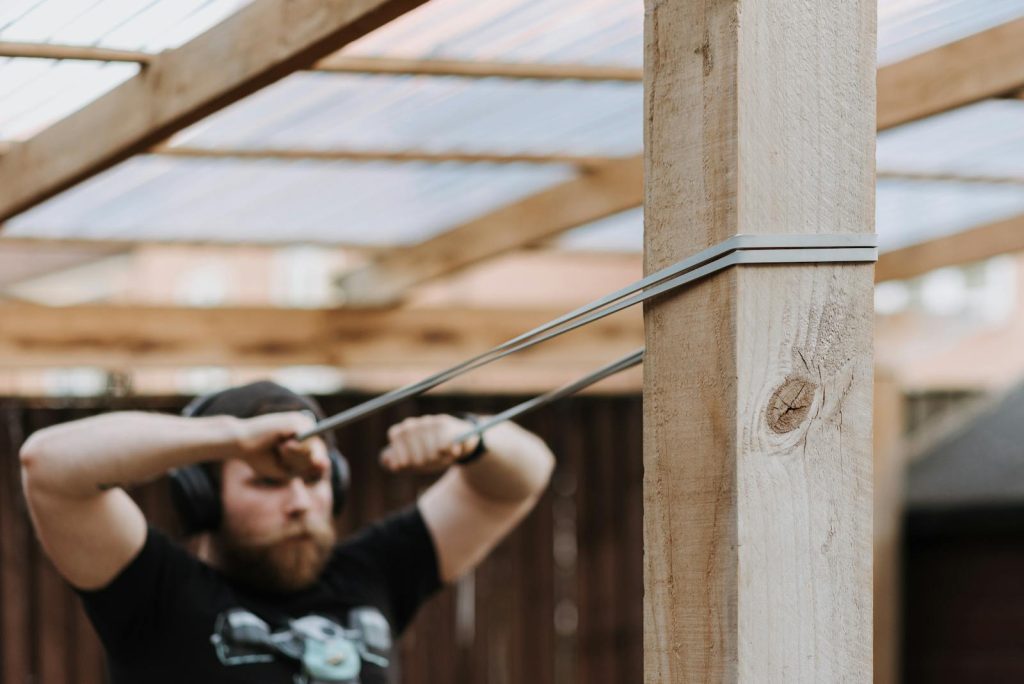
Face pulls are one of the most useful upper-body accessory exercises for building the rear delts and upper back while supporting shoulder stability and better posture. They are typically done with a cable rope set around eye height, although a resistance band works well too.
The movement is especially valuable in push-heavy programs where pressing volume is much higher than pulling volume. According to NASM, face pulls can help develop posterior shoulder and upper-back strength while supporting shoulder stability and posture-focused training.
This guide covers how to do face pulls correctly, which muscles they train, why they work, the mistakes that reduce their value, and how to program them in a practical routine. The goal is simple: help you get more out of the exercise without turning it into a sloppy shrug-and-yank.
What Face Pulls Are Best For
Face pulls are best for improving rear-delt strength, upper-back engagement, and shoulder-friendly pulling volume. They are a practical accessory exercise for lifters who want more pulling balance in routines dominated by bench presses, push-ups, overhead presses, or chest machines.
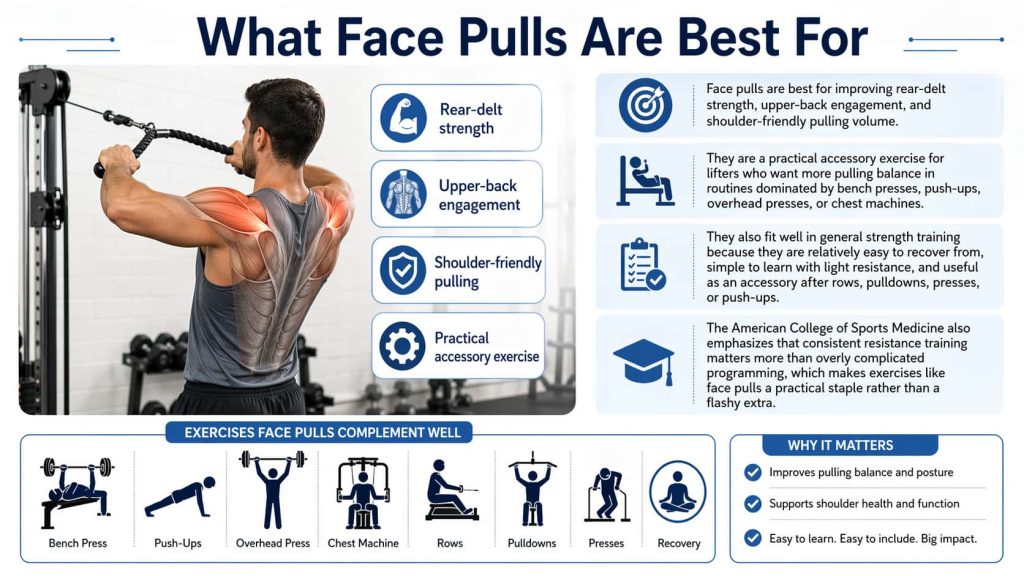
They also fit well in general strength training because they are relatively easy to recover from, simple to learn with light resistance, and useful as an accessory after rows, pulldowns, presses, or push-ups. The American College of Sports Medicine also emphasizes that consistent resistance training matters more than overly complicated programming, which makes exercises like face pulls a practical staple rather than a flashy extra.
Face Pull Muscles Worked
The main muscles worked in face pulls are the posterior deltoids, rhomboids, and middle trapezius. NASM also lists the infraspinatus and biceps brachii as supporting muscles during the movement. In simple terms, face pulls train the back side of the shoulders and the upper back muscles that help control scapular position and pulling mechanics.
That muscle emphasis is a big reason face pulls pair so well with bench presses, push-ups, machine presses, and other front-dominant upper-body work. If your training has lots of pressing and not much direct rear-delt or upper-back work, face pulls can help balance that out. The American Council on Exercise also highlights the value of including exercises that strengthen the muscles supporting posture and upper-back function.
Face Pull Exercise Breakdown
Best for: Rear-delt development, upper-back training, shoulder-friendly accessory work, and improving pulling balance in upper-body programs.
Equipment needed: A cable machine with a rope attachment is the standard setup. A resistance band can also work well when a cable is not available.
Suggested sets and reps: NASM specifically recommends 3 sets of 12 to 15 reps for postural muscle development and shoulder health. For most lifters, that moderate-to-high rep range works better than chasing heavy weight. A practical range is 2 to 4 sets of 10 to 20 reps depending on the goal and exercise placement.
How to do it:
- Attach a rope handle to a cable machine at about eye height.
- Stand facing the cable with feet about hip-width apart and knees slightly bent.
- Grab the rope and step back until there is tension.
- Brace your core and keep your shoulders set back and down.
- Pull the rope toward your face while driving your elbows back.
- Think about retracting the shoulder blades and squeezing the rear delts and upper back.
- Finish with the hands near the sides of the face or ears.
- Return to the start slowly without letting the weight yank you forward.
Coaching cue: “Pull the rope to your face, elbows back, shoulders down, and squeeze the upper back.” This cue keeps the emphasis on quality contraction instead of just moving the handle.
How to use in a workout: Face pulls work best as an accessory after your main upper-body lifts or near the end of the session as quality volume for the rear delts and upper back. They can also fit into a warm-up if the load stays light and the goal is activation rather than fatigue.
How to Do Face Pulls With Proper Form
The setup matters more than most people think. Start with the rope around eye height, not too low. If the pulley is set too low, the movement often turns into more of a row. If it is set too high, it becomes harder to keep tension where you want it. Eye-level setup helps keep the line of pull closer to the intended rear-delt and upper-back pattern.
Your torso should stay stable from start to finish. Keep a soft bend in the knees, brace the abs, and avoid leaning way back to move the weight. A small staggered stance can help some lifters feel more stable, especially with bands or if cable balance is an issue.
As you pull, think about leading with the elbows and letting the shoulder blades move into retraction instead of cranking the hands backward first. The goal is not just to bring the rope in. The goal is to make the rear delts and upper back do the work while the neck stays relaxed and the shoulders do not creep upward.
On the return, control the weight. The lowering phase is where many lifters lose tension and posture. Letting the cable snap forward usually means the load is too heavy or the set is going past the point where good reps are possible. Controlled returns are part of what makes face pulls effective with moderate weight.
Benefits of Face Pulls
1. They train muscles many people undertrain
A lot of programs overemphasize chest, anterior delts, and triceps. Face pulls help bring more work to the posterior shoulder and upper back, which can make an upper-body plan feel more balanced. That does not mean face pulls “fix” every posture issue on their own, but they can be a useful part of a better-balanced routine.
2. They support shoulder-friendly upper-body training
Face pulls use relatively light loading and controlled motion, which makes them a good choice for accessory work when heavy pressing or heavy rowing has already taken a toll. NASM specifically describes face pulls as helpful for shoulder stability and posture correction when used correctly.
3. They fit corrective and performance-focused programs
NASM includes face pulls among upper-back corrective exercises and links that general category to issues like altered upper-body posture and rounded-shoulder patterns. That does not make face pulls a medical treatment, but it does make them a practical training tool for lifters who spend a lot of time sitting, pressing, or living in a forward-rounded position.
4. They are easy to scale
You can do face pulls with a cable or a band, keep the resistance light, and still get useful training volume. The American College of Sports Medicine also notes that nontraditional resistance options like elastic bands and home-based routines can produce meaningful benefits, which makes band face pulls a legitimate option rather than a backup plan.
Common Face Pull Mistakes to Avoid
Using too much weight
This is the most common mistake. If you have to lean back hard, jerk the rope, or lose the finish position, the load is too heavy. Face pulls usually work better with lighter resistance and cleaner reps.
Shrugging the shoulders
If your shoulders rise toward your ears during the pull, you are losing the intended pattern. Keep the neck relaxed and think “shoulders down” as the elbows move back. This helps keep tension where you want it instead of shifting the stress upward into the neck and upper traps.
Pulling with the hands instead of the elbows
When people focus only on getting the rope close to the face, they often overuse the arms and underuse the rear delts and upper back. Think elbows back, upper back tight, then finish the rep.
Cutting reps short
A half-rep face pull usually becomes a weak partial row. You want a controlled finish with the rope near the face and the upper back fully engaged.
Letting the return turn sloppy
The eccentric matters. If the weight snaps you forward, the set is no longer doing what you want. Lower with control and keep tension through the return.
Beginner, Intermediate, and Advanced Application
Beginners
Start with a resistance band or a light cable load. Focus on feeling the rear delts and upper back rather than trying to make the stack look impressive. A good starting point is 2 to 3 sets of 10 to 15 reps with slow, clean reps. This matches the general idea of building skill and consistency before pushing load.
Intermediate lifters
Use face pulls as a regular accessory on upper-body or pull days. 3 to 4 sets of 12 to 20 reps works well for most lifters, especially if you pause the squeeze briefly at the end. Progress by improving control, adding a small amount of load, or increasing total weekly volume gradually.
Advanced lifters
Advanced trainees often benefit from using face pulls as high-quality volume rather than as a max-effort movement. They fit well as a shoulder-balance exercise after pressing, between heavier pulling sets, or in a finisher with rear-delt raises or band pull-aparts. The American College of Sports Medicine also notes that weekly volume can be adjusted to support muscle growth goals, which is where advanced lifters can use face pulls strategically without treating them like a primary strength lift.
Best Face Pull Variations
1. Band Face Pull
Best for: The band face pull is best for home training, beginners, warm-ups, and anyone who wants a joint-friendly version of the exercise. It works well when the goal is to practice clean movement, improve rear-delt and upper-back activation, or add light accessory volume without needing a cable machine.
Muscles worked: This variation mainly works the rear delts, rhomboids, and middle traps. It also involves the upper back and smaller shoulder-support muscles that help control scapular movement and keep the pull smooth and stable.
Equipment needed: You need a resistance band and a secure anchor point set around face or eye height. A light to moderate band usually works best because it allows better control and cleaner reps.
Why it stands out: This version stands out because it is simple, accessible, and easy to scale. It is a strong choice for learning the movement pattern, getting in extra upper-back work at home, or using as a low-fatigue activation drill before heavier upper-body training.
Suggested sets and reps:
- Beginners: Beginners can start with 1 to 2 sets of 10 to 15 reps using a light band and slow tempo. The focus should be on control, not band tension.
- Intermediate: Intermediate lifters can use 2 to 4 sets of 12 to 20 reps. A slightly stronger band or a brief squeeze at the end of each rep can make the set more effective.
- Advanced: Advanced lifters can use 3 to 4 sets of 15 to 25 reps as accessory volume, activation work, or part of a finisher. More band tension should only be added if form stays clean.
- Rest: Rest about 30 to 60 seconds between sets. If you are using this in a warm-up, shorter rest is usually enough. If you are using it as a finisher, rest just long enough to keep rep quality high.
How to do it:
- Anchor the band at about face height.
- Grab the band with both hands and step back until there is light tension.
- Stand tall with your core braced and knees slightly bent.
- Pull the band toward your face while driving your elbows back.
- Keep your shoulders down and think about squeezing the rear delts and upper back.
- Pause briefly at the end if you can maintain control.
- Return to the start slowly without letting the band snap you forward.
Common mistakes: The most common mistakes are using too much band tension, shrugging the shoulders, rushing the reps, and letting the elbows drop too low. Another mistake is standing too close to the anchor, which reduces tension and makes the movement less effective.
Expert tip: Use a lighter band than you think you need and focus on feeling the rear delts and upper back working. If you cannot pause the finish position without losing posture, the band is probably too strong.
2. Cable Face Pull With Pause
Best for: This variation is best for lifters who already know the basic face pull pattern and want better control, stronger end-range contraction, and more quality from moderate loads. It is especially useful for people who tend to rush reps or let momentum take over.
Muscles worked: The cable face pull with pause mainly targets the rear delts, rhomboids, and middle traps. The pause increases time under tension and can help you feel the upper back and posterior shoulders working more clearly.
Equipment needed: You need a cable machine with a rope attachment. Setting the pulley around eye height usually gives the best line of pull for this variation.
Why it stands out: This version stands out because the pause makes it harder to cheat. It improves body awareness, reinforces a strong finish position, and helps turn a basic accessory exercise into a more controlled and effective upper-back movement without needing heavy weight.
Suggested sets and reps:
- Beginners: Beginners can use 2 sets of 8 to 12 reps with a light load and a short one-second pause. The goal is to learn control before adding more volume.
- Intermediate: Intermediate lifters can use 3 to 4 sets of 10 to 15 reps with a one- to two-second pause at the contraction. This is often the sweet spot for quality accessory work.
- Advanced: Advanced lifters can use 3 to 5 sets of 12 to 20 reps, especially after pressing or rowing work. Longer pauses can increase difficulty without needing more load.
- Rest: Rest about 45 to 75 seconds between sets. Because the pause increases difficulty, slightly longer rest can help maintain rep quality.
How to do it:
- Set a rope attachment on a cable machine at eye height.
- Grab the rope and step back until the cable is under tension.
- Stand in a stable stance with your core braced and chest up.
- Pull the rope toward your face while driving the elbows back and out.
- Finish with your hands near the sides of your face and your upper back fully engaged.
- Hold the contraction for one to two seconds without shrugging.
- Return to the start slowly and repeat with control.
Common mistakes: Common mistakes include using too much weight, shortening the pause, leaning back to move the load, and turning the movement into a sloppy row. Some lifters also lose the purpose of the variation by pausing in a weak position instead of at a strong, controlled finish.
Expert tip: Think of the pause as a quality check. If you cannot hold the top position with your shoulders down and upper back tight, reduce the load and clean up the rep.
3. Half-Kneeling Face Pull
Best for: The half-kneeling face pull is best for lifters who need better torso control and less body sway during the exercise. It is useful for anyone who tends to lean back, overuse momentum, or lose posture during standing face pulls.
Muscles worked: This variation still mainly trains the rear delts, rhomboids, and middle traps, but the half-kneeling setup also increases the demand on core stability and body positioning. It helps lock the torso in place so the upper back does more of the work.
Equipment needed: You need a cable machine with a rope attachment or a resistance band anchored around face height. A pad or folded mat under the down knee can make the setup more comfortable.
Why it stands out: This version stands out because it reduces cheating and improves movement discipline. By removing some lower-body involvement and limiting torso sway, it helps many lifters perform cleaner reps and feel the target muscles more clearly.
Suggested sets and reps:
- Beginners: Beginners can use 1 to 2 sets of 8 to 12 reps per side of stance with light resistance. The priority is balance, posture, and smooth execution.
- Intermediate: Intermediate lifters can use 2 to 4 sets of 10 to 15 reps with moderate resistance. This works well when the goal is stricter accessory work.
- Advanced: Advanced lifters can use 3 to 4 sets of 12 to 20 reps as part of upper-body accessory training or movement-quality work. A brief pause can make this variation even more demanding.
- Rest: Rest about 45 to 75 seconds between sets. If balance or setup is a limiting factor, taking a bit more time between sets can help keep technique clean.
How to do it:
- Set the rope or band at about face height.
- Get into a half-kneeling stance facing the anchor point.
- Brace your core and keep your torso tall.
- Grab the handle with both hands and create light tension.
- Pull toward your face while driving your elbows back.
- Keep your hips steady and avoid leaning away from the resistance.
- Finish with the upper back engaged and the shoulders down.
- Return slowly to the start and repeat.
Common mistakes: The main mistakes are letting the hips shift, arching the lower back, rushing the movement, and using too much load. Some lifters also become so focused on kneeling balance that they forget to finish the pull with full upper-back engagement.
Expert tip: Squeeze the glute of the down-leg side and brace your abs before each rep. That small setup adjustment often makes the movement feel much more stable and keeps the torso from drifting.
How to Use Face Pulls in a Workout
The American Council on Exercise recommends including work from different back regions across the week, either in a focused back session or spread across full-body training. Face pulls fit best as upper-back and rear-delt accessory work rather than your main heavy pull.
Here are practical options:
Beginner option
- 1 upper-body session 2 to 3 times per week
- Pressing movement
- Rowing movement
- Face pulls: 2 to 3 sets of 10 to 15
- Optional curls or triceps work
This works well if you are learning basic movement patterns and need more balanced pulling volume.
Intermediate option
- Pull-ups or pulldowns
- Chest-supported row or cable row
- Face pulls: 3 sets of 12 to 20
- Rear-delt raises
- Biceps work
This setup gives face pulls a useful support role without wasting energy you need for larger compound lifts.
Accessory finisher option
- Face pulls: 15 reps
- Band pull-aparts: 15 to 20 reps
- Repeat for 2 to 3 rounds
This is a simple way to finish an upper-body workout with extra rear-delt and upper-back volume.
Face Pull Safety Tips
Face pulls should feel like muscular work in the rear shoulders and upper back, not sharp joint pain. The American Academy of Orthopaedic Surgeons is clear that you should not feel pain during an exercise and should talk with a doctor or physical therapist if pain occurs while training.
Stop the set and get qualified help if you feel sharp pain, numbness, unusual clicking with pain, dizziness, or symptoms that keep returning even with lighter resistance and better form. For many people, simply reducing the weight, slowing the reps, and cleaning up the finish position solves the problem, but pain is not something to push through.
FAQ About Face Pulls
Are face pulls a shoulder exercise or a back exercise?
Both. Face pulls mainly train the rear delts and upper back, especially the rhomboids and middle traps, so they sit right between shoulder and back accessory work.
How many reps should I do for face pulls?
A moderate-to-high rep range usually works best. NASM specifically recommends 3 sets of 12 to 15 reps for postural muscle development and shoulder health.
Should face pulls be heavy?
Usually no. Most lifters get more from lighter, cleaner reps than from heavy, sloppy sets. If the load forces shrugging, leaning back, or momentum, it is too heavy.
Can I do face pulls with a resistance band?
Yes. A resistance band is a practical alternative to a cable machine, and the American College of Sports Medicine recognizes elastic bands as effective resistance-training tools.
Where should face pulls go in a workout?
They usually work best after your main compound lifts or near the end of an upper-body workout as accessory volume for the rear delts and upper back.
Are face pulls enough for rear-delt training?
They are very useful, but they do not have to be your only rear-delt exercise. Many lifters do well pairing them with rows, reverse fly variations, or band pull-aparts for more complete upper-back and posterior-shoulder volume.
Conclusion
Face pulls are a simple exercise, but they earn their place in a lot of programs. They train the rear delts and upper back, support better shoulder mechanics, and add useful pulling volume without needing heavy loads. When you keep the rope around eye height, lead with the elbows, avoid shrugging, and control the return, face pulls become much more effective.
A smart next step is to add face pulls to your routine 2 to 3 times per week and keep them crisp, controlled, and moderately light. For most people, that approach works better than trying to turn them into a max-effort movement. If the exercise causes sharp pain, numbness, dizziness, or other unusual symptoms, stop and get professional guidance.
References
- National Academy of Sports Medicine (NASM) — Face Pull Exercise Library
- National Academy of Sports Medicine (NASM) — 12 Great Corrective Exercises for the Upper Back
- American Council on Exercise (ACE) — Back Exercises That Build Muscle
- American College of Sports Medicine (ACSM) — Resistance Training Prescription for Muscle Function, Hypertrophy, and Physical Performance in Healthy Adults: An Overview of Reviews
- American Academy of Orthopaedic Surgeons (AAOS) — Rotator Cuff and Shoulder Conditioning Program
- Schory et al. — A Systematic Review of the Exercises That Produce Optimal Muscle Ratios of the Scapular Stabilizers
- Currier et al. — Resistance Training Prescription for Muscle Strength and Hypertrophy: A Systematic Review and Bayesian Meta-Analysis
- Schoenfeld et al. — Loading Recommendations for Muscle Strength, Hypertrophy, and Local Endurance: A Re-Examination of the Repetition Continuum