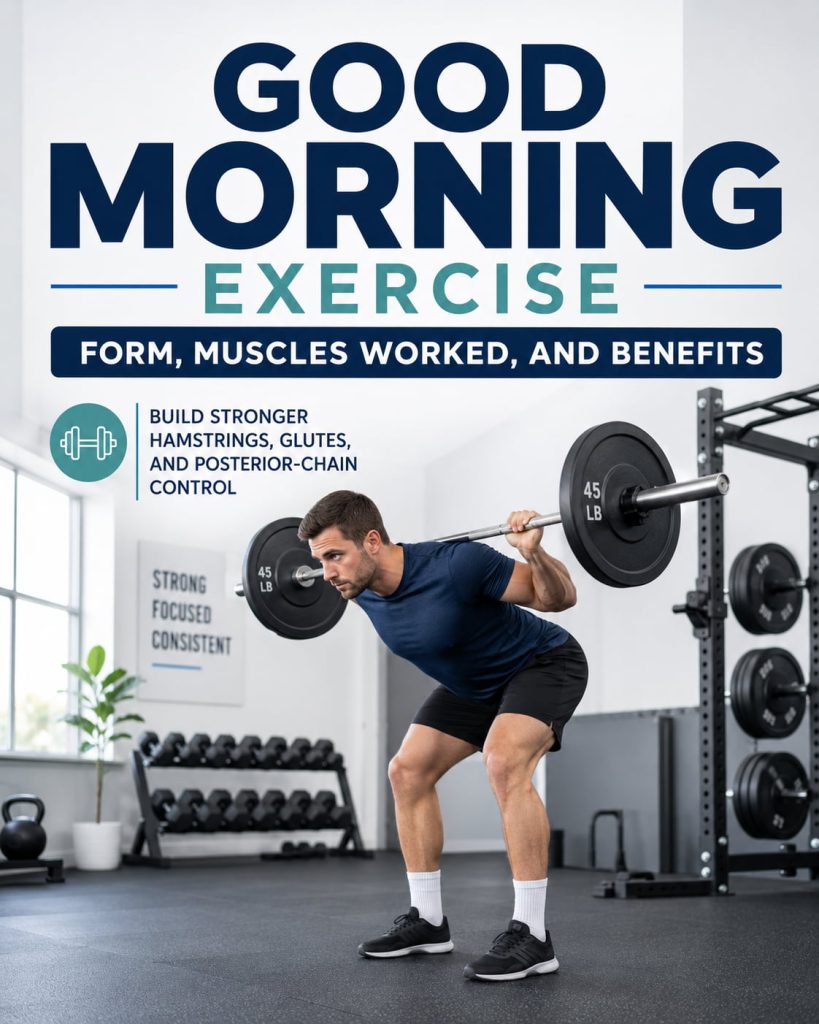
The good morning exercise is a hip-hinge strength move that trains the hamstrings, glutes, spinal erectors, and core while teaching you how to bend at the hips with control. It is usually performed with a barbell across the upper back, but beginners can start with bodyweight, a dowel, a resistance band, or a very light load.
This guide explains how to do the good morning exercise correctly, which muscles it works, common mistakes to avoid, safer beginner options, useful progressions, and how to add it to a workout.
What Is the Good Morning Exercise?
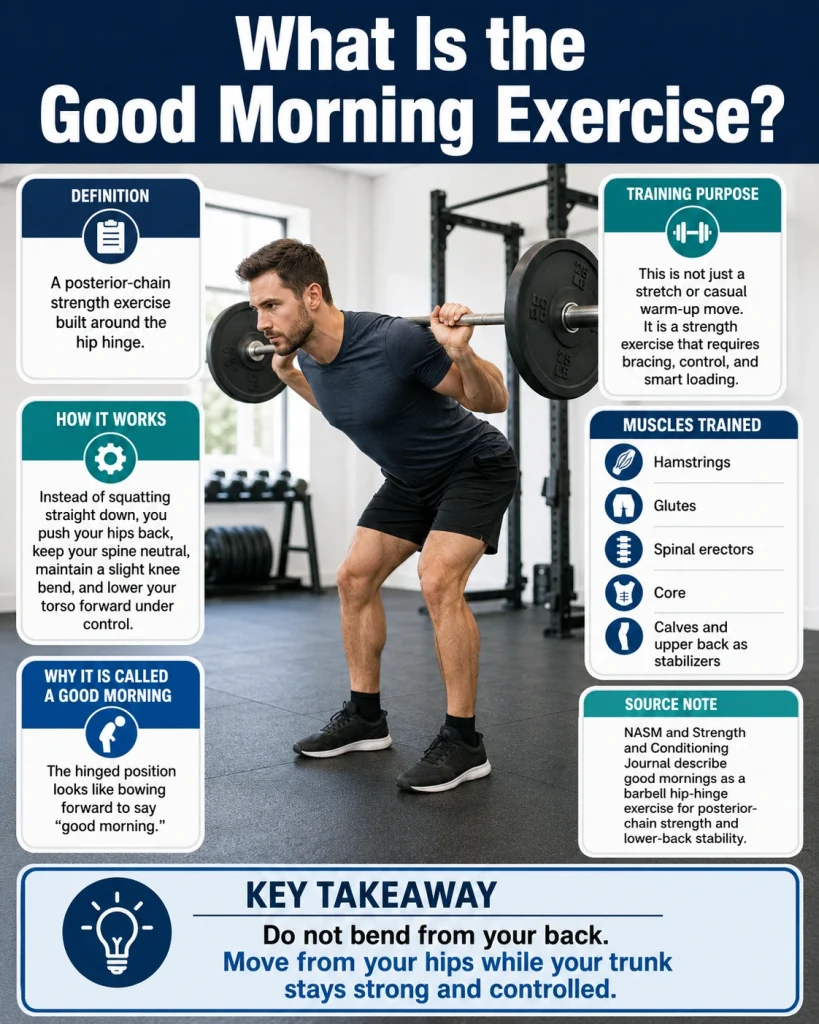
The good morning exercise is a posterior-chain strength exercise built around the hip hinge. Instead of squatting straight down, you push your hips back, keep your spine neutral, maintain a slight knee bend, and lower your torso forward under control.
The movement gets its name because the hinged position looks a little like bowing forward to say “good morning.” In training, however, it is not a stretch or a casual warm-up move. It is a strength exercise that requires bracing, control, and smart loading.
According to the National Academy of Sports Medicine, good mornings are performed with a barbell across the upper back and are used to develop posterior-chain strength, hip-hinge mechanics, and lower-back stability. A review in the Strength and Conditioning Journal also describes the good morning as a barbell hip-hinge exercise that trains the hamstrings, gluteal muscles, spinal erectors, and calf complex.
The key point is simple: the good morning is not about bending your back. It is about moving from the hips while your trunk stays strong and controlled.
Good Morning Exercise Muscles Worked
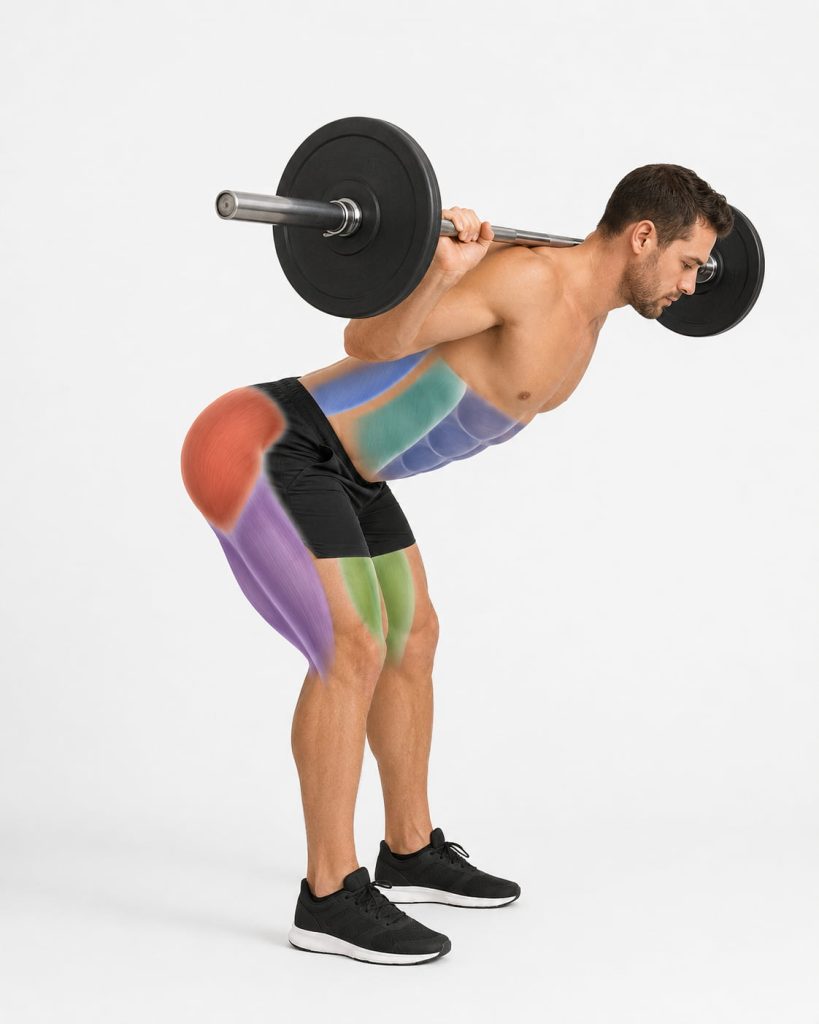
The good morning exercise mainly targets the muscles on the back side of the body. These muscles work together to control the hinge, stabilize the spine, and bring you back to standing.
Hamstrings
The hamstrings are one of the main muscle groups trained during good mornings. They lengthen as you push your hips back and help extend the hips as you return to standing.
You should feel controlled tension through the back of your thighs, not sharp pulling behind the knee or strain in the lower back.
Glutes
The gluteus maximus helps drive hip extension. As you stand up, your glutes help bring your hips forward and finish the rep.
Good mornings can be useful for lifters who want more glute and hamstring work without relying only on deadlifts or hip thrusts.
Erector Spinae
The erector spinae muscles run along the spine. During the good morning, they should work mostly as stabilizers to help keep the spine neutral.
They are not meant to round and straighten the back repeatedly. If your lower back is doing all the work, the load is likely too heavy, your range of motion is too deep, or your hinge mechanics need work.
Core
Your abs, obliques, and deeper trunk muscles help brace the torso. A strong brace keeps your ribs, pelvis, and spine controlled as the bar tries to pull your torso forward.
Adductors, Upper Back, and Calves
The adductors assist with hip control, especially in a slightly wider stance. The upper back and traps help support the bar position. The calves help stabilize the lower leg and foot position.
Benefits of the Good Morning Exercise
The good morning exercise is valuable because it trains strength, control, and movement skill at the same time.
1. Builds Posterior-Chain Strength
Good mornings train the hamstrings, glutes, and spinal erectors together. These muscles are important for hip extension, lifting mechanics, sprinting, jumping, and many lower-body strength exercises.
For strength training, the good morning is often used as an accessory lift after squats or deadlifts.
2. Teaches the Hip Hinge
Many lifters struggle to separate a hip hinge from a squat. The good morning helps teach that difference because your hips must move back while your knees bend only slightly.
The American Council on Exercise describes the hip hinge as a movement where the hips shift backward, the torso leans forward, and the knees move only slightly. That same pattern is the foundation of a good morning.
3. Strengthens Hamstrings in a Lengthened Position
During the lowering phase, the hamstrings work while lengthening. This makes the exercise useful for building controlled strength through the back of the thighs.
A study published on PubMed Central found that hamstring and spinal erector muscle activity tended to increase as good morning load increased. This supports using the exercise with careful progression instead of rushing into heavy loading.
4. Supports Squat and Deadlift Training
The good morning can build the hip-hinge strength and trunk control needed for stronger squats, deadlifts, Romanian deadlifts, and other lower-body lifts.
It can also help lifters learn to keep tension through the posterior chain instead of collapsing forward when a lift gets hard.
5. Reduces Grip Demands Compared With Deadlift Variations
Because the bar rests across the upper back, the good morning does not require you to hold the weight in your hands. This may be useful for lifters who want posterior-chain work but find their grip limits Romanian deadlifts or deadlifts.
That does not mean it is easier overall. It simply shifts the loading demand away from the hands and onto the trunk, hips, and upper-back position.
How to Do the Good Morning Exercise
Best for: Building hamstring, glute, and posterior-chain strength with a controlled hip hinge.
Muscles worked: Hamstrings, glutes, erector spinae, core, adductors, upper back, and calves.
Equipment needed: Barbell, squat rack, and weight plates if loading beyond the empty bar.
Why it stands out: The barbell good morning trains the hinge pattern with the load across the upper back. This makes it a strong accessory exercise for lifters who want better posterior-chain control, stronger hamstrings, and improved trunk bracing.
Suggested sets and reps: Start with 2–3 sets of 8–12 controlled reps. Use a light load that allows perfect positioning. More advanced lifters may use 3–4 sets of 5–10 reps as an accessory lift.
Beginners: Start with a bodyweight good morning, dowel hip hinge, or resistance band good morning before using a barbell. Focus on learning the hinge pattern and stopping before your spine position changes.
Intermediate: Use an empty barbell or light barbell load. Keep 2–3 reps in reserve and avoid grinding reps.
Advanced: Use the barbell version as an accessory after squats or deadlifts. Progress slowly and keep technique strict. Heavy good mornings are not a max-effort exercise for most lifters.
Rest: Rest 60–90 seconds for light technique work and 2–3 minutes for heavier strength-focused sets.
How to do it:
- Set a barbell in a rack around upper-chest height.
- Step under the bar and place it across your upper traps, not on your neck.
- Grip the bar firmly with both hands and pull your shoulder blades slightly together.
- Step back and stand with your feet about hip-width to shoulder-width apart.
- Brace your core as if preparing to take a light punch to the stomach.
- Keep a soft bend in your knees.
- Push your hips back and let your torso hinge forward under control.
- Lower until you feel tension in your hamstrings while keeping your spine neutral.
- Pause briefly without relaxing your brace.
- Drive your hips forward and return to standing.
- Finish tall without leaning back or overextending your lower back.
Common mistakes: The biggest mistakes are rounding the lower back, bending the knees too much, using a load that is too heavy, dropping too low, moving too fast, and resting the bar on the neck. Another common mistake is turning the movement into a squat instead of a hinge.
Expert tip: Think “hips back, ribs down, spine long.” Your torso moves because your hips move, not because your back folds.
Exercise variations: Useful variations include bodyweight good mornings, dowel good mornings, band good mornings, seated good mornings, safety bar good mornings, and Smith machine good mornings.
Easier variation: Use a dowel or PVC pipe along your back. Keep contact with the back of your head, upper back, and tailbone as you hinge. This helps teach a neutral spine.
Harder variation: Use a safety squat bar or loaded barbell good morning, but only after you can control the hinge with lighter versions.
Common Good Morning Exercise Mistakes
Rounding the Lower Back
This is the most important mistake to avoid. The good morning should challenge your hamstrings and glutes while your spine stays stable.
If your lower back rounds, reduce the load, shorten the range of motion, or return to a dowel hip hinge.
Going Too Heavy Too Soon
The good morning puts the load behind the neck and across the upper back, which creates a long lever as your torso leans forward. That means even light weight can feel challenging.
Start lighter than you think you need. Build skill first, then load.
Squatting Instead of Hinging
A good morning uses a slight knee bend, but your hips should travel backward. If your knees bend deeply and your torso stays too upright, you have turned the movement into more of a squat pattern.
Use the cue “push the hips to the wall behind you.”
Dropping Too Deep
You do not need to reach parallel to the floor. Your best depth is the lowest point where you can keep a neutral spine, balanced feet, and hamstring tension.
For many lifters, that may be around a 45-degree torso angle.
Losing Core Tension
A relaxed trunk makes the movement harder to control. Brace before each rep and keep your ribs from flaring as you stand up.
Moving With Momentum
Fast reps make it harder to feel the hinge and easier to lose position. Use a controlled lowering phase and a smooth return to standing.
Good Morning Exercise Variations
Bodyweight Good Morning
The bodyweight good morning is the best starting point for beginners. Place your hands across your chest or behind your head, push your hips back, and practice hinging without load.
Use it as a warm-up, technique drill, or beginner posterior-chain exercise.
Dowel Good Morning
A dowel good morning teaches alignment. Hold a dowel along your back so it touches the back of your head, upper back, and tailbone. If one point loses contact, your spine position is changing too much.
This is one of the best regressions for learning the movement.
Band Good Morning
A resistance band good morning is a joint-friendly home option. Stand on the band and place the other end across your upper back or shoulders. The band creates more tension as you stand up.
This version is useful for beginners, home workouts, and warm-ups.
Seated Good Morning
The seated good morning reduces lower-body movement and emphasizes trunk control, hips, and spinal positioning. It can be useful for advanced lifters, but it should be loaded carefully.
Start with a very light load and a small range of motion.
Safety Bar Good Morning
A safety squat bar can make the exercise more comfortable because the handles help you hold position. It may also feel more secure than a straight bar for some lifters.
This is a good option for intermediate or advanced lifters who have access to the equipment.
Smith Machine Good Morning
The Smith machine version uses a fixed bar path. It may help some lifters feel more stable, but it can also force a path that does not match everyone’s body.
Use a light load and adjust foot position until the hinge feels natural.
Good Morning Exercise Sets, Reps, and Programming
The good morning is best used as an accessory exercise, technique drill, or posterior-chain builder. It is usually not the first exercise beginners should load heavily.
For Beginners
Use bodyweight, dowel, or band good mornings.
Do 2–3 sets of 10–15 reps.
Rest 60–90 seconds.
Train 1–2 times per week.
Keep the effort around 5–6 out of 10. You should finish every set feeling like you could do several more clean reps.
For Intermediate Lifters
Use an empty barbell or light barbell load.
Do 3 sets of 8–12 reps.
Rest 90–120 seconds.
Train 1–2 times per week.
Keep 2–3 reps in reserve. The goal is clean hinge strength, not max loading.
For Advanced Lifters
Use the good morning as an accessory after squats, deadlifts, or lower-body strength work.
Do 3–4 sets of 5–10 reps.
Rest 2–3 minutes.
Train once per week for heavier work or twice per week if one session is light technique work.
Keep the movement strict. If bar speed slows dramatically or your back position changes, end the set.
The American College of Sports Medicine emphasizes that resistance-training load and volume should be individualized based on goals, safety, and long-term consistency. That is especially important with good mornings because the exercise rewards control more than ego.
Sample Good Morning Exercise Workout
Use this routine as a posterior-chain accessory workout after your main lower-body lift or as part of a light technique day.
Beginner Posterior-Chain Routine
Bodyweight good morning: 2 sets of 12 reps
Glute bridge: 2 sets of 12 reps
Bird dog: 2 sets of 8 reps per side
Bodyweight split squat: 2 sets of 8 reps per side
Rest: 60–90 seconds between exercises
Frequency: 1–2 times per week
Effort level: Easy to moderate, around 5–6 out of 10
Progress by adding reps first. Once you can perform every rep with control, move to a band good morning.
Intermediate Lower-Body Accessory Routine
Barbell good morning: 3 sets of 8 reps
Romanian deadlift or hip thrust: 3 sets of 8–10 reps
Reverse lunge: 3 sets of 8 reps per side
Side plank: 2 sets of 20–30 seconds per side
Rest: 90–120 seconds between strength exercises
Frequency: 1 time per week after squats or deadlifts
Effort level: Moderate, around 7 out of 10
Progress by adding a small amount of weight only when all reps look the same from start to finish.
Advanced Strength Accessory Routine
Barbell good morning: 4 sets of 5–6 reps
Front squat or deadlift variation: 3 sets of 4–6 reps
Hamstring curl: 3 sets of 10–12 reps
Back extension: 2–3 sets of 10 reps
Loaded carry: 3 short carries
Rest: 2–3 minutes for heavier sets
Frequency: Once per week
Effort level: Hard but controlled, around 8 out of 10
Avoid taking good mornings to failure. Stop the set when your hinge position, brace, or bar control starts to break down.
Safety Tips for the Good Morning Exercise
Warm up before loading the movement. The Mayo Clinic recommends warming up before weight training, using controlled movement, lowering the weight when form breaks, and stopping an exercise if it causes pain.
For good mornings, that means you should start with light hip-hinge drills before adding a barbell.
Keep the bar on your upper traps, not your neck.
Use a range of motion you can control.
Do not chase depth if your back rounds.
Keep your knees slightly bent, not locked.
Avoid heavy loading if you are still learning the hip hinge.
Stop and seek professional help if you feel sharp pain, numbness, tingling, dizziness, chest pain, symptoms traveling down the leg, or any unusual symptoms.
If you have a history of back pain, hip issues, hamstring injury, balance problems, or you are unsure whether this exercise is appropriate for you, speak with a qualified healthcare professional or certified coach before loading the movement.
Who Should Use the Good Morning Exercise?
The good morning exercise can be useful for intermediate and advanced lifters who want to strengthen the posterior chain, improve hip-hinge mechanics, and build accessory strength for squats and deadlifts.
Beginners can still use the movement pattern, but they should start with bodyweight, dowel, or band versions. The loaded barbell good morning requires more control than many people expect.
This exercise may not be the best choice for someone who cannot maintain a neutral spine during a basic hip hinge, feels lower-back discomfort during hinge movements, or has not yet learned how to brace properly.
Good Morning Exercise vs Romanian Deadlift
The good morning and Romanian deadlift both train the hip hinge, hamstrings, glutes, and spinal stabilizers. The biggest difference is where the load sits.
In the good morning, the bar rests across your upper back.
In the Romanian deadlift, the weight is held in the hands.
Because of this, the Romanian deadlift challenges grip more, while the good morning places more demand on trunk control and upper-back bar position. Many lifters can use both, but they should not load the good morning as aggressively as a deadlift variation.
If you are new to hinges, the Romanian deadlift with dumbbells may feel easier to learn because the load can be kept closer to the body and dropped safely if needed.
FAQs About the Good Morning Exercise
Is the good morning exercise safe?
The good morning exercise can be safe when it is performed with good technique, light-to-moderate loading, and a range of motion you can control. It becomes riskier when lifters round their back, use too much weight, or treat it like a max-effort lift.
Are good mornings good for hamstrings?
Yes. Good mornings train the hamstrings strongly because the hamstrings lengthen during the hinge and help extend the hips as you return to standing. You should feel controlled tension in the back of the thighs.
Should beginners do barbell good mornings?
Most beginners should learn bodyweight, dowel, or band good mornings first. The barbell version is better after you understand how to hinge, brace, and keep your spine neutral.
How low should I go on good mornings?
Go only as low as you can while keeping a neutral spine and controlled hamstring tension. You do not need to force your torso parallel to the floor. For many lifters, a shorter range is safer and more effective.
Do good mornings work the lower back?
Yes, but mostly as a stabilizer. Your lower back muscles help maintain spinal position. The movement should not feel like repeated lower-back bending and straightening.
How often should I do good mornings?
Most lifters can use good mornings 1–2 times per week. Beginners should use lighter versions and focus on technique. Intermediate and advanced lifters can place them after squats or deadlifts as accessory work.
What is the best alternative to the good morning exercise?
Good alternatives include Romanian deadlifts, hip thrusts, back extensions, cable pull-throughs, kettlebell deadlifts, and band good mornings. Choose the option that lets you train the hinge pattern with the best control.
Conclusion
The good morning exercise is a powerful hip-hinge movement for building stronger hamstrings, glutes, spinal stabilizers, and better posterior-chain control. Start with a simple bodyweight or dowel version, learn to push your hips back without rounding your spine, and progress the load slowly.
For best results, treat good mornings as a controlled accessory exercise, not a lift to rush or max out. Clean reps, smart loading, and steady progression will give you the most value.
This content is for informational purposes only and is not a substitute for professional medical advice.
References
- National Academy of Sports Medicine: Good Mornings
- American Council on Exercise: Hip Hinge
- Strength and Conditioning Journal: The Good Morning Exercise Technique and Exercise Selection Principles
- PubMed Central: Effects of Load on Good Morning Kinematics and EMG Activity
- Mayo Clinic: Weight Training Dos and Don’ts of Proper Technique