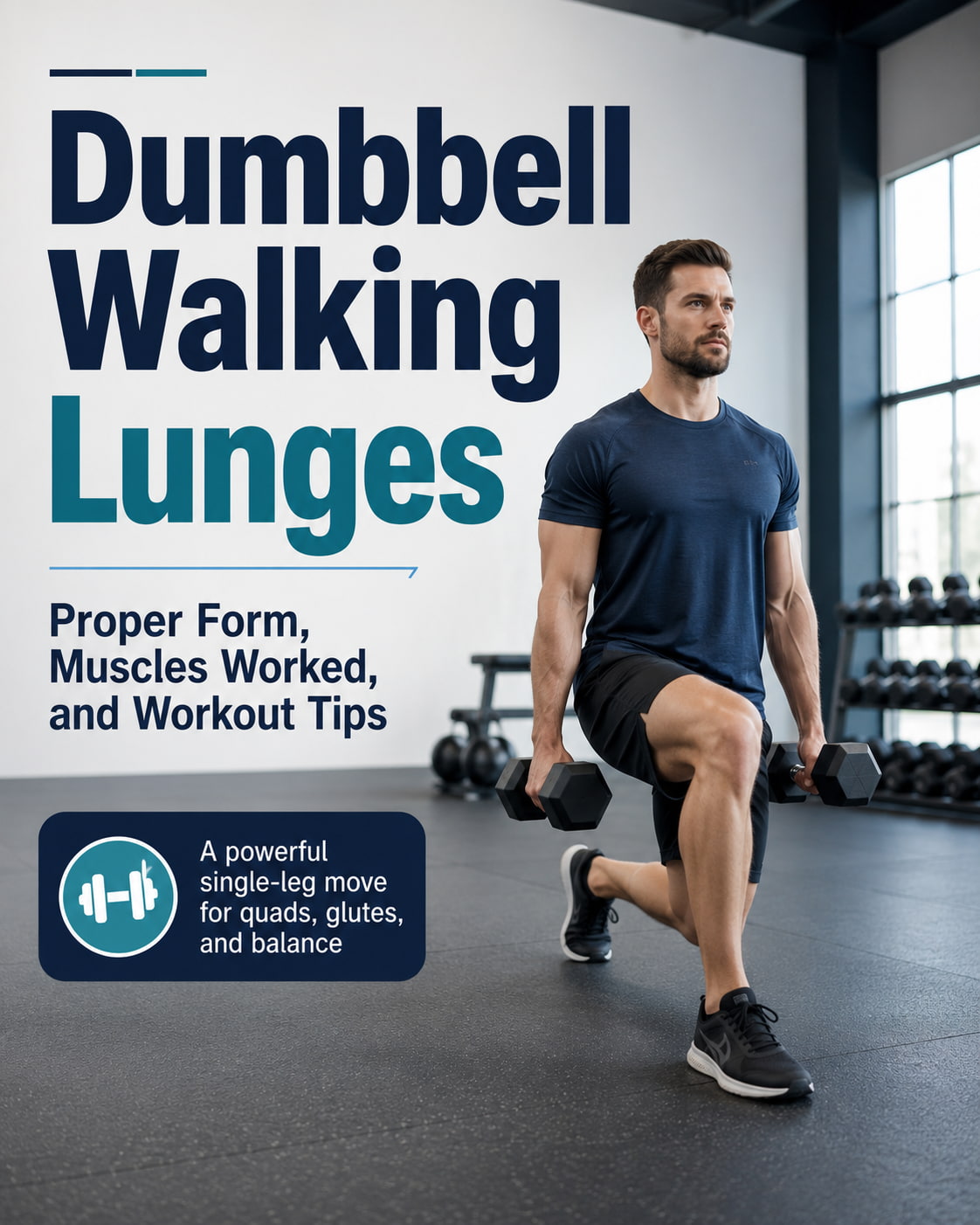
Dumbbell walking lunges are a lower-body strength exercise where you hold dumbbells at your sides and step forward from one lunge directly into the next. They train your legs one side at a time, build the quads and glutes, challenge balance, and add a useful conditioning effect when done for moderate to higher reps.
This guide explains how to do dumbbell walking lunges with proper form, which muscles they work, the main benefits, common mistakes, easier variations, harder progressions, and how to use them in a real leg workout.
What Are Dumbbell Walking Lunges?
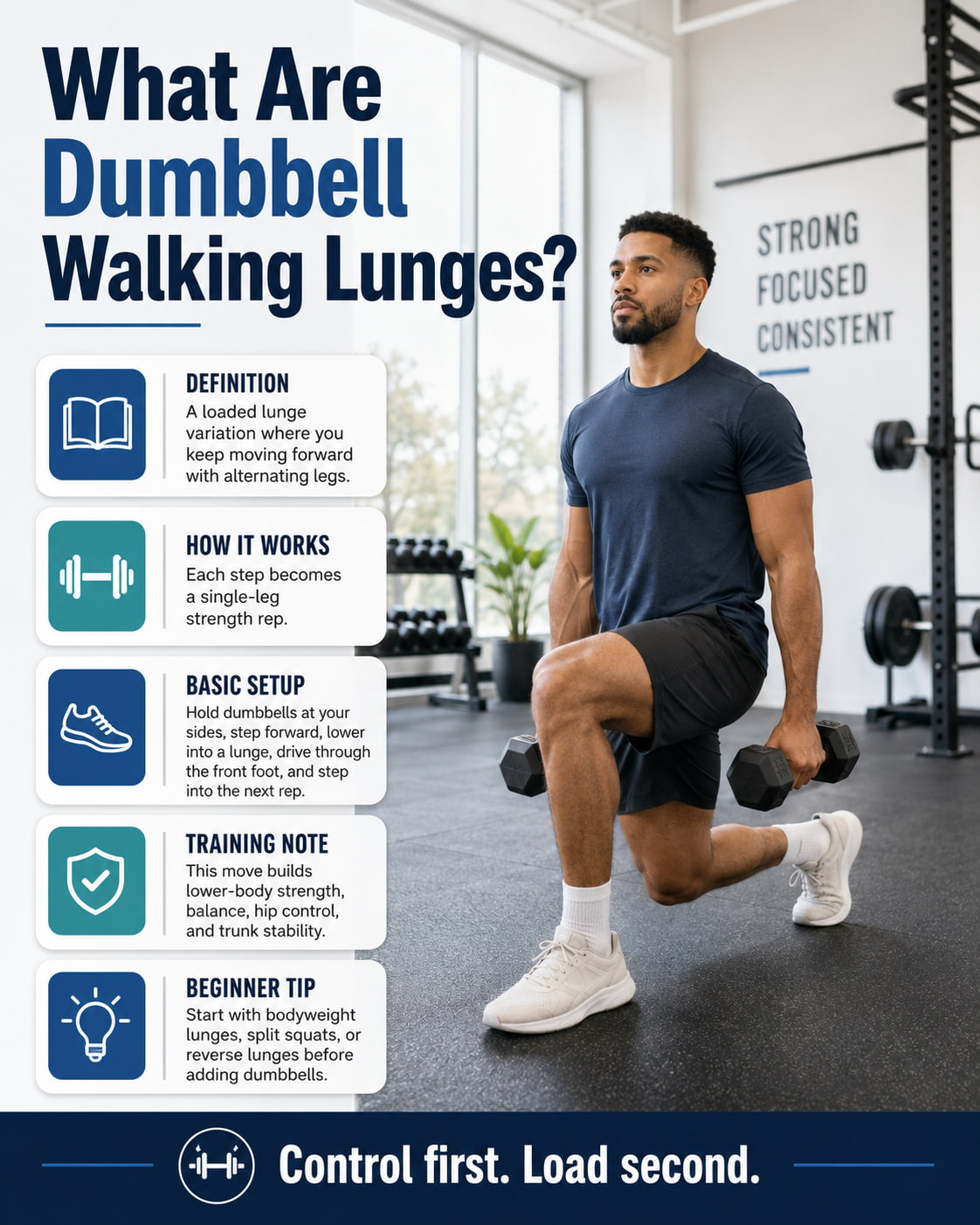
Dumbbell walking lunges are a loaded lunge variation. Instead of stepping forward and returning to the same spot, you keep moving forward with alternating legs. Each step becomes its own single-leg strength rep.
The basic setup is simple: hold one dumbbell in each hand, step forward, lower into a lunge, drive through the front foot, and bring the back leg forward into the next rep.
The movement looks simple, but it requires coordination, balance, hip control, and trunk stability. That is why beginners should usually master bodyweight lunges, split squats, or reverse lunges before using heavier dumbbells. ACE Fitness recommends starting walking lunges with body weight if the exercise is new, then adding equipment once the movement is controlled.
Dumbbell Walking Lunges Exercise Guide
Best for: Dumbbell walking lunges are best for building lower-body strength, muscle, balance, coordination, and single-leg control. They work especially well as an accessory exercise after squats, deadlifts, leg presses, or hip thrusts.
Muscles worked: Dumbbell walking lunges mainly work the quadriceps, gluteus maximus, hamstrings, adductors, calves, and core. The gluteus medius and other hip stabilizers help keep the pelvis steady, while the forearms, grip, traps, and upper back help hold the dumbbells.
Equipment needed: You need a pair of dumbbells and enough clear floor space to walk forward safely. A flat, non-slip surface is best.
Suggested sets and reps: For general strength and muscle, use 2 to 4 sets of 8 to 12 reps per leg. For heavier strength work, use 3 to 4 sets of 6 to 8 reps per leg with longer rest. For conditioning, use lighter dumbbells for 2 to 3 sets of 12 to 20 steps per leg. Most sets should finish with about 1 to 3 reps in reserve.
Beginners: Start with bodyweight walking lunges or stationary split squats. When your knee tracking, balance, and step control are consistent, add light dumbbells. Keep the range of motion comfortable and stop the set before your form breaks down.
Intermediate: Use moderate dumbbells and aim for controlled sets of 8 to 12 reps per leg. Keep your steps smooth, your torso stable, and your front foot fully planted before lowering into each rep.
Advanced: Use heavier dumbbells, slower lowering tempos, pauses near the bottom, longer walking distances, or front-rack dumbbell lunges. Advanced variations should still look clean. If the dumbbells swing, the steps wobble, or the back knee crashes into the floor, reduce the load.
Rest: Rest 60 to 90 seconds for muscle-building sets, 90 to 120 seconds for heavier sets, and 45 to 75 seconds for lighter conditioning sets. Use enough rest to keep your next set stable and controlled.
How to do it:
- Stand tall with your feet about hip-width apart and a dumbbell in each hand.
- Let the dumbbells hang at your sides with your arms long, shoulders relaxed, and grip firm.
- Brace your core as if you are preparing for a controlled push.
- Step forward with one leg and plant the whole front foot on the floor.
- Lower your body by bending both knees under control.
- Keep your front knee tracking in the same direction as your toes.
- Lower until your back knee is close to the floor or your front thigh is near parallel, based on your mobility and comfort.
- Push through the front foot to stand up.
- Bring the back leg forward into the next lunge instead of stepping back to the start.
- Continue alternating legs for the target number of reps or steps.
Common mistakes: The most common mistakes are using dumbbells that are too heavy, stepping too narrow like walking on a tightrope, letting the front knee cave inward, rushing the lowering phase, slamming the back knee into the floor, and leaning so far forward that the exercise turns into a sloppy hinge. Good reps should feel strong, balanced, and repeatable.
Expert tip: Think “train tracks, not tightrope.” Your feet should land about hip-width apart, not directly in front of each other. This gives your hips more room to stabilize and makes it easier to keep the front knee aligned with the toes.
Exercise variations: Useful variations include bodyweight walking lunges, dumbbell reverse lunges, stationary split squats, front-rack dumbbell walking lunges, offset dumbbell walking lunges, and step-ups. Each option changes the balance demand, loading position, or movement difficulty.
Easier variation: The stationary split squat is the best easier variation for most beginners because your feet stay planted. This lets you practice the lunge pattern without worrying about stepping, balance, and forward movement at the same time.
Harder variation: The pause dumbbell walking lunge is a strong progression. Lower into each rep, pause briefly near the bottom without relaxing, then drive up into the next step. The pause removes momentum and makes your quads, glutes, and stabilizers work harder.
Dumbbell Walking Lunges Muscles Worked
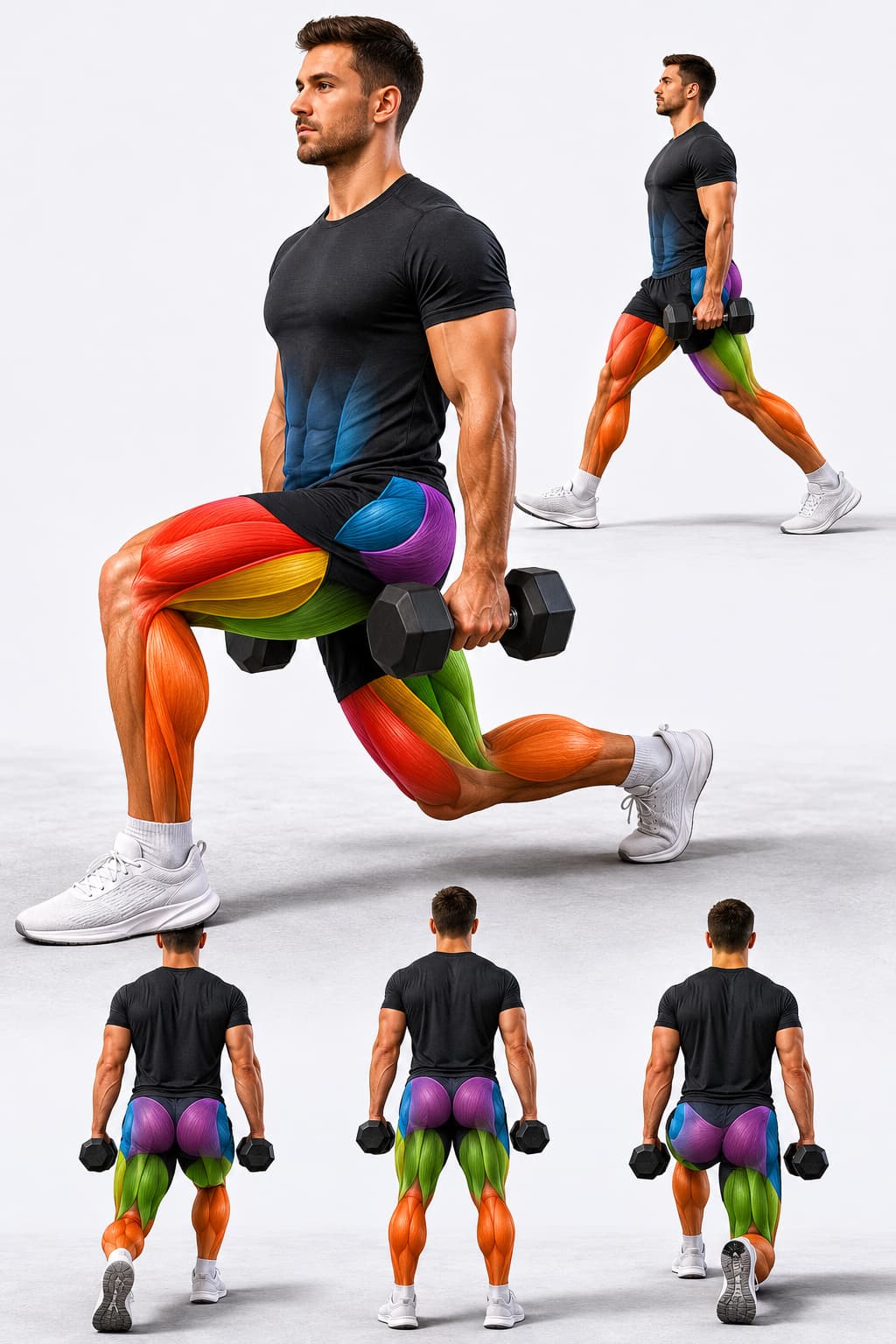
Dumbbell walking lunges are a compound lower-body exercise, which means several joints and muscle groups work together. The front leg usually does most of the work, while the back leg assists and helps with balance.
Quadriceps
The quadriceps are the muscles on the front of your thighs. They straighten the knee as you drive up from the bottom of the lunge.
You will usually feel more quad emphasis when your torso stays more upright and your step length is moderate. A very short step can crowd the knee and make the movement feel awkward, so the goal is not to force tiny steps. The goal is to choose a step length that lets your front foot stay flat and your knee track smoothly over your toes.
Glutes
The gluteus maximus helps extend the hip as you stand and step forward. Your glutes work hard when you push through the front foot and bring your hips back under your body.
A slightly longer step and a small forward torso angle can increase glute involvement, as long as the movement stays controlled. NASM explains that an upright lunge tends to be more quad-dominant, while a slight forward lean can increase glute contribution by spreading demand across the hip, knee, and ankle.
Hamstrings
The hamstrings assist with hip extension and help control the lowering phase. They are not usually the main muscle in a walking lunge, but they support the glutes and help stabilize the knee and hip.
If you want more hamstring emphasis, use a controlled step, avoid bouncing, and keep tension through the whole rep. If you only feel your front knee or hip flexor, reduce the load and improve your setup.
Adductors and Hip Stabilizers
The adductors, or inner-thigh muscles, help control the leg position and stabilize the hips. The gluteus medius and other hip stabilizers help prevent the pelvis from dropping or shifting side to side.
This is one reason dumbbell walking lunges are useful for single-leg control. You are not just moving up and down. You are also controlling side-to-side motion with every step.
Calves
The calves help stabilize the ankle and foot. They also assist as you push through the front foot and transition into the next step.
Your front foot should stay stable and grounded. If your heel lifts too early or your foot rolls inward, lighten the dumbbells and slow down.
Core, Grip, and Upper Back
Your core helps keep your ribs, pelvis, and spine controlled while your legs move. Your grip, forearms, traps, and upper back work because you must hold the dumbbells steady for the entire set.
The heavier the dumbbells, the more your grip and trunk stability matter. If your posture collapses before your legs are tired, the load is too heavy for the purpose of the set.
Benefits of Dumbbell Walking Lunges
Build Single-Leg Strength
Dumbbell walking lunges train one leg at a time, which can help build balanced lower-body strength. Many lifters have one side that feels stronger or more coordinated than the other. Lunges make those differences easier to notice and address.
This does not mean both sides will feel identical. It means each side gets direct work instead of letting the stronger side dominate a two-leg lift.
Train the Quads and Glutes Together
The exercise trains the quads and glutes in the same movement. Your quads help control and extend the knee, while your glutes help drive the hip forward as you stand.
This makes dumbbell walking lunges useful for leg-building workouts, athletic accessory training, and dumbbell-only lower-body routines.
Improve Balance and Coordination
Because you step, lower, stand, and repeat, dumbbell walking lunges challenge balance more than stationary exercises. Your body has to control the foot, knee, hip, pelvis, and trunk as you move forward.
This balance demand is a benefit only when the load matches your ability. If every rep feels like you are falling, the dumbbells are too heavy or the variation is too advanced.
Add Lower-Body Conditioning
Walking lunges can raise your heart rate, especially when performed for longer sets or distances. This makes them useful as a leg-day finisher or conditioning accessory.
For conditioning, use lighter dumbbells and clean movement. The goal is not to rush sloppy reps. The goal is to keep moving with control.
Work Well With Limited Equipment
Dumbbell walking lunges do not require a squat rack, machines, or heavy plates. A pair of dumbbells and open floor space are enough.
This makes the exercise a practical choice for home gyms, hotel gyms, garage gyms, and busy commercial gyms where machines are taken.
Step Length, Knee Position, and Torso Angle
Step length changes how the exercise feels. A shorter, more upright lunge usually feels more quad-focused. A slightly longer step with a controlled forward torso angle often brings in more glute work. Both can be useful.
The key is control. A step that is too long can make you push off the back foot or use momentum. A step that is too short can make the movement feel cramped and unstable.
Your front knee can move forward naturally as long as your foot stays planted, your knee tracks with your toes, and the movement feels controlled. Do not force your knee to stay behind your toes if that makes your form stiff or unstable. At the same time, do not let the knee collapse inward or shoot forward because you lost control.
Your torso does not have to be perfectly vertical. A small forward lean is fine when it comes from the whole body and your spine stays neutral. Avoid rounding your back, arching hard through your lower back, or letting the dumbbells pull your shoulders down and forward.
How to Choose the Right Dumbbell Weight
Choose dumbbells that let you complete every rep with clean balance, a stable front foot, and smooth knee tracking. If your grip gives out, your shoulders round, or your steps become uneven, the weight is too heavy.
For beginners, light dumbbells are enough. The exercise already has a balance and coordination demand. Adding too much load too early usually makes the movement worse instead of more effective.
For muscle growth, use a weight that makes the final few reps challenging while still leaving about 1 to 3 reps in reserve. For strength, use heavier dumbbells and lower reps, but only if your lower-body control stays consistent.
ACSM notes that resistance training should be individualized by goal, safety, and adherence. In practice, that means your best dumbbell weight is the heaviest load you can control for the goal of the set, not the heaviest pair you can pick up.
Common Dumbbell Walking Lunge Mistakes
Starting Too Heavy
Heavy dumbbells can be useful, but only after the movement is stable. If you cannot step, lower, and stand without wobbling, start lighter.
A good loaded lunge should look like a stronger version of your bodyweight lunge, not a completely different movement.
Walking on a Tightrope
A very narrow stance makes balance harder and can cause the front knee to cave inward. Step as if each foot is landing on its own rail.
This small change often improves balance immediately.
Rushing the Descent
Dropping quickly into the bottom position reduces muscle tension and increases the chance of losing control. Lower with purpose.
A simple tempo is two seconds down, a brief pause near the bottom, then a strong drive up.
Letting the Back Knee Crash Down
Your back knee can come close to the floor, but it should not slam into it. Think of lowering the back knee under control, then stopping just above the ground.
If you cannot control the bottom, reduce the range of motion or use lighter dumbbells.
Pushing Mostly From the Back Foot
The front leg should do most of the work. If you push hard from the back foot, you may turn the exercise into a forward stumble instead of a controlled lunge.
Drive through the front foot and think about pushing the floor away.
Letting the Dumbbells Swing
The dumbbells should stay quiet at your sides. If they swing forward and back, your pace is too fast or your grip is too loose.
Keep your arms long, shoulders steady, and torso braced.
Dumbbell Walking Lunges Variations and Alternatives
Bodyweight Walking Lunge
The bodyweight walking lunge is the best starting point if you are new to the movement. It lets you learn the step pattern, balance, and knee control before adding load.
Use this version until you can complete smooth reps without your torso twisting or your front knee collapsing inward.
Stationary Split Squat
The split squat keeps both feet in place. It is easier to control because you do not have to step forward into each rep.
Use split squats if walking lunges feel too unstable, if you have limited space, or if you want to focus on strength without the coordination challenge.
Reverse Lunge
The reverse lunge is often easier to control than the forward or walking lunge. Stepping backward can reduce the forward momentum that makes some lifters feel unstable.
It is a smart regression for beginners and a useful alternative for people who want a smoother lunge pattern.
Front-Rack Dumbbell Walking Lunge
In this variation, you hold the dumbbells at shoulder height. This increases the demand on your core and upper back.
Use lighter dumbbells than you would for suitcase-style walking lunges. The front-rack position should not make your ribs flare or your lower back arch.
Offset Dumbbell Walking Lunge
The offset version uses one dumbbell on one side. This challenges the core because your trunk must resist side bending and rotation.
This is an advanced control variation, not a max-load variation. Keep the dumbbell light enough that your torso stays tall and steady.
Step-Up
The step-up is not the same exercise, but it trains single-leg strength with less forward stepping. It can be a good substitute when space is limited or when walking lunges do not feel comfortable.
Use a box height that lets you control the rep without bouncing off the back foot.
Sample Dumbbell Walking Lunges Workout
Use dumbbell walking lunges 1 to 2 times per week in most lower-body programs. The CDC recommends adults perform muscle-strengthening activities at least 2 days per week that train all major muscle groups. Dumbbell walking lunges can be one part of that plan, along with upper-body, hinge, squat, push, pull, and core exercises.
| Level | Workout Use | Prescription | Rest | Frequency | Progression |
|---|---|---|---|---|---|
| Beginner | Technique and control | 2 to 3 sets of 6 to 8 reps per leg | 60 to 90 sec | 1 time per week | Add reps before adding weight |
| Intermediate | Leg strength and muscle | 3 to 4 sets of 8 to 12 reps per leg | 75 to 120 sec | 1 to 2 times per week | Add small weight increases |
| Advanced | Heavy accessory work | 3 to 5 sets of 6 to 10 reps per leg | 90 to 180 sec | 1 time per week | Add load, tempo, or pause reps |
| Finisher | Conditioning | 2 to 3 sets of 12 to 20 steps per leg | 45 to 75 sec | 1 time per week | Add distance or density gradually |
A practical lower-body session could include a squat or leg press first, a hip hinge such as a Romanian deadlift second, dumbbell walking lunges third, and a calf or core exercise at the end. This keeps the most technical or heaviest lift early while using lunges as a strong accessory movement.
Warm-Up Before Dumbbell Walking Lunges
Warm up before loaded walking lunges so your hips, knees, ankles, and core are ready to stabilize. Start with 3 to 5 minutes of easy movement such as brisk walking, cycling, or light jogging.
Then use bodyweight prep work. Good options include bodyweight squats, reverse lunges, glute bridges, ankle rocks, and a few slow bodyweight walking lunges.
Your first loaded set should not be your heaviest set. Start with light dumbbells and build up only if your balance and form feel solid.
Safety Tips
Dumbbell walking lunges should feel challenging in the working muscles, not sharp or unstable in the joints. Stop the exercise if you feel sharp pain, numbness, dizziness, chest pain, or unusual symptoms.
Use a clear walking path and avoid cluttered spaces. Do not perform walking lunges near loose plates, benches, bags, or slippery flooring.
If you have current knee, hip, ankle, back, or balance concerns, get guidance from a qualified fitness or healthcare professional before using loaded walking lunges. You may do better with split squats, reverse lunges, step-ups, or a shorter range of motion.
FAQs
Are dumbbell walking lunges good for building legs?
Yes. Dumbbell walking lunges can help build the quads, glutes, hamstrings, and stabilizing muscles when you use enough load, controlled reps, and progressive training. They work best as part of a complete lower-body plan, not as the only leg exercise.
What muscles do dumbbell walking lunges work the most?
They usually work the quadriceps and glutes the most. The hamstrings, adductors, calves, core, grip, and upper back also assist. Your exact muscle emphasis depends on step length, torso angle, load, and control.
Are dumbbell walking lunges better than regular lunges?
They are not automatically better. They are more dynamic and often more challenging for balance and coordination. Regular stationary lunges or split squats are better for beginners who need more control. Dumbbell walking lunges are a strong choice once you can lunge smoothly.
How heavy should dumbbells be for walking lunges?
Use a weight that lets you complete all reps without knee collapse, wobbling, dumbbell swinging, or posture breakdown. Beginners may need very light dumbbells. Intermediate and advanced lifters can go heavier, but form should decide the load.
Should my knee go past my toes during walking lunges?
It can happen naturally depending on your limb length, ankle mobility, and step length. The more important points are that your front foot stays planted, your knee tracks in line with your toes, and the rep feels controlled. Do not force an awkward position just to follow a rigid knee rule.
Why do I lose balance during dumbbell walking lunges?
Balance problems often come from stepping too narrow, using too much weight, rushing the reps, or not bracing your core. Start with bodyweight lunges, widen your stance slightly, slow down, and use lighter dumbbells until the pattern improves.
Can beginners do dumbbell walking lunges?
Some beginners can, but many should start with easier variations first. Bodyweight walking lunges, split squats, assisted split squats, and reverse lunges are better starting points if balance or knee control is not consistent yet.
Conclusion
Dumbbell walking lunges are a practical lower-body exercise for building stronger legs, glutes, balance, and single-leg control. Start with a version you can perform well, choose dumbbells that match your ability, and progress gradually through more reps, more load, slower tempo, or harder variations.
The main goal is not to take the longest step or use the heaviest dumbbells. The goal is to move with control, keep your knees tracking well, and make every rep train the muscles you want to build.
1 thought on “Dumbbell Walking Lunges: Proper Form, Muscles Worked, and Benefits”