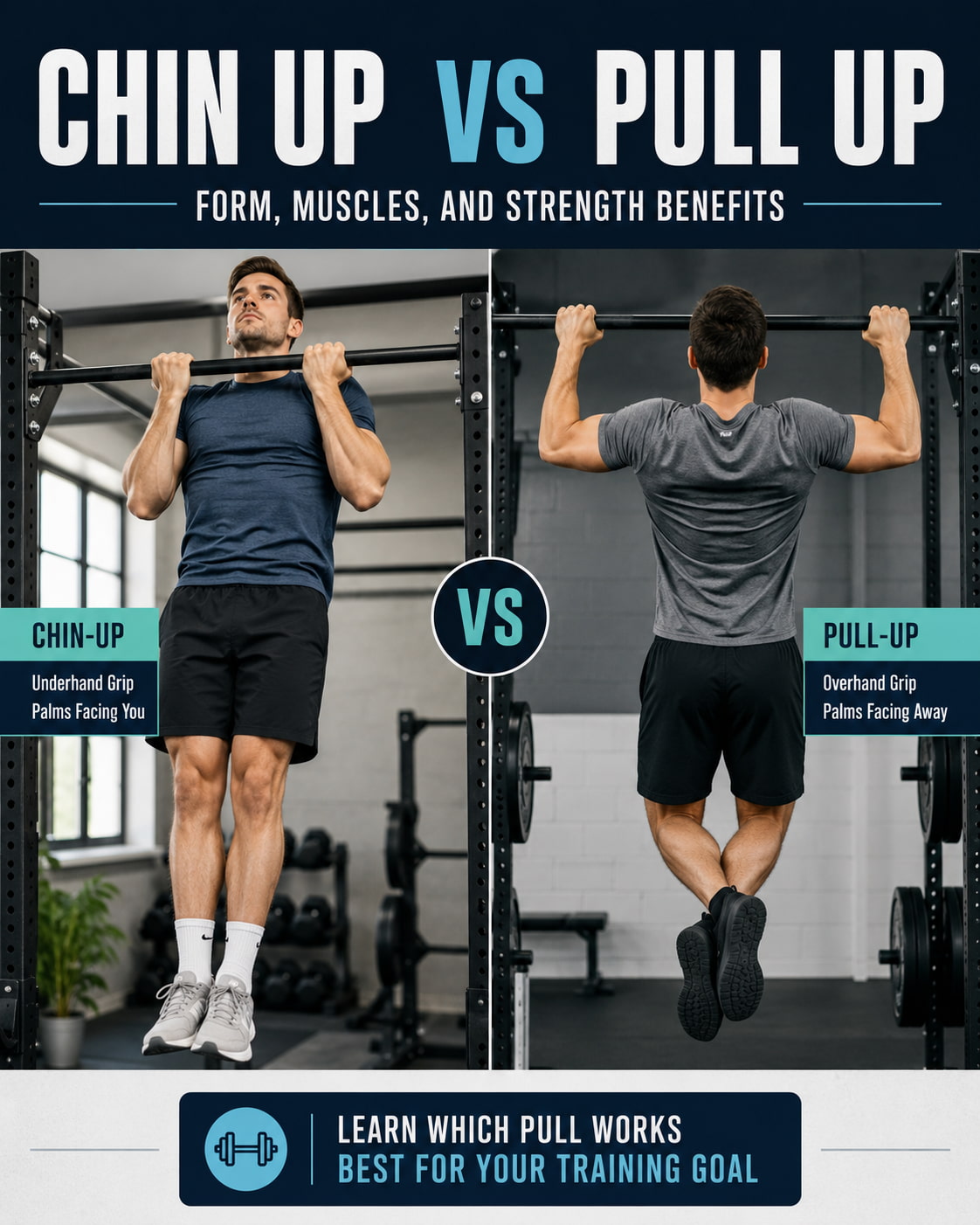
The main difference in the chin up vs pull up is grip position: chin-ups use an underhand grip, while pull-ups use an overhand grip. That small hand change affects how the exercise feels, which muscles get more emphasis, and which version is usually easier to learn.
Both exercises are excellent upper-body pulling movements. They train your back, arms, shoulders, grip, and core without needing much equipment. The best choice depends on your goal, strength level, shoulder comfort, and how you want to structure your workout.
In this guide, you will learn the key differences between chin-ups and pull-ups, how to do each exercise correctly, which muscles they work, common mistakes to avoid, beginner-friendly progressions, and how to use both in a smart training plan.
Chin Up vs Pull Up: Quick Comparison
| Category | Chin-Up | Pull-Up |
|---|---|---|
| Grip | Underhand grip, palms facing you | Overhand grip, palms facing away |
| Typical hand position | Shoulder-width or slightly narrower | Shoulder-width to slightly wider |
| Main emphasis | Biceps, lats, upper back | Lats, upper back, rear shoulders |
| Difficulty | Usually easier for beginners | Usually harder for beginners |
| Best for | Building pulling strength with more arm help | Building strong back-focused pulling power |
| Common progression | Assisted chin-up, negative chin-up, weighted chin-up | Assisted pull-up, negative pull-up, weighted pull-up |
| Equipment | Pull-up bar or assisted pull-up machine | Pull-up bar or assisted pull-up machine |
The chin-up and pull-up are not completely different exercises. They use many of the same muscles, but the grip changes the leverage. A chin-up usually lets the biceps help more, while a pull-up often feels more demanding on the lats, upper back, and grip.
What Is a Chin-Up?
A chin-up is a bodyweight pulling exercise done with your palms facing toward you. You hang from a bar, brace your body, pull your chest toward the bar, and lower under control.
According to the National Academy of Sports Medicine, chin-ups use a supinated grip and involve the lats, biceps, shoulders, and upper back. Because the palms face you, the biceps can contribute strongly to the pull, which is one reason many people find chin-ups easier than pull-ups.
Chin-Up
Best for: Chin-ups are best for beginners building their first vertical pulling reps, lifters who want more biceps involvement, and anyone who wants a strong upper-body pulling exercise that still trains the back hard.
Muscles worked: Chin-ups mainly train the latissimus dorsi, biceps brachii, brachialis, brachioradialis, rhomboids, traps, rear delts, forearms, and deep core muscles. The biceps usually feel more active than they do during pull-ups because of the underhand grip.
Equipment needed: You need a sturdy pull-up bar. A resistance band, assisted pull-up machine, or box can help if you are still building strength.
Why it stands out: The chin-up is one of the most useful bodyweight exercises for building pulling strength. It gives your arms a stronger pulling position while still requiring your back and core to work hard.
Suggested sets and reps: For strength, use 3–5 sets of 3–6 controlled reps. For muscle building, use 3–4 sets of 6–12 reps. For beginners, use 3–4 sets of assisted reps, slow negatives, or holds.
Beginners: Start with band-assisted chin-ups, machine-assisted chin-ups, or negative reps. Focus on smooth control instead of forcing full bodyweight reps before you are ready.
Intermediate: Use full chin-ups for moderate sets. Add pauses at the top or slow lowering phases to build control and improve strength through the full range of motion.
Advanced: Use weighted chin-ups, tempo chin-ups, or chest-to-bar chin-ups. Add load only when you can perform clean bodyweight reps without swinging or shortening the range of motion.
Rest: Rest 2–3 minutes between hard strength sets. Rest 60–90 seconds for lighter accessory sets or assisted volume work.
How to do it:
- Grip the bar with your palms facing you and hands about shoulder-width apart.
- Hang with your arms straight, ribs controlled, and legs still.
- Set your shoulders by gently pulling your shoulder blades down.
- Brace your abs and squeeze your glutes lightly.
- Pull your elbows down toward your sides as your chest rises.
- Bring your chin over the bar without reaching your neck forward.
- Pause briefly at the top if you can control it.
- Lower slowly until your arms are straight again.
Common mistakes: The most common chin-up mistakes are swinging the legs, shrugging the shoulders toward the ears, craning the neck to clear the bar, cutting the bottom range short, and dropping too fast on the way down. These mistakes reduce muscle tension and can make the shoulders or elbows feel irritated.
Expert tip: Think about driving your elbows down instead of pulling your chin up. This helps you use your lats and upper back instead of turning every rep into an arm-only movement.
Exercise variations: Useful chin-up variations include close-grip chin-ups, neutral-grip chin-ups, band-assisted chin-ups, negative chin-ups, paused chin-ups, and weighted chin-ups.
Easier variation: The band-assisted chin-up is the best starting point for many beginners because it lets you practice the full movement pattern while reducing the amount of bodyweight you need to pull.
Harder variation: The weighted chin-up is one of the strongest progressions. Use a dip belt, weighted vest, or carefully held dumbbell only after you can complete several strict bodyweight reps.
What Is a Pull-Up?
A pull-up is a bodyweight pulling exercise done with your palms facing away from you. You hang from a bar, brace your trunk, pull your body upward, and lower with control.
The ACE Fitness pull-up exercise library describes the pull-up as an upper-body exercise performed from a hanging position with the palms facing away. Pull-ups typically feel harder than chin-ups because the overhand grip gives the biceps less help and often places more demand on the lats, upper back, and shoulder stabilizers.
Pull-Up
Best for: Pull-ups are best for building strong lats, upper-back strength, grip strength, and overhand pulling ability. They are also useful for athletes and lifters who want a harder bodyweight pulling challenge.
Muscles worked: Pull-ups mainly train the latissimus dorsi, teres major, rhomboids, traps, rear delts, biceps, brachialis, forearms, and core. Compared with chin-ups, pull-ups usually shift more emphasis toward the back and away from the biceps.
Equipment needed: You need a sturdy pull-up bar. A resistance band, assisted pull-up machine, or lat pulldown station can help you build toward full reps.
Why it stands out: The pull-up is a classic back-strength exercise because it challenges you to pull your full bodyweight with an overhand grip. It builds strength that carries over well to other pulling movements.
Suggested sets and reps: For strength, use 3–5 sets of 2–6 clean reps. For muscle building, use 3–4 sets of 5–10 reps. For skill practice, use low-fatigue sets that stop before form breaks down.
Beginners: Start with assisted pull-ups, scapular pull-ups, slow negatives, inverted rows, and lat pulldowns. Build control before chasing high reps.
Intermediate: Use strict pull-ups for multiple sets and stop each set with 1–2 reps in reserve. Add slow eccentrics or paused reps when regular bodyweight reps become consistent.
Advanced: Use weighted pull-ups, chest-to-bar pull-ups, wide-grip pull-ups, or tempo pull-ups. Keep the reps clean and avoid using momentum to move heavier loads.
Rest: Rest 2–3 minutes for strength-focused sets. Rest 60–120 seconds for accessory sets, assisted reps, or moderate-volume back training.
How to do it:
- Grip the bar with your palms facing away and hands about shoulder-width to slightly wider.
- Hang with your arms straight and your body still.
- Brace your core and avoid excessive arching or kicking.
- Set your shoulders by pulling your shoulder blades slightly down.
- Pull your elbows down and back as your body rises.
- Bring your chin over the bar without reaching your head forward.
- Keep your ribs controlled at the top.
- Lower slowly to a full controlled hang.
Common mistakes: Common pull-up mistakes include using a grip that is too wide, kicking the legs, shrugging at the start, pulling with a loose core, using half reps, and relaxing too quickly during the lowering phase. A grip that is too wide can also limit range of motion and make the movement feel rough on the shoulders.
Expert tip: Start each rep by setting the shoulders before bending the elbows. This helps your lats and upper back contribute more effectively.
Exercise variations: Useful pull-up variations include band-assisted pull-ups, machine-assisted pull-ups, neutral-grip pull-ups, negative pull-ups, paused pull-ups, wide-grip pull-ups, chest-to-bar pull-ups, and weighted pull-ups.
Easier variation: The assisted pull-up is the best regression because it lets you train the same movement pattern with less bodyweight resistance.
Harder variation: The weighted pull-up is the strongest progression for advanced lifters. Add weight slowly and keep your range of motion strict.
Chin Up vs Pull Up Muscles Worked
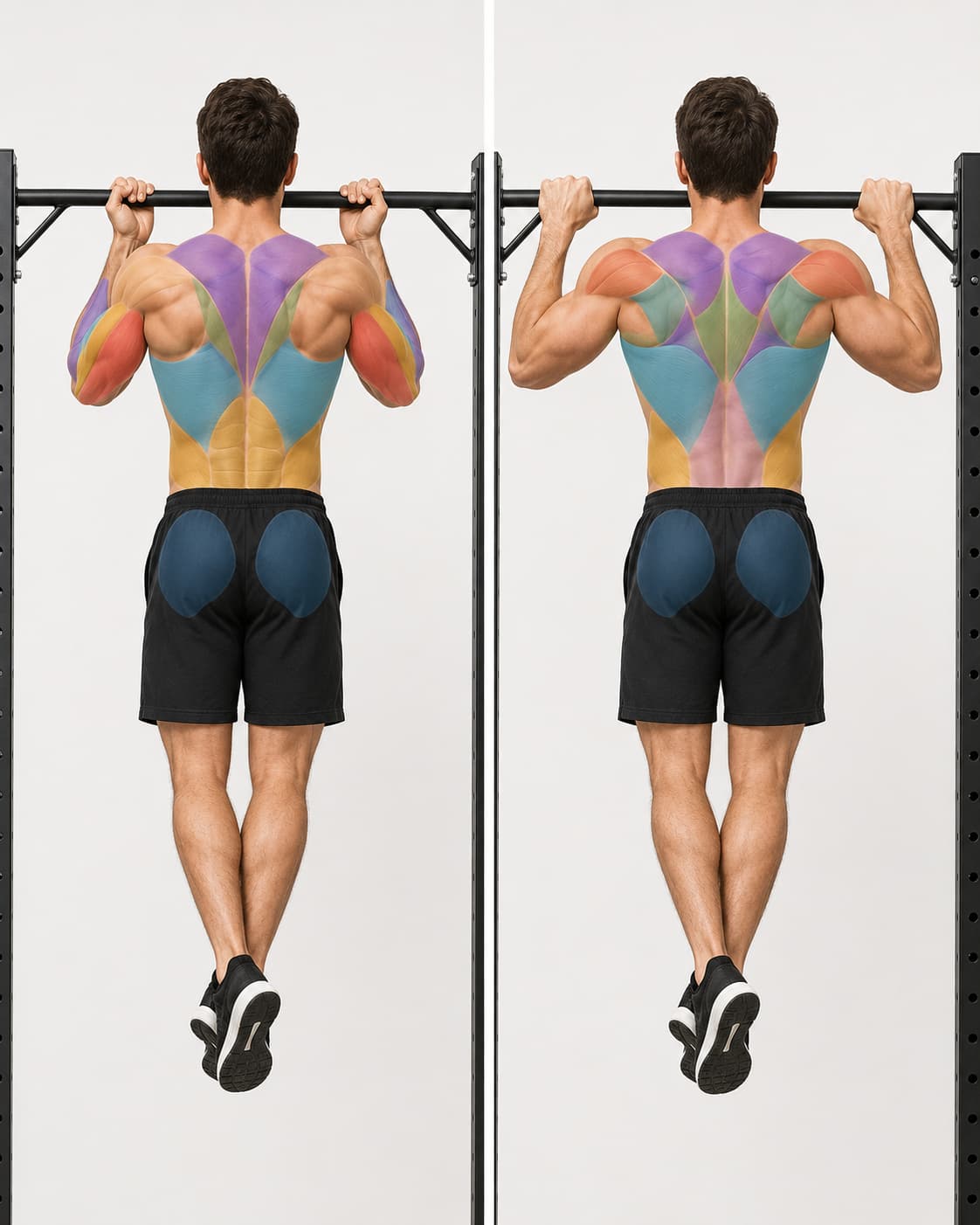
Chin-ups and pull-ups both train the same major pulling muscles. The difference is not that one is only for arms and the other is only for back. The real difference is muscle emphasis.
The lats are heavily involved in both exercises. These large back muscles help pull your upper arms down and toward your body. The rhomboids and traps help control the shoulder blades. The rear delts assist the pulling motion, while the forearms and grip muscles keep you attached to the bar. Your abs, obliques, and glutes help keep your body from swinging.
Chin-ups usually create more biceps involvement because the underhand grip puts the elbows in a stronger pulling position. Pull-ups usually feel more lat and upper-back dominant because the overhand grip reduces biceps leverage and makes the back work harder to control the pull.
A PubMed-indexed EMG study on pull-up variations found that muscle activation patterns across different grip styles were broadly similar during complete reps, although some differences appeared between grip types and phases of the movement. That supports a practical takeaway: grip matters, but both exercises are valuable pulling movements.
Which Is Better for Back Strength?
Pull-ups are usually the better choice if your main goal is back-focused pulling strength. The overhand grip often makes the lats, teres major, rear delts, and upper-back muscles work harder because the biceps cannot dominate the movement as easily.
That does not mean chin-ups are poor for the back. A well-done chin-up still trains the lats hard. The difference is that chin-ups usually share more of the work with the biceps.
For most lifters, the best plan is not choosing one forever. Use pull-ups as your main back-focused vertical pull and chin-ups as a strong secondary lift or variation.
Which Is Better for Biceps?
Chin-ups are usually better for biceps emphasis because the palms-facing-you grip puts the biceps in a stronger pulling position. If you want a bodyweight exercise that trains your back while giving your arms more direct work, chin-ups are a strong choice.
Still, chin-ups should not replace all direct arm training if your goal is maximum biceps growth. They are a compound movement, not an isolation curl. Use them with rows, curls, and other pulling exercises for a complete plan.
Which One Should Beginners Do First?
Most beginners should start with chin-ups or assisted chin-ups because the underhand grip usually makes the movement easier to learn. If you cannot do a full chin-up yet, use assistance instead of forcing sloppy reps.
The American Council on Exercise recommends progressions such as assisted pull-ups, negatives, and lat-strengthening drills to build toward full pull-up strength. These options let you practice control while gradually increasing your ability to move your bodyweight.
A simple beginner path is to train inverted rows, assisted chin-ups, negative chin-ups, assisted pull-ups, and scapular pull-ups. Once you can perform several clean chin-ups, start adding pull-ups with assistance or low-rep sets.
Common Mistakes to Avoid
Swinging is one of the biggest mistakes in both exercises. A small natural body movement can happen, but repeated kicking turns the exercise into momentum instead of strength training.
Another common mistake is starting every rep from a loose shoulder position. Hanging passively without control can make the first part of the pull feel weak and uncomfortable. Set your shoulders before you pull.
Many lifters also shorten the range of motion. They either avoid the bottom position or stop before the chin clears the bar. Use a full comfortable range you can control.
Neck reaching is another issue. The goal is not to poke your chin forward. Pull your body high enough while keeping your neck neutral.
Finally, avoid doing too much too soon. Chin-ups and pull-ups can be demanding on the elbows, shoulders, and grip. Build volume slowly and give your joints time to adapt.
How to Program Chin-Ups and Pull-Ups
Use chin-ups and pull-ups 2–3 times per week depending on your experience, recovery, and total upper-body training volume. The American College of Sports Medicine notes that bodyweight exercises can support strength and hypertrophy when used consistently and progressed over time.
For strength, use lower reps with longer rest. A good starting point is 3–5 sets of 3–6 reps with 2–3 minutes of rest.
For muscle growth, use moderate reps and enough total volume. Try 3–4 sets of 6–12 reps with 60–120 seconds of rest.
For your first rep, use assistance and slow negatives. Train 3–4 sets of controlled assisted reps, stopping before your form falls apart.
For advanced strength, add weight gradually. Only use external load when your bodyweight reps are strict, controlled, and pain-free.
Sample Chin-Up and Pull-Up Workout
Use this workout 1–2 times per week as part of an upper-body or pull-focused training day.
Beginner workout: Start with assisted chin-ups for 3 sets of 5–8 reps, then do inverted rows for 3 sets of 8–12 reps. Finish with scapular pull-ups for 2 sets of 6–10 controlled reps. Rest 60–120 seconds between sets. Progress by reducing assistance or adding one clean rep per set.
Intermediate workout: Start with pull-ups for 4 sets of 4–8 reps, then do chin-ups for 3 sets of 6–10 reps. Add a row variation for 3 sets of 8–12 reps. Rest 90–150 seconds between hard pulling sets. Keep 1–2 reps in reserve on most sets.
Advanced workout: Start with weighted pull-ups for 4 sets of 3–5 reps, then do bodyweight chin-ups for 3 sets of 8–12 reps. Finish with paused or slow-eccentric pull-ups for 2 sets of 4–6 reps. Rest 2–3 minutes after weighted sets. Add load only when all reps stay clean.
Safety Tips
Use a grip width that lets your shoulders move comfortably. Wider is not always better. A very wide pull-up grip can shorten your range of motion and may feel uncomfortable for some lifters.
Warm up your shoulders, elbows, and upper back before hard sets. Light rows, band pulldowns, scapular pull-ups, and easy assisted reps can prepare your joints and muscles.
Stop the exercise if you feel sharp pain, numbness, dizziness, chest pain, or unusual symptoms. Mild muscle effort is normal. Pain that feels sharp, sudden, or unusual is not something to push through.
If pull-ups bother your shoulders or elbows, try neutral-grip pull-ups, assisted reps, lat pulldowns, or rows. You can still build pulling strength while choosing a variation that feels better for your body.
Frequently Asked Questions
Are chin-ups easier than pull-ups?
Chin-ups are usually easier for most people because the underhand grip lets the biceps help more. Pull-ups often feel harder because the overhand grip shifts more demand to the lats, upper back, and grip.
Do chin-ups build back muscles?
Yes, chin-ups can build back strength and muscle. They train the lats, rhomboids, traps, rear delts, and other pulling muscles. They also involve more biceps help than pull-ups.
Do pull-ups build more lats than chin-ups?
Pull-ups often feel more lat-focused because the overhand grip reduces biceps assistance. However, both exercises train the lats. Your form, range of motion, and progression matter more than the name of the exercise alone.
Should I do chin-ups or pull-ups first?
Do the exercise that best matches your main goal first. If your goal is back-focused strength, start with pull-ups. If your goal is getting your first vertical pulling rep or building biceps-assisted pulling strength, start with chin-ups.
Can I train chin-ups and pull-ups on the same day?
Yes, you can train both on the same day. A simple approach is to do the harder version first, then use the easier version for extra volume. For many lifters, that means pull-ups first and chin-ups second.
How many chin-ups or pull-ups should I do?
Beginners should focus on controlled assisted reps instead of chasing a number. Intermediate lifters can work toward 3–4 sets of 6–10 clean reps. Advanced lifters can use weighted sets, higher total volume, or harder tempo variations.
Conclusion
The chin up vs pull up difference comes down to grip, muscle emphasis, and difficulty. Chin-ups use an underhand grip and usually feel more biceps-assisted. Pull-ups use an overhand grip and usually feel more challenging for the lats, upper back, and grip.
For better training, do not think of one as the only correct choice. Use chin-ups to build pulling strength and arm involvement. Use pull-ups to challenge your back and overhand pulling power. Train both with clean form, steady progression, and enough recovery.
References
- National Academy of Sports Medicine: Chin-Ups vs Pull-Ups: Differences, Benefits & Muscles Worked
- ACE Fitness: Pull-Ups Exercise Library
- ACE Fitness: 4 Moves to Help You Master the Pull-Up
- PubMed: Electromyographic Analysis of Muscle Activation During Pull-Up Variations
- American College of Sports Medicine: Updated Resistance Training Guidelines