The best leg exercises for runners build stronger glutes, quads, hamstrings, calves, hips, and single-leg control so each stride feels more stable and powerful. Leg Exercises for Runners should not feel like a random leg day copied from bodybuilding. They should support running mechanics, help you handle impact, improve hill strength, and build lower-body durability without leaving your legs too sore to run.
Running is repetitive. Every step asks one leg to absorb force, stabilize the pelvis, and push the body forward. That is why runners need more than miles. A smart strength plan should include squats, lunges, hinges, step-ups, calf work, hip stability drills, and a small amount of power training when appropriate.
In this guide, you will learn the best leg exercises for runners, how to perform each one, which muscles they train, common mistakes to avoid, and how to use them in a real running schedule.
Why Leg Exercises for Runners Matter
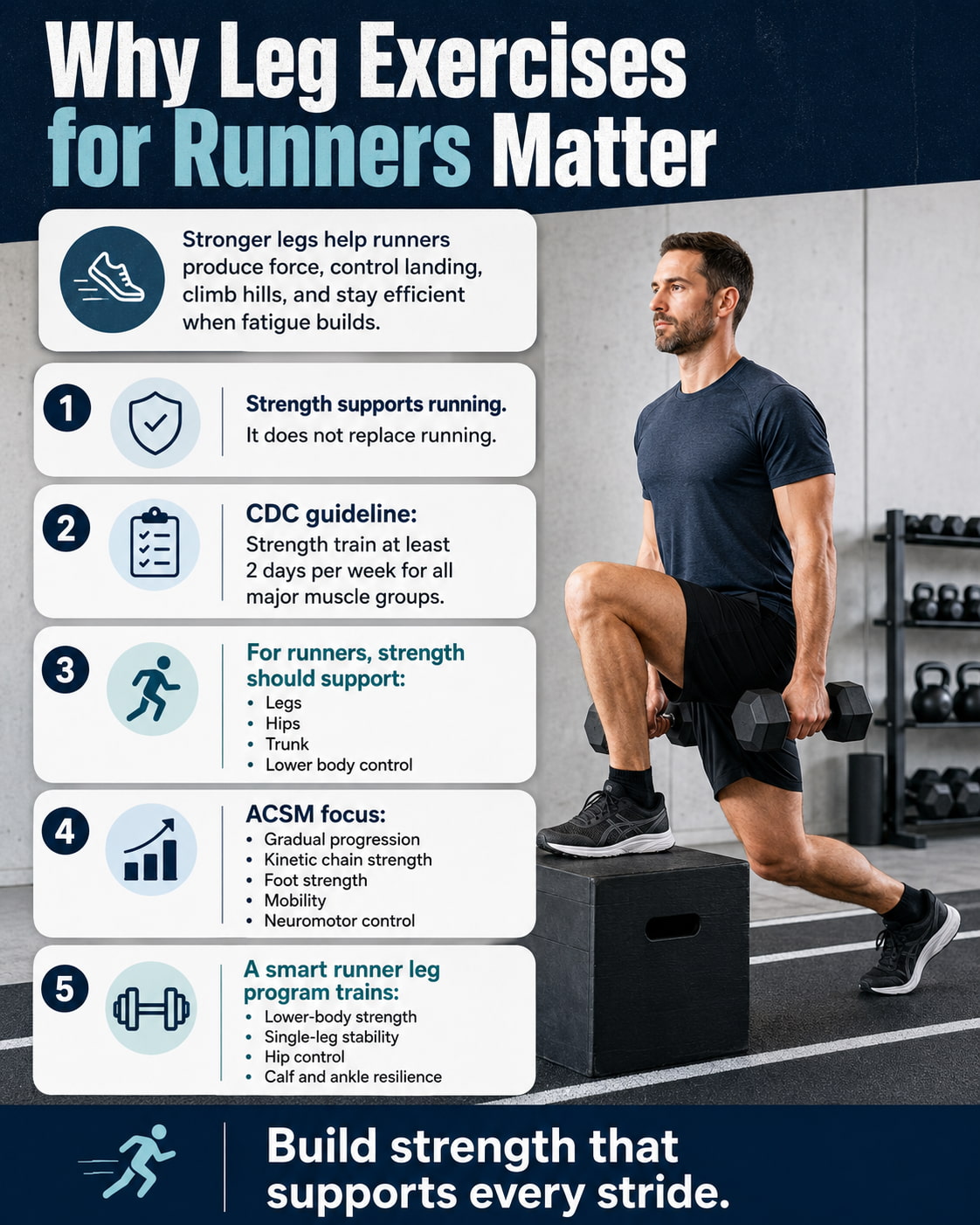
Leg strength helps runners produce force, control landing, climb hills, and stay efficient when fatigue builds. Stronger legs do not replace running, but they can support better stride control and help your body tolerate training.
The CDC adult physical activity guidelines recommend muscle-strengthening activities at least 2 days per week for all major muscle groups. For runners, that does not mean crushing heavy leg workouts every week. It means adding enough resistance training to support the legs, hips, trunk, and lower body.
The American College of Sports Medicine also highlights the importance of healthy running habits, gradual progression, kinetic chain strength, foot strength, mobility, and neuromotor control for distance runners. In simple terms, runners need strength that supports the whole stride, not just bigger leg muscles.
A good runner-focused leg program should train four things: lower-body strength, single-leg stability, hip control, and calf/ankle resilience.
Muscles Runners Should Train
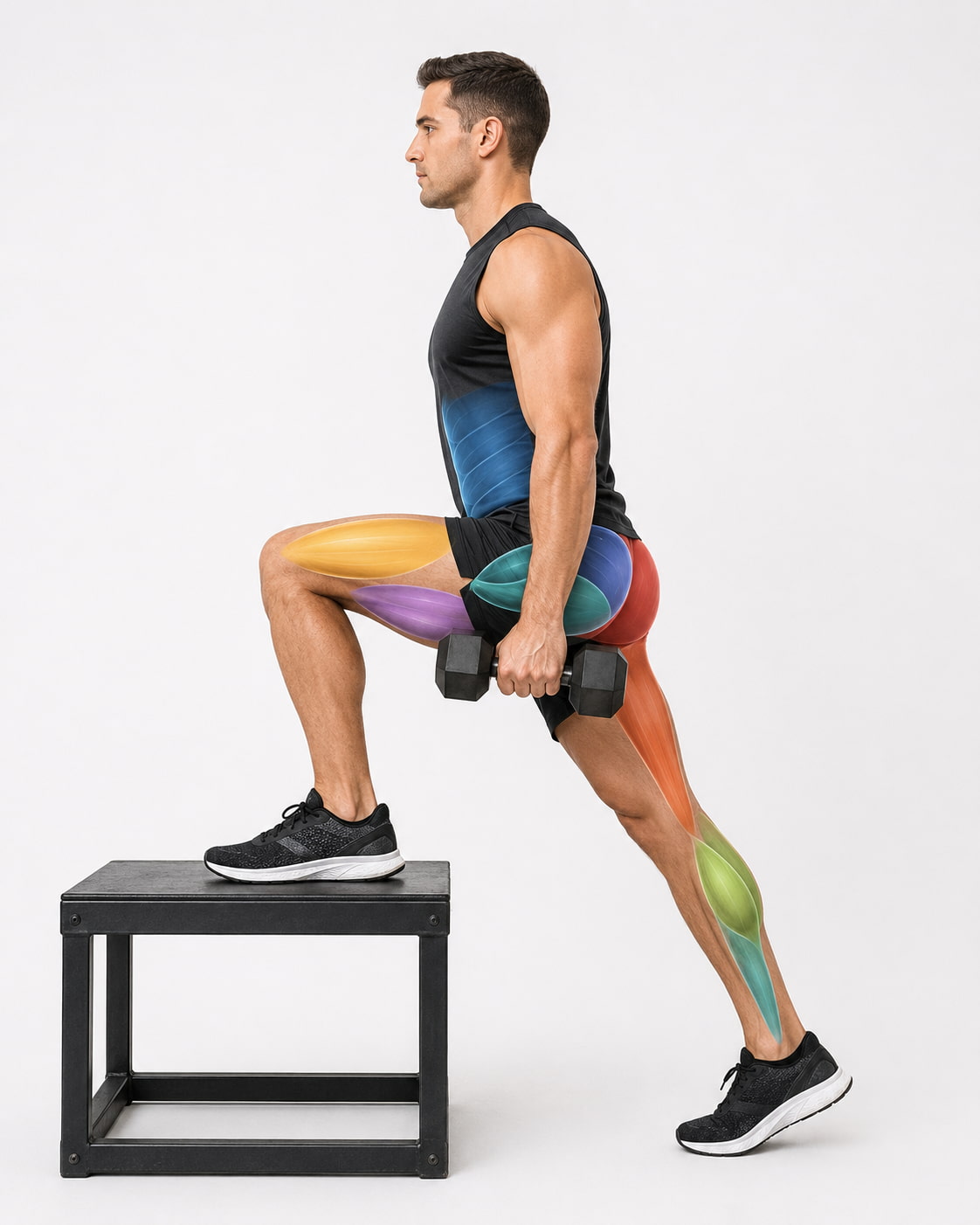
Runners should train the quads, glutes, hamstrings, calves, hip stabilizers, adductors, and core.
The quadriceps help control knee bend and support landing. The glutes help extend the hip, stabilize the pelvis, and drive the body forward. The hamstrings assist hip extension and help control the leg as it cycles through the stride. The calves and soleus help with push-off and repeated ground contact. The glute medius, adductors, and deep hip stabilizers help keep the hips and knees from drifting during single-leg stance.
The Hospital for Special Surgery notes that runner stability is closely tied to core and hip strength, balance, and proper lower-body alignment. That is why this list includes both strength moves and control-focused exercises.
The 13 Best Leg Exercises for Runners
1. Goblet Squat
Best for: Building general lower-body strength for runners who need stronger quads, glutes, and hips.
Muscles worked: Quadriceps, glutes, hamstrings, adductors, calves, and core.
Equipment needed: Dumbbell or kettlebell.
Why it stands out: The goblet squat teaches runners to squat with control while keeping the torso upright. It is easier to learn than a barbell squat and works well for building leg strength without needing advanced gym skills.
Suggested sets and reps: Do 2–4 sets of 6–12 reps. Use a load that feels challenging but still allows clean knee tracking and a stable torso.
Beginners: Start with a bodyweight squat or squat to a box. Focus on depth you can control without heels lifting or knees collapsing inward.
Intermediate: Use a dumbbell or kettlebell at chest height and pause for 1 second at the bottom.
Advanced: Use a heavier goblet squat, front squat, or tempo squat with a slow 3-second lowering phase.
Rest: Rest 60–120 seconds between sets.
How to do it:
- Stand with your feet about shoulder-width apart and hold the weight close to your chest.
- Brace your core and keep your chest tall.
- Push your hips back slightly as your knees bend.
- Lower until your thighs are near parallel or as deep as you can control.
- Keep your knees tracking in line with your toes.
- Drive through your midfoot and heels to stand tall.
Common mistakes: Letting the knees cave inward, lifting the heels, rounding the back, dropping too fast, or relaxing the core at the bottom.
Expert tip: Think about spreading the floor gently with your feet as you squat. This helps the hips stay active and keeps the knees tracking better.
Exercise variations: Bodyweight squat, box squat, dumbbell front squat, double-kettlebell front squat, and barbell front squat.
Easier variation: Box squat.
Harder variation: Tempo goblet squat or front squat.
2. Reverse Lunge
Best for: Building single-leg strength with less forward knee stress than some forward lunge variations.
Muscles worked: Glutes, quadriceps, hamstrings, calves, adductors, and core.
Equipment needed: Dumbbells optional.
Why it stands out: The reverse lunge trains each leg separately and teaches runners to control the hip, knee, and ankle. It also carries over well to stride control because one leg must stabilize while the other moves.
Suggested sets and reps: Do 2–4 sets of 8–12 reps per side.
Beginners: Use bodyweight and hold a wall, post, or rack for balance.
Intermediate: Hold dumbbells at your sides and keep the lowering phase slow.
Advanced: Use a front-rack kettlebell position, deficit reverse lunge, or heavier dumbbells.
Rest: Rest 60–90 seconds between sets.
How to do it:
- Stand tall with feet hip-width apart.
- Step one foot backward into a lunge.
- Lower until both knees bend comfortably.
- Keep the front foot flat and the front knee tracking over the toes.
- Push through the front foot to return to standing.
- Complete all reps on one side or alternate legs.
Common mistakes: Pushing mostly off the back foot, leaning too far forward, slamming the back knee down, or letting the front knee collapse inward.
Expert tip: Treat the front leg as the working leg. The back leg should help with balance, not do most of the work.
Exercise variations: Alternating reverse lunge, dumbbell reverse lunge, front-rack reverse lunge, and deficit reverse lunge.
Easier variation: Assisted reverse lunge.
Harder variation: Deficit reverse lunge.
3. Walking Lunge
Best for: Building leg endurance, stride control, and hip stability.
Muscles worked: Quadriceps, glutes, hamstrings, calves, adductors, and core.
Equipment needed: Dumbbells optional.
Why it stands out: Walking lunges train strength while moving forward, which makes them useful for runners who need better control through a longer stride. They also challenge balance more than stationary lunges.
Suggested sets and reps: Do 2–3 sets of 8–16 steps per side.
Beginners: Start with stationary split squats before using walking lunges.
Intermediate: Hold light to moderate dumbbells and keep each rep smooth.
Advanced: Use heavier dumbbells or add a controlled knee drive at the top of each step.
Rest: Rest 60–120 seconds between sets.
How to do it:
- Stand tall with feet hip-width apart.
- Step forward with one leg.
- Lower into a lunge while keeping the front foot flat.
- Push through the front foot to bring the back leg forward.
- Step directly into the next lunge.
- Continue with controlled, even steps.
Common mistakes: Taking steps that are too narrow, rushing the movement, wobbling through the hips, or letting the front knee dive inward.
Expert tip: Move like you are on train tracks, not a tightrope. Keep enough width between your feet to stay balanced.
Exercise variations: Bodyweight walking lunge, dumbbell walking lunge, reverse walking lunge, and walking lunge with knee drive.
Easier variation: Stationary split squat.
Harder variation: Dumbbell walking lunge with a slow lowering phase.
4. Bulgarian Split Squat
Best for: Building serious single-leg strength in the quads, glutes, and hips.
Muscles worked: Quadriceps, glutes, hamstrings, adductors, calves, and core.
Equipment needed: Bench or sturdy box, dumbbells optional.
Why it stands out: The Bulgarian split squat is one of the most effective leg exercises for runners because it loads one leg heavily while challenging balance and pelvic control. It can improve strength for hills, speed work, and stronger push-off.
Suggested sets and reps: Do 2–4 sets of 6–10 reps per side.
Beginners: Start with a regular split squat before elevating the back foot.
Intermediate: Use bodyweight or light dumbbells and work through a controlled range.
Advanced: Use heavier dumbbells, a slow eccentric, or a pause near the bottom.
Rest: Rest 90–150 seconds between sets.
How to do it:
- Stand a few feet in front of a bench.
- Place the top of one foot behind you on the bench.
- Keep your front foot flat and torso controlled.
- Lower until your front thigh approaches parallel or your comfortable range.
- Keep the front knee tracking with the toes.
- Push through the front foot to stand back up.
Common mistakes: Standing too close to the bench, bouncing at the bottom, arching the lower back, or pushing too much through the back foot.
Expert tip: Your front leg should feel like the main engine. If your back hip or lower back feels overloaded, shorten the range or switch to a split squat.
Exercise variations: Bodyweight Bulgarian split squat, dumbbell Bulgarian split squat, front-foot-elevated split squat, and tempo split squat.
Easier variation: Stationary split squat.
Harder variation: Dumbbell Bulgarian split squat with a 3-second lowering phase.
5. Step-Up
Best for: Hill strength, single-leg drive, and glute control.
Muscles worked: Glutes, quadriceps, hamstrings, calves, and core.
Equipment needed: Box, step, or bench; dumbbells optional.
Why it stands out: Step-ups closely match the single-leg drive runners use during hills and stairs. The ACE step-up guide emphasizes controlled stepping, knee alignment, and stable posture, which are all important for runners.
Suggested sets and reps: Do 2–4 sets of 8–12 reps per side.
Beginners: Use a low step and bodyweight only.
Intermediate: Hold dumbbells and control the lowering phase.
Advanced: Use a higher box, heavier load, or step-up with knee drive.
Rest: Rest 60–120 seconds between sets.
How to do it:
- Place one foot fully on a sturdy box or step.
- Keep your torso tall and your working foot flat.
- Drive through the foot on the box to stand up.
- Bring the opposite knee up or place the other foot lightly on the box.
- Lower slowly with control.
- Repeat on one side before switching.
Common mistakes: Pushing off the floor leg, letting the knee cave inward, using a box that is too high, or dropping down too quickly.
Expert tip: Imagine the floor leg is quiet. The leg on the box should do most of the lifting.
Exercise variations: Low step-up, dumbbell step-up, lateral step-up, step-up with knee drive, and weighted step-up.
Easier variation: Low box step-up.
Harder variation: Dumbbell step-up with knee drive.
6. Single-Leg Romanian Deadlift
Best for: Hamstring strength, glute control, balance, and hip stability.
Muscles worked: Hamstrings, glutes, adductors, calves, foot stabilizers, and core.
Equipment needed: Dumbbell or kettlebell optional.
Why it stands out: Running happens one leg at a time. The single-leg Romanian deadlift trains the posterior chain while teaching runners to keep the hips level and the trunk stable.
Suggested sets and reps: Do 2–3 sets of 6–10 reps per side.
Beginners: Use a wall, dowel, or light fingertip support for balance.
Intermediate: Hold one dumbbell in the opposite hand from the standing leg.
Advanced: Use heavier weight, a longer range of motion, or a slow tempo.
Rest: Rest 60–120 seconds between sets.
How to do it:
- Stand on one leg with a slight bend in the knee.
- Brace your core and keep your hips square.
- Hinge at the hips as the free leg moves behind you.
- Lower until you feel tension in the standing-leg hamstring.
- Keep your back neutral and chest facing the floor.
- Drive through the standing foot to return to the top.
Common mistakes: Rotating the hips open, rounding the back, locking the standing knee, reaching too far with the weight, or moving too fast.
Expert tip: Think about your back leg and torso moving like one long line. The movement should come from the hip hinge, not the lower back.
Exercise variations: Bodyweight single-leg RDL, kickstand RDL, dumbbell single-leg RDL, and kettlebell single-leg RDL.
Easier variation: Kickstand Romanian deadlift.
Harder variation: Dumbbell single-leg Romanian deadlift with a 2-second pause near the bottom.
7. Romanian Deadlift
Best for: Building hamstring and glute strength for stronger push-off.
Muscles worked: Hamstrings, glutes, erector spinae, adductors, lats, and core.
Equipment needed: Dumbbells, kettlebells, or barbell.
Why it stands out: The Romanian deadlift trains the hip hinge pattern. This helps runners build posterior-chain strength without needing to squat heavy every session.
Suggested sets and reps: Do 2–4 sets of 6–10 reps.
Beginners: Start with light dumbbells and stop the range before your back position changes.
Intermediate: Use moderate dumbbells or a barbell and control the lowering phase.
Advanced: Use heavier loading, pauses, or single-leg variations.
Rest: Rest 90–150 seconds between sets.
How to do it:
- Stand tall with the weight in front of your thighs.
- Soften your knees slightly.
- Push your hips back while keeping your spine neutral.
- Lower the weight close to your legs.
- Stop when you feel strong hamstring tension.
- Drive your hips forward to stand tall.
Common mistakes: Squatting instead of hinging, rounding the back, letting the weight drift away from the legs, or lowering beyond your available mobility.
Expert tip: Your hips should move backward first. If your knees bend a lot, reduce the weight and practice the hinge.
Exercise variations: Dumbbell RDL, barbell RDL, kettlebell RDL, kickstand RDL, and single-leg RDL.
Easier variation: Dumbbell Romanian deadlift from mid-shin range.
Harder variation: Barbell Romanian deadlift or tempo Romanian deadlift.
8. Hip Thrust or Glute Bridge
Best for: Strengthening the glutes with lower impact and less knee demand.
Muscles worked: Gluteus maximus, hamstrings, glute medius, core, and hip stabilizers.
Equipment needed: Bench for hip thrusts; dumbbell, barbell, or band optional.
Why it stands out: Strong glutes help runners extend the hip and stabilize the pelvis. The ACE glute bridge guide emphasizes glute contraction and abdominal bracing, which helps prevent turning the movement into a lower-back arch.
Suggested sets and reps: Do 2–4 sets of 8–15 reps.
Beginners: Start with a bodyweight glute bridge on the floor.
Intermediate: Add a dumbbell, mini band, or pause at the top.
Advanced: Use a loaded hip thrust or single-leg hip thrust.
Rest: Rest 60–120 seconds between sets.
How to do it:
- Lie on your back with knees bent and feet flat.
- Brace your core lightly.
- Drive through your heels and midfoot.
- Lift your hips until your body forms a straight line from shoulders to knees.
- Squeeze your glutes at the top without over-arching.
- Lower with control.
Common mistakes: Arching the lower back, pushing through the toes, flaring the ribs, or lifting too high.
Expert tip: Keep your ribs down and pelvis controlled. You should feel glutes, not mostly lower back.
Exercise variations: Glute bridge, banded glute bridge, dumbbell glute bridge, hip thrust, and single-leg hip thrust.
Easier variation: Bodyweight glute bridge.
Harder variation: Barbell hip thrust or single-leg hip thrust.
9. Standing Calf Raise
Best for: Calf strength, ankle control, and repeated push-off.
Muscles worked: Gastrocnemius, soleus, foot stabilizers, and ankle stabilizers.
Equipment needed: Wall, step, dumbbells, or calf raise machine optional.
Why it stands out: Runners rely on the calves with every stride. The ACE standing calf raise guide cues a slow heel raise and controlled lowering, which is important because runners often rush calf work.
Suggested sets and reps: Do 2–4 sets of 10–20 reps.
Beginners: Use both legs and hold a wall for balance.
Intermediate: Use single-leg calf raises with a full controlled range.
Advanced: Add load, pauses, or a slow eccentric lowering phase.
Rest: Rest 45–90 seconds between sets.
How to do it:
- Stand tall with feet hip-width apart.
- Hold a wall or rack lightly for balance.
- Lift your heels slowly as high as you can.
- Pause briefly at the top.
- Lower your heels with control.
- Keep your feet pointing forward without rolling outward.
Common mistakes: Bouncing, turning the feet out, cutting the range short, or dropping the heels too fast.
Expert tip: Treat calf raises like strength training, not a warm-up bounce. Slow reps work better than rushed reps.
Exercise variations: Wall calf raise, step calf raise, dumbbell calf raise, single-leg calf raise, and machine calf raise.
Easier variation: Two-leg wall calf raise.
Harder variation: Single-leg calf raise from a step.
10. Bent-Knee Calf Raise
Best for: Training the soleus, which works hard during distance running.
Muscles worked: Soleus, gastrocnemius, ankle stabilizers, and foot muscles.
Equipment needed: Chair, bench, dumbbell, or seated calf raise machine optional.
Why it stands out: Straight-knee calf raises emphasize the upper calf more, while bent-knee calf raises shift more work toward the soleus. This is useful for runners because the soleus helps manage repeated ground contact during distance running.
Suggested sets and reps: Do 2–4 sets of 12–20 reps.
Beginners: Do seated bodyweight calf raises and focus on full range.
Intermediate: Place a dumbbell on your thigh or use a machine.
Advanced: Use heavier loading, single-leg reps, or slow eccentric reps.
Rest: Rest 45–90 seconds between sets.
How to do it:
- Sit on a bench or chair with knees bent.
- Keep your feet flat and about hip-width apart.
- Place a dumbbell across your thigh if using weight.
- Lift your heels as high as possible.
- Pause briefly at the top.
- Lower your heels slowly to the floor.
Common mistakes: Bouncing through reps, letting the ankles roll outward, using too little range, or loading too heavy before control is built.
Expert tip: Keep the big toe, little toe, and heel connected to the ground as your heel moves. This helps the foot stay stable.
Exercise variations: Seated calf raise, dumbbell seated calf raise, machine seated calf raise, and single-leg seated calf raise.
Easier variation: Bodyweight seated calf raise.
Harder variation: Weighted single-leg seated calf raise.
11. Lateral Band Walk
Best for: Hip stability, glute medius strength, and knee control.
Muscles worked: Glute medius, glute minimus, glute maximus, tensor fasciae latae, quads, and core.
Equipment needed: Mini resistance band.
Why it stands out: Running moves mostly forward, but runners still need side-to-side hip control. Lateral band walks help train the hip muscles that keep the pelvis steady and the knees tracking well.
Suggested sets and reps: Do 2–3 sets of 8–15 steps each direction.
Beginners: Use a light band above the knees.
Intermediate: Place the band around the ankles and keep a low athletic stance.
Advanced: Use a stronger band or add this as part of a warm-up before strength work.
Rest: Rest 30–60 seconds between sets.
How to do it:
- Place a mini band above the knees, around the ankles, or around the feet.
- Stand with feet about hip-width apart.
- Bend your knees slightly and keep your hips back.
- Step sideways under control.
- Bring the other foot in without letting the band go slack.
- Continue for the planned number of steps, then switch directions.
Common mistakes: Standing too tall, dragging the feet, letting the knees cave inward, or rocking the torso side to side.
Expert tip: Keep your toes pointing forward and move from the hips. You should feel the side of the hips working.
Exercise variations: Band above-knee walk, ankle-band walk, monster walk, and banded squat walk.
Easier variation: Band above the knees.
Harder variation: Band around the feet.
12. Lateral Lunge
Best for: Side-to-side strength, adductor control, and hip mobility.
Muscles worked: Glutes, quadriceps, adductors, hamstrings, calves, and core.
Equipment needed: Dumbbell or kettlebell optional.
Why it stands out: Runners often lack frontal-plane strength because running is mostly forward and backward. The lateral lunge helps train side-to-side control, inner-thigh strength, and hip loading.
Suggested sets and reps: Do 2–3 sets of 6–10 reps per side.
Beginners: Use a shallow range and bodyweight only.
Intermediate: Hold one dumbbell at the chest.
Advanced: Use a heavier goblet hold or progress to a Cossack squat variation.
Rest: Rest 60–120 seconds between sets.
How to do it:
- Stand tall with feet together.
- Step one foot out to the side.
- Bend the stepping-side knee and push that hip back.
- Keep the other leg straighter.
- Keep your chest controlled and foot flat.
- Push through the bent leg to return to standing.
Common mistakes: Letting the heel lift, twisting the torso, collapsing the knee inward, or forcing more depth than your hips can control.
Expert tip: Sit into the stepping hip like a side squat. Do not turn it into a forward lunge.
Exercise variations: Bodyweight lateral lunge, goblet lateral lunge, alternating lateral lunge, and Cossack squat.
Easier variation: Shallow lateral lunge.
Harder variation: Goblet lateral lunge or Cossack squat.
13. Pogo Hop or Squat Jump
Best for: Power, reactive strength, and advanced runner stiffness training.
Muscles worked: Calves, quads, glutes, hamstrings, foot muscles, and core.
Why it stands out: Plyometric work can help advanced runners train quick ground contact and force production. This should be added only after a runner has good strength and landing control.
Suggested sets and reps: Do 2–4 sets of 10–20 seconds for pogo hops or 3–6 reps for squat jumps.
Beginners: Skip jumping at first and use calf raises, squats, and step-ups until strength and control improve.
Intermediate: Start with low pogo hops on two legs.
Advanced: Use squat jumps, low-level bounds, or single-leg pogo progressions if landing mechanics are solid.
Rest: Rest 60–120 seconds between sets.
How to do it:
- Stand tall with feet about hip-width apart.
- Keep your core braced and posture tall.
- For pogo hops, bounce lightly through the ankles with minimal knee bend.
- For squat jumps, lower into a controlled quarter squat.
- Jump up with control and land softly.
- Reset if your landing becomes noisy or unstable.
Common mistakes: Landing stiff and loud, letting knees cave inward, jumping too high too soon, or adding plyometrics when already fatigued.
Expert tip: Quality matters more than height. Stop the set when your landings stop looking quiet and controlled.
Exercise variations: Pogo hop, squat jump, snap-down, low box jump, and jump squat.
Easier variation: Fast calf raise or low pogo hop.
Harder variation: Squat jump with controlled landing or low-level bounding.
Sample Leg Workout for Runners
Use this workout 1–2 times per week. Keep the first few weeks conservative so your legs can adapt without hurting your running quality.
| Exercise | Sets | Reps | Rest |
|---|---|---|---|
| Goblet Squat | 3 | 8–10 | 90 sec |
| Reverse Lunge | 3 | 8 each side | 60–90 sec |
| Romanian Deadlift | 3 | 8–10 | 90 sec |
| Step-Up | 2 | 10 each side | 60–90 sec |
| Standing Calf Raise | 3 | 12–20 | 45–75 sec |
| Lateral Band Walk | 2 | 10 steps each way | 30–60 sec |
Use a moderate effort. Most sets should finish with 1–3 reps in reserve. That means you should feel challenged, but you should not grind through ugly reps.
Beginner Runner Leg Workout
A beginner can train legs once or twice per week using bodyweight and light resistance. A good starting session is bodyweight squat for 2 sets of 10 reps, assisted reverse lunge for 2 sets of 8 reps per side, glute bridge for 2 sets of 12 reps, low step-up for 2 sets of 8 reps per side, and wall calf raise for 2 sets of 15 reps.
Keep the workout short and controlled. Add more reps or light dumbbells only when your form stays clean and your running does not feel worse for several days.
Intermediate Runner Leg Workout
An intermediate runner can use two sessions per week. One session can focus on strength with goblet squats, Romanian deadlifts, Bulgarian split squats, step-ups, and calf raises. The second session can be lighter and focus on single-leg control, lateral band walks, glute bridges, and low-level pogo hops.
This setup works well because it builds strength without making every session heavy.
How Often Should Runners Do Leg Exercises?
Most runners do well with 1–2 lower-body strength sessions per week. Beginners should start with one session and add a second only when recovery feels good. Intermediate and advanced runners can usually handle two sessions if they place them carefully.
Avoid heavy leg training the day before a long run, race, hill workout, or speed session. A simple rule is to put harder strength training after an easy run or on a day that is already moderately hard, then keep easy days truly easy.
How to Progress Leg Exercises for Runners
Progress slowly. Add one variable at a time: more reps, more weight, more range of motion, slower tempo, or a harder variation.
For strength, increase load when you can complete all target reps with clean form. For stability, progress only when the hips stay level and the knee tracks well. For plyometrics, progress only when landings stay quiet, controlled, and pain-free.
Do not add heavy squats, lunges, deadlifts, and jumping all in the same week if you are new to strength training. Your muscles, tendons, joints, and running schedule need time to adjust.
Common Mistakes Runners Make With Leg Training
One common mistake is doing too much too soon. Runners often have strong aerobic fitness, but that does not mean the legs are ready for heavy loaded strength work right away.
Another mistake is skipping calf and soleus work. The calves handle a lot of repeated loading during running, so they deserve direct training.
A third mistake is treating every strength workout like a hard conditioning session. Runner strength work should improve your training, not compete with every run. Rest between sets, use clean form, and avoid turning all leg exercises into a breathless circuit.
The final mistake is ignoring single-leg control. If your hips drop, knees cave inward, or feet wobble during step-ups and lunges, reduce the load and rebuild the movement first.
Warm-Up Before Leg Exercises
Start with 5–8 minutes of easy movement, such as brisk walking, light jogging, cycling, or dynamic mobility. Then perform a few low-intensity warm-up drills such as bodyweight squats, hip hinges, glute bridges, calf raises, and lateral band walks.
Before heavier sets, do one or two lighter practice sets. This helps you check your range of motion, balance, and form before adding load.
FAQ
Are leg exercises good for runners?
Yes. Leg exercises can help runners build strength, improve stability, and support better control during landing and push-off. The key is choosing exercises that match running needs and programming them without interfering with key runs.
Should runners lift heavy or use bodyweight only?
Both can work. Beginners should start with bodyweight and light resistance. More experienced runners can benefit from heavier strength work when technique is solid and recovery is managed well.
What is the best single leg exercise for runners?
Step-ups, reverse lunges, Bulgarian split squats, and single-leg Romanian deadlifts are all excellent. The best choice depends on your goal. Step-ups are great for hill strength, while single-leg Romanian deadlifts are useful for hamstrings, glutes, and balance.
Should runners do squats?
Yes, squats can be useful for runners when performed with good form. They train the quads, glutes, hips, and trunk. Goblet squats are a good starting point because they are easier to learn than heavy barbell squats.
How many leg exercises should runners do in one workout?
Most runners only need 4–7 leg exercises in one session. A balanced workout should include a squat or lunge, a hip hinge, a step-up or single-leg move, calf work, and a hip stability drill.
Should runners do leg exercises before or after running?
For most runners, strength training works best after an easy run or in a separate session. Avoid heavy leg work right before speed training, hill repeats, racing, or long runs.
Conclusion
The best Leg Exercises for Runners are the ones that build strength you can actually use on the road, track, trail, or treadmill. Start with controlled squats, lunges, hinges, step-ups, calf raises, and hip stability work. Then progress slowly with more load, single-leg control, and low-level power training when your form is ready.
Train legs consistently, keep your reps clean, and place strength work around your running schedule so it supports your miles instead of stealing from them. Stop and seek professional help if an exercise causes sharp pain, numbness, dizziness, chest pain, or unusual symptoms.
This content is for informational purposes only and is not a substitute for professional medical advice.