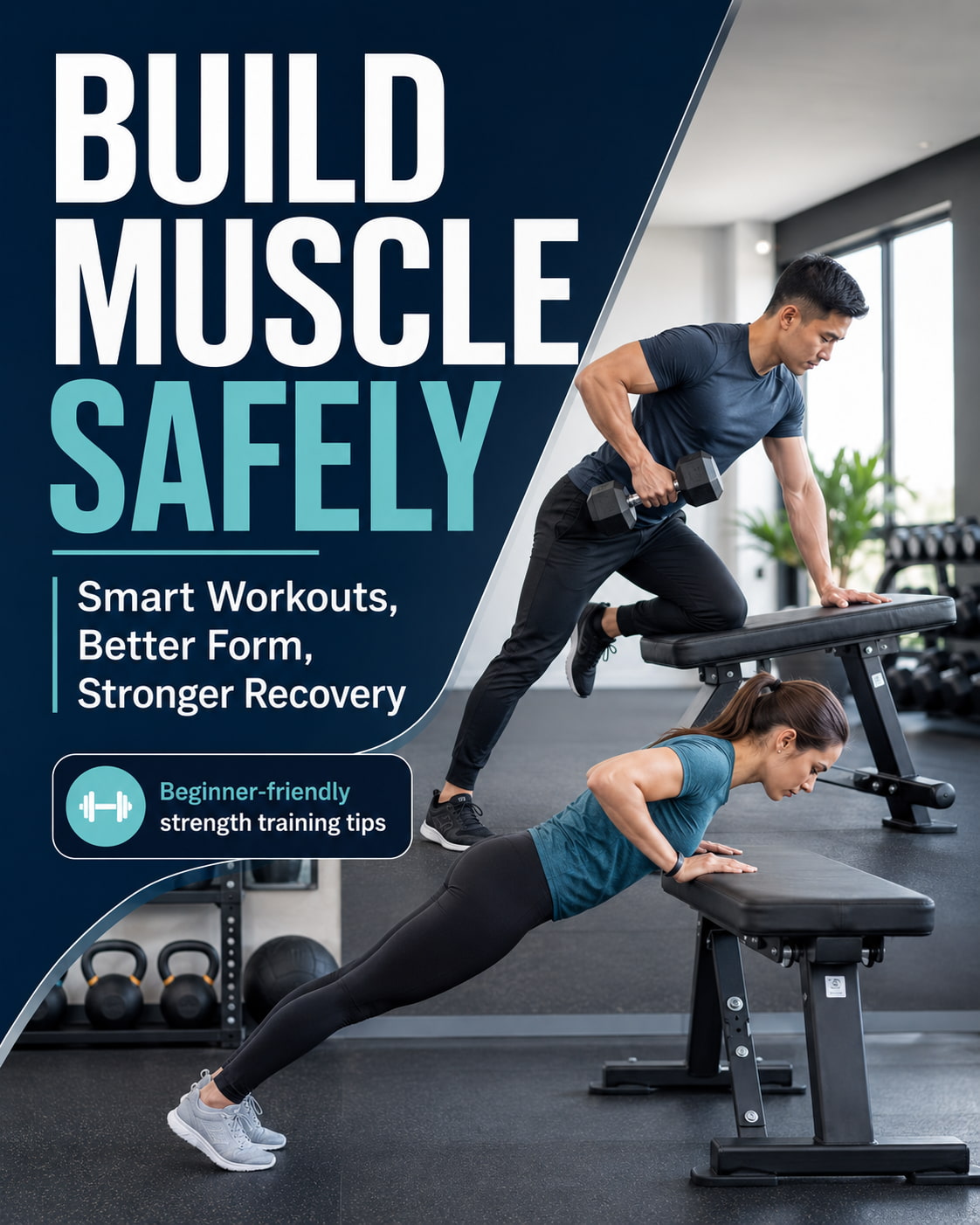
The safest way to build muscle is to strength train consistently, use proper form, increase difficulty gradually, recover between workouts, and support your training with enough food, protein, and sleep. Learning how to build muscle safely is not about chasing the hardest workout every day. It is about repeating quality training often enough for your body to adapt.
This guide explains how to choose safe muscle-building exercises, use proper sets and reps, progress without rushing, recover well, and build a simple weekly workout plan that works for beginners and developing lifters.
How to Build Muscle Safely: The Big Picture
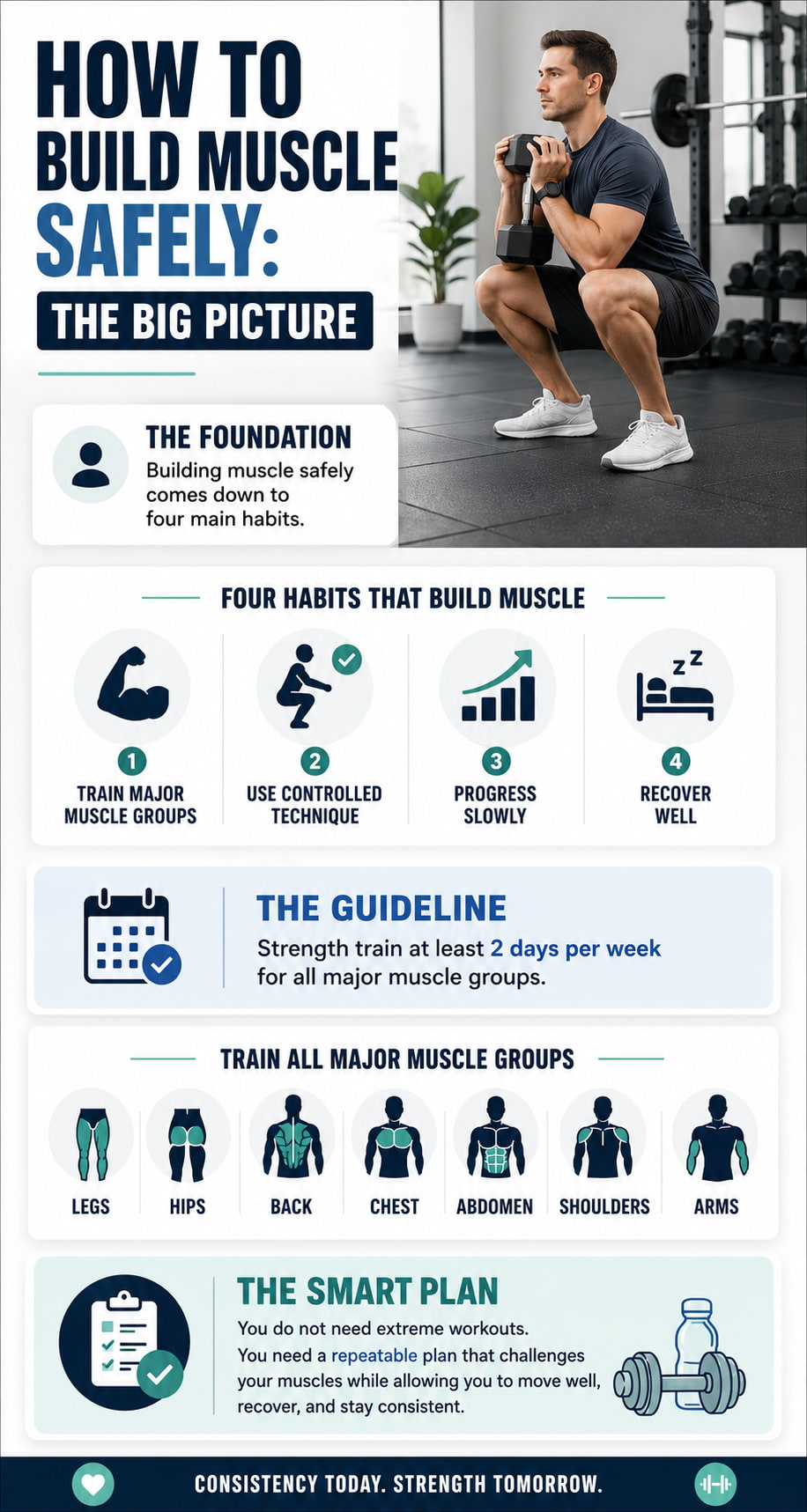
Building muscle safely comes down to four main habits: train the major muscle groups, use controlled technique, apply progressive overload slowly, and recover well enough to repeat strong workouts.
The CDC adult physical activity guidelines recommend muscle-strengthening activity at least 2 days per week for all major muscle groups. That includes the legs, hips, back, chest, abdomen, shoulders, and arms.
For muscle growth, you do not need extreme workouts. You need a repeatable plan. A safe program should challenge your muscles while still allowing you to move well, recover, and stay consistent.
What Muscle Growth Requires
Muscle growth happens when strength training gives your muscles a reason to adapt. The workout creates the signal. Recovery, food, and sleep help your body respond to that signal.
A safe muscle-building plan usually includes:
- Controlled resistance training
- Enough weekly training volume
- Gradual progression over time
- Good exercise technique
- Recovery between hard sessions
- Enough protein and total nutrition
- Consistent sleep and hydration
The American College of Sports Medicine notes that hypertrophy training often benefits from higher weekly volume, such as around 10 sets per muscle group per week for trained lifters. Beginners do not need to start there. They should first build skill, tolerance, and consistency.
Start With Form Before Weight
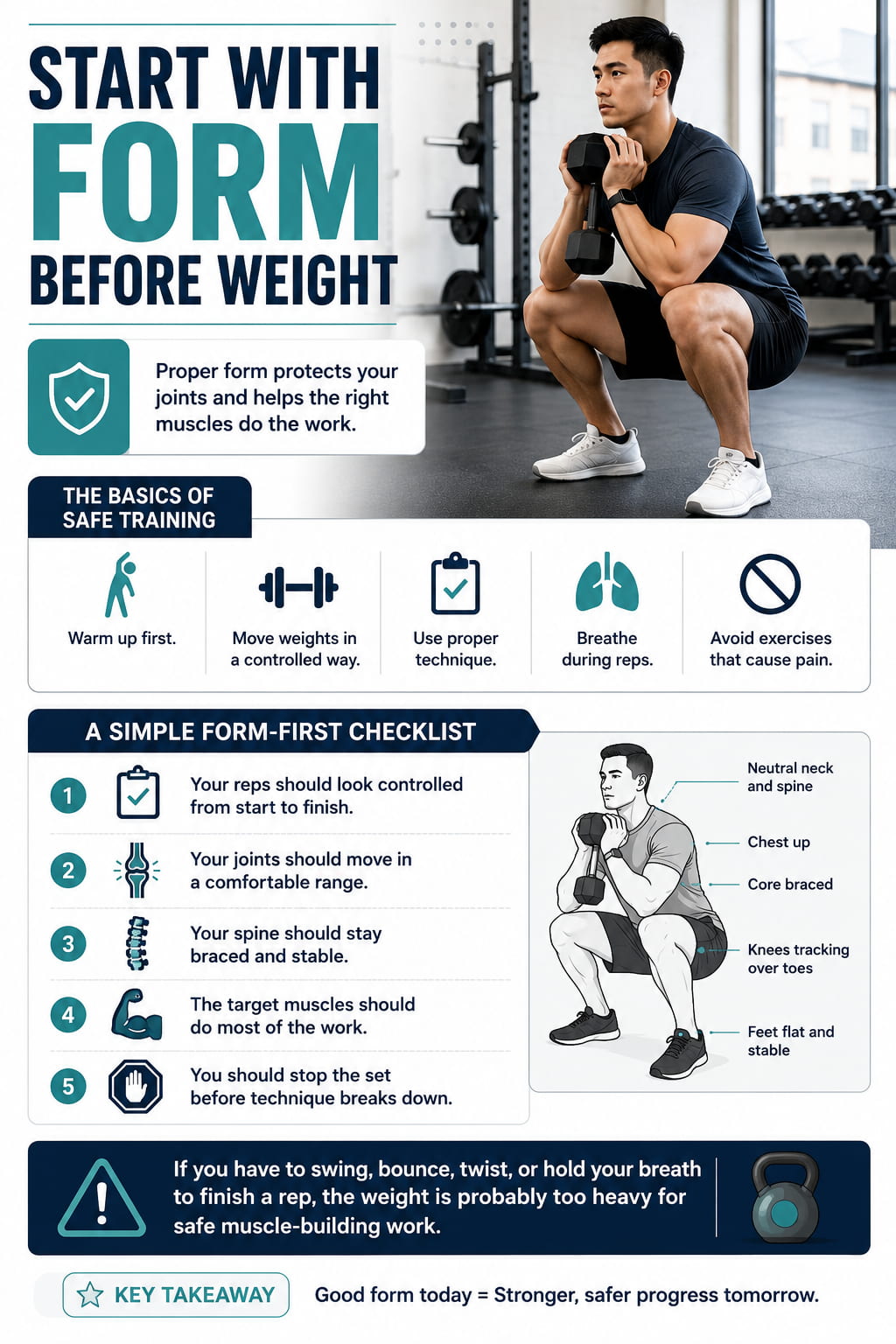
Proper form protects your joints and helps the right muscles do the work. The Mayo Clinic weight training guide recommends warming up, moving weights in a controlled way, using proper technique, breathing during reps, and avoiding exercises that cause pain.
A simple form-first checklist:
- Your reps should look controlled from start to finish.
- Your joints should move in a comfortable range.
- Your spine should stay braced and stable.
- The target muscles should do most of the work.
- You should stop the set before technique breaks down.
If you have to swing, bounce, twist, or hold your breath to finish a rep, the weight is probably too heavy for safe muscle-building work.
Best Exercises for Building Muscle Safely
The best exercises are not always the most complicated ones. A safe muscle-building plan should train the main movement patterns: squat, hinge, push, pull, single-leg work, and core stability.
1. Goblet Squat
Best for: Building lower-body strength with beginner-friendly form control.
Muscles worked: Quadriceps, glutes, hamstrings, calves, and core.
Equipment needed: Dumbbell or kettlebell.
Why it stands out: The goblet squat is easier to learn than many barbell squat variations because the weight sits in front of your body. This helps many beginners keep a more upright torso and control depth.
Suggested sets and reps: Start with 2–3 sets of 8–12 reps.
Beginners: Use bodyweight squats first or hold a light dumbbell close to your chest.
Intermediate: Use a heavier dumbbell and slow the lowering phase.
Advanced: Use front squats, tempo squats, or higher weekly squat volume.
Rest: Rest 60–90 seconds between sets.
How to do it:
- Stand with your feet about shoulder-width apart.
- Hold the dumbbell close to your chest.
- Brace your core and keep your chest tall.
- Bend your knees and hips to lower under control.
- Keep your feet flat and knees tracking in line with your toes.
- Drive through your feet to stand tall.
Common mistakes: Letting the knees collapse inward, rounding the back, lifting the heels, or dropping too fast into the bottom position.
Expert tip: Think “sit between your heels” instead of folding forward.
2. Dumbbell Romanian Deadlift
Best for: Training the hip hinge and building the glutes and hamstrings.
Muscles worked: Hamstrings, glutes, spinal erectors, lats, forearms, and core.
Equipment needed: Dumbbells.
Why it stands out: The Romanian deadlift teaches you to load the hips instead of pulling with the lower back. It is useful for building posterior-chain strength safely when performed with control.
Suggested sets and reps: Use 2–4 sets of 8–12 reps.
Beginners: Start with light dumbbells and stop when you feel a strong hamstring stretch.
Intermediate: Add load gradually while keeping the dumbbells close to your thighs.
Advanced: Use slower eccentrics, single-leg variations, or barbell Romanian deadlifts.
Rest: Rest 90–120 seconds between sets.
How to do it:
- Stand tall with dumbbells in front of your thighs.
- Brace your core and keep your shoulders packed.
- Push your hips back while keeping a soft bend in your knees.
- Lower the dumbbells close to your legs.
- Stop when your hamstrings feel stretched and your back position is still strong.
- Drive your hips forward to stand tall.
Common mistakes: Squatting too much, rounding the lower back, letting the weights drift forward, or forcing extra range of motion.
Expert tip: Keep the dumbbells close enough that they almost slide down your legs.
3. Incline Push-Up
Best for: Building safe pushing strength before full floor push-ups.
Muscles worked: Chest, shoulders, triceps, serratus anterior, and core.
Equipment needed: Bench, box, sturdy table, or Smith machine bar.
Why it stands out: The incline push-up lets beginners train the push-up pattern with less bodyweight load. It is also easy to progress by lowering the incline over time.
Suggested sets and reps: Use 2–4 sets of 8–15 reps.
Beginners: Start with hands on a higher surface.
Intermediate: Lower the surface or move to regular push-ups.
Advanced: Use deficit push-ups, weighted push-ups, or dumbbell pressing.
Rest: Rest 60–90 seconds between sets.
How to do it:
- Place your hands on a stable elevated surface.
- Step your feet back until your body forms a straight line.
- Brace your core and squeeze your glutes lightly.
- Lower your chest toward the surface under control.
- Keep your elbows at a comfortable angle from your body.
- Press back up without sagging through your hips.
Common mistakes: Letting the hips drop, shrugging the shoulders, flaring the elbows too wide, or rushing the reps.
Expert tip: Move your whole body as one piece from head to heels.
4. One-Arm Dumbbell Row
Best for: Building back strength and balancing pressing exercises.
Muscles worked: Lats, rhomboids, traps, rear delts, biceps, forearms, and core.
Equipment needed: Dumbbell and bench or sturdy support.
Why it stands out: Rows strengthen the upper back, which helps posture, shoulder control, and balanced upper-body training. They are also easier to scale than pull-ups.
Suggested sets and reps: Use 2–4 sets of 8–12 reps per side.
Beginners: Support one hand on a bench and use a light dumbbell.
Intermediate: Add weight while keeping the torso still.
Advanced: Use chest-supported rows, heavier dumbbell rows, or pull-up progressions.
Rest: Rest 60–90 seconds between sides or sets.
How to do it:
- Place one hand on a bench or stable support.
- Hold a dumbbell in the opposite hand.
- Brace your core and keep your back flat.
- Pull the dumbbell toward your lower ribs.
- Pause briefly without twisting your torso.
- Lower the weight under control.
Common mistakes: Twisting the body, shrugging the shoulder, yanking the weight, or letting the dumbbell swing.
Expert tip: Pull your elbow toward your back pocket instead of straight up.
5. Split Squat
Best for: Building single-leg strength and improving lower-body control.
Muscles worked: Quadriceps, glutes, hamstrings, calves, adductors, and core.
Equipment needed: Bodyweight, dumbbells, or kettlebells.
Why it stands out: The split squat trains each leg independently. This helps you notice strength differences and build control without needing heavy loading.
Suggested sets and reps: Use 2–3 sets of 8–12 reps per side.
Beginners: Start with bodyweight and hold a wall or support if needed.
Intermediate: Hold dumbbells at your sides.
Advanced: Use rear-foot-elevated split squats or slow tempo reps.
Rest: Rest 60–90 seconds between sides.
How to do it:
- Stand in a staggered stance.
- Keep your front foot flat and back heel lifted.
- Brace your core and stay tall.
- Lower your back knee toward the floor under control.
- Keep your front knee tracking in line with your toes.
- Push through your front foot to return to the top.
Common mistakes: Taking too narrow of a stance, pushing off the back leg too much, letting the front knee cave inward, or leaning excessively forward.
Expert tip: Think of your front leg as the working leg and your back leg as a kickstand.
6. Dead Bug
Best for: Building core control without stressing the lower back.
Muscles worked: Deep core, rectus abdominis, obliques, hip flexors, and stabilizing muscles.
Equipment needed: None.
Why it stands out: The dead bug trains your core to resist unwanted movement. That makes it useful for safer squats, hinges, presses, and rows.
Suggested sets and reps: Use 2–3 sets of 6–10 reps per side.
Beginners: Move only the arms or only the legs.
Intermediate: Move opposite arm and leg together.
Advanced: Add a band, hold a light weight, or slow the tempo.
Rest: Rest 30–60 seconds between sets.
How to do it:
- Lie on your back with arms up and knees bent.
- Brace your core so your ribs stay down.
- Slowly lower one arm and the opposite leg.
- Stop before your lower back arches.
- Return to the start with control.
- Repeat on the other side.
Common mistakes: Arching the lower back, rushing the movement, holding the breath, or lowering the limbs too far.
Expert tip: Make the movement smaller if your back starts to lift from the floor.
Sets, Reps, and Rest for Safe Muscle Growth
For beginners, a simple starting point is 2–3 full-body workouts per week. Use 1–3 sets per exercise and aim for 8–12 controlled reps on most strength movements.
A safe effort level is about 2–3 reps in reserve. That means you finish the set feeling like you could do two or three more good reps if you had to. This keeps training challenging without forcing sloppy reps.
Use these guidelines:
Beginner: 1–3 sets per exercise, 8–12 reps, 2–3 days per week
Intermediate: 3–4 sets per exercise, 6–15 reps, 3–4 days per week
Advanced: Higher weekly volume, more exercise variety, and planned recovery weeks
For rest, use 60–90 seconds for smaller or easier exercises and 90–180 seconds for harder compound lifts. If your goal is better form and stronger reps, resting a little longer is usually better than rushing.
How to Use Progressive Overload Safely
Progressive overload means making training slightly more challenging over time. It does not mean adding weight every workout forever.
Safe ways to progress include:
- Adding 1–2 reps per set
- Adding a small amount of weight
- Adding one extra set
- Improving range of motion
- Using slower, more controlled reps
- Reducing assistance on bodyweight exercises
- Training with better technique at the same weight
A simple rule is to increase difficulty only when you can complete all planned reps with clean form and no unusual pain. For example, if your plan is 3 sets of 10 goblet squats and all reps feel controlled, you can add a small amount of weight next time.
Avoid increasing weight, sets, reps, and frequency all at once. Change one variable at a time.
Recovery: Where Muscle Building Actually Happens
Your muscles do not grow because you destroy them every workout. They adapt because training and recovery work together.
The Mayo Clinic strength training guide recommends training all major muscle groups at least two times per week and resting before training the same muscles hard again.
Good recovery includes:
- Sleeping enough for your age and schedule
- Taking rest days between hard sessions for the same muscles
- Eating enough total food
- Drinking enough fluids
- Managing soreness instead of chasing it
- Using lighter weeks when fatigue builds up
Mild muscle soreness can happen when you start or change training. Sharp pain, joint pain, numbness, dizziness, chest pain, or unusual symptoms are not normal training goals. Stop the exercise and seek professional help if those symptoms happen.
Nutrition Basics for Building Muscle Safely
Training gives your body the signal to build muscle. Nutrition gives it the materials.
Protein matters because it supports muscle repair and growth. The International Society of Sports Nutrition states that many active people benefit from about 1.4–2.0 grams of protein per kilogram of body weight per day.
For most readers, the practical goal is simple: include a protein source at each meal. Good options include eggs, Greek yogurt, lean meat, fish, milk, tofu, tempeh, beans, lentils, and protein-rich whole foods.
Carbohydrates also support training energy. Fats support general health. Do not use overly restrictive eating to build muscle. If you are training hard, your body needs enough total food to recover and perform well.
Sample Beginner Muscle-Building Workout
Use this routine 2–3 days per week on nonconsecutive days. Keep the effort moderate and stop each set with about 2–3 good reps left.
Full-Body Beginner Workout
- Goblet squat: 2–3 sets of 8–12 reps
- Dumbbell Romanian deadlift: 2–3 sets of 8–12 reps
- Incline push-up: 2–3 sets of 8–15 reps
- One-arm dumbbell row: 2–3 sets of 8–12 reps per side
- Split squat: 2 sets of 8–10 reps per side
- Dead bug: 2 sets of 6–10 reps per side
Rest 60–120 seconds between sets. Start with lighter loads and focus on technique. When you can complete the top end of the rep range with clean form for every set, increase the weight slightly or add one rep per set.
Weekly Training Structure
A simple weekly plan could look like this:
- Monday: Full-body strength workout
- Tuesday: Light cardio or mobility
- Wednesday: Rest or easy walking
- Thursday: Full-body strength workout
- Friday: Light cardio or mobility
- Saturday: Optional third full-body workout or active recovery
- Sunday: Rest
If you train 3 days per week, keep at least one day between hard full-body sessions when possible. If you feel run down, reduce sets, lower the weight, or take an extra recovery day.
Common Mistakes to Avoid
Lifting Too Heavy Too Soon
Heavy weight is not useful if your form falls apart. Start with a load you can control. Build strength by earning heavier weights over time.
Training Through Pain
Muscle effort is normal. Sharp pain, nerve symptoms, dizziness, chest pain, or unusual symptoms are not. Stop and get help when needed.
Skipping Warm-Ups
Warm-ups help your body prepare for training. Use 5–10 minutes of easy cardio, then do lighter practice sets before your main lifts.
Rushing Every Rep
Fast, sloppy reps often shift stress away from the target muscles. Use a controlled lowering phase and a strong but stable lift.
Training the Same Muscles Hard Every Day
Muscles need recovery. More training is not always better if your performance, sleep, joints, or motivation start to drop.
Ignoring Pulling Exercises
Many beginners do more push-ups and presses than rows. Balance pushing with pulling to train the back, shoulders, and arms more evenly.
Changing Exercises Too Often
Variety can be useful, but changing everything every workout makes progress harder to track. Keep your main exercises consistent for several weeks.
Beginner, Intermediate, and Advanced Use
Beginners
Start with 2 full-body workouts per week. Use simple exercises, lighter resistance, and controlled reps. Your main goal is to learn movement patterns and build consistency.
Intermediate Lifters
Train 3–4 days per week. Add more weekly sets, use slightly heavier loads, and track performance. You can split training into upper/lower days or keep using full-body workouts.
Advanced Lifters
Use more planned volume, exercise variation, and recovery management. Advanced training should include deload weeks, movement-specific goals, and more careful load selection.
How Long Does It Take to Build Muscle?
Beginners may feel stronger within a few weeks because the nervous system gets better at performing the movements. Visible muscle changes usually take longer and depend on training consistency, nutrition, sleep, genetics, age, and starting point.
Do not judge progress only by the mirror. Better form, more reps, heavier weights, improved control, and better workout consistency are all signs that your plan is working.
FAQ
Can beginners build muscle safely at home?
Yes. Beginners can build muscle at home with bodyweight exercises, dumbbells, kettlebells, or resistance bands. The key is to train consistently, use proper form, and make exercises gradually harder.
How many days a week should I train to build muscle?
Most beginners do well with 2–3 strength workouts per week. This gives enough practice and enough recovery. More advanced lifters may train 3–5 days per week depending on their program.
Do I need to lift heavy to build muscle?
You need enough resistance to challenge your muscles, but you do not need maximum weights. Moderate loads, controlled reps, and enough weekly volume can build muscle safely.
Should I train to failure?
Training to failure is not required for most beginners. Stopping with 1–3 reps in reserve is usually safer and easier to recover from while still building strength and muscle.
What should I do if I feel pain during an exercise?
Stop the exercise. Check your form, reduce the load, or switch to an easier variation. If pain is sharp, repeated, or unusual, speak with a qualified healthcare or fitness professional.
Is soreness required for muscle growth?
No. Soreness is not proof of a good workout. You can build muscle without being very sore. Progress comes from consistent training, gradual overload, and recovery.
Conclusion
The best way to build muscle safely is to master the basics and progress patiently. Choose exercises you can control, train all major muscle groups, add difficulty slowly, recover between hard sessions, and support your workouts with enough food and sleep.
Start with two or three well-planned strength workouts per week. Track your form, reps, and recovery. When the basics feel strong, progress one step at a time.
This content is for informational purposes only and is not a substitute for professional medical advice.