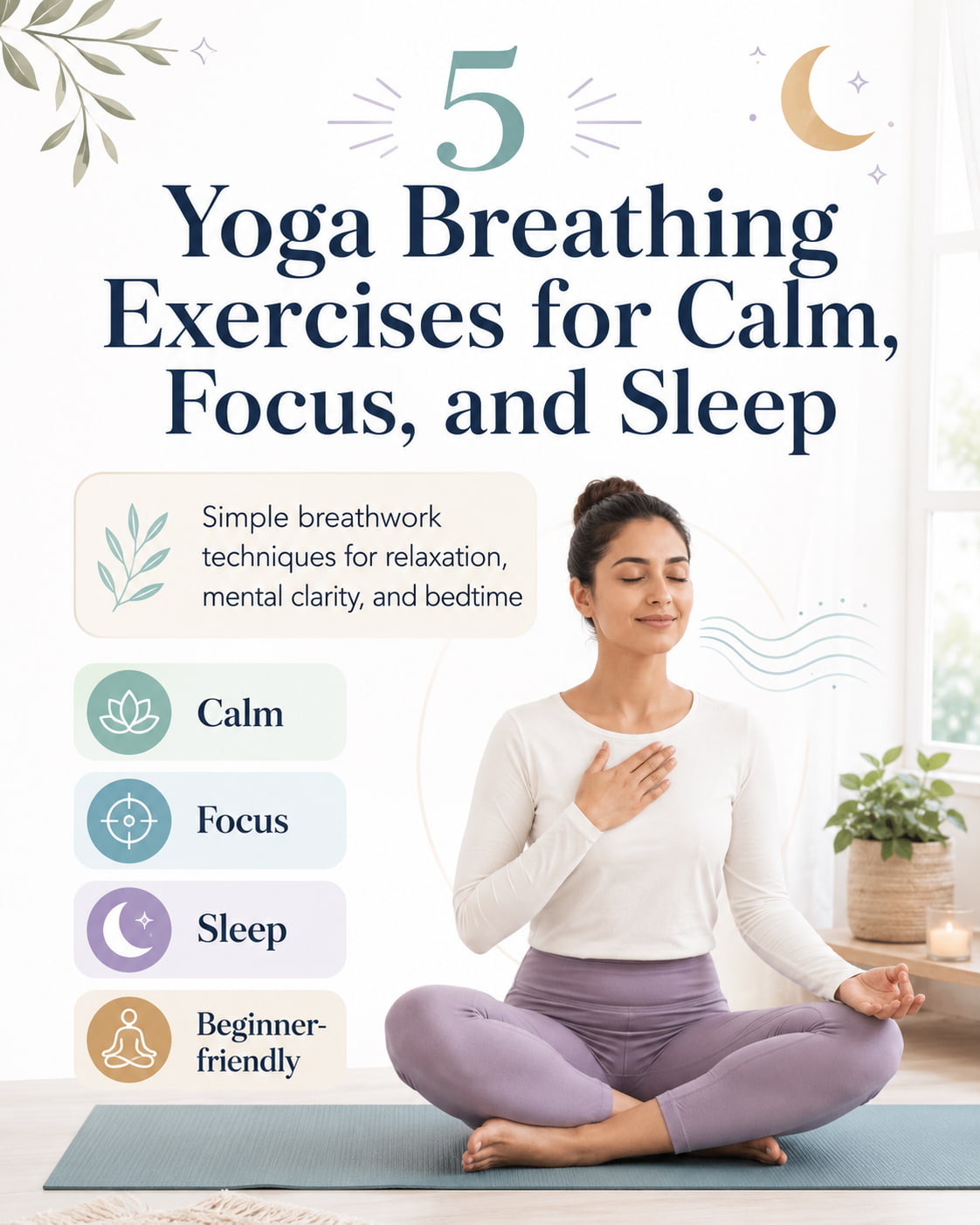
Yoga breathing exercises are simple breath-control techniques that may help you feel calmer, improve focus, and prepare your body for sleep. They are often used in yoga as pranayama, which means breath regulation or breath control.
You do not need advanced yoga experience to start. The goal is not to force deep breathing or hold your breath as long as possible. The goal is to breathe with control, stay relaxed, and use the right technique for the right moment.
In this guide, you will learn five beginner-friendly yoga breathing exercises, how to do them correctly, when to use each one, common mistakes to avoid, and how to build a short breathing routine.
What Are Yoga Breathing Exercises?
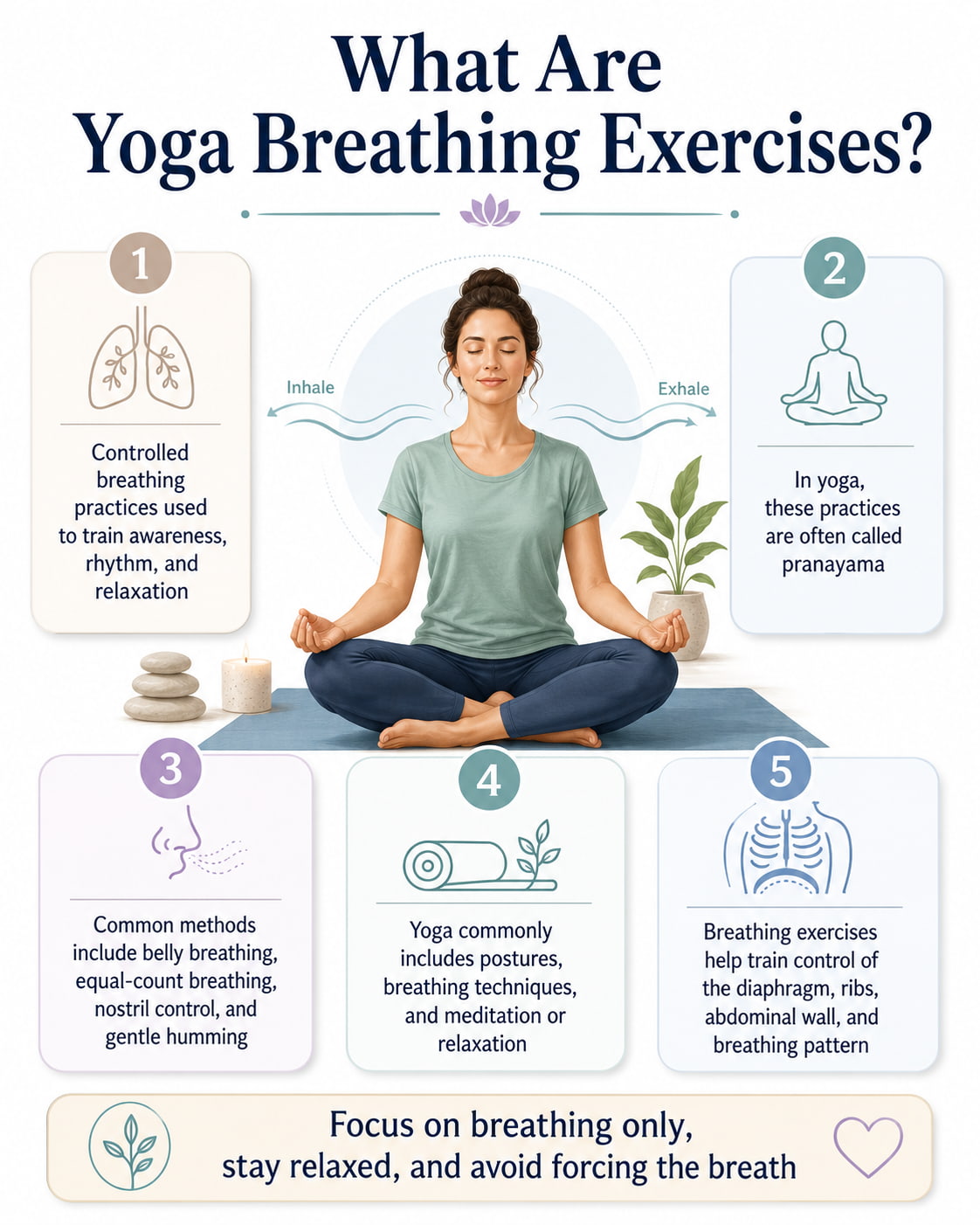
Yoga breathing exercises are controlled breathing practices used to train awareness, rhythm, and relaxation. In yoga, these practices are often called pranayama. Some techniques use slow belly breathing, some use equal counts, and others use nostril control or a gentle humming sound.
According to the National Center for Complementary and Integrative Health, yoga commonly includes physical postures, breathing techniques, and meditation or relaxation. For this article, the focus is breathing only.
These exercises are not strength training in the usual sense, but they do train control of the diaphragm, ribs, abdominal wall, and breathing pattern. They can also help you notice tension in your shoulders, jaw, chest, and neck.
Benefits of Yoga Breathing Exercises
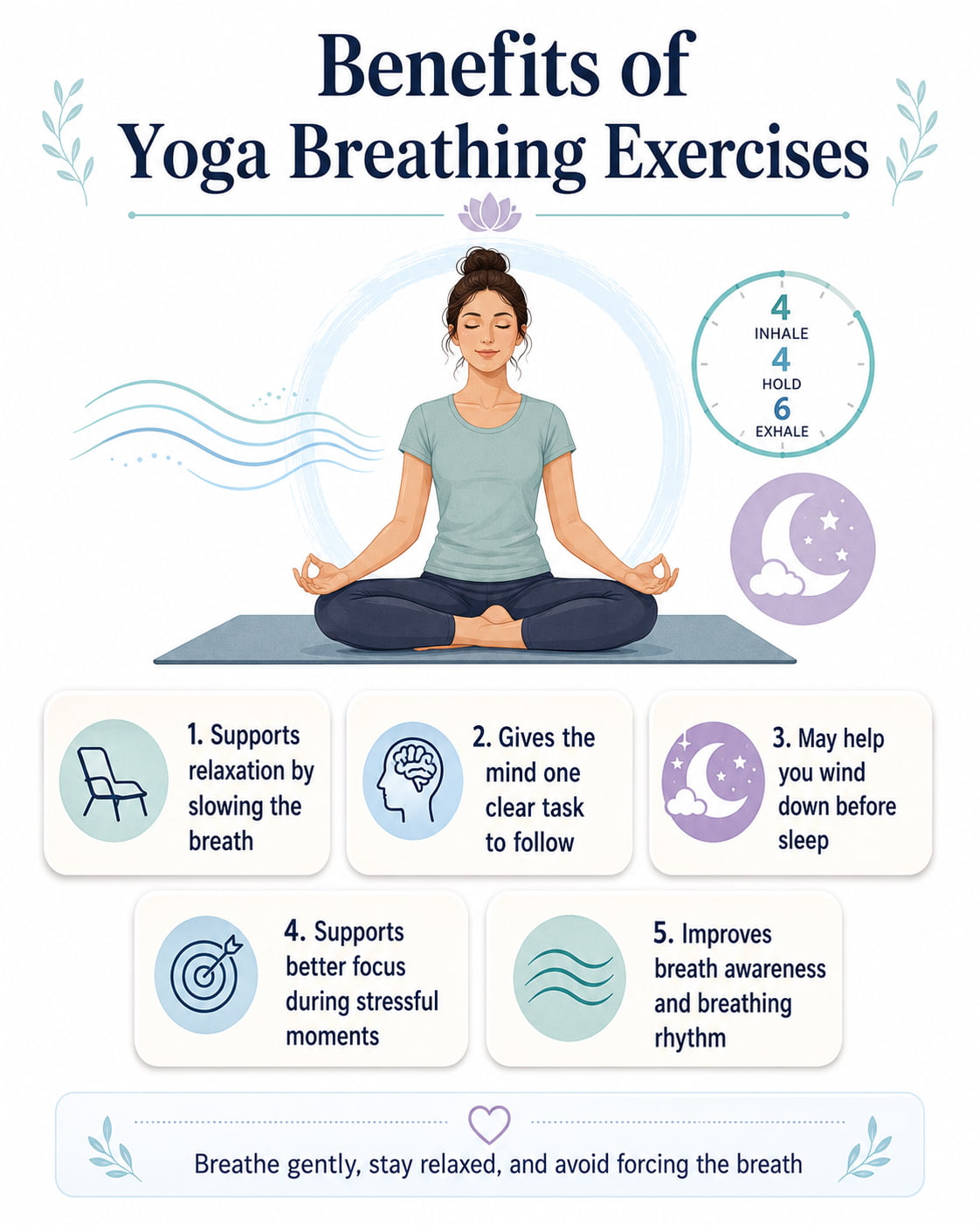
Yoga breathing exercises may help support relaxation because they slow your breathing down and give your mind one clear task to follow. The NHS recommends gentle breathing into the belly without forcing it, which is a good starting point for beginners.
Breathing exercises can also be useful before sleep. The Sleep Foundation includes breathing techniques such as 4-7-8 breathing, box breathing, alternate nostril breathing, and Bhramari breathing as options that may help people relax before bed.
For focus, structured breathing gives your attention a steady rhythm. Instead of thinking about everything at once, you count, breathe, pause, and repeat. That is why box breathing is often used as a simple reset during stressful or mentally busy moments.
The main benefits include better breath awareness, a calmer pace of breathing, improved relaxation before sleep, better focus during stressful moments, and a simple tool you can use almost anywhere.
How to Practice Yoga Breathing Exercises Safely
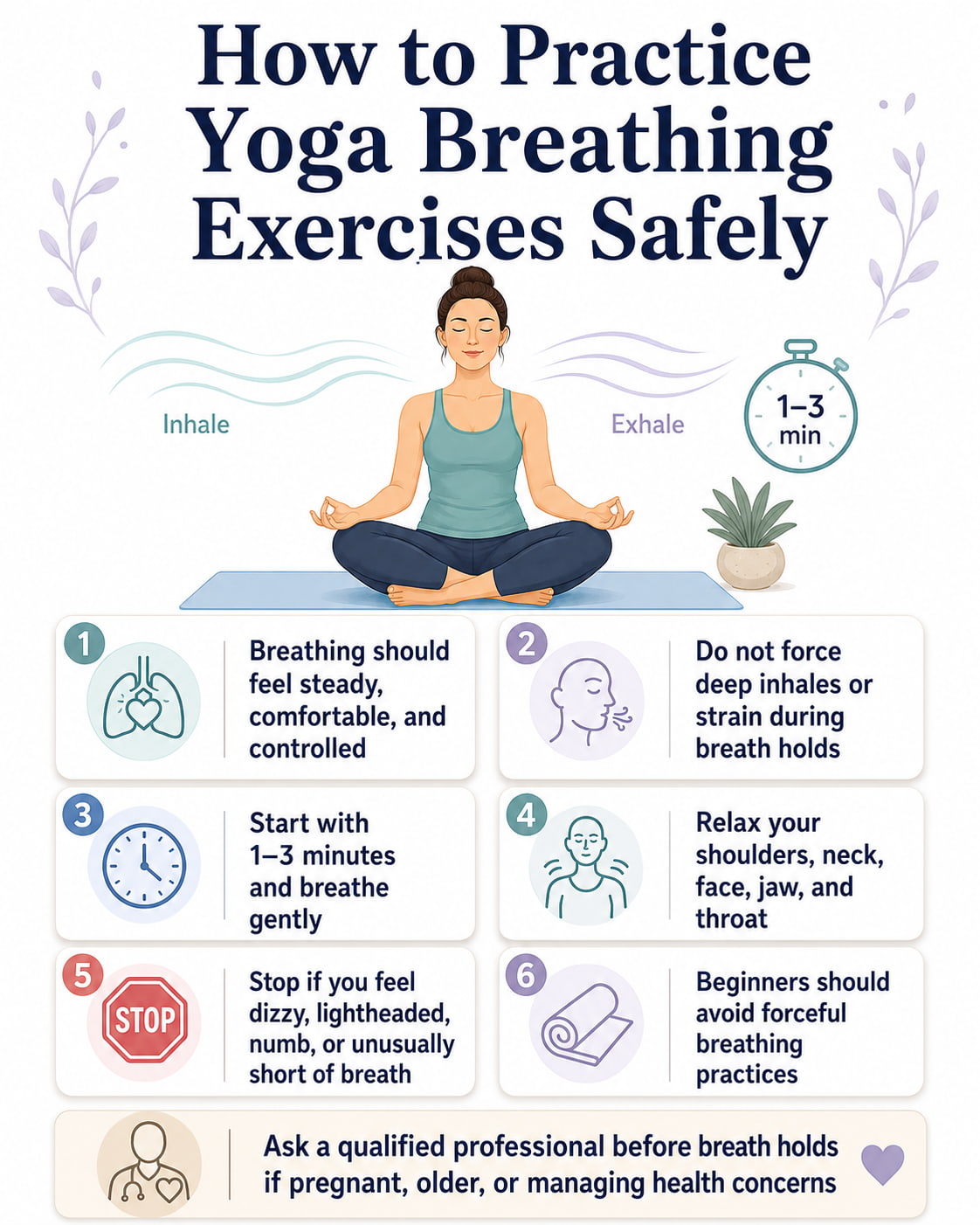
Breathing should feel steady, comfortable, and controlled. Do not force a bigger inhale, strain during breath holds, or compete with a count that feels too long.
Start with one to three minutes. Sit upright, lie down, or choose a relaxed position where your shoulders and neck can soften. Keep your face, jaw, and throat relaxed. If you feel dizzy, lightheaded, unusually short of breath, numb, or uncomfortable, stop and return to normal breathing.
The National Center for Complementary and Integrative Health advises beginners to avoid forceful breathing practices. That is why this guide focuses on gentle techniques instead of fast or aggressive pranayama.
People who are pregnant, older adults, or anyone with heart, lung, blood pressure, neurological, or medical concerns should ask a qualified healthcare professional before using breath holds or advanced breathing practices.
5 Yoga Breathing Exercises for Calm, Focus, and Sleep
The five exercises below are organized from simple to more structured. Start with Three-Part Breath if you are new. Use Box Breathing for focus, Alternate Nostril Breathing for calm attention, Humming Bee Breath for winding down, and 4-7-8 Breathing for bedtime.
1. Three-Part Breath
Best for: Beginners, stress relief, body awareness, and preparing for meditation or sleep.
Why it stands out: Three-Part Breath teaches you how to breathe into the belly, ribs, and upper chest without rushing. It is one of the best starting points because it helps you feel where your breath is moving.
Suggested sets and reps: Practice for two to five minutes. Use slow, easy breaths instead of chasing a perfect count.
Beginners: Place one hand on your belly and one hand on your ribs. Feel the breath move without trying to make it dramatic.
Intermediate: Use a gentle count such as four seconds in and six seconds out.
Advanced: Add a short pause after the inhale and exhale, but keep the pause soft and optional.
Rest: Return to normal breathing for 30 to 60 seconds before moving to another technique.
How to do it:
- Sit tall or lie on your back with your shoulders relaxed.
- Inhale slowly through your nose and let your lower belly expand gently.
- Continue the inhale into your lower ribs.
- Let the final part of the inhale rise softly into the upper chest.
- Exhale slowly and let the upper chest, ribs, and belly relax.
- Repeat without forcing the inhale or squeezing the exhale.
Common mistakes: The biggest mistakes are lifting the shoulders, overfilling the lungs, pushing the belly out aggressively, and turning the breath into a strain.
Expert tip: Think “soft belly, wide ribs, easy chest.” The breath should feel smooth, not forced.
Exercise variations: Try it lying down before bed, seated before meditation, or standing with one hand on your ribs to feel expansion.
Easier variation: Breathe only into the belly and ribs. Skip the upper-chest focus if it makes you tense.
Harder variation: Extend the exhale slightly longer than the inhale, such as four seconds in and six seconds out.
2. Box Breathing
Best for: Focus, stress resets, mental clarity, and calming down during a busy day.
Why it stands out: Box Breathing gives your mind a clear four-part pattern. The Cleveland Clinic describes the classic pattern as inhale, hold, exhale, and hold again, often using a count of four for each step.
Suggested sets and reps: Start with three to four rounds. One round is inhale, hold, exhale, hold.
Beginners: Use a smaller count, such as three seconds for each side of the box.
Intermediate: Use the classic four-count pattern.
Advanced: Practice for three to five minutes while keeping every phase smooth and relaxed.
Rest: Take three to five normal breaths between rounds if you feel tense.
How to do it:
- Sit upright with your feet relaxed and your shoulders down.
- Exhale gently to empty your breath without forcing.
- Inhale through your nose for a count of four.
- Hold gently for a count of four.
- Exhale slowly for a count of four.
- Hold gently again for a count of four.
- Repeat for three to four rounds.
Common mistakes: Avoid clenching your jaw, holding too aggressively, rushing the exhale, or pushing through dizziness.
Expert tip: The holds should feel like quiet pauses, not breath-holding challenges.
Exercise variations: Use a 3-3-3-3 count for easier practice or a 4-4-6-2 count when you want a longer exhale.
Easier variation: Remove the holds and simply breathe in for four and out for four.
Harder variation: Use five-count sides only if four counts feels easy and calm.
3. Alternate Nostril Breathing
Best for: Calm focus, meditation preparation, and slowing down when your mind feels scattered.
Why it stands out: Alternate Nostril Breathing, often called Nadi Shodhana, uses one nostril at a time to create a steady breathing rhythm. It can feel more focused than regular breathing because your hand position and breath pattern keep your attention anchored.
Suggested sets and reps: Practice for one to three minutes at first. Build toward five minutes if it feels comfortable.
Beginners: Skip breath holds. Use a simple inhale through one side and exhale through the other.
Intermediate: Use a steady count, such as four seconds in and four seconds out.
Advanced: Add a short, gentle pause after each inhale only if you already tolerate the basic version well.
Rest: Rest your hand down and breathe normally for 30 seconds after practice.
How to do it:
- Sit tall with your shoulders relaxed.
- Bring your right hand near your nose.
- Gently close your right nostril with your thumb.
- Inhale through your left nostril.
- Close your left nostril with a finger and release the right nostril.
- Exhale through your right nostril.
- Inhale through your right nostril.
- Close your right nostril and release the left.
- Exhale through your left nostril.
- Continue slowly and gently.
Common mistakes: Do not press hard on the nostrils, lift the shoulders, twist the neck, or hold your breath if it feels uncomfortable.
Expert tip: Keep the touch light. You only need enough pressure to guide airflow.
Exercise variations: Practice without holds for relaxation, with equal counts for focus, or before meditation to settle your attention.
Easier variation: Skip the hand position and imagine breathing through one side at a time.
Harder variation: Use a longer exhale, such as four seconds in and six seconds out, while keeping the breath quiet.
4. Humming Bee Breath
Best for: Winding down, reducing mental noise, and preparing for sleep or quiet meditation.
Why it stands out: Humming Bee Breath, often called Bhramari, uses a soft humming sound during the exhale. The sound gives your mind something steady to follow and may help create a calming effect before sleep. A PubMed Central review on yogic breath regulation notes that yogic breathing practices have been studied for stress and mental well-being, while also emphasizing the need for proper guidance and more high-quality research.
Suggested sets and reps: Start with five slow humming exhales. Build toward two to five minutes.
Beginners: Keep the hum quiet and comfortable. Do not force the sound.
Intermediate: Make the exhale longer while keeping the inhale natural.
Advanced: Use the practice before meditation or as part of a longer bedtime routine.
Rest: Breathe normally for a few breaths after each set of five humming exhales.
How to do it:
- Sit comfortably or lie down.
- Relax your jaw, tongue, eyes, and shoulders.
- Inhale slowly through your nose.
- Exhale through your nose while making a soft humming sound.
- Keep the hum smooth until the exhale naturally ends.
- Pause briefly and breathe normally if needed.
- Repeat for five slow rounds.
Common mistakes: Avoid humming too loudly, tightening the throat, forcing a long exhale, or practicing in a way that irritates your throat.
Expert tip: The hum should feel soothing, like a gentle vibration, not like singing or pushing your voice.
Exercise variations: Try a lower-pitched hum, a softer hum, or a shorter exhale if the full version feels uncomfortable.
Easier variation: Exhale with a quiet “mmm” sound for only three rounds.
Harder variation: Pair it with a longer exhale count, such as four seconds in and eight seconds humming out.
5. 4-7-8 Breathing
Best for: Bedtime, evening relaxation, and downshifting after a stressful day.
Why it stands out: The Cleveland Clinic describes 4-7-8 breathing as inhaling through the nose for four counts, holding for seven counts, and exhaling through the mouth for eight counts. The long exhale makes it especially useful as a calming nighttime practice.
Suggested sets and reps: Start with two rounds. Build toward four rounds if you stay comfortable.
Beginners: Use a shorter version such as 4-2-6 or 3-3-6. Breath holds should never feel stressful.
Intermediate: Use the full 4-7-8 rhythm for two to four rounds.
Advanced: Use the technique before sleep for several weeks and track whether it helps you wind down more consistently.
Rest: Take normal breaths between rounds whenever needed.
How to do it:
- Sit or lie down in a comfortable position.
- Place the tip of your tongue lightly behind your upper front teeth if comfortable.
- Inhale through your nose for a count of four.
- Hold your breath gently for a count of seven.
- Exhale slowly through your mouth for a count of eight.
- Repeat for two to four total rounds.
Common mistakes: Do not force the hold, rush the exhale, tighten your chest, or keep practicing if you feel lightheaded.
Expert tip: If the seven-count hold creates tension, shorten it. A relaxed 4-2-6 pattern is better than a strained 4-7-8 pattern.
Exercise variations: Try 3-3-6, 4-2-6, or 4-4-8 depending on comfort.
Easier variation: Inhale for four and exhale for six with no breath hold.
Harder variation: Use the full 4-7-8 pattern only after the easier version feels calm and natural.
5-Minute Yoga Breathing Routine for Beginners
This routine is simple enough to use in the morning, during a break, or before bed. Keep the effort level easy, around 2 to 3 out of 10. You should finish feeling calmer, not drained.
| Minute | Exercise | How to Practice |
|---|---|---|
| 1 | Three-Part Breath | Breathe into the belly, ribs, and chest without forcing. |
| 2 | Box Breathing | Use a 3-3-3-3 or 4-4-4-4 rhythm. |
| 3 | Alternate Nostril Breathing | Breathe gently through one nostril at a time with no holds. |
| 4 | Humming Bee Breath | Use soft humming exhales for several rounds. |
| 5 | Easy Long Exhale Breathing | Inhale for four and exhale for six. |
Use this routine three to five days per week. Once it feels easy, repeat it daily or extend the total time to eight to ten minutes. Progress by making the breath smoother before making it longer.
When to Use Each Breathing Exercise
| Goal | Best Exercise | Suggested Time |
|---|---|---|
| Calm down quickly | Three-Part Breath | Two to five minutes |
| Improve focus | Box Breathing | Three to four rounds |
| Prepare for meditation | Alternate Nostril Breathing | Three to five minutes |
| Wind down at night | Humming Bee Breath | Five to ten rounds |
| Prepare for sleep | 4-7-8 Breathing | Two to four rounds |
For sleep, use breathing as part of a full wind-down routine. Dim the lights, put your phone away, and practice in bed or next to your bed. Breathing exercises work best when they are repeated consistently rather than used only after you already feel very tense.
Common Mistakes to Avoid
The most common mistake is trying too hard. Yoga breathing should not feel like a performance. If your neck, shoulders, face, or chest tighten, make the breath smaller and easier.
Another mistake is forcing breath holds. Breath retention can be useful for some people, but beginners should treat it as optional. If a hold makes you anxious, dizzy, or uncomfortable, skip it.
Avoid practicing advanced or forceful breathing without guidance. Fast, aggressive breathing techniques are not the right starting point for calm, focus, or sleep.
Do not use breathing exercises while driving, swimming, standing in an unsafe place, or doing anything where dizziness could be dangerous. Practice seated, lying down, or in a safe quiet space.
How Often Should You Do Yoga Breathing Exercises?
Most beginners can start with five minutes per day. A short, consistent practice is usually better than one long session once in a while.
For calm, practice once in the morning or during a daily break. For focus, use Box Breathing before studying, work, or a demanding task. For sleep, use Humming Bee Breath, Three-Part Breath, or a gentle 4-7-8 variation before bed.
If you feel more tense after breathing practice, reduce the count, remove breath holds, and choose Three-Part Breath instead.
FAQ
What is the best yoga breathing exercise for beginners?
Three-Part Breath is the best starting point for most beginners because it teaches body awareness and relaxed breathing without breath holds. It is simple, gentle, and easy to practice seated or lying down.
Which yoga breathing exercise is best for sleep?
Humming Bee Breath and 4-7-8 Breathing are often useful before sleep. If breath holds feel uncomfortable, choose Humming Bee Breath or a simple four-count inhale and six-count exhale instead.
Can yoga breathing exercises help with anxiety?
Yoga breathing exercises may help support relaxation and reduce feelings of stress in the moment, but they are not a replacement for mental health care. If anxiety is persistent, intense, or affecting daily life, speak with a qualified healthcare professional.
Should I breathe through my nose or mouth?
Many yoga breathing exercises use nasal breathing because it encourages a slower, steadier rhythm. Some techniques, such as 4-7-8 breathing, use a nasal inhale and mouth exhale. Choose the version that feels comfortable and safe.
How long should I practice yoga breathing each day?
Start with one to five minutes per day. Once that feels easy, you can build to five to ten minutes. More time is not always better if the breath becomes forced or uncomfortable.
Why do I feel dizzy during breathing exercises?
Dizziness can happen if you breathe too deeply, breathe too fast, hold your breath too long, or tense your body. Stop, breathe normally, and use a shorter, easier pattern next time. If dizziness continues or feels concerning, seek professional medical advice.
Conclusion
Yoga breathing exercises are simple tools for calm, focus, and sleep when they are practiced gently and consistently. Start with Three-Part Breath, then add Box Breathing, Alternate Nostril Breathing, Humming Bee Breath, or 4-7-8 Breathing based on your goal.
Keep the breath smooth, comfortable, and easy to control. The best breathing technique is the one you can practice regularly without strain.
This content is for informational purposes only and is not a substitute for professional medical advice.