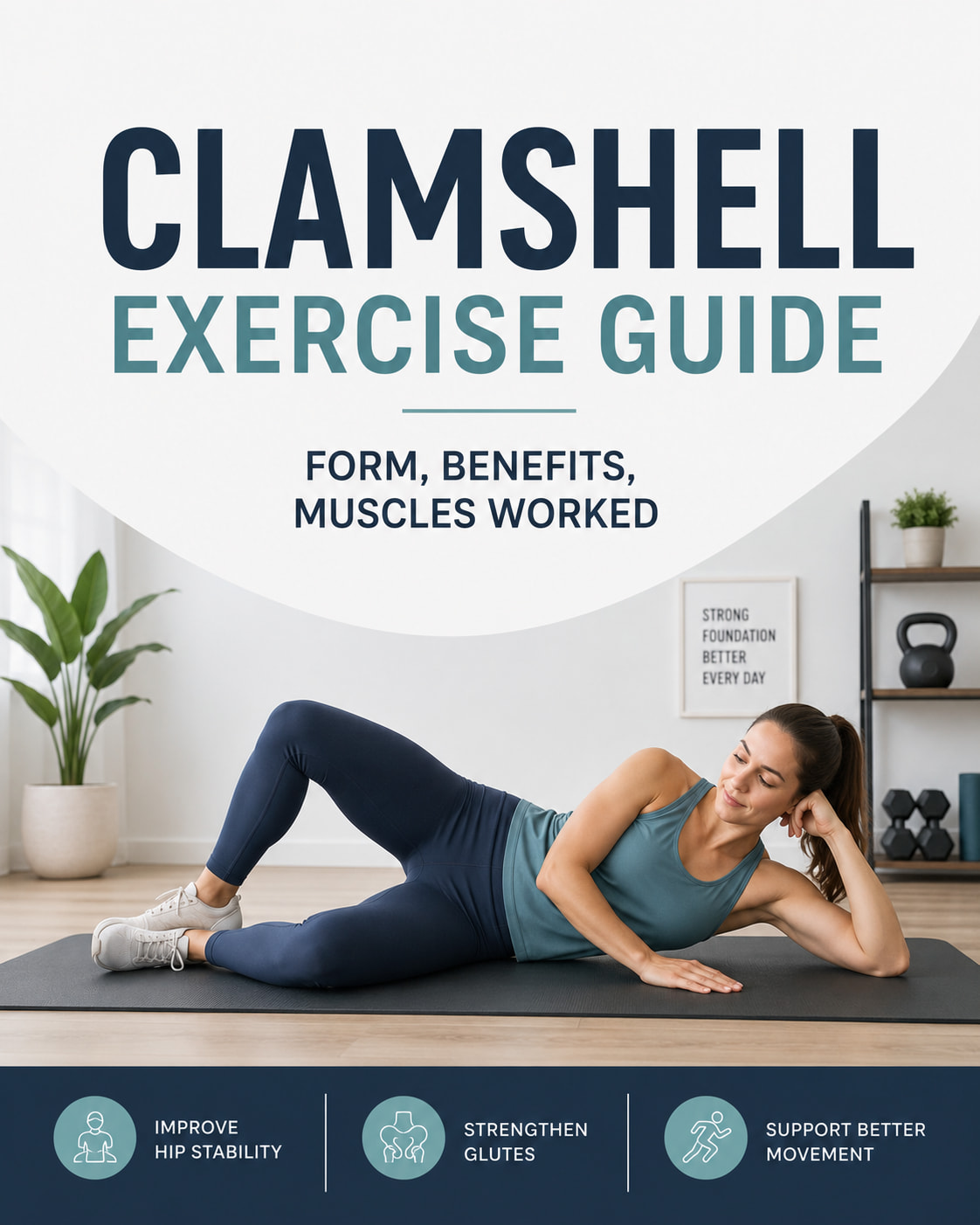
The clamshell exercise is a side-lying hip-strengthening move that mainly targets the gluteus medius and helps train better hip control, pelvic stability, and lower-body alignment. It looks simple, but the benefit comes from doing it with control, not from lifting the knee as high as possible.
The clamshell exercise is commonly used in warmups, glute activation routines, beginner strength plans, running programs, and physical therapy-style training. In this guide, you will learn how to do it correctly, which muscles it works, common mistakes to avoid, useful variations, and how to add it to a real workout.
What Is the Clamshell Exercise?
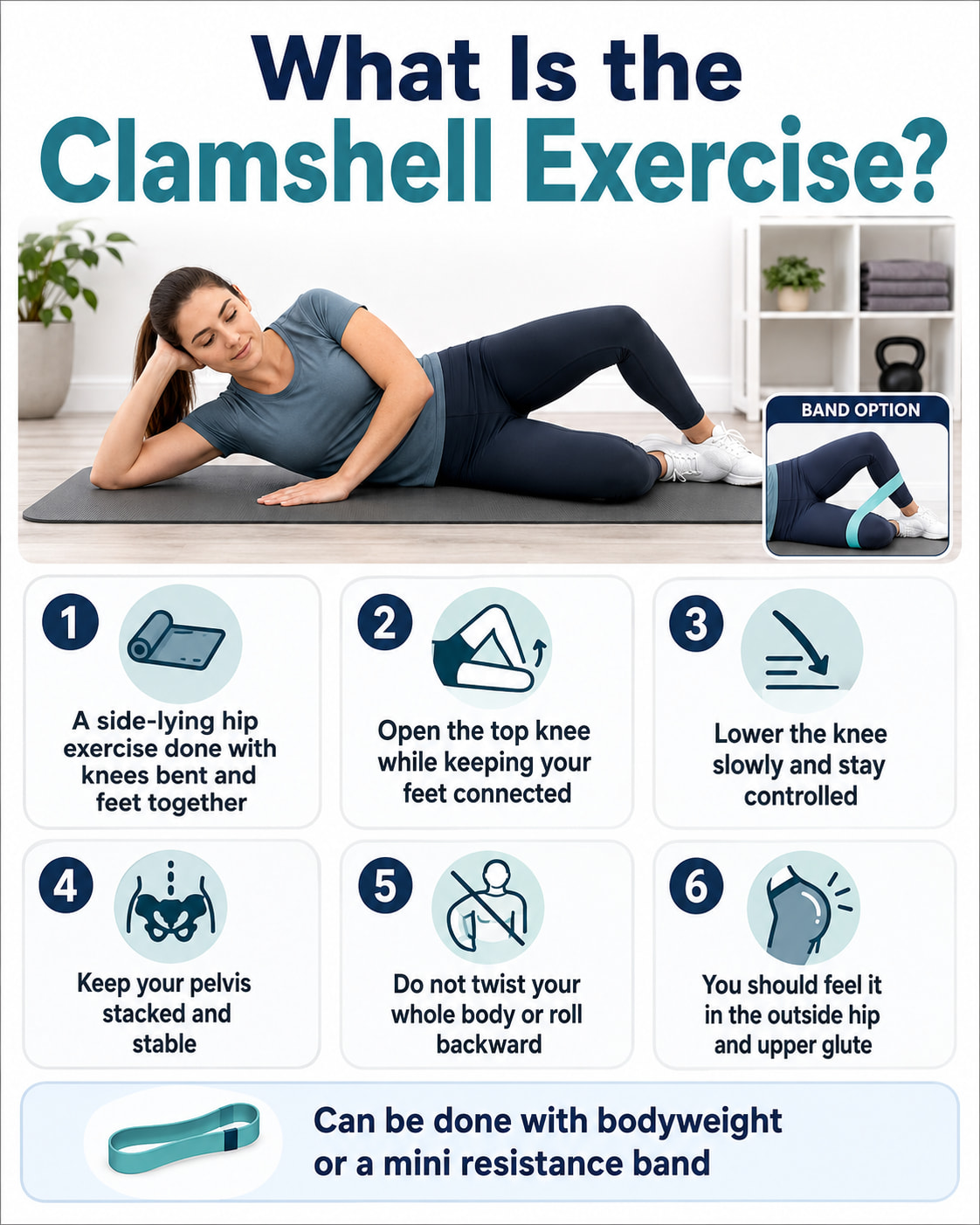
The clamshell exercise is performed while lying on your side with your knees bent and your feet together. From that position, you open your top knee while keeping your feet connected, then lower the knee with control. The movement looks like a clamshell opening and closing, which is where the name comes from.
The goal is not to twist your whole body. The goal is to rotate the top thigh from the hip while keeping your pelvis stacked and stable. When done well, you should feel the work on the outside of your hip and upper glute, not mostly in your low back or the front of your hip.
The American Council on Exercise includes the clam shell as a mini-band exercise performed from a side-lying position, opening and closing the knees with control. It can also be done without a band when learning the movement.
Clamshell Exercise: Quick Coaching Guide
Best for: The clamshell exercise is best for glute medius activation, hip stability, beginner-friendly glute training, warmups before lower-body workouts, and improving control before exercises like squats, lunges, step-ups, and running drills.
Muscles worked: The main muscle worked is the gluteus medius. The gluteus minimus, upper fibers of the gluteus maximus, deep hip external rotators, and core stabilizers also assist. The tensor fasciae latae may contribute, especially if your setup is poor or you feel the exercise mostly in the front of the hip.
Equipment needed: An exercise mat is helpful. A mini resistance band is optional and can be placed just above the knees to make the movement harder.
Why it stands out: The clamshell is low impact, easy to set up, and useful for teaching the hips to move without the pelvis rolling. It works well as a warmup or accessory exercise because it helps you focus on side-glute control before heavier lower-body training.
Suggested sets and reps: Start with 2 sets of 10–15 reps per side. For accessory work, use 2–3 sets of 12–20 reps per side. Use a slow tempo and stop the set when you can no longer keep your hips stacked.
Beginners: Start without a band. Keep the range of motion small and controlled. Focus on feeling the side of the hip rather than forcing the knee higher.
Intermediate: Add a light mini band above the knees and use a 2-second lift, 1-second pause, and 2-second lower. Keep the pelvis still during every rep.
Advanced: Use a stronger band, add a longer pause at the top, or progress to a side plank clamshell. Do not choose a harder version if it causes your hips to roll backward.
Rest: Rest 30–60 seconds between sides or sets. If using it in a warmup, move smoothly from one side to the other without rushing.
How to do it:
- Lie on your side with your knees bent and your feet stacked.
- Rest your head on your lower arm or a small pad so your neck stays relaxed.
- Stack your hips so the top hip is directly over the bottom hip.
- Brace your core lightly and keep your ribs from flaring.
- Keep your feet together as you lift your top knee.
- Open the knee only as far as you can without rolling your pelvis backward.
- Pause briefly at the top and feel the outside of your hip working.
- Lower the knee slowly and repeat before switching sides.
Common mistakes: The biggest mistakes are rolling the hips backward, separating the feet, using a band that is too heavy, moving too fast, arching the low back, and turning the exercise into a big twisting motion instead of a controlled hip movement.
Expert tip: Imagine your pelvis is resting against a wall behind you. Your top knee opens, but your hips stay stacked and quiet.
Exercise variations: Useful variations include the bodyweight clamshell, banded clamshell, elevated-feet clamshell, reverse clamshell, and side plank clamshell.
Easier variation: Do the clamshell without a band and reduce the range of motion. You can also place your back lightly against a wall to stop your hips from rolling.
Harder variation: Add a mini band above the knees or perform the clamshell from a side plank position if you can maintain clean alignment.
Clamshell Exercise Muscles Worked
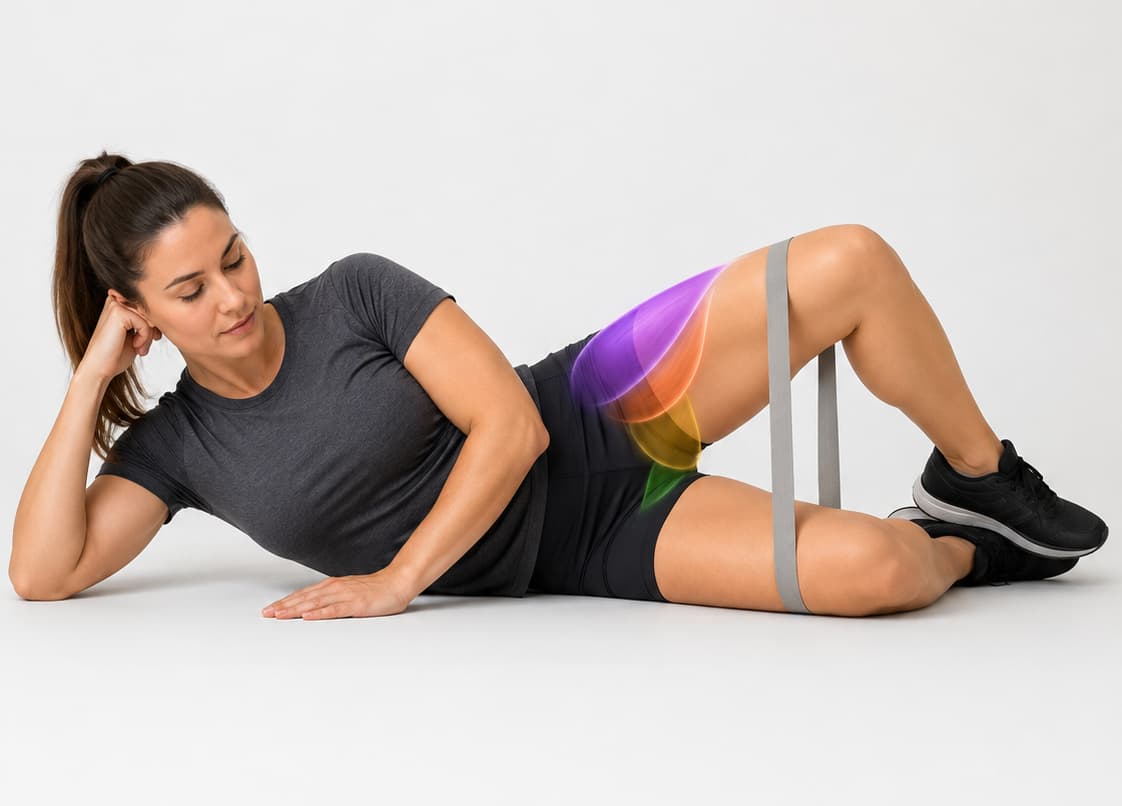
The clamshell exercise is often called a glute exercise, but it does not train every glute muscle equally. It is best understood as a hip control and side-glute exercise.
Gluteus Medius
The gluteus medius is the main target. It sits on the outside of the hip and helps move the thigh away from the midline of the body. It also helps control the pelvis when you stand, walk, run, climb stairs, or balance on one leg.
During the clamshell, the gluteus medius helps rotate and lift the top thigh while the pelvis stays steady. This is why the exercise is often used to support better hip and knee control during lower-body movement.
Gluteus Minimus
The gluteus minimus is a smaller hip muscle underneath the gluteus medius. It helps with hip stability and assists with hip abduction. You may not feel it directly, but it works with the gluteus medius to control the hip joint.
Gluteus Maximus
The gluteus maximus is the largest glute muscle. In the clamshell, it is not loaded as heavily as it would be during hip thrusts, bridges, squats, or deadlifts. However, some upper fibers can assist with hip external rotation and abduction.
A 2024 study in PLOS ONE found that hip flexion angle can affect muscle activity during the clam exercise, including the gluteus medius, tensor fasciae latae, and upper gluteus maximus. This supports an important coaching point: small setup changes can change how the exercise feels and which muscles contribute most.
Deep Hip External Rotators
Small muscles deep around the hip help rotate the thigh outward. These muscles assist during the opening phase of the clamshell and help control the hip joint.
Core and Pelvic Stabilizers
Your abs, obliques, and deep trunk muscles help keep your pelvis from rocking. If your core relaxes completely, your body will usually cheat by rolling backward instead of making the hip do the work.
Tensor Fasciae Latae
The tensor fasciae latae, often called the TFL, is a small muscle on the front-outside of the hip. It can assist in hip movement, but it should not dominate the clamshell. If you feel most of the exercise in the front of the hip, reduce the band tension, slow down, and check your hip position.
Benefits of the Clamshell Exercise
Builds Better Side-Glute Awareness
Many people struggle to feel their side glutes during squats, lunges, and step-ups. The clamshell gives you a simple way to isolate the movement and learn what glute medius engagement feels like.
This does not mean you need to “activate” your glutes before every workout. It simply means clamshells can be a useful drill when you want to improve control before harder lower-body exercises.
Supports Hip Stability
The hips help control the position of the pelvis, knees, and feet during movement. Stronger and better-coordinated hip muscles may help support smoother lower-body mechanics.
The National Academy of Sports Medicine describes banded clamshells as a way to strengthen the glute medius and improve hip stability. For most people, that makes the exercise useful as part of a balanced lower-body routine.
Helps With Knee Tracking During Exercise
When the hip loses control, the knee may drift inward during squats, lunges, running, or landing movements. The clamshell does not fix every knee-tracking issue by itself, but it can help train the hip muscles that support better alignment.
Pair it with functional exercises like split squats, step-downs, lateral band walks, and single-leg balance drills for better carryover.
Beginner-Friendly and Low Impact
The clamshell is easy to start because it does not require heavy weights, machines, or advanced coordination. You can do it on a mat at home, in the gym, or as part of a warmup.
It is also easy to scale. Beginners can use bodyweight. Intermediate lifters can add a light band. Advanced users can progress to side plank clamshells or use it as a controlled accessory drill.
Useful Before Lower-Body Workouts
Clamshells can fit well before squats, deadlifts, lunges, step-ups, and running drills. They help you focus on keeping the hips steady before moving into bigger exercises.
Use them early in the session, but do not turn them into a fatiguing workout before heavy lifts. One or two controlled sets are usually enough for warmup work.
How to Feel the Clamshell in the Right Place
You should usually feel the clamshell on the outside of your upper glute or side hip. A light burn in that area is normal during higher-rep sets.
If you feel it mostly in the front of your hip, your hip flexors or TFL may be taking over. Try bending your hips a little more, reducing the range of motion, using no band, or slowing down.
If you feel it in your low back, your pelvis is probably rolling. Keep your ribs stacked over your pelvis, brace lightly, and imagine your top hip staying pointed straight forward.
If you feel it in your knees, check that the band is not too tight and that you are not forcing the joint. The movement should come from the hip, not from twisting the knee.
Common Clamshell Exercise Mistakes to Avoid
Rolling the Hips Backward
This is the most common mistake. When the top hip rolls backward, the knee can lift higher, but the movement is no longer coming mainly from the target hip muscles.
Keep your hips stacked. A smaller range of motion with better control is more effective than a large range with poor form.
Using Too Much Band Resistance
A heavy band can make the exercise look harder but feel worse. If the band forces you to twist, jerk, or lose position, it is too strong.
Start with bodyweight or a light mini band. Add resistance only when your pelvis stays still.
Lifting the Feet Apart
The feet should stay together during the standard clamshell. If the feet separate, the movement changes and you may lose the clean hip rotation pattern.
Think “knees open, feet stay connected.”
Moving Too Fast
Fast reps usually turn the clamshell into a momentum drill. Slow reps make it easier to feel the glute medius and control the lowering phase.
Use a steady tempo: lift for 2 seconds, pause briefly, lower for 2 seconds.
Chasing a Huge Range of Motion
You do not need to open the knee as far as possible. Once your pelvis starts to move, you have gone too far.
Use the biggest range you can control without rolling.
Arching the Low Back
If your low back arches, your ribs and pelvis are no longer stacked. Keep your trunk quiet and your core lightly engaged.
Clamshell Exercise Variations and Progressions
Bodyweight Clamshell
The bodyweight clamshell is the best starting point. It helps you learn the movement without fighting band tension. Use it if you are new to the exercise, warming up, or trying to clean up your form.
Do 2 sets of 10–15 reps per side with slow control.
Banded Clamshell
The banded clamshell adds resistance from a mini band placed just above the knees. This makes the glute medius work harder as the top knee opens.
Use a light to moderate band. If the band makes you roll your hips backward, switch to a lighter band or return to bodyweight.
Elevated-Feet Clamshell
In this version, your feet stay together but are lifted slightly off the floor while your knees remain bent. This increases the challenge because your hip and core stabilizers must work harder to control the pelvis.
Use this only after you can do standard clamshells without twisting.
Reverse Clamshell
The reverse clamshell keeps the knees together while the top foot lifts. This shifts the focus toward hip internal rotation control. It is not a replacement for the standard clamshell, but it can be useful for building more complete hip control.
Move slowly and keep the knees stacked.
Side Plank Clamshell
The side plank clamshell combines hip stability with trunk stability. You hold a modified side plank while opening and closing the top knee.
This is a harder variation. Use it only if you can maintain a straight line from shoulders to hips and keep the movement controlled.
How Many Sets and Reps Should You Do?
The right sets and reps depend on how you use the clamshell exercise.
| Goal | Sets and Reps | Rest | Effort |
|---|---|---|---|
| Warmup or glute activation | 1–2 sets of 10–15 reps per side | 15–30 seconds | Easy to moderate |
| Beginner strength | 2 sets of 10–15 reps per side | 30–45 seconds | Moderate |
| Accessory work | 2–3 sets of 12–20 reps per side | 30–60 seconds | Moderate to hard |
| Banded variation | 2–3 sets of 10–15 reps per side | 45–60 seconds | Stop before form breaks |
A good effort level is about 2–3 reps in reserve. You should finish each set feeling the side glute working, but not at the cost of form.
How to Use Clamshells in a Workout
The clamshell works best as a warmup, activation drill, or accessory exercise. It should not be your only lower-body strength movement.
Use it before lower-body training when you want to improve hip awareness. For example, do one set per side before squats, lunges, step-ups, or lateral band walks.
Use it after your main lifts if you want extra glute medius work. In that case, pair it with exercises that train the hips in more functional positions, such as split squats, step-downs, lateral lunges, or single-leg Romanian deadlifts.
Use it on recovery or mobility days as a low-intensity hip control drill. Keep the reps smooth and avoid turning it into a max-effort exercise.
Sample Clamshell Exercise Routine
Here is a simple hip stability routine you can use 2–3 times per week.
Beginner Hip Stability Routine
| Exercise | Sets | Reps | Rest |
|---|---|---|---|
| Bodyweight Clamshell | 2 | 12–15 per side | 30 seconds |
| Glute Bridge | 2 | 10–12 | 45 seconds |
| Side-Lying Hip Abduction | 2 | 10–12 per side | 45 seconds |
| Split Squat or Sit-to-Stand | 2 | 8–10 per side | 60 seconds |
| Lateral Band Walk | 1–2 | 8–12 steps each way | 45 seconds |
Use a controlled pace and keep the effort around 6–7 out of 10. When all sets feel smooth for two weeks, add a light band to the clamshell or add one extra set.
Who Should Use the Clamshell Exercise?
The clamshell exercise can be useful for beginners who need simple glute training, runners who want better hip control, lifters who want a warmup before lower-body sessions, and anyone working on side-to-side stability.
It can also be useful in physical therapy-style programs, but exercise selection should match the person. EMG research published in the Journal of Athletic Training found that different side-lying hip exercises can create different muscle activation patterns. That means clamshells are useful, but they are not always the only or best option for every goal.
For best results, use clamshells alongside other lower-body exercises instead of relying on them alone.
When the Clamshell Exercise May Not Be Enough
Clamshells are helpful, but they are not a complete glute program. They do not load the glutes as heavily as hip thrusts, squats, deadlifts, step-ups, or lunges.
If your goal is strength, muscle growth, or athletic performance, use clamshells as a support exercise. Your main program should still include progressive lower-body strength training.
Good exercises to pair with clamshells include:
- Glute bridges
- Hip thrusts
- Side-lying hip abductions
- Lateral band walks
- Step-downs
- Split squats
- Romanian deadlifts
- Single-leg Romanian deadlifts
The clamshell teaches control. Bigger strength exercises build more total force.
Safety Tips
The clamshell exercise should feel controlled and joint-friendly. Stop the exercise and seek professional help if you feel sharp pain, numbness, dizziness, chest pain, sudden weakness, or unusual symptoms.
If you have current hip, knee, back, or pelvic pain, use professional guidance before adding resistance or advanced variations. Keep the range of motion small, avoid forcing the knee open, and do not use a heavy band if it changes your form.
FAQ
What is the clamshell exercise good for?
The clamshell exercise is good for training the gluteus medius, improving hip control, and supporting better lower-body alignment. It works well as a warmup, beginner glute drill, or accessory exercise.
Where should I feel clamshells?
You should feel clamshells on the outside of your upper glute or side hip. If you feel them mostly in the front of your hip or low back, check your pelvis position, reduce the range of motion, or use a lighter band.
Do clamshells build bigger glutes?
Clamshells can help strengthen and activate the side glutes, but they are not usually enough for major glute muscle growth by themselves. For more complete glute development, combine them with progressive exercises like hip thrusts, squats, lunges, step-ups, and Romanian deadlifts.
Should I do clamshells with a band?
Use a band only after you can control the bodyweight version. A mini band can make the exercise more challenging, but too much resistance often causes twisting and poor form.
How often should I do the clamshell exercise?
Most people can do clamshells 2–4 times per week depending on the routine. Use 1–2 sets for warmups or 2–3 sets for accessory work.
Are clamshells good for runners?
Clamshells can be useful for runners because they train hip control and glute medius awareness. For better carryover, runners should also include functional strength exercises such as step-downs, split squats, lateral band walks, and single-leg hinges.
Why do clamshells hurt my hip flexors?
Hip flexor discomfort may happen if your pelvis rolls, your band is too heavy, or you are forcing too much range of motion. Try using no band, bending the hips slightly more, slowing down, and keeping the movement smaller. Stop if the discomfort feels sharp or unusual.
Conclusion
The clamshell exercise is a simple but valuable hip-strengthening drill when you do it with clean form. Keep your hips stacked, feet together, and reps slow. Focus on feeling the side glute work instead of chasing a big knee lift.
Use clamshells as a warmup, accessory exercise, or beginner-friendly glute drill, then pair them with stronger lower-body movements for better long-term results.
This content is for informational purposes only and is not a substitute for professional medical advice.
References
- NASM: Banded Clamshell Workout
- ACE Fitness: Booty Bootcamp Glute Exercises
- PLOS ONE: Hip Flexion Angle and Hip Abductor Muscle Activity During Clam Exercise
- PubMed: The Influence of Hip Angle and Pelvis Position During the Clam Exercise
- PMC: Hip Muscle Activity During Side-Lying Hip-Strengthening Exercises