Dumbbell lateral raises are an isolation exercise that primarily trains the lateral deltoids—the muscles that lift your upper arms away from your body. The exercise works best when you use a manageable weight, keep your torso stable, and raise the dumbbells through a comfortable range without swinging.
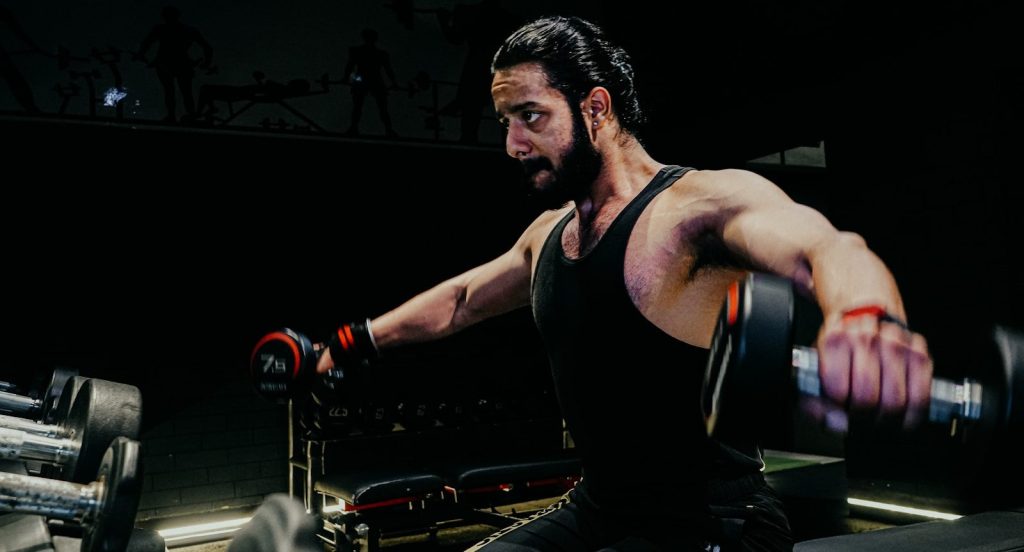
This guide explains proper dumbbell lateral raise form, the muscles worked, common mistakes, suitable sets and repetitions, beginner modifications, and practical ways to progress.
Dumbbell Lateral Raises at a Glance
| Category | Recommendation |
|---|---|
| Main purpose | Build and strengthen the lateral deltoids |
| Primary muscle | Lateral or middle deltoid |
| Equipment | Pair of dumbbells |
| Experience level | Beginner to advanced |
| Typical repetitions | 10–20 per set |
| Working sets | 2–4 |
| Rest | 60–120 seconds |
| Range of motion | From the sides to approximately shoulder height |
| Workout placement | Usually after presses and rows |
How to Do Dumbbell Lateral Raises
Best for: Direct lateral-deltoid training and adding focused shoulder work to an upper-body routine.
Muscles worked: Lateral deltoid, supraspinatus, trapezius, serratus anterior, rotator cuff muscles, and smaller contributions from the anterior and posterior deltoids.
Equipment needed: Two dumbbells.
Sets, reps, and rest: Begin with 2–3 sets of 10–15 repetitions. Rest for 60–90 seconds between sets.
Step-by-Step Instructions
- Stand with your feet approximately hip- to shoulder-width apart.
- Hold one dumbbell in each hand with your arms beside your body and palms facing inward.
- Keep a small bend in your elbows and maintain that angle throughout the repetition.
- Brace your abdomen, control your ribs, and keep your head, torso, and pelvis in a comfortable neutral position.
- Raise your arms out to the sides, allowing them to travel slightly forward rather than forcing them directly sideways.
- Keep your wrists neutral and lift until your upper arms are approximately level with your shoulders.
- Pause briefly without shrugging your shoulders toward your ears.
- Lower the dumbbells under control and begin the next repetition without swinging.
A controlled repetition may take approximately one to two seconds on the way up and two to three seconds on the way down. The exact tempo is less important than maintaining consistent control.
Coaching cue: Reach your elbows outward while keeping your neck long and your torso still.
The American Council on Exercise lateral raise guide also emphasizes a stable torso, neutral wrists, controlled shoulder movement, and a lifting range that ends near shoulder height.
Muscles Worked by Dumbbell Lateral Raises
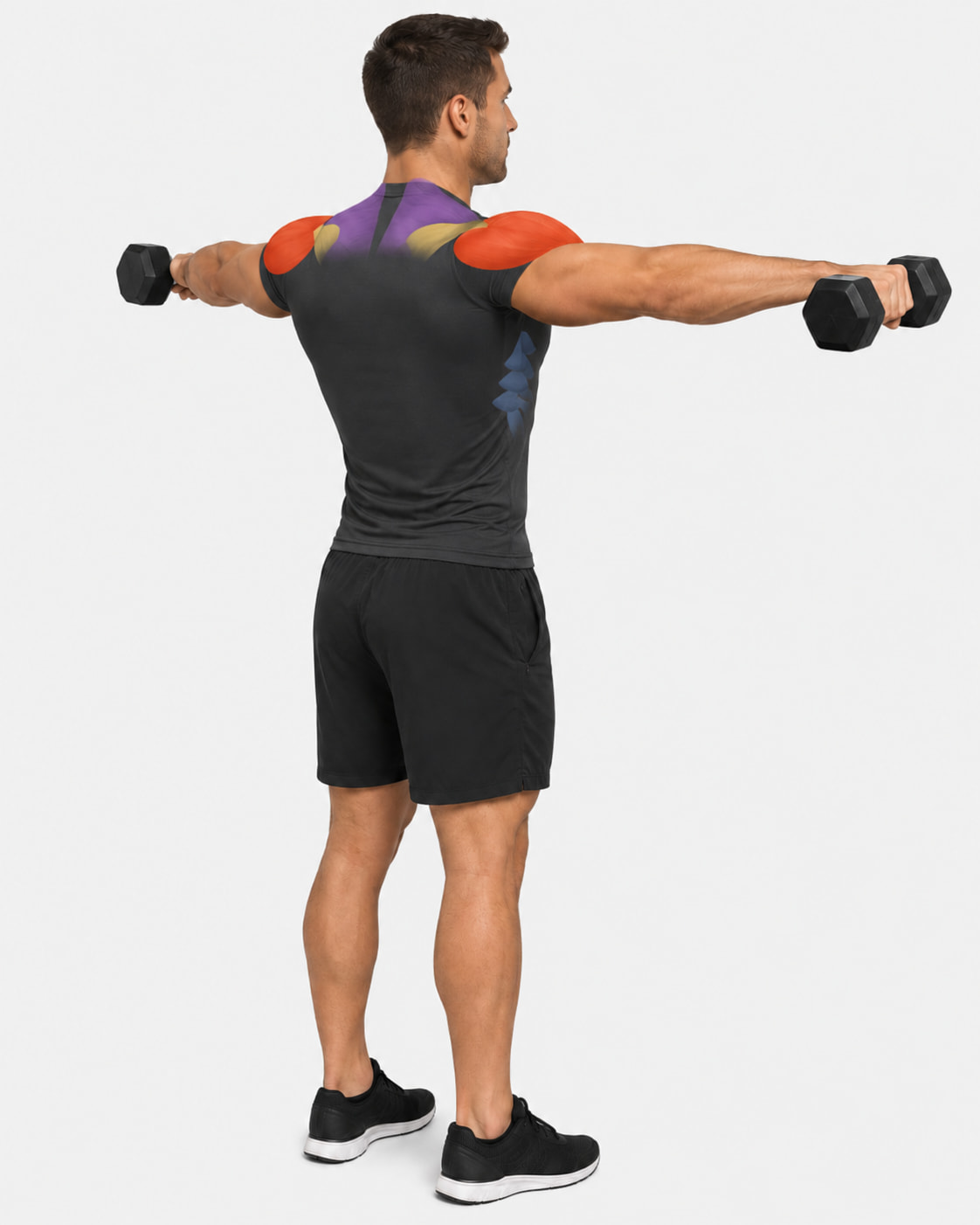
Lateral Deltoid
The lateral deltoid, also called the middle or acromial deltoid, is the primary muscle trained during dumbbell lateral raises. Its main role in this exercise is shoulder abduction—lifting the upper arm away from the side of the body.
The exercise does not train every part of the deltoid equally. The anterior and posterior deltoids may assist, but the movement is primarily selected for direct lateral-deltoid work.
Supraspinatus
The supraspinatus is one of the four rotator cuff muscles. It assists during the early portion of arm elevation and helps stabilize the upper-arm bone within the shoulder joint.
Trapezius and Serratus Anterior
The trapezius and serratus anterior help rotate and control the shoulder blades as the arms rise. Some trapezius activity during lateral raises is normal.
The goal is not to completely remove the trapezius from the exercise. Instead, avoid excessive shrugging that causes your shoulders to rise toward your ears before your arms begin moving.
Rotator Cuff and Other Stabilizers
The remaining rotator cuff muscles help control the shoulder joint. Your core, forearms, and upper-back muscles also work to stabilize your torso, wrists, and shoulder blades.
The NCBI Bookshelf overview of the arm-abductor muscles provides more detail about the roles of the deltoid, supraspinatus, trapezius, and serratus anterior during arm elevation.
Benefits of Dumbbell Lateral Raises
Direct Lateral-Deltoid Training
Overhead presses train several shoulder and arm muscles at once, often with substantial involvement from the anterior deltoids and triceps. Lateral raises provide more focused work for the lateral deltoids.
Minimal Equipment
You only need a pair of dumbbells and enough room to move your arms safely. This makes lateral raises practical for home and gym workouts.
Independent Arm Movement
Each arm controls its own dumbbell. This allows you to notice differences in strength, coordination, or range of motion between sides.
Do not automatically add extra repetitions to the weaker side. Use a load and range that both arms can control unless a qualified professional has given you different instructions.
Effective With Relatively Light Loads
The long lever created by holding weights away from your body makes the exercise challenging without heavy dumbbells. This can make it a useful accessory exercise after compound movements.
Multiple Useful Variations
The exercise can be performed standing, seated, one arm at a time, or with external support. These options make it easier to adjust the movement to your experience and available equipment.
Dumbbell Lateral Raise Form: Important Details
How High Should You Raise the Dumbbells?
For the standard lateral raise, stop when your upper arms are approximately parallel with the floor or level with your shoulders.
You do not have to reach that height if doing so causes discomfort or makes you arch, shrug, or lose control. Use the highest comfortable position you can reach with stable form.
Lifting above shoulder height is not automatically wrong, but it changes the movement and requires more shoulder-blade rotation. It is unnecessary for most people using lateral raises as a lateral-deltoid isolation exercise.
Should Your Arms Move Directly Sideways?
Your arms do not need to move in a perfectly straight line beside your torso. Raising them slightly forward of your sides often creates a more natural shoulder path.
The exact angle can vary between people. Keep the movement comfortable, controlled, and reasonably consistent from one repetition to the next.
Should Your Thumbs Point Up or Down?
Begin with a neutral grip, keeping your palms generally facing the floor as the weights rise. Your thumbs may remain level with your hands or turn slightly upward near the top.
Avoid deliberately lifting your pinkies higher than your thumbs or aggressively turning your thumbs downward as though pouring liquid from a pitcher. This internally rotates the upper arms and may feel uncomfortable for some shoulders.
A neutral or slightly thumbs-up position is a practical starting point. A study comparing different lateral raise positions found that a neutral hand position effectively activated the middle deltoid, while internal rotation changed the involvement of several surrounding muscles. Muscle-activation findings do not directly prove long-term muscle growth, but they can help clarify how technique changes muscle recruitment. The study is available through PubMed Central.
Should You Pin Your Shoulder Blades Down?
Do not force your shoulder blades into a rigid downward position throughout the exercise. The shoulder blades naturally move and rotate as your arms rise.
Instead, keep your neck relaxed, avoid excessive shrugging, and allow controlled shoulder-blade movement.
Common Dumbbell Lateral Raise Mistakes
Using Too Much Weight
Heavy dumbbells often cause swinging, leaning, shrugging, shortened repetitions, and changes in elbow position.
Correction: Select a weight that lets you complete at least 10 controlled repetitions without using your legs or torso to create momentum.
Swinging the Dumbbells
Bending your knees, rocking backward, or throwing the weights upward reduces your control over the movement.
Correction: Keep your knees softly unlocked, brace your abdomen, and pause briefly between repetitions when necessary.
Shrugging Toward the Ears
The upper trapezius assists with normal arm elevation, but excessive shrugging can make it dominate the exercise.
Correction: Use less weight, keep your neck long, and begin the repetition by moving your upper arms rather than lifting your shoulders.
Changing the Elbow Bend
Bending your elbows more as the dumbbells rise shortens the lever and makes the weight easier to lift. This often happens when the weight is too heavy.
Correction: Choose a small elbow bend before starting and maintain approximately the same angle throughout the set.
Leading With the Hands
Pulling the dumbbells upward while the elbows remain low can bend the wrists and change the exercise into an awkward upright-row motion.
Correction: Let the elbows guide the movement while keeping the wrists aligned with the forearms.
Turning the Pinkies Up
An exaggerated pinkies-up position internally rotates the upper arms.
Correction: Keep the hands approximately level, or allow the thumbs to point slightly upward if that position feels more comfortable.
Dropping the Dumbbells
Allowing the weights to fall quickly removes control from the lowering phase and can encourage swinging into the next repetition.
Correction: Lower the weights slowly until your arms return to your sides.
Forcing a Painful Range
Reaching shoulder height is not a requirement when the position causes sharp pain, pinching, or unusual weakness.
Correction: Reduce the range, lower the weight, or stop the exercise. Do not repeatedly train through shoulder-joint pain.
How Much Weight Should You Use?
Use a lighter weight than you would normally use for dumbbell presses, rows, or curls. Even small dumbbells can become challenging because the weights move farther away from your body.
The correct weight should allow you to:
- Keep your torso nearly motionless.
- Maintain the same elbow bend.
- Raise both arms through a comfortable range.
- Control the lowering phase.
- Finish with approximately 1–3 technically sound repetitions remaining.
Do not choose a weight based on how much another person is lifting. Shoulder structure, training experience, dumbbell increments, and available range of motion can all affect the appropriate load.
Sets, Reps, Rest, and Frequency
Beginner Starting Point
Perform:
- 2–3 sets
- 10–15 repetitions
- 60–90 seconds of rest
- 1–2 sessions per week
Stop each set while you could still complete approximately 2–3 controlled repetitions.
Muscle-Building Accessory Work
Perform:
- 3–4 sets
- 10–20 repetitions
- 60–120 seconds of rest
- 1–3 sessions per week
Most sets can finish with approximately 1–3 good repetitions remaining. You do not need to reach complete muscular failure on every set.
Place lateral raises after major exercises such as overhead presses, chest presses, pull-downs, and rows. Performing them later in the session lets you train the shoulders directly without tiring them before heavier compound movements.
The American College of Sports Medicine’s resistance-training guidance emphasizes consistent, individualized programming rather than requiring one exact load, repetition range, or advanced training method for everyone.
How to Progress Dumbbell Lateral Raises
Increasing the weight is only one form of progression. Because lateral raises use relatively light dumbbells, moving to the next available pair may represent a large increase.
Use this progression method:
- Select a repetition range, such as 10–15.
- Begin with a weight you can control for approximately 10 repetitions.
- Gradually add repetitions without changing your technique.
- Once you can complete 15 repetitions on every set with 1–3 repetitions remaining, use the next small weight increase.
- Return to the lower end of the repetition range.
When the next dumbbell is too heavy, continue progressing by:
- Adding one or two repetitions.
- Adding an extra set when recovery is good.
- Pausing briefly near shoulder height.
- Slowing the lowering phase.
- Improving range or control with the same weight.
Do not use swinging or a shorter range simply to claim a heavier dumbbell.
Beginner Regressions
Lateral Raise Without Weights
Practice the movement with empty hands. Concentrate on controlling your ribs, elbows, wrists, and shoulder blades.
Short-Range Lateral Raise
Raise your arms only to mid-torso or chest height. Gradually increase the range as your control and comfort improve.
Seated Dumbbell Lateral Raise
Sit on a stable bench or chair with your feet flat. The seated position reduces the ability to use your legs for momentum, although you must still avoid leaning backward.
Supported Single-Arm Lateral Raise
Hold a stable support with one hand while raising a dumbbell with the other. This can make balance and torso control easier.
Bent-Arm Lateral Raise
Use a slightly greater elbow bend to shorten the lever. This makes the same dumbbell easier to control, but it is a modified version rather than an identical replacement for the standard raise.
Dumbbell Lateral Raise Variations
Seated Dumbbell Lateral Raise
Best for: Reducing leg drive and practicing stricter upper-body control.
Sit tall on a stable bench, hold the dumbbells beside your thighs, and perform the same controlled raising motion. Avoid leaning backward as fatigue increases.
Alternating Dumbbell Lateral Raise
Best for: Concentrating on one arm while maintaining a standing setup.
Raise one dumbbell while the other arm remains by your side. Alternate sides without rotating or shifting your torso.
Supported Single-Arm Dumbbell Lateral Raise
Best for: Improving stability and focusing on one shoulder at a time.
Hold a rack, post, or other stable structure with your free hand. Keep your body upright rather than leaning far away from the support.
Cable Lateral Raise
Best for: Training the same movement pattern with a different resistance profile.
A cable maintains tension differently from a dumbbell because its line of resistance does not depend entirely on gravity. An eight-week study involving trained adults found that both cable and dumbbell lateral raises increased lateral-deltoid muscle thickness, without a meaningful difference between the two versions. You can review the study in Frontiers in Physiology.
Use whichever variation fits your equipment, comfort, and ability to progress consistently.
Sample Shoulder Workout With Dumbbell Lateral Raises
Complete this routine one or two times per week with at least one recovery day between sessions.
| Exercise | Sets | Reps | Rest |
|---|---|---|---|
| Dumbbell overhead press | 3 | 6–10 | 90–150 seconds |
| One-arm dumbbell row | 3 | 8–12 per side | 90 seconds |
| Dumbbell lateral raise | 3 | 12–20 | 60–90 seconds |
| Bent-over dumbbell rear-delt raise | 2–3 | 12–20 | 60–90 seconds |
Choose weights that leave approximately 1–3 good repetitions available at the end of each set.
For the lateral raises, add repetitions before increasing the weight. Once you reach 20 controlled repetitions across all sets, use the smallest available weight increase and return to approximately 12 repetitions.
Safety Considerations
Dumbbell lateral raises should create muscular effort around the shoulders, but they should not cause sharp pain or persistent joint pinching.
Use these precautions:
- Begin with lighter dumbbells than you think you need.
- Lift only through a comfortable range.
- Keep the movement slow enough to control.
- Avoid aggressively turning the thumbs downward.
- Do not force the shoulder blades into a rigid position.
- Stop the set when you can no longer prevent swinging or shrugging.
- Allow adequate recovery before training the shoulders again.
Stop exercising and seek appropriate professional help if you experience sharp pain, numbness, sudden weakness, dizziness, chest pain, or other unusual symptoms. Speak with a qualified healthcare professional before performing the exercise if you have an existing shoulder injury, recent surgery, persistent pain, or significant difficulty raising your arm.
Frequently Asked Questions
How high should you raise dumbbells during lateral raises?
Raise the dumbbells until your upper arms are approximately level with your shoulders. Stop lower if you cannot reach shoulder height without pain, shrugging, leaning, or losing control.
Should your arms be straight during lateral raises?
Keep a small bend in your elbows rather than locking them completely straight. Maintain approximately the same elbow angle throughout each repetition.
Should your thumbs point up or down?
A neutral position is a suitable default. Keep your hands approximately level, or let the thumbs point slightly upward near the top. Avoid deliberately turning the thumbs downward or lifting the pinkies higher.
Why do I feel lateral raises in my traps?
The trapezius helps rotate the shoulder blades during arm elevation, so some trap involvement is normal. Excessive trap effort may occur when the weight is too heavy, you begin by shrugging, or you raise the dumbbells beyond the range you can control.
Are seated or standing lateral raises better?
Neither version is universally better. Standing raises allow a natural athletic stance, while seated raises reduce the opportunity to use your legs. Choose the variation that lets you maintain the best control.
How often should you perform dumbbell lateral raises?
One to three times per week can work, depending on your training schedule and the amount of pressing and direct shoulder work you already perform. Beginners can start with two sessions of two or three sets.
Are dumbbell lateral raises a push or pull exercise?
Lateral raises are usually classified as a shoulder isolation exercise rather than a traditional push or pull. They are commonly included in shoulder, upper-body, or push workouts.
Conclusion
Dumbbell lateral raises are most effective when you treat them as a controlled isolation exercise rather than an opportunity to lift the heaviest possible weight. Use a neutral hand position, maintain a small elbow bend, raise through a comfortable range, and lower the dumbbells slowly.
Start with 2–3 sets of 10–15 repetitions. Add repetitions while preserving your form, then increase the weight in small steps when you can complete every set without swinging, shrugging, or shortening the movement.
References
- American Council on Exercise: Lateral Raise
- NCBI Bookshelf: Anatomy of the Arm-Abductor Muscles
- NCBI Bookshelf: Anatomy of the Deltoid Muscle
- PubMed Central: Deltoid and Trapezius Activation During Lateral Raise Variations
- Frontiers in Physiology: Dumbbell Versus Cable Lateral Raises
- American College of Sports Medicine: Resistance Training Guidelines Update
This content is for informational and educational purposes only and is not intended as a substitute for professional medical advice, diagnosis, or treatment.