
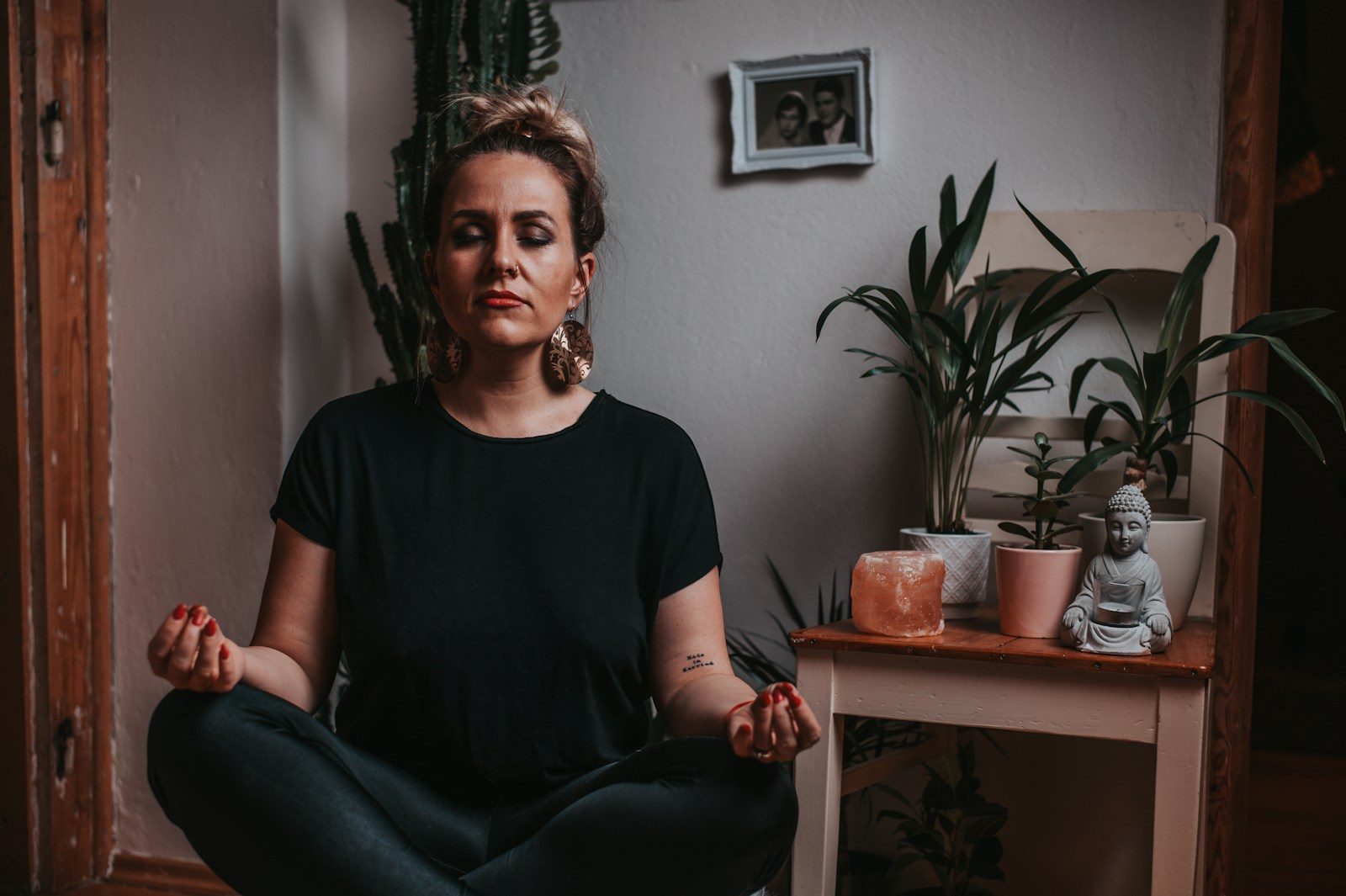
Breathing exercises to relax can help you slow your breathing, release unnecessary tension, and give your mind something steady to focus on. You do not need equipment or a long session to begin.
The seven techniques below explain exactly how to practice, how long to start with, and which ones to choose when you need a calmer moment.
7 Breathing Exercises to Relax Your Body and Mind
Start with a comfortable position and gentle breaths. The counts are guides, not tests. If a pattern feels difficult, shorten it or return to normal breathing.
1. Diaphragmatic Breathing (Belly Breathing)
Best for: Beginners and everyday relaxation.
Practice: 2–5 minutes, or a few comfortable breaths to start.
Diaphragmatic breathing helps you notice the movement of your lower ribs and abdomen instead of relying on large, tense breaths into your upper chest.
How to Do It
- Lie on your back with your knees bent, or sit in a chair with your back supported.
- Place one hand on your upper chest and the other just below your ribs.
- Inhale gently through your nose. Let your lower ribs and abdomen expand naturally under your hand.
- Exhale slowly through your mouth or nose. Feel your abdomen settle without pushing it inward.
- Keep your neck, jaw, and shoulders relaxed. Repeat at a comfortable rhythm.
Common mistake: Trying to push the belly out as far as possible or lifting the shoulders with every inhale. Keep the movement small and easy. If sitting feels awkward, try lying down.
2. 4-6 Breathing (Longer Exhale)
Best for: Unwinding after a stressful moment without holding your breath.
Practice: 1–3 minutes.
This technique makes the exhale slightly longer than the inhale. It is easy to use at a desk or in bed.
How to Do It
- Sit or lie comfortably and let your shoulders drop.
- Breathe in softly through your nose for 4 counts.
- Breathe out slowly through your nose or mouth for 6 counts.
- Begin the next inhale without an intentional pause or hold.
- Continue for a minute or two, keeping each breath light and unforced.
Common mistake: Taking a huge inhale just to make the six-count exhale possible. If you run out of air or feel strained, try 3 counts in and 4 counts out instead.
3. Box Breathing (4-4-4-4)
Best for: Settling your attention before a meeting or other demanding task.
Practice: 3–4 comfortable rounds to start.
Box breathing uses four equal phases. Following the pattern gives your mind a simple counting task.
How to Do It
- Sit upright with your feet supported and shoulders relaxed.
- Inhale gently through your nose for 4 counts.
- Hold your breath softly for 4 counts.
- Exhale through your nose or mouth for 4 counts.
- Pause after exhaling for 4 counts.
- Repeat for 3–4 rounds without straining.
Common mistake: Treating the holds like a challenge. Do not tighten your throat or brace hard. If the pauses feel uncomfortable, skip this exercise and use 4-6 breathing instead.
4. Cyclic Sighing
Best for: A brief relaxation break when you feel keyed up.
Practice: Start with 2–3 cycles; build toward a few minutes if comfortable.
Cyclic sighing uses two nasal inhales followed by one slow, longer exhale. A Stanford Medicine study found promising improvements in mood with regular five-minute practice, although results do not guarantee the same effect for everyone.
How to Do It
- Sit in a stable, comfortable position.
- Inhale smoothly through your nose.
- Before exhaling, take a second, shorter inhale through your nose to add a little more air.
- Exhale slowly through your mouth, allowing the breath to taper off naturally.
- Pause if needed, then repeat without rushing.
Common mistake: Repeatedly gasping for the second inhale or forcing every last bit of air out. The two-part inhale and longer exhale should feel controlled, not strenuous.
5. Five-Finger Breathing
Best for: Relaxation when your thoughts keep wandering or counting feels distracting.
Practice: Trace all five fingers once or twice.
Five-finger breathing combines a slow breath with the sensation of tracing your hand. It gives you a visual and physical point of attention.
How to Do It
- Hold one hand open in front of you, with fingers comfortably spread.
- Place the index finger of your other hand at the outer base of your thumb.
- Inhale gently while tracing up the side of your thumb.
- Exhale while tracing down the other side.
- Continue up and down each remaining finger, matching the tracing speed to your natural breathing.
- Finish at your little finger. Repeat or reverse direction if you want a longer practice.
Common mistake: Moving your finger too quickly and making the breath feel rushed. Slow the tracing rather than trying to take bigger breaths. This is also a useful option for beginners who prefer not to close their eyes.
6. Alternate Nostril Breathing
Best for: Quiet, focused relaxation when you have a few uninterrupted minutes.
Practice: 2–5 minutes at an easy pace.
Also called Nadi Shodhana, this technique alternates which nostril you breathe through. It takes a little coordination but does not require equipment.
How to Do It
- Sit upright and relax your shoulders. Keep your left hand resting comfortably.
- Raise your right hand to your nose. Position your thumb beside your right nostril and your ring finger beside your left nostril.
- Gently close the right nostril and inhale through the left.
- Close the left nostril, release the right, and exhale through the right.
- Inhale through the right nostril. Switch sides and exhale through the left.
- Repeat that cycle slowly, allowing brief, natural transitions without prolonged breath holds.
Common mistake: Pressing hard on your nose or trying to maintain a strict count. Use light finger pressure. If your nose is congested or the switching becomes frustrating, choose belly breathing instead.
7. 4-7-8 Breathing
Best for: A quiet wind-down routine, including before bedtime, if breath holds feel comfortable.
Practice: 2–4 cycles to start.
The 4-7-8 pattern has a longer hold than the other techniques in this guide. It is optional, not a necessary part of learning to relax.
How to Do It
- Sit with your back supported or lie down comfortably.
- Breathe out gently through your mouth to prepare.
- Inhale quietly through your nose for 4 counts.
- Hold your breath without straining for 7 counts.
- Exhale slowly through slightly pursed lips for 8 counts.
- Repeat for 2–4 cycles if the pattern remains comfortable.
Common mistake: Forcing the seven-count hold or squeezing out the final seconds of the exhale. If you feel short of breath or lightheaded, stop and use a no-hold technique such as 4-6 breathing.
How Breathing Exercises Help You Relax
Stress can make breathing faster and shallower while increasing physical tension. A slow, comfortable breathing practice encourages you to pay attention to your breath and may help your body shift toward a calmer state.
The National Center for Complementary and Integrative Health describes slower breathing as one feature of the body’s relaxation response.
These exercises may also help by giving your attention a simple task: counting, feeling your abdomen move, or tracing your fingers.
Individual responses vary, and breathing exercises are tools for relaxation—not treatments for medical or mental health conditions.
Which Breathing Exercise Should You Choose?
| If you want to… | Try this first |
|---|---|
| Learn the basics | Diaphragmatic breathing |
| Relax without breath holds | 4-6 breathing |
| Focus before a stressful task | Box breathing |
| Try a longer-exhale technique | Cyclic sighing |
| Settle a busy mind without counting | Five-finger breathing |
| Practice focused, seated breathing | Alternate nostril breathing |
| Wind down before sleep | 4-7-8 breathing, if comfortable |
For most beginners, belly breathing or 4-6 breathing is the easiest place to start. There is no need to master all seven.
A Simple 5-Minute Breathing Routine for Relaxation
Use this no-hold routine once a day or whenever you want a short break.
| Time | Exercise | What to Focus On |
|---|---|---|
| 2 minutes | Diaphragmatic breathing | Gentle movement through the lower ribs and abdomen |
| 2 minutes | 4-6 breathing | A comfortable exhale that lasts a little longer |
| 1 minute | Five-finger breathing | Matching your breath to slow finger tracing |
Effort: Easy. You should never feel as though you are working hard to breathe.
Progression: Begin with 2–3 minutes total if five minutes feels too long. Add time gradually, or keep the same short routine and practice more consistently.
The NHS recommends regular breathing practice rather than reserving it only for stressful moments.
Common Breathing Mistakes to Avoid
- Breathing too deeply or forcefully. Bigger breaths are not automatically more relaxing. Keep the air moving comfortably.
- Trying to hit every count perfectly. Shorten the timing when needed. Your comfort matters more than the number.
- Tensing the shoulders, jaw, or neck. Choose a supported position and release unnecessary muscle tension.
- Pushing through dizziness or tingling. Stop and return to normal breathing. Breathing too rapidly or excessively can contribute to these symptoms.
- Using breath holds when they feel unpleasant. Choose belly breathing, 4-6 breathing, or five-finger breathing instead.
Stop and seek appropriate professional help if a practice causes sharp pain, numbness, dizziness, chest pain, or other unusual symptoms. New or severe chest pain or significant difficulty breathing requires urgent medical attention.
If you have a heart or lung condition, discuss more demanding breath-holding practices with your clinician first.
Frequently Asked Questions
What is the easiest breathing exercise for relaxation?
Diaphragmatic breathing is a good first choice. Sit or lie comfortably, inhale gently through your nose, and feel your abdomen rise and fall naturally. No counting or breath-holding is required.
How long should I practice breathing exercises to relax?
Start with 1–3 minutes if you are new to the practice. You can gradually work toward five minutes or longer if it feels comfortable. Regular, gentle practice is more useful than forcing a long session.
Can breathing exercises help you relax before sleep?
They may help you unwind as part of a bedtime routine. Try 4-6 breathing or gentle belly breathing while lying in bed.
The 4-7-8 pattern is another option if you tolerate breath holds, but no technique guarantees sleep.
Should I breathe through my nose or mouth?
Many techniques use a gentle nasal inhale. The exhale may be through your nose or mouth, depending on the exercise.
Choose the comfortable option when the technique allows it; do not force nasal breathing if you are congested.
Why do I feel dizzy when practicing breathing exercises?
You may be breathing too quickly, too deeply, or forcing a long pattern. Stop the exercise, breathe normally, and rest.
If dizziness persists, recurs, or comes with other concerning symptoms, seek medical advice.
How often can I practice relaxation breathing?
You can practice comfortable, gentle breathing daily, including during calm moments. Begin with one short session and use the same technique consistently before adding more methods.
The Bottom Line
The best breathing exercises to relax are the ones you can perform slowly, comfortably, and regularly.
Start with belly breathing or 4-6 breathing, practice for a few minutes, and notice which pattern helps you settle without strain. Add the other techniques only when they feel useful.
References
- NHS — Breathing Exercises for Stress
- NCCIH — Relaxation Techniques: What You Need to Know
- Stanford Medicine — Cyclic Sighing and Stress
- Cleveland Clinic — Box Breathing
- Cleveland Clinic — Alternate Nostril Breathing
- Cleveland Clinic — 4-7-8 Breathing
- CHOC — Five-Finger Breathing
- Cambridge University Hospitals — Breathing and Hyperventilation
This content is for informational purposes only and is not a substitute for medical advice.