Deep breathing exercises use slow, controlled breathing patterns that may help reduce physical tension, settle a racing mind, and create a greater sense of calm during everyday stress.
You do not need special equipment or a long meditation session. Most techniques can be practiced while sitting, standing, or lying down for two to five minutes.
The key is not to take the biggest breath possible. Your breathing should feel quiet, smooth, and comfortable—not forced.
This guide explains 10 deep breathing exercises, how to perform them, which technique to choose, common mistakes, and how to build a simple relaxation routine.
What Are Deep Breathing Exercises?
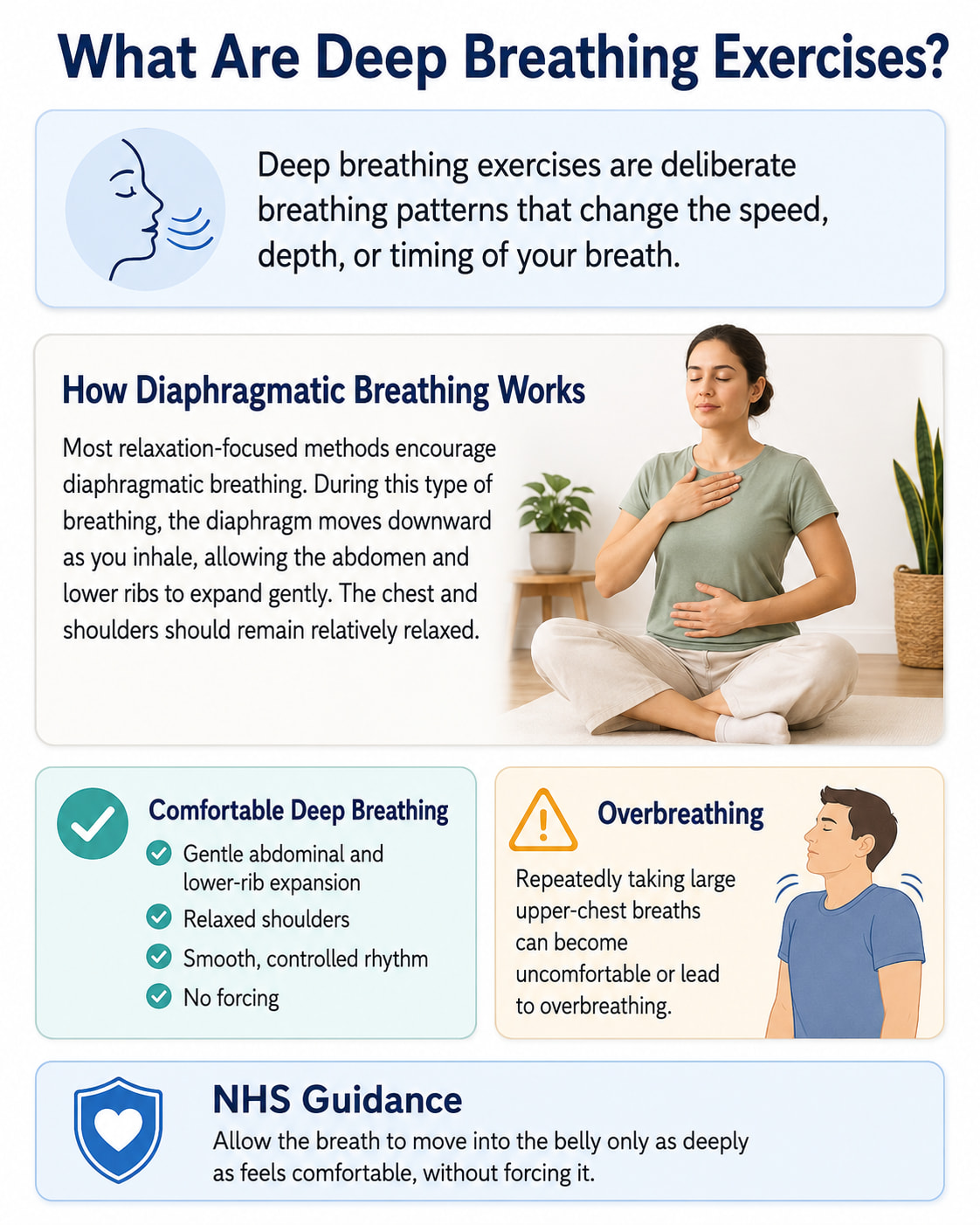
Deep breathing exercises are deliberate breathing patterns that change the speed, depth, or timing of your breath.
Most relaxation-focused methods encourage diaphragmatic breathing. During this type of breathing, the diaphragm moves downward as you inhale, allowing the abdomen and lower ribs to expand gently. The chest and shoulders should remain relatively relaxed.
This differs from repeatedly taking large upper-chest breaths, which can become uncomfortable or lead to overbreathing.
The NHS breathing guidance recommends allowing the breath to move into the belly only as deeply as feels comfortable, without forcing it.
Can Deep Breathing Help With Stress?
Deep breathing is commonly used as a relaxation technique because slowing and controlling the breath can help shift attention away from stressful thoughts and reduce some of the physical tension associated with stress.
A 2023 meta-analysis of randomized controlled trials found that breathwork was associated with a small-to-medium reduction in self-reported stress. Possible improvements were also reported for anxiety and depressive symptoms, although the researchers cautioned that study quality and methods varied.
The National Center for Complementary and Integrative Health describes deep breathing as a relaxation technique but notes that evidence for specific health conditions remains limited. Breathing exercises should therefore be viewed as a useful stress-management tool rather than a cure or replacement for professional care.
Before Starting Deep Breathing Exercises
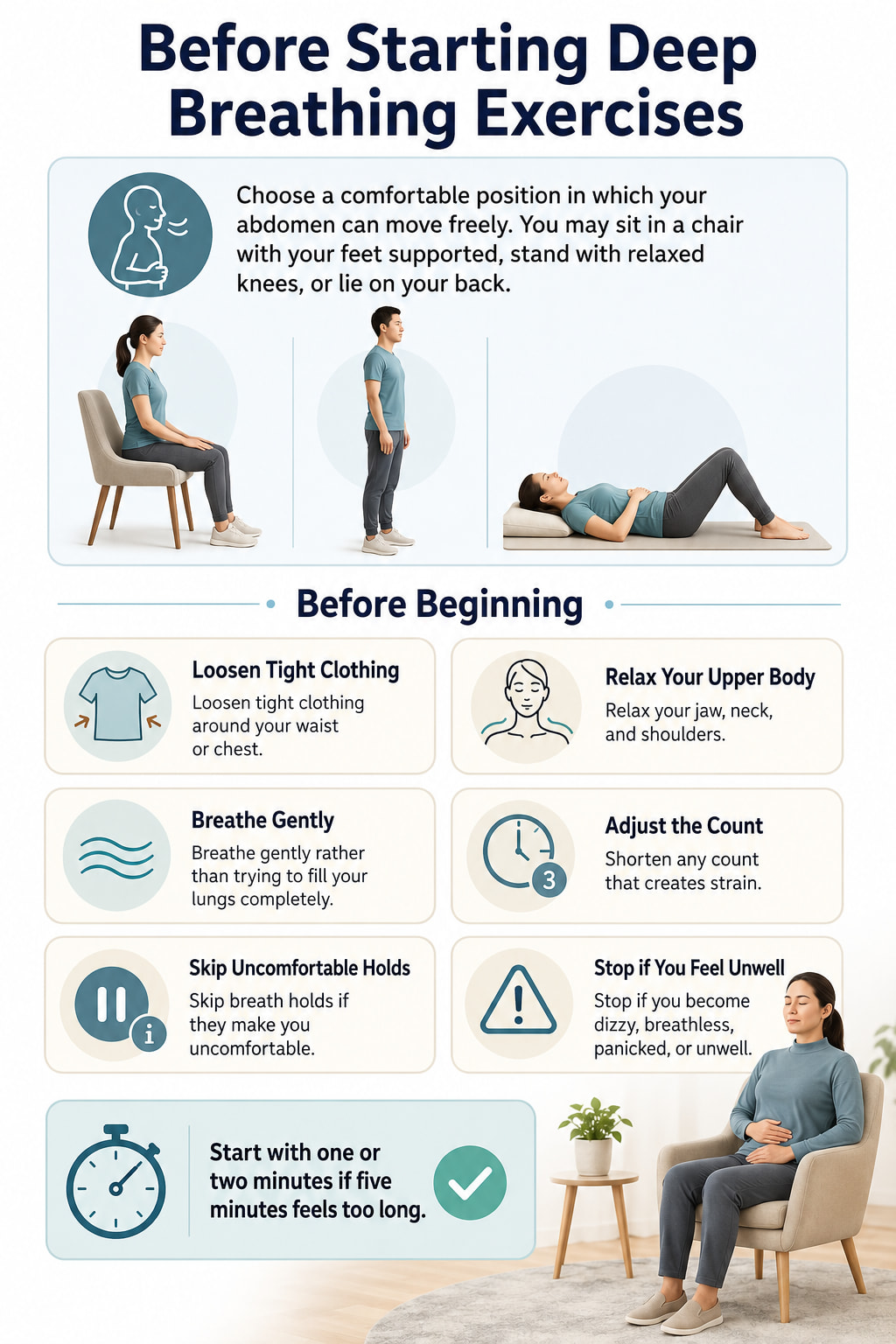
Choose a comfortable position in which your abdomen can move freely. You may sit in a chair with your feet supported, stand with relaxed knees, or lie on your back.
Before beginning:
- Loosen tight clothing around your waist or chest.
- Relax your jaw, neck, and shoulders.
- Breathe gently rather than trying to fill your lungs completely.
- Shorten any count that creates strain.
- Skip breath holds if they make you uncomfortable.
- Stop if you become dizzy, breathless, panicked, or unwell.
Start with one or two minutes if five minutes feels too long.
Which Deep Breathing Exercise Should You Choose?
You do not need to perform all 10 exercises. Choose one technique that suits your situation and practice it consistently.
| Your goal or preference | Suggested exercise |
|---|---|
| You are completely new to breathwork | Diaphragmatic breathing |
| You want a simple rhythm | Equal breathing |
| You dislike holding your breath | Extended-exhale breathing |
| You need a structured mental focus | Box breathing |
| You want an evening wind-down exercise | 4-7-8 breathing |
| You want a brief physical reset | Cyclic sighing |
| Your exhale feels rushed | Pursed-lip breathing |
| You want a longer paced practice | Coherent breathing |
| You enjoy yoga-based exercises | Alternate-nostril breathing |
| You find counting difficult | Five-finger breathing |
10 Deep Breathing Exercises for Stress and Relaxation
The following deep breathing exercises use simple, controlled breathing patterns to support relaxation and reduce everyday stress.
Choose one or two methods that feel comfortable, start slowly, and avoid forcing the breath or holding it longer than feels natural.
1. Diaphragmatic Breathing
Best for: Beginners learning how to breathe with less upper-body tension.
Time: Two to five minutes.
How to Do It
- Sit comfortably or lie on your back with your knees bent.
- Place one hand on your upper chest and the other over your abdomen, below your ribs.
- Inhale slowly through your nose.
- Allow your abdomen and lower ribs to expand gently.
- Exhale slowly through your nose or mouth.
- Let your abdomen soften as the air leaves.
- Continue at a comfortable pace.
Your lower hand should move more than the hand on your upper chest, although some chest movement is normal.
Common mistakes: Pulling in too much air, forcing the stomach outward, lifting the shoulders, arching the lower back, or trying to keep the chest completely still.
Easier option: Forget the counting and simply make each breath quiet and unhurried.
Coaching cue: Let the breath widen your lower ribs instead of lifting your shoulders.
The American Lung Association includes diaphragmatic or belly breathing as a method for helping the diaphragm work more effectively.
2. Equal Breathing
Best for: Creating a steady rhythm without breath-holding.
Breathing pattern: Inhale for four counts and exhale for four counts.
Time: Two to five minutes.
How to Do It
- Sit or lie in a comfortable position.
- Inhale gently through your nose for four counts.
- Exhale through your nose or mouth for four counts.
- Begin the next inhale without pausing or gasping.
- Repeat while keeping the breath smooth.
The count is only a pacing tool. It does not need to match exact seconds.
Common mistakes: Counting too slowly, taking an oversized inhale, pausing unintentionally, or becoming tense while trying to maintain the rhythm.
Easier option: Use a three-count inhale and three-count exhale.
Progression: Gradually increase to five counts in and five counts out, provided the rhythm remains comfortable.
3. Extended-Exhale Breathing
Best for: Relaxation without long breath holds.
Breathing pattern: Inhale for four counts and exhale for six counts.
Time: Two to five minutes.
How to Do It
- Settle into a supported sitting or lying position.
- Inhale gently through your nose for four counts.
- Exhale slowly through your nose or softly pursed lips for six counts.
- Allow the next inhale to begin naturally.
- Continue without forcing the lungs completely empty.
The exhale should be slightly longer than the inhale, not dramatically slower.
Common mistakes: Squeezing out every last bit of air, collapsing the chest, tightening the abdominal muscles forcefully, or making the exhale so long that the next inhale becomes a gasp.
Easier option: Inhale for three counts and exhale for four counts.
Coaching cue: Let the air leave slowly rather than pushing it out.
4. Box Breathing
Best for: Giving the mind a clear task during a stressful moment.
Breathing pattern: Inhale, pause, exhale, and pause for four counts each.
Rounds: Three to five rounds.
How to Do It
- Sit upright without stiffening your back.
- Inhale gently for four counts.
- Pause for four counts without tightening your throat.
- Exhale steadily for four counts.
- Pause for four counts before beginning again.
- Repeat for three to five rounds.
You can picture tracing the four equal sides of a square as you move through the pattern.
Common mistakes: Taking a maximum-effort inhale, clenching during the pauses, lifting the shoulders, or continuing when the breath holds feel stressful.
Regression: Use three counts for each phase or remove both pauses and practice equal breathing instead.
Safety note: Breath retention is optional. A technique is not more effective simply because the holds are difficult.
The British Heart Foundation describes the traditional box-breathing pattern as four equal stages but advises stopping when breathing exercises cause concerning symptoms.
5. 4-7-8 Breathing
Best for: A short wind-down practice before rest or sleep.
Breathing pattern: Inhale for four counts, hold for seven, and exhale for eight.
Rounds: Up to four beginner rounds.
How to Do It
- Sit with your back supported or lie down.
- Inhale quietly through your nose for four counts.
- Hold gently for seven counts.
- Exhale slowly through your mouth for eight counts.
- Begin the next round without taking an extra-large recovery breath.
- Complete up to four rounds.
The count represents relative timing. It does not need to equal exact seconds.
Common mistakes: Treating the exercise as a test, straining through the seven-count hold, blowing out forcefully, or performing too many rounds on the first attempt.
Regression: Use a 2-3-4 pattern, or skip the hold and use extended-exhale breathing.
Safety note: Direct research on the exact 4-7-8 ratio is limited. Its main practical value is providing a structured rhythm with a longer exhale, not a uniquely proven formula.
6. Cyclic Sighing
Best for: A brief reset when you feel physically tense or mentally overstimulated.
Time: One to five minutes.
How to Do It
- Inhale gently through your nose.
- Before exhaling, take a second, smaller nasal inhale.
- Exhale slowly and fully through your mouth.
- Pause briefly and allow the next inhale to arrive naturally.
- Repeat at a calm, controlled pace.
The second inhale should be smaller than the first. Avoid repeated gasping.
Common mistakes: Making both inhales very large, performing the pattern rapidly, forcing the exhale, shrugging the shoulders, or continuing when lightheaded.
Easier option: Perform one or two cyclic sighs, then return to normal breathing.
A preliminary randomized study compared three five-minute breathing practices with mindfulness meditation. Daily cyclic sighing produced promising improvements in mood and resting breathing rate, although the study was relatively small and does not prove that this method is best for everyone.
7. Pursed-Lip Breathing
Best for: Slowing an exhale that feels short or rushed.
Breathing pattern: Inhale for approximately two counts and exhale for four.
Time: One to five minutes.
How to Do It
- Relax your neck and shoulders.
- Keep your mouth closed and inhale slowly through your nose.
- Purse your lips as though you are gently blowing out a candle.
- Exhale slowly through your lips for roughly twice as long as the inhale.
- Avoid pushing or emptying your lungs forcefully.
- Repeat at an easy pace.
Common mistakes: Blowing too hard, puffing the cheeks, tightening the jaw, squeezing the abdomen, or taking a large breath before every exhale.
Easier option: Forget the counts and focus only on making the exhale slower than the inhale.
Pursed-lip breathing is frequently used in pulmonary care to slow breathing and improve control of the exhale. The American Lung Association recommends relaxing the neck and shoulders, inhaling through the nose, and exhaling slowly through softly pursed lips.
New or unexplained breathlessness should be medically evaluated rather than managed only with a breathing exercise.
8. Coherent Breathing
Best for: A steady, longer relaxation practice using a timer or breathing guide.
Breathing pattern: Approximately five seconds in and five seconds out.
Time: Five to 10 minutes.
How to Do It
- Sit or lie comfortably.
- Inhale gently for about five seconds.
- Exhale smoothly for about five seconds.
- Continue without holding your breath between phases.
- Adjust the count whenever you need a smaller or more natural breath.
This pattern produces approximately six breaths per minute, but you do not need to achieve an exact rate.
Common mistakes: Chasing a “perfect” breathing rate, breathing more deeply than necessary, becoming rigid with the timer, or ignoring discomfort.
Easier option: Use four seconds in and four seconds out.
A randomized trial comparing coherent breathing at approximately 5.5 breaths per minute with faster paced breathing found improvements over time in both groups, but coherent breathing was not clearly superior. A comfortable, repeatable pattern may matter more than reaching a precise rate.
9. Alternate-Nostril Breathing
Best for: Readers who enjoy a focused, yoga-derived breathing practice.
Time: One to three minutes.
How to Do It
- Sit upright with your shoulders relaxed.
- Close your right nostril gently with your right thumb.
- Inhale slowly through your left nostril.
- Close your left nostril with your ring finger and release the right.
- Exhale through your right nostril.
- Inhale through the right nostril.
- Close the right side, open the left, and exhale through the left.
- Continue alternating sides.
Breathing in and out through both sides completes one round.
Common mistakes: Pressing too hard on the nose, pulling in air forcefully, holding the breath unintentionally, rushing the hand changes, or losing an upright but relaxed posture.
Regression: Alternate sides only after each complete breath: inhale and exhale through the left, then inhale and exhale through the right.
Safety note: Skip this technique when your nose is blocked, irritated, or uncomfortable. Do not force air through a restricted nostril.
The British Heart Foundation includes alternate-nostril breathing as a relaxation practice and recommends slow, smooth breaths rather than forceful inhalation.
10. Five-Finger Breathing
Best for: People who find it difficult to concentrate on counting alone.
Rounds: Trace one hand once or twice.
How to Do It
- Hold one hand in front of you with your fingers spread.
- Place the index finger of your other hand at the base of your thumb.
- Trace upward along the thumb while inhaling.
- Trace downward along the other side while exhaling.
- Continue up and down each finger.
- Keep your eyes on the tracing movement and your breath comfortable.
Common mistakes: Moving the tracing finger too quickly, forcing the breath to match an uncomfortable pace, holding the shoulders rigid, or judging yourself when your attention wanders.
Progression: Pause briefly at the top of each finger, but only when a short pause feels comfortable.
Coaching cue: Follow your finger with your eyes and let the movement set the pace.
Cedars-Sinai describes this as “take-five breathing,” using hand tracing to provide a visual and physical cue for each inhale and exhale.
A Simple 5-Minute Deep Breathing Routine
This beginner routine uses diaphragmatic breathing and a slightly longer exhale.
Minute 1: Settle Your Posture
Sit with your feet supported or lie down. Relax your jaw, shoulders, hands, and abdomen. Observe your normal breathing without changing it.
Minutes 2–4: Practice a Comfortable Rhythm
Inhale through your nose for three or four counts. Exhale gently for four to six counts.
Keep the breath quiet and reduce the count whenever you feel air hunger or strain.
Minute 5: Return to Natural Breathing
Stop counting and allow your breathing to return to its normal rhythm. Notice whether your shoulders, jaw, or hands feel less tense.
The NHS suggests practicing gentle, regular breathing for at least five minutes, but beginners can start with a shorter session and build gradually.
Common Deep Breathing Mistakes
Trying to Take the Biggest Possible Breath
A deeper breath is not always a better breath. Repeated oversized breaths can turn into overbreathing and leave you feeling uncomfortable.
Aim for moderate abdominal and lower-rib movement rather than maximum lung expansion.
Raising the Shoulders
Shoulder lifting often indicates that the inhale is too large or tense. Allow the shoulders to remain heavy while the lower ribs expand.
Forcing a Long Exhale
A longer exhale should feel controlled, not squeezed. Shorten the count if you need to gasp afterward.
Treating the Counts as Strict Rules
A four-count inhale may feel easy for one person and difficult for another. Adjust the rhythm to your comfort and breathing capacity.
Practicing Too Many Techniques at Once
Choose one method and practice it for several days. Constantly switching techniques makes it harder to determine which pattern feels most useful.
Continuing While Dizzy
Rapid or excessively deep breathing can reduce carbon dioxide levels and cause lightheadedness, tingling, a racing heartbeat, or a feeling of breathlessness. Stop the exercise, breathe normally, and sit or lie down safely if this occurs.
How Often Should You Practice Deep Breathing?
Begin with two to five minutes once a day.
After the technique feels familiar, you might use it:
- Before a stressful meeting, test, or appointment
- During a quiet break
- After finishing work or school
- Before a relaxation or stretching session
- As part of an evening wind-down routine
Practicing while you are relatively calm can make the pattern easier to remember when you feel stressed.
Longer sessions are not automatically better. Stop when the exercise becomes uncomfortable or causes you to focus anxiously on your breathing.
Deep Breathing Safety
Relaxation techniques are generally considered safe for healthy people, but they do not feel calming for everyone. Some people experience increased anxiety, intrusive thoughts, or discomfort when focusing closely on internal sensations.
Use these precautions:
- Do not force your breathing.
- Avoid long breath holds when pregnant or when you have a significant heart or lung condition unless a healthcare professional has approved them.
- Stop if you develop dizziness, numbness, tingling, pain, unusual breathlessness, panic, or other concerning symptoms.
- Return to your normal breathing rather than trying to “push through” discomfort.
- Seek medical advice for recurring or unexplained shortness of breath.
- Seek urgent medical help for severe difficulty breathing, fainting, chest pressure or pain, sudden confusion, or blue or gray lips or skin.
Severe breathing difficulty or chest symptoms should not be assumed to be stress.
Frequently Asked Questions
What Is the Best Deep Breathing Exercise for Stress?
Diaphragmatic breathing or extended-exhale breathing is a practical starting point for most beginners because neither requires a long breath hold.
The best exercise is the one you can perform comfortably and consistently. A complicated pattern is not necessarily more effective than a simple one.
How Long Should I Do Deep Breathing Exercises?
Start with two to five minutes. You may gradually increase to five or 10 minutes when the exercise remains comfortable.
A few controlled breaths can also be useful when you do not have time for a complete session.
Why Do I Feel Dizzy When I Breathe Deeply?
You may be taking breaths that are too large, too fast, or too frequent. This can lead to overbreathing and a temporary drop in carbon dioxide levels.
Stop the exercise, return to normal breathing, and sit or lie down. Speak with a healthcare professional if dizziness is persistent, severe, recurring, or accompanied by chest pain, fainting, or unusual breathlessness.
Is Box Breathing Better Than 4-7-8 Breathing?
Neither technique has been proven best for everyone.
Box breathing uses four equal phases and includes a pause after both the inhale and exhale. The 4-7-8 technique uses a longer hold and exhale. Box breathing may feel more balanced, while 4-7-8 breathing may feel more demanding.
Choose equal or extended-exhale breathing when breath retention is uncomfortable.
Should I Breathe Through My Nose or Mouth?
For most exercises, inhaling through the nose is comfortable and easy to control. You can exhale through either the nose or mouth, depending on the technique.
Pursed-lip breathing and cyclic sighing normally use a mouth exhale. Breathe in the way that feels comfortable if nasal congestion makes nose breathing difficult.
Can I Use Deep Breathing Exercises Before Sleep?
A gentle breathing exercise may help you settle into a calmer bedtime routine, but it does not guarantee that you will fall asleep or treat persistent insomnia.
Equal breathing, extended-exhale breathing, diaphragmatic breathing, and a comfortable version of 4-7-8 breathing are common evening options.
Can Breathing Exercises Replace Treatment for Anxiety?
No. Deep breathing can be used as one coping skill, but it does not replace therapy, medication, medical evaluation, or other care recommended by a qualified professional.
Seek professional support when stress or anxiety is persistent, worsening, difficult to manage, or interfering with school, work, sleep, relationships, or daily activities.
Conclusion
Deep breathing exercises work best when the breath remains gentle, comfortable, and controlled. Begin with diaphragmatic breathing, equal breathing, or a slightly extended exhale before experimenting with longer breath holds.
Choose one technique, practice it for a few minutes while calm, and adjust the timing to suit your body. Stop whenever the exercise creates dizziness, breathlessness, panic, or other concerning symptoms.
References
- National Center for Complementary and Integrative Health: Relaxation Techniques
- NHS: Breathing Exercises for Stress
- Scientific Reports: Effect of Breathwork on Stress and Mental Health
- Cell Reports Medicine: Brief Structured Respiration Practices
- American Lung Association: Breathing Exercises
- British Heart Foundation: Deep Breathing Exercises
- MedlinePlus: Hyperventilation
This content is for informational purposes only and is not a substitute for professional medical advice.
1 thought on “10 Deep Breathing Exercises for Stress and Relaxation”