The Barbell Romanian Deadlift (RDL) is one of the most effective exercises for building strong glutes and hamstrings. This lift works by training the hip-hinge pattern while placing high tension on the posterior chain—especially during the lowering (eccentric) phase. Understanding how the RDL works is important because it strengthens the muscles that support your spine, hips, and athletic performance.
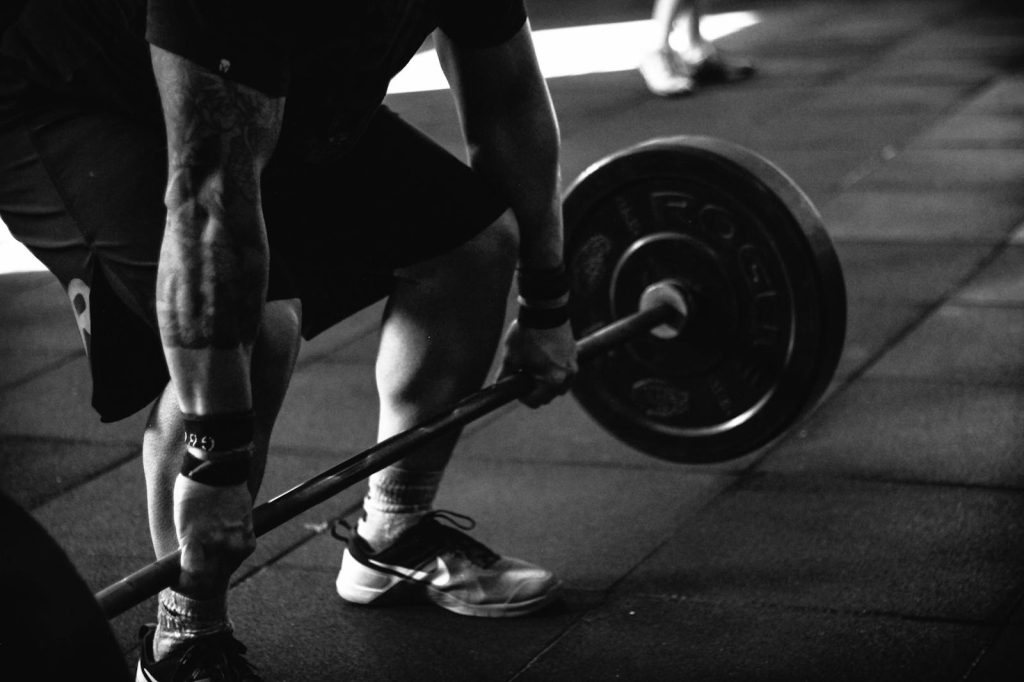
In this guide, you’ll learn proper form, benefits, muscles worked, common mistakes, safety tips, and programming guidance. This is a research-backed breakdown suitable for beginners and advanced lifters.
What Is the Barbell Romanian Deadlift?
The Barbell Romanian Deadlift is a hip-dominant strength exercise where you lower the barbell by pushing your hips backward while keeping a slight bend in your knees. Unlike the traditional deadlift, the RDL starts from a standing position and emphasizes controlled hamstring loading rather than pulling weight from the floor.

Benefits of the Barbell Romanian Deadlift
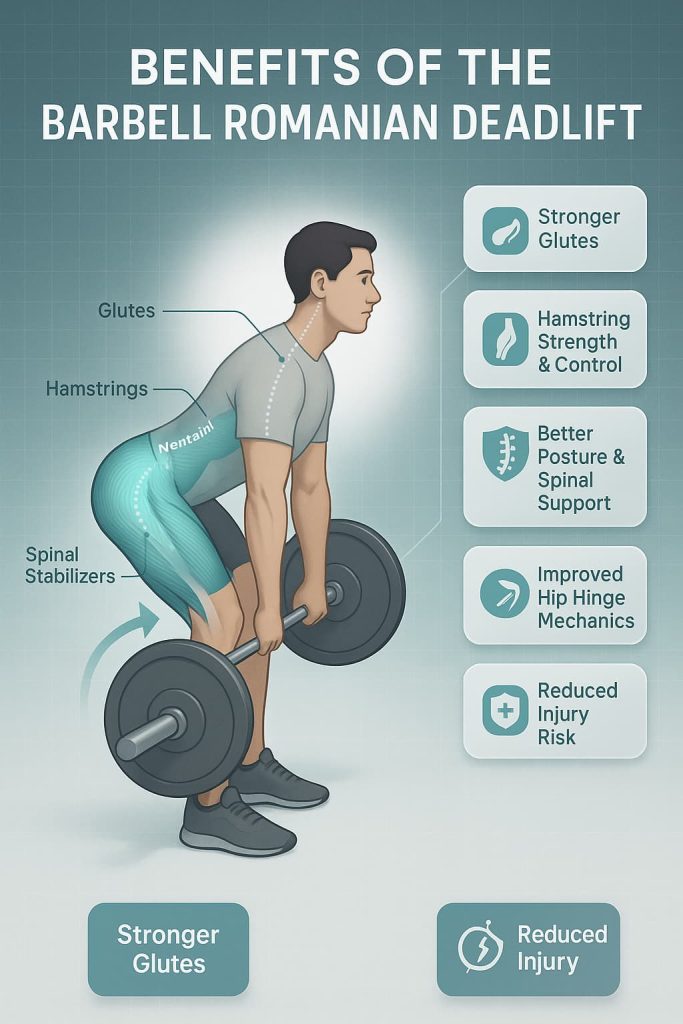
The RDL offers evidence-supported advantages:
1. Builds Stronger Glutes
The RDL heavily recruits the gluteus maximus, helping improve hip extension power used in walking, running, climbing stairs, and lifting.
2. Enhances Hamstring Strength & Flexibility
The extended eccentric phase encourages hamstring tension, which may improve flexibility and muscle control over time.
3. Improves Posture & Spinal Stability
Keeping a neutral spine during the hinge trains the erector spinae and deep core stabilizers, supporting lower-back resilience.
4. Strengthens the Hip Hinge Pattern
The RDL teaches the fundamental hinge that transfers to squats, deadlifts, kettlebell swings, and everyday lifting tasks.
5. Helps Reduce Injury Risk
By improving posterior-chain strength, the RDL may support better balance, running mechanics, and hip alignment—reducing stress on knees and lower back.
How to Do the Barbell Romanian Deadlift (Step-by-Step)
Follow these technique steps to ensure proper form and safety.
Step 1 — Set Up
- Stand with feet hip-width apart.
- Hold the bar with hands slightly wider than your thighs.
- Brace your core and keep your spine neutral.
Step 2 — Begin the Hinge
- Push your hips backward as if closing a car door.
- Maintain a slight knee bend (about 15–20 degrees).
- Keep the bar close to your body, sliding against your thighs and shins.
Step 3 — Lower Under Control
- Lower until your hamstrings feel a strong stretch.
- Stop before your spine rounds—typically mid-shin height.
- Maintain level shoulders and stable hips.
Step 4 — Return to Standing
- Press your feet into the floor.
- Drive your hips forward to stand tall.
- Squeeze your glutes at the top without leaning backward.
Muscles Worked in the Barbell Romanian Deadlift
The RDL primarily targets:
- Hamstrings (biceps femoris, semitendinosus, semimembranosus)
- Gluteus maximus
- Erector spinae
- Adductor magnus
- Secondary involvement: core stabilizers, grip muscles, lats (for keeping bar close)
How to Warm Up Before Doing the Barbell Romanian Deadlift
A short warm-up prepares your hips, hamstrings, and lower back for a safe and effective hinge. Spend 2–3 minutes on these quick drills:
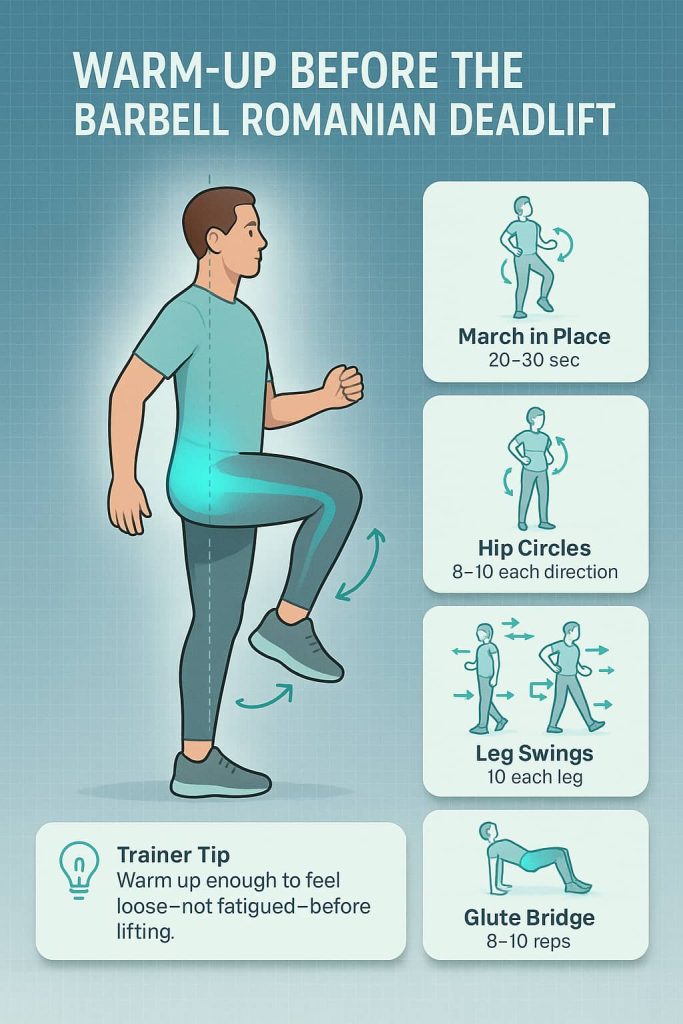
- March in Place — 20–30 seconds
Light activation for hips and core. - Hip Circles — 8–10 each direction
Loosens the hip joints for smoother hinging. - Leg Swings — 10 each leg
Dynamically warms the hamstrings and improves range. - Glute Bridge — 8–10 reps
Activates the glutes for stronger hip extension. - PVC/Broomstick Hip Hinge — 6–8 reps
Reinforces neutral spine and proper hinge mechanics.
Trainer Tip:
Warm up just enough to feel loose and controlled—avoid fatiguing your hamstrings before lifting.
Common Mistakes to Avoid
Avoid these common errors to ensure proper loading and prevent pain:
- Rounding the lower back (places excessive stress on spine)
- Hyperextending at the top (leaning back excessively)
- Letting the bar drift away from your legs
- Bending knees too much, turning the lift into a squat
- Lowering too far beyond mobility limits
How Often Should You Do the Barbell Romanian Deadlift?
For most lifters:
- Beginners: 2–3 sets of 8–12 reps, once per week
- Intermediate/Advanced: 3–5 sets of 5–8 reps, 1–2 times per week
- Load: Typically 60–80% of 1RM depending on your training goal
Progress only when your last 2–3 reps feel controlled and stable.
Barbell Romanian Deadlift vs Traditional Deadlift
| Feature | Barbell RDL | Conventional Deadlift |
|---|---|---|
| Start Position | Standing | From the floor |
| Knee Bend | Slight | Moderate |
| Main Focus | Hamstrings + Glutes | Full posterior chain + quads |
| Movement | Hip hinge only | Hip + knee extension |
| Best For | Hypertrophy, hinge training | Max strength, power lifts |
Both lifts are valuable—many programs use both for complete lower-body development.
Variations of the Romanian Deadlift
Try these variations to match your training goals, mobility, and equipment availability.
1. Dumbbell Romanian Deadlift
Why it works:
This variation allows for a more natural arm position and easier range-of-motion control, making it ideal for beginners. It also provides independent loading on each side, helping correct strength imbalances.
Muscles worked:
Hamstrings, gluteus maximus, erector spinae, adductors, forearm and grip muscles.
How to do it:
- Stand with feet hip-width apart holding a dumbbell in each hand.
- Keep a slight bend in your knees and brace your core.
- Push your hips backward and lower the dumbbells while keeping them close to your legs.
- Stop when you feel a stretch in your hamstrings.
- Drive your hips forward and return to standing tall.
Trainer Tip:
Keep the dumbbells close to your thighs to reduce stress on the lower back and improve hinge mechanics.
2. Single-Leg Romanian Deadlift
Why it works:
This unilateral variation challenges hip stability, balance, and coordination. It also exposes asymmetries between left and right sides, making it a strong corrective exercise.
Muscles worked:
Gluteus medius and maximus, hamstrings, core stabilizers, ankle stabilizers.
How to do it:
- Stand on one leg with a dumbbell or kettlebell in the opposite hand.
- Keep a slight knee bend in your standing leg.
- Hinge from the hips as your free leg extends behind you.
- Lower the weight toward the floor while keeping your spine neutral.
- Return to standing by driving your hips forward and keeping the knee soft.
Trainer Tip:
Focus your gaze on a fixed point ahead to reduce wobbling and maintain balance.
3. Trap Bar Romanian Deadlift
Why it works:
The neutral handles of the trap bar place less stress on the lower back and shoulders. This variation suits beginners, tall lifters, or those with limited mobility.
Muscles worked:
Hamstrings, glutes, adductors, erector spinae, upper back stabilizers.
How to do it:
- Stand inside the trap bar with feet hip-width apart.
- Grip the handles and brace your core.
- Push your hips back while keeping a slight bend in your knees.
- Lower the bar by hinging until you feel hamstring tension.
- Stand back up by driving your hips forward.
Trainer Tip:
Think “hips back first,” not “reach down,” to avoid turning the movement into a squat.
4. Snatch-Grip Romanian Deadlift
Why it works:
The wide grip increases the torso angle and lengthens the hamstring leverage, creating a deeper stretch and greater posterior-chain engagement. It also activates the upper back more strongly due to the wider arm position.
Muscles worked:
Hamstrings, gluteus maximus, erector spinae, lats, lower traps, upper-back stabilizers.
How to do it:
- Set a wide snatch grip on the bar—roughly double shoulder width.
- Brace your core and maintain a neutral spine.
- Push your hips backward and lower the bar while keeping it close to your legs.
- Stop when your hamstrings reach a strong stretch.
- Drive your hips forward to return to standing.
Trainer Tip:
Use straps if grip becomes limiting, especially on higher-rep sets or slow eccentrics.
Safety Guidelines Before You Start
- Start with light weights to learn proper hip-hinge mechanics.
- Keep your core braced the entire time.
- Maintain a neutral spine; avoid forcing the range of motion.
- Use lifting straps only after mastering technique.
- Stop immediately if sharp pain occurs in the lower back or hamstrings.
- If you have low-back or hip irritation, consult a qualified professional before heavy lifting.
When to Avoid the RDL or Modify It
You may need modifications if you experience:
- Sharp lumbar pain during hinging
- Hamstring strains
- Severe hip mobility limitations
- Existing disc issues (consult a clinician first)
Safer alternatives include hip thrusts, glute bridges, back extensions, or banded RDLs.
FAQ: Barbell Romanian Deadlift
1. Is the RDL safe for beginners?
Yes, but start with light weight and prioritize learning the hip-hinge pattern with a PVC pipe or dumbbells.
2. How low should I go during the RDL?
Lower only until your hamstrings stretch while maintaining a neutral spine—usually between knee and mid-shin height.
3. Can the RDL help with lower-back strength?
When performed correctly, it may support spinal stability by strengthening the posterior chain.
4. Should I lock out my knees?
No. Keep a soft bend in the knees throughout the movement.
5. What grip should I use?
Double overhand is best for beginners. Use mixed or hook grip for heavier loads.
6. Is the RDL better than the deadlift for hamstrings?
Typically yes—the RDL places the hamstrings under greater eccentric tension.
7. Can I do RDLs and squats in the same workout?
Absolutely. Most programs pair them to balance quad and posterior-chain development.
Conclusion
The Barbell Romanian Deadlift is one of the most reliable exercises for developing strong glutes, hamstrings, and a powerful hip hinge. With proper form and progressive loading, it supports better posture, improved lifting mechanics, and more resilient movement. Add it to your lower-body routine 1–2 times per week for best results.
References
- Coratella G, et al. (2022). “An Electromyographic Analysis of Romanian, Step-Romanian, and Stiff-Leg Deadlift: Implication for Resistance Training.” International Journal of Environmental Research and Public Health.
- Martín-Fuentes I, et al. (2020). “Electromyographic Activity in Deadlift Exercise and Its Variants: A Systematic Review.” PLOS ONE.
- Lee S, et al. (2018). “An Electromyographic and Kinetic Comparison of Conventional and Romanian Deadlifts.” Journal of Exercise Science & Fitness.
- Otani R, et al. (2025). “The Effect of Single Leg Romanian Deadlift on the Risk of Hamstring Strain Injuries in Track and Field Athletes: A Cohort Study.” International Journal of Sports Physical Therapy.
- Samson M, et al. (2012). “Effects of Dynamic and Static Stretching Within General and Activity-Specific Warm-Ups.” Journal of Strength and Conditioning Research.
- Li FY, et al. (2023). “A Systematic Review and Net Meta-Analysis of the Effects of Different Warm-Up Methods on the Acute Effects of Lower Limb Explosive Strength.” BMC Sports Science, Medicine and Rehabilitation.
2 thoughts on “Barbell Romanian Deadlift: Build Stronger Glutes & Hamstrings”