Leg raise exercises are some of the best bodyweight movements for building a stronger, more controlled core. They can help you train the rectus abdominis, deep trunk stabilizers, and hip flexors while teaching better pelvic control, which is what makes these exercises feel so effective for the “lower abs” area. In strict anatomy terms, the rectus abdominis is one muscle, but certain leg raise variations often create more tension in the lower portion people usually mean when they say lower abs, as explained by Mayo Clinic.
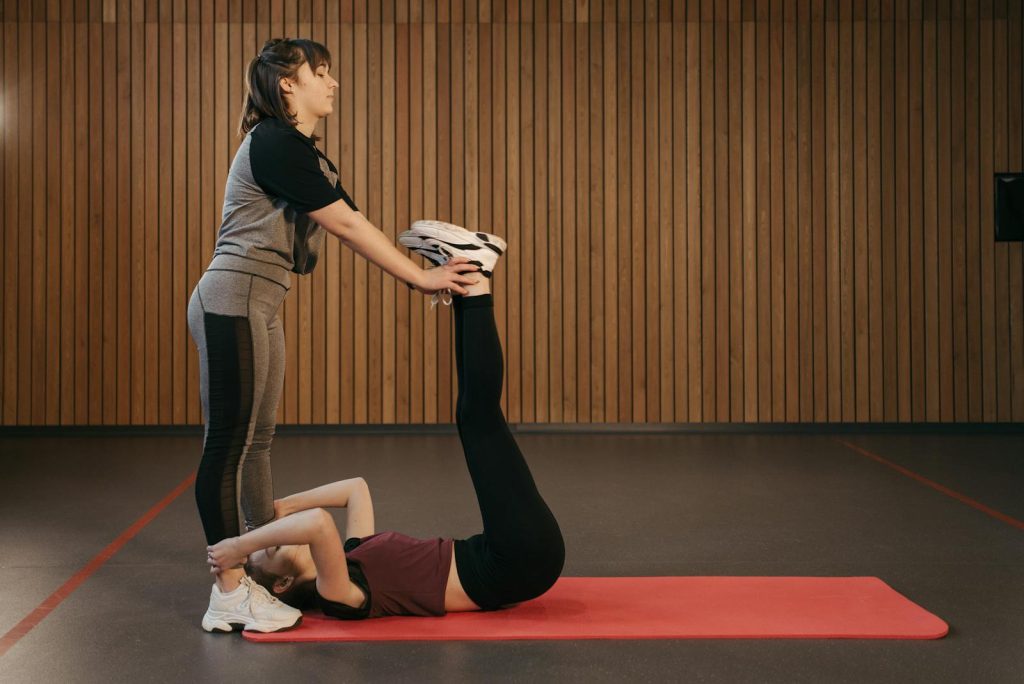
A good leg raise is not just about lifting your legs. It is about keeping your rib cage and pelvis organized, bracing your trunk, and moving with control instead of swinging. That is why the best leg raise exercises range from simple floor variations to advanced hanging versions, which aligns well with the progression model described by NASM.
Why Leg Raise Exercises Work
Your core includes the abdominal muscles, back muscles, and the muscles around the pelvis. Stronger core muscles make many physical activities easier, and better core training starts with good bracing and progression, not just harder variations. Guidance from Mayo Clinic, NASM, and ACE Fitness all supports that idea.
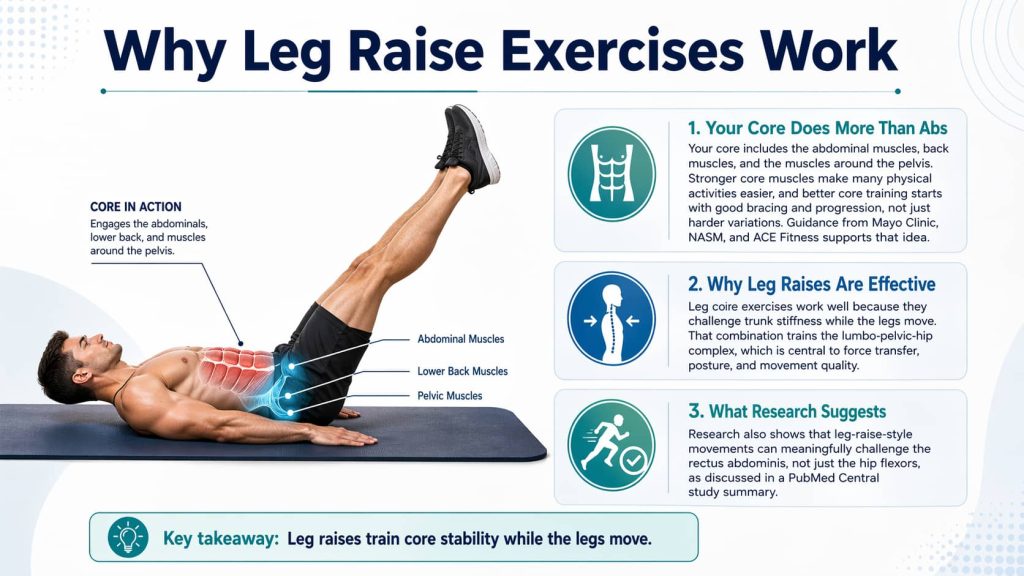
Leg raise exercises work well because they challenge trunk stiffness while the legs move. That combination trains the lumbo-pelvic-hip complex, which is central to force transfer, posture, and movement quality. Research also shows that leg-raise-style movements can meaningfully challenge the rectus abdominis, not just the hip flexors, as discussed in the PubMed Central study summary.
10 Best Leg Raise Exercises
Build a stronger core with these 10 best leg raise exercises for lower abs, control, and stability. From beginner-friendly floor variations to advanced hanging raises, this list helps you train smarter with better form and progression.
1. Bent-Knee Reverse Crunch
Best for: Beginners who want to learn pelvic control and actually feel their abs working.
Muscles worked: Rectus abdominis, transverse abdominis, hip flexors.
Equipment needed: Exercise mat.
Why it stands out: This is the best place to start because it teaches the key skill behind almost every good leg raise: bringing the pelvis toward the rib cage instead of just swinging the legs.
Suggested sets and reps: 2–4 sets of 8–15 reps.
How to do it:
- Lie on your back with your knees bent and feet off the floor.
- Bring your knees directly above your hips.
- Brace your abs and gently press your low back toward the floor.
- Curl your hips up slightly and bring your knees toward your chest.
- Lower slowly without dropping your feet.
Common mistakes: Pulling with momentum, making the movement too big, or relaxing the abs on the way down.
Coaching cue: “Roll your pelvis up, don’t just throw your knees.”
Exercise variations:
- Easier variation: reduce range of motion.
- Harder variation: pause at the top for 1–2 seconds.
How to use in a workout: Use this early in your core progression or as a controlled finisher after lower-body or full-body training, following the movement pattern shown by ACE Fitness.
2. Bent-Knee Leg Raise
Best for: Beginners who need a simple floor-based leg raise without jumping straight into straight-leg work.
Muscles worked: Rectus abdominis, hip flexors, deep core stabilizers.
Equipment needed: Exercise mat.
Why it stands out: Keeping the knees bent shortens the lever, which makes it easier to control the pelvis and avoid excessive low-back arching.
Suggested sets and reps: 2–3 sets of 10–15 reps.
How to do it:
- Lie on your back with your arms by your sides.
- Bend your knees to about 90 degrees.
- Brace your trunk and keep your rib cage down.
- Lift your legs until your thighs are near vertical.
- Lower slowly until your heels almost touch the floor.
Common mistakes: Letting the low back arch, rushing the lowering phase, or losing abdominal tension at the bottom.
Coaching cue: “Keep your belly tight all the way down.”
Exercise variations:
- Easier variation: shorten the lowering range.
- Harder variation: add a small hip lift at the top.
How to use in a workout: This fits well after reverse crunches or as a second exercise in a beginner core circuit, which matches the progression principles outlined by NASM.
3. Alternating Single-Leg Raise
Best for: Building control one side at a time and learning how to resist low-back extension.
Muscles worked: Rectus abdominis, transverse abdominis, hip flexors.
Equipment needed: Exercise mat.
Why it stands out: Training one leg at a time reduces the load compared with bilateral raises and makes it easier to keep position.
Suggested sets and reps: 2–3 sets of 8–12 reps per side.
How to do it:
- Lie on your back with one leg bent and one leg straight.
- Brace your abs and keep your pelvis steady.
- Raise the straight leg to about 60–90 degrees.
- Lower with control.
- Repeat all reps, then switch sides.
Common mistakes: Twisting the hips, lifting too high too fast, or shrugging the shoulders.
Coaching cue: “Move the leg, not the torso.”
Exercise variations:
- Easier variation: bend the working leg slightly.
- Harder variation: hover the non-working leg off the floor.
How to use in a workout: Use this when straight-leg raises feel too difficult or when you want extra control work without a lot of spinal motion, which fits well with the core stability approach from NASM.
4. Straight-Leg Floor Raise
Best for: Intermediate trainees ready for a longer lever and more abdominal tension.
Muscles worked: Rectus abdominis, hip flexors, transverse abdominis.
Equipment needed: Exercise mat.
Why it stands out: Straightening the knees increases the lever length and makes the exercise much harder without adding equipment.
Suggested sets and reps: 2–4 sets of 8–12 reps.
How to do it:
- Lie flat with both legs straight.
- Place your hands by your sides or lightly under your hips if needed.
- Brace your abs before moving.
- Raise both legs under control.
- Lower slowly and stop before your low back peels off the floor.
Common mistakes: Dropping the legs too low, arching hard through the low back, or chasing range over control.
Coaching cue: “Only lower as far as you can keep your abs locked in.”
Exercise variations:
- Easier variation: partial-range reps.
- Harder variation: slower 3–5 second lowering.
How to use in a workout: This is a strong main core exercise on mat-based days when you want more difficulty than bent-knee versions, which follows the same controlled progression described by NASM.
5. Leg Raise With Hip Lift
Best for: Lifters who want more abdominal involvement than a basic straight-leg raise.
Muscles worked: Rectus abdominis, lower trunk stabilizers, hip flexors.
Equipment needed: Exercise mat.
Why it stands out: The added hip lift makes the abs do more than just stabilize. It adds a small posterior pelvic tilt that usually makes the exercise feel more direct in the front of the core.
Suggested sets and reps: 2–4 sets of 8–12 reps.
How to do it:
- Start in a straight-leg raise position with your legs vertical.
- Brace hard.
- Lift your hips slightly off the floor by curling your pelvis up.
- Pause briefly.
- Lower your hips first, then the legs under control.
Common mistakes: Turning the hip lift into a wild swing or kicking the legs for momentum.
Coaching cue: “Lift with your abs, not with a swing.”
Exercise variations:
- Easier variation: bent-knee version.
- Harder variation: add a slow 2-second pause at the top.
How to use in a workout: Use this after standard floor raises when you want more tension without moving to hanging work yet, similar to the pelvic-control focus shown by ACE Fitness.
6. Hollow-Body Leg Raise
Best for: Advanced floor training and improving total-body core tension.
Muscles worked: Rectus abdominis, transverse abdominis, obliques, hip flexors.
Equipment needed: Exercise mat.
Why it stands out: The hollow-body position increases trunk tension and makes even short leg raises feel much harder.
Suggested sets and reps: 2–4 sets of 6–10 reps or 10–20 second holds.
How to do it:
- Lie on your back and flatten your low back into the floor.
- Lift your shoulders slightly.
- Raise your legs a few inches to your chosen range.
- Keep the rib cage down and abs tight.
- Return slowly without losing the hollow position.
Common mistakes: Letting the low back lift off the floor or holding your breath.
Coaching cue: “Crush the floor with your low back.”
Exercise variations:
- Easier variation: tuck both knees.
- Harder variation: longer lever or longer hold.
How to use in a workout: This works well as a short, hard finisher when you want quality tension rather than high reps, which fits the trunk-stability model discussed by NASM.
7. Captain’s Chair Knee Raise
Best for: Beginners and intermediates who want to progress from floor work to supported vertical core training.
Muscles worked: Rectus abdominis, hip flexors, obliques, shoulder stabilizers.
Equipment needed: Captain’s chair or vertical knee raise station.
Why it stands out: The back support and arm pads reduce the technical challenge compared with full hanging work, so you can focus on bracing and pelvic control.
Suggested sets and reps: 2–4 sets of 8–15 reps.
How to do it:
- Set yourself into the chair with forearms on the pads.
- Press down through the handles and keep your chest tall.
- Raise your knees toward your chest.
- Curl the pelvis slightly at the top.
- Lower slowly without swinging.
Common mistakes: Short, sloppy reps, pushing the head forward, or bouncing at the bottom.
Coaching cue: “Bring your knees up, then tuck your pelvis.”
Exercise variations:
- Easier variation: smaller range.
- Harder variation: hold the top position for 1–2 seconds.
How to use in a workout: Use this as your bridge between floor leg raises and unsupported hanging versions, much like the progression suggested by ACE Fitness.
8. Captain’s Chair Knee Raise With Twist
Best for: Intermediate trainees who want more oblique involvement.
Muscles worked: Rectus abdominis, obliques, hip flexors.
Equipment needed: Captain’s chair.
Why it stands out: A small twist adds frontal and rotational demand without making the movement reckless.
Suggested sets and reps: 2–3 sets of 8–12 reps per side.
How to do it:
- Start in the captain’s chair.
- Raise your knees as usual.
- At the top, gently angle them toward one side.
- Return to center.
- Lower under control and alternate sides.
Common mistakes: Twisting too aggressively, shrugging into the shoulders, or speeding through the reps.
Coaching cue: “Rotate a little, control a lot.”
Exercise variations:
- Easier variation: regular captain’s chair knee raise.
- Harder variation: slower eccentric.
How to use in a workout: This is a good second or third exercise in a core session when you want some oblique work without doing separate side-focused movements, which is consistent with the vertical core exercise options highlighted by ACE Fitness.
9. Hanging Knee Raise
Best for: Intermediate and advanced trainees ready for unsupported core work.
Muscles worked: Rectus abdominis, deep abdominal muscles, hip stabilizers, hip flexors, grip.
Equipment needed: Pull-up bar.
Why it stands out: Hanging knee raises increase the demand on the core because the legs are unsupported, and they also train grip strength and shoulder control.
Suggested sets and reps: 2–4 sets of 6–12 reps.
How to do it:
- Hang from a pull-up bar with a controlled grip.
- Set your shoulders down and back.
- Raise your knees toward your chest.
- Avoid swinging.
- Lower slowly for full control.
Common mistakes: Kipping the legs up, overextending the low back, or losing shoulder position.
Coaching cue: “Own the lowering phase.”
Exercise variations:
- Easier variation: captain’s chair knee raise.
- Harder variation: top pause or slight twist.
How to use in a workout: Use this as a main advanced core movement after your big strength work, following the unsupported core training ideas described by ACE Fitness.
10. Hanging Straight-Leg Raise
Best for: Advanced lifters who already control hanging knee raises.
Muscles worked: Rectus abdominis, transverse abdominis, obliques, hip flexors, grip, shoulder stabilizers.
Equipment needed: Pull-up bar.
Why it stands out: This is one of the hardest pure bodyweight core movements because the straight-leg lever increases the challenge dramatically.
Suggested sets and reps: 2–4 sets of 5–10 reps.
How to do it:
- Hang from the bar with full-body tension.
- Keep your legs straight and together.
- Raise them only as high as you can without losing control.
- Pause briefly.
- Lower slowly, fighting the urge to swing.
Common mistakes: Turning the set into momentum reps, bending the knees halfway through, or losing abdominal tension on the descent.
Coaching cue: “Lift smooth, lower slower.”
Exercise variations:
- Easier variation: hanging knee raise.
- Harder variation: toes-to-bar progression.
How to use in a workout: Place this near the end of an upper-body, full-body, or dedicated core session when your grip and shoulders are still fresh enough to stay strict, which fits the more advanced progression options shown by ACE Fitness.
Common Mistakes With Leg Raise Exercises
The biggest mistake with leg raise exercises is treating them like a leg swing instead of a core exercise. Good reps depend on bracing, rib-to-pelvis control, and a slow lowering phase. NASM emphasizes bracing and lumbo-pelvic stability as essential for safe, effective core work, and ACE Fitness reinforces the value of controlled movement.
Watch for these problems:
- lowering the legs farther than you can control
- arching the low back hard off the floor
- yanking the knees or feet upward with momentum
- forgetting the pelvic curl on reverse-crunch-style reps
- moving too quickly on the way down
- progressing to hanging versions before you can control floor versions
If a leg raise causes sharp pain, numbness, dizziness, or unusual symptoms, stop and get professional guidance. Unsupported hanging leg work is also not a smart choice for everyone, especially if you already have diagnosed lower-back problems, which is why ACE Fitness recommends progressing gradually.
How to Program Leg Raise Exercises in a Workout
Leg raise exercises work best as part of a bigger strength plan, not as the only core training you do. Current guidance from ACSM and the CDC supports training all major muscle groups regularly, with muscle-strengthening work at least 2 days per week.
A simple rule works well:
- pick 1–2 leg raise exercises per session
- do 2–4 hard sets
- keep most sets in a controlled 6–15 rep range
- progress by improving control first, then range, then variation difficulty
Beginner option
- Bent-Knee Reverse Crunch — 3 sets of 10–12
- Bent-Knee Leg Raise — 2 sets of 8–10
- Alternating Single-Leg Raise — 2 sets of 8 per side
Intermediate option
- Straight-Leg Floor Raise — 3 sets of 8–12
- Leg Raise With Hip Lift — 3 sets of 8–10
- Captain’s Chair Knee Raise — 3 sets of 10–12
Accessory finisher option
- Hanging Knee Raise — 2 sets of 8–10
- Hollow-Body Leg Raise — 2 sets of 10–20 seconds
- Captain’s Chair Knee Raise With Twist — 2 sets of 8 per side
Are Leg Raise Exercises Good for Beginners?
Yes, but beginners should start with bent-knee and floor-based versions. A progressive approach is the smart one: build stability first, then move toward harder strength-focused variations. That is also the general progression supported by NASM and ACE Fitness.
FAQ
Do leg raise exercises really work the lower abs?
They work the rectus abdominis as a whole. The “lower abs” phrase is common and useful for search intent, but it is not a separate muscle in the strict anatomical sense. Some leg raise variations simply create more tension in the lower region people feel most during the exercise, as explained by ACE Fitness.
Are hanging leg raises better than floor leg raises?
Not automatically. Hanging versions usually demand more from your grip, shoulder stability, and deep core control, but floor versions are often better for learning technique and keeping tension where you want it, which is consistent with the guidance from ACE Fitness.
Are leg raises bad for your lower back?
They can bother the low back if you lose bracing, arch too hard, or progress too quickly. That is why bent-knee and smaller-range versions are usually the better starting point. If you already have back problems, get individual guidance before forcing advanced variations, which aligns with the recommendations from NASM.
Should I do leg raises every day?
Most people do better training them 2–4 times per week depending on total workload and recovery. You do not need daily leg raises to build a strong core. Regular strength work across the week matters more than chasing daily volume, as supported by ACSM.
What is the best first leg raise exercise for beginners?
The bent-knee reverse crunch is usually the best starting point because it teaches bracing, pelvic control, and slow movement without the long lever of straight-leg versions, which is exactly how ACE Fitness presents the movement.
How many leg raise exercises should I do in one workout?
Usually one or two is enough. Pick one main variation and, if you want, one secondary variation with a different difficulty or angle. That keeps quality high and makes progression easier to track, which fits the practical training approach outlined by ACSM.
Conclusion
The best leg raise exercises are the ones you can control without swinging, arching, or turning the set into a hip-flexor-only movement. Start with bent-knee floor variations, earn your way to stricter straight-leg work, and then progress to captain’s chair or hanging raises when your trunk control is ready. Choose 3–5 exercises from this list, organize them by difficulty, and build a simple routine you can repeat consistently.
References
- ACE Fitness — Reverse Crunch Exercise Library
- ACE Fitness — 6 Exercises for a Stronger Core
- ACE Fitness — Can You Train Upper & Lower Abs Separately?
- NASM — Core Stability Exercises: Targeting Progressive Core Training
- Mayo Clinic — Exercises to Improve Your Core Strength
- CDC — Adult Activity Guidelines
- PubMed Central — Muscle Activities of the Rectus Abdominis and Rectus Femoris During a Leg Raise
- PubMed Central — Core Muscle Activity During Physical Fitness Exercises: A Systematic Review