Shoulder taps are a high-plank bodyweight exercise that builds core stability, shoulder control, and full-body coordination without equipment. The Shoulder Taps exercise looks simple, but it becomes effective when you keep your hips steady, brace your abs, and tap each shoulder without twisting your body.
This guide explains how to do shoulder taps with proper form, which muscles they work, the main benefits, common mistakes, beginner modifications, advanced progressions, and how to use them in a real core workout.
What Are Shoulder Taps?
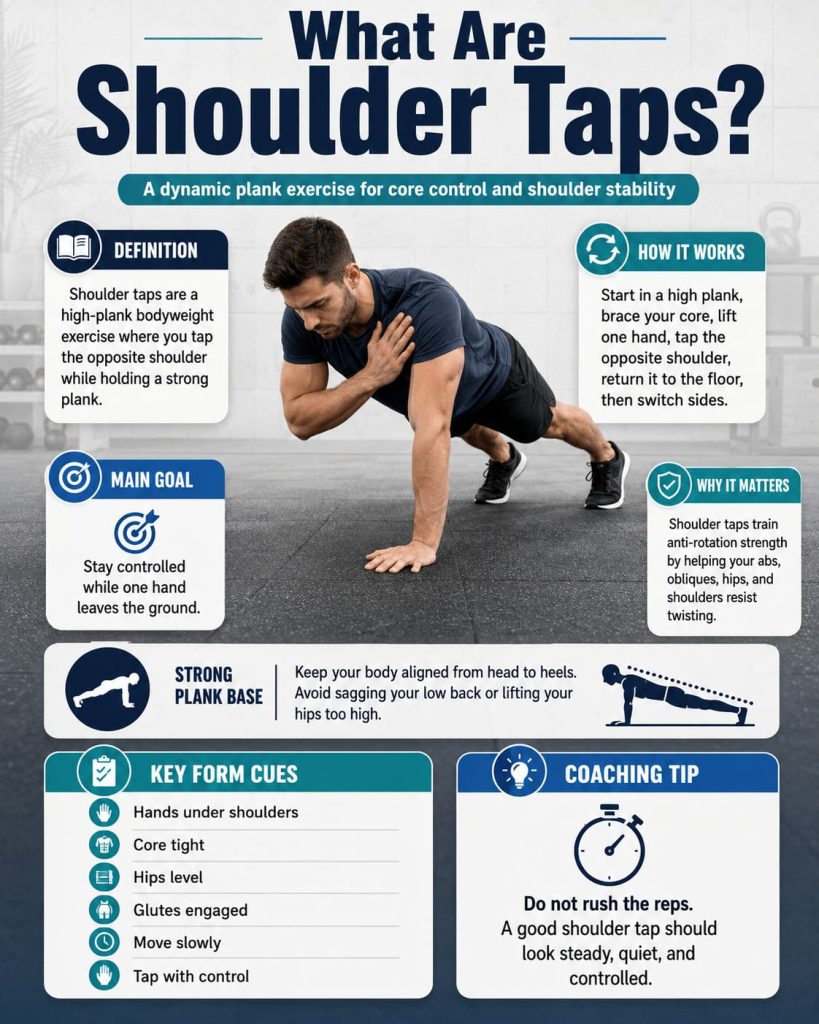
Shoulder taps are a dynamic plank variation performed from a high plank position. You place your hands on the floor, extend your legs behind you, brace your core, then lift one hand to tap the opposite shoulder. After returning that hand to the floor, you repeat on the other side.
The goal is not to move fast. The goal is to stay controlled while one hand leaves the ground. That makes shoulder taps an anti-rotation core exercise, meaning your abs, obliques, hips, and shoulders work together to stop your torso from rocking side to side.
A strong plank position is the base of the movement. The ACE Fitness front plank guide emphasizes keeping the body aligned and avoiding common plank faults such as sagging the low back or lifting the hips too high. Those same principles apply to shoulder taps.
Shoulder Taps Muscles Worked
Shoulder taps mainly target your core, but they also train several upper-body and lower-body muscles because your entire body has to stay stable.
The primary muscles worked are the rectus abdominis, transverse abdominis, internal obliques, and external obliques. These muscles help brace your trunk and resist rotation as you lift one hand off the floor.
The secondary muscles include the deltoids, triceps, chest, serratus anterior, trapezius, rhomboids, glutes, hip flexors, and quads. The shoulders and arms support your body weight, while the glutes and quads help keep your lower body steady.
The Hospital for Special Surgery shoulder anatomy guide explains that the shoulder depends on several muscles working together to support motion and stability. Shoulder taps can be useful because they challenge those muscles in a controlled bodyweight position.
Benefits of Shoulder Taps
1. Build Anti-Rotation Core Strength
Shoulder taps train your abs and obliques to resist twisting while one hand leaves the floor. This helps improve trunk control, balance, and stability during planks, push-ups, and other full-body movements.
2. Improve Shoulder Stability
Shoulder taps require one arm to support your body while the other arm moves. This helps your shoulders, chest, triceps, and shoulder blade muscles stay active and controlled.
3. Train Full-Body Control
A good shoulder tap uses more than your core. Your shoulders, glutes, quads, and hips all work together to keep your body straight and steady.
4. Require No Equipment
Shoulder taps can be done anywhere with just enough floor space. They are easy to add to home workouts, warm-ups, core circuits, or bodyweight training routines.
How to Do Shoulder Taps With Proper Form
How to do it:
- Start in a high plank with your hands under your shoulders and your legs extended behind you.
- Set your feet slightly wider than hip-width to create a stable base.
- Brace your abs, squeeze your glutes, and keep your body in a straight line from head to heels.
- Press one hand firmly into the floor and lift the opposite hand.
- Tap the opposite shoulder lightly without letting your hips rotate.
- Return your hand to the floor under control.
- Repeat on the other side and continue alternating.
- Move slowly enough that your shoulders and hips stay square to the floor.
Suggested sets and reps: Start with 2 to 3 sets of 6 to 10 taps per side. As your control improves, progress to 3 sets of 10 to 20 taps per side. For timed circuits, use 20 to 40 seconds of slow, clean reps.
Beginners: Beginners should use a wider foot stance and slow tempo. If the hips rock too much, elevate the hands on a bench or perform the exercise from the knees. The goal is to control the body before increasing reps.
Intermediate: Intermediate exercisers can perform shoulder taps from a standard high plank with feet about hip-width apart. Use a 1-second pause after each tap to prove that your body is stable before switching sides.
Advanced: Advanced exercisers can narrow the feet, slow each rep to a 3-second tap, elevate the feet, or combine shoulder taps with push-ups. Only use harder versions if you can keep your hips level and your lower back neutral.
Rest: Rest 30 to 60 seconds between sets. Use longer rest if your shoulders, wrists, or core fatigue so much that your form breaks down.
Common mistakes: The most common mistake is rocking the hips from side to side. This usually happens when the stance is too narrow, the reps are too fast, or the core is not braced. Other mistakes include letting the low back sag, lifting the hips too high, placing the hands too far forward, shrugging the shoulders, holding the breath, or slapping the shoulder instead of tapping with control.
Expert tip: Think about balancing a glass of water on your low back. If your hips twist or bounce, the glass would spill. Slow down, widen your feet, and make each tap quiet and controlled.
Exercise variations: Shoulder tap variations include incline shoulder taps, kneeling shoulder taps, wide-stance shoulder taps, narrow-stance shoulder taps, slow-tempo shoulder taps, feet-elevated shoulder taps, and shoulder tap push-ups. Each version changes the stability demand, so choose the one that lets you maintain clean form.
Easier variation: Incline shoulder taps are the best easier variation. Place your hands on a bench, box, or sturdy table and perform the same tapping motion. The elevated angle reduces the load on your wrists, shoulders, and core while still teaching anti-rotation control.
Harder variation: Feet-elevated shoulder taps are a harder variation. Place your feet on a low bench or step and perform slow shoulder taps from a decline plank. This increases the demand on your shoulders and core, so use it only after you can perform standard shoulder taps without hip rotation.
How Many Shoulder Taps Should You Do?
The right number depends on your fitness level and your ability to control your hips.
| Level | Sets | Reps or Time | Rest | Effort |
|---|---|---|---|---|
| Beginner | 2 to 3 | 6 to 10 taps per side | 45 to 60 seconds | Stop with 2 to 3 good reps left |
| Intermediate | 3 | 10 to 20 taps per side | 30 to 60 seconds | Keep every rep controlled |
| Advanced | 3 to 4 | 20 to 40 seconds | 30 to 45 seconds | Use slower tempo or harder variation |
Use quality as your main progression rule. Add reps only when you can keep your shoulders and hips square. If your hips twist, your low back sags, or your shoulders shrug, reduce the reps or use an easier variation.
Common Shoulder Tap Mistakes
Rocking the Hips Side to Side
Hip rocking is the biggest sign that you are rushing or using a variation that is too hard. Shoulder taps should train your body to stay still while your arms move.
Fix this by widening your feet, slowing down, and tapping lightly instead of quickly shifting your weight. You can also practice incline shoulder taps until you can keep your pelvis more stable.
Letting the Lower Back Sag
A sagging lower back usually means the core and glutes are not braced enough. This reduces the quality of the exercise and can make the movement feel uncomfortable.
Before each rep, lightly tuck your ribs down, squeeze your glutes, and push the floor away. Stop the set when you can no longer hold a straight line.
Placing the Hands Too Far Forward
Your hands should be under your shoulders, not far in front of your face. A forward hand position can make the exercise harder to control and may place more stress on the shoulders.
Set up like the top of a strong push-up. Wrists, elbows, and shoulders should feel stacked and stable.
Moving Too Fast
Fast reps often turn shoulder taps into a twisting drill instead of a core stability exercise. The best shoulder taps are quiet, steady, and controlled.
Use a slower tempo. Lift, tap, return, reset, then switch sides. If you cannot pause briefly after each tap, the variation is probably too advanced.
Holding Your Breath
Holding your breath can make your body tense in the wrong places. It may also make longer sets harder than necessary.
Breathe through each rep. Exhale lightly as you tap, then inhale as you return your hand to the floor.
Shoulder Tap Modifications for Beginners
Incline shoulder taps are the best starting point for many beginners. Place your hands on an elevated surface and keep your body in a straight line. The higher the surface, the easier the movement becomes.
Kneeling shoulder taps are another option. Start on your hands and knees, brace your core, and tap the opposite shoulder without shifting your body. This version is useful for learning the basic pattern before moving into a full plank.
Wide-stance shoulder taps are helpful if you can hold a high plank but struggle with hip rotation. The wider your feet, the more stable your base becomes. As your control improves, gradually move your feet closer together.
Wall shoulder taps can work well for people who need the easiest version. Stand facing a wall, place your hands on the wall at shoulder height, brace your core, and alternate shoulder taps. This is a low-load way to practice the movement pattern.
Shoulder Tap Progressions
Narrow-stance shoulder taps increase the anti-rotation demand because your base of support is smaller. Move your feet closer together only when you can control standard shoulder taps with a wider stance.
Slow-tempo shoulder taps make each rep harder without adding equipment. Take 2 to 3 seconds to lift, tap, and return the hand to the floor. This increases time under tension and makes it harder to hide poor control.
Feet-elevated shoulder taps place more weight through the upper body. This makes the shoulders, triceps, chest, and core work harder. Keep the elevation low at first.
Shoulder tap push-ups combine a push-up with a shoulder tap at the top. This is a more advanced option because it requires pressing strength, core control, and shoulder stability in one movement. The ACE Fitness bodyweight circuit includes a push-up shoulder tap variation as part of a home workout format.
Best Tempo for Shoulder Taps
A good tempo is one of the easiest ways to make shoulder taps more effective.
Start with a slow rhythm: lift the hand, tap the shoulder, return the hand, then pause before switching sides. Each tap should take about 2 seconds.
For core strength, use slow and controlled reps. For conditioning, you can move slightly faster, but only if your hips stay steady. Never trade control for speed.
When to Use Shoulder Taps in a Workout
Shoulder taps work well near the beginning, middle, or end of a workout depending on your goal.
Use them in a warm-up before upper-body training to activate your core, shoulders, and serratus anterior. Use them in the main workout as a core stability drill. Use them near the end as a bodyweight finisher when you want extra core work without heavy equipment.
For most people, shoulder taps fit best 2 to 4 times per week. Leave at least one day between harder variations if your shoulders, wrists, or core feel unusually fatigued.
Sample Shoulder Taps Workout for Core Strength
This simple routine uses shoulder taps as the main anti-rotation exercise. Move with control and rest as needed.
| Exercise | Sets | Reps or Time | Rest |
|---|---|---|---|
| Dead bug | 2 | 8 to 10 reps per side | 30 seconds |
| Shoulder taps | 3 | 8 to 15 taps per side | 45 seconds |
| Side plank | 2 | 20 to 30 seconds per side | 30 seconds |
| Glute bridge | 2 | 12 to 15 reps | 30 seconds |
Perform this workout 2 to 3 times per week. When shoulder taps feel easy, first add reps. Then narrow your stance. After that, try a slower tempo or an incline-to-floor progression.
Shoulder Taps for Beginners
Beginners should focus on position before reps. A short set with excellent control is better than a long set with twisting hips.
Start with incline shoulder taps or wide-stance shoulder taps. Keep your hands under your shoulders, brace your abs, and move slowly. Use 2 sets of 6 taps per side as your starting point.
Once you can complete every rep without hip rocking, add 2 reps per side. When you can do 12 to 15 taps per side with control, move to a slightly harder variation.
Shoulder Taps for Intermediate Lifters
Intermediate lifters can use shoulder taps as a core accessory after strength work. They pair well with push-ups, rows, presses, squats, lunges, and loaded carries.
A good target is 3 sets of 10 to 20 taps per side. Keep 1 to 2 reps in reserve instead of going to failure. The goal is stability, not exhaustion.
Shoulder Taps for Advanced Training
Advanced exercisers can use shoulder taps to challenge full-body tension and shoulder control. The best progressions are slow-tempo shoulder taps, narrow-stance shoulder taps, feet-elevated shoulder taps, and shoulder tap push-ups.
Advanced does not mean sloppy. If your hips rotate, your feet are too narrow, your tempo is too fast, or the variation is too hard. Reduce the difficulty and earn the harder version with better control.
Are Shoulder Taps Safe?
Shoulder taps are generally safe for healthy exercisers when performed with good form and an appropriate variation. However, they place load through the wrists, elbows, shoulders, and core.
If your wrists are uncomfortable, try incline shoulder taps on a bench or use push-up handles if they feel better. If your shoulders feel pinchy or unstable, reduce the range, use an easier variation, or choose a different core exercise.
Stop the exercise and seek professional help if you feel sharp pain, numbness, dizziness, chest pain, unusual symptoms, or discomfort that does not feel like normal muscle effort.
Shoulder Taps FAQs
Are shoulder taps good for abs?
Yes, shoulder taps are good for training the abs because they challenge your core to resist rotation. Your abs and obliques work to keep your hips and ribs steady while one hand leaves the floor.
Do shoulder taps build shoulders?
Shoulder taps can help strengthen shoulder stability and endurance, but they are not the best exercise for building large shoulder muscles. For shoulder muscle growth, use pressing and raising exercises. For shoulder control and plank stability, shoulder taps are useful.
Why are shoulder taps so hard?
Shoulder taps are hard because they reduce your base of support. When one hand leaves the floor, your core, hips, and shoulders must work harder to stop your body from twisting.
Should beginners do shoulder taps?
Beginners can do shoulder taps if they use the right variation. Incline shoulder taps, wall shoulder taps, kneeling shoulder taps, and wide-stance shoulder taps are better starting points than full plank shoulder taps.
How many shoulder taps should I do?
Most beginners should start with 2 to 3 sets of 6 to 10 taps per side. Intermediate exercisers can do 3 sets of 10 to 20 taps per side. Stop the set when your hips start rocking or your lower back starts sagging.
Are shoulder taps better than planks?
Shoulder taps are not automatically better than planks. They are different. A regular plank teaches you to hold a stable position. Shoulder taps add movement and anti-rotation control. Many people benefit from using both.
Conclusion
Shoulder taps are a simple but powerful bodyweight exercise for core strength, shoulder stability, and full-body control. The key is to move slowly, keep your hips steady, and choose a variation that matches your current level.
Start with 2 to 3 sets of clean reps, use a wide stance if needed, and progress only when you can control every tap. For best results, add shoulder taps to your core routine 2 to 4 times per week and focus on quality before speed.
2 thoughts on “Shoulder Taps Guide for Core Strength and Shoulder Stability”