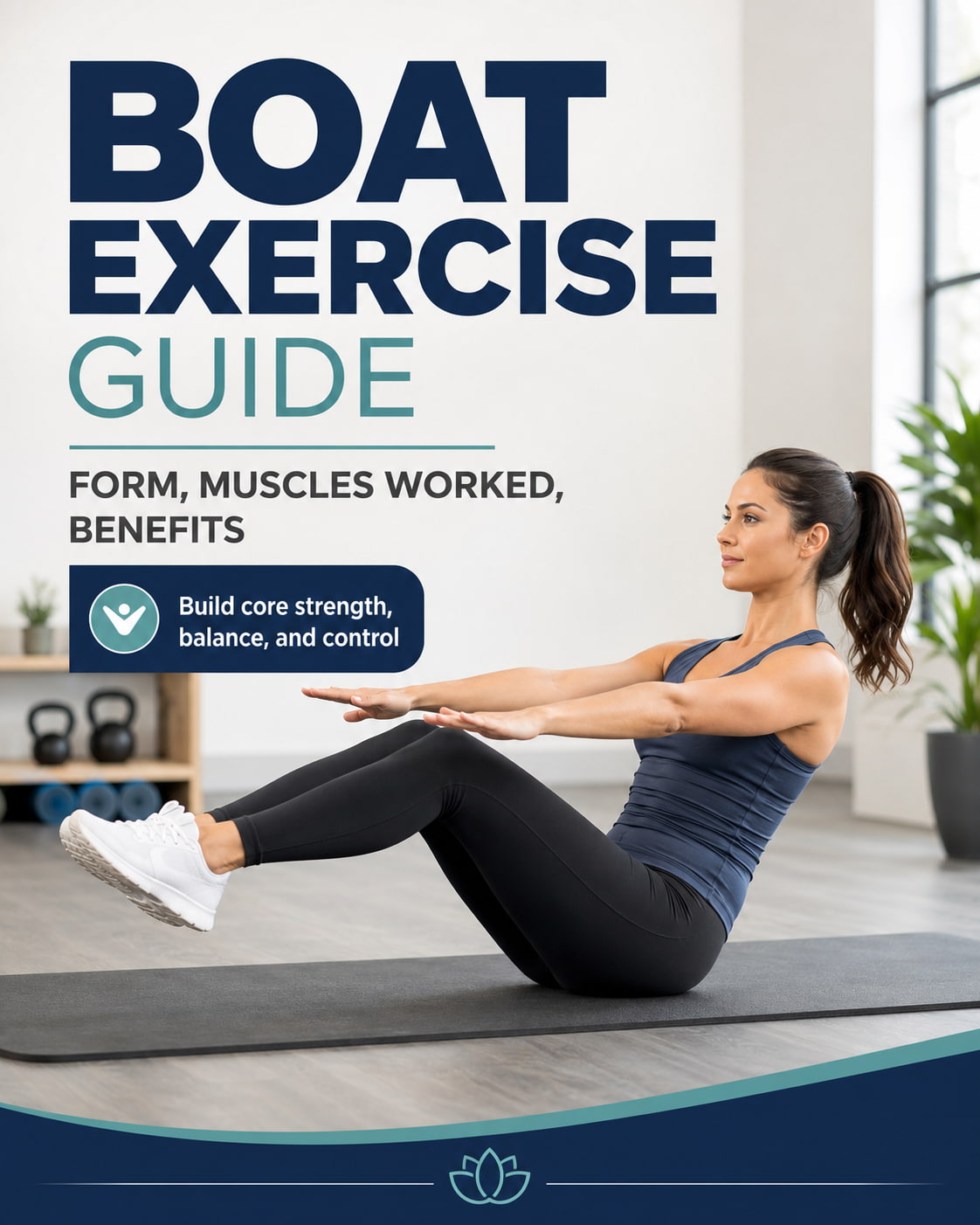
The boat exercise is a bodyweight core exercise that strengthens your abs, hip flexors, spinal stabilizers, and balance by holding a controlled V-shaped position. It is also known as Boat Pose or Navasana in yoga, but it works well in general fitness routines, ab workouts, Pilates-style training, and mobility-focused core sessions.
The main goal is not to force straight legs or hold the pose as long as possible. The goal is to keep your spine tall, brace your core, breathe steadily, and control the position without your lower back collapsing.
In this guide, you will learn how to do the boat exercise with proper form, which muscles it works, the main benefits, common mistakes, beginner modifications, harder variations, and how to use it in a simple core workout.
What Is the Boat Exercise?
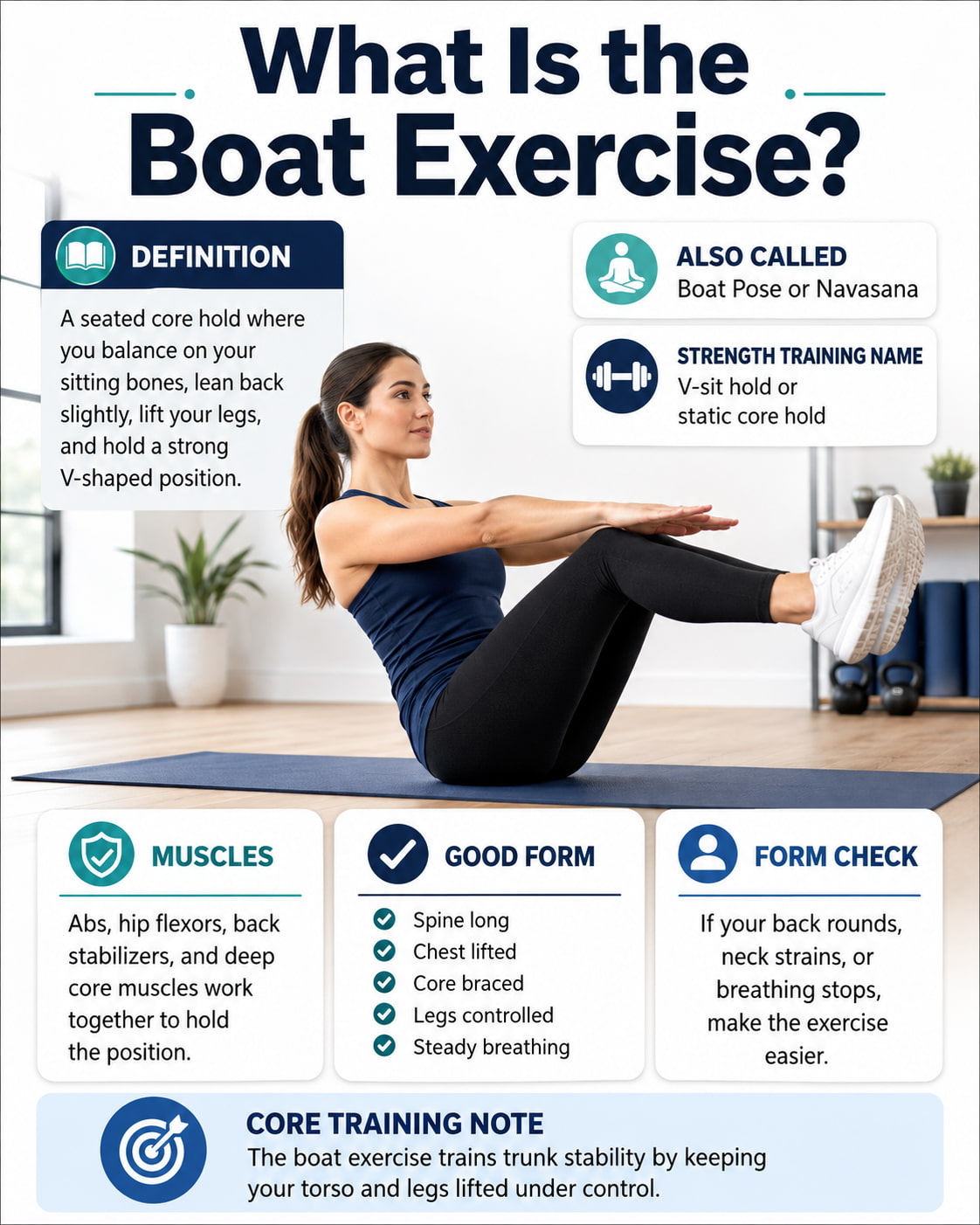
The boat exercise is a seated core hold where you balance on your sitting bones, lean your torso back slightly, lift your legs, and hold your body in a strong V-like position. In yoga, this exercise is commonly called Boat Pose or Navasana.
In strength training, many people think of it as a V-sit hold or a static core exercise. The exact name matters less than the position: your abs and hip flexors work together to keep your torso and legs lifted while your spine stays long and controlled.
A good boat exercise should feel challenging through the front of your core and hips, but it should not feel like your lower back is taking over. If your back rounds, your neck strains, or you cannot breathe normally, the version is too hard for your current level.
The Mayo Clinic explains that core-strength exercises train the muscles around the abdomen, back, and pelvis. The boat exercise fits that category because it requires your trunk muscles to stabilize your body while your legs and torso stay lifted.
How to Do the Boat Exercise With Proper Form
Best for: The boat exercise is best for building core strength, hip flexor control, trunk stability, balance, and body awareness without equipment.
Muscles worked: The main muscles worked are the rectus abdominis, transverse abdominis, obliques, hip flexors, spinal stabilizers, quadriceps, adductors, shoulders, and arms.
Equipment needed: A yoga mat or exercise mat is helpful but not required.
Why it stands out: The boat exercise trains your core in a controlled hold instead of a fast crunching motion. It teaches you to keep your spine long, brace your abs, control your hips, and breathe under tension.
Suggested sets and reps: Start with 2 to 3 sets of 10 to 20 seconds. As you improve, build toward 3 sets of 20 to 30 seconds. Advanced users can use 3 to 4 sets of 30 to 45 seconds or controlled dynamic variations.
Beginners: Keep your knees bent, hold behind your thighs, or let your heels lightly touch the floor. Focus on a tall spine and steady breathing before trying to straighten your legs.
Intermediate: Reach your arms forward and lift both feet while keeping the knees bent or slightly extended. Hold the position without rocking, rounding, or holding your breath.
Advanced: Straighten your legs only if you can keep your spine long. You can also add boat-to-low-boat reps, boat twists, or longer holds.
Rest: Rest 30 to 60 seconds between sets. Use the longer rest if your form breaks down quickly.
How to do it:
- Sit on the floor with your knees bent and feet flat.
- Place your hands behind your thighs and sit tall through your spine.
- Lean your torso back slightly while keeping your chest lifted.
- Brace your core and lift one foot, then the other, until your shins are roughly parallel to the floor.
- Balance on your sitting bones without collapsing into your lower back.
- Keep your knees bent or straighten your legs only if your spine stays tall.
- Reach your arms forward beside your legs if you can stay stable.
- Hold the position while breathing slowly and evenly.
- Lower your feet with control before your back rounds or your breathing breaks down.
Common mistakes: The most common mistakes are rounding the lower back, straightening the legs too soon, holding the breath, shrugging the shoulders, pulling on the neck, and letting the hip flexors do all the work.
Expert tip: Think “chest tall, ribs controlled, thighs lifted.” Your spine should stay long while your abs stay braced. If your chest drops or your back rounds, make the exercise easier.
Exercise variations: Useful variations include bent-knee boat, supported boat, full boat, low boat, boat crunch, boat twist, and boat-to-low-boat.
Easier variation: Keep your heels on the floor and hold behind your thighs. This reduces the load on your abs and hip flexors while still teaching the correct posture.
Harder variation: Straighten your legs and reach your arms forward, or move slowly between full boat and low boat while keeping your lower back controlled.
Boat Exercise Muscles Worked
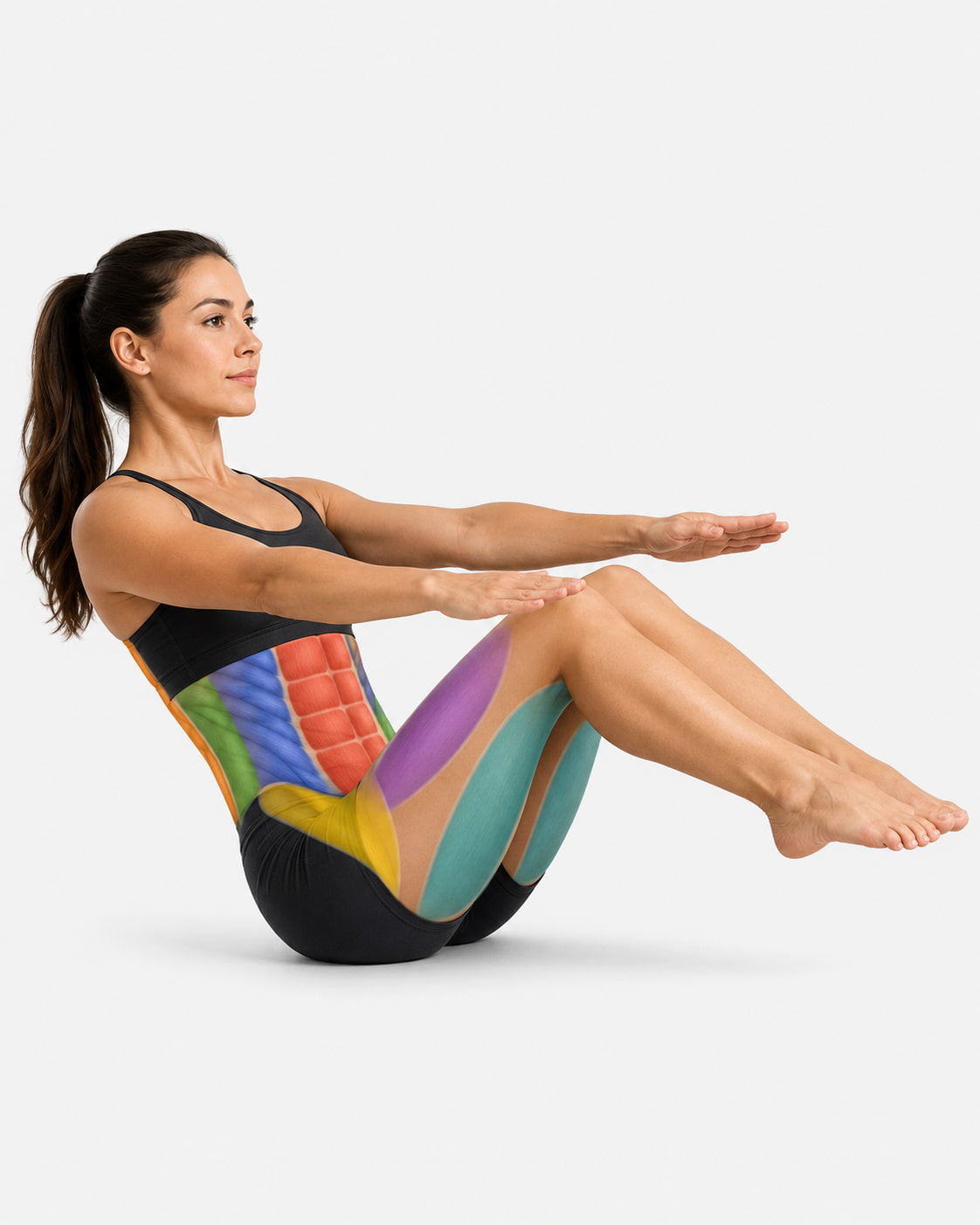
The boat exercise mainly trains the core, but several muscles help create and hold the position.
Rectus Abdominis
The rectus abdominis is the front abdominal muscle often associated with crunching and trunk control. During the boat exercise, it helps keep your torso from falling backward and supports the V-shaped position.
You do not need to aggressively crunch your ribs toward your hips. Instead, think about bracing your midsection while keeping your chest lifted.
Transverse Abdominis
The transverse abdominis is a deep core muscle that helps support your trunk like a natural weight belt. It becomes especially important when you hold the position without wobbling or collapsing.
A useful cue is to gently tighten your waist as if you are preparing for someone to tap your stomach, while still allowing yourself to breathe.
Obliques
The internal and external obliques help resist twisting and side-to-side movement. They are especially active when you keep both sides of your waist long and avoid tipping to one hip.
Boat twist variations increase the demand on the obliques, but the standard hold still trains them as stabilizers.
Hip Flexors
The hip flexors help lift and hold your thighs. This includes muscles such as the iliopsoas and rectus femoris. It is normal to feel some work near the front of the hips, especially during longer holds.
However, the hip flexors should not dominate the exercise. If you only feel the front of your hips and cannot keep your spine tall, bend your knees, hold behind your thighs, or shorten the hold.
Spinal Stabilizers
The muscles along your spine help keep your back long and lifted. In a good boat exercise, these muscles support posture without forcing your lower back into an exaggerated arch.
This is why posture matters so much. A tall spine helps the core and back share the work instead of dumping pressure into one area.
Quadriceps and Adductors
When you straighten your legs, your quadriceps help keep the knees extended. Your inner thighs also assist when you keep the legs together and controlled.
Straight legs make the exercise much harder. They are not required for a strong core workout.
Shoulders and Arms
When your arms reach forward, your shoulders, upper back, and arms help you hold a stable position. They should stay relaxed and controlled, not tense or shrugged.
Benefits of the Boat Exercise
1. Builds Core Strength Without Equipment
The boat exercise is useful because it trains your core with only your body weight. You can do it at home, in the gym, on a mat, or as part of a warm-up or finisher.
Unlike fast ab exercises, the boat exercise requires control. You have to create tension, hold your posture, and breathe under effort.
2. Improves Trunk Stability
Core training is not only about making the abs burn. It is also about helping the trunk stay stable while the arms and legs move or hold position. The boat exercise challenges that skill because your torso and legs are both off the floor.
The American Council on Exercise emphasizes control and body awareness in core stability training. That same idea applies here: the movement works best when you avoid momentum and hold the position with intention.
3. Trains Balance and Body Control
Because you balance on your sitting bones, the boat exercise challenges body awareness. Small changes in rib position, leg height, breathing, or arm placement can change how hard the exercise feels.
This makes it useful for people who want a core exercise that builds more than just abdominal endurance.
4. Strengthens the Hip Flexors
Many core exercises involve the hip flexors, but the boat exercise makes that role clear. Your hip flexors help keep your thighs lifted while your abs keep your trunk organized.
This can be useful for athletes, runners, lifters, and general fitness users who want better control through the hips and trunk. Just keep the exercise pain-free and choose a version that lets your abs stay involved.
5. Helps Teach Bracing and Breathing
A strong boat hold requires you to brace without holding your breath. This is an important training skill.
If you cannot breathe in the position, the version is too hard. Reduce the lever by bending your knees, holding your thighs, or lowering your feet lightly to the floor.
6. Fits Many Workout Styles
The boat exercise can work in a yoga flow, bodyweight core workout, strength warm-up, ab circuit, or short home routine. It does not require equipment, and it can be scaled for beginners or made harder for advanced users.
Common Boat Exercise Mistakes and How to Fix Them
Rounding the Lower Back
This is the biggest mistake in the boat exercise. When the lower back rounds, the core position becomes weaker and the exercise may feel uncomfortable.
Fix it by bending your knees, holding behind your thighs, or lowering your feet to the floor. A shorter, cleaner hold is better than a longer hold with poor posture.
Straightening the Legs Too Soon
Straight legs look impressive, but they are not the main goal. If straightening your legs makes your back round or your chest collapse, stay with bent knees.
The best version is the one you can control. Build strength first, then increase difficulty.
Holding Your Breath
Many people brace so hard that they stop breathing. This usually means the exercise is too intense or the hold is too long.
Fix it by shortening the hold to a few steady breaths. You can also use the supported version until you can breathe comfortably.
Leaning Too Far Back
If you lean too far back, you may lose control and turn the exercise into a low-back strain or a poorly supported V-sit.
Keep your torso lifted. You should feel like you are balancing with control, not falling backward.
Shrugging the Shoulders
Your arms may reach forward, but your shoulders should not climb toward your ears. Shrugging adds unnecessary tension and can make the exercise feel harder than it needs to be.
Keep your neck long, face relaxed, and shoulder blades gently set.
Letting the Hip Flexors Take Over
Some hip flexor work is normal. The problem happens when the abs stop helping and the entire exercise feels like a front-of-hip strain.
Fix it by bending your knees more, holding behind the thighs, or taking shorter sets. Focus on bracing the midsection before lifting the legs.
Boat Exercise Modifications for Beginners
The boat exercise can be scaled easily. Beginners should choose the version that allows the spine to stay tall and the breath to stay steady.
| Modification | Best use |
|---|---|
| Heels on the floor | Best for learning posture and core bracing |
| Hands behind thighs | Best for reducing strain and improving control |
| Bent-knee boat | Best beginner version for most people |
| Hands on floor behind hips | Best for extra support and balance |
| Short breath-based holds | Best for building control without fatigue |
| Yoga strap or towel support | Best for users who need help keeping the legs lifted |
The Yoga Journal Boat Pose guide includes modifications such as keeping the hands on the floor, holding the backs of the thighs, or using a strap when straight-leg versions are too difficult.
A good beginner goal is to hold a clean bent-knee boat for 10 to 20 seconds while breathing normally. Once that feels steady, reach your arms forward or increase the hold time.
Boat Exercise Progressions and Variations
Bent-Knee Boat
This is the best starting version for most people. Keep your knees bent and shins lifted. Your spine should stay tall, and your core should feel active without forcing your legs straight.
Use this version until you can hold the position without shaking excessively, rounding your back, or holding your breath.
Supported Boat
In supported boat, you hold behind your thighs or place your hands on the floor behind your hips. This helps you learn the position with less strain.
This version is useful during warm-ups, beginner core sessions, or recovery-focused training days.
Full Boat
Full boat is the classic straight-leg version. Your torso and legs form a stronger V-shape, and your arms reach forward.
Only use full boat if you can keep your lower back from rounding. Straight legs increase the lever length, which makes the exercise significantly harder.
Low Boat
Low boat lowers your torso and legs closer to the floor. This increases the challenge on the abs and resembles a hollow-body hold.
This is an advanced variation. Avoid it if your lower back lifts, arches, or feels uncomfortable.
Boat Crunch
A boat crunch moves between a tucked position and a longer boat position. It adds motion while keeping the same core challenge.
Move slowly. Do not swing your legs or use momentum.
Boat Twist
Boat twists add rotation for more oblique work. Keep the chest lifted and rotate from the torso rather than just waving the arms side to side.
Start with bent knees before adding weight or straight-leg versions.
Boat to Low Boat
This progression moves from full boat down toward low boat, then back up. It is one of the hardest variations because it challenges the abs through a longer range.
Use slow control and stop before your back rounds.
The Alo Moves variation guide shows several boat pose options, including twists, crunches, and low-boat variations that can make the exercise more dynamic.
How Long Should You Hold the Boat Exercise?
Your hold time should depend on form, not ego. A clean 15-second hold is more useful than a 45-second hold with a rounded back and strained breathing.
| Level | Sets | Hold time | Rest |
|---|---|---|---|
| Beginner | 2 to 3 | 10 to 20 seconds | 45 to 60 seconds |
| Intermediate | 3 | 20 to 30 seconds | 30 to 60 seconds |
| Advanced | 3 to 4 | 30 to 45 seconds | 30 to 60 seconds |
You can also measure the exercise by breaths instead of seconds. Start with 3 steady breaths, then progress toward 5 to 8 controlled breaths.
The Peloton Boat Pose guide recommends starting with a few breaths and building control over time. This is a smart approach because it keeps the focus on posture and breathing.
How to Use the Boat Exercise in a Workout
The boat exercise works best as a core accessory, warm-up activator, or finisher. It should not leave your hip flexors or lower back irritated.
For most people, 2 to 4 times per week is enough. You can place it after strength training, after a mobility session, or as part of a short core circuit.
Beginner Core Workout
| Exercise | Sets | Reps or time | Rest |
|---|---|---|---|
| Dead bug | 2 | 6 to 8 reps per side | 30 seconds |
| Supported boat exercise | 2 to 3 | 10 to 20 seconds | 45 seconds |
| Forearm plank | 2 | 15 to 30 seconds | 45 seconds |
| Glute bridge | 2 | 10 to 12 reps | 30 seconds |
Use this routine 2 to 3 times per week. Keep every rep slow and controlled.
Intermediate Boat Exercise Core Circuit
| Exercise | Sets | Reps or time | Rest |
|---|---|---|---|
| Bent-knee boat hold | 3 | 20 to 30 seconds | 30 seconds |
| Side plank | 3 | 15 to 25 seconds per side | 30 seconds |
| Bird dog | 3 | 6 to 10 reps per side | 30 seconds |
| Boat crunch | 2 | 8 to 12 controlled reps | 45 seconds |
Use this circuit after a workout or on a separate core-training day. Stop each set with 1 to 2 clean reps or a few seconds of control left.
Advanced Boat Exercise Finisher
| Exercise | Sets | Reps or time | Rest |
|---|---|---|---|
| Full boat hold | 3 | 30 to 45 seconds | 30 seconds |
| Boat to low boat | 3 | 6 to 10 reps | 45 seconds |
| Boat twist | 2 to 3 | 8 to 12 reps per side | 45 seconds |
Use this finisher only if you can keep your spine controlled. If form breaks down, return to bent-knee boat or supported boat.
Boat Exercise Form Cues
Use these simple cues during the exercise:
| Problem | Coaching cue |
|---|---|
| Lower back rounds | Lift your chest and bend your knees |
| Hip flexors dominate | Brace your abs before lifting your feet |
| Shoulders tense | Keep your neck long and shoulders relaxed |
| Legs shake too much | Shorten the hold or support your thighs |
| Breath feels stuck | Make the version easier and breathe slowly |
A useful rule is this: the boat exercise should challenge your core, but you should still feel in control. Once you lose control, the set is over.
Who Should Be Careful With the Boat Exercise?
The boat exercise is safe for many healthy adults when performed with control, but it is not the right choice for everyone.
Be careful with this exercise if you have current back pain, hip pain, osteoporosis, pregnancy-related concerns, recent abdominal surgery, or any condition that makes loaded trunk flexion or strong hip-flexor work uncomfortable.
The National Center for Complementary and Integrative Health notes that yoga is generally considered safe for healthy people when practiced properly, but injuries can still happen. The same practical idea applies to the boat exercise: use a version you can control and avoid pushing through symptoms.
Stop the exercise if you feel sharp pain, numbness, dizziness, chest pain, unusual symptoms, or pain that changes your movement. Ask a qualified professional for guidance if you are unsure whether this exercise fits your body or training history.
Boat Exercise FAQs
Is the boat exercise good for abs?
Yes, the boat exercise can be good for strengthening the abs because it challenges your core to hold your torso and legs in a stable position. It works best when you keep your spine long, brace your midsection, and avoid using momentum.
Is boat exercise the same as Boat Pose?
Yes, in most fitness and yoga contexts, the boat exercise refers to Boat Pose, also called Navasana. Some strength programs may call similar positions a V-sit hold, but the basic idea is the same: balance in a seated V-shape while your core works to stabilize the body.
Why does the boat exercise hurt my hip flexors?
Some hip flexor work is normal because those muscles help lift your thighs. However, if your hip flexors feel strained or dominate the movement, the version may be too hard. Bend your knees, hold behind your thighs, shorten the hold, or keep your heels lightly on the floor.
Should I keep my legs straight during the boat exercise?
Only straighten your legs if you can keep your spine tall and your breathing steady. Bent knees are not a beginner failure. They are a smart modification that helps you train the right position.
How often should I do the boat exercise?
Most people can use the boat exercise 2 to 4 times per week as part of a core routine. Start with 2 to 3 sets and increase time or difficulty gradually.
Is the boat exercise bad for your back?
The boat exercise is not automatically bad for your back, but poor form can make it uncomfortable. Rounding the lower back, holding too long, or choosing a version that is too hard may increase strain. Keep the movement controlled and stop if you feel sharp pain or unusual symptoms.
What is the easiest boat exercise variation?
The easiest variation is a supported boat with your heels on the floor and your hands behind your thighs. This lets you practice the posture and core brace without overloading your hip flexors or lower back.
Conclusion
The boat exercise is a simple but challenging core movement that builds abdominal strength, hip flexor control, trunk stability, and balance. Start with a version that lets you keep your spine tall and your breathing steady. Then progress gradually by lifting the feet, reaching the arms forward, straightening the legs, or adding controlled dynamic variations.
Use clean form first. A shorter, stronger hold will do more for your core than a longer hold with a rounded back.
References
- Yoga Journal: Boat Pose: How to Practice Paripurna Navasana
- SELF: The Right Way to Do Boat Pose If You Really Want to Fire Up Your Abs
- Peloton: Boat Pose: Your Quickstart Guide for Building a Stronger Core
- Mayo Clinic: Exercises to Improve Your Core Strength
- American Council on Exercise: 7 Core Stability Exercises