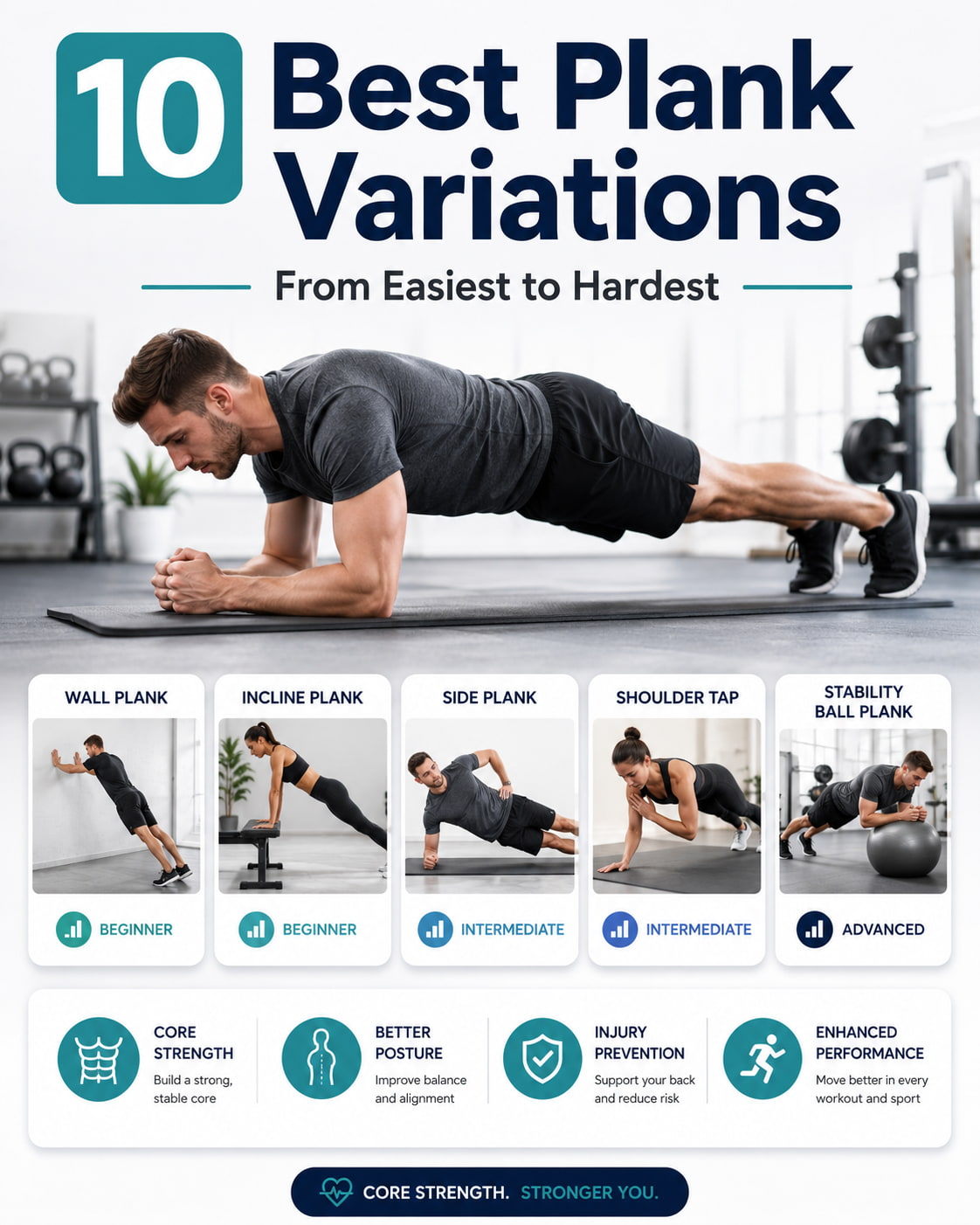
Plank variations are core stability exercises that help you build stronger abs, obliques, hips, glutes, shoulders, and back control without needing complicated equipment. This guide ranks the 10 best plank variations from easiest to hardest so you can choose the right level, train with better form, and progress safely.
A plank is not just about holding still for as long as possible. A good plank teaches your body to resist movement, keep the ribs and pelvis controlled, brace the core, and maintain a strong line from head to heels. As the variations get harder, the challenge increases through a longer body lever, less support, side-body loading, movement, or instability.
How to Choose the Right Plank Variation
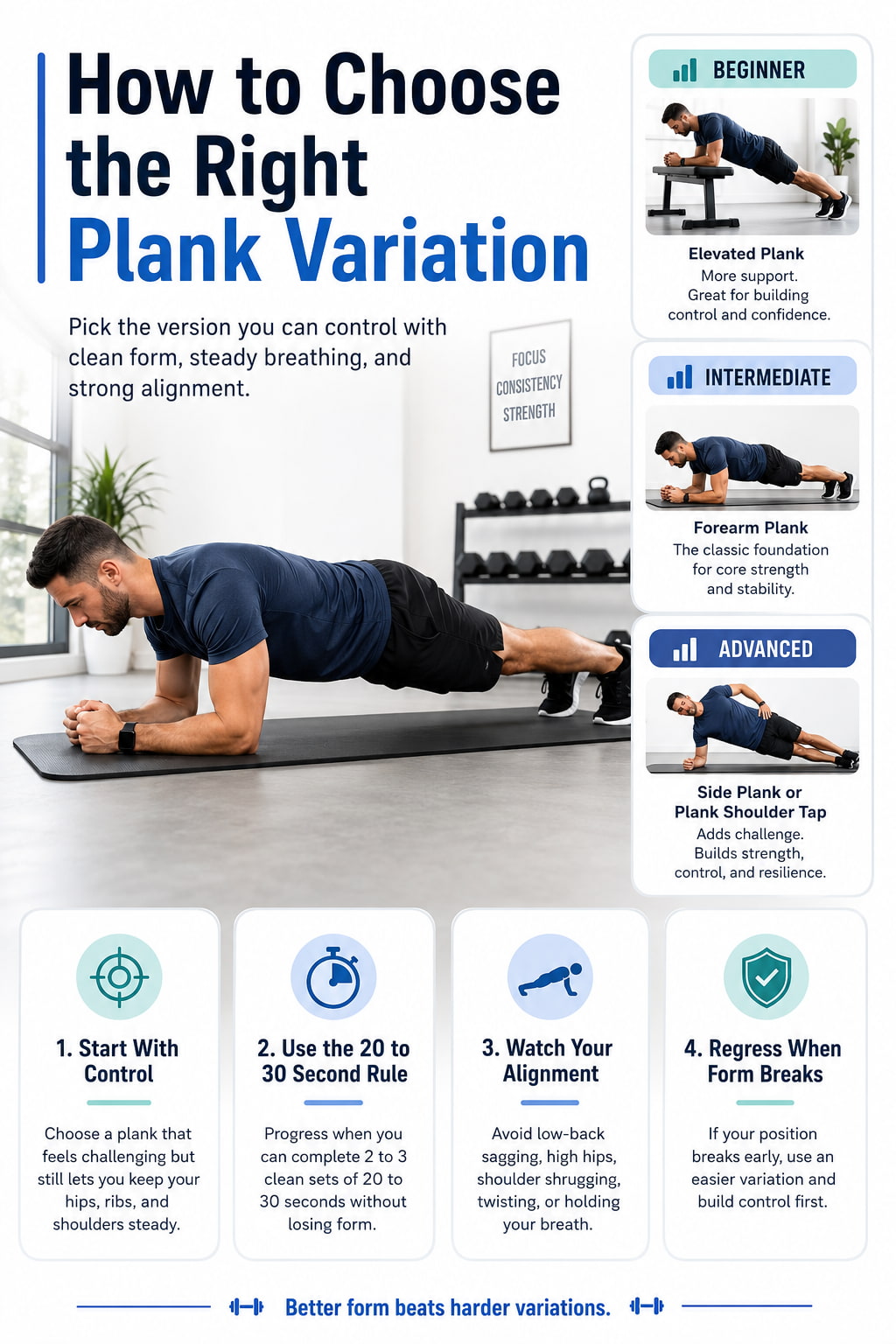
Choose the plank variation that lets you hold a strong position without pain, shaking out of control, or losing alignment. The right level should feel challenging, but you should still be able to breathe and keep your hips, ribs, and shoulders steady.
A good progression rule is simple: move to the next variation when you can complete 2 to 3 clean sets of 20 to 30 seconds without sagging your lower back, hiking your hips, shrugging your shoulders, or holding your breath.
If your form breaks early, do not force a harder plank. Use an easier variation and build control first.
Muscles Worked by Plank Variations
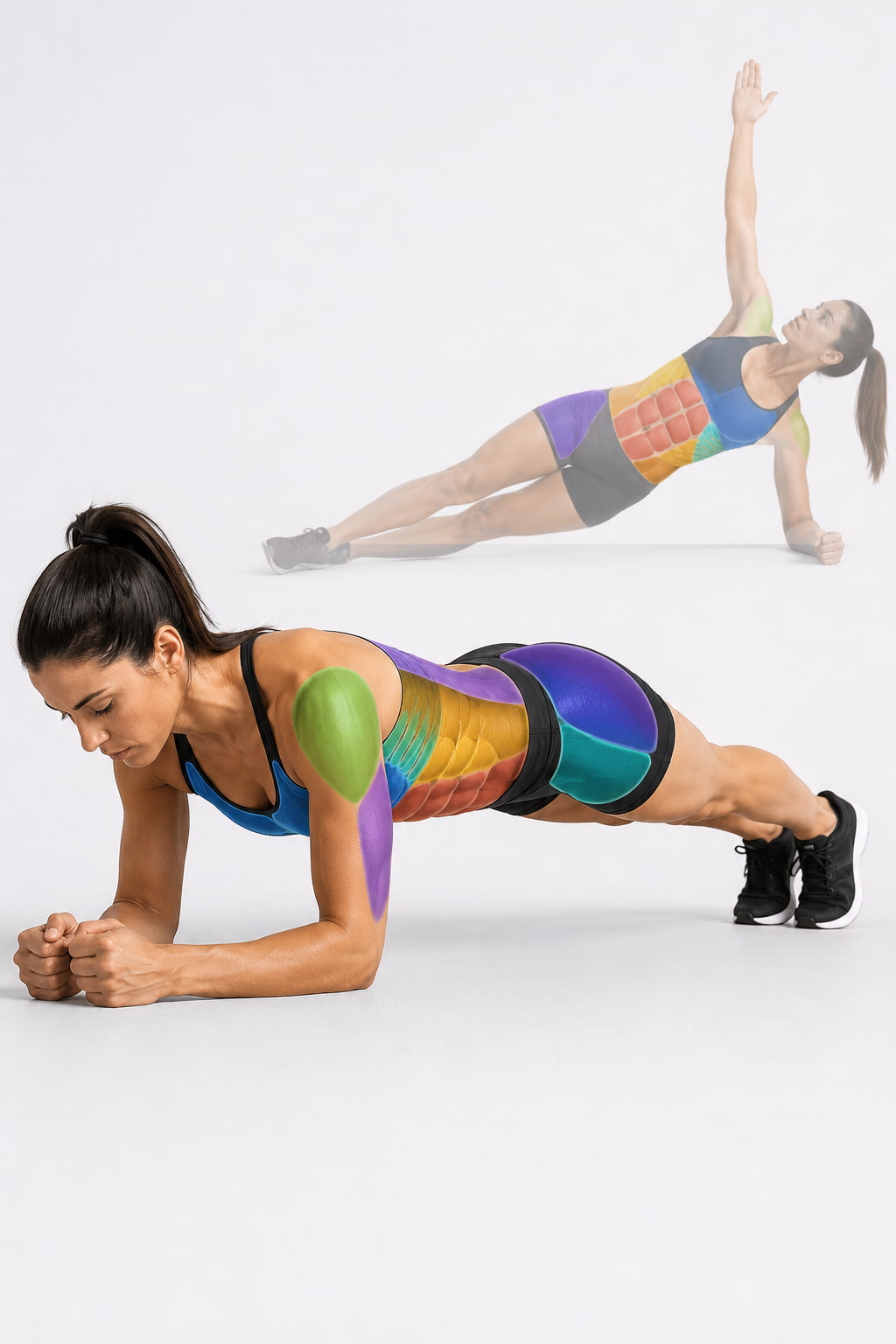
Plank variations train more than the “six-pack” muscles. Cleveland Clinic’s abdominal muscle overview explains that the abdominal muscles include the rectus abdominis, external obliques, internal obliques, and transversus abdominis, and that these muscles help support the trunk and keep the body stable.
The main muscles worked during plank variations include the rectus abdominis, transverse abdominis, internal and external obliques, erector spinae, glutes, hip stabilizers, shoulders, serratus anterior, chest, and triceps. Forearm planks usually feel more core-focused, while high planks add more shoulder, wrist, chest, and triceps demand. Side planks place more emphasis on the obliques, glute medius, and shoulder stability.
10 Best Plank Variations From Easiest to Hardest
Plank variations can be scaled from very easy beginner positions to advanced core stability drills. Start with the level you can control, then progress to harder variations as your form, strength, and body control improve.
1. Wall Plank
Best for: Wall planks are best for absolute beginners, warm-ups, seniors, people returning to training, or anyone who struggles to hold a floor plank with good form.
Muscles worked: Rectus abdominis, transverse abdominis, obliques, shoulders, chest, triceps, glutes, and postural muscles.
Equipment needed: Wall.
Why it stands out: The wall plank is the easiest plank variation because your body is more upright. This reduces the load on your core, shoulders, wrists, and lower back while still teaching the basic plank shape.
Suggested sets and reps: Do 2 to 3 sets of 20 to 45 seconds. Use it as a warm-up, beginner core drill, or form practice before harder plank variations.
Beginners: Start with your hands on the wall at chest height and your feet close enough that you can control your body line.
Intermediate: Walk your feet farther from the wall to increase the angle and core challenge.
Advanced: Use this as a warm-up drill before push-ups, high planks, or shoulder taps.
Rest: Rest 30 to 45 seconds between sets.
How to do it:
- Stand facing a wall and place your hands on the wall at about shoulder height.
- Step your feet back until your body forms a straight line from head to heels.
- Brace your core lightly and squeeze your glutes.
- Keep your shoulders down and your neck neutral.
- Hold the position while breathing steadily.
- Step forward to finish the set.
Common mistakes: The most common mistakes are leaning with a rounded upper back, letting the hips sag forward, shrugging the shoulders, and holding the breath.
Expert tip: Think about pushing the wall away while keeping your ribs stacked over your hips.
2. Incline Plank
Best for: Incline planks are best for beginners who are ready to move beyond the wall but not yet ready for a full floor plank.
Muscles worked: Rectus abdominis, transverse abdominis, obliques, shoulders, serratus anterior, chest, triceps, glutes, and hip stabilizers.
Equipment needed: Sturdy bench, box, countertop, or step.
Why it stands out: The incline plank is one of the best beginner plank variations because you can adjust the difficulty by changing the height of the surface. A higher surface is easier. A lower surface is harder.
Suggested sets and reps: Do 2 to 3 sets of 15 to 40 seconds. Keep the effort around 6 to 7 out of 10.
Beginners: Use a high surface such as a countertop or wall-mounted rail.
Intermediate: Use a lower bench or box and focus on cleaner bracing.
Advanced: Use it as a setup for incline shoulder taps or incline plank walkouts.
Rest: Rest 30 to 60 seconds between sets.
How to do it:
- Place your hands or forearms on a sturdy elevated surface.
- Step your feet back until your body forms a straight line.
- Keep your shoulders stacked over your hands or elbows.
- Brace your abs and squeeze your glutes.
- Hold without letting your hips drop or pike up.
- Step forward and stand tall to finish.
Common mistakes: Avoid using a wobbly surface, dropping the hips, bending the knees, collapsing into the shoulders, or looking too far forward.
Expert tip: The lower the surface, the more your body has to resist gravity. Lower the height gradually instead of jumping straight to the floor.
3. Knee Forearm Plank
Best for: Knee forearm planks are best for beginners learning floor plank form while reducing stress on the lower back and shoulders.
Muscles worked: Rectus abdominis, transverse abdominis, obliques, glutes, shoulders, upper back, and spinal stabilizers.
Why it stands out: This variation shortens the lever by keeping the knees on the floor. Mayo Clinic uses a modified plank position with the forearms and knees as a beginner-friendly core exercise, with the head and neck aligned and shoulders above the elbows.
Suggested sets and reps: Do 2 to 3 sets of 10 to 30 seconds. Stop before your hips sag or your breathing becomes forced.
Beginners: Start with short 10-second holds and build slowly.
Intermediate: Add a gentle elbow-to-knee press by thinking about pulling your elbows and knees toward each other without actually moving them.
Advanced: Use the knee plank as a warm-up or reset drill between harder core exercises.
Rest: Rest 30 to 60 seconds between sets.
How to do it:
- Lie face down and place your forearms on the floor.
- Set your elbows under your shoulders.
- Keep your knees on the floor and lift your hips.
- Form a straight line from your head to your knees.
- Brace your core and squeeze your glutes lightly.
- Hold while breathing slowly.
Common mistakes: Common errors include letting the belly drop, sitting the hips too far back, placing the elbows too far forward, and letting the head hang.
Expert tip: Imagine shortening the space between your ribs and pelvis without rounding your back.
4. Standard Forearm Plank
Best for: The standard forearm plank is best for building foundational core strength, anti-extension control, and body tension.
Muscles worked: Rectus abdominis, transverse abdominis, obliques, erector spinae, glutes, quads, shoulders, lats, and upper back.
Why it stands out: This is the classic plank variation most people should master before moving to harder versions. ACE’s front plank guide highlights the importance of elbows under the shoulders, a stiff torso, extended legs, steady breathing, and avoiding low-back sagging or high hips.
Suggested sets and reps: Do 2 to 4 sets of 15 to 45 seconds. Build toward 60 seconds only if your form stays strong.
Beginners: Start with 10 to 20 seconds and use the knee plank when needed.
Intermediate: Hold 30 to 45 seconds with steady breathing and no hip movement.
Advanced: Add a longer lever, alternating leg lift, or weighted plank only after you can control the basic version.
Rest: Rest 45 to 75 seconds between sets.
How to do it:
- Lie face down and place your forearms on the floor.
- Set your elbows directly under your shoulders.
- Step your feet back and press through your toes.
- Squeeze your glutes and lightly tighten your thighs.
- Keep your body straight from head to heels.
- Breathe steadily and hold the position.
Common mistakes: Do not let your lower back sag, hips rise too high, knees bend, shoulders shrug, or head drop.
Expert tip: Think “elbows down, ribs down, glutes on.” This helps keep your torso tight without holding your breath.
5. High Plank
Best for: High planks are best for building core control in a push-up position while strengthening the shoulders, wrists, chest, triceps, and serratus anterior.
Muscles worked: Rectus abdominis, transverse abdominis, obliques, shoulders, chest, triceps, serratus anterior, glutes, quads, and spinal stabilizers.
Why it stands out: The high plank transfers well to push-ups, mountain climbers, burpees, and many bodyweight strength exercises. NASM’s standard plank guide describes the straight-arm plank with hands under the shoulders, toes supporting the lower body, glutes engaged, and the body held in a straight line.
Suggested sets and reps: Do 2 to 4 sets of 15 to 45 seconds.
Beginners: Use an incline high plank if your wrists or shoulders are not ready for the floor.
Intermediate: Hold the floor position with steady shoulder pressure and quiet hips.
Advanced: Use high plank as the base for shoulder taps, plank rows, mountain climbers, and walkups.
Rest: Rest 45 to 75 seconds between sets.
How to do it:
- Start on your hands and knees.
- Place your hands under your shoulders.
- Step both feet back into a push-up position.
- Push the floor away so your upper back stays active.
- Brace your core and squeeze your glutes.
- Hold a straight line from head to heels.
Common mistakes: Avoid locking the elbows aggressively, letting the shoulder blades sink, shifting too far forward, sagging the lower back, or turning the head upward.
Expert tip: Spread your fingers and press through the whole hand, not just the heel of the palm.
6. Side Plank From Knees
Best for: Side plank from knees is best for beginners who want to train the obliques, hips, and lateral core without the full load of a straight-leg side plank.
Muscles worked: Internal and external obliques, transverse abdominis, glute medius, glute minimus, quadratus lumborum, shoulders, and side-body stabilizers.
Why it stands out: This is the best entry point for side planks. It trains side-to-side stability while keeping the lever shorter and easier to control.
Suggested sets and reps: Do 2 to 3 sets of 10 to 30 seconds per side.
Beginners: Keep both knees bent and focus on lifting the hips without rolling forward or backward.
Intermediate: Straighten the top leg while the bottom knee stays down.
Advanced: Use this as a warm-up before full side planks or side plank hip lifts.
Rest: Rest 30 to 60 seconds between sides or sets.
How to do it:
- Lie on one side with your knees bent.
- Place your bottom elbow under your shoulder.
- Stack your shoulders and hips.
- Brace your core and lift your hips off the floor.
- Keep a straight line from head to knees.
- Hold, lower slowly, then switch sides.
Common mistakes: The main mistakes are placing the elbow too far from the shoulder, letting the hips drift backward, rolling the chest toward the floor, and pushing the head forward.
Expert tip: Imagine your body is between two glass walls. Do not rotate forward or backward.
7. Full Side Plank
Best for: Full side planks are best for intermediate core training, oblique strength, hip stability, and shoulder control.
Muscles worked: Obliques, transverse abdominis, glute medius, glute minimus, quadratus lumborum, shoulders, lats, and deep core stabilizers.
Why it stands out: The full side plank increases the lever and loads one side of the body at a time. ACE lists the straight-leg side plank as an intermediate no-equipment exercise for the abs and butt/hips, and notes that it can be progressed by holding longer or lifting a leg.
Suggested sets and reps: Do 2 to 3 sets of 10 to 35 seconds per side.
Beginners: Start with the knee side plank until you can keep your hips stacked.
Intermediate: Hold the full version with feet stacked or staggered.
Advanced: Add a top-leg raise, reach-through, hip dip, or star plank.
Rest: Rest 45 to 75 seconds between sets.
How to do it:
- Lie on one side with your legs straight.
- Place your bottom elbow under your shoulder.
- Stack or stagger your feet.
- Brace your core and lift your hips.
- Keep your body straight from head to heels.
- Hold, lower with control, then switch sides.
Common mistakes: Avoid dropping the bottom hip, twisting the torso, shrugging the shoulder, letting the head fall forward, or placing the elbow too far away.
Expert tip: Push the floor away with your elbow and pull your ribs slightly down toward your pelvis.
8. Plank Shoulder Tap
Best for: Plank shoulder taps are best for anti-rotation strength, shoulder stability, and learning to keep the hips quiet while one hand leaves the floor.
Muscles worked: Rectus abdominis, transverse abdominis, obliques, shoulders, serratus anterior, chest, triceps, glutes, and hip stabilizers.
Why it stands out: This variation turns the high plank into a moving anti-rotation drill. Every time you lift one hand, your core has to resist twisting.
Suggested sets and reps: Do 2 to 4 sets of 6 to 12 taps per side. Move slowly instead of rushing.
Beginners: Use an incline shoulder tap or widen your feet for more stability.
Intermediate: Perform controlled floor reps with minimal hip shift.
Advanced: Bring the feet closer together or pause briefly after each tap.
Rest: Rest 45 to 75 seconds between sets.
How to do it:
- Start in a high plank with hands under shoulders.
- Set your feet slightly wider than hip-width.
- Brace your core and squeeze your glutes.
- Lift one hand and tap the opposite shoulder.
- Return the hand to the floor with control.
- Alternate sides while keeping your hips steady.
Common mistakes: The biggest mistakes are rocking the hips side to side, rushing the taps, shifting the shoulders too far forward, and letting the lower back sag.
Expert tip: Move as if a glass of water is balanced on your lower back.
9. Plank Walkup
Best for: Plank walkups are best for dynamic core training, shoulder strength, triceps work, and coordination.
Muscles worked: Rectus abdominis, transverse abdominis, obliques, shoulders, chest, triceps, serratus anterior, glutes, and spinal stabilizers.
Why it stands out: The plank walkup, also called a forearm-to-high plank, adds movement while forcing your core to stay stable. It is harder than a static plank because your arms move while your torso tries to rotate.
Suggested sets and reps: Do 2 to 4 sets of 4 to 8 reps per side or 20 to 40 seconds.
Beginners: Start from the knees or use an incline surface.
Intermediate: Perform full reps from toes with a slow, controlled rhythm.
Advanced: Alternate the lead arm each rep and keep the feet narrow.
Rest: Rest 60 to 90 seconds between sets.
How to do it:
- Start in a forearm plank.
- Brace your core and keep your hips steady.
- Place one hand on the floor under the same shoulder.
- Press up onto that hand, then place the other hand down.
- Lower one forearm at a time back to the starting position.
- Repeat while alternating the lead arm.
Common mistakes: Avoid twisting the hips, rushing the transition, placing the hands too far forward, letting the elbows flare, and collapsing into the shoulders.
Expert tip: Keep your feet wider at first. A wider stance gives your core a better chance to control rotation.
10. Stability Ball Plank to Jackknife
Best for: Stability ball plank to jackknife is best for advanced core control, anti-extension strength, shoulder stability, and dynamic abdominal work.
Muscles worked: Rectus abdominis, transverse abdominis, obliques, hip flexors, shoulders, chest, triceps, serratus anterior, glutes, and spinal stabilizers.
Equipment needed: Stability ball.
Why it stands out: This is the hardest plank variation in this list because the ball creates instability and the jackknife adds movement. Mayo Clinic’s fitness-ball plank guidance recommends holding the ball plank only as long as balance and form can be maintained and making it harder by moving the ball farther toward the shins.
Suggested sets and reps: Start with 2 to 3 sets of 10 to 20 seconds for the ball plank. For the jackknife, do 2 to 3 sets of 6 to 10 controlled reps.
Beginners: Do not start here. Build control with forearm planks, high planks, shoulder taps, and plank walkups first.
Intermediate: Start with a stability ball plank hold with the ball closer to the thighs.
Advanced: Move the ball toward the shins and add slow knee tucks.
Rest: Rest 60 to 90 seconds between sets.
How to do it:
- Place your hands on the floor under your shoulders.
- Rest your thighs or shins on top of the stability ball.
- Brace your core and hold a strong high plank.
- Keep your shoulders stacked over your hands.
- For the jackknife, pull your knees toward your chest.
- Extend your legs back with control and repeat.
Common mistakes: Avoid using a ball that is too large or unstable for your level, sagging the lower back, rushing the knee tuck, shifting the shoulders too far forward, or losing balance.
Expert tip: Master the ball plank hold before adding the jackknife. The hold is your form test.
Plank Variation Difficulty Chart
| Rank | Plank Variation | Difficulty | Best Use |
|---|---|---|---|
| 1 | Wall Plank | Beginner | Learning body alignment |
| 2 | Incline Plank | Beginner | Transitioning toward floor planks |
| 3 | Knee Forearm Plank | Beginner | Building floor-based core control |
| 4 | Standard Forearm Plank | Beginner to intermediate | Foundational anti-extension strength |
| 5 | High Plank | Beginner to intermediate | Push-up position strength |
| 6 | Side Plank From Knees | Beginner to intermediate | Oblique and hip stability |
| 7 | Full Side Plank | Intermediate | Lateral core strength |
| 8 | Plank Shoulder Tap | Intermediate | Anti-rotation control |
| 9 | Plank Walkup | Intermediate to advanced | Dynamic core and shoulder strength |
| 10 | Stability Ball Plank to Jackknife | Advanced | Instability and dynamic core control |
Sample Plank Workout
Use this routine 2 to 3 times per week after your warm-up or at the end of a strength workout. Keep the effort around 6 to 8 out of 10. Stop each set before your form breaks.
Beginner Plank Workout
| Exercise | Sets | Time or Reps | Rest |
|---|---|---|---|
| Wall Plank | 2 | 30 seconds | 30 seconds |
| Incline Plank | 2 | 20 seconds | 45 seconds |
| Knee Forearm Plank | 2 | 10 to 20 seconds | 45 seconds |
| Side Plank From Knees | 2 | 10 seconds per side | 45 seconds |
Progress when you can complete every set with steady breathing, no hip sagging, and no shoulder discomfort.
Intermediate Plank Workout
| Exercise | Sets | Time or Reps | Rest |
|---|---|---|---|
| Standard Forearm Plank | 3 | 30 to 45 seconds | 60 seconds |
| High Plank | 2 | 30 seconds | 60 seconds |
| Full Side Plank | 2 | 20 seconds per side | 60 seconds |
| Plank Shoulder Tap | 2 | 8 taps per side | 60 seconds |
Progress by adding 5 to 10 seconds, adding 1 to 2 reps per side, or choosing a harder variation.
Advanced Plank Workout
| Exercise | Sets | Time or Reps | Rest |
|---|---|---|---|
| Forearm Plank | 2 | 45 to 60 seconds | 60 seconds |
| Plank Shoulder Tap | 3 | 10 to 12 taps per side | 60 seconds |
| Plank Walkup | 3 | 6 to 8 reps per side | 75 seconds |
| Stability Ball Plank to Jackknife | 3 | 6 to 10 reps | 90 seconds |
Keep the reps slow. Advanced plank training should feel controlled, not sloppy or rushed.
Common Plank Mistakes to Avoid
Letting the Lower Back Sag
This usually happens when the plank is too hard or held too long. Squeeze your glutes, brace your abs, and choose an easier variation if your lower back starts to dip.
Hiking the Hips Too High
High hips reduce the core challenge and shift the position away from a true plank. Aim for a straight line from head to heels or head to knees.
Holding Your Breath
A plank should train bracing and breathing together. Breathe slowly through your nose or mouth while keeping your torso tight.
Shrugging the Shoulders
Keep your shoulders active but not jammed toward your ears. In forearm planks, push your elbows into the floor. In high planks, push the floor away.
Chasing Long Holds With Poor Form
Longer is not always better. A clean 20-second plank is more useful than a 90-second plank with sagging hips and a strained neck.
Progressing Too Fast
If you cannot control a standard plank, do not rush into shoulder taps, walkups, or stability ball jackknives. Build the base first.
How to Progress Plank Variations Safely
Progress plank variations in this order:
- Improve alignment.
- Increase hold time.
- Add more sets.
- Reduce the support base.
- Add movement.
- Add instability.
A good goal for most people is to build toward 2 to 3 clean sets of 30 to 60 seconds on basic plank variations. After that, harder variations such as shoulder taps, side plank progressions, and stability ball work usually offer more benefit than simply holding a basic plank for several minutes.
Stop and seek professional guidance if a plank causes sharp pain, numbness, dizziness, chest pain, unusual symptoms, or low-back discomfort that does not improve when you switch to an easier version.
FAQs
What is the easiest plank variation?
The wall plank is usually the easiest plank variation because your body is more upright and less weight goes through your arms and core. It is a good starting point for beginners before moving to incline and floor planks.
What is the hardest plank variation?
In this list, the stability ball plank to jackknife is the hardest because it combines an unstable surface with dynamic knee-tuck movement. It requires strong core control, shoulder stability, and balance.
Are forearm planks harder than high planks?
It depends on the person. Forearm planks often feel harder on the core because your body is closer to the floor. High planks may feel harder on the wrists, shoulders, chest, and triceps because they use a push-up position.
Which plank variation is best for obliques?
Side plank variations are the best choice for targeting the obliques and lateral core. Start with side plank from knees, then progress to the full side plank when you can keep your hips stacked and stable.
How long should I hold a plank?
Most beginners should start with 10 to 30 seconds. Intermediate lifters can work toward 30 to 60 seconds. Stop the set when your form breaks, even if the timer is not finished.
Can I do plank variations every day?
You can practice easy plank variations often, but most people do well training planks 2 to 3 times per week as part of a balanced strength routine. Harder plank variations need recovery, especially when they challenge the shoulders, wrists, and hips.
Do planks burn belly fat?
Planks strengthen the core, but they do not spot-reduce belly fat. For changes in body composition, planks should be part of a complete plan that includes strength training, regular physical activity, sleep, and nutrition habits that support your goals.
Conclusion
The best plank variations are the ones you can perform with control. Start with wall planks, incline planks, or knee forearm planks if you are new. Build toward standard forearm planks and high planks, then progress to side planks, shoulder taps, walkups, and stability ball variations when your form is ready.
Use planks as a core stability tool, not a test of suffering. Keep your body aligned, breathe through each hold, and progress only when you can maintain clean technique.
This content is for informational purposes only and is not a substitute for professional medical advice.
2 thoughts on “10 Best Plank Variations From Easiest to Hardest”