Quad exercises can help strengthen the muscles that support standing, walking, stair climbing, and controlled knee movement when the range and resistance match what your knees can tolerate.
The best quad exercises for bad knees usually begin with gentle muscle contractions and gradually progress to supported squats, chair stands, and low step-ups. You do not need to perform all 10 exercises at once. Choose a few movements that feel controlled and build from there.
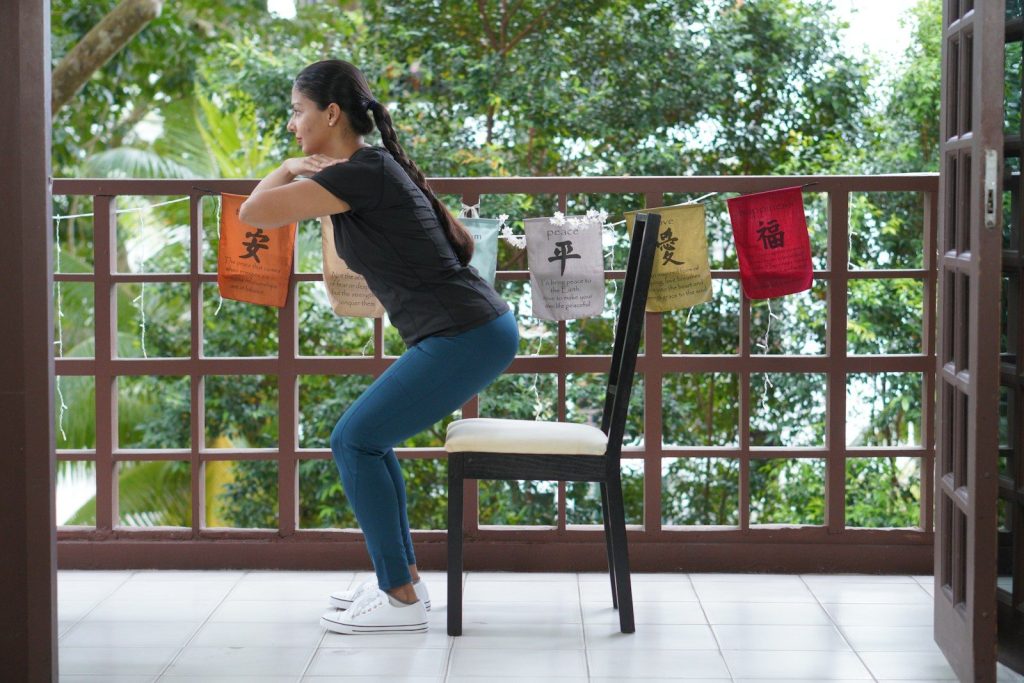
“Bad knees” is not a medical diagnosis. Knee discomfort may come from osteoarthritis, overuse, an old injury, patellofemoral pain, tendon irritation, or another condition. Exercise selection should therefore be based on your symptoms, current ability, and any guidance you have received from a healthcare professional.
Can You Strengthen Your Quads With Bad Knees?
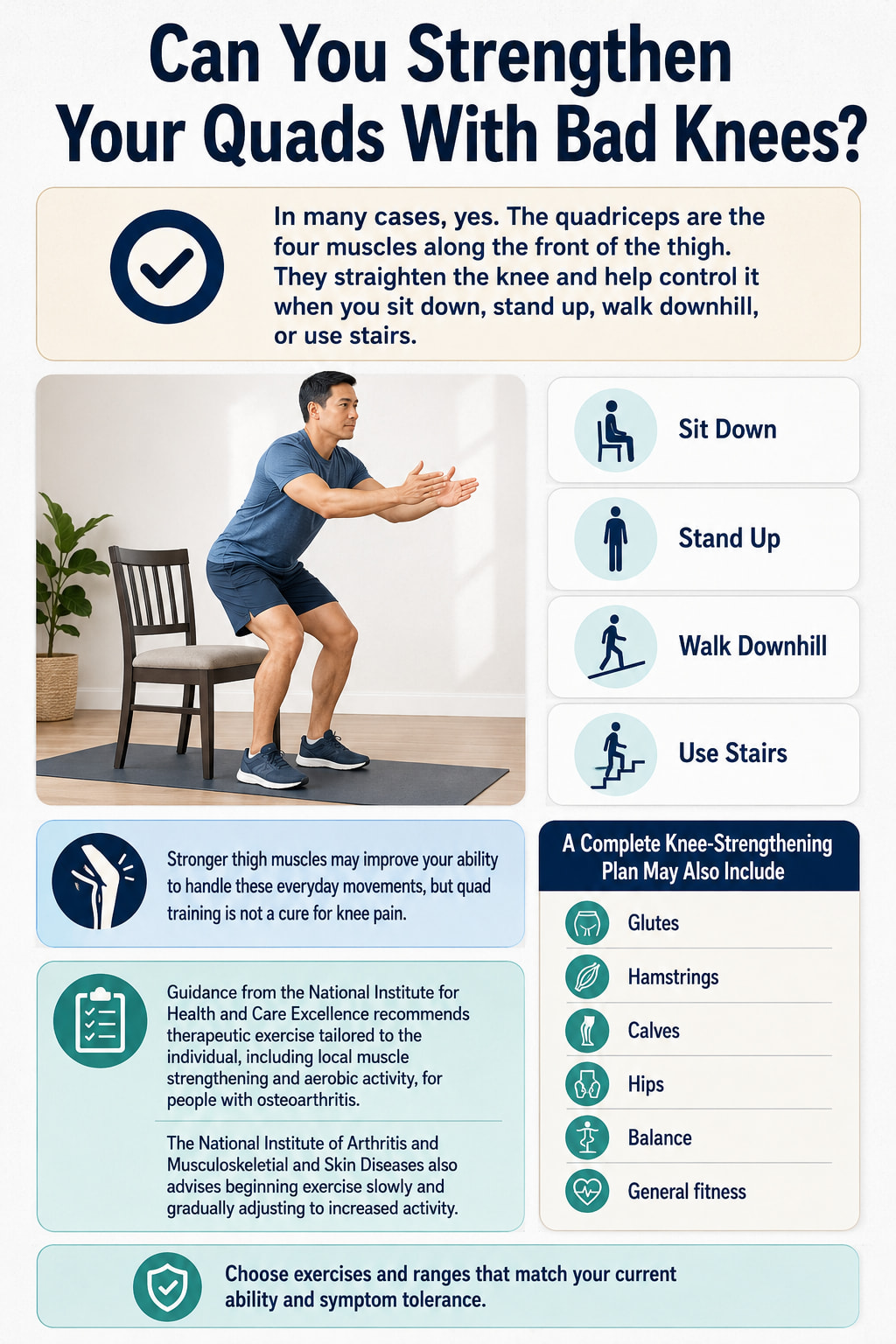
In many cases, yes. The quadriceps are the four muscles along the front of the thigh. They straighten the knee and help control it when you sit down, stand up, walk downhill, or use stairs.
Stronger thigh muscles may improve your ability to handle these everyday movements, but quad training is not a cure for knee pain. A complete knee-strengthening plan may also include exercises for the glutes, hamstrings, calves, hips, balance, and general fitness.
Guidance from the National Institute for Health and Care Excellence recommends therapeutic exercise tailored to the individual, including local muscle strengthening and aerobic activity, for people with osteoarthritis. The National Institute of Arthritis and Musculoskeletal and Skin Diseases also advises beginning exercise slowly and gradually adjusting to increased activity.
Before Doing Quad Exercises for Bad Knees
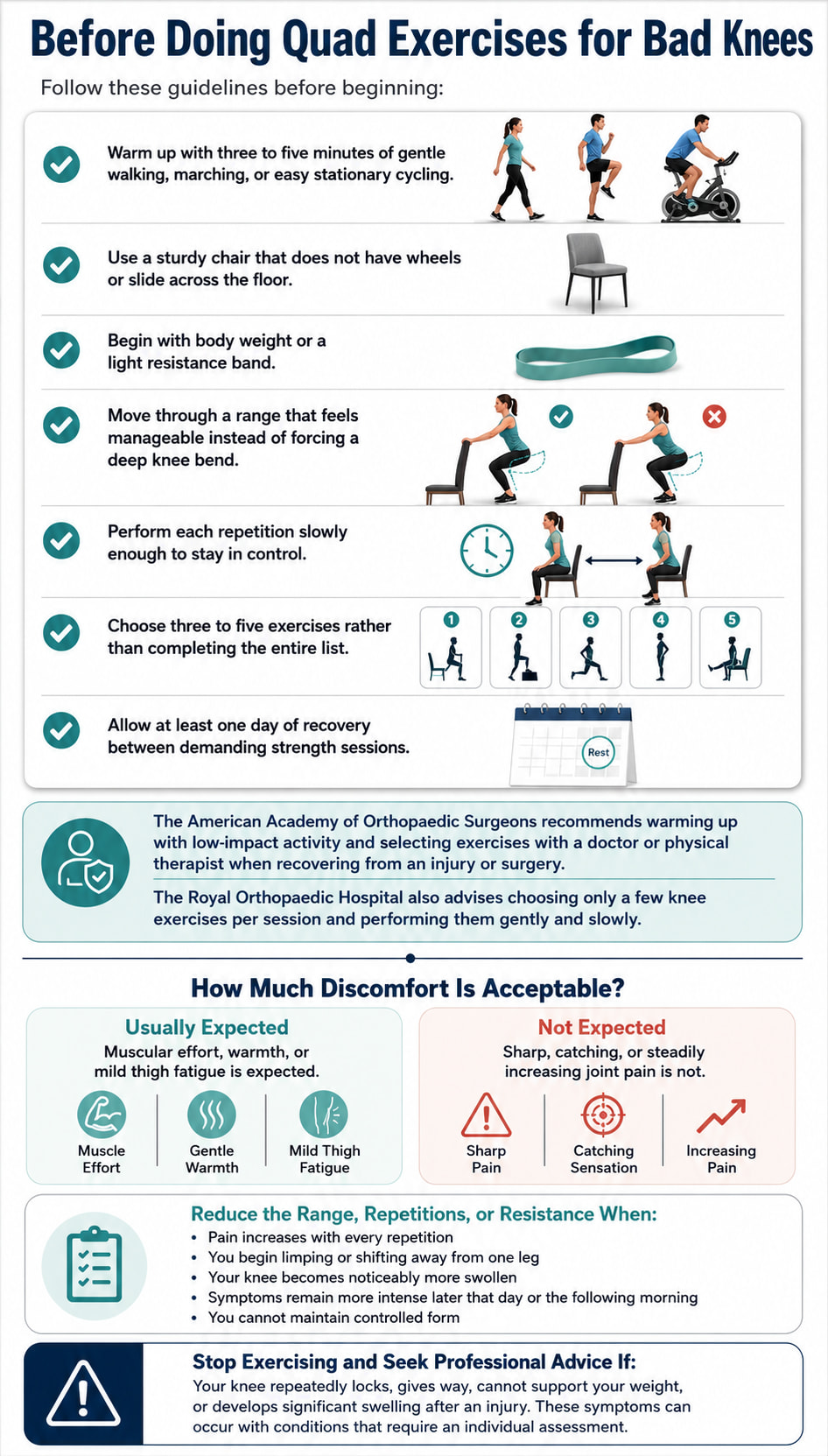
Follow these guidelines before beginning:
- Warm up with three to five minutes of gentle walking, marching, or easy stationary cycling.
- Use a sturdy chair that does not have wheels or slide across the floor.
- Begin with body weight or a light resistance band.
- Move through a range that feels manageable instead of forcing a deep knee bend.
- Perform each repetition slowly enough to stay in control.
- Choose three to five exercises rather than completing the entire list.
- Allow at least one day of recovery between demanding strength sessions.
The American Academy of Orthopaedic Surgeons recommends warming up with low-impact activity and selecting exercises with a doctor or physical therapist when recovering from an injury or surgery. The Royal Orthopaedic Hospital also advises choosing only a few knee exercises per session and performing them gently and slowly.
How Much Discomfort Is Acceptable?
Muscular effort, warmth, or mild thigh fatigue is expected. Sharp, catching, or steadily increasing joint pain is not.
Reduce the range, repetitions, or resistance when:
- Pain increases with every repetition
- You begin limping or shifting away from one leg
- Your knee becomes noticeably more swollen
- Symptoms remain more intense later that day or the following morning
- You cannot maintain controlled form
Stop exercising and seek professional advice if your knee repeatedly locks, gives way, cannot support your weight, or develops significant swelling after an injury. These symptoms can occur with conditions that require an individual assessment.
10 Quad Exercises for Bad Knees at Home
The following exercises progress from low-movement quad activation to more demanding weight-bearing movements. The order is only a general guide. Your knee may tolerate one movement pattern better than another.
1. Quad Set
Best for: Beginning quad activation with almost no knee movement.
Muscles worked: Quadriceps.
Equipment needed: Rolled towel or small cushion.
Sets, reps, and rest: Start with 1–2 sets of 5–8 holds. Hold each contraction for five seconds and rest briefly between repetitions.
How to do it:
- Sit or lie with one leg extended in front of you.
- Place a small rolled towel beneath the knee if that feels more comfortable.
- Tighten the front of your thigh and gently press the back of your knee toward the towel or floor.
- Keep the heel down and hold the contraction without holding your breath.
- Relax fully before beginning the next repetition.
Common mistakes: Pushing through the heel instead of tightening the thigh, holding your breath, or forcing the knee downward aggressively.
Progression or regression: Use a shorter hold if the exercise feels difficult. Progress by holding for 8–10 seconds or performing more repetitions.
2. Short-Arc Quad
Best for: Strengthening knee extension through a small, controlled range.
Muscles worked: Quadriceps.
Equipment needed: Firm rolled towel, foam roller, or small cushion.
Sets, reps, and rest: Perform 1–2 sets of 8–12 repetitions with 45–60 seconds of rest.
How to do it:
- Lie on your back with a rolled towel beneath one knee.
- Let the knee remain supported while the heel rests on the floor.
- Tighten your thigh and lift your heel until the lower leg straightens.
- Pause for two to five seconds without lifting the knee off the towel.
- Lower the heel slowly.
Common mistakes: Lifting the entire leg, rushing the lowering phase, or forcing the knee completely straight when that position is uncomfortable.
Progression or regression: Use a smaller towel to reduce the movement. Progress by increasing the hold or adding a very light ankle weight only after body-weight repetitions are comfortable.
The Royal Orthopaedic Hospital uses this inner-range quadriceps movement as a home exercise for strengthening the muscles around the knee.
3. Straight-Leg Raise
Best for: Training the quadriceps to keep the knee straight while the leg moves.
Muscles worked: Quadriceps and hip flexors.
Equipment needed: Exercise mat or firm bed.
Sets, reps, and rest: Start with 1–2 sets of 6–10 repetitions per leg. Rest for 45–60 seconds.
How to do it:
- Lie on your back with one knee bent and the other leg straight.
- Tighten the thigh of the straight leg before lifting.
- Raise the leg approximately 6–10 inches from the floor.
- Pause briefly while keeping the knee straight.
- Lower the leg slowly and relax before repeating.
Common mistakes: Allowing the knee to bend during the lift, raising the leg too high, arching the lower back, or using momentum.
Progression or regression: Begin by lifting only a few inches. Progress by increasing repetitions before considering a light ankle weight.
The AAOS knee conditioning program emphasizes tightening the quadriceps before lifting and keeping the leg straight throughout the movement.
4. Seated Knee Extension
Best for: Directly strengthening the quads from a stable seated position.
Muscles worked: Quadriceps.
Equipment needed: Sturdy chair.
Sets, reps, and rest: Perform 1–2 sets of 8–12 repetitions per leg. Rest for 45–60 seconds.
How to do it:
- Sit tall with your feet flat and thighs supported by the chair.
- Tighten one thigh and slowly straighten that knee.
- Stop at the highest comfortable position.
- Pause for one to three seconds.
- Lower your foot slowly instead of letting it drop.
Common mistakes: Swinging the lower leg, leaning backward, kicking forcefully, or adding resistance before controlling body-weight repetitions.
Progression or regression: Use a partial range if fully straightening the knee is uncomfortable. Progress with a longer pause, a light resistance band, or a light ankle weight.
Seated knee extensions are included in the AAOS conditioning program, which recommends controlled movement without swinging the leg or using momentum.
5. Standing Band Terminal Knee Extension
Best for: Strengthening the final portion of knee extension and improving standing control.
Muscles worked: Quadriceps, with the glutes and calf assisting with stability.
Equipment needed: Light resistance band and secure anchor.
Sets, reps, and rest: Perform 1–2 sets of 8–12 repetitions per leg. Rest for 45–60 seconds.
How to do it:
- Secure a resistance band to a stable anchor at knee height.
- Step inside the band so it rests behind one knee.
- Move backward until the band has light tension.
- Begin with the working knee slightly bent.
- Tighten the thigh and straighten the knee without forcefully locking it.
- Slowly return to the slightly bent position.
Common mistakes: Snapping the knee backward, rocking the entire body, using excessive band tension, or attaching the band to an unstable object.
Progression or regression: Begin with a very small bend and light resistance. Progress by increasing band tension slightly or performing the movement with less hand support.
Coaching cue: Think “tighten the thigh” rather than “push the knee backward.”
6. Supine Resistance-Band Leg Press
Best for: Introducing resisted knee and hip extension without standing.
Muscles worked: Quadriceps, glutes, and hamstrings.
Equipment needed: Light resistance band.
Sets, reps, and rest: Perform 1–2 sets of 8–12 repetitions per side. Rest for 60 seconds.
How to do it:
- Lie on your back and loop the middle of a resistance band around one foot.
- Hold one end of the band in each hand.
- Bring the knee toward your torso only as far as comfortable.
- Press the foot forward, gradually straightening the hip and knee.
- Pause briefly before returning slowly.
Common mistakes: Allowing the band to slide off the foot, straightening the leg too quickly, arching the lower back, or pulling the knee into an uncomfortable depth.
Progression or regression: Reduce the knee bend or use a lighter band. Progress by adding repetitions before increasing band resistance.
The AAOS includes an elastic-band leg press as a home exercise for the quadriceps and hamstrings and advises keeping the movement controlled.
7. High-Chair Sit-to-Stand
Best for: Improving the strength needed to get out of chairs and off other seated surfaces.
Muscles worked: Quadriceps and glutes, with the hamstrings and calves assisting.
Equipment needed: Firm, stable chair.
Sets, reps, and rest: Start with 1–3 sets of 5–10 repetitions. Rest for 60–90 seconds.
How to do it:
- Sit near the front of a firm chair with your feet approximately hip-width apart.
- Position your feet beneath or slightly behind your knees.
- Lean your torso forward slightly while keeping your back long.
- Press through both feet and stand tall.
- Push your hips backward and lower yourself to the chair under control.
Common mistakes: Dropping onto the chair, pushing mostly through one leg, allowing the knees to collapse inward, or using a chair that is too low.
Progression or regression: Use your hands on the chair or thighs for assistance. A cushion can raise the seat and reduce the required knee bend. Progress by using less hand support or lowering the seat gradually.
Both the NHS home strength guide and Royal Orthopaedic Hospital knee program include controlled sit-to-stand exercises for improving lower-body strength and mobility.
8. Chair-Supported Mini Squat
Best for: Developing weight-bearing quad strength with adjustable depth and balance support.
Muscles worked: Quadriceps, glutes, and hamstrings.
Equipment needed: Sturdy chair or countertop.
Sets, reps, and rest: Perform 1–3 sets of 6–10 repetitions. Rest for 60–90 seconds.
How to do it:
- Stand behind a stable chair with your feet approximately hip- to shoulder-width apart.
- Hold the chair lightly for balance.
- Push your hips slightly backward and bend your knees a small amount.
- Keep your feet flat and your knees generally aligned with your toes.
- Pause briefly, then press through your feet to stand.
Common mistakes: Squatting deeper than your current tolerance, lifting the heels, letting the knees collapse inward, or pulling heavily on the chair.
Progression or regression: Begin with a very shallow bend. Progress by gradually increasing depth, using less hand support, or holding a light weight close to your chest.
A shallow mini squat does not need to reach parallel. The Royal Orthopaedic Hospital suggests limiting its introductory version to approximately 45 degrees of knee bend.
9. Shallow Wall Sit
Best for: Building quadriceps endurance without repeatedly bending and straightening the knee.
Muscles worked: Quadriceps and glutes.
Equipment needed: Clear wall and supportive shoes.
Sets, reps, and rest: Perform 2–4 holds of 10–20 seconds. Rest for 45–90 seconds.
How to do it:
- Stand with your back against a wall and your feet slightly forward.
- Slide down only a few inches.
- Keep your knees aligned with your feet.
- Hold the shallow position while breathing normally.
- Press through your feet and slide back up.
Common mistakes: Automatically lowering until the knees reach 90 degrees, placing the feet too close to the wall, holding your breath, or staying in the position after form breaks down.
Progression or regression: Begin almost upright and hold for 5–10 seconds. Progress by extending the hold before increasing depth.
Coaching cue: Use the shallowest position that creates thigh effort without aggravating the knee.
10. Low Step-Up
Best for: Building functional quad strength for stairs, curbs, and changes in elevation.
Muscles worked: Quadriceps and glutes, with the hamstrings and calves assisting.
Equipment needed: Low, stable step and nearby railing or countertop.
Sets, reps, and rest: Perform 1–2 sets of 5–8 repetitions per side. Rest for 60–90 seconds.
How to do it:
- Place one entire foot on a low, stable step.
- Hold a railing or countertop if needed.
- Lean forward slightly and press through the foot on the step.
- Stand tall without jumping from the trailing leg.
- Step down slowly and under control.
Common mistakes: Starting with a step that is too high, pushing forcefully from the floor, allowing the working knee to collapse inward, or dropping quickly during the descent.
Progression or regression: Begin with a book-height platform designed to support body weight or the lowest stair available. Progress by adding repetitions, reducing hand support, or increasing the step height slightly.
Step-ups are included in the Royal Orthopaedic Hospital’s home knee-strengthening program.
Beginner Quad Workout for Bad Knees
Do not assume that more exercises will produce better results. Start with four movements that match your current tolerance.
Beginner Home Routine
- Quad set: 2 sets of 5 holds per leg
- Short-arc quad: 2 sets of 8 repetitions per leg
- High-chair sit-to-stand: 2 sets of 5–8 repetitions
- Chair-supported mini squat: 2 sets of 6–8 repetitions
Rest for approximately 45–90 seconds between sets. Complete the routine two or three nonconsecutive days per week.
Finish each set while you could still perform approximately three or four controlled repetitions. The goal is to practice good movement, not to train until your legs fail.
When the standing exercises are not currently comfortable, substitute a straight-leg raise or seated knee extension.
How to Progress Without Aggravating Your Knees
Progress only after you can complete the current version with controlled form and without a meaningful increase in symptoms later that day or the following morning.
Increase one variable at a time:
- Add one or two repetitions.
- Increase the hold by five seconds.
- Add another set.
- Use a slightly larger range of motion.
- Reduce how much you hold the chair.
- Add light band resistance.
- Increase the step height or external weight last.
Avoid increasing the resistance, range, and total number of sets during the same workout. Small changes make it easier to identify what your knees tolerate.
During a flare-up, reduce the range, resistance, repetitions, or number of exercises. You can temporarily return to quad sets, short-arc quads, and other lower-movement options rather than stopping all activity automatically. The Royal Orthopaedic Hospital recommends reducing exercise volume during flare-ups and seeking professional advice when exercises continue causing problems.
Common Quad-Training Mistakes
Bending the Knee Too Deeply Too Soon
A squat or chair stand does not need to use maximum depth to strengthen the quads. Begin with a range you can control and gradually increase it.
Adding Weight Before Building Control
A resistance band or ankle weight is useful only when you can lift and lower without swinging, twisting, or shifting away from the affected leg.
Letting the Knee Collapse Inward
Keep the knee generally tracking in the same direction as the middle toes during squats, chair stands, and step-ups. Do not force a perfectly rigid position, but avoid an uncontrolled inward collapse.
Moving Quickly Through the Easy Part
The lowering phase is an important part of a chair stand, squat, knee extension, or step-up. Lower for approximately two or three seconds instead of dropping.
Performing All 10 Exercises
The list provides options, not a mandatory workout. Three to five well-chosen exercises are usually more practical than trying to complete every movement.
Ignoring the Next-Day Response
An exercise may feel manageable during the session but cause a noticeable flare afterward. Use how your knee feels later that day and the following morning to guide the next session.
Frequently Asked Questions
What is the gentlest quad exercise for bad knees?
The quad set is usually one of the gentlest starting options because it contracts the quadriceps with almost no knee movement. A short-arc quad is a logical next step when small-range knee extension feels comfortable.
Can weak quads contribute to knee problems?
Weak quadriceps can make it harder to control the knee during walking, stairs, squatting, and sitting down. However, weakness is only one possible factor. Knee discomfort may also involve joint irritation, previous injury, activity changes, hip weakness, mobility limitations, or other conditions.
Are squats safe when your knees hurt?
Some people can tolerate supported mini squats when the range is shallow and controlled. Others may find seated or lying exercises more comfortable. Reduce the depth or choose another exercise when squatting causes sharp, increasing, or lingering discomfort.
Are seated knee extensions bad for the knees?
Seated knee extensions are not automatically harmful. The appropriate range and resistance depend on the individual. Begin with body weight, move slowly, and stop short of any range that causes significant discomfort.
Should quad exercises hurt?
You may feel the thigh muscles working, but exercises should not cause sharp pain, catching, instability, or steadily worsening joint pain. Reduce the exercise difficulty when symptoms increase.
How often should you perform quad exercises?
Two or three strength sessions per week is a reasonable starting point for many adults, with recovery between demanding sessions. A physical therapist may prescribe lighter activation exercises more frequently depending on the condition and goal.
When should you see a physical therapist?
Consider an assessment when pain persists, limits normal activities, follows an injury, or prevents you from progressing. Seek prompt medical attention for major swelling, inability to bear weight, repeated locking or giving way, an obvious deformity, redness with fever, numbness, or unusual calf symptoms.
Conclusion
Quad exercises for bad knees should begin at a level you can control. Start with gentle contractions or seated movements, then progress toward chair stands, mini squats, wall sits, and low step-ups as your tolerance improves.
Choose a small number of exercises, use a comfortable range, and progress one variable at a time. Stop and seek professional help if exercise causes sharp pain, numbness, dizziness, chest pain, instability, or other unusual symptoms.
References
- American Academy of Orthopaedic Surgeons: Knee Conditioning Program
- National Institute for Health and Care Excellence: Osteoarthritis Recommendations
- National Institute of Arthritis and Musculoskeletal and Skin Diseases: Osteoarthritis Treatment and Exercise
- Royal Orthopaedic Hospital: Exercises for Osteoarthritis of the Knee
- NHS: Strength Exercises at Home
- MedlinePlus: Knee Injuries and Disorders
This content is for informational purposes only and is not a substitute for professional medical advice.