The best exercises to strengthen foot and ankle muscles combine toe control, calf and shin strengthening, resisted ankle movements, and single-leg balance. Together, these exercises train the muscles that support your arches, move your ankles, stabilize your feet, and help you control each step.
You do not need a complicated routine. A resistance band, a towel, a wall, and a stable chair are enough for most of the exercises below.
How Exercises to Strengthen Foot and Ankle Muscles Help
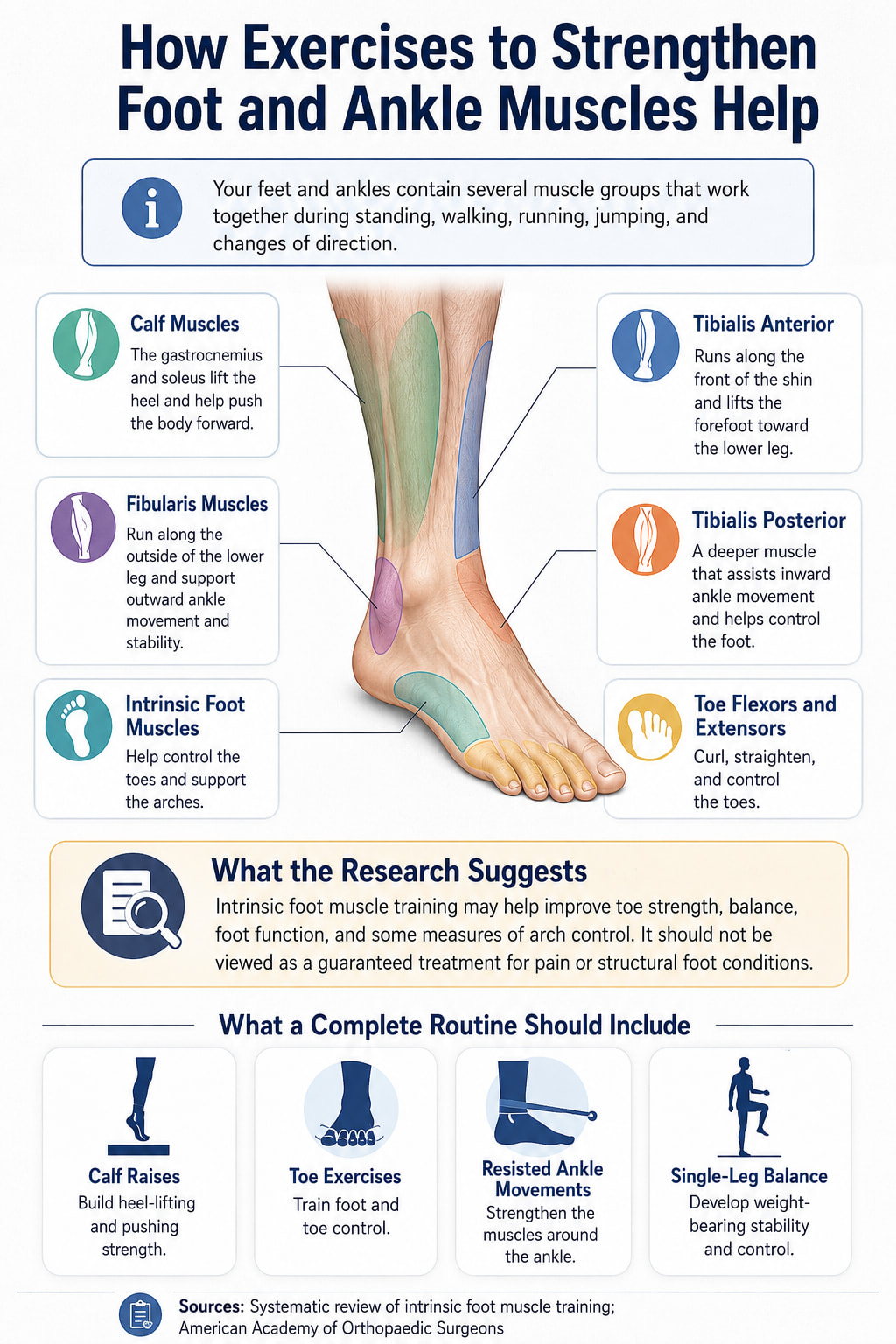
Your feet and ankles contain several muscle groups that work together during standing, walking, running, jumping, and changes of direction.
The main muscles trained include:
- Intrinsic foot muscles: Small muscles located within the foot that help control the toes and support the arches.
- Calf muscles: The gastrocnemius and soleus produce plantar flexion, which lifts your heel and helps push you forward.
- Tibialis anterior: The muscle along the front of the shin that lifts the forefoot toward the lower leg.
- Tibialis posterior: A deeper lower-leg muscle that assists ankle inversion and helps control the foot.
- Fibularis muscles: Also called the peroneal muscles, these run along the outside of the lower leg and assist ankle eversion and stability.
- Toe flexors and extensors: These muscles curl, straighten, and control the toes.
Research suggests that intrinsic foot muscle training may improve toe strength, balance, foot function, and some measures related to arch control. However, it should not be presented as a guaranteed treatment for pain or structural foot conditions.
A complete routine should also strengthen the larger muscles surrounding the ankle. The American Academy of Orthopaedic Surgeons foot and ankle conditioning program includes calf raises, toe exercises, resisted ankle movements, and single-leg balance.
Before You Begin
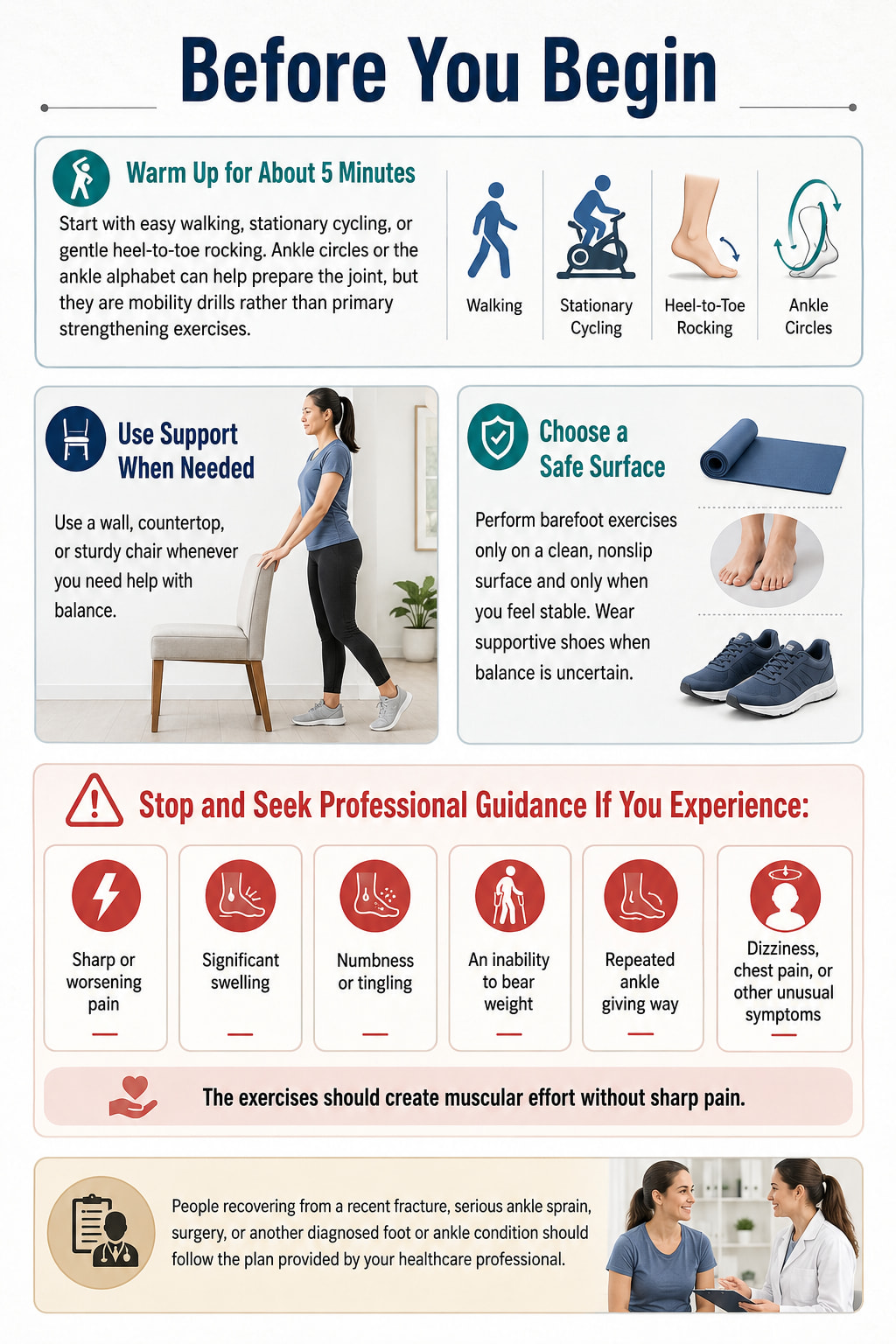
Warm up with approximately five minutes of easy walking, stationary cycling, or gentle heel-to-toe rocking. Ankle circles or the ankle alphabet may also be used to prepare the joint, but they are mobility exercises rather than primary strengthening exercises.
Use a wall, countertop, or sturdy chair whenever you need balance support. Perform barefoot exercises only on a clean, nonslip surface and only when you feel stable. Supportive shoes are a better choice when balance is uncertain.
The exercises should create muscular effort without sharp pain. Stop and seek professional guidance if you experience:
- Sharp or worsening pain.
- Significant swelling.
- Numbness or tingling.
- An inability to bear weight.
- Repeated ankle giving way.
- Dizziness, chest pain, or other unusual symptoms.
People recovering from a recent fracture, serious ankle sprain, surgery, or another diagnosed foot or ankle condition should follow the plan provided by their healthcare professional.
10 Best Exercises to Strengthen Foot and Ankle Muscles
These 10 exercises strengthen the small muscles of the feet and the larger muscles surrounding the ankles. Together, they can help improve balance, stability, control, and lower-body movement.
1. Short-Foot Exercise
Best for: Learning to activate the small muscles supporting the foot without curling the toes.
Muscles worked: Intrinsic foot muscles, including muscles that help control the medial arch and stabilize the toes.
Sets, reps, and rest: Perform 2 sets of 6–10 holds per foot. Hold each repetition for 5–10 seconds and rest for approximately 30 seconds between sets.
How to do it:
- Sit in a chair with your foot flat and your toes pointing forward.
- Keep your heel, the base of your big toe, and the base of your little toe in contact with the floor.
- Gently draw the ball of your foot toward your heel without sliding either point.
- Allow the arch to lift slightly while keeping the toes long and relaxed.
- Hold, release fully, and repeat.
Common mistakes: Curling the toes, rolling onto the outside of the foot, lifting the big toe, or creating so much tension that the foot cramps.
Progression or regression: Practice seated if the movement is difficult. Progress to standing with weight divided between both feet, followed by a supported single-leg position.
Coaching cue: Shorten the foot without scrunching the toes.
2. Toe Yoga
Best for: Improving independent control of the big toe and smaller toes.
Muscles worked: Intrinsic foot muscles and the muscles that flex and extend the toes.
Sets, reps, and rest: Perform 2 sets of 6–10 controlled repetitions of each toe pattern per foot.
How to do it:
- Sit or stand with the heel and ball of the foot supported.
- Keep the four smaller toes down while slowly lifting the big toe.
- Lower the big toe without pressing it forcefully into the floor.
- Keep the big toe down and lift the four smaller toes.
- Alternate between the two patterns.
Common mistakes: Rolling the ankle inward or outward, lifting the entire forefoot, rushing the movement, or forcing a range you cannot control.
Progression or regression: Start by using your fingers to guide the toes into position. Progress from seated practice to standing.
3. Towel Curl
Best for: Beginner-friendly toe-flexor and plantar-foot strengthening.
Muscles worked: Intrinsic foot muscles, flexor digitorum muscles, flexor hallucis muscles, and other toe flexors.
Equipment needed: A small hand towel.
Sets, reps, and rest: Perform 2 sets of 10–15 controlled curls per foot, resting 30–45 seconds between sets.
How to do it:
- Sit in a stable chair and place a towel flat beneath the front of one foot.
- Keep your heel resting on the floor.
- Use your toes to gather a small section of the towel toward you.
- Relax and spread the toes before beginning the next repetition.
- Continue until the middle of the foot begins to fatigue.
Common mistakes: Lifting the heel, twisting the knee, curling the toes continuously without relaxing, or pulling the towel mainly by sliding the whole foot.
Progression or regression: Use a thin towel on a smooth floor to make the exercise easier. Place a small, light object on the far end of the towel to add resistance.
The AAOS includes towel curls in its foot and ankle conditioning program and recommends increasing the challenge by adding weight to the towel.
4. Wall Tibialis Raise
Best for: Strengthening the muscles on the front of the shin that lift the foot.
Muscles worked: Tibialis anterior, extensor hallucis longus, and extensor digitorum longus.
Sets, reps, and rest: Perform 2–3 sets of 10–20 repetitions, resting 30–60 seconds.
How to do it:
- Stand with your back against a wall and your feet several inches in front of you.
- Keep your heels firmly on the floor.
- Lift your toes and forefeet toward your shins as high as you can control.
- Pause briefly at the top.
- Lower slowly without allowing the feet to drop.
Common mistakes: Rocking the body, lifting the heels, turning the toes outward, or dropping the forefeet quickly.
Progression or regression: Move your feet closer to the wall to reduce the difficulty. Move them slightly farther away or perform one foot at a time to progress.
5. Standing Calf Raise
Best for: Building general calf strength and improving the pushing action used during walking, running, and stair climbing.
Muscles worked: Gastrocnemius and soleus, with the foot and ankle muscles assisting stability.
Equipment needed: A wall, countertop, or chair for support.
Sets, reps, and rest: Perform 2–3 sets of 8–15 repetitions. Rest 45–90 seconds between sets.
How to do it:
- Stand tall with your feet approximately hip-width apart.
- Hold a stable surface lightly.
- Keep your weight balanced across the base of the big toe, base of the little toe, and heel.
- Raise both heels as high as you can without rolling the ankles outward.
- Pause briefly, then lower under control.
Common mistakes: Bouncing, shifting all the pressure toward the little toes, bending the knees excessively, or completing only the easiest part of the movement.
Progression or regression: Begin with both legs and firm hand support. Progress by reducing hand support, holding a dumbbell, standing on a step, or performing single-leg calf raises.
The AAOS recommends progressing from two-legged calf raises toward single-leg repetitions as strength and control improve.
Coaching cue: Rise straight up through the center of your feet.
6. Bent-Knee Calf Raise
Best for: Placing greater emphasis on the soleus, which works strongly when the knee is bent.
Muscles worked: Soleus, gastrocnemius, and supporting ankle stabilizers.
Equipment needed: A chair, wall, or countertop for balance.
Sets, reps, and rest: Perform 2–3 sets of 10–20 repetitions. Rest 45–60 seconds between sets.
How to do it:
- Stand with your feet hip-width apart and hold a stable surface.
- Bend your knees slightly while keeping your torso upright.
- Maintain the knee bend as you lift both heels.
- Pause at the top without rolling onto the outside edges of the feet.
- Lower slowly while keeping the knees bent.
Common mistakes: Straightening the knees during each repetition, sitting the hips too far backward, rushing the lowering phase, or allowing the arches to collapse inward.
Progression or regression: Use a small knee bend and both legs initially. Progress by holding a weight, increasing the range from a step, or using one leg with support.
7. Resistance-Band Ankle Inversion
Best for: Strengthening controlled inward ankle movement.
Muscles worked: Tibialis posterior and tibialis anterior, with assistance from other ankle invertors.
Equipment needed: A light resistance band and a secure anchor.
Sets, reps, and rest: Perform 2–3 sets of 10–15 repetitions per side. Rest approximately 30–60 seconds.
How to do it:
- Sit with one leg supported and the band attached to the outside of the working foot.
- Begin with the foot in a comfortable neutral position.
- Keep the knee and lower leg still.
- Slowly turn the sole inward against the band.
- Return to the starting position under control.
Common mistakes: Rotating the entire leg, moving through pain, using too much resistance, or allowing the band to pull the foot rapidly back to the start.
Progression or regression: Begin with a very light band and a small range. Progress to a stronger band after you can complete every repetition without moving the knee.
8. Resistance-Band Ankle Eversion
Best for: Strengthening the muscles along the outside of the lower leg.
Muscles worked: Fibularis longus and fibularis brevis, also called the peroneal muscles.
Equipment needed: A light resistance band and a secure anchor.
Sets, reps, and rest: Perform 2–3 sets of 10–15 repetitions per side. Rest approximately 30–60 seconds.
How to do it:
- Sit with your leg supported and the band pulling from the inside of the working foot.
- Keep the heel, knee, and lower leg still.
- Turn the sole slightly outward against the resistance.
- Pause when you reach the end of your controlled range.
- Return slowly to neutral.
Common mistakes: Rotating the hip, moving the knee, forcing a large range, or using momentum to stretch the band.
Progression or regression: Start with a light band. Increase resistance only when the movement remains smooth and isolated at the ankle.
Resisted ankle exercises are commonly used to train muscles such as the tibialis anterior, tibialis posterior, gastrocnemius-soleus complex, and fibularis muscles.
9. Supported Single-Leg Balance
Best for: Developing basic foot and ankle stability during weight-bearing.
Muscles worked: Foot intrinsics, calf muscles, tibialis anterior, tibialis posterior, fibularis muscles, and supporting hip muscles.
Equipment needed: A stable chair or countertop.
Sets, reps, and rest: Perform 2–3 holds of 15–30 seconds per side. Rest as needed between attempts.
How to do it:
- Stand beside a stable support with both feet facing forward.
- Place your weight over one foot.
- Lift the opposite foot slightly from the floor.
- Keep the standing knee soft and your pelvis approximately level.
- Use your fingertips for support whenever necessary.
Common mistakes: Locking the knee, gripping the floor aggressively with the toes, holding the breath, allowing the arch to collapse, or continuing after balance control has been lost.
Progression or regression: Begin with both hands on the support and the lifted toes lightly touching the floor. Progress by using fewer fingers, making small head turns, or adding slow arm movements.
Do not begin by closing your eyes or standing on an unstable object. First build control on a firm, level surface.
Balance and neuromuscular exercises are included in clinical guidance for people recovering from ankle sprains or managing ankle instability, although an individualized rehabilitation plan may be needed after an injury.
10. Single-Leg Clock Reach
Best for: Progressing basic balance into controlled movement in several directions.
Muscles worked: Foot and ankle stabilizers, calves, quadriceps, hamstrings, glutes, and lateral hip muscles.
Equipment needed: A stable support when needed.
Sets, reps, and rest: Perform 2 sets of 3–5 reaches in each chosen direction per leg. Rest 30–60 seconds.
How to do it:
- Stand on one foot with a slight bend in the supporting knee.
- Imagine you are standing in the center of a clock.
- Reach the free foot forward and lightly tap the floor.
- Return to the center, then reach to the side and diagonally behind you.
- Keep most of your weight over the standing foot throughout the set.
Common mistakes: Shifting weight onto the reaching foot, allowing the standing knee to collapse inward, losing heel contact, or reaching farther than you can control.
Progression or regression: Begin with short reaches while holding a countertop. Progress by increasing the reach distance, reducing hand support, or adding more directions.
Coaching cue: Reach only as far as you can return without losing your balance.
Beginner Foot and Ankle Strength Workout
You do not need to perform all 10 exercises in every session. The following routine covers foot control, dorsiflexion, plantar flexion, lateral ankle strength, and balance.
| Exercise | Sets and reps |
|---|---|
| Short-foot exercise | 2 sets of 6–8 holds per foot |
| Toe yoga | 2 sets of 6 repetitions per pattern |
| Wall tibialis raise | 2 sets of 10–15 repetitions |
| Standing calf raise | 2 sets of 10–15 repetitions |
| Resistance-band eversion | 2 sets of 10–12 repetitions per side |
| Supported single-leg balance | 2 holds of 20–30 seconds per side |
Rest: Take 30–60 seconds between sets and slightly longer when needed after calf raises.
Frequency: Perform the routine two or three times per week. Low-load coordination exercises such as short-foot holds and toe yoga may be practiced more frequently when they do not cause soreness or cramping.
Effort level: Finish strength sets feeling as though you could complete approximately two or three more controlled repetitions.
A 2025 review found that foot and ankle strengthening studies used many different exercise prescriptions. Three sets of 10 repetitions performed three times per week appeared frequently, but resistance and progression were often poorly reported. This makes gradual, measurable progression especially important.
How to Progress Foot and Ankle Exercises
Progress when you can complete the top of the suggested repetition or hold range with controlled form and no meaningful increase in symptoms.
Change only one variable at a time:
- Add two or three repetitions.
- Increase the hold by five seconds.
- Use a stronger resistance band.
- Add a small amount of external weight.
- Increase the movement range.
- Move from two legs to one leg.
- Use less hand support during balance exercises.
- Progress from seated to standing practice.
More resistance is not useful when it causes toe gripping, ankle rolling, shortened range, or loss of balance.
Common Foot and Ankle Exercise Mistakes
Training Only the Calves
Calf raises are valuable, but they do not train every function of the foot and ankle. Include exercises for dorsiflexion, inversion, eversion, toe control, and balance.
Confusing Mobility With Strength
Ankle circles and the ankle alphabet move the joint through different directions, but they provide little external resistance. Use them as warm-up or mobility drills rather than the main part of a strengthening program.
Curling the Toes During Every Exercise
Aggressive toe gripping can compensate for poor foot control. During short-foot exercises, calf raises, and balance work, keep the toes relaxed and in contact with the floor instead of clawing downward.
Progressing Balance Too Quickly
Standing on unstable equipment or closing your eyes can make an exercise harder, but not necessarily more useful. First master single-leg balance on a stable surface with open eyes.
Using Too Much Resistance
A heavy band can cause the knee and hip to rotate during ankle inversion or eversion. Use enough resistance to challenge the ankle while keeping the lower leg still.
Ignoring One Side
Training both feet helps you notice meaningful differences in strength, balance, and coordination. Begin with your less-controlled side and use the same appropriate workload on the other side.
How Often Should You Train Your Feet and Ankles?
Most people can perform focused foot and ankle strengthening two or three times per week. Leave at least one recovery day between harder calf, tibialis, or resistance-band sessions when the muscles are sore.
Low-intensity toe-control and arch-control exercises may be practiced three to five days per week because they rely heavily on coordination. Balance work can also be performed frequently when it is brief, supported, and does not produce excessive fatigue.
The AAOS describes four to six weeks as a typical initial conditioning period and notes that exercises may continue as part of a maintenance program. Individual progress will vary according to training history, exercise difficulty, consistency, and current foot or ankle health.
Frequently Asked Questions
Can you strengthen weak feet and ankles at home?
Yes. Many useful exercises require only body weight, a towel, a resistance band, and a stable support. The exercises must become gradually more challenging over time if continued strength improvement is the goal.
Should foot-strengthening exercises be performed barefoot?
Some toe and intrinsic-foot exercises are easier to understand barefoot because you can see and feel the foot working. Shoes may be safer for standing balance exercises or for anyone who feels unstable, has reduced foot sensation, or needs additional support.
Use a nonslip surface and choose the option that allows the best control.
Can these exercises prevent ankle sprains?
Strength and balance training may improve physical qualities related to ankle control, but no exercise can guarantee that an ankle sprain will not occur. People with repeated sprains, ongoing instability, or a recent injury may need a structured rehabilitation program.
Can foot exercises fix flat feet?
Foot exercises may strengthen the muscles supporting the foot and improve control or function. They should not be promised to permanently change a person’s structural foot shape or eliminate symptoms.
Painful or suddenly changing arches should be assessed by an appropriate healthcare professional.
Are ankle circles a strengthening exercise?
Ankle circles are primarily a mobility and movement-control drill. They can be useful during a warm-up, but resistance exercises, calf raises, toe exercises, and weight-bearing balance drills provide a clearer strengthening challenge.
How long does it take to strengthen the feet and ankles?
Some people notice better coordination within a few sessions, while strength changes normally require consistent practice over several weeks. Use four to six weeks as an initial training block, then assess whether your repetitions, resistance, balance time, and movement quality have improved.
Should I exercise a painful or swollen ankle?
Do not push through sharp pain, substantial swelling, an inability to bear weight, or symptoms following a recent injury. Seek professional assessment before using a general strengthening routine in these situations.
Conclusion
The most effective exercises to strengthen foot and ankle muscles train more than one movement. Combine intrinsic foot work, toe control, calf raises, tibialis exercises, resisted inversion and eversion, and single-leg balance.
Start with six exercises two or three times per week. Focus on slow repetitions, relaxed toes, controlled ankle alignment, and gradual progression rather than completing as many repetitions as possible.
Stop and seek professional help if an exercise causes sharp pain, numbness, dizziness, chest pain, worsening swelling, or other unusual symptoms.
This content is for informational purposes only and is not a substitute for professional medical advice.
References
- American Academy of Orthopaedic Surgeons: Foot and Ankle Conditioning Program
- Evidence for Intrinsic Foot Muscle Training in Improving Foot Function: A Systematic Review and Meta-Analysis
- Muscle Strengthening Exercises for the Foot and Ankle: A Scoping Review
- Ankle Stability and Movement Coordination Impairments: Lateral Ankle Ligament Sprains Revision 2021
- The Effects of Ankle and Foot Exercises on Strength, Flexibility, Balance, and Falls in Older Adults
2 thoughts on “10 Best Exercises to Strengthen Foot and Ankle Muscles”