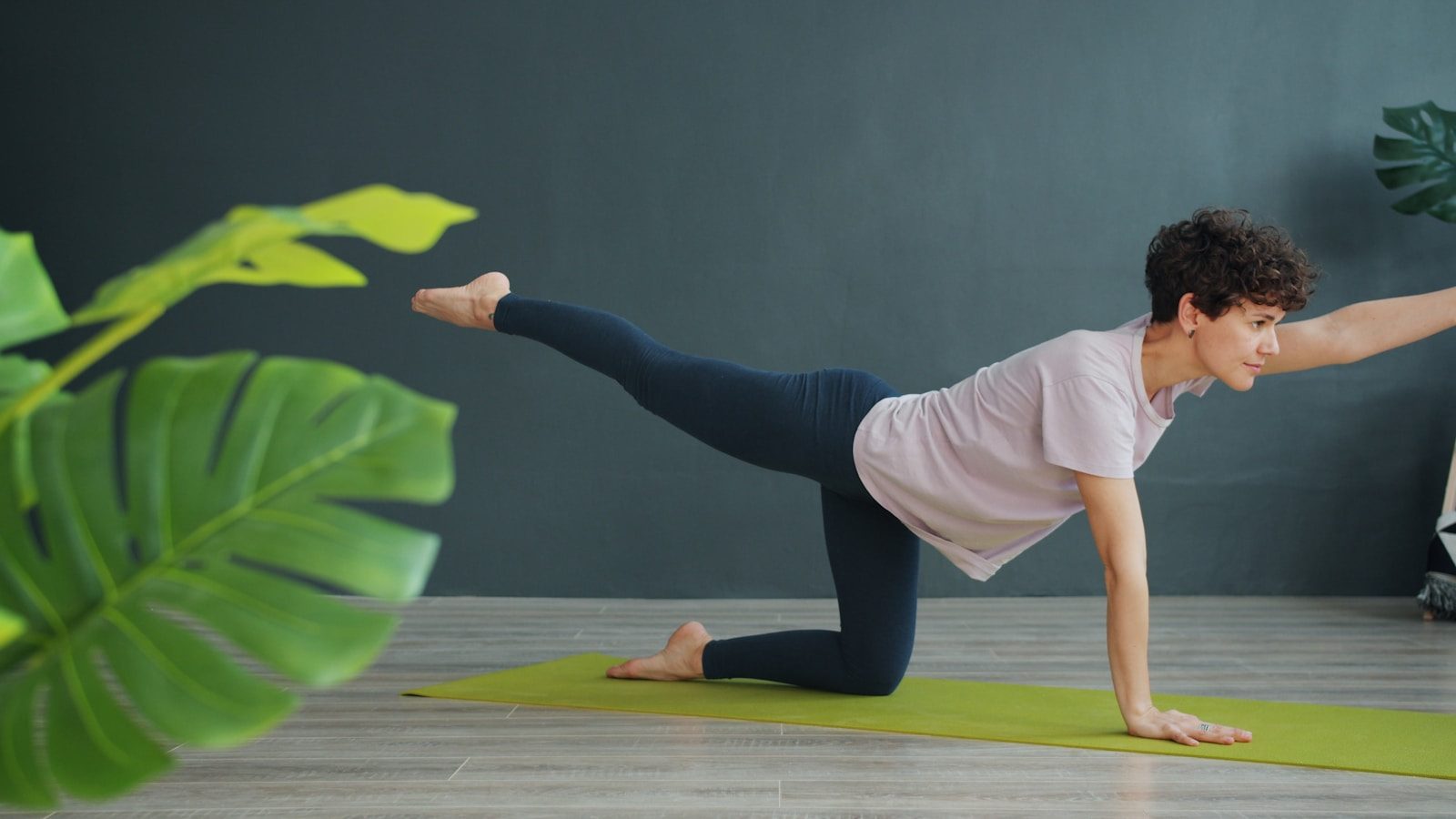
This beginner full body Pilates workout routine trains your core, legs, glutes, back, chest, shoulders, and arms in about 20–25 minutes. It requires no reformer and can be completed at home with an exercise mat and a stable wall or countertop.
Move slowly, breathe continuously, and use the easier variation whenever you cannot maintain control.
Full Body Pilates Workout Routine at a Glance
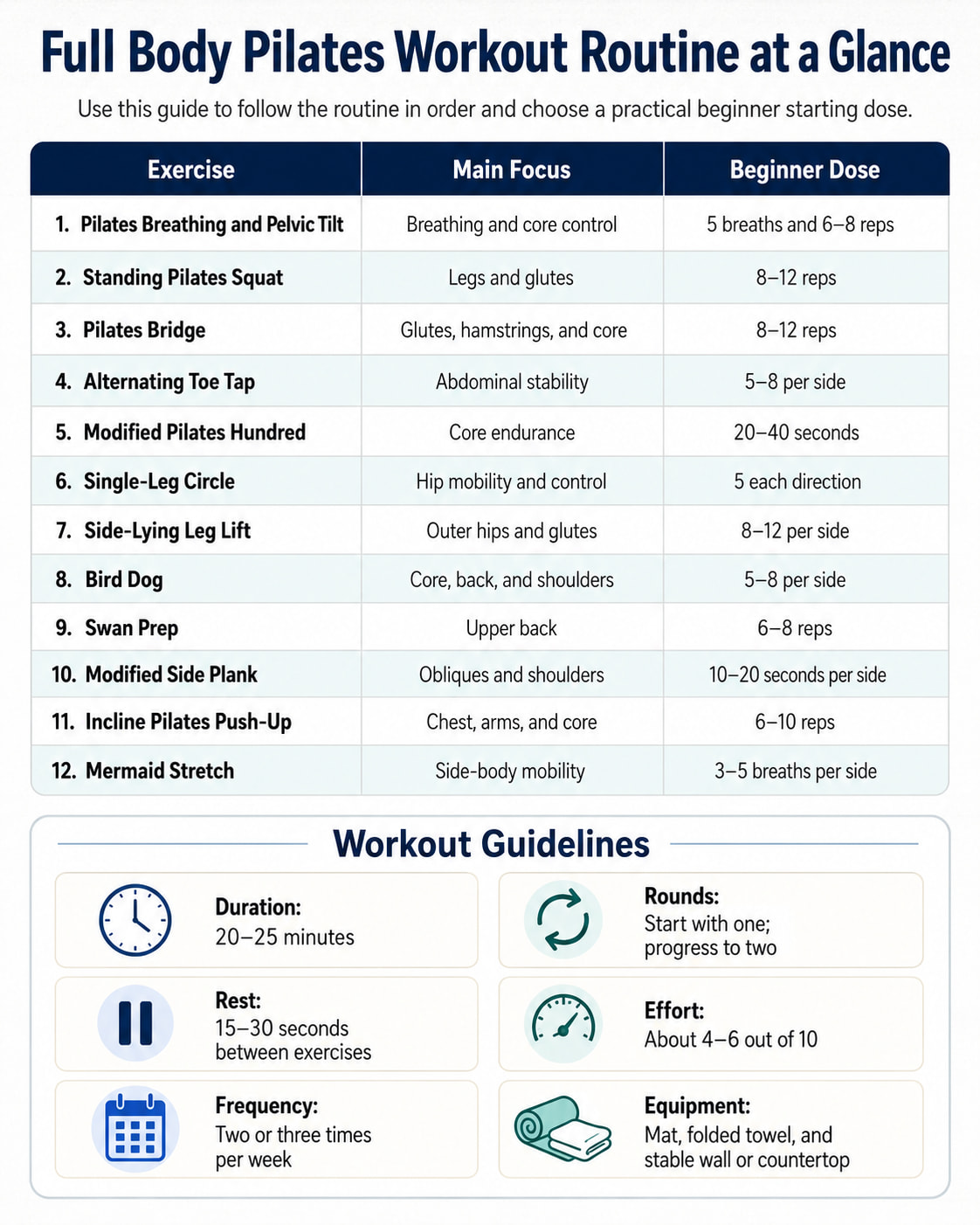
| Exercise | Main focus | Beginner |
|---|---|---|
| Pilates breathing and pelvic tilt | Breathing and core control | 5 breaths and 6–8 reps |
| Standing Pilates squat | Legs and glutes | 8–12 reps |
| Pilates bridge | Glutes, hamstrings, and core | 8–12 reps |
| Alternating toe tap | Abdominal stability | 5–8 per side |
| Modified Pilates Hundred | Core endurance | 20–40 seconds |
| Single-leg circle | Hip mobility and control | 5 each direction |
| Side-lying leg lift | Outer hips and glutes | 8–12 per side |
| Bird dog | Core, back, and shoulders | 5–8 per side |
| Swan prep | Upper back | 6–8 reps |
| Modified side plank | Obliques and shoulders | 10–20 seconds per side |
| Incline Pilates push-up | Chest, arms, and core | 6–10 reps |
| Mermaid stretch | Side-body mobility | 3–5 breaths per side |
Workout Guidelines
- Duration: 20–25 minutes
- Rounds: Start with one; progress to two
- Rest: 15–30 seconds between exercises
- Effort: About 4–6 out of 10
- Frequency: Two or three times per week
- Equipment: Mat, folded towel, and stable wall or countertop
How to Breathe During Pilates
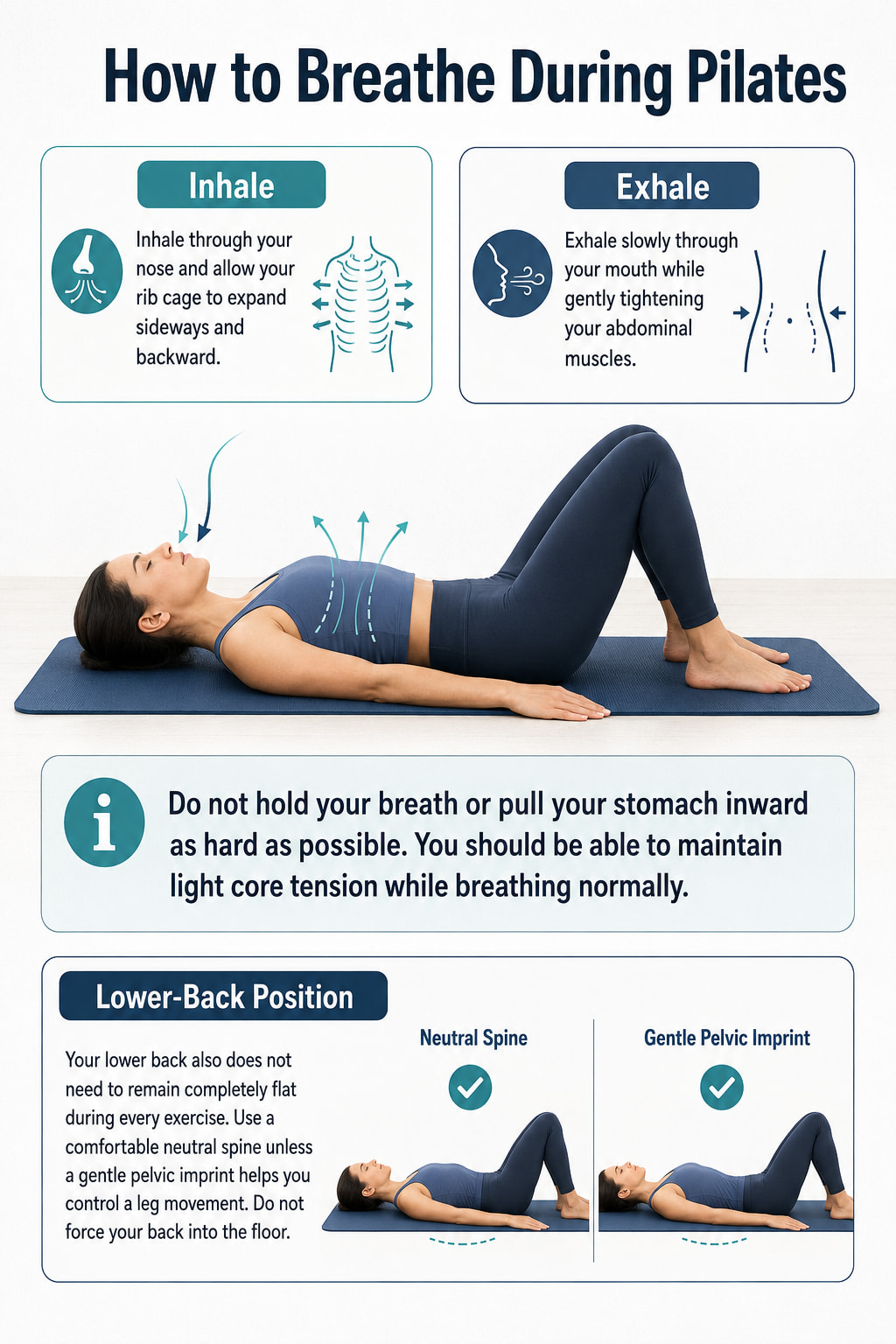
Inhale through your nose and allow your rib cage to expand sideways and backward. Exhale slowly through your mouth while gently tightening your abdominal muscles.
Do not hold your breath or pull your stomach inward as hard as possible. You should be able to maintain light core tension while breathing normally.
Your lower back also does not need to remain completely flat during every exercise. Use a comfortable neutral spine unless a gentle pelvic imprint helps you control a leg movement. Do not force your back into the floor.
Warm-Up: Pilates Breathing and Pelvic Tilt
Best for: Learning breathing, abdominal engagement, and pelvic control.
Muscles worked: Deep abdominals, obliques, and spinal stabilizers.
Sets, reps, and rest: Take five slow breaths, followed by 6–8 pelvic tilts.
How to Do It
- Lie on your back with your knees bent and feet hip-width apart.
- Rest your arms beside you and relax your shoulders.
- Inhale into the sides and back of your ribs.
- Exhale and gently tighten your abdominal muscles.
- Tilt your pelvis slightly toward you to reduce the curve in your lower back.
- Inhale and return to a comfortable neutral position.
Common mistakes: Lifting the hips, squeezing the glutes forcefully, holding the breath, or making the movement too large.
Once your breathing feels steady and the pelvic tilt feels controlled, continue to the main workout. Move slowly and rest briefly whenever you need to regain your form.
1. Standing Pilates Squat
Best for: Warming up the legs and building lower-body strength.
Muscles worked: Quadriceps, glutes, hamstrings, calves, and core.
Sets, reps, and rest: Perform 8–12 reps. Rest for 20–30 seconds.
How to Do It
- Stand with your feet approximately hip- to shoulder-width apart.
- Keep your chest comfortably tall and shoulders relaxed.
- Bend your knees and move your hips backward and down.
- Keep your heels planted and knees aligned with your toes.
- Press through your feet to return to standing.
Common mistakes: Allowing the knees to collapse inward, lifting the heels, rounding the back, or dropping too quickly.
Make it easier: Hold a stable countertop or reduce the squat depth.
Progression: Lower for three seconds before standing.
2. Pilates Bridge
Best for: Strengthening the glutes and hamstrings while controlling the pelvis.
Muscles worked: Glutes, hamstrings, abdominals, and spinal stabilizers.
Sets, reps, and rest: Perform 8–12 reps. Rest for 20 seconds.
How to Do It
- Lie on your back with your knees bent and feet hip-width apart.
- Exhale and gently tilt your pelvis.
- Press through your feet and lift your hips.
- Stop before your lower back begins to overarch.
- Pause briefly, then lower slowly.
Common mistakes: Lifting too high, pushing through the toes, allowing the knees to spread, or flaring the ribs.
Make it easier: Use a smaller lifting range.
Progression: Pause for two or three seconds at the top.
3. Alternating Toe Tap
Best for: Training the abdominals to stabilize the pelvis while the legs move.
Muscles worked: Deep abdominals, rectus abdominis, obliques, and hip flexors.
Sets, reps, and rest: Perform 5–8 reps per side. Rest for 20 seconds.
How to Do It
- Lie on your back and bring your legs into tabletop.
- Keep your knees bent and arms beside your body.
- Exhale and lower one foot toward the floor.
- Tap lightly or stop before reaching the floor.
- Return to tabletop and alternate sides.
Common mistakes: Arching the lower back, lowering the foot too far, rushing, or allowing the pelvis to rock.
Make it easier: Keep one foot on the floor while moving the opposite leg.
Progression: Tap farther away from your hips.
4. Modified Pilates Hundred
Best for: Building abdominal endurance and coordinating breathing with movement.
Muscles worked: Abdominals, hip flexors, shoulders, chest, and upper back.
Sets, reps, and rest: Perform for 20–40 seconds. Rest for 30 seconds.
How to Do It
- Lie on your back with your knees bent and feet planted.
- Reach your arms beside your body, slightly above the mat.
- Keep your head supported or lift it only if your neck feels comfortable.
- Pump your arms through a small range.
- Breathe steadily while keeping your ribs controlled.
Common mistakes: Tensing the shoulders, pulling the chin toward the chest, holding the breath, or lifting the legs before you can control your pelvis.
Make it easier: Keep your head, arms, and feet supported while practicing the breathing pattern.
Progression: Lift one leg, then both legs into tabletop.
5. Single-Leg Circle
Best for: Improving hip mobility without allowing the pelvis to move excessively.
Muscles worked: Hip flexors, inner thighs, glutes, and abdominals.
Sets, reps, and rest: Perform five circles in each direction per leg.
How to Do It
- Lie on your back with both knees bent.
- Extend one leg upward, keeping a slight knee bend if necessary.
- Keep the opposite foot planted.
- Draw a small circle with the raised leg.
- Keep both sides of your pelvis supported.
- Reverse direction, then change legs.
Common mistakes: Making the circle too large, locking the knee, rocking the pelvis, or holding the breath.
Make it easier: Bend the moving knee and reduce the circle size.
Progression: Straighten the supporting leg along the floor.
6. Side-Lying Leg Lift
Best for: Strengthening the outer hips and glutes.
Muscles worked: Gluteus medius, gluteus minimus, gluteus maximus, and obliques.
Sets, reps, and rest: Perform 8–12 reps per side.
How to Do It
- Lie on your side with your hips and shoulders stacked.
- Bend the bottom knee and straighten the top leg.
- Keep the top leg in line with your body.
- Lift the leg without rolling your pelvis backward.
- Lower slowly without fully relaxing.
Common mistakes: Swinging the leg, turning the toes upward, hiking the hip, or lifting too high.
Make it easier: Use a smaller range.
Progression: Pause at the top or add small controlled circles.
7. Bird Dog
Best for: Improving cross-body core stability.
Muscles worked: Abdominals, spinal extensors, glutes, shoulders, and upper back.
Sets, reps, and rest: Perform 5–8 reps per side. Rest for 20 seconds.
How to Do It
- Begin on your hands and knees.
- Keep your hands beneath your shoulders and knees beneath your hips.
- Extend one leg backward.
- Reach the opposite arm forward.
- Pause while keeping your hips and shoulders level.
- Return slowly and change sides.
Common mistakes: Arching the lower back, lifting the leg too high, twisting the pelvis, or shifting heavily to one side.
Make it easier: Move only one arm or one leg at a time.
Progression: Hold each repetition for three to five seconds.
8. Swan Prep
Best for: Strengthening the upper back and practicing gentle spinal extension.
Muscles worked: Spinal extensors, upper back, rear shoulders, and glutes.
Sets, reps, and rest: Perform 6–8 reps. Rest for 20 seconds.
How to Do It
- Lie on your stomach with your hands near your shoulders.
- Lengthen the top of your head forward.
- Lift your head and upper chest slightly.
- Keep the back of your neck long.
- Lower slowly to the mat.
Common mistakes: Pushing strongly through the hands, lifting too high, compressing the neck, or overusing the lower back.
Make it easier: Lift only your head and upper chest a few inches.
Progression: Reach your arms beside your body during the lift.
9. Modified Side Plank From the Knees
Best for: Strengthening the obliques and stabilizing the shoulder.
Muscles worked: Obliques, deep abdominals, gluteus medius, shoulders, and triceps.
Sets, reps, and rest: Hold for 10–20 seconds per side.
How to Do It
- Lie on one side with your knees bent.
- Position your elbow beneath your shoulder.
- Press through your forearm and lift your hips.
- Create a straight line from your head to your knees.
- Breathe steadily, then lower with control.
Common mistakes: Collapsing into the shoulder, rotating the chest downward, pushing the hips backward, or holding the breath.
Make it easier: Keep your bottom hip on the floor and practice lifting through the waist.
Progression: Straighten the top leg or both legs.
10. Incline Pilates Push-Up
Best for: Training the chest, shoulders, arms, and core.
Muscles worked: Chest, triceps, shoulders, abdominals, and glutes.
Equipment needed: A stable wall, countertop, or heavy table.
Sets, reps, and rest: Perform 6–10 reps. Rest for 30 seconds.
How to Do It
- Place your hands on a wall or countertop.
- Walk your feet backward until your body forms a straight line.
- Bend your elbows and bring your chest toward the support.
- Keep your hips from sagging.
- Press away and return to the starting position.
Common mistakes: Using an unstable surface, flaring the elbows, shrugging, dropping the hips, or moving only the upper body.
Make it easier: Use a wall and stand more upright.
Progression: Use a lower stable surface.
After completing the final exercise, slow your breathing and finish with the Mermaid Stretch to gently relax the side of your torso.
Cooldown: Mermaid Stretch
Best for: Gently stretching the side of the torso after the workout.
How to Do It
- Sit cross-legged or on a firm cushion.
- Place one hand on the floor beside you.
- Reach the opposite arm overhead.
- Lean gently to the side.
- Take three to five slow breaths.
- Repeat on the opposite side.
Do not force the stretch or continue if it causes pinching in the back, hip, or shoulder.
How to Use This Routine
New Beginner
Complete one set of each exercise using the lower repetition range. Rest whenever you need to regain control.
Progressed Beginner
Complete two rounds and use the upper repetition ranges. Rest for 30–60 seconds between rounds.
Example Weekly Schedule
| Day | Training |
|---|---|
| Monday | Full-body Pilates |
| Tuesday | Walking or light cardio |
| Wednesday | Rest |
| Thursday | Full-body Pilates |
| Friday | Walking, cycling, or strength training |
| Weekend | Optional third Pilates session or rest |
Pilates can support strength, muscular endurance, mobility, and balance, but it does not need to replace cardio or progressive resistance training.
How to Progress Safely
Progress only after you can complete the current version while breathing steadily and maintaining control.
Use this order:
- Improve your form.
- Reach the upper repetition range.
- Increase the range slightly.
- Slow the lowering phase.
- Add a pause.
- Use a harder variation.
- Add a second round.
Reduce the difficulty when you begin holding your breath, straining your neck, arching your back, or using momentum.
Benefits of a Full Body Pilates Routine
A well-structured routine may help:
- Improve muscular endurance
- Strengthen the core, hips, glutes, and upper body
- Develop better balance and coordination
- Improve control of the pelvis and rib cage
- Support flexibility and comfortable movement
- Provide a low-equipment home workout
A systematic review of Pilates research found evidence of improvements in flexibility, dynamic balance, and muscular endurance, although results vary between programs and participants.
Common Beginner Mistakes
Holding the Breath
Breathe continuously. Make the exercise easier if you cannot maintain a steady breathing pattern.
Using Too Much Range
A high bridge, large leg circle, or deep squat is not better if you lose control. Use the range you can perform correctly.
Moving Too Quickly
Momentum makes it harder to stabilize the body. Slow down, particularly during the lowering phase.
Pulling on the Neck
Keep your head supported during abdominal exercises when necessary. Stop if neck fatigue becomes painful.
Progressing Too Soon
Straight legs, longer holds, and lower push-up surfaces increase difficulty. Master the easier version first.
Safety Considerations
This routine is designed for generally healthy beginners.
Speak with a qualified healthcare or exercise professional before starting if you have a recent injury or operation, a condition that affects exercise, significant balance problems, or if you are pregnant or recently postpartum.
Stop exercising and seek professional guidance if you experience sharp or worsening pain, numbness, dizziness, chest pain, unusual shortness of breath, or other concerning symptoms.
The NHS beginner Pilates guidance also recommends obtaining professional advice when injuries, symptoms, medical conditions, pregnancy, or recent surgery may affect exercise.
Frequently Asked Questions
Is Pilates a full-body workout?
It can be. A balanced Pilates routine should include movements for the legs, hips, glutes, abdominals, back, chest, shoulders, and arms.
Is 20 minutes of Pilates enough for a beginner?
Yes. A focused 20-minute session is a practical starting point. Consistent, controlled practice matters more than making every workout long.
How often should beginners do Pilates?
Start with two sessions per week. Add a third when you recover comfortably and can maintain good form.
Do I need a Pilates reformer?
No. Mat Pilates can improve control, balance, mobility, and muscular endurance without specialized equipment.
Should I press my lower back flat?
Not during every exercise. Use a comfortable neutral position or a gentle imprint when needed, but do not force your spine into the floor.
Can Pilates replace strength training and cardio?
Pilates can contribute to general strength and muscular endurance, but people seeking greater muscle or maximal strength will usually need progressively heavier resistance. Cardio should also remain part of a balanced fitness program.
Conclusion
A beginner full body Pilates workout routine should feel controlled, challenging, and manageable—not rushed or painful.
Start with one round two times per week. Focus on breathing, alignment, and smooth movement before increasing repetitions or choosing harder variations. As your control improves, add a second round or progress individual exercises gradually.
References
- NHS: Pilates for Beginners
- American College of Sports Medicine: Resistance Training Guidelines
- Mayo Clinic: Core Strength Exercises
- Merrithew: Pilates Principles
- PubMed: Systematic Review of the Pilates Method
This content is for informational purposes only and is not a substitute for medical advice.