This free chair yoga for seniors routine provides 15 minutes of gentle, fully seated movement using only a stable chair. It combines breathing, upper-body mobility, spinal movement, ankle work, and light leg exercises without requiring floor poses or special equipment.
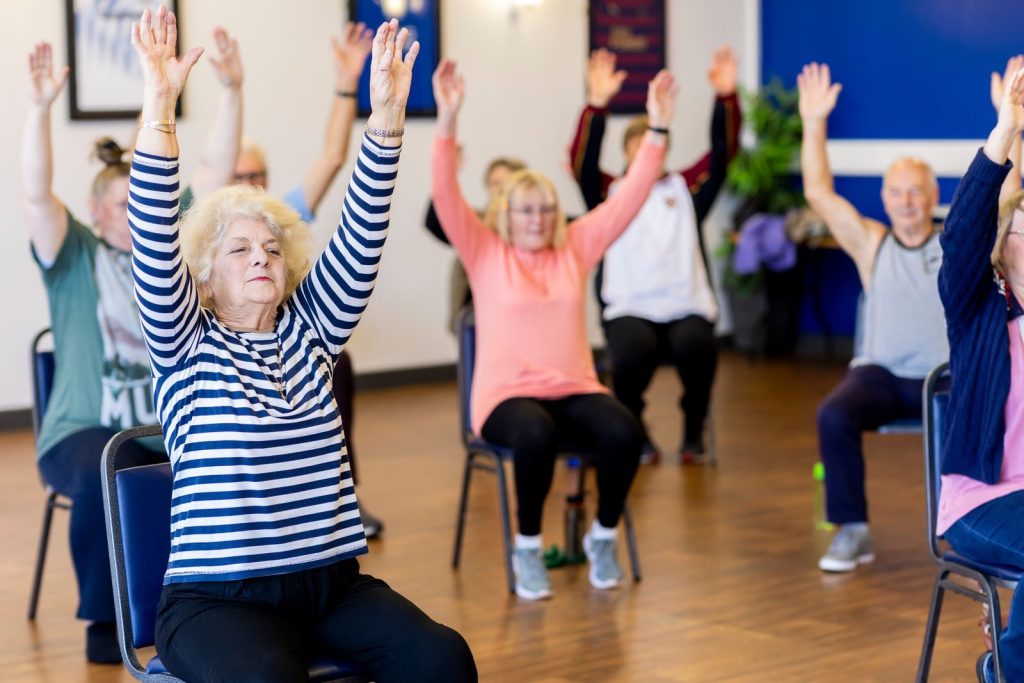
Move slowly and stay within a comfortable range. You should feel gentle muscular effort or a mild stretch, but never sharp pain, numbness, dizziness, or unusual shortness of breath.
Chair Yoga for Seniors Free: Workout at a Glance
Each movement receives 90 seconds, creating an exact 15-minute chair yoga workout. You do not need to move continuously for the entire interval. Pause, breathe, or reduce the range whenever necessary.
| Time | Exercise | Main purpose |
|---|---|---|
| 0:00–1:30 | Seated Mountain Breathing | Posture and breathing |
| 1:30–3:00 | Seated Sun Breaths and Shoulder Rolls | Shoulder and upper-back mobility |
| 3:00–4:30 | Ankle Pumps and Circles | Ankle mobility and lower-leg movement |
| 4:30–6:00 | Seated Cat-Cow | Gentle spinal movement |
| 6:00–7:30 | Seated Side Bend | Side-body mobility |
| 7:30–9:00 | Gentle Seated Twist | Upper-back rotation |
| 9:00–10:30 | Seated March | Hip and thigh activity |
| 10:30–12:00 | Alternating Knee Extension | Quadriceps and knee control |
| 12:00–13:30 | Seated Heel and Toe Raises | Calves, shins, and ankles |
| 13:30–15:00 | Seated Mountain Cool-Down | Relaxation and controlled breathing |
What You Need Before Starting
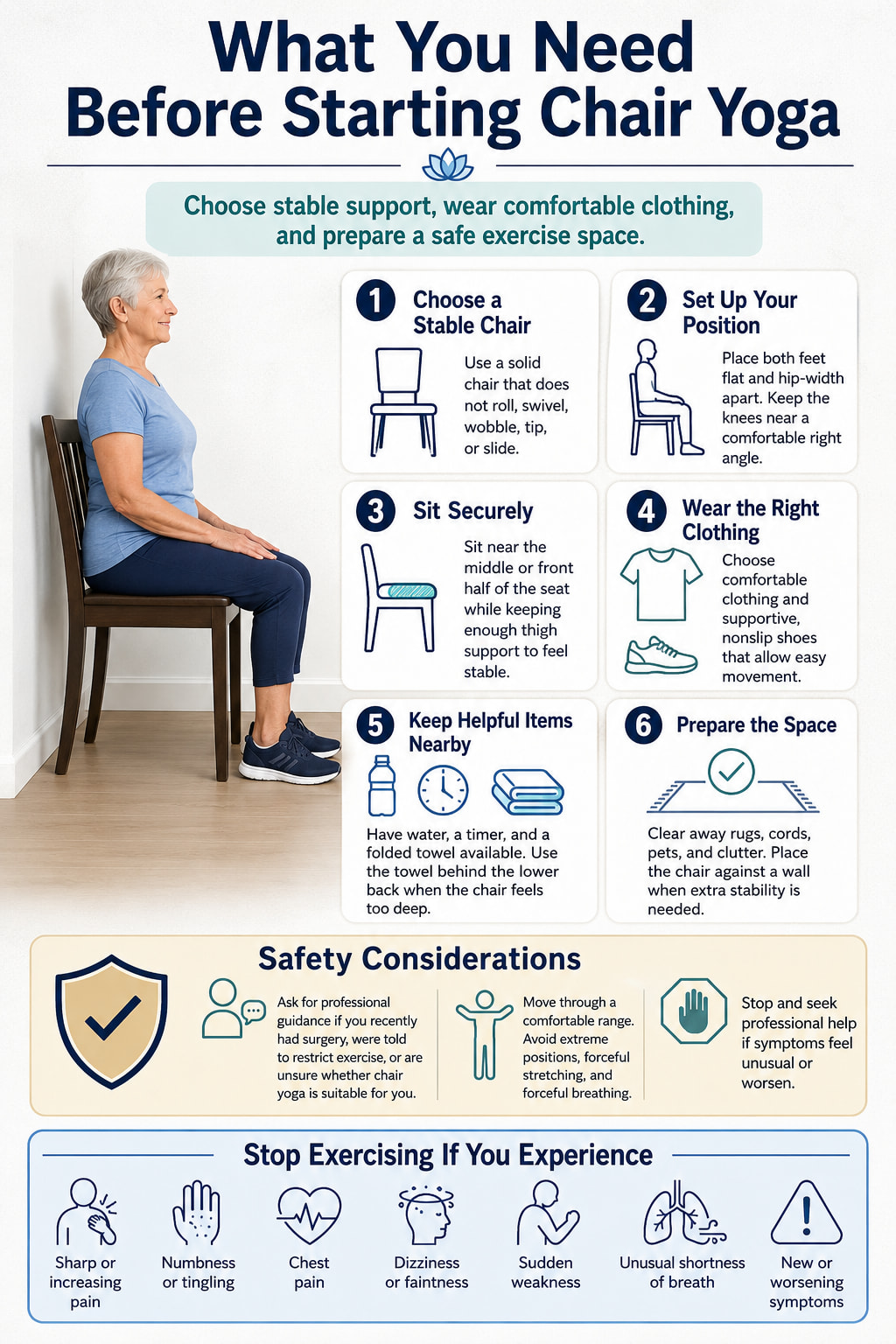
Use a solid chair that will not slide, tip, or roll. A dining chair placed against a wall usually works well. Avoid swivel chairs, folding chairs that feel unstable, and chairs with wheels.
The NHS seated-exercise guidance recommends choosing a stable chair and sitting where both feet can rest flat on the floor with the knees around a right angle. A chair without armrests provides more space, although armrests may be useful when someone needs additional support.
You may also want:
- Comfortable clothing that does not restrict movement
- Supportive, nonslip shoes
- Water nearby
- A timer or clock
- A folded towel behind the lower back if the chair feels too deep
Sit near the middle or front half of the seat when comfortable. Keep enough of your thighs supported that you feel secure. Position the feet approximately hip-width apart and let the shoulders relax.
Safety considerations
Check with a qualified healthcare professional before starting when you have recently had surgery, have been told to restrict exercise, or are unsure how an existing condition affects movement.
The National Center for Complementary and Integrative Health notes that yoga is generally considered safe when performed correctly, but older adults and people with certain health conditions may need modifications or professional guidance. Beginners should avoid forcing extreme positions or using forceful breathing techniques.
Stop exercising and seek professional help if you experience:
- Sharp or increasing pain
- Numbness or tingling
- Chest pain
- Dizziness or faintness
- Sudden weakness
- Unusual shortness of breath
- New or worsening symptoms
15-Minute Seated Chair Yoga Workout
Follow the exercises below as a gentle 15-minute seated chair yoga workout designed for seniors and beginners. Move slowly, breathe naturally, and use a comfortable range without forcing any position.
1. Seated Mountain Breathing
Best for: Establishing upright posture, relaxing the shoulders, and preparing for the workout.
Muscles worked: Abdominal muscles, spinal erectors, upper-back muscles, and other postural muscles.
Suggested time and reps: Practice for 90 seconds using five to eight slow breaths.
How to do it:
- Sit upright with both feet flat on the floor.
- Rest your hands on your thighs.
- Distribute your weight evenly across both sides of your pelvis.
- Gently lengthen through the top of your head.
- Relax your jaw and allow the shoulders to move away from the ears.
- Inhale comfortably through your nose.
- Exhale slowly without forcing all the air out.
- Continue breathing at a calm, natural pace.
Expert tip: Think about becoming tall rather than stiff. Good seated posture should still allow comfortable breathing.
2. Seated Sun Breaths and Shoulder Rolls
Best for: Warming up the shoulders, arms, chest, and upper back.
Muscles worked: Deltoids, trapezius, upper-back muscles, chest muscles, and arm muscles.
Suggested time and reps: Perform four to six Sun Breaths followed by five shoulder rolls in each direction.
How to do it:
- Begin in Seated Mountain with the arms relaxed.
- Inhale as you sweep the arms outward and upward.
- Stop before the shoulders rise toward the ears.
- Exhale as you lower the arms through the same wide path.
- Complete four to six controlled repetitions.
- Let the arms rest beside you.
- Roll both shoulders gently forward, up, back, and down.
- Reverse the direction after five repetitions.
Expert tip: Lead the arm sweep with the thumbs or palms while keeping the neck relaxed.
3. Ankle Pumps and Ankle Circles
Best for: Warming up the ankles and creating movement through the feet and lower legs.
Muscles worked: Calves, tibialis anterior along the front of the shin, and smaller muscles surrounding the ankles and feet.
Suggested time and reps: Complete eight to ten ankle pumps and four to six circles in each direction per foot.
How to do it:
- Sit upright and hold the sides of the chair if needed.
- Extend the right foot slightly forward.
- Point the toes away without forcing the ankle.
- Pull the toes gently back toward the shin.
- Repeat eight to ten times.
- Make four to six slow circles in one direction.
- Reverse the circles.
- Return the foot to the floor and repeat with the left side.
Expert tip: Imagine drawing a small, smooth circle with the end of the big toe.
4. Seated Cat-Cow
Best for: Gentle movement through the spine, pelvis, chest, and upper back.
Muscles worked: Abdominal muscles, spinal erectors, upper-back muscles, and muscles controlling the pelvis.
Suggested time and reps: Complete six to eight slow repetitions.
Rest: Sit upright for one breath after every two or three repetitions if needed.
How to do it:
- Place both feet flat on the floor and rest the hands on the thighs.
- Inhale as you gently tilt the pelvis forward.
- Allow the chest to lift without throwing the head backward.
- Exhale as you tilt the pelvis backward.
- Let the upper back round slightly as the chin moves gently toward the chest.
- Continue alternating between the two positions.
- Keep the movement comfortable rather than trying to create the largest possible curve.
Expert tip: Begin the motion at the pelvis and allow the rest of the spine to follow.
5. Seated Side Bend
Best for: Gentle mobility through the side of the torso, shoulders, and upper back.
Muscles worked: Obliques, latissimus dorsi, quadratus lumborum, shoulder muscles, and intercostal muscles between the ribs.
Suggested time and reps: Complete three to five slow bends per side.
How to do it:
- Sit tall with both feet grounded.
- Hold the side of the chair lightly with your right hand.
- Inhale and raise the left arm to a comfortable height.
- Exhale as you lean gently toward the right.
- Keep both sides of the pelvis in contact with the seat.
- Inhale as you return to the center.
- Lower the arm and repeat on the opposite side.
Expert tip: Think about creating length before bending sideways.
6. Gentle Seated Twist
Best for: Comfortable upper-back rotation and posture awareness.
Muscles worked: Obliques, spinal rotators, abdominal muscles, and upper-back muscles.
Suggested time and reps: Perform three to five controlled twists per side.
How to do it:
- Sit tall with the knees and feet facing forward.
- Cross your arms loosely over the chest or rest your hands on the thighs.
- Inhale to lengthen the spine.
- Exhale and rotate the rib cage gently toward the right.
- Keep the knees facing forward.
- Return to the center with control.
- Repeat toward the left.
- Continue alternating sides.
Expert tip: Turn from the upper torso rather than forcing the neck to create more range.
7. Seated March
Best for: Activating the hips and thighs while adding a small coordination challenge.
Muscles worked: Hip flexors, quadriceps, abdominal muscles, and postural muscles.
Suggested time and reps: Alternate legs for 45 to 60 seconds at a comfortable pace.
How to do it:
- Sit near the front half of the chair with both feet flat.
- Hold the sides of the seat for support if needed.
- Lift the right foot a comfortable distance from the floor.
- Lower it quietly and with control.
- Lift the left foot.
- Continue alternating sides.
- Keep the chest upright and breathe normally.
Expert tip: A small controlled lift is more useful than a high lift that causes the torso to rock.
8. Alternating Knee Extension
Best for: Activating the quadriceps and practicing controlled knee movement.
Muscles worked: Quadriceps, hip flexors, and muscles that stabilize the thigh and pelvis.
Suggested time and reps: Perform six to ten repetitions per leg.
How to do it:
- Sit tall with the feet hip-width apart.
- Keep the right thigh supported by the chair.
- Slowly straighten the right knee through a comfortable range.
- Keep the ankle relaxed or gently pull the toes toward the shin.
- Pause briefly without forcefully locking the knee.
- Lower the foot with control.
- Repeat with the left leg.
- Continue alternating sides.
Expert tip: Imagine lifting and lowering the foot through thick water.
9. Seated Heel and Toe Raises
Best for: Lower-leg activation and ankle control.
Muscles worked: Gastrocnemius and soleus in the calves, tibialis anterior in the shins, and muscles of the feet.
Suggested time and reps: Perform ten to fifteen heel raises followed by ten to fifteen toe raises.
How to do it:
- Sit with both feet flat and approximately hip-width apart.
- Keep the balls of the feet on the floor.
- Lift both heels slowly.
- Lower the heels without dropping them.
- Complete ten to fifteen repetitions.
- Keep the heels grounded and lift the toes.
- Lower the toes with control.
- Complete ten to fifteen repetitions.
Expert tip: Keep pressure spread across the base of the big toe, little toe, and heel.
10. Seated Mountain Cool-Down
Best for: Gradually finishing the workout and returning the breathing to a relaxed rhythm.
Muscles worked: Postural muscles remain lightly active, but the primary goal is relaxation rather than strengthening.
Suggested time and reps: Remain seated for 90 seconds and take five to eight comfortable breaths.
How to do it:
- Place both feet flat on the floor.
- Rest your hands on the thighs or lower abdomen.
- Allow the shoulders and jaw to relax.
- Inhale naturally.
- Exhale slowly and comfortably.
- Notice your feet contacting the floor.
- Gently move the fingers and toes.
- Open your eyes fully before standing.
- Use the chair for support if you need it when getting up.
Expert tip: Keep the eyes open with a soft gaze when closing them makes you feel unsteady.
What Muscles Does Chair Yoga Work?
Chair yoga involves muscles throughout the body, although the amount of resistance is usually light.
The main muscles used in this routine include:
- Postural muscles: Help hold the torso upright during breathing, bends, and twists
- Abdominal muscles: Assist with trunk control and controlled spinal movement
- Upper-back muscles: Support shoulder movement and upright posture
- Shoulder muscles: Work during arm sweeps and overhead reaches
- Hip flexors: Lift the thighs during seated marching
- Quadriceps: Straighten the knees during leg extensions
- Calves: Lift the heels and help control the ankles
- Shin muscles: Lift the toes and pull the feet upward
This routine creates light muscular activity, but it is not a complete strength-training program. Building substantial strength generally requires progressive resistance that becomes more challenging over time.
Potential Benefits of Chair Yoga for Older Adults
Provides an accessible way to move
Chair yoga removes the need to kneel, lie on the floor, or repeatedly move between standing and floor positions. This can make movement more approachable for people with limited mobility or low confidence with traditional yoga.
Supports comfortable joint movement
The routine moves the shoulders, spine, hips, knees, and ankles through controlled ranges. Regular gentle movement may help maintain mobility when it is performed consistently and without forcing painful positions.
Creates light muscular activity
Marching, knee extensions, heel raises, and postural holds activate the thighs, hips, lower legs, and trunk. However, the resistance may be too low to produce large strength gains without additional progression.
A 2025 systematic review of chair-based exercise programs found improvements in several measures of muscle endurance and flexibility among postmenopausal women. The included programs varied and were not limited to chair yoga, so the findings should not be interpreted as proof that one short routine will produce the same outcomes. (BMC Geriatrics)
Combines movement with breathing
Coordinating comfortable breathing with movement may help create a calmer pace and reduce unnecessary tension. Broader yoga research summarized by NCCIH suggests potential benefits for areas such as sleep and balance, but results vary between populations and styles of yoga.
Can help establish an exercise habit
A short routine may feel more manageable than a long workout. Practicing for 15 minutes consistently can help someone become more familiar with movement before gradually adding other suitable activities.
Evidence remains mixed
Chair yoga should not be presented as a guaranteed treatment. A 2024 randomized trial involving 454 adults aged 65 or older with multiple long-term conditions found that offering a 12-week chair-based yoga program did not significantly improve health-related quality of life or key secondary outcomes compared with usual care. No serious related adverse events were reported, and the program was acceptable to most participants. (NIHR Open Research)
These findings show why it is more accurate to describe chair yoga as an accessible movement option rather than a cure or guaranteed health solution.
Common Chair Yoga Mistakes to Avoid
Using an unstable chair
A chair that rolls, swivels, folds unexpectedly, or slides across the floor increases the chance of losing balance. Place a stable chair on a nonslip surface and consider positioning it against a wall.
Forcing the range of motion
A deeper stretch is not automatically better. Stop before the movement causes joint pain, pinching, dizziness, or loss of control.
Holding the breath
Breath-holding can create unnecessary tension. Continue breathing normally, especially during marching, knee extensions, and longer holds.
Moving too quickly
Speed can make it harder to notice poor alignment or discomfort. Use a pace that allows each repetition to remain smooth.
Leaning backward during leg exercises
Leaning backward reduces trunk control and may shift the work away from the intended muscles. Reduce the height of the march or the range of the knee extension instead.
Pulling into twists
The hands should not drag the torso into a deeper position. Use the trunk muscles to rotate gently and stop while the movement still feels comfortable.
Treating pain as progress
Mild muscular effort or a comfortable stretching sensation can be normal. Sharp, radiating, or increasing pain is a reason to stop.
How Often Should Seniors Do Chair Yoga?
Beginners can start with this routine two or three times per week. When the session feels comfortable and recovery is good, it may be practiced more frequently.
Use an easy to light-moderate effort of approximately 2–4 out of 10. You should be able to speak in complete sentences throughout the workout.
Progress gradually by changing one factor at a time:
- Complete the routine consistently.
- Improve control and breathing.
- Use a slightly larger comfortable range.
- Add one or two repetitions to selected movements.
- Extend selected intervals by 15–30 seconds.
- Add separate resistance or supported standing exercises when appropriate.
Do not progress by forcing stretches, moving faster, or continuing through pain.
How Chair Yoga Fits Into a Complete Exercise Plan
Chair yoga can be a useful mobility session, warm-up, recovery activity, or starting point, but it should not automatically be considered a complete exercise plan.
Current CDC recommendations for adults aged 65 and older include aerobic activity, muscle-strengthening activity on at least two days per week, and activities that improve balance. Adults who cannot meet the full recommendations should be as active as their abilities and conditions allow.
A gentle, fully seated routine may not:
- Raise the heart rate enough to count as moderate aerobic activity
- Provide enough resistance for comprehensive strength development
- Train standing balance directly
- Load the bones and lower body in the same way as suitable standing activity
Depending on individual ability, chair yoga may be combined with walking, resistance-band exercises, sit-to-stands, water exercise, or supported balance practice.
Example weekly structure
| Day | Activity |
|---|---|
| Monday | 15-minute chair yoga routine |
| Tuesday | Suitable aerobic activity and strength training |
| Wednesday | Chair yoga or light recovery movement |
| Thursday | Rest or comfortable daily activity |
| Friday | Chair yoga and suitable strength exercises |
| Saturday | Aerobic activity and supported balance practice |
| Sunday | Rest or gentle mobility |
The exact plan should match the person’s health, mobility, experience, and professional recommendations.
Frequently Asked Questions
Is chair yoga safe for seniors?
Chair yoga is generally a low-impact activity, but no exercise is appropriate for every person. Use a stable chair, move through a comfortable range, and seek professional guidance when an injury, medical condition, recent surgery, or balance problem affects exercise.
Is 15 minutes of chair yoga enough?
Fifteen minutes is enough for a short mobility and breathing session. It can be a useful starting point, but most older adults also benefit from appropriate aerobic, strength, and balance activities.
Can seniors practice chair yoga every day?
A gentle routine may be suitable on most days when it does not cause pain, excessive fatigue, or worsening symptoms. Beginners can start with two or three days per week and increase gradually.
What is the best chair for chair yoga?
Use a solid, stable chair with a firm seat and no wheels. Both feet should reach the floor comfortably. Place the chair against a wall when extra stability is needed.
Can chair yoga improve balance?
Chair yoga may support posture, body awareness, mobility, and movement control. However, a fully seated routine does not directly challenge standing balance. Suitable standing-balance activities should be added separately when safe.
Does chair yoga help with weight loss?
Chair yoga adds some physical activity, but a gentle 15-minute routine is unlikely to create substantial weight loss by itself. Body-weight changes depend on overall activity, eating patterns, sleep, health, and other individual factors.
Can I do chair yoga with arthritis or limited mobility?
Many movements can be modified by reducing the range, slowing the pace, or using the backrest. Chair yoga should not be described as a treatment for arthritis. Speak with a healthcare or rehabilitation professional when joint symptoms are significant, changing, or difficult to manage.
Conclusion
This chair yoga for seniors free routine offers a simple way to move the shoulders, spine, hips, knees, ankles, and legs without getting onto the floor. Begin with a stable chair, use comfortable ranges, and focus on smooth breathing rather than stretching farther.
Practice consistently before increasing the duration or difficulty. For a more complete fitness plan, combine seated mobility with suitable aerobic, resistance, and balance activities.
References
- CDC: Older Adult Activity—An Overview
- NCCIH: Yoga—Effectiveness and Safety
- NHS: Sitting Exercises
- BMC Geriatrics: Chair-Based Exercise and Physical Functioning
- NIHR Open Research: Gentle Years Yoga Randomized Trial
This content is for informational purposes only and is not a substitute for professional medical advice.