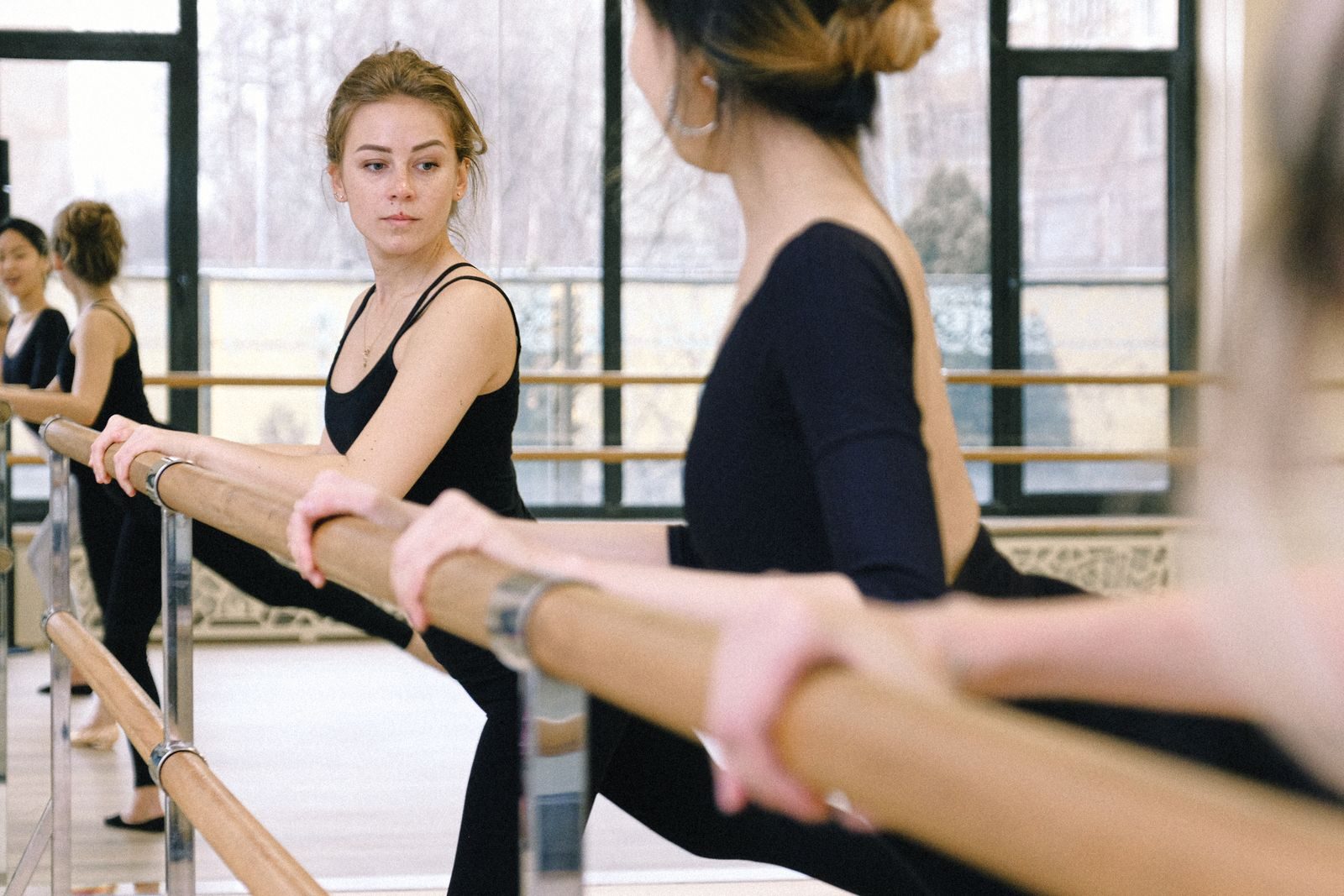
The main difference in Pilates vs barre is the training emphasis: Pilates centers on controlled movement and trunk stability, while barre commonly uses ballet-inspired exercises, holds, and repeated small movements to challenge muscular endurance. Both can involve whole-body training, but the experience depends on the class and instructor.
Neither is better for everyone. The useful question is which format matches your goals, feels manageable, and gives you room to progress. Here is how they compare, what the exercises involve, and how to start.
Pilates vs Barre at a Glance
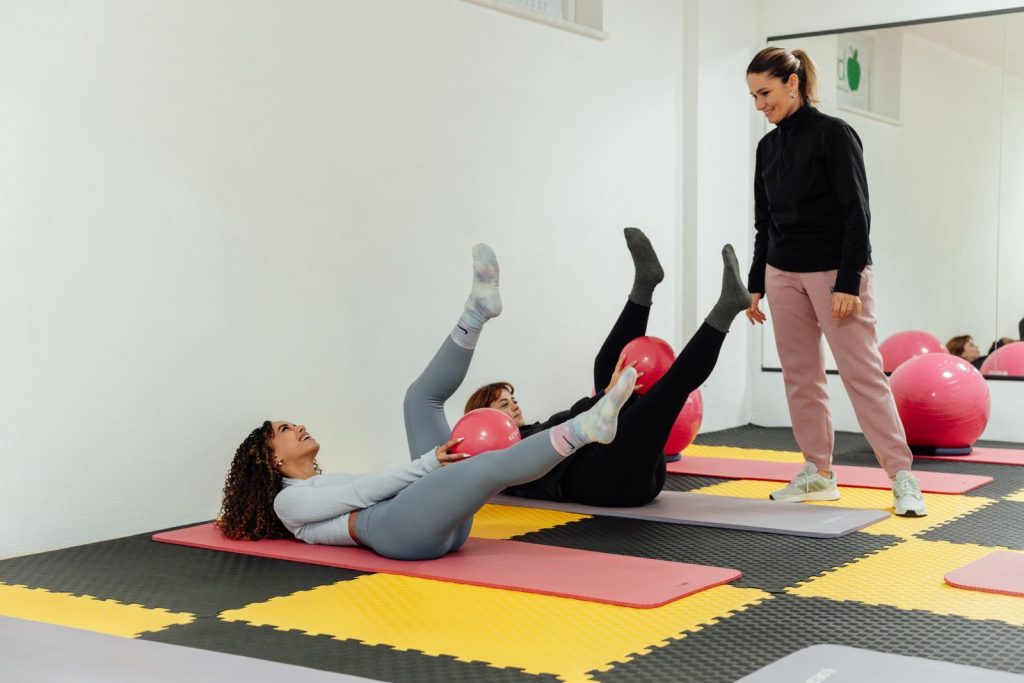
Mat Pilates, reformer Pilates, and barre have overlapping features, but their equipment and training methods differ. These are typical characteristics rather than rules for every class.
| Feature | Mat Pilates | Reformer Pilates | Barre |
|---|---|---|---|
| Main emphasis | Movement control, breathing, and trunk stability | Controlled movement with adjustable spring resistance and support | Muscular endurance through repeated movements and holds |
| Equipment | Mat; optional small props | Reformer with a moving carriage, springs, and straps | Barre or stable support; sometimes weights, bands, or a ball |
| Resistance | Primarily body weight against gravity | Springs and body weight | Body weight and often light external resistance |
| Typical movements | Floor exercises involving the trunk, hips, and limbs | Presses, pulls, and other movements using the apparatus | Knee bends, heel raises, standing leg work, and floor exercises |
| Home access | Many exercises need only a mat | Requires appropriate equipment and setup knowledge | Basic movements can use a fixed countertop |
| Beginner consideration | Choose introductory exercises rather than assuming all mat work is easy | Learn equipment settings with an instructor | Start with a foundations class and comfortable movement ranges |
What Do You Actually Do in Each Workout?
Pilates: Coordinate Movement, Breathing, and Control
Pilates asks you to move deliberately while controlling how your trunk and limbs work together. Depending on the exercise, you might keep your pelvis steady while moving a leg, lift your hips into a bridge, or coordinate an arm-and-leg reach.
As Cleveland Clinic explains, Pilates combines precise movement, controlled breathing, and work involving the abdominal and lower-back muscles. It is not simply an abdominal workout: the hips, glutes, and other muscle groups also contribute.
Mat versus reformer: As Merrithew explains, a reformer is not automatically the advanced option. Its equipment can provide assistance or introduce additional challenges. Likewise, some mat exercises are demanding because you must control your body without that support.
Barre: Repeat, Hold, and Control
Barre combines ballet-inspired positions with conditioning exercises. A session may alternate larger movements with small pulses and stationary holds.
The American Council on Exercise describes this combination of body-weight exercises, sustained positions, and optional resistance equipment. A hold keeps a position still; a pulse moves through a small range. They are related techniques, not the same action.
According to Cleveland Clinic, common lower-body barre movements involve the quadriceps, glutes, and calves. Trunk work and upper-body exercises may also appear, depending on the class.
Which Is Better for Your Goals?
For Focused Core Control: Start by Trying Pilates
Pilates is a sensible starting point when your main interest is coordinating movement, breathing, and trunk control. For example, a four-point kneeling reach challenges you to move opposite limbs without losing your position.
The Calderdale and Huddersfield NHS Foundation Trust includes exercises targeting abdominal control, glute function, coordination, and balance in its Pilates library. That makes the actual exercise selection more informative than the broad label “core workout.”
This is a recommendation based on training emphasis—not proof that Pilates produces better core results than every barre program.
For Repetition-Based Muscular Endurance: Try Barre
Barre is worth trying when you enjoy repeated leg movements and sustained positions. Look for a beginner class that gives you time to adjust your stance and take breaks.
Choose it for that training experience, not because a stronger burning sensation must mean a better workout. Your priority should remain controlled movement.
For Broader Strength Goals: Examine the Program, Not Just the Name
Either method can contribute to strength training, but a class label does not tell you whether all major muscle groups receive an appropriate challenge.
For healthy adults, the American College of Sports Medicine emphasizes consistent resistance training, individualized progression, and working the major muscle groups at least twice weekly. Its 2026 guidance recognizes body-weight exercises, bands, and home-based training as useful options—not just gym machines or free weights.
When evaluating a class, ask whether it includes upper- and lower-body work, whether exercises can be adjusted, and how the instructor helps participants progress.
What Does Research Say About a Winner?
A 2022 systematic review indexed by the National Library of Medicine did not establish a clear advantage for Pilates over other exercise methods for the assessed strength, balance, and flexibility outcomes. Evidence certainty was low to very low, so this should not be interpreted as proof that all workouts are equivalent.
A small study from Chulalongkorn University found improvements in lower-limb and core strength and endurance after eight weeks of barre training in sedentary female office workers. However, the study involved only 30 participants and compared barre with usual activity—not Pilates.
Neither finding establishes that Pilates or barre is universally better. Use the evidence to understand potential benefits, then choose a suitable class rather than chasing a definitive ranking.
Four Beginner Exercises That Show the Difference
These examples illustrate movements you may encounter in Pilates and barre. They are not exclusive to either method, and they do not represent a complete class.
Use a mat for the floor exercises and a fixed countertop or securely installed barre for standing support. Avoid furniture that can slide or tip.
Before starting, seek individualized guidance when an injury, recent surgery, or health condition could affect exercise suitability. The NHS distinguishes general Pilates exercise from treatment for a specific condition and advises stopping if exercise causes pain or makes you feel unwell. Stop and seek professional help for sharp pain, numbness, dizziness, chest pain, or other unusual symptoms.
1. Pilates Bridge: Basic Version
Best for: Practicing a controlled hip lift.
Muscles worked: Primarily the glutes, with trunk muscles helping control your position.
How to do it:
- Lie on your back with knees bent, feet flat and approximately hip-width apart, and arms resting beside you.
- Gently engage your abdominal muscles and press through your feet to lift your hips.
- Stop at a comfortable height without forcing an arch through your lower back.
- Lower slowly, keeping your knees aligned with your feet.
Common mistakes: Lifting higher by arching the back, letting the knees fall inward, or pushing through the neck.
Make it easier: Use a smaller lift. Keep your head and shoulders relaxed on the mat. As Cleveland Clinic explains, bridge exercises are also used outside Pilates to train the glutes and surrounding trunk muscles.
2. Pilates Four-Point Kneeling Reach
Best for: Coordinating arm and leg movement while keeping the trunk steady.
Muscles worked: Abdominal and back muscles, glutes, and shoulder-supporting muscles.
How to do it:
- Begin on hands and knees, with hands beneath shoulders and knees beneath hips.
- Look toward the mat and gently engage your trunk.
- Reach one arm forward and the opposite leg backward, only as far as you can without twisting or arching.
- Return slowly, reset your position, and change sides.
Common mistakes: Lifting the leg too high, rotating the pelvis, or looking forward and compressing the back of the neck.
Make it easier: Move one limb at a time. You can also slide a foot backward along the floor instead of lifting it.
The movement, demonstrated by the American Council on Exercise, is often called a bird dog; the goal is control rather than reaching as high as possible.
3. Supported Shallow Plié
Best for: Learning a controlled barre knee bend with support.
Muscles worked: Quadriceps and glutes.
How to do it:
- Stand at a fixed countertop or barre, with your heels close together and toes turned out only as far as comfortable.
- Rest your hands lightly on the support and keep your torso upright.
- Bend your knees through a shallow range, letting them track in the same direction as your toes.
- Keep your heels grounded, then straighten your legs without forcefully locking your knees.
Common mistakes: Forcing turnout, collapsing the knees inward, or lowering farther than you can control.
Make it easier: Reduce the depth. When turnout feels awkward, use parallel feet for a shallow supported knee bend instead. Comfortable alignment matters more than reproducing a ballet position.
4. Supported Parallel Calf Raise
Best for: Practicing controlled heel lifting with balance assistance.
Muscles worked: Calf muscles.
How to do it:
- Stand with feet approximately hip-width apart and toes facing forward.
- Place your hands lightly on a stable support.
- Raise your heels slowly, keeping your feet facing forward and your body upright.
- Pause briefly, then lower your heels with control.
Common mistakes: Bouncing, turning the feet during the movement, or shifting heavily onto the outside edges of the feet.
Make it easier: Lift through a smaller range and keep both hands on the support.
A parallel-foot version lets you practice the heel-raise movement without adding turnout. The same basic action, demonstrated by the American Council on Exercise, appears in general strength training as well as barre.
A Simple Pilates and Barre Starter Routine
Use this as a short technique-practice session, not a complete replacement for all other activity.
Begin with about five minutes of comfortable walking or marching. Start with one set of each exercise, using the following suggested ranges.
| Exercise | Starting repetitions | Rest |
|---|---|---|
| Supported shallow plié | 8–10 | 30–60 seconds |
| Supported parallel calf raise | 10–12 | 30–60 seconds |
| Pilates bridge | 8–10 | 30–60 seconds |
| Four-point kneeling reach | 5–6 per side | 30–60 seconds |
Effort: Keep the session manageable—roughly 5–6 out of 10 overall—and finish sets before you lose control. Take longer rests whenever needed.
Frequency: As a starting option, practice once or twice weekly on separate days. Fit it around your existing activity rather than automatically adding more sessions.
Progression: Once one set feels comfortable and repeatable, add a second set to one or two exercises. There is no need to increase every exercise at once.
Can You Take Both Pilates and Barre Classes?
Yes. A practical trial is one beginner Pilates class and one beginner barre class on different days. Notice which teaching style helps you learn, whether modifications are available, and how you recover afterward.
You do not need to commit to both. Keeping the option you enjoy and can attend consistently is a reasonable outcome.
Neither class automatically covers your aerobic activity needs. The CDC explains that moderate aerobic intensity generally raises breathing enough that you can talk but not sing. A locally tiring leg exercise does not, by itself, tell you that an entire session meets that intensity.
How to Progress Without Losing Form
Mat Pilates: Increase the Control Challenge Gradually
Start with a comfortable range and a version you can perform without rushing. A useful progression might be a slightly longer reach, a brief pause, or a more demanding variation—not necessarily more repetitions.
For example, progress from moving one limb in the kneeling reach to moving opposite limbs together. Keep the movement smaller when your trunk begins to shift.
Barre: Establish the Movement Before Adding More Work
Practice controlled repetitions before adding longer holds or extra pulses. Adjust one variable at a time, and keep breaks available.
Do not force turnout, depth, or a higher heel position to match another participant. End the set when fatigue prevents you from maintaining the intended position.
Reformer Pilates: Let the Exercise Determine the Spring Setting
More spring resistance is not always harder, and less is not always easier. Springs can assist movement as well as resist it.
Equipment manufacturer Align-Pilates notes that lower resistance can make some exercises more challenging. Learn settings from a trained instructor familiar with the machine instead of treating spring changes like a simple weight increase or decrease.
Across all three formats, avoid treating skipped rests, breath-holding, or deteriorating technique as signs of progress. Aim to repeat the movement well before making it harder.
Frequently Asked Questions
Is Barre the Same as Pilates?
No. Barre may incorporate Pilates exercises, but it also uses ballet-inspired positions and its own combinations of standing work, holds, and repetitions. An exercise can appear in both without making the methods identical.
Which Is Easier for Beginners?
Neither is automatically easier. An introductory class with clear instruction is a better starting point than an advanced class in either method. Mat Pilates can be demanding, while a reformer may provide useful support for certain exercises.
Do You Need Dance Experience for Barre?
No. A beginner barre class should teach the positions and offer adjustments. You do not need to reproduce a dancer’s turnout or flexibility to participate.
Can You Start Pilates or Barre at Home?
Basic mat Pilates and supported barre movements can be practiced at home with appropriate instruction. Choose a beginner session and an uncluttered exercise area. Reformer practice requires equipment-specific knowledge, so get instruction before attempting unfamiliar setups or exercises.
How Can You Tell Whether You Are Improving?
Track practical changes: steadier positioning, smoother repetitions, more comfortable movement, and less need to pause during the same task.
Compare your current performance with your own starting point. Do not use how exhausted you feel afterward as the only measure of a useful session.
The Bottom Line
Pilates and barre offer different ways to practice controlled, challenging movement. Start with Pilates when focused movement coordination appeals to you; try barre when you enjoy repetition-based standing and floor work.
Choose an introductory session, learn the basic positions, and progress one manageable step at a time. The better workout is the one that fits your goals and supports consistent, comfortable participation.
This content is for informational purposes only and is not a substitute for medical advice.
References
- Pinto JR, et al. (2022). Is Pilates Better Than Other Exercises at Increasing Muscle Strength? A Systematic Review.
- Yang K, et al. (2023). Pilates and Multiple Health Outcomes: An Umbrella Review.
- Wells C, Kolt GS, Bialocerkowski A. (2012). Defining Pilates Exercise: A Systematic Review.
- Parhonlakan A, Masodsai K. (2024). Effects of Barre Exercise Training on Lower Limbs and Core Muscle Endurance and Strength in Sedentary Female Office Workers.
- Currier BS, et al. (2026). American College of Sports Medicine Position Stand: Resistance Training Prescription for Muscle Function, Hypertrophy, and Physical Performance in Healthy Adults.