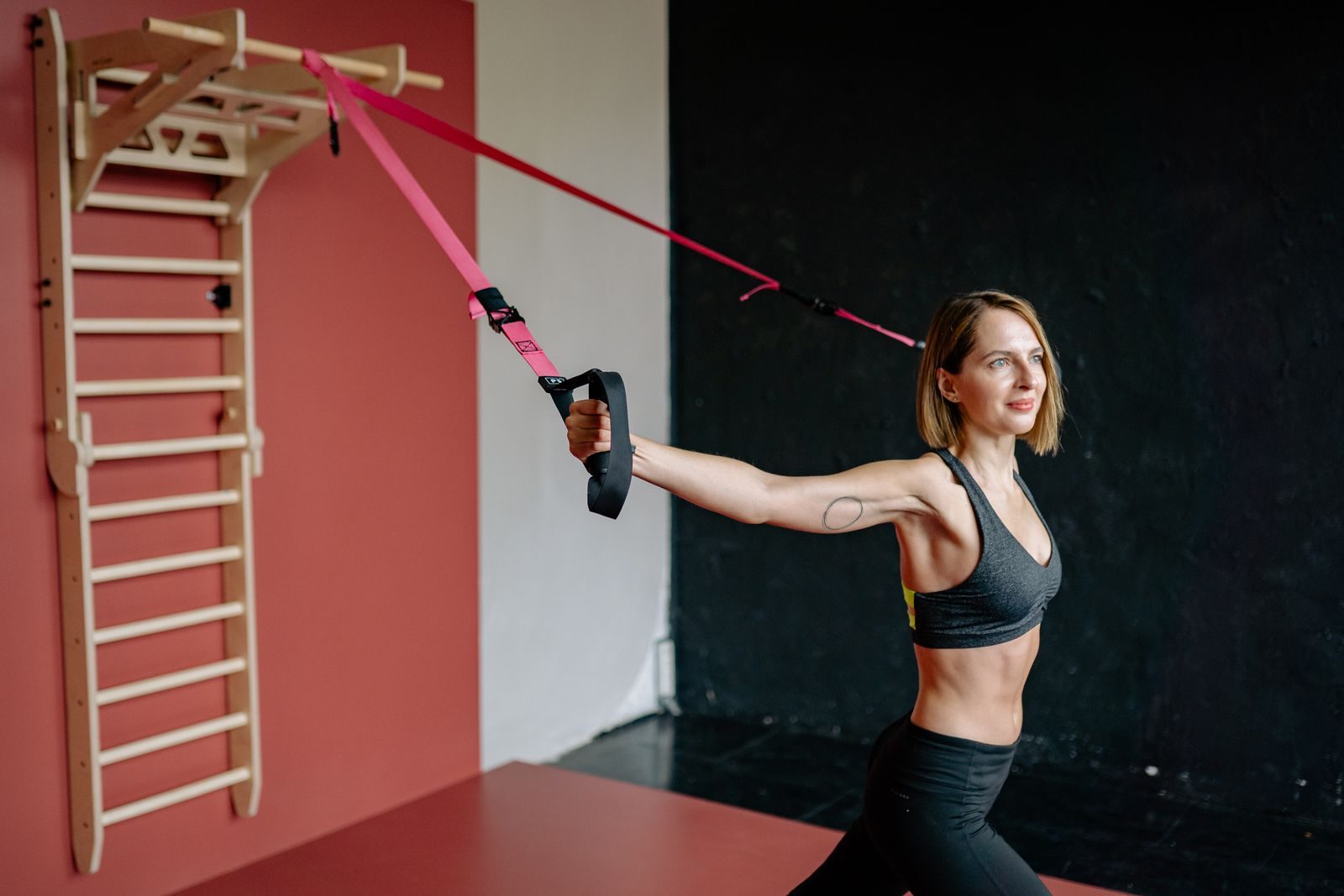
Resistance band upper body exercises can build strength in your chest, back, shoulders, and arms when you train consistently and gradually increase the challenge. Presses, rows, and pulldowns provide a useful foundation, while smaller movements add focused shoulder and arm work. Resistance bands are recognized as an effective training option in the American College of Sports Medicine resistance-training guidance.
The exercises below explain the setup, movement, and most important form checks. You do not need to perform all 11 in one session—the sample workout shows what to combine.
Before You Start
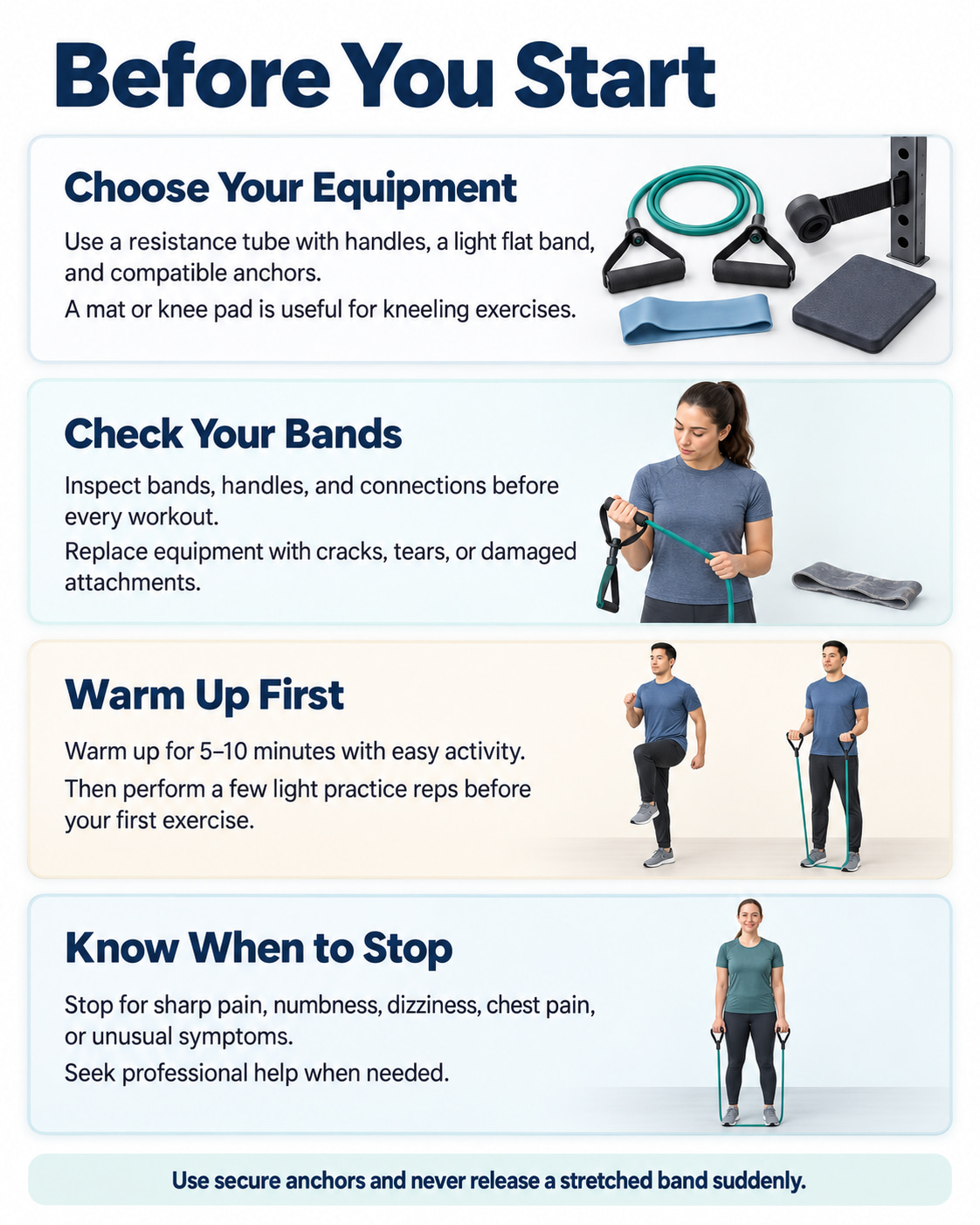
For this guide, you will need a resistance tube with handles, a light flat band, and compatible anchors for the anchored exercises. A mat or knee pad is useful for kneeling pulldowns.
Inspect the bands, handles, and connections before training. Discard damaged equipment, follow the manufacturer’s stretching limits, and never release a stretched band suddenly. Use anchors designed for your equipment rather than loose furniture or improvised attachments. These precautions follow guidance from the American Council on Exercise.
Warm up with 5–10 minutes of easy activity, followed by a few light practice repetitions of your first exercises. The American Academy of Orthopaedic Surgeons recommends a brief low-impact warm-up before shoulder-conditioning work.
Stop for sharp pain, numbness, dizziness, chest pain, or other unusual symptoms and seek professional help. MedlinePlus advises that new, unexplained chest pain—especially with shortness of breath—requires urgent medical attention.
11 Best Resistance Band Upper Body Exercises
Start with the first four movements for your main pressing and pulling work. Use the remaining exercises when you want additional chest, shoulder, or arm training.
Suggested starting dose: Perform 1–2 sets per selected exercise. Aim for 8–12 repetitions on exercises 1–4 and 10–15 repetitions on exercises 5–11. Rest approximately 90–120 seconds after the main movements and 60–90 seconds after accessories, taking longer when needed to maintain control.
1. Standing Resistance Band Chest Press
Best for: Your main chest-strengthening exercise without a bench.
Muscles worked: Primarily the chest, with assistance from the front shoulders and triceps.
This version uses a handled resistance tube anchored behind you at chest height, a setup included in chest-training guidance from the American Council on Exercise.
How to do it:
- Secure the tube through a compatible chest-height anchor. Face away from it and hold one handle in each hand.
- Step one foot forward. Bring the handles beside your chest, with palms facing down and elbows below shoulder level.
- Brace your abdomen and press the handles forward until your arms are comfortably straight. Keep your wrists aligned with your forearms.
- Return slowly, stopping before your elbows travel excessively behind your torso.
Common mistakes: Flaring the elbows straight sideways, pushing your ribs upward, bending your wrists, or leaning farther forward with each repetition.
Make it easier: Use a lighter tube or move slightly closer to the anchor while keeping the movement controlled.
2. Bent-Over Resistance Band Row
Best for: Back training without an external anchor.
Muscles worked: The upper back and rear shoulders, with the lats and elbow flexors assisting the pull.
The palms-in grip and controlled, elbows-close rowing action follow resistance-tubing row instructions from the Mayo Clinic.
How to do it:
- Stand on the middle of the tube with both feet approximately shoulder-width apart. Hold one handle in each hand, palms facing inward.
- Soften your knees and push your hips backward, inclining your torso while keeping your spine neutral.
- Pull the handles toward your lower ribs. Let your elbows travel backward close to your body.
- Lower your hands slowly without changing your torso position.
Common mistakes: Rounding your back, lifting your chest to generate momentum, shrugging, or turning the movement into a curl.
Form check: Your torso should remain almost still while your arms move. Reduce the resistance when maintaining the hinge becomes harder than completing the row.
3. Kneeling Resistance Band Lat Pulldown
Best for: Adding a vertical pulling movement to your workout.
Muscles worked: Primarily the lats, with assistance from the biceps and other upper-back muscles.
This is the kneeling version of a high-anchored, palms-forward band pulldown—not a seated row or behind-the-neck pull. The setup follows the resistance-band pulldown guidance from FITTR.
How to do it:
- Attach the handled tube to a secure overhead anchor. Kneel facing it on a padded surface, with the anchor above and slightly in front of you.
- Hold the handles with palms facing forward. Begin with your arms overhead in a comfortable range and your hips over your knees.
- Pull your elbows down toward your sides, bringing the handles toward shoulder or upper-chest level.
- Let your arms rise slowly, allowing your shoulder blades to move naturally as you return overhead.
Common mistakes: Pulling behind your neck, arching your back, rocking your hips, or leaning backward until the movement becomes a row.
Setup check: The tube must be suitable for the anchor height and movement. Do not create the starting tension by exceeding its stretching limit.
4. Standing Resistance Band Shoulder Press
Best for: Overhead pressing strength.
Muscles worked: Primarily the shoulders and triceps.
CommonSpirit Health describes the standing, foot-anchored version with the hands starting near the shoulders and palms facing forward.
How to do it:
- Stand on the middle of the tube with both feet, leaving similar lengths on each side.
- Hold the handles near shoulder height, palms facing forward. Position your elbows slightly in front of your torso.
- Brace your abdomen and press upward until your arms are comfortably extended overhead.
- Lower the handles to shoulder level without leaning backward or using your legs to drive the next repetition.
Common mistakes: Flaring the ribs, arching the lower back, bouncing through the knees, or forcing an uncomfortable overhead position.
Make it easier: Choose a lighter, sufficiently long tube. Your band must allow the entire overhead movement without exceeding its stretching limit.
5. Standing Resistance Band Chest Fly
Best for: Additional chest work after your main press.
Muscles worked: Primarily the chest, with the front shoulders assisting.
Unlike a press, a fly maintains a small elbow bend while the arms move together in an arc. That distinction is also emphasized in resistance-band exercise guidance from the National Center on Health, Physical Activity and Disability.
How to do it:
- Secure the handled tube behind you at chest height. Face away from the anchor in a staggered stance.
- Open your arms to the sides with a small bend in each elbow. Keep your hands slightly below shoulder height and palms facing inward.
- Bring your hands together in front of your chest along a wide arc, maintaining the elbow bend.
- Open your arms slowly, stopping around the point where your upper arms align with your torso.
Common mistakes: Straightening the elbows to press, reaching too far backward, shrugging, or allowing the band to pull your arms open abruptly.
Loading tip: Start lighter than you would for chest presses. Prioritize a smooth arc rather than a deep stretch.
6. Resistance Band Pull-Apart
Best for: Focused upper-back and rear-shoulder work without an anchor.
Muscles worked: Rear deltoids and the muscles that draw the shoulder blades toward each other.
Physical therapist guidance from Point Performance emphasizes a straight-arm pulling movement without shrugging or pushing the head forward.
How to do it:
- Hold a light flat band in front of your chest with palms facing down and hands slightly wider than shoulder-width apart.
- Keep your arms nearly straight and your ribs positioned over your pelvis.
- Move your hands apart until your arms approach the line of your torso and the band moves toward your chest.
- Bring your hands together slowly without letting the band snap back.
Common mistakes: Bending your elbows into a row, arching your back, jutting your chin forward, or forcing the band against your chest.
Make it easier: Use a lighter band or a wider starting grip. Chest contact is not required.
7. Single-Arm Resistance Band Lateral Raise
Best for: Training one shoulder at a time.
Muscles worked: Primarily the middle portion of the deltoid.
The lateral raise adds shoulder work without another overhead press. The American Council on Exercise includes the single-arm lateral raise among its resistance-band exercise options.
How to do it:
- Secure the tube beneath the middle of your working-side foot. Hold that side’s handle beside your thigh, palm facing inward.
- Stand tall with a small bend in the working elbow. Keep the unused section of tubing clear of your feet.
- Raise your arm outward and slightly forward until your hand reaches approximately shoulder height.
- Lower slowly, complete your repetitions, then change sides.
Common mistakes: Leaning away from the working arm, swinging the handle upward, bending the elbow progressively, or turning the thumb sharply downward.
Form check: Keep the torso quiet and use a light enough band to control the top of the lift. Finish both sides with the same number of clean repetitions.
8. Standing Resistance Band External Rotation
Best for: Light, controlled shoulder-rotation work.
Muscles worked: Primarily the infraspinatus and teres minor, two rotator-cuff muscles.
This is an externally anchored exercise. The opposite hand does not hold the band.
How to do it:
- Secure a light flat band at elbow height. Stand sideways with your working arm farther from the anchor.
- Hold the band with your working elbow bent about 90 degrees and resting beside your ribs. Place a small rolled towel between your elbow and torso.
- Keeping your wrist straight and thumb upward, rotate your forearm outward through a comfortable range.
- Return slowly without twisting your torso or letting your elbow move away from your side.
Common mistakes: Using heavy resistance, rotating your whole body, bending your wrist, or forcing the hand farther outward after shoulder rotation stops.
The Merck Manual uses the same elbow-at-the-side and towel-supported principles in its external-rotation guidance. Treat this as a controlled accessory, not a maximum-strength test.
9. Standing Resistance Band Biceps Curl
Best for: Direct arm work after rows and pulldowns.
Muscles worked: Primarily the biceps and brachialis, with forearm muscles assisting.
This version curls both handles together with a palms-forward grip rather than alternating arms or using a hammer grip, following the resistance-tube curl setup from FITTR.
How to do it:
- Stand on the middle of a handled resistance tube with both feet approximately shoulder-width apart.
- Hold the handles beside your thighs with palms facing forward and elbows close to your torso.
- Bend both elbows to bring the handles toward your shoulders without swinging your upper arms forward.
- Lower slowly until your elbows are comfortably extended.
Common mistakes: Leaning backward, bending the wrists, lifting the elbows forward, or dropping the handles through the lowering phase.
Form check: Your elbows should stay near the same position throughout the set. Once you need a body swing to lift the handles, end the set or reduce the resistance.
10. Standing Resistance Band Triceps Pressdown
Best for: Direct triceps work with a high anchor.
Muscles worked: Primarily the triceps.
The high-anchored pressdown uses elbow extension while the upper arms remain close to the torso. A small forward lean is acceptable; repeated rocking is not. This setup follows the resistance-tube pressdown guidance from FITTR.
How to do it:
- Secure a handled tube above head height. Face the anchor with your knees soft and torso leaning slightly forward from the hips.
- Hold one handle in each hand, palms facing inward. Keep your upper arms beside your ribs and elbows bent.
- Straighten your elbows to move the handles toward your thighs without driving your shoulders downward.
- Bend your elbows slowly to return, keeping your upper arms still.
Common mistakes: Using body weight to push the handles down, moving the elbows forward and backward, hunching the shoulders, or bending the wrists.
Loading tip: Choose resistance you can control without pressing your whole body onto the handles.
11. Bent-Over Resistance Band Triceps Kickback
Best for: A triceps option that does not require an external anchor.
Muscles worked: Primarily the triceps.
This two-arm variation uses a handled tube beneath both feet.
How to do it:
- Stand on the middle of the tube with both feet hip-width apart. Hold one handle in each hand with palms facing inward.
- Bend your knees slightly and hinge forward from your hips, keeping your spine neutral.
- Bring your upper arms alongside your torso with elbows bent. Hold this upper-arm position as you straighten both elbows, moving the handles backward.
- Bend your elbows slowly to return without letting your upper arms drop.
Common mistakes: Swinging the shoulders, lifting the elbows excessively, rounding the back, or shortening every repetition because the band is too heavy.
The wrist control, neutral-back position, and smooth movement emphasized in the Mayo Clinic’s tubing-kickback guidance also apply here.
A Simple Resistance Band Upper Body Workout
Use this as a starting routine twice per week on nonconsecutive days, such as Monday and Thursday. Training major muscle groups at least twice weekly is consistent with American College of Sports Medicine guidance.
| Exercise | Sets | Repetitions | Rest |
|---|---|---|---|
| Standing chest press | 2 | 8–12 | 90–120 seconds |
| Bent-over row | 2 | 8–12 | 90–120 seconds |
| Standing shoulder press | 2 | 8–12 | 90–120 seconds |
| Kneeling lat pulldown | 2 | 8–12 | 90–120 seconds |
| Biceps curl | 1–2 | 10–15 | 60–90 seconds |
| Triceps pressdown | 1–2 | 10–15 | 60–90 seconds |
For a beginner: Start with one set of the first four exercises. Add a second set as you become comfortable with the movements, then include curls and pressdowns when the session remains manageable.
Effort: As a practical starting target, finish each set feeling you could perform approximately two or three more controlled repetitions. Do not continue once the movement becomes a swing, lean, or shortened repetition.
Using the other exercises: Replace pressdowns with kickbacks when you do not have a high anchor. For extra chest or shoulder work, choose one accessory—fly, pull-apart, lateral raise, or external rotation—rather than automatically adding all four.
This routine trains the upper body, not the entire body. Include lower-body training elsewhere in your week to cover the major muscle groups identified in CDC activity recommendations.
How to Progress Without Losing Your Form
Use a simple progression rule: add controlled repetitions before adding resistance.
For example, begin with two sets of eight chest presses. Build toward two sets of 12 while maintaining the same stance, range of motion, and controlled return. When both sets feel manageable at your intended effort, move to slightly greater resistance and return toward eight repetitions.
Keep a short training log showing the exercise, band used, sets, repetitions, and starting position. These details matter because band tension changes with stretch; stepping farther from an anchor changes the exercise’s resistance. Stay within the manufacturer’s limits.
When progress stalls, check your technique and recovery before adding more exercises. Ask yourself whether you are completing the same range of motion, taking sufficient rest, and using a repeatable setup.
For external rotations and lateral raises, make smaller resistance increases. Completing the movement smoothly matters more than moving to the next band quickly.
Frequently Asked Questions
Can resistance bands build upper-body muscle?
Yes. Resistance-band training can improve muscle size as well as strength. The important requirements are a sufficiently challenging training stimulus, consistent practice, and progression—not simply stretching a band for a large number of easy repetitions.
Are resistance bands as effective as weights?
They can produce meaningful strength gains. A systematic review published in SAGE Open Medicine found no statistically significant difference in strength gains between elastic resistance and conventional resistance equipment across the included studies. That supports bands as a useful option, but it does not establish that every band exercise and weight-training program produces identical results.
Which resistance band should I use?
Choose resistance separately for each exercise. Use the repetition ranges and effort target above as your starting test: you should be able to complete the movement without swinging, shortening the range, or losing your posture.
Do not expect the same tube to suit both a row and an external rotation.
Can I do this workout every day?
For this routine, use two nonconsecutive training days initially rather than repeating the full workout daily. Add training only when you are recovering well and maintaining your performance. You do not need to train to failure in every session to make progress.
Can I train without a door or wall anchor?
Several exercises here use your feet or hands instead: rows, shoulder presses, pull-aparts, lateral raises, curls, and kickbacks. However, the chest press, chest fly, pulldown, external rotation, and pressdown variations described here require secure external anchors.
Skip an exercise when the required attachment is unavailable rather than improvising an unsafe setup.
Build a Routine You Can Repeat
Start with a manageable combination of presses and pulls, then add arm or shoulder work where it serves a clear purpose. Use resistance that lets you control the entire repetition, record your setup, and increase the challenge gradually.
For your next session, practice the first four exercises with light resistance. Establish clean repetitions before making the workout harder.
This content is for informational purposes only and is not a substitute for medical advice.
References
- Lopes JS, Machado AF, Micheletti JK, et al. Effects of training with elastic resistance versus conventional resistance on muscular strength: A systematic review and meta-analysis. SAGE Open Medicine. 2019;7.
View the study on PubMed - Seguin RC, Cudlip AC, Holmes MWR. The Efficacy of Upper-Extremity Elastic Resistance Training on Shoulder Strength and Performance: A Systematic Review. Sports. 2022;10(2):24.
Read the full study on PubMed Central - Iversen VM, Mork PJ, Vasseljen O, Bergquist R, Fimland MS. Multiple-joint exercises using elastic resistance bands vs. conventional resistance-training equipment: A cross-over study. European Journal of Sport Science. 2017;17(8):973–982.
View the study on PubMed - Currier BS, Mcleod JC, Banfield L, et al. Resistance training prescription for muscle strength and hypertrophy in healthy adults: A systematic review and Bayesian network meta-analysis. British Journal of Sports Medicine. 2023;57:1211–1220.
Read the full study on PubMed Central - American College of Sports Medicine. Updated Resistance Training Guidelines. 2026.
Read the ACSM Resistance Training Guidelines