

Resistance band exercises for shoulders can build strength by combining presses, raises, pulling movements, and controlled rotation. The exercises below cover the front, sides, and back of your shoulders, plus muscles that help control your shoulder blades.
You do not need to perform all nine in one session. Learn the movements, then use the five-exercise workout below as a manageable starting point.
Before You Start
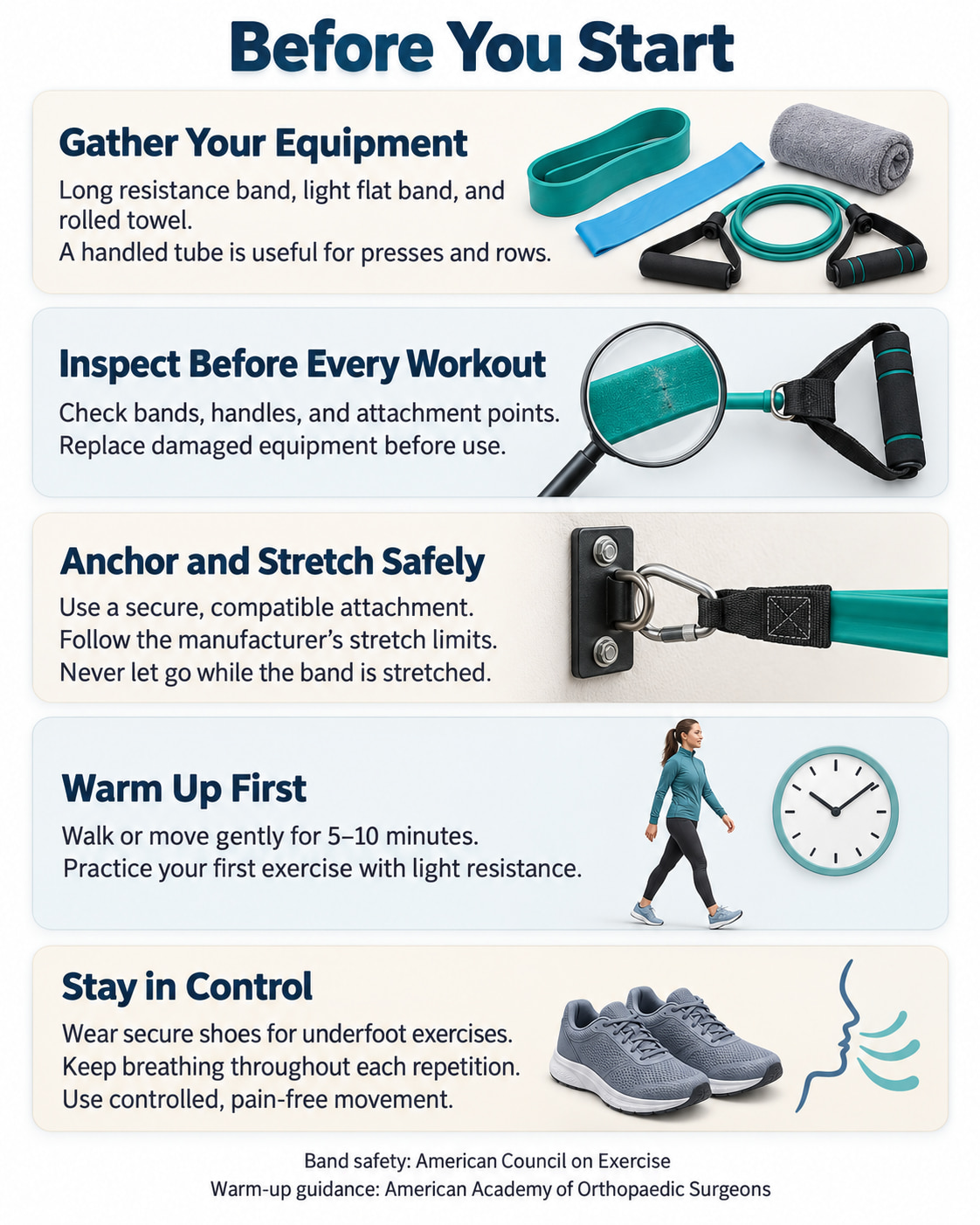
Have a long resistance band, a light flat band, and a small rolled towel available. A handled resistance tube is useful for presses and rows. Anchored exercises require a secure attachment designed for your band.
Check the band, handles, and attachment points for damage. Follow the manufacturer’s instructions for anchoring and maximum stretch, and never release a stretched band suddenly. These precautions follow the American Council on Exercise’s resistance-band guidance.
Warm up with 5–10 minutes of walking or another easy activity, then rehearse your first exercise with light resistance. The American Academy of Orthopaedic Surgeons recommends warming up and performing shoulder exercises without pain.
Wear secure footwear for exercises that anchor the band under your feet. Breathe throughout each repetition, and choose resistance you can control through the entire movement.
9 Resistance Band Exercises for Shoulders
Use the setup described for each exercise; changing your grip, anchor, or arm path changes the movement.
The repetition ranges below are starting suggestions for general fitness.
1. Standing Band Overhead Press
Focus: Shoulders and triceps.
Equipment: Long resistance tube with handles.
Reps: 8–12.
The overhead press trains several muscles together. INTEGRIS Health includes it among its home shoulder-strengthening exercises.
How to Do It
- Stand on the middle of the tube with your feet about hip-width apart. Hold one handle in each hand.
- Bring your hands to shoulder level, with palms facing forward and the tubing running behind your upper arms.
- Keep your knees soft and ribs above your pelvis. Press upward until your arms straighten comfortably overhead.
- Lower your hands to shoulder level under control.
Form check: Avoid leaning backward to finish the press. Your shoulder blades should move naturally as your arms rise. If you must arch your back, use lighter resistance.
2. Band Lateral Raise
Focus: Middle deltoids, which lift your arms out to the sides.
Equipment: Long resistance band.
Reps: 10–15.
How to Do It
- Stand with the middle of the band secured beneath your feet, about hip-width apart.
- Hold an end in each hand beside your thighs, palms facing inward.
- Keep a slight bend in your elbows and raise both arms out to the sides, stopping around shoulder height.
- Lower slowly while keeping your torso still.
Form check: Avoid swinging, leaning, or bending your elbows more as you lift. Keep your wrists aligned with your forearms. If the last part of the raise is too difficult, use a lighter band.
3. Single-Arm Band Front Raise
Focus: Front deltoid.
Equipment: Long flat resistance band.
Reps: 10–15 per arm.
This uses the thumb-up position described in The Stone Clinic’s shoulder-raise guidance.
How to Do It
- Secure one end of the band beneath your foot and hold the other in the working hand.
- Stand tall with your arm beside you and your elbow straight without forcing it backward.
- Keeping your thumb pointing upward, lift your arm directly forward to just below shoulder height.
- Lower smoothly to your side. Complete your repetitions, then switch arms.
Form check: Avoid leaning back or lifting your shoulder toward your ear.
Front raises are optional if your workout already includes plenty of overhead pressing or chest pressing.
4. Band Pull-Apart
Focus: Rear shoulders and upper-back muscles.
Equipment: Long flat resistance band.
Reps: 10–15.
How to Do It
- Stand tall with your feet about shoulder-width apart.
- Hold the band in front of you at shoulder height, hands about shoulder-width apart and palms facing down.
- Keep your arms straight and pull your hands outward, allowing your shoulder blades to move toward each other.
- Stop within a comfortable range, then slowly bring your hands back to the starting position.
Form check: Avoid flaring your ribs or forcing your arms behind your torso. The movement should come from your shoulders and shoulder blades, without bending your elbows into a row.
Use a lighter band if you cannot separate your hands while keeping your torso steady.
5. Standing Band Row
Focus: Upper back and rear shoulders.
Equipment: Resistance band with a secure anchor.
Reps: 10–15.
How to Do It
- Attach the band securely around elbow height. Face the anchor, holding one end or handle in each hand.
- Step back until the band has light tension with your arms reaching forward. Keep your knees slightly bent and palms facing inward.
- Pull your hands toward your lower ribs, keeping your elbows close to your sides.
- Stop when your elbows reach approximately the line of your torso. Extend your arms slowly, allowing your shoulder blades to move forward.
Form check: Avoid rocking backward or pulling your elbows far behind you. Your body should remain steady while your arms and shoulder blades move.
6. Self-Anchored Band External Rotation With Towel
Focus: Rotator cuff muscles that turn the upper arm outward.
Equipment: Light flat band and rolled towel.
Reps: 10–15 per arm.
How to Do It
- Place the towel between your working upper arm and ribs. Bend that elbow to 90 degrees.
- Hold the band with both hands. Start with your working forearm pointing forward; your opposite hand holds the band stationary.
- Keeping your elbow beside you, rotate the working hand outward through a comfortable range.
- Return slowly, then repeat on the other side.
Form check: Keep your wrist straight. Avoid moving the anchoring hand, twisting your torso, or squeezing the towel aggressively.
The resistance should be light enough to preserve the small, controlled movement.
7. Band Internal Rotation at Your Side
Focus: Muscles that turn the upper arm inward, including the subscapularis.
Equipment: Light band, secure anchor, and rolled towel.
Reps: 10–15 per arm.
How to Do It
- Secure the band at forearm height with your elbow bent to 90 degrees. Stand with your working side closest to the anchor.
- Hold the band with your thumb up and place the towel between your upper arm and ribs.
- Starting with your forearm pointing forward or slightly outward, rotate your hand inward toward your abdomen.
- Return slowly without letting the band pull your arm beyond a comfortable range. Switch sides.
Form check: Keep your elbow beside you and your wrist straight. Avoid turning your whole body to move the band.
8. Single-Arm Band Scaption Raise
Focus: Shoulder muscles working through a diagonal arm raise.
Equipment: Long flat resistance band.
Reps: 10–15 per arm.
How to Do It
- Secure one end of the band beneath your foot and hold the other in the working hand.
- Stand tall with your arm beside you and your thumb pointing upward.
- Keeping your elbow straight without forcing it backward, lift your arm diagonally—between straight ahead and directly out to your side.
- Stop at or just below shoulder height, within a comfortable range. Lower slowly and repeat on the other side.
Form check: Maintain the diagonal path throughout. Avoid drifting into a front raise or leaning sideways.
Scaption offers another lifting angle; choose it according to comfort and your training goals.
9. Band Serratus Punch
Focus: Serratus anterior, which helps move your shoulder blades around your rib cage.
Equipment: Long flat resistance band.
Reps: 10–15.
How to Do It
- Position the middle of the band around your upper back, below your shoulders, and hold an end in each hand.
- Reach your arms forward at about shoulder height, with thumbs up and elbows straight without hyperextending.
- Keeping your elbow angle unchanged, reach your hands a little farther forward by moving your shoulder blades around your ribs.
- Let your shoulder blades return under control while your arms remain extended.
Form check: This is a short reaching movement. Avoid bending and straightening your elbows like a chest press, or rounding your whole back to reach farther.
A Complete Resistance Band Shoulder Workout
Use this routine twice weekly on nonconsecutive days as a starting point. Complete the sets for one exercise before moving to the next.
| Exercise | Sets | Reps | Rest between sets |
|---|---|---|---|
| Standing band overhead press | 2 | 8–12 | 60–90 seconds |
| Standing band row | 2 | 10–15 | 60–90 seconds |
| Band lateral raise | 1–2 | 10–15 | 45–60 seconds |
| Self-anchored external rotation | 1–2 | 10–15 per arm | 45–60 seconds |
| Band serratus punch | 1–2 | 10–15 | 45–60 seconds |
If you are new to resistance training, start with one set of each exercise. Take longer rests whenever you need them to maintain control.
Finish most sets feeling that you could perform another two or three good repetitions. Use particularly light resistance for rotation exercises.
The remaining exercises let you adjust the session:
- Pull-aparts: An option for additional rear-shoulder and upper-back work. Start with one set if recovery is good.
- Scaption raises: An alternative raising angle to use in place of lateral raises.
- Front raises: Optional extra front-shoulder work; avoid adding them automatically when you already press regularly.
- Internal rotation: Optional direct inward-rotation work. Start with one light set rather than adding several exercises at once.
This is a shoulder-focused session. Include training for your other major muscle groups elsewhere in your week.
How to Choose Resistance and Progress
Choose your band by how the exercise feels, rather than its color alone. Color and resistance ratings differ between brands.
Bands generally become harder to stretch as they lengthen. A repetition that feels easy at the bottom can still be challenging near the top. Select resistance that lets you complete the intended range without changing your posture.
When you can reach the top of the repetition range for every set with consistent form across two sessions, try a slightly stronger band. Return toward the lower end of the range as needed.
Record the band and setup you used. Changing your grip length, stance, or distance from an anchor also changes the resistance, making progress harder to compare.
Frequently Asked Questions
Can Resistance Bands Build Shoulder Muscle?
Yes. The American College of Sports Medicine’s updated resistance-training guidance recognizes elastic bands as an effective option for improving strength and muscle size. Your training must remain sufficiently challenging as you get stronger; reaching complete muscle failure is not required.
Do I Need a Door Anchor?
An external anchor is needed for the standing row and internal rotation described here. The other seven exercises use your feet, hands, or upper back to provide resistance.
Use a purpose-built attachment according to its instructions. Avoid improvising with an unsecured handle or object.
Should I Train My Shoulders Every Day?
Daily hard shoulder training is unnecessary for this routine. Start with the twice-weekly schedule and allow recovery between sessions. Remember that chest presses, push-ups, and other upper-body exercises also contribute to your shoulders’ workload.
Are These Exercises Suitable for Shoulder Pain?
These are general fitness instructions, not an individualized rehabilitation plan. Stop any movement that causes shoulder pain, particularly sharp or worsening pain. Seek guidance from a qualified healthcare professional if you have an injury, recent surgery, persistent pain, numbness, or weakness.
This content is for informational purposes only and is not a substitute for medical advice.
References
- Seguin et al. (2022) — Elastic Resistance Training for Shoulder Strength and Performance: A Systematic Review
- AAOS — Rotator Cuff and Shoulder Conditioning Program
- ACSM (2026) — Updated Resistance Training Guidelines
- Lopes et al. (2019) — Elastic Versus Conventional Resistance Training: A Systematic Review and Meta-Analysis
- Fukunaga et al. (2022) — Band Pull-Apart Exercise: Effects of Movement Direction and Hand Position on Shoulder Muscle Activity
- ACE (2025) — The ACE Workout Builder for Resistance Band Workouts