

Resistance band chest exercises can build chest strength through presses, flyes, and band-resisted push-ups without a weight machine or a full home gym. The American College of Sports Medicine recognizes elastic-band and home-based resistance training as useful options for improving strength and muscle size when training is sufficiently challenging and progresses over time.
The nine options below include standing, floor-based, and no-anchor exercises. Choose one main press and, when suitable, one fly—you do not need all nine in a single workout.
Before You Start
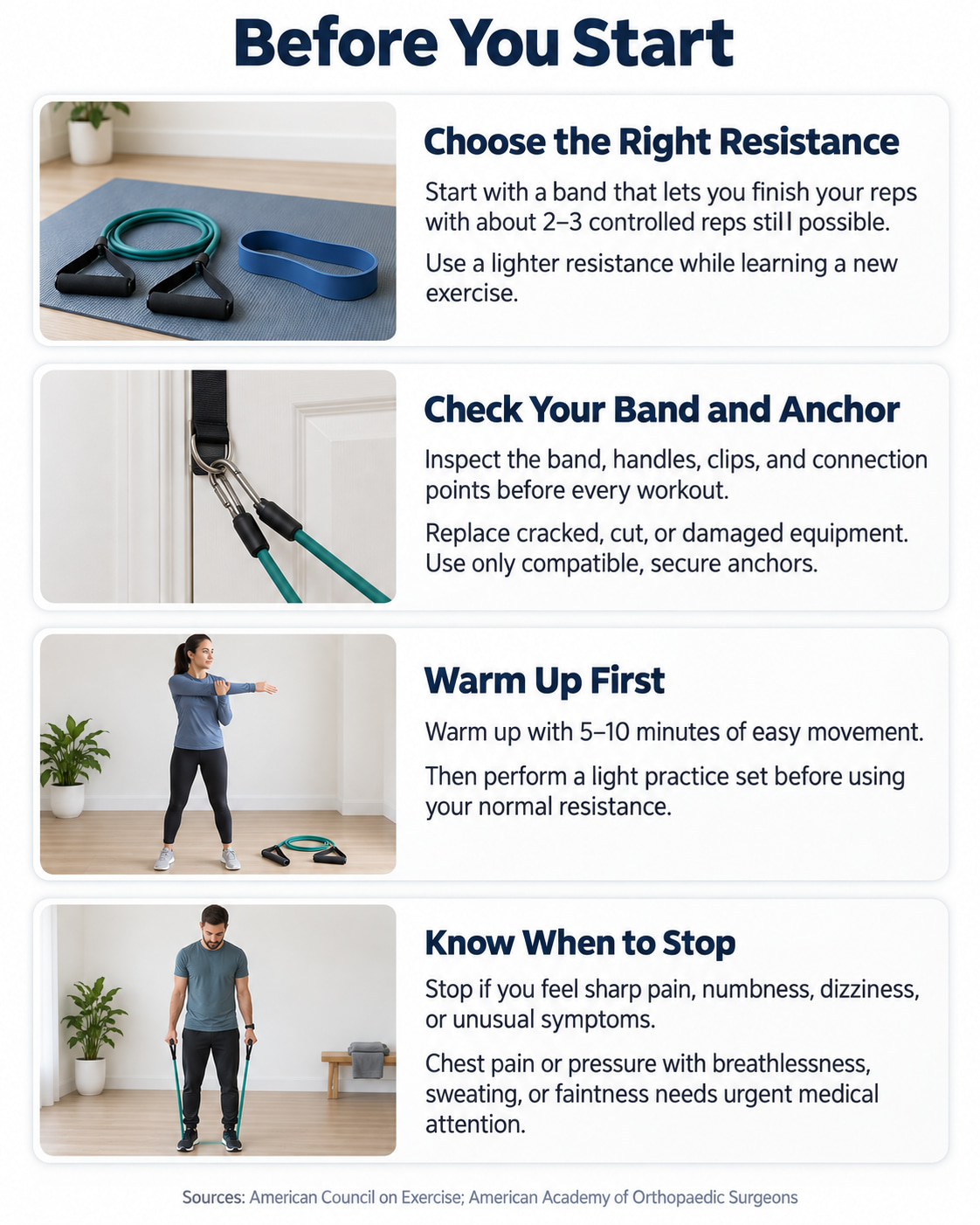
Choose resistance that lets you complete the suggested repetitions while keeping approximately two or three more controlled repetitions in reserve. Start lighter while learning a new setup.
Inspect the band, handles, and connection points before training. The American Council on Exercise recommends discarding damaged bands, following the manufacturer’s stretching limits, and never releasing a band under tension. Use compatible anchors and prevent anyone from opening a door used for anchoring.
Warm up with 5–10 minutes of easy movement, then perform a light practice set. The American Academy of Orthopaedic Surgeons recommends warming up with low-impact activity before shoulder-focused exercise. Breathe throughout each repetition rather than holding your breath.
Stop and seek professional guidance for sharp pain, numbness, dizziness, or unusual symptoms. Chest pain or pressure—especially with breathlessness, sweating, or faintness—requires urgent medical attention.
9 Best Resistance Band Chest Exercises
Use the equipment specified for each variation. The sets, repetitions, and rest periods are starting suggestions for the exercises you select, not instructions to complete the entire list.
1. Standing Resistance Band Chest Press
Best for: A main pressing exercise with a chest-height anchor.
Equipment: Resistance tubing with two handles and a secure anchor.
Sets, reps, and rest: 2 sets of 8–12 repetitions; rest 90–120 seconds.
How to do it:
- Anchor the tubing behind you at chest height. Hold one handle in each hand with equal working lengths on both sides.
- Face away from the anchor and take a staggered stance. Establish light tension, then bring your hands beside your chest with bent elbows and straight wrists.
- Brace your abdomen and press both handles forward. Extend your arms comfortably while keeping your torso steady.
- Pause briefly, then return slowly to chest level without letting your shoulders pull into an uncomfortable backward stretch.
Peak Physio describes this chest-height anchor, split stance, and controlled forward press.
Common mistakes: Rocking forward to finish each repetition, shrugging, or bending the wrists. Reduce resistance when your body position starts changing.
Make it easier: Use a lighter tube while preserving the same movement.
2. Wraparound CLX Band Chest Press
Best for: Standing chest training without an external anchor.
Equipment: A CLX-style resistance band with built-in hand loops.
Sets, reps, and rest: 2 sets of 8–12 repetitions; rest 90–120 seconds.
How to do it:
- Stand upright and position the middle of the band across your upper back, below your neck.
- Place your hands through corresponding loops on each side. Close your hands with your thumbs pointing upward, and hold them beside your chest.
- Press both hands forward until your arms are comfortably extended. Keep your ribs controlled rather than leaning backward.
- Hold briefly, then slowly return your hands to chest level.
Performance Health describes the CLX chest press using this upper-back placement, hand-loop grip, and forward pressing movement.
Common mistakes: Letting the band ride toward the neck or using loops that make the starting position excessively tight. Reset the band before continuing.
Equipment note: This setup uses a band with multiple built-in loops—not a short mini-band or an ordinary resistance tube.
3. Resistance Band Floor Press
Best for: A supported pressing position without a bench or anchor.
Equipment: A suitable long resistance band and an exercise mat.
Sets, reps, and rest: 2 sets of 8–12 repetitions; rest 90–120 seconds.
How to do it:
- Position the band across your upper back and hold it securely in both hands. Lie on your back with your knees bent and feet flat.
- Bring your hands beside your chest with your elbows bent and forearms approximately perpendicular to the floor.
- Press your hands toward the ceiling above your chest. Extend your arms while keeping your feet planted and your torso supported.
- Lower slowly until your upper arms lightly contact the floor. Pause without bouncing, then repeat.
FITTR describes its band chest press from this floor-based position, with bent knees, planted feet, and an upward press.
Common mistakes: Bouncing the upper arms, raising the hips, or losing your grip as tension increases.
Make it easier: Choose less resistance. Keep the supported position rather than shortening every repetition to move a band that is too strong.
4. Single-Arm Resistance Band Chest Press with a High Anchor
Best for: Training each side separately while practicing a steady torso.
Equipment: A high anchor, clip-ended tubing, and one compatible handle.
Sets, reps, and rest: 2 sets of 8–12 repetitions per side; rest 90–120 seconds before repeating the same side.
How to do it:
- Install the anchor near the top of a suitable door. Thread compatible tubing through it and connect both ends to one handle designed for that configuration.
- Face away from the anchor. Hold the handle in your working hand, place the opposite foot forward, and rest your free hand on the front thigh.
- Position the handle beside your chest with your elbow bent and upper arm around shoulder height.
- Press forward while keeping your shoulders facing ahead. Return slowly, complete your repetitions, and then switch sides.
Common mistakes: Turning the movement into a twisting punch or letting the working shoulder pull backward during the return. Keep the load manageable and the movement deliberate.
ACE’s single-arm chest press guidance also emphasizes abdominal bracing and a controlled return, although its illustrated setup uses a different anchor position.
5. Standing Incline Resistance Band Chest Press
Best for: Adding an upward pressing angle without an adjustable bench.
Equipment: Resistance tubing with two handles and a low anchor.
Sets, reps, and rest: 2 sets of 8–12 repetitions; rest 90–120 seconds.
How to do it:
- Secure the tubing just below knee height behind you. Face away and take a stable staggered stance.
- Hold the handles beside your upper chest with your elbows bent. Move forward enough to create light starting tension.
- Press forward and upward along a diagonal path, keeping your abdomen braced.
- Follow the same path back. Stop with your upper arms approximately in line with your torso rather than reaching far behind you.
The Bodylastics exercise guidance describes a low-anchor setup and forward-upward pressing path for an incline resistance-band chest press.
Common mistakes: Leaning backward, flaring the ribs, or turning the movement into a press straight overhead.
Make it easier: Reduce resistance. Use the horizontal chest press instead when you cannot maintain a comfortable diagonal path.
6. Standing Decline Resistance Band Chest Press
Best for: A forward-and-downward pressing alternative.
Equipment: Resistance tubing with two handles and a secure high anchor.
Sets, reps, and rest: 2 sets of 8–12 repetitions; rest 90–120 seconds.
How to do it:
- Attach the tubing near the top of a suitable door behind you. Hold one handle in each hand with even working lengths.
- Face away, take a staggered stance, and maintain a slight forward lean. Start with your hands beside your chest.
- Press forward and downward until your arms are comfortably extended. Keep your torso position unchanged.
- Return slowly along the same diagonal path. At the end of the set, move toward the anchor to reduce tension before releasing the handles.
Common mistakes: Driving the hands straight toward the thighs or repeatedly bending at the waist. Keep a forward pressing component rather than turning the exercise into a triceps pushdown.
This is an optional change of pressing direction, not a movement you must add alongside every other press. ACE notes that bands can be used for upward and downward pressing variations without changing a bench angle.
7. Standing Resistance Band Chest Fly
Best for: Adding an arcing chest movement after your main press.
Equipment: Resistance tubing with two handles and a chest-height anchor.
Sets, reps, and rest: 2 sets of 10–15 repetitions; rest 60–90 seconds.
How to do it:
- Anchor the tubing behind you at chest height. Face away and take a staggered stance with light initial tension.
- Open your arms to the sides, keeping a small bend in your elbows. Begin with your upper arms approximately in line with your torso.
- Maintain that elbow bend as you sweep your arms forward in an arc until your hands meet in front of your chest.
- Pause briefly, then reverse the arc slowly without allowing your arms to travel far behind you.
ACE’s standing chest fly guidance emphasizes slightly bent elbows and controlled movement in both directions.
Common mistakes: Bending and straightening the elbows to move a heavy band, or chasing an exaggerated backward stretch.
Make it easier: Start with a lighter band than you would normally choose for a press.
8. Single-Arm High-to-Low Resistance Band Chest Fly
Best for: A one-sided fly using a downward, inward arm path.
Equipment: A high anchor, compatible clip-ended tubing, and one handle.
Sets, reps, and rest: 2 sets of 10–15 repetitions per side; rest 60–90 seconds before repeating the same side.
How to do it:
- Install the anchor near the top of a suitable door. Thread compatible tubing through it and connect both ends to one handle.
- Stand side-on with your working side nearest the anchor. Move away enough to establish light tension.
- Hold your working arm out toward the anchor with a small elbow bend. Sweep the arm downward and forward until your hand is in front of the middle of your chest.
- Return slowly along the same arc, keeping the elbow bend consistent and your torso steady. Complete the set before changing sides.
Common mistakes: Rotating the whole body, pulling the handle straight downward, or turning the fly into a press by repeatedly bending the elbow.
Make it easier: Use less resistance and a comfortable starting arm height. Do not force a high starting position.
9. Band-Resisted Push-Up
Best for: Progressing push-ups after you can control the bodyweight version.
Equipment: A long-loop resistance band and a nonslip floor.
Sets, reps, and rest: 2 sets of 6–10 repetitions; rest approximately 2 minutes.
How to do it:
- While kneeling, position an untwisted long-loop band across your upper back, below your neck. Secure it around your hands and beneath your palms, with the band running outside your arms.
- Set your hands about shoulder-width apart or slightly wider. Extend your legs into a high plank with your head, trunk, and legs aligned.
- Bend your elbows to lower your chest toward the floor. Let your elbows angle back naturally rather than flare directly sideways.
- Press the floor away to return to the top. Allow your shoulder blades to move around your rib cage while keeping your trunk steady.
E3 Rehab emphasizes secure band placement, controlled push-up technique, and natural shoulder-blade movement.
Common mistakes: Letting the hips sag, reaching the head toward the floor, or allowing the band to slip.
Make it easier: Remove the band. The National Academy of Sports Medicine recommends maintaining full-body alignment during push-ups, so use bodyweight or hands-elevated push-ups on a stable surface when adding resistance causes your position to break down.
Muscles Worked and Main Benefits
Presses and push-ups train several muscles together. Flyes emphasize bringing the upper arms inward while keeping the elbow angle relatively consistent.
| Muscle group | Main role |
|---|---|
| Pectoralis major | The main chest muscle contributing to presses, flyes, and push-ups. |
| Anterior deltoids | The front shoulder muscles assist pressing movements. |
| Triceps | Straighten the elbows during presses and push-ups. |
| Serratus anterior and trunk muscles | Help control the shoulder blades and maintain body alignment, particularly during push-ups. |
NASM identifies the chest, front shoulders, and triceps as major push-up muscles, while the trunk muscles help maintain body alignment.
The practical advantage is flexibility: you can choose a standing or supported position, train without a bench, and progress resistance without storing several pairs of dumbbells.
A Simple Resistance Band Chest Workout
Start with this twice-weekly routine on nonconsecutive days, such as Monday and Thursday. Perform the press before the fly.
| Exercise | Working sets | Repetitions | Rest |
|---|---|---|---|
| Standing resistance band chest press | 2 | 8–12 | 90–120 seconds |
| Standing resistance band chest fly | 2 | 10–15 | 60–90 seconds |
Finish most sets with approximately two or three good repetitions still possible. Rest longer when necessary to keep the next set controlled.
Without an anchor: Start with 2 sets of the floor press or wraparound CLX press. You do not need to force a fly into the workout. Experienced exercisers can use band-resisted push-ups as their main press instead.
With more experience: Add a third set to the main press before adding several new exercises. Alternatively, replace the main press with the incline, decline, or single-arm version. Do not automatically add these on top of the existing workout.
The Mayo Clinic recommends training the major muscle groups as part of a balanced strength program and allowing recovery before working the same muscles hard again. Include back, leg, and other major-muscle exercises elsewhere in your program.
How to Progress Without Losing Form
Keep a record of the band, anchor height, starting distance, sets, and repetitions. A consistent setup makes progress easier to judge.
Use this progression rule: once you reach the top of the repetition range for every set, with good control and about two repetitions remaining, repeat that performance in another session. Then increase resistance slightly and work upward through the repetition range again.
Choose a stronger band or make a small distance adjustment within the manufacturer’s limits. Band resistance generally increases as the band stretches, so moving farther from an anchor can change the resistance substantially.
Do not count extra repetitions achieved by shortening the movement, twisting, or using momentum as progress. Reduce resistance when those compensations appear.
Frequently Asked Questions
Can resistance bands build chest muscle and strength?
Yes. ACSM recognizes elastic bands and home-based resistance training as effective options for improving strength and muscle size when training is performed with sufficient effort and progression.
A study indexed in PubMed compared elastic-band push-ups with bench pressing in 30 resistance-trained university students. Under the study’s matched five-week training conditions, both groups improved their strength tests similarly. This supports band-resisted push-ups as a useful strength exercise, but it does not establish that every resistance-band chest exercise is equivalent to every weight-training exercise.
Which exercise should a beginner start with?
Start with a light standing chest press when you have a secure anchor, or the floor press when you prefer a supported position. Choose the setup you can control comfortably before experimenting with different angles.
Save band-resisted push-ups until your bodyweight repetitions remain controlled from start to finish.
Do I need both incline and decline presses?
No. Treat them as alternatives rather than compulsory additions. Changing the pressing direction changes the movement’s demands, but you do not need every available angle in each session.
Begin with one comfortable press and progress it consistently.
Should I train my chest with bands every day?
Daily hard chest workouts are unnecessary for this starting plan. Use two nonconsecutive sessions and allow recovery between them.
Account for other pressing exercises too. Push-ups, bench presses, and additional chest exercises all contribute to your total weekly workload.
The Bottom Line
Choose resistance band chest exercises that match your equipment and current strength. Start with a controlled press, add a fly when useful, and repeat the setup consistently.
For your next workout, select one main exercise, record your repetitions, and leave room for gradual progression. Better execution and repeatable training matter more than completing every variation.
This content is for informational purposes only and is not a substitute for medical advice.