
To do a resistance band shoulder press, stand on the middle of a long resistance tube, bring the handles to shoulder height, and press overhead without leaning back or using your legs. Lower the handles under control and repeat.
This guide covers the standing, two-arm version with handles and the tubing secured beneath both feet.
What You Need Before You Start
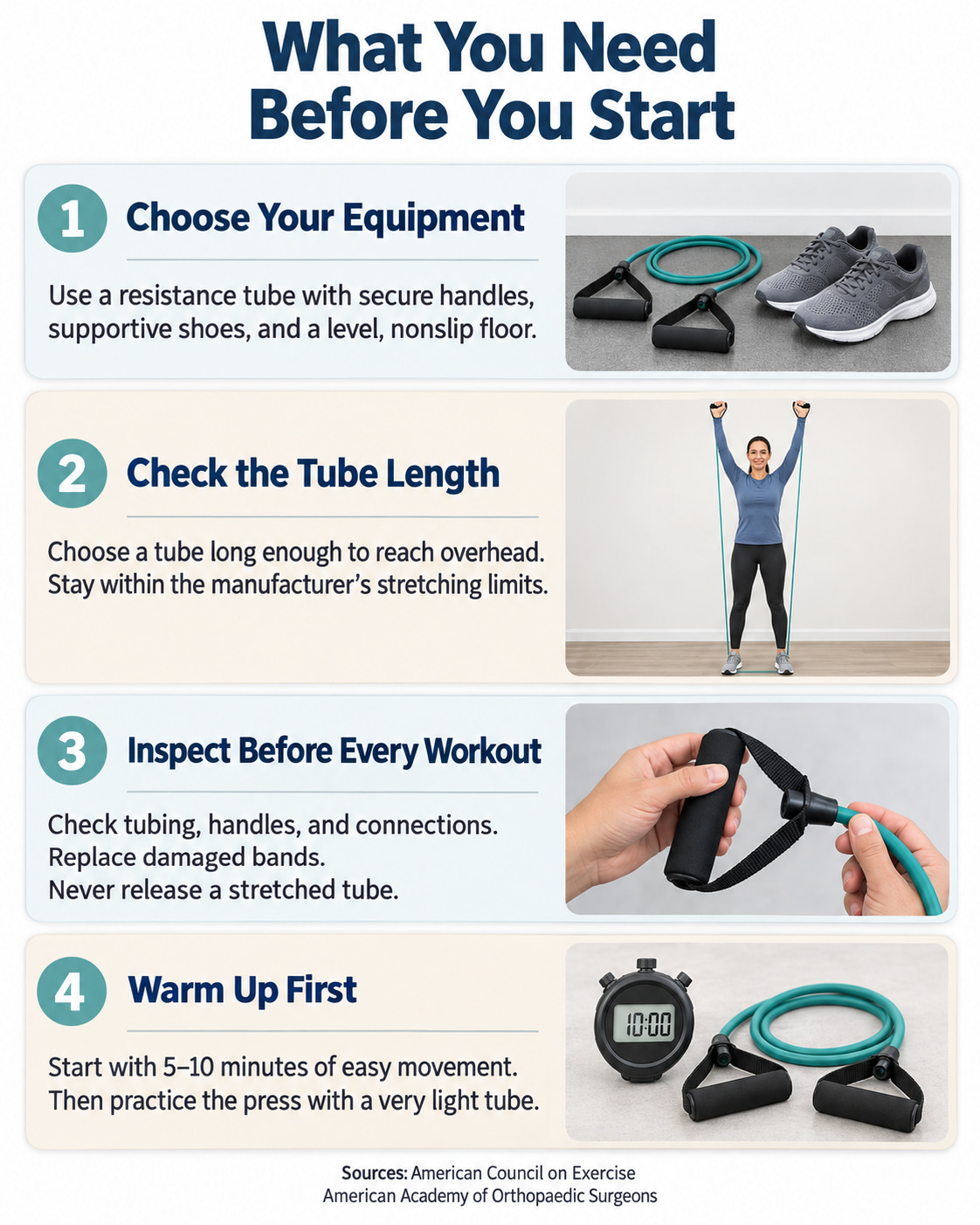
Use a resistance tube with secure handles, supportive shoes, and a level, nonslip surface. The tube must be long enough to let you reach overhead while staying within the manufacturer’s stretching limits.
Check the tubing, handles, and connections before each workout. The American Council on Exercise recommends replacing damaged bands, following the manufacturer’s instructions, and never releasing a band while it is stretched.
Warm up with 5–10 minutes of easy movement, consistent with guidance from the American Academy of Orthopaedic Surgeons. Then rehearse the press with a very light tube.
How to Do the Resistance Band Shoulder Press
- Secure the band. Place the middle of the tubing beneath the middle of both shoes. Stand with your feet about hip- to shoulder-width apart, with equal working lengths of tubing on each side. Keep both feet planted throughout the set.
- Set your grip. Hold one handle in each hand with your fingers and thumbs wrapped around it. Bring the handles to shoulder height, palms facing forward. Keep your wrists straight, forearms nearly vertical, and elbows angled slightly forward of your torso.
- Brace your body. Stand tall with your ribs over your pelvis. Gently tighten your abdomen and glutes. Keep your knees softly unlocked and your head facing forward.
- Press overhead. Exhale as you extend both arms upward. Finish with your hands above your shoulders and your elbows comfortably straight. Keep your torso upright and your legs still; avoid leaning back to finish the repetition.
- Lower with control. Inhale as you return the handles to the same shoulder-height starting position. Resist the band’s pull instead of letting it snap your hands downward.
- Finish safely. After the final repetition, lower the handles carefully until the tubing is slack. Only then step off the band.
Your shoulder blades should move naturally as your arms rise. The National Strength and Conditioning Association explains that cues to hold the shoulder blades down can interfere with the upward rotation needed for overhead movement. Avoid squeezing them down and back throughout the press.
A good repetition starts and ends at shoulder height, reaches a comfortable overhead position, and keeps your trunk steady. If you cannot do that with the selected tube, reduce the resistance.
Muscles Worked and Benefits
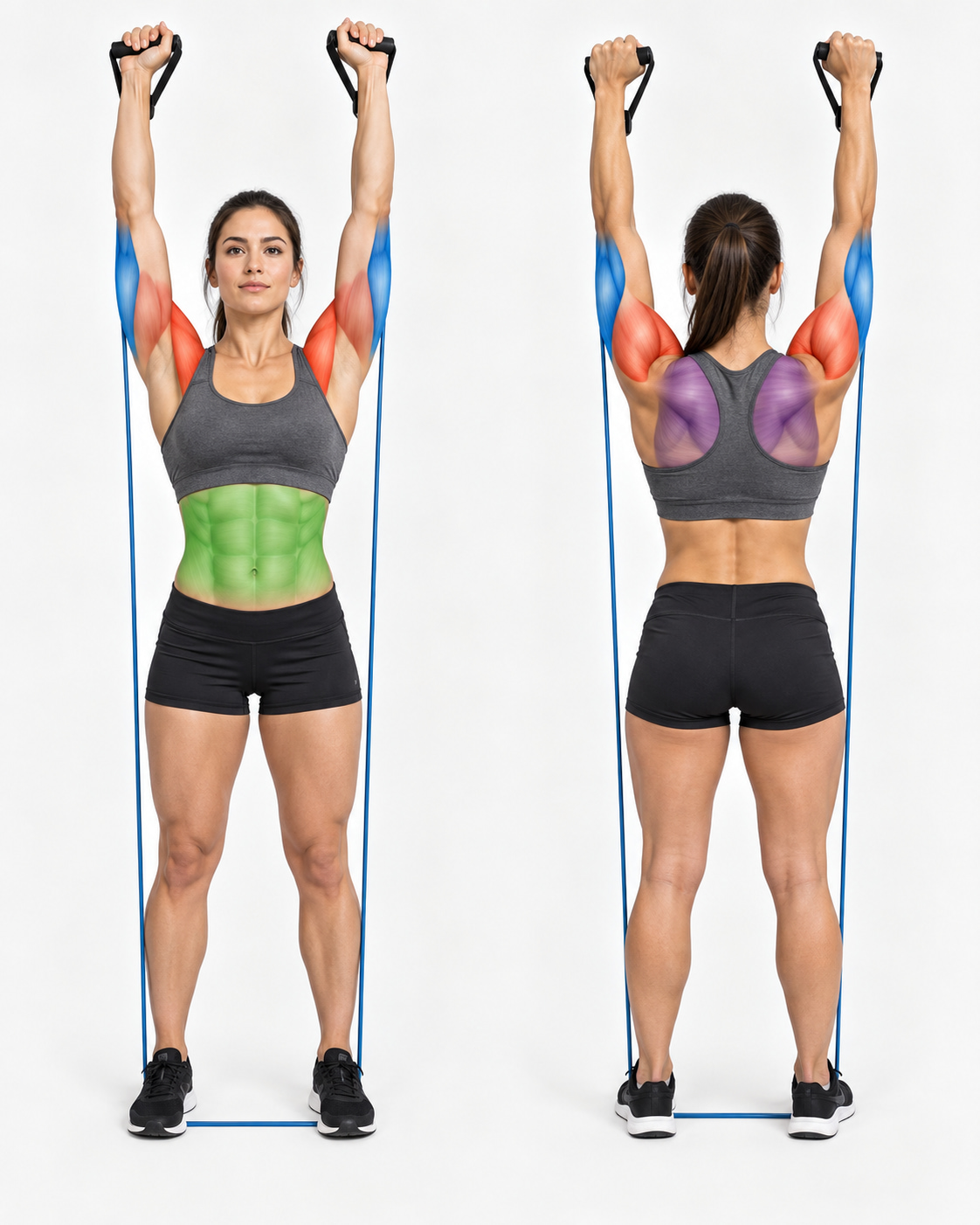
The resistance band shoulder press mainly trains your deltoids and triceps. Your trunk muscles help keep you upright against the band’s downward pull.
| Muscle group | Main role |
|---|---|
| Front and middle deltoids | Raise and support the upper arms during the press |
| Triceps | Straighten the elbows |
| Muscles around the shoulder blades | Support and control shoulder-blade movement |
| Abdominal and other trunk muscles | Help limit unwanted leaning and back extension |
Shoulder presses emphasize the front deltoids and also involve the middle deltoids. The American Council on Exercise notes that balanced shoulder training requires more than one movement because the different deltoid regions have different roles.
The practical advantages are straightforward: a tube is portable, takes little storage space, and lets you train an overhead pressing movement without a bench or external anchor. You can adjust the challenge by choosing a different resistance level.
Common Mistakes and How to Fix Them
| Mistake | What to do instead |
|---|---|
| Arching your lower back or pushing your ribs forward | Use a lighter tube and keep your ribs over your pelvis. |
| Dipping your knees to launch the handles upward | Keep your legs still and choose resistance you can press with your upper body. |
| Letting your wrists fold backward | Keep the handles aligned with your forearms and maintain a secure grip. |
| Pinning your shoulder blades down | Allow them to rotate upward as your arms rise. |
| Cutting every repetition short because the band is too heavy | Reduce resistance so you can complete the intended movement with control. |
| Rushing the lowering phase | Guide the handles back to shoulder height without bouncing or losing control. |
End the set when you can no longer maintain your technique. Extra repetitions achieved by leaning or using leg drive do not match this exercise.
Sets, Reps, and Weekly Frequency
The following is a practical starting point for a generally healthy adult who can press overhead comfortably.
| Training detail | Starting recommendation |
|---|---|
| Practice set | 1 set of 6–8 repetitions with a very light tube |
| Working sets | 2 sets |
| Repetitions | 8–12 per set |
| Rest | About 90–120 seconds between working sets |
| Effort | Finish with about 2–3 more good repetitions possible |
| Frequency | Twice weekly on nonconsecutive days |
For example, include the press in your Monday and Thursday strength sessions. If you are new to resistance training, begin with one working set while learning the movement, then add the second as you adapt.
The American College of Sports Medicine recommends training the major muscle groups at least twice weekly and recognizes resistance bands as an effective training option. This press can form part of that routine; it does not cover all your muscle groups by itself.
How to Choose Resistance and Progress
Band resistance increases as the tubing stretches, so judge the load across the entire repetition. A tube that feels manageable at shoulder height may still be too demanding near the top.
Choose a resistance that lets you complete your target repetitions without changing your stance, arching your back, or shortening the movement. Keep the same foot position and setup when comparing workouts.
When you can complete two sets of 12 controlled repetitions for two consecutive sessions, with a few good repetitions still possible, try a small increase in resistance. Return toward eight repetitions and build back up. This is a simple progression method, not a requirement to increase resistance every week.
Do not shorten or stretch a tube beyond its specified limits to make it harder. Use an appropriate tube for your height and the exercise.
When to Stop or Get Advice
Muscular effort is expected; sharp or pinching shoulder pain is a reason to stop. Do not force your arms overhead or lean backward to work around discomfort.
Stop exercising if you develop numbness, dizziness, chest pain, or other unusual symptoms. Seek prompt medical help for chest pain or severe symptoms. If you have a current shoulder injury, recent surgery, or pain during overhead movement, ask a qualified clinician or physical therapist for individualized guidance before using this exercise.
Frequently Asked Questions
Should I fully straighten my elbows?
Aim for comfortable elbow extension at the top. Avoid snapping into the end position or forcing your elbows backward beyond their normal range.
Can I use a small loop band?
A mini loop is generally too short for this feet-to-overhead setup. Use a suitably long resistance tube with handles for the version described here, and follow its stretching limits.
What if one arm rises faster than the other?
First, check that both sides have equal working lengths of tubing and that your feet have not shifted. Reduce the resistance and press both handles together at a controlled pace. Stop the set if you cannot keep the movement even.
Is this enough for complete shoulder training?
It is a useful pressing exercise, but it does not give every part of the shoulder the same training stimulus. Include it within a balanced program that also addresses the back of the shoulders and the rest of the upper body.
Start with a light tube, make each repetition consistent, and record your sets and reps. Increase resistance when you can maintain the same controlled movement throughout the set.
The Bottom Line
The resistance band shoulder press is a practical way to train your shoulders and triceps with minimal equipment. Keep the tube secure beneath both feet, brace your torso, and press overhead without leaning back or using your legs. Start with light resistance and controlled repetitions, then increase the challenge when you can maintain good form throughout every set.
This content is for informational purposes only and is not a substitute for medical advice.