FUPA exercises for women can strengthen the lower abs, improve core control, and support an active lifestyle, but they cannot reliably make fat disappear from one specific area. Where your body stores and loses fat is influenced by factors such as genetics, hormones, age, and overall body composition.
A useful FUPA workout should therefore include more than crunches. The routine below combines beginner-friendly core exercises with glute, leg, upper-body, and low-impact conditioning movements. You can perform it at home with a mat, a sturdy chair, and a stable wall or countertop.
What Are FUPA Exercises for Women, and Can They Reduce Lower-Abdominal Fat?
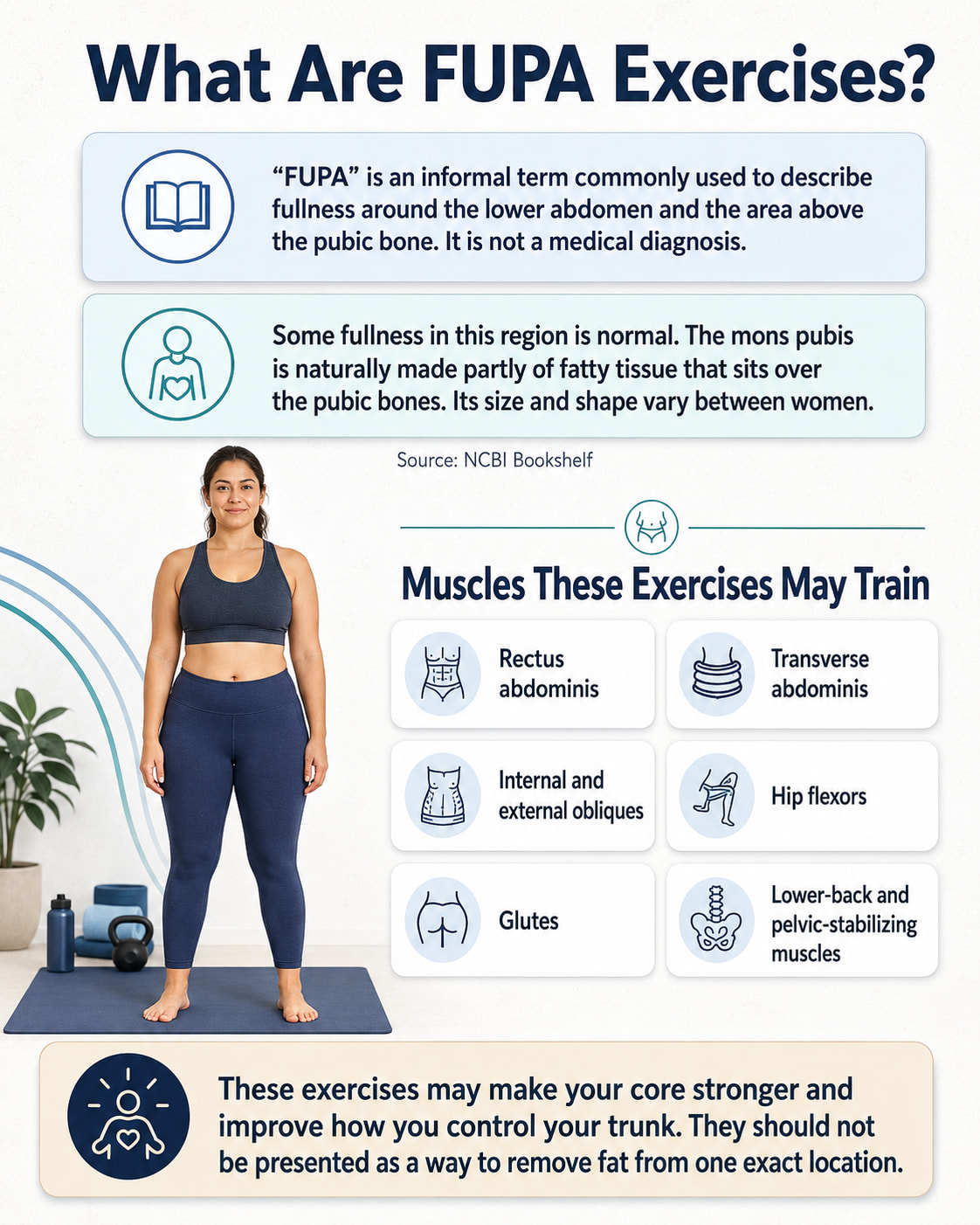
“FUPA” is an informal term used to describe fullness around the lower abdomen and the area above the pubic bone. It is not a medical diagnosis. Some fullness in this area is normal because the mons pubis naturally contains fatty tissue, and its size and shape vary among women.
FUPA exercises generally include movements that strengthen the muscles around the abdomen, hips, and pelvis, including the rectus abdominis, transverse abdominis, obliques, hip flexors, glutes, and lower-back stabilizers.
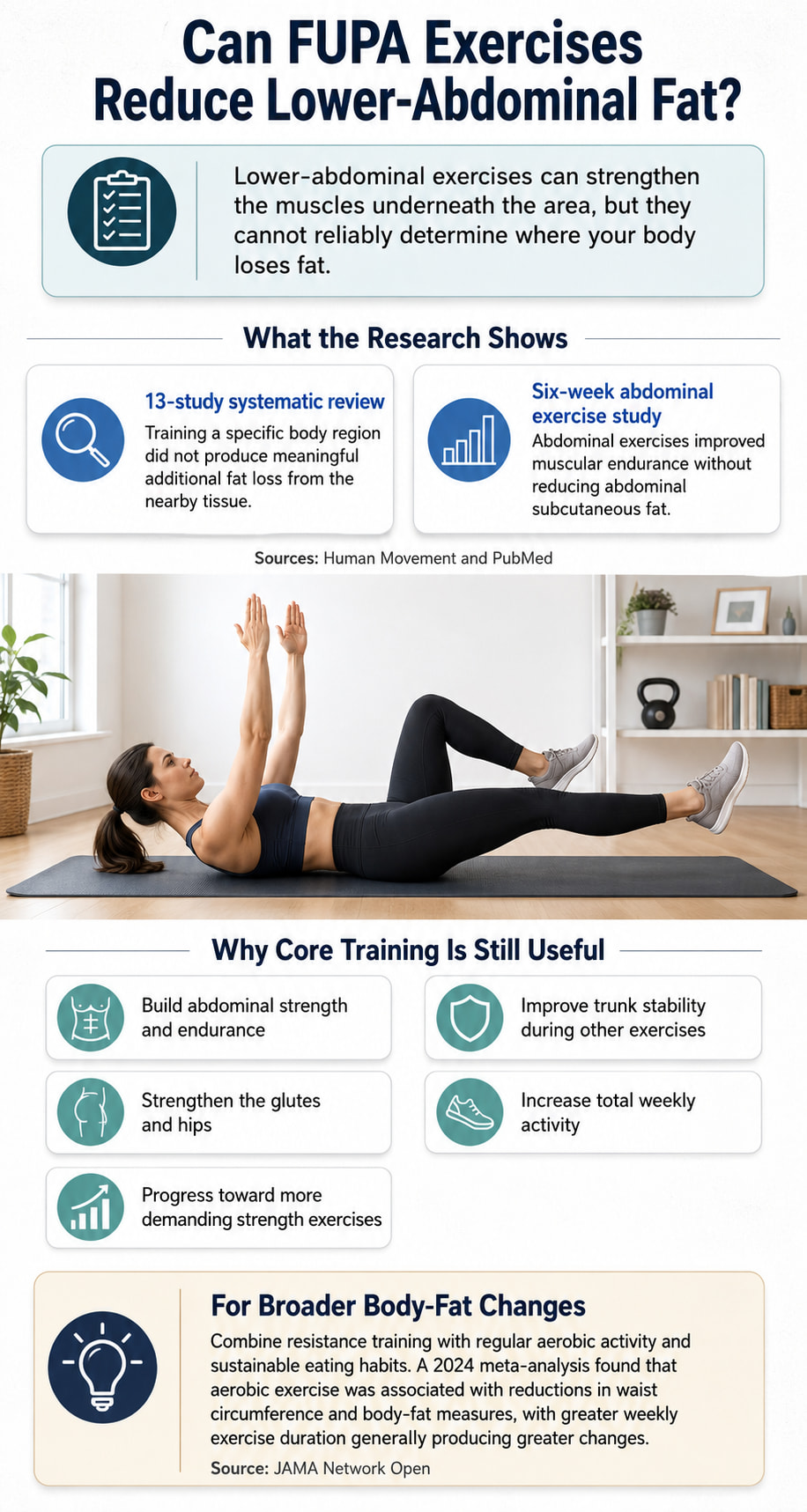
These exercises can improve core strength, trunk control, posture, and stability during workouts and everyday activities. However, they cannot reliably make a woman lose fat from the lower abdomen alone.
Research on localized fat loss has found that exercising one body area does not produce greater fat loss from the nearby tissue. Abdominal training may improve muscular strength and endurance without directly reducing lower-abdominal fat.
That does not make FUPA exercises pointless. They may help women:
- Build abdominal strength and endurance.
- Improve stability during lifting and daily movement.
- Strengthen the hips and glutes.
- Increase overall physical activity.
- Prepare for more challenging strength exercises.
For broader changes in waist circumference or body-fat levels, combine core exercises with full-body resistance training, regular aerobic activity, and sustainable eating habits. FUPA exercises are most effective as part of a balanced women’s fitness routine—not as a method for removing fat from one exact area.
11 Best FUPA Exercises for Women
Start with exercises you can perform while breathing normally and maintaining control. Stop the set when your form begins to change rather than forcing extra repetitions.
1. Supine Abdominal Brace
Best for: Learning how to engage the core without moving the spine.
Muscles worked: Transverse abdominis, obliques, rectus abdominis, diaphragm, and pelvic stabilizers.
Sets, reps, and rest: Perform 2 sets of 5–8 breaths. Rest for 20–30 seconds.
How to do it:
- Lie on your back with your knees bent and feet flat.
- Allow your spine to rest in a comfortable, neutral position.
- Exhale gently and tighten your midsection as though preparing for a light push against your stomach.
- Keep the tension while taking a quiet breath in.
- Relax briefly and repeat.
Common mistakes: Pulling the stomach inward as hard as possible, pressing the lower back forcefully into the floor, holding the breath, or tightening the neck and shoulders.
Progression: Maintain the brace while slowly lifting one foot an inch from the floor.
2. Heel Slide
Best for: Building lower-core control while moving one leg.
Muscles worked: Deep abdominal muscles, rectus abdominis, hip flexors, and pelvic stabilizers.
Sets, reps, and rest: Perform 2 sets of 5–8 repetitions per side. Rest for 30 seconds.
How to do it:
- Lie on your back with your knees bent and feet flat.
- Gently brace your core.
- Slowly slide one heel away until the leg is nearly straight or your trunk begins to move.
- Keep your ribs, pelvis, and lower back controlled.
- Slide the heel back and switch sides.
Common mistakes: Extending the leg too far, arching the lower back, rushing the movement, or holding the breath.
Make it easier: Use a shorter slide.
Progression: Allow the heel to hover slightly above the floor.
3. Dead Bug
Best for: Coordinating opposite arm and leg movement while keeping the trunk stable.
Muscles worked: Rectus abdominis, transverse abdominis, obliques, hip flexors, and shoulder stabilizers.
Sets, reps, and rest: Perform 2–3 sets of 5–8 repetitions per side. Rest for 30–45 seconds.
How to do it:
- Lie on your back with your arms pointing upward.
- Lift your legs so your hips and knees are bent to approximately 90 degrees.
- Brace your core and slowly extend one leg and the opposite arm.
- Move only as far as you can without your ribs lifting or lower back arching.
- Return to the starting position and alternate sides.
Common mistakes: Moving too quickly, reaching too close to the floor, flaring the ribs, or allowing the lower back to arch.
Make it easier: Move only the arms or tap one heel to the floor at a time.
4. Bent-Knee Reverse Crunch
Best for: Training controlled abdominal flexion without using a large range of motion.
Muscles worked: Rectus abdominis, obliques, and hip flexors.
Sets, reps, and rest: Perform 2 sets of 6–10 repetitions. Rest for 30–45 seconds.
How to do it:
- Lie on your back with your hips and knees bent.
- Keep your arms beside your body for support.
- Exhale and gently curl your pelvis toward your ribs.
- Allow your tailbone to lift slightly from the floor.
- Lower slowly without swinging the legs.
Common mistakes: Throwing the knees toward the chest, using momentum, lifting the hips excessively, or pressing hard through the arms.
Make it easier: Practice a small pelvic tilt without lifting the hips.
Coaching cue: Think about curling the pelvis rather than launching the legs.
5. Glute Bridge
Best for: Strengthening the glutes while the floor supports the upper body.
Muscles worked: Gluteus maximus, hamstrings, abdominal muscles, and spinal stabilizers.
Sets, reps, and rest: Perform 2–3 sets of 10–15 repetitions. Rest for 30–60 seconds.
How to do it:
- Lie on your back with your knees bent and feet approximately hip-width apart.
- Brace your core lightly.
- Push through your feet and squeeze your glutes to raise your hips.
- Stop when your shoulders, hips, and knees form a comfortable line.
- Lower your hips slowly.
Common mistakes: Overarching the lower back, pushing mainly through the toes, allowing the knees to fall outward, or lifting higher than you can control.
Progression: Pause for two seconds at the top or perform a marching bridge.
6. Bird Dog
Best for: Improving trunk stability, balance, and opposite-side coordination.
Muscles worked: Deep abdominal muscles, obliques, spinal erectors, glutes, and shoulder stabilizers.
Sets, reps, and rest: Perform 2 sets of 5–8 repetitions per side. Rest for 30 seconds.
How to do it:
- Begin on your hands and knees with your hands under your shoulders.
- Brace your core without rounding your back.
- Extend one leg behind you and the opposite arm in front.
- Keep your hips and shoulders facing the floor.
- Return slowly and switch sides.
Common mistakes: Rotating the hips, lifting the leg too high, arching the lower back, or reaching farther than you can control.
Make it easier: Move one limb at a time.
Coaching cue: Imagine balancing a glass of water across your lower back.
7. Side Plank From the Knees
Best for: Strengthening the side of the core with a shorter, beginner-friendly lever.
Muscles worked: Obliques, transverse abdominis, quadratus lumborum, gluteus medius, and shoulder stabilizers.
Sets, reps, and rest: Perform 2 sets of 10–25 seconds per side. Rest for 30–45 seconds.
How to do it:
- Lie on your side with your knees bent and elbow below your shoulder.
- Stack or slightly stagger your knees.
- Brace your core and lift your hips from the floor.
- Keep your head, ribs, hips, and knees aligned.
- Lower with control before switching sides.
Common mistakes: Letting the hips roll backward, sinking into the shoulder, holding the breath, or pushing the head forward.
Progression: Straighten the top leg or move to a full side plank.
8. Incline Plank
Best for: Building full-core endurance without starting in a difficult floor plank.
Muscles worked: Rectus abdominis, transverse abdominis, obliques, glutes, chest, and shoulder stabilizers.
Equipment needed: A stable countertop, bench, or wall.
Sets, reps, and rest: Perform 2–3 holds of 15–30 seconds. Rest for 30–45 seconds.
How to do it:
- Place both hands on a secure elevated surface.
- Walk your feet backward until your body forms a straight line.
- Gently brace your abs and squeeze your glutes.
- Keep your shoulders away from your ears.
- Hold while breathing normally.
Common mistakes: Letting the hips sag, lifting the hips too high, locking the shoulders toward the ears, or using an unstable surface.
Progression: Use a lower surface before progressing to the floor.
9. Chair Squat
Best for: Strengthening the legs and glutes while increasing total-body effort.
Muscles worked: Quadriceps, glutes, hamstrings, calves, and core.
Equipment needed: A sturdy chair without wheels.
Sets, reps, and rest: Perform 2–3 sets of 8–12 repetitions. Rest for 45–60 seconds.
How to do it:
- Stand in front of the chair with your feet around hip- to shoulder-width apart.
- Brace your core and move your hips backward.
- Bend your knees and lower toward the chair.
- Touch the seat lightly without dropping onto it.
- Push through your feet to stand.
Common mistakes: Collapsing onto the chair, allowing the knees to cave inward, lifting the heels, or rounding the torso excessively.
Progression: Hold a dumbbell close to your chest or remove the chair when you can control the same depth.
Standard bodyweight squat technique emphasizes controlled hip and knee movement with the trunk braced and the feet firmly supported. (ACE Exercise Library)
10. Incline Push-Up
Best for: Training the upper body and core together.
Muscles worked: Chest, triceps, shoulders, abdominal muscles, and glutes.
Equipment needed: A stable countertop, bench, or wall.
Sets, reps, and rest: Perform 2–3 sets of 6–12 repetitions. Rest for 45–60 seconds.
How to do it:
- Place your hands slightly wider than shoulder-width on a secure surface.
- Step backward until your body forms a straight line.
- Bend your elbows and lower your chest toward the surface.
- Keep your hips and ribs controlled.
- Press the surface away to return to the starting position.
Common mistakes: Leading with the head, letting the hips sag, flaring the elbows directly sideways, or using a surface that can move.
Make it easier: Use a wall.
Progression: Move your hands to a lower surface.
11. Wall Mountain Climber
Best for: Low-impact conditioning with controlled knee drives.
Muscles worked: Hip flexors, abdominal muscles, shoulders, glutes, quadriceps, and calves.
Equipment needed: A wall or stable countertop.
Sets, reps, and rest: Perform 2–3 rounds of 20–40 seconds. Rest for 30–60 seconds.
How to do it:
- Place your hands on a wall at approximately shoulder height.
- Step backward and lean slightly toward the wall.
- Brace your core and lift one knee toward your torso.
- Return the foot and alternate sides.
- Begin slowly and increase the pace only if your trunk remains stable.
Common mistakes: Bouncing through the movement, rounding the shoulders, leaning too heavily into the hands, or moving faster than you can control.
Make it easier: Perform a slow standing march without leaning on the wall.
Simple FUPA Workout for Women
You do not need to perform all 11 exercises in one session. This circuit provides a balanced mix of core control, strength, and low-impact conditioning.
Warm-Up
Complete approximately three to five minutes:
- Easy marching: 30–60 seconds.
- Shoulder rolls: 5 in each direction.
- Gentle hip hinges: 8 repetitions.
- Chair squats through a comfortable range: 5 repetitions.
- Supine abdominal brace: 3 slow breaths.
Beginner Workout
Complete one or two rounds.
| Exercise | Starting dose |
|---|---|
| Supine abdominal brace | 5 controlled breaths |
| Heel slide | 6 per side |
| Glute bridge | 10–12 reps |
| Bird dog | 5 per side |
| Chair squat | 8–12 reps |
| Incline push-up | 6–10 reps |
| Incline plank | 15–25 seconds |
| Wall mountain climber | 20–30 seconds |
Rest for 30–60 seconds between exercises as needed and 60–90 seconds between rounds.
Keep the overall effort around 6 or 7 out of 10. You should feel challenged but still able to maintain good technique.
How Often to Do the Workout
Perform the routine two or three times per week on nonconsecutive days.
You can also include walking, cycling, swimming, dancing, or another enjoyable aerobic activity during the week. Current US physical activity guidance recommends working toward at least 150 minutes of moderate-intensity aerobic activity each week and training all major muscle groups on at least two days. Beginners can start with smaller amounts and build gradually. (Office of Disease Prevention and Health Promotion)
The 2026 American College of Sports Medicine resistance-training guidance also emphasizes that consistent training matters more than complicated programming. Bodyweight and home-based exercises can be effective when they are performed regularly and progressed appropriately. (American College of Sports Medicine)
How to Progress
Use one progression at a time:
- Add one or two repetitions per set.
- Add five seconds to a plank.
- Complete one additional workout round.
- Slow the lowering phase of an exercise.
- Use a slightly lower incline for planks or push-ups.
- Add light resistance to squats or bridges.
Progress only when you can complete every repetition without holding your breath, rushing, or losing trunk control. Training to complete muscular failure is not necessary.
Common FUPA Workout Mistakes
Relying Only on Ab Exercises
Hundreds of crunches do not provide the same overall training effect as a balanced routine. Include leg, glute, pushing, pulling, and aerobic exercises in your weekly program.
Moving Too Quickly
Fast repetitions often allow momentum to replace muscular control. Slow down the heel slides, reverse crunches, bridges, and bird dogs.
Forcing the Lower Back Flat
The goal is not to crush your lower back into the floor during every exercise. Maintain a comfortable spinal position and prevent uncontrolled arching as your arms or legs move.
Holding Your Breath
Exhale during the hardest part of the repetition and continue taking quiet breaths during planks and abdominal bracing.
Progressing Everything at Once
Do not add more repetitions, longer holds, extra rounds, and harder variations during the same workout. Change one variable and allow your body time to adapt.
Expecting a Specific Appearance Timeline
Strength and fitness progress can be measured through improved control, more repetitions, longer holds, easier daily movement, and better workout consistency. Changes in appearance vary widely and cannot be guaranteed within a specific number of days or weeks.
Pregnancy, Postpartum, and Pelvic-Floor Considerations
Exercise selection may need to change during pregnancy, after childbirth, or following a C-section or other abdominal surgery. Recovery is individual, so do not use another person’s timeline as your own.
Speak with an appropriate healthcare professional before beginning or resuming the routine when you:
- Are pregnant and have exercise restrictions.
- Recently gave birth.
- Are recovering from abdominal or pelvic surgery.
- Experience urinary or bowel leakage.
- Feel pelvic pressure, heaviness, or bulging.
- Have persistent pelvic, abdominal, or lower-back pain.
The pelvic floor works with the abdominal muscles and surrounding tissues to support the pelvic organs. Leakage, heaviness, and pelvic pressure may indicate that an exercise or progression is not currently appropriate. (FDA Office of Women’s Health)
Research supports individualized postpartum exercise and pelvic-floor muscle training, but postpartum programs should consider symptoms, delivery history, healing, and current function rather than relying on a single standard routine. (PubMed)
Stop exercising and seek professional help if you experience sharp or worsening pain, numbness, dizziness, chest pain, unusual shortness of breath, vaginal bleeding, or other concerning symptoms.
Frequently Asked Questions
What is the best FUPA exercise for women?
There is no single best exercise. Beginners can start with the supine abdominal brace and heel slide to learn core control. A balanced routine should also include exercises such as glute bridges, chair squats, incline push-ups, and walking.
Can FUPA exercises get rid of lower-abdominal fat?
They can strengthen the muscles underneath the area, but they cannot reliably target fat loss from that specific location. Overall activity, resistance training, aerobic exercise, nutrition habits, genetics, and other individual factors affect body composition.
How often should women do FUPA exercises?
Two or three sessions per week is a practical starting point. Avoid training the same routine intensely every day, especially when you are new to exercise or still experiencing muscle soreness.
Should I do these exercises every day?
Gentle abdominal bracing may be practiced frequently, but the complete strength workout does not need to be performed daily. Allow at least one recovery day between sessions when possible.
Are standing or floor exercises better?
Neither category is automatically better. Floor exercises make it easier to learn abdominal control, while standing movements train the core together with the legs and upper body. Using both creates a more balanced workout.
Can I perform this workout after pregnancy?
Some exercises may be appropriate, but your starting point depends on healing, symptoms, delivery type, and previous training experience. Seek individualized guidance if you experience leakage, pelvic pressure, pain, significant abdominal bulging, or uncertainty about returning to exercise.
Do I need equipment?
No specialized equipment is required. A mat, sturdy chair without wheels, wall, and stable countertop are enough for the beginner routine.
Conclusion
FUPA exercises for women are most useful when they are treated as part of a complete fitness routine rather than a shortcut for targeted fat loss. Start with controlled core exercises, add full-body strength movements, and include regular aerobic activity you can maintain.
Choose manageable variations, breathe throughout each exercise, and progress one step at a time. Consistent training that improves your strength and function is more valuable than an extreme routine focused only on changing one body area.
This content is for informational purposes only and is not a substitute for medical advice.
References
- A Proposed Model to Test Exercise-Induced Localized Fat Reduction: Systematic Review and Meta-Analysis
- The Effect of Abdominal Exercise on Abdominal Fat
- Aerobic Exercise and Weight Loss in Adults: A Systematic Review and Dose-Response Meta-Analysis
- ACSM Position Stand: Resistance Training Prescription for Healthy Adults
- Physical Activity Guidelines for Americans: Key Recommendations
- Impact of Postpartum Exercise on Pelvic Floor Disorders and Diastasis Recti Abdominis