A stationary bike workout for beginners should be simple, low-impact, and easy to control: warm up, ride at a moderate pace, recover, and finish with a cooldown. This 20-minute stationary bike workout for beginners gives you a clear plan you can follow at home or in the gym without needing advanced cycling experience.
The goal is not to crush yourself in the first session. The goal is to learn how the bike feels, control your breathing, build steady cardio, and finish feeling like you could come back and do it again.
What Is a Stationary Bike Workout for Beginners?
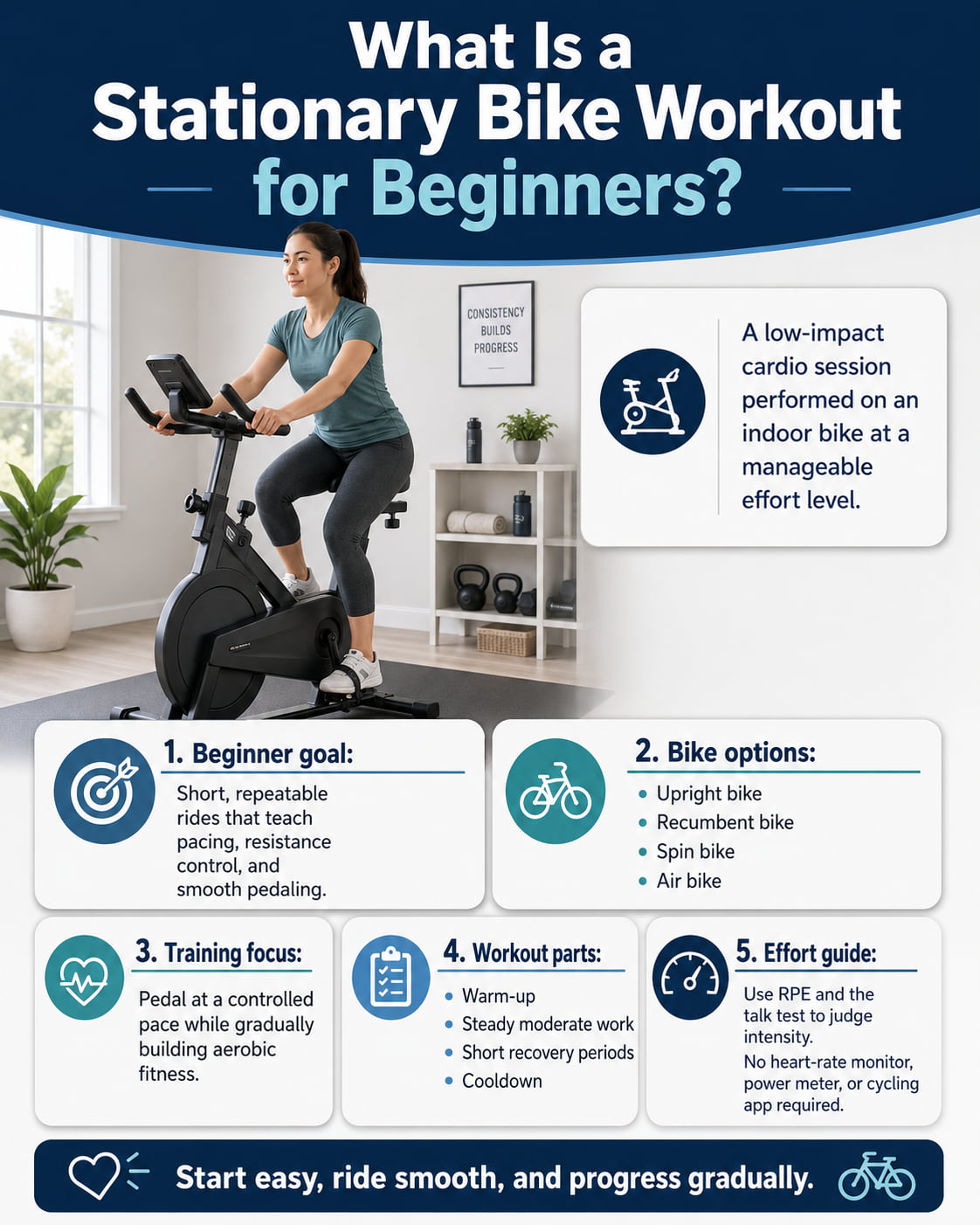
A stationary bike workout for beginners is a low-impact cardio session performed on an indoor bike at a manageable effort level. Instead of jumping into hard sprints or long rides, beginners should start with short, repeatable sessions that teach pacing, resistance control, and smooth pedaling.
You can do this workout on an upright bike, recumbent bike, spin bike, or air bike. The setup and feel may be different, but the training goal is the same: pedal at a controlled pace while gradually building your aerobic fitness.
A beginner bike workout should include four parts:
- Warm-up time to prepare your legs and breathing.
- Steady moderate work to build endurance.
- Short recovery periods so the workout stays manageable.
- A cooldown to bring your breathing back down.
The CDC explains that adults can use relative intensity, including effort level and the talk test, to judge how hard they are exercising. That is useful for beginners because you do not need a heart-rate monitor, power meter, or cycling app to get started.
Muscles Worked During a Stationary Bike Workout
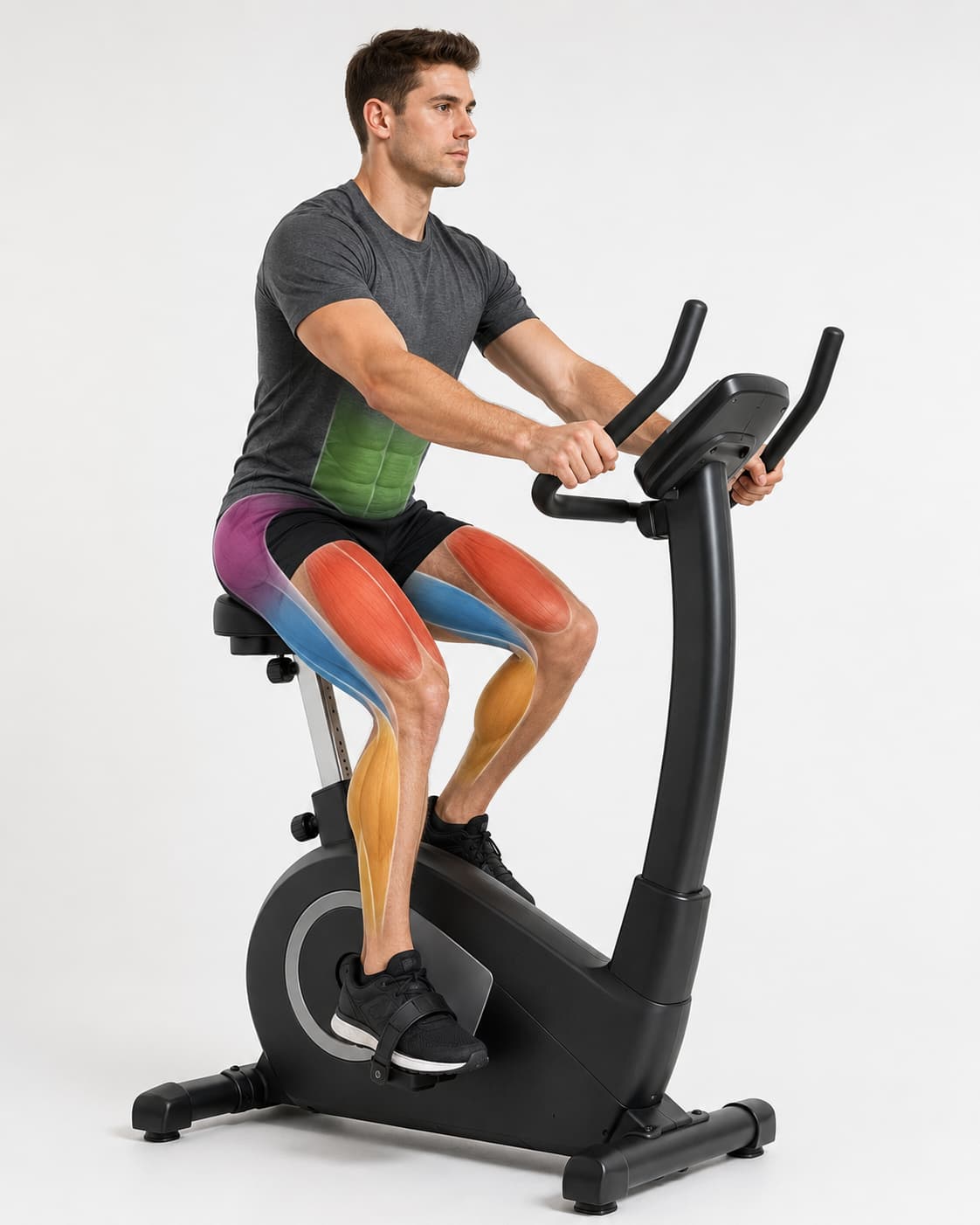
Stationary biking mainly trains the lower body, with support from the core and postural muscles.
The quadriceps work hard as you press the pedals down, especially when resistance increases.
The hamstrings assist during the pedal stroke and help control the leg as it cycles back.
The glutes help drive the hips and support stronger pedaling, especially when resistance is moderate or high.
The calves assist with ankle control and help keep the pedal stroke smooth.
The hip flexors help bring the leg back up through the cycling motion.
The core helps you keep your torso steady, especially on an upright or spin bike.
A stationary bike workout can strengthen muscular endurance in the legs, but it should not replace full-body strength training. For a balanced program, pair cycling with exercises such as squats, hinges, rows, presses, carries, and core work.
How to Set Up Your Stationary Bike
Good setup makes the workout more comfortable and helps you pedal with better control. Before starting the 20-minute plan, take a minute to adjust the bike.
Seat Height
Stand next to the bike and set the seat close to hipbone height as a starting point. When you sit on the bike and place one pedal at the bottom of the stroke, your knee should still have a slight bend.
The Hospital for Special Surgery recommends using hipbone height as a starting point and then checking your knee position on the bike.
If the seat is too low, your knees may feel crowded. If the seat is too high, your hips may rock side to side to reach the bottom of the pedal stroke.
Seat Distance
When the pedals are level, your front knee should feel comfortable over the pedal area without forcing you too far forward or backward. You do not need a perfect bike fit for a beginner workout, but you should avoid feeling jammed, stretched, or unstable.
Handlebar Height
Set the handlebars where you can reach them without rounding your back or shrugging your shoulders. Beginners usually do better with a slightly higher handlebar position because it is easier to keep the chest open and neck relaxed.
Foot Position
Place the balls of your feet over the pedals. If the bike has straps or cages, tighten them enough that your feet feel secure, but not so tight that they create pressure or discomfort.
Riding Posture
Keep your chest lifted, shoulders relaxed, elbows soft, and hands light on the handlebars. Your upper body should stay calm while your legs do the work.
How to Use RPE, Resistance, and Cadence
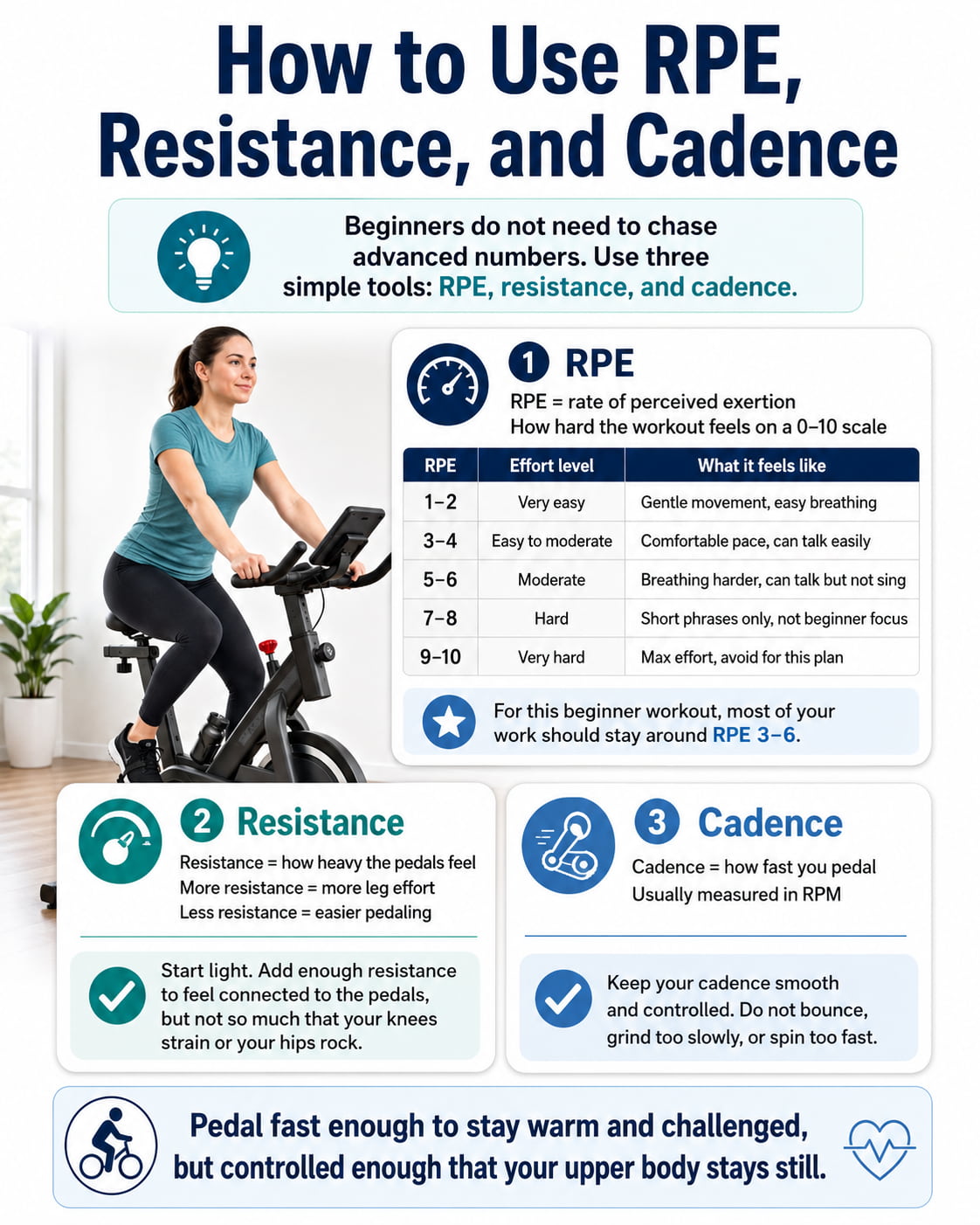
Beginners do not need to chase advanced numbers. Use three simple tools: RPE, resistance, and cadence.
RPE
RPE means rate of perceived exertion. It is how hard the workout feels on a 0 to 10 scale.
| RPE | Effort level | What it feels like |
|---|---|---|
| 1–2 | Very easy | Gentle movement, easy breathing |
| 3–4 | Easy to moderate | Comfortable pace, can talk easily |
| 5–6 | Moderate | Breathing harder, can talk but not sing |
| 7–8 | Hard | Short phrases only, not beginner focus |
| 9–10 | Very hard | Max effort, avoid for this plan |
For this beginner stationary bike workout, most of your work should stay around RPE 3–6. The CDC talk test is simple: at moderate intensity, you can talk but not sing.
Resistance
Resistance is how heavy the pedals feel. More resistance means your legs must push harder. Less resistance means the pedals spin more easily.
Start light. Add just enough resistance that your legs feel connected to the pedals. Avoid turning the resistance so high that your knees strain, your hips rock, or your pedal stroke becomes choppy.
Cadence
Cadence means how fast you pedal, usually measured in revolutions per minute. Some bikes show RPM on the screen. Some do not.
For beginners, the best cadence is smooth and controlled. You should not bounce in the seat, grind slowly with heavy resistance, or spin so fast that your hips shift around.
A simple rule: pedal fast enough to stay warm and challenged, but controlled enough that your upper body stays still.
20-Minute Stationary Bike Workout for Beginners
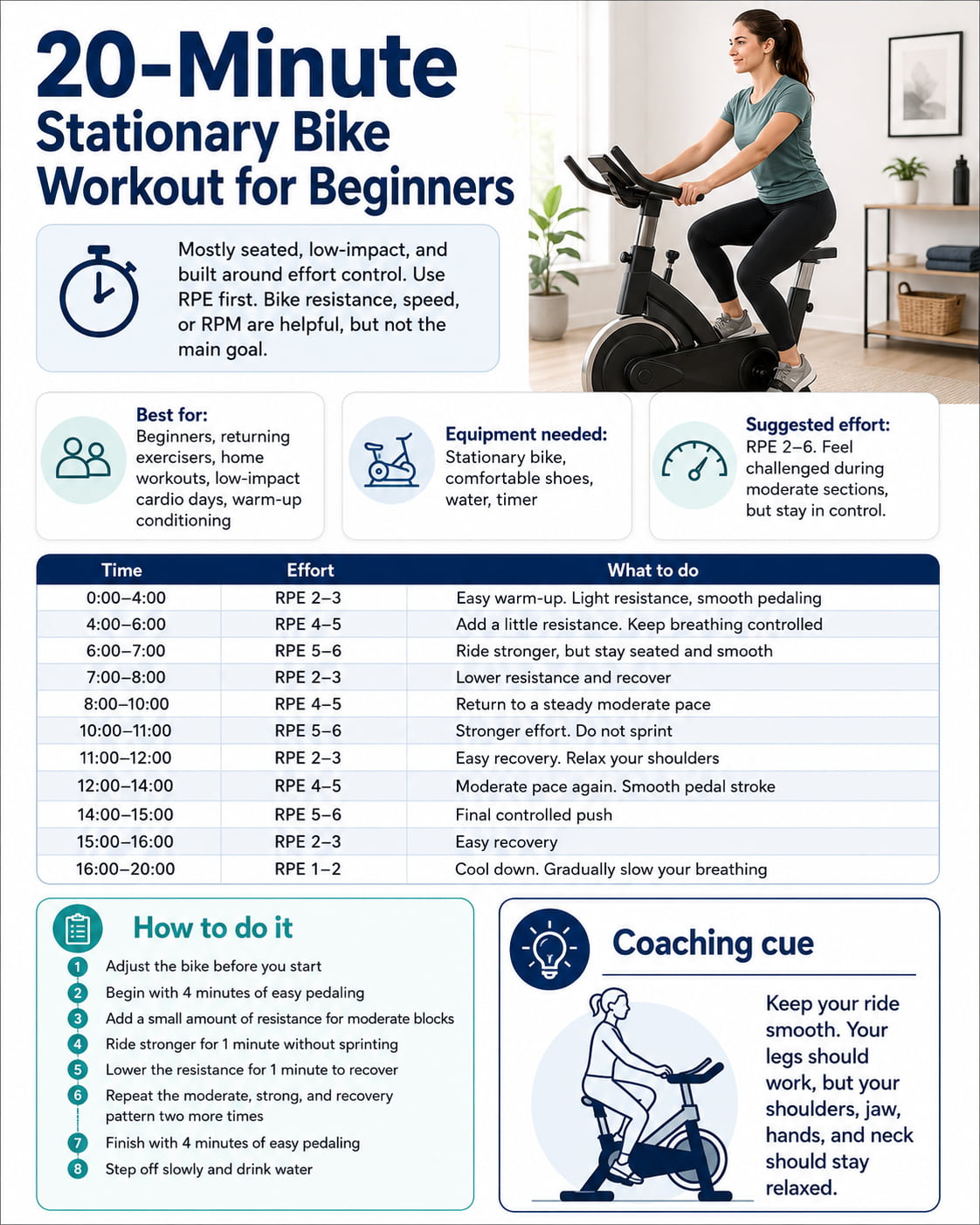
This workout is mostly seated, low-impact, and built around effort control. Use RPE first. If your bike shows resistance, speed, or RPM, treat those as helpful details, not the main goal.
Best for
This workout is best for beginners, returning exercisers, home workouts, low-impact cardio days, warm-up conditioning, and anyone who wants a simple ride plan without complicated cycling metrics.
Equipment needed
You need a stationary bike, comfortable shoes, water, and a timer. A heart-rate monitor is optional, not required.
Suggested effort
Keep the workout between RPE 2 and 6. You should feel challenged during the moderate sections, but you should not feel out of control.
The 20-Minute Plan
| Time | Effort | What to do |
|---|---|---|
| 0:00–4:00 | RPE 2–3 | Easy warm-up. Light resistance, smooth pedaling. |
| 4:00–6:00 | RPE 4–5 | Add a little resistance. Keep breathing controlled. |
| 6:00–7:00 | RPE 5–6 | Ride stronger, but stay seated and smooth. |
| 7:00–8:00 | RPE 2–3 | Lower resistance and recover. |
| 8:00–10:00 | RPE 4–5 | Return to a steady moderate pace. |
| 10:00–11:00 | RPE 5–6 | Stronger effort. Do not sprint. |
| 11:00–12:00 | RPE 2–3 | Easy recovery. Relax your shoulders. |
| 12:00–14:00 | RPE 4–5 | Moderate pace again. Smooth pedal stroke. |
| 14:00–15:00 | RPE 5–6 | Final controlled push. |
| 15:00–16:00 | RPE 2–3 | Easy recovery. |
| 16:00–20:00 | RPE 1–2 | Cool down. Gradually slow your breathing. |
How to Do It
- Adjust the bike before you start.
- Begin with 4 minutes of easy pedaling.
- Add a small amount of resistance for the first moderate block.
- Ride stronger for 1 minute without turning it into a sprint.
- Lower the resistance for 1 minute to recover.
- Repeat the moderate, strong, and recovery pattern two more times.
- Finish with 4 minutes of easy pedaling.
- Step off slowly and drink water.
Coaching Cue
Keep your ride smooth. Your legs should work, but your shoulders, jaw, hands, and neck should stay relaxed.
Beginner, Intermediate, and Advanced Options
Beginner
Keep every work interval at RPE 4–5. Skip the RPE 6 pushes if needed. Your goal is to complete the full 20 minutes with steady breathing and good control.
Intermediate
Keep the same structure, but make the 1-minute stronger sections a true RPE 6. Add only a small resistance increase. Do not sprint.
Advanced
Use this as a recovery or aerobic base ride between harder training days. Keep the session controlled and resist the urge to turn every interval into high-intensity work.
How Often Should Beginners Use a Stationary Bike?
Most beginners can start with 2–3 stationary bike workouts per week. Leave at least one easier day between rides at first, especially if your legs are sore or you are new to structured cardio.
A simple weekly plan could look like this:
| Day | Workout |
|---|---|
| Monday | 20-minute stationary bike workout |
| Tuesday | Strength training or easy walk |
| Wednesday | Rest or mobility |
| Thursday | 20-minute stationary bike workout |
| Friday | Strength training |
| Saturday | Optional easy 15–20 minute ride |
| Sunday | Rest or light walking |
The CDC adult activity guidelines recommend at least 150 minutes of moderate-intensity aerobic activity per week, plus 2 days of muscle-strengthening activity. A 20-minute bike ride is a useful starting point toward that weekly goal.
The American College of Sports Medicine also supports regular moderate-intensity aerobic activity and strength work as part of a complete fitness routine.
How to Progress This Workout
Do not make the workout longer, harder, and more frequent all at once. Progress one variable at a time.
Week 1
Do the 20-minute ride 2 times. Keep the effort comfortable and focus on learning the bike.
Week 2
Do the 20-minute ride 2–3 times. Make the moderate sections a little smoother, not necessarily harder.
Week 3
Add 2–5 minutes to one ride if you are recovering well. Keep the extra time easy.
Week 4
Increase one moderate block slightly by adding a small amount of resistance or pedaling a little faster. Keep your strongest work at RPE 6 or below.
A good progression rule is simple: if you can finish the workout with steady breathing, no sharp pain, and good control, you can progress slightly next time. If the workout leaves you wiped out, stay at the same level or make it easier.
Common Mistakes to Avoid
Setting the Seat Too Low
A low seat can make your knees feel cramped and may reduce pedaling efficiency. Start near hip height and check for a slight knee bend at the bottom of the pedal stroke.
Using Too Much Resistance
Heavy resistance is not automatically better. If you have to rock your hips, grip the handlebars hard, or grind each pedal stroke, lower the resistance.
Pedaling Too Fast Without Control
Fast spinning can feel like hard work, but it is not useful if you bounce in the seat or lose posture. Smooth pedaling matters more than chasing speed.
Skipping the Warm-Up
A warm-up helps your legs, heart rate, and breathing ease into the session. Do not jump straight into the hardest minute.
Leaning Too Hard on the Handlebars
Your hands should guide your position, not hold your body weight. Keep your grip light and your shoulders relaxed.
Making Every Ride Hard
Beginners improve by repeating manageable workouts. If every ride becomes a max-effort test, it is harder to recover and stay consistent.
Ignoring Pain or Unusual Symptoms
Muscle fatigue is normal. Sharp pain, numbness, dizziness, chest pain, or unusual symptoms are not something to push through.
Safety Tips for Beginner Stationary Bike Workouts
Start with light resistance and increase gradually.
Stay seated for this beginner plan unless you already know how to ride safely out of the saddle.
Keep water nearby, especially if the room is warm.
Stop if your form breaks down or your breathing feels uncontrolled.
Avoid locking your knees at the bottom of the pedal stroke.
Use the talk test to keep the workout at a safe, manageable effort.
Stop the workout and seek professional help if you feel sharp pain, numbness, dizziness, chest pain, or unusual symptoms.
If you have a heart condition, lung condition, joint issue, recent injury, or you are unsure whether exercise is safe for you, talk with a qualified healthcare professional before starting.
Where This Workout Fits in a Training Routine
A stationary bike workout is cardio training. It can support endurance and conditioning, but it should not be your only form of exercise.
For a balanced beginner routine, use the bike 2–3 days per week and add strength training 2 days per week. Strength training can include bodyweight squats, hip hinges, wall push-ups, rows, step-ups, glute bridges, planks, and loaded carries when appropriate.
You can use this bike workout in three ways:
As a standalone cardio workout.
As a low-impact conditioning day between strength sessions.
As a warm-up before a lighter full-body workout.
If you lift weights first, keep the bike ride easier afterward. If the bike is your main workout, you can use the full 20-minute plan as written.
Simple 4-Week Beginner Stationary Bike Plan
| Week | Frequency | Workout goal |
|---|---|---|
| 1 | 2 rides | Complete the 20-minute plan comfortably. |
| 2 | 2–3 rides | Make the moderate sections smoother. |
| 3 | 3 rides | Add 2–5 easy minutes to one ride if ready. |
| 4 | 3 rides | Add slight resistance to one or two work blocks. |
Use this plan as a guide, not a rule. If you need more recovery, repeat the same week before progressing.
Benefits of Stationary Bike Workouts for Beginners
1. Low-Impact Cardio
Stationary biking is easier on the joints than running or jumping because your body weight is supported by the seat. The Cleveland Clinic describes cycling as a low-impact aerobic exercise that can support heart, lung, and joint-friendly fitness.
2. Easy to Control
A stationary bike lets you adjust speed, resistance, and workout length quickly. If the ride feels too hard, you can lower the resistance or slow down without stopping completely.
3. Builds Aerobic Endurance
A 20-minute ride can help beginners build steady cardio fitness. Over time, the same workout should feel easier as your heart, lungs, and legs adapt.
4. Good for Consistency
Stationary biking is simple, weather-proof, and easy to repeat. You can use it as a standalone cardio workout, a warm-up, or a low-impact recovery session.
5. Works for Different Fitness Levels
The workout is easy to adjust. Beginners can use light resistance, while stronger riders can increase resistance slightly as long as the effort stays controlled.
FAQ
Is a 20-minute stationary bike workout enough for beginners?
Yes. A 20-minute ride is enough to start building consistency, aerobic endurance, and confidence on the bike. As your fitness improves, you can gradually add more weekly minutes.
What resistance should a beginner use on a stationary bike?
Use a resistance level that feels light to moderate. Your legs should feel some pressure against the pedals, but your knees should not strain and your pedal stroke should stay smooth.
Should beginners use RPM or heart rate?
You can, but you do not have to. RPE and the talk test are easier for most beginners. If you can talk but not sing during the moderate parts, you are likely in a good beginner training range.
Can I do a stationary bike workout every day?
Some people can ride daily at an easy effort, but beginners usually do better starting with 2–3 rides per week. Build consistency first, then add more frequency if your body recovers well.
Is the stationary bike good for weight loss?
A stationary bike can support calorie burn and help you build a consistent cardio habit. For weight loss, it works best when combined with strength training, daily movement, enough sleep, and a sustainable nutrition plan.
Should I stand while riding?
For this beginner workout, stay seated. Standing can be useful in some cycling workouts, but it requires more control, balance, and bike familiarity.
What should I do if my knees hurt on the bike?
Stop and check your setup. A seat that is too low or too high can make the ride uncomfortable. If knee pain is sharp, keeps returning, or does not improve with setup changes, seek professional help.
Conclusion
A good stationary bike workout for beginners does not need to be complicated. Start with a smooth warm-up, use moderate effort you can control, recover before you get sloppy, and cool down before stepping off the bike.
Use this 20-minute plan 2–3 times per week, progress slowly, and focus on consistency. Once the ride feels easier, add time, frequency, or a small amount of resistance one step at a time.
This content is for informational purposes only and is not a substitute for professional medical advice.