The best shoulder exercises at home are the ones that train all three parts of your deltoids: front delts, side delts, and rear delts. A complete home shoulder workout should include pressing, raising, rear-delt work, and shoulder-stability exercises so you build strength, width, and control without needing a full gym.
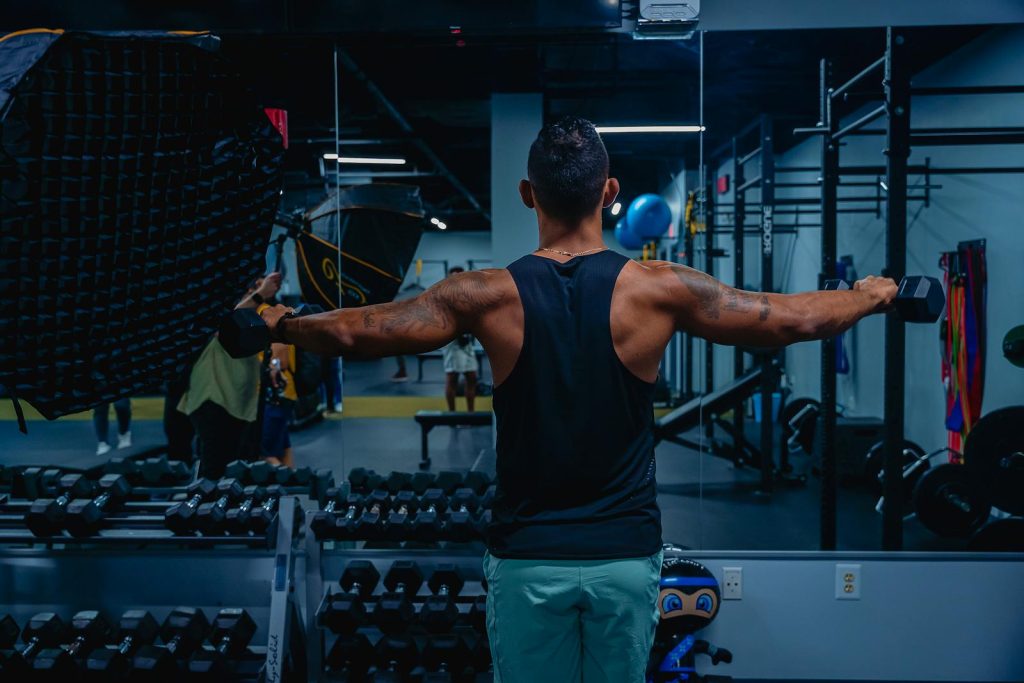
You can train shoulders at home with bodyweight, dumbbells, resistance bands, or a mix of all three. This guide covers the best exercises, proper form, common mistakes, easier and harder variations, and simple workout routines you can follow based on your level.
Why Shoulder Training at Home Can Work
You do not need a cable machine or barbell to build better shoulders. At-home shoulder training works when you use enough effort, control your form, and progress over time.
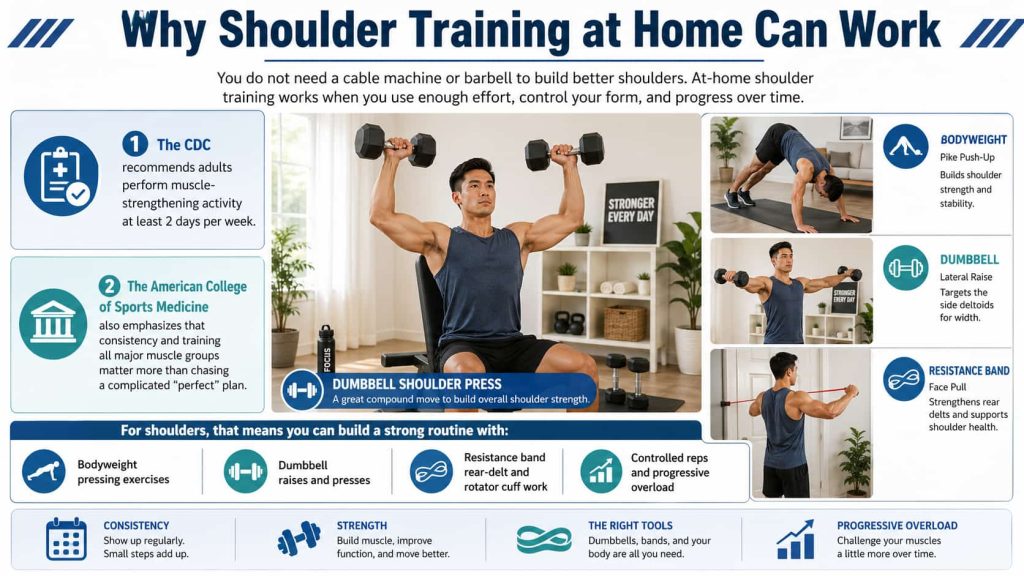
The CDC recommends adults perform muscle-strengthening activity at least 2 days per week. The American College of Sports Medicine also emphasizes that consistency and training all major muscle groups matter more than chasing a complicated “perfect” plan.
For shoulders, that means you can build a strong routine with:
- Bodyweight pressing exercises
- Dumbbell raises and presses
- Resistance band rear-delt and rotator cuff work
- Controlled reps and progressive overload
Equipment You Can Use for At-Home Shoulder Workouts
You can do many shoulder exercises with no equipment, but a few basic tools make your workouts more complete.
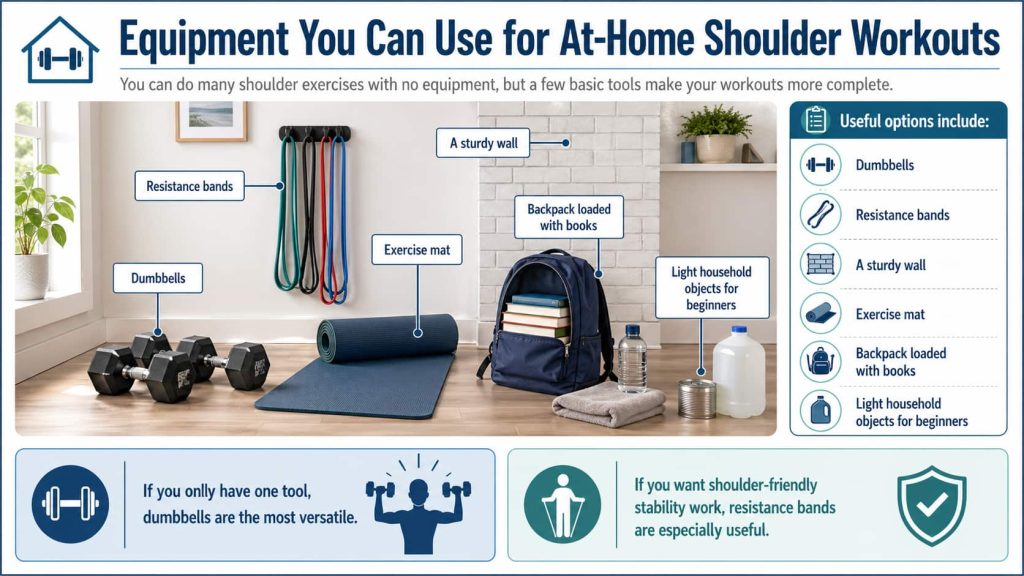
Useful options include:
- Dumbbells
- Resistance bands
- A sturdy wall
- Exercise mat
- Backpack loaded with books
- Light household objects for beginners
If you only have one tool, dumbbells are the most versatile. If you want shoulder-friendly stability work, resistance bands are especially useful.
12 Best Shoulder Exercises at Home for Stronger, Broader Shoulders
Below are the 12 best shoulder exercises at home to build strength, width, stability, and better upper-body control. These moves use bodyweight, dumbbells, resistance bands, and simple wall-based drills, so you can train your shoulders without a full gym.
1. Pike Push-Up
Best for:
Building bodyweight shoulder strength at home, especially in the front delts and upper body.
Muscles worked:
Anterior deltoids, triceps, upper chest, upper traps, serratus anterior, core.
Equipment needed:
No equipment.
Why it stands out
The pike push-up is one of the best no-equipment shoulder exercises because it shifts more of your bodyweight toward your shoulders than a regular push-up. It is also a good stepping stone toward harder overhead bodyweight exercises.
Suggested sets and reps
Beginners: 2–3 sets of 5–8 reps
Intermediate: 3–4 sets of 8–12 reps
Advanced: 4 sets of 10–15 reps or feet-elevated reps
How to do it
- Start in a push-up position.
- Walk your feet forward and lift your hips toward the ceiling.
- Keep your arms straight and your head between your arms.
- Bend your elbows and lower the top of your head toward the floor.
- Press through your hands to return to the starting position.
- Keep your core tight and avoid collapsing through your lower back.
Common mistakes:
- Turning it into a regular push-up
- Letting the elbows flare too wide
- Dropping the head too far forward
- Rushing the lowering phase
- Arching the lower back
Coaching cue:
Think “hips high, head down, press the floor away.”
Exercise variations
- Easier: Do pike push-ups with your hands elevated on a bench, couch, or sturdy step.
- Harder: Elevate your feet on a chair or perform slow tempo reps.
How to use in a workout:
Use pike push-ups early in your workout as a main strength movement before raises or isolation work.
2. Wall Walk
Best for:
Advanced bodyweight shoulder strength, overhead stability, and full-body control.
Muscles worked:
Deltoids, triceps, upper traps, serratus anterior, chest, core, glutes.
Equipment needed:
A sturdy wall.
Why it stands out
Wall walks train your shoulders under a strong overhead bodyweight load. They also build core tension and shoulder-blade control, making them useful for advanced at-home shoulder training.
Suggested sets and reps
Beginners: 2–3 sets of 2–3 partial wall walks
Intermediate: 3 sets of 3–5 reps
Advanced: 4 sets of 4–6 controlled reps
How to do it
- Start in a push-up position with your feet near a wall.
- Place your feet on the wall.
- Walk your hands backward as your feet move up the wall.
- Stop when your body reaches a strong angle you can control.
- Pause briefly with your core tight.
- Walk your hands forward and feet down the wall with control.
Common mistakes:
- Moving too fast
- Letting the ribs flare
- Sagging through the lower back
- Shrugging aggressively toward the ears
- Going closer to the wall than you can control
Coaching cue:
Keep your body tight like a plank from hands to feet.
Exercise variations
- Easier: Perform a partial wall walk and stop halfway.
- Harder: Add a controlled handstand hold near the wall.
How to use in a workout:
Use wall walks as a strength or skill exercise near the beginning of your session. Avoid doing them when your shoulders are already exhausted.
3. Push-Up to Downward Dog
Best for:
Training shoulders, chest, arms, and shoulder mobility in one bodyweight movement.
Muscles worked:
Anterior deltoids, chest, triceps, serratus anterior, upper back, core.
Equipment needed:
No equipment.
Why it stands out
This exercise combines a push-up with a shoulder-focused downward dog position. It is useful when you want a home shoulder exercise that also challenges control, mobility, and upper-body endurance.
Suggested sets and reps
Beginners: 2 sets of 6–8 reps
Intermediate: 3 sets of 8–12 reps
Advanced: 3–4 sets of 12–15 reps
How to do it
- Start in a push-up position.
- Lower your chest toward the floor with control.
- Press back up.
- Push your hips back and up into a downward dog position.
- Reach your chest gently toward your thighs.
- Return to the push-up position and repeat.
Common mistakes:
- Rushing through the downward dog position
- Letting the shoulders collapse
- Flaring elbows too wide in the push-up
- Losing core tension
- Forcing the stretch
Coaching cue:
Press the floor away and reach your hips back after every push-up.
Exercise variations
- Easier: Do the push-up from your knees, then move into downward dog.
- Harder: Add a slow 3-second lowering phase on each push-up.
How to use in a workout:
Use it as a warm-up movement, upper-body finisher, or bodyweight shoulder endurance exercise.
4. Plank Shoulder Tap
Best for:
Shoulder stability, core control, and anti-rotation strength.
Muscles worked:
Deltoids, serratus anterior, chest, triceps, abs, obliques, glutes.
Equipment needed:
No equipment.
Why it stands out
The plank shoulder tap trains your shoulders to stay stable while your body resists twisting. It is not a heavy muscle-building move, but it is excellent for shoulder control and core strength.
Suggested sets and reps
Beginners: 2 sets of 10–16 total taps
Intermediate: 3 sets of 20–30 total taps
Advanced: 3–4 sets of 30–40 total taps
How to do it
- Start in a high plank position.
- Place your feet slightly wider than hip-width.
- Brace your abs and squeeze your glutes.
- Lift one hand and tap the opposite shoulder.
- Return that hand to the floor.
- Repeat on the other side without letting your hips twist.
Common mistakes:
- Rocking side to side
- Letting the hips sag
- Moving too quickly
- Holding the breath
- Placing the hands too far forward
Coaching cue:
Imagine balancing a glass of water on your lower back.
Exercise variations
- Easier: Widen your feet or perform the movement from your knees.
- Harder: Bring your feet closer together or slow each tap.
How to use in a workout:
Use shoulder taps as a warm-up, core exercise, or stability finisher after heavier shoulder work.
5. Bear Crawl Shoulder Tap
Best for:
Shoulder stability, core strength, coordination, and athletic control.
Muscles worked:
Deltoids, serratus anterior, traps, abs, obliques, quads, glutes.
Equipment needed:
No equipment.
Why it stands out
Bear crawl shoulder taps create more full-body tension than regular plank shoulder taps. Because your knees hover above the floor, your shoulders and core have to work harder to keep your body steady.
Suggested sets and reps
Beginners: 2 sets of 8–12 total taps
Intermediate: 3 sets of 12–20 total taps
Advanced: 3–4 sets of 20–30 total taps
How to do it
- Start on your hands and knees.
- Place your hands under your shoulders and knees under your hips.
- Lift your knees 1–2 inches off the floor.
- Brace your core.
- Tap one hand to the opposite shoulder.
- Return it to the floor and switch sides.
Common mistakes:
- Lifting the hips too high
- Letting the knees drift too far back
- Twisting the torso
- Moving too fast
- Collapsing through the shoulder blades
Coaching cue:
Keep your knees low and your torso quiet.
Exercise variations
- Easier: Keep your knees on the floor.
- Harder: Add a forward bear crawl between taps.
How to use in a workout:
Use it as a shoulder-stability drill, core movement, or conditioning finisher.
6. Dumbbell Shoulder Press
Best for:
Building shoulder strength and size at home.
Muscles worked:
Anterior deltoids, lateral deltoids, triceps, upper chest, upper traps, core.
Equipment needed:
Dumbbells.
Why it stands out
The dumbbell shoulder press is one of the most effective at-home shoulder exercises if you have weights. It lets you train both shoulders through a strong overhead pressing pattern. The American Council on Exercise includes dumbbell and shoulder-focused exercises in its shoulder exercise library for building and stabilizing the deltoids, rotator cuff, and traps.
Suggested sets and reps
Beginners: 2–3 sets of 8–10 reps
Intermediate: 3–4 sets of 8–12 reps
Advanced: 4–5 sets of 6–12 reps
How to do it
- Stand tall or sit on a sturdy chair.
- Hold a dumbbell in each hand at shoulder height.
- Keep your wrists stacked over your elbows.
- Brace your abs and keep your ribs down.
- Press the dumbbells overhead until your arms are almost straight.
- Lower the weights back to shoulder height with control.
Common mistakes:
- Arching the lower back
- Pressing the weights too far forward
- Bouncing out of the bottom
- Letting the wrists bend backward
- Using weights that are too heavy
Coaching cue:
Press up while keeping your ribs stacked over your hips.
Exercise variations
- Easier: Use one dumbbell at a time or perform a seated shoulder press.
- Harder: Use a slow tempo or pause at the bottom of each rep.
How to use in a workout:
Use dumbbell shoulder presses as your main weighted shoulder exercise. Perform them early while you are fresh.
7. Dumbbell Lateral Raise
Best for:
Building wider-looking shoulders by targeting the side delts.
Muscles worked:
Lateral deltoids, anterior deltoids, upper traps, supraspinatus.
Equipment needed:
Dumbbells or light household objects.
Why it stands out
The lateral raise is one of the best shoulder exercises at home for building shoulder width. It directly targets the side delts, which help create a broader upper-body look. ACE’s lateral raise guidance emphasizes a stable stance, controlled movement, and raising the arms only to about shoulder level.
Suggested sets and reps
Beginners: 2–3 sets of 10–12 reps
Intermediate: 3–4 sets of 12–15 reps
Advanced: 4 sets of 12–20 reps
How to do it
- Stand tall with a dumbbell in each hand.
- Keep a slight bend in your elbows.
- Brace your core.
- Raise your arms out to the sides until they reach shoulder height.
- Pause briefly at the top.
- Lower the weights slowly.
Common mistakes:
- Swinging the dumbbells
- Shrugging the shoulders
- Raising the weights too high
- Locking the elbows stiff
- Using too much weight
Coaching cue:
Lead with your elbows and stop around shoulder height.
Exercise variations
- Easier: Use lighter weights or raise one arm at a time.
- Harder: Add a 1–2 second pause at the top.
How to use in a workout:
Use lateral raises after presses. They work well in moderate to high reps because the side delts often respond well to controlled volume.
8. Dumbbell Front Raise
Best for:
Targeting the front delts and improving shoulder control.
Muscles worked:
Anterior deltoids, upper chest, serratus anterior, traps, core.
Equipment needed:
Dumbbells or a light plate substitute, such as a backpack.
Why it stands out
Front raises isolate the front delts more directly than many bodyweight moves. They can be helpful if your goal is shoulder definition, but they should not replace side-delt and rear-delt work.
Suggested sets and reps
Beginners: 2 sets of 10–12 reps
Intermediate: 3 sets of 10–15 reps
Advanced: 3–4 sets of 12–20 reps
How to do it
- Stand tall with dumbbells in front of your thighs.
- Brace your abs.
- Raise one or both arms in front of your body.
- Stop when your hands reach shoulder height.
- Pause briefly.
- Lower with control.
Common mistakes:
- Leaning backward
- Swinging the weights
- Raising the dumbbells too high
- Letting the shoulders shrug
- Going too heavy
Coaching cue:
Lift with control, not momentum.
Exercise variations
- Easier: Alternate arms instead of lifting both at once.
- Harder: Use a slow 3-second lowering phase.
How to use in a workout:
Use front raises as an accessory exercise after pressing. If you already do many push-ups or presses, you may not need a lot of extra front-delt volume.
9. Bent-Over Reverse Fly
Best for:
Rear delts, shoulder balance, and upper-back support.
Muscles worked:
Posterior deltoids, rhomboids, mid traps, lower traps, rotator cuff.
Equipment needed:
Dumbbells or light household objects.
Why it stands out
Many home workouts overtrain the front of the shoulders with push-ups and presses. The bent-over reverse fly helps balance that by training the rear delts and upper back.
Suggested sets and reps
Beginners: 2–3 sets of 10–12 reps
Intermediate: 3–4 sets of 12–15 reps
Advanced: 4 sets of 15–20 reps
How to do it
- Hold a light dumbbell in each hand.
- Hinge forward at your hips.
- Keep your back flat and chest angled toward the floor.
- Let the dumbbells hang under your shoulders.
- Raise your arms out to the sides.
- Squeeze the back of your shoulders, then lower slowly.
Common mistakes:
- Turning it into a row
- Swinging the weights
- Rounding the back
- Shrugging the shoulders
- Using weights that are too heavy
Coaching cue:
Move the weights out wide, not straight back.
Exercise variations
- Easier: Perform the exercise chest-supported on an incline bench or with very light objects.
- Harder: Pause at the top of each rep.
How to use in a workout:
Use reverse flyes after presses and lateral raises, or pair them with push-ups to balance your shoulder training.
10. Resistance Band Face Pull
Best for:
Rear delts, upper back, posture support, and shoulder stability.
Muscles worked:
Posterior deltoids, mid traps, lower traps, rhomboids, rotator cuff.
Equipment needed:
Resistance band and a secure anchor point.
Why it stands out
The band face pull is one of the best at-home shoulder exercises for rear delts and shoulder-blade control. It helps balance pressing work and trains the muscles that support strong shoulder positioning.
Suggested sets and reps
Beginners: 2–3 sets of 12–15 reps
Intermediate: 3–4 sets of 15–20 reps
Advanced: 4 sets of 15–25 reps
How to do it
- Anchor a resistance band at about upper-chest or face height.
- Hold one end of the band in each hand.
- Step back until the band has light tension.
- Pull the band toward your face.
- Keep your elbows high but controlled.
- Squeeze your shoulder blades gently, then return slowly.
Common mistakes:
- Pulling too low
- Flaring the ribs
- Shrugging the shoulders
- Jerking the band
- Using too much band tension
Coaching cue:
Pull toward your face while keeping your neck relaxed.
Exercise variations
- Easier: Use a lighter band or stand closer to the anchor.
- Harder: Add a pause with the hands near your face.
How to use in a workout:
Use face pulls near the end of your workout or between pressing sets to keep your shoulders balanced.
11. Resistance Band External Rotation
Best for:
Rotator cuff strength, shoulder stability, and warm-up work.
Muscles worked:
Infraspinatus, teres minor, posterior deltoid, scapular stabilizers.
Equipment needed:
Resistance band.
Why it stands out
External rotations train smaller shoulder-stabilizing muscles that often get ignored. They are not meant to be heavy, but they can help improve control during pressing and raising exercises.
Suggested sets and reps
Beginners: 2 sets of 10–12 reps per side
Intermediate: 2–3 sets of 12–15 reps per side
Advanced: 3 sets of 15–20 reps per side
How to do it
- Anchor a resistance band at about elbow height.
- Stand sideways to the anchor.
- Hold the band with your outside hand.
- Keep your elbow bent at 90 degrees and tucked near your side.
- Rotate your forearm away from your body.
- Return slowly without letting your elbow drift.
Common mistakes:
- Moving the elbow away from the body
- Twisting the torso
- Using too much resistance
- Rushing the movement
- Turning it into a large arm swing
Coaching cue:
Keep your elbow pinned and rotate only from the shoulder.
Exercise variations
- Easier: Use a very light band or do side-lying external rotations with no weight.
- Harder: Add a slow tempo and longer pause at the end range.
How to use in a workout:
Use band external rotations during your warm-up or as a light accessory exercise at the end.
12. Wall Slide
Best for:
Shoulder mobility, posture, scapular control, and warm-up work.
Muscles worked:
Serratus anterior, lower traps, rotator cuff, rear delts, upper back.
Equipment needed:
A wall.
Why it stands out
Wall slides are not a heavy strength exercise, but they are excellent for improving shoulder control. They help you practice moving your arms overhead without excessive back arching or shoulder shrugging.
Suggested sets and reps
Beginners: 2 sets of 8–10 reps
Intermediate: 2–3 sets of 10–12 reps
Advanced: 3 sets of 12–15 slow reps
How to do it
- Stand with your back against a wall.
- Keep your ribs down and core lightly braced.
- Place your forearms or backs of your hands near the wall.
- Slowly slide your arms upward.
- Stop before your lower back arches.
- Lower your arms with control.
Common mistakes:
- Arching the lower back
- Forcing the arms overhead
- Shrugging the shoulders
- Moving too quickly
- Letting the ribs flare
Coaching cue:
Reach up without letting your ribs pop forward.
Exercise variations
- Easier: Stand slightly away from the wall or use a smaller range of motion.
- Harder: Add a light resistance band around your wrists.
How to use in a workout:
Use wall slides in your warm-up before presses, pike push-ups, or wall walks.
How to Build a Shoulder Workout at Home
A good home shoulder workout should include three types of training:
1. A press or bodyweight strength move
Examples:
- Pike push-up
- Dumbbell shoulder press
- Wall walk
These exercises build strength and train the shoulders under heavier tension.
2. A side-delt exercise
Examples:
- Dumbbell lateral raise
- Band lateral raise
- Leaning lateral raise
Side-delt work helps build the wider shoulder look many people want.
3. A rear-delt or stability exercise
Examples:
- Bent-over reverse fly
- Band face pull
- Band external rotation
- Wall slide
This keeps your shoulder training balanced and may support better movement quality.
Beginner Shoulder Workout at Home
Use this workout if you are new to shoulder training or returning after a break.
Beginner option
Wall Slide: 2 sets of 10 reps
Pike Push-Up: 2 sets of 5–8 reps
Dumbbell Lateral Raise: 2 sets of 10–12 reps
Bent-Over Reverse Fly: 2 sets of 10–12 reps
Plank Shoulder Tap: 2 sets of 10–16 total taps
Rest 45–75 seconds between sets.
Start light and focus on clean reps. Your shoulders should feel challenged, not irritated.
Intermediate Shoulder Workout at Home
Use this workout if you already have basic strength and can perform push-ups, raises, and presses with control.
Intermediate option
Dumbbell Shoulder Press: 3 sets of 8–12 reps
Pike Push-Up: 3 sets of 8–10 reps
Dumbbell Lateral Raise: 3 sets of 12–15 reps
Band Face Pull: 3 sets of 15–20 reps
Band External Rotation: 2 sets of 12–15 reps per side
Rest 60–90 seconds after presses and 30–60 seconds after isolation exercises.
Advanced Shoulder Workout at Home
Use this workout if you have strong pressing mechanics and good shoulder control.
Advanced option
Wall Walk: 4 sets of 3–5 reps
Dumbbell Shoulder Press: 4 sets of 6–10 reps
Feet-Elevated Pike Push-Up: 3 sets of 8–12 reps
Dumbbell Lateral Raise: 4 sets of 12–20 reps
Bent-Over Reverse Fly: 4 sets of 15–20 reps
Band Face Pull: 3 sets of 20 reps
Rest 90 seconds after the hardest moves and 45–60 seconds after accessory exercises.
How Often Should You Train Shoulders at Home?
Most people can train shoulders 2–3 times per week, depending on total workout volume and recovery.
A simple weekly plan could look like this:
Option 1: Two days per week
- Day 1: Pressing, lateral raises, rear delts
- Day 2: Pike push-ups, wall slides, face pulls, stability work
Option 2: Three days per week
- Day 1: Strength focus
- Day 2: Light stability and rear-delt focus
- Day 3: Hypertrophy focus with raises and presses
Avoid doing hard shoulder workouts every day. Your shoulders also work during chest exercises, push-ups, back exercises, and many core movements.
Common Mistakes to Avoid During At-Home Shoulder Training
Going too heavy on raises
Lateral raises, front raises, and reverse flyes work best with control. If you need to swing your torso to move the weight, the load is too heavy.
Ignoring the rear delts
Many people do push-ups and presses but skip rear-delt work. This can make your shoulder training feel unbalanced. Include reverse flyes, face pulls, or band pull-aparts.
Arching the lower back during overhead exercises
If your ribs flare and your lower back arches, you may be turning a shoulder press into a back extension. Brace your abs and keep your ribs stacked over your hips.
Shrugging during every rep
Some upper-trap involvement is normal, but your shoulders should not jam up toward your ears on every raise. Use lighter weights and focus on smooth arm movement.
Training through sharp pain
Muscle fatigue is normal. Sharp pain, numbness, tingling, dizziness, or sudden weakness is not. Stop the exercise and seek professional guidance if unusual symptoms occur.
Safety Tips for Shoulder Exercises at Home
Shoulder training should feel challenging, controlled, and repeatable. It should not feel sharp, unstable, or forced.
Use these safety rules:
- Warm up before hard pressing.
- Start with lighter resistance than you think you need.
- Keep your movements controlled.
- Avoid forcing your arms into painful ranges.
- Stop when your form breaks down.
- Increase weight, reps, or difficulty gradually.
- Give your shoulders time to recover between hard sessions.
If you already have shoulder pain, a recent injury, or a history of dislocation, get guidance from a qualified healthcare or rehab professional before trying advanced shoulder exercises.
Best Shoulder Exercises at Home Without Equipment
If you do not have dumbbells or bands, start with these:
- Pike push-up
- Push-up to downward dog
- Plank shoulder tap
- Bear crawl shoulder tap
- Wall walk
- Wall slide
These exercises can build shoulder strength, stability, and control using only your bodyweight.
Best Shoulder Exercises at Home With Dumbbells
If you have dumbbells, prioritize these:
- Dumbbell shoulder press
- Dumbbell lateral raise
- Dumbbell front raise
- Bent-over reverse fly
For most people, dumbbells make shoulder training easier to progress because you can gradually add reps, sets, tempo, or weight.
Best Shoulder Exercises at Home With Resistance Bands
If you have bands, use them for shoulder balance and stability:
- Band face pull
- Band external rotation
- Band lateral raise
- Band pull-apart
- Band overhead press
Bands are especially useful for rear delts, rotator cuff work, and high-rep finishers.
FAQ About the Best Shoulder Exercises at Home
What is the best shoulder exercise at home?
The dumbbell shoulder press is one of the best weighted shoulder exercises at home, while the pike push-up is one of the best no-equipment options. For complete shoulder development, combine pressing, lateral raises, rear-delt work, and stability exercises.
Can I build bigger shoulders at home?
Yes, you can build bigger shoulders at home if you train consistently, use enough resistance, and progress over time. Dumbbells, bands, tempo reps, pauses, and harder bodyweight angles can all make home shoulder workouts more effective.
How do I get broader shoulders at home?
Focus on the side delts with lateral raises, but do not skip presses and rear-delt exercises. A good plan includes dumbbell shoulder presses, lateral raises, reverse flyes, and band face pulls.
Are push-ups enough for shoulders?
Push-ups train the front delts, chest, and triceps, but they are not enough for complete shoulder development. Add side-delt exercises like lateral raises and rear-delt exercises like reverse flyes or face pulls.
How many shoulder exercises should I do per workout?
Most home shoulder workouts only need 3–5 exercises. Choose one main press, one side-delt exercise, one rear-delt exercise, and one stability or mobility drill.
Should I train shoulders every day?
Hard shoulder training every day is usually not necessary. Most people do better with 2–3 focused shoulder sessions per week, especially because the shoulders also work during chest, back, and bodyweight exercises.
What should I do if shoulder exercises hurt?
Stop the exercise if you feel sharp pain, numbness, tingling, dizziness, or unusual weakness. Reduce the range of motion, lower the resistance, or choose a different exercise. If symptoms continue, speak with a qualified professional.
Conclusion
The best shoulder exercises at home are not just presses or push-ups. To build stronger, broader shoulders, train the front delts, side delts, rear delts, and smaller stabilizing muscles with a balanced plan.
Start with 3–5 exercises, use controlled reps, and progress slowly. A simple mix of pike push-ups, dumbbell shoulder presses, lateral raises, reverse flyes, face pulls, and wall slides can give you a complete shoulder workout without needing a gym.
References
- American Council on Exercise — Shoulder Exercises Library
- American Council on Exercise — Lateral Raise Exercise Guide
- American Council on Exercise — ACE Research Identifies Top Shoulder Exercises
- CDC — Adult Physical Activity Guidelines
- American College of Sports Medicine — Updated Resistance Training Guidelines
- NHS — Shoulder Pain