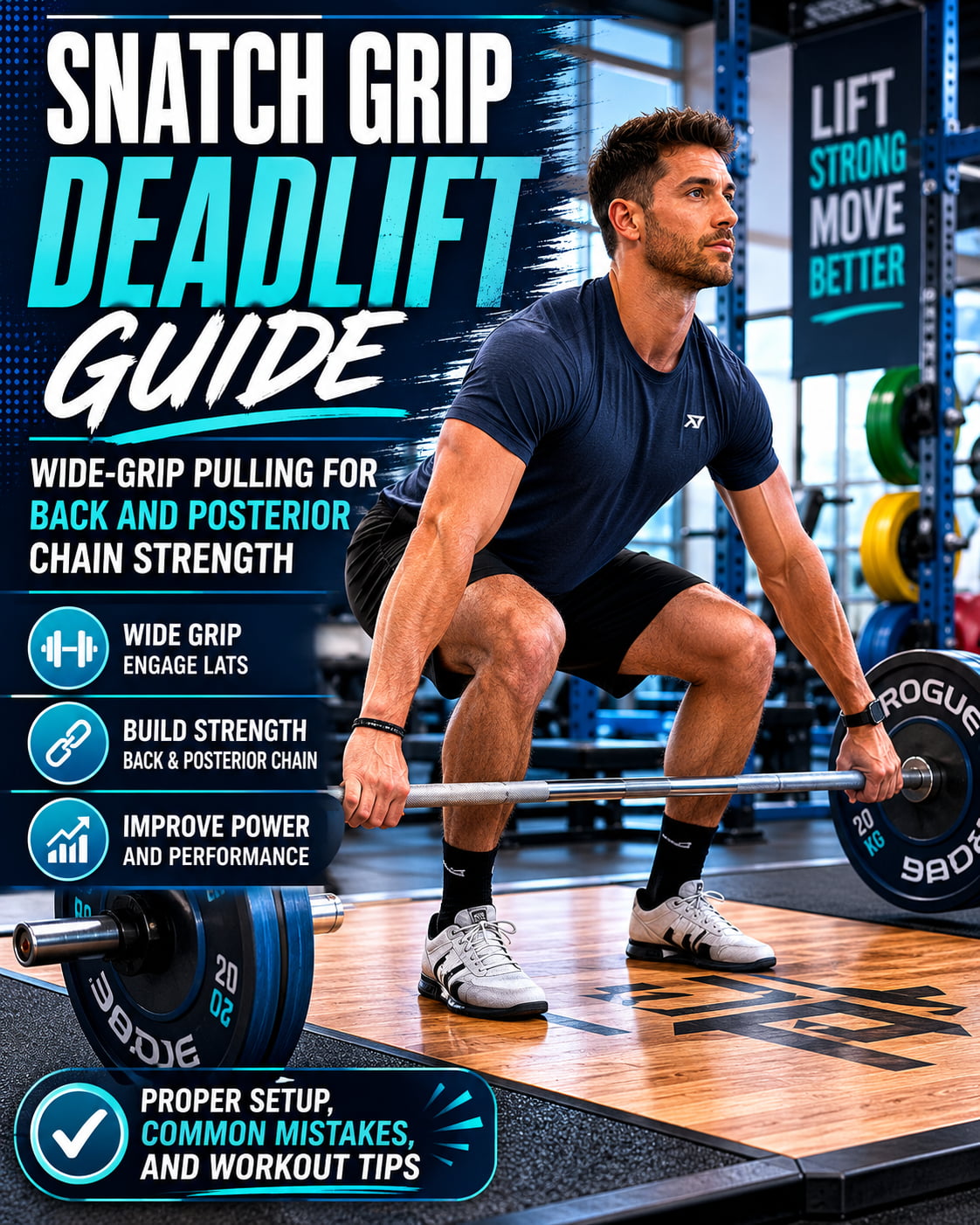
The snatch grip deadlift is a wide-grip deadlift variation that builds strong hamstrings, glutes, spinal erectors, lats, traps, grip, and upper-back strength. It uses a wider hand position than a conventional deadlift, which increases the range of motion and makes the lift more demanding from the floor.
This guide explains how to do the snatch grip deadlift with proper form, which muscles it works, why it is useful, common mistakes to avoid, and how to program it in a real workout.
What Is the Snatch Grip Deadlift?
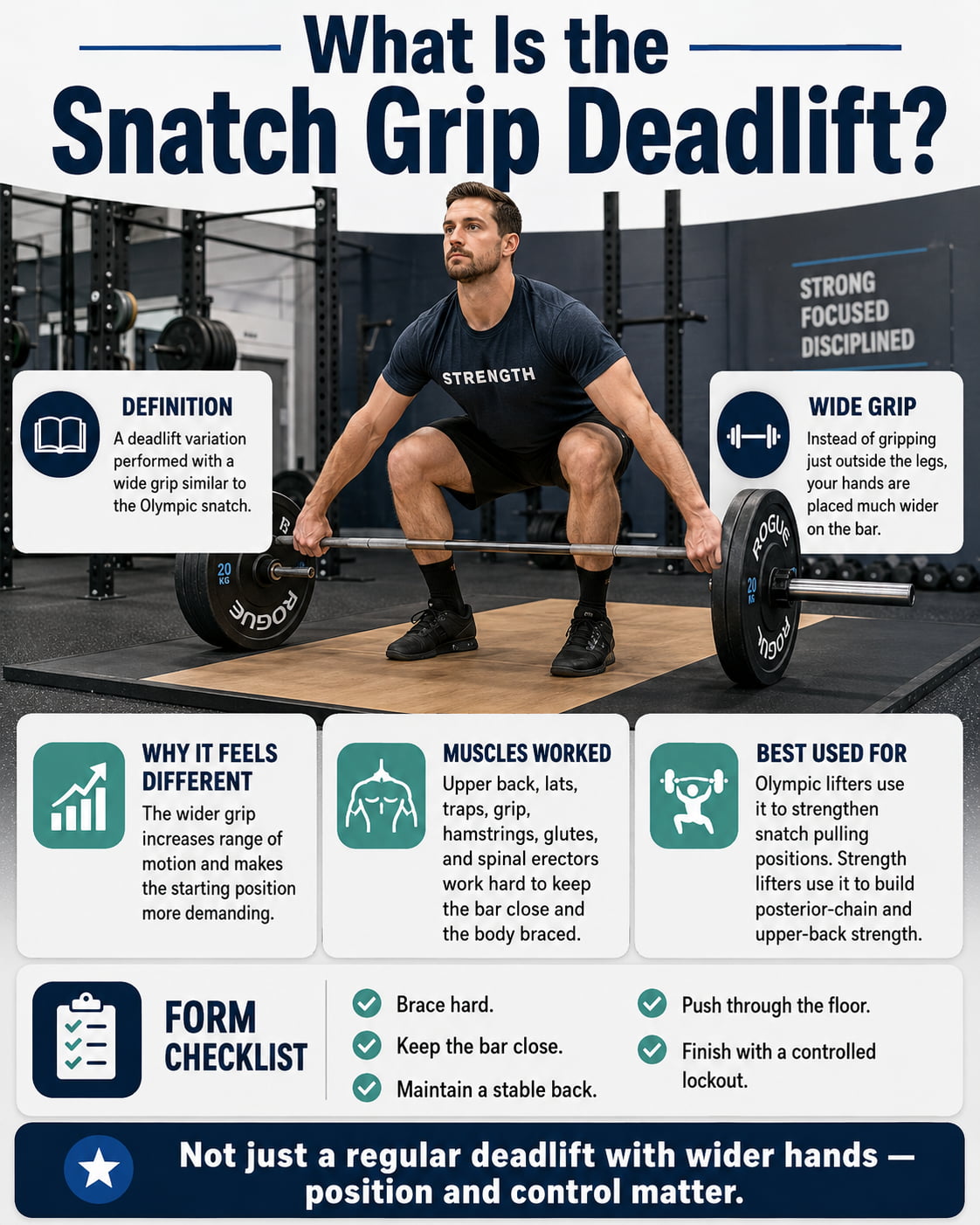
The snatch grip deadlift is a deadlift variation performed with a wide grip similar to the hand position used in the Olympic snatch. Instead of gripping the bar just outside your legs, you place your hands much wider on the bar.
That wider grip changes the lift in several important ways.
Your torso usually starts in a lower position. Your hips may sit slightly lower than they would in a conventional deadlift. The bar has to travel farther. Your upper back, lats, traps, grip, hamstrings, glutes, and spinal erectors have to work harder to keep the bar close and your body braced.
For Olympic weightlifters, the movement can help strengthen snatch pulling positions. For general strength training, it is a powerful posterior-chain and upper-back builder when performed with control.
The snatch grip deadlift is not just a regular deadlift with your hands placed wider. A good rep should still have a tight brace, stable back position, close bar path, strong leg drive, and controlled lockout.
Snatch Grip Deadlift Muscles Worked
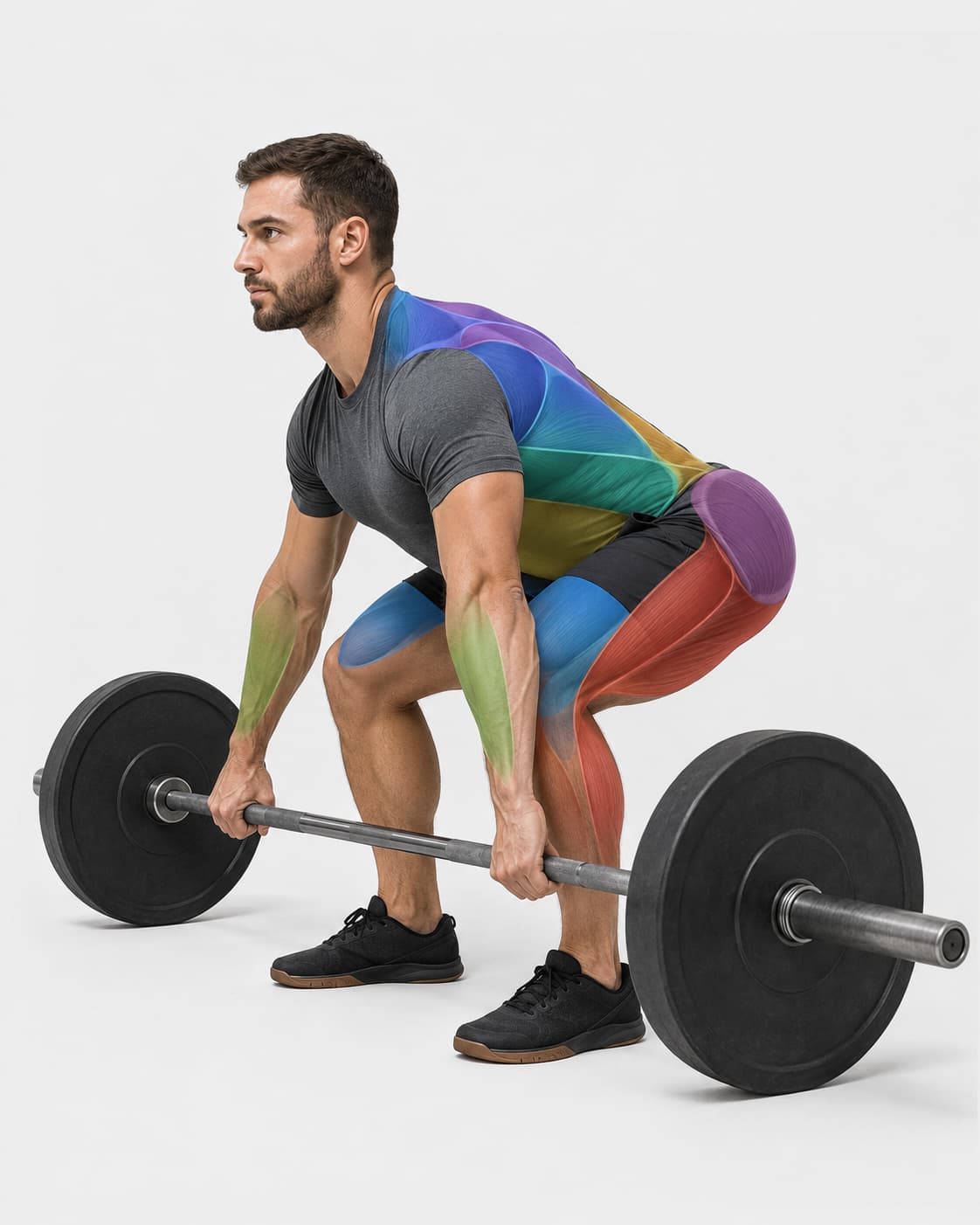
The snatch grip deadlift is a full-body pulling exercise, but it mainly targets the posterior chain and back.
The glutes help extend the hips as you stand up with the bar. They are especially important during the second half of the lift and at lockout.
The hamstrings assist hip extension and help control the pull from the floor. Because the wider grip increases the range of motion, many lifters feel a strong hamstring demand in this variation.
The spinal erectors work to keep your torso rigid and your back position stable. They do not need to create excessive movement. Their job is to resist collapsing as the bar leaves the floor.
The lats help keep the bar close to your body. If your lats relax, the bar drifts forward, the lift feels heavier, and your position becomes harder to control.
The traps, rhomboids, and upper back work hard because the wide grip creates more demand through the shoulders and upper torso. This is one reason the snatch grip deadlift is popular for building upper-back strength.
The forearms and grip muscles are heavily challenged, especially if you train without straps. The wider grip makes the bar harder to hold than a conventional deadlift.
The quadriceps help push the floor away at the start. The movement is still hip-dominant, but the lower starting position gives the quads a meaningful role off the floor.
The core muscles brace your trunk so your rib cage, pelvis, and spine stay controlled throughout the pull.
Snatch Grip Deadlift Benefits for Strength and Muscle
The snatch grip deadlift is useful because it makes lighter loads feel challenging while training several important strength qualities at once.
It can build a stronger posterior chain. The glutes, hamstrings, and spinal erectors have to produce and control force through a longer pulling range than a standard deadlift.
It can improve upper-back strength. The wide grip forces your lats, traps, rhomboids, and rear shoulder area to work hard to keep the bar close and your torso stable.
It can build grip strength. If you train it without straps, your hands and forearms have to work harder to hold the bar because the grip is wide and the pull is longer.
It can improve pulling position. The movement rewards patience off the floor. If you rush the start, let your hips shoot up, or lose your brace, the lift quickly falls apart.
It can support Olympic lifting technique. Lifters who train the snatch often use snatch deadlift variations to reinforce the posture, balance, and bar path needed for stronger pulls. Catalyst Athletics provides a useful technical breakdown of the snatch deadlift as a snatch-position strength exercise.
It can reduce the need for very heavy loads. Because the wide grip increases difficulty, many lifters can get a strong training effect with less weight than they use on a conventional deadlift.
Snatch Grip Deadlift Versus Conventional Deadlift
The conventional deadlift uses a narrower grip and usually allows you to lift more weight. It is often the better main strength lift because it is easier to load heavily and easier for many lifters to set up.
The snatch grip deadlift uses a much wider grip. This increases the range of motion, makes the starting position more demanding, and places more stress on the upper back and grip.
Use the conventional deadlift when your main goal is maximum pulling strength. Use the snatch grip deadlift when you want a harder accessory lift for upper-back strength, posterior-chain development, grip training, or snatch-style pulling positions.
You do not need to replace one with the other. Many lifters use conventional deadlifts as the main lift and snatch grip deadlifts as a secondary movement.
How Wide Should Your Snatch Grip Be?
A practical starting point is to grip the bar wide enough that it rests around the crease of your hips when you stand tall with straight arms. From there, adjust based on your body proportions, shoulder comfort, and ability to keep the bar close.
Your grip should be wide, but it should not be so wide that your shoulders feel forced, your wrists lose position, or you cannot create upper-back tension.
A very wide grip increases the range of motion and makes the lift harder. That can be useful, but only if you can keep control. If your back rounds, your grip fails immediately, or the bar drifts forward, bring your hands slightly inward or raise the bar from blocks.
How to Do the Snatch Grip Deadlift With Proper Form
Equipment needed: You need a barbell and weight plates. Lifting straps are optional. Use straps when the goal is back and posterior-chain loading, but train without straps sometimes if grip strength is one of your goals.
Suggested sets and reps: For strength, use 3 to 5 sets of 3 to 5 reps. For muscle and accessory work, use 3 to 4 sets of 6 to 10 reps. For technique work, use 3 to 5 sets of 2 to 4 controlled reps with lighter loads.
Beginners: Beginners should start with a conventional deadlift, Romanian deadlift, or snatch grip deadlift from blocks before pulling from the floor. Use light weight and focus on keeping the spine braced, the bar close, and the feet balanced.
Intermediate: Intermediate lifters can use the snatch grip deadlift as a secondary pull after squats, deadlifts, or Olympic lifting work. Start around an effort level of RPE 6 to 8 and add load only when every rep looks clean.
Advanced: Advanced lifters can use paused reps, deficits, slow eccentrics, or heavier low-rep sets. Keep the goal specific. Do not turn every snatch grip deadlift session into a max-effort test.
Rest: Rest 2 to 3 minutes between moderate sets. Rest 3 to 5 minutes between heavier strength sets. For lighter technique work, 90 to 150 seconds is often enough.
How to do it:
- Stand with your feet about hip-width apart and the bar over the midfoot or slightly toward the balls of the feet.
- Take a wide snatch-style grip on the bar, using the hip-crease rule as your starting point.
- Bend your knees and hinge your hips until you can grip the bar with straight arms.
- Brace your core, pull your chest tall, and create tension through your lats and upper back.
- Keep your shoulders slightly over the bar and your whole foot connected to the floor.
- Push the floor away and let the bar rise while staying close to your legs.
- Keep your back angle controlled as the bar passes your knees.
- Extend your hips and knees together to stand tall.
- Finish with your glutes squeezed and ribs down, not with an exaggerated lower-back lean.
- Lower the bar under control, reset your brace, and repeat.
Common mistakes: The biggest mistakes are gripping too wide, letting the hips shoot up first, pulling the bar away from the legs, losing the brace, rounding the back under load, bending the arms, and leaning back too far at lockout. Another common mistake is using the same weight you use for conventional deadlifts. Start lighter because the wide grip makes the lift much harder.
Expert tip: Think “push the floor away and drag the bar up the legs.” This cue helps you stay patient from the floor instead of yanking the bar and losing position.
Exercise variations: Useful variations include the snatch grip Romanian deadlift, paused snatch grip deadlift, snatch grip block pull, snatch grip rack pull, deficit snatch grip deadlift, and snatch segment deadlift.
Easier variation: The snatch grip deadlift from blocks is the best easier variation. Raising the bar shortens the range of motion and helps you practice the wide grip without forcing a position you cannot hold from the floor.
Harder variation: The deficit snatch grip deadlift is a harder variation because it increases the range of motion even more. Use it only if you can maintain a strong brace, close bar path, and stable back position from the floor.
Common Snatch Grip Deadlift Mistakes
Mistake 1 Gripping Too Wide
A wider grip is not always better. If your hands are so wide that you cannot create lat tension, keep your wrists comfortable, or hold the bar securely, the grip is too wide for your current build and mobility.
Start with the hip-crease rule, then adjust slightly. The right grip is wide enough to challenge you but controlled enough to keep good positions.
Mistake 2 Letting the Bar Drift Forward
The bar should stay close to your legs. When the bar moves away from you, the lift becomes harder on your back and less efficient.
Before each rep, tighten your lats like you are trying to squeeze your armpits toward your pockets. Keep that tension as the bar leaves the floor.
Mistake 3 Hips Shooting Up First
If your hips rise before the bar moves, the lift turns into a stiff-legged pull from a poor position. This usually happens when the weight is too heavy, the brace is weak, or the lifter is rushing.
Set your back, push through the floor, and let your hips and shoulders rise together at the start.
Mistake 4 Rounding the Back Under Load
Some upper-back rounding can happen in heavy pulling, but beginners and most general lifters should learn to keep a strong, braced position. If your lower back rounds or you cannot control your trunk, reduce the weight or raise the bar.
A controlled snatch grip deadlift should feel hard because your muscles are working, not because your position is collapsing.
Mistake 5 Turning It Into a Max Deadlift
The snatch grip deadlift is usually best as a strength accessory, technique builder, or muscle-building movement. It does not need to be loaded like your strongest deadlift.
Most lifters should use less weight than they use on conventional deadlifts and focus on clean reps.
Best Snatch Grip Deadlift Variations
Snatch Grip Romanian Deadlift
The snatch grip Romanian deadlift starts from the standing position and focuses on the hip hinge. It is excellent for hamstrings, glutes, lats, and upper-back tension.
Use this variation if you want posterior-chain training without pulling from the floor. It is also a good teaching tool for lifters who need to learn how to keep the bar close.
Snatch Grip Block Pull
The snatch grip block pull raises the bar from the floor. This makes the starting position easier and reduces the range of motion.
Use it if you cannot keep a strong back position from the floor, if your mobility limits the setup, or if you want to overload the upper back without the deepest starting position.
Paused Snatch Grip Deadlift
The paused snatch grip deadlift adds a short pause below the knee, at the knee, or just above the knee. This helps build positional strength and makes it harder to rush the pull.
Use lighter loads and pause without relaxing your brace.
Snatch Segment Deadlift
The snatch segment deadlift uses multiple pauses during the pull. It is especially useful for Olympic lifting technique because it teaches balance, patience, and position awareness.
Catalyst Athletics explains the snatch segment deadlift as a way to build strength in specific pulling positions and correct balance errors.
Deficit Snatch Grip Deadlift
The deficit snatch grip deadlift is performed while standing on a small platform or plates. It increases the range of motion and makes the start even harder.
This is an advanced variation. Do not use it if your back position breaks down from the floor.
How to Program the Snatch Grip Deadlift
The snatch grip deadlift can fit into a workout in several ways.
Use it as a main strength lift if you are experienced and want a wide-grip pulling focus. In this case, perform it early in the workout after a warm-up.
Use it as an accessory lift after conventional deadlifts or squats. This is the best option for many lifters because it builds the back and posterior chain without replacing the main lift.
Use it as Olympic lifting assistance if you train the snatch. Keep the reps clean, the bar close, and the positions consistent. British Weight Lifting explains that the snatch is a wide-grip lift that requires speed, mobility, strength, and technical skill, so related strength work should be controlled and purposeful.
Use it for hypertrophy when you want a challenging back, glute, and hamstring movement. Moderate reps with controlled form work well here.
For general strength and muscle, train the snatch grip deadlift 1 time per week. Some advanced lifters can use a lighter technical variation on another day, but most people do not need more than that.
Sample Snatch Grip Deadlift Workout
Use this workout as a posterior-chain and upper-back accessory day.
Warm-up: Start with 5 to 8 minutes of light cardio, then do hip hinges, bodyweight squats, glute bridges, and light ramp-up sets with the empty bar.
Main lift: Snatch grip deadlift for 4 sets of 5 reps at RPE 7. Rest 2 to 3 minutes between sets.
Secondary hinge: Romanian deadlift for 3 sets of 8 reps. Rest 2 minutes.
Upper-back pull: Chest-supported row for 3 sets of 8 to 12 reps. Rest 90 seconds.
Core brace: Dead bug or plank for 3 controlled sets. Rest 60 seconds.
Progression: Add 5 to 10 pounds next week only if all working sets stay controlled. If your grip fails before your back and legs are trained, use straps on the last set or reduce the load.
Beginner Snatch Grip Deadlift Plan
Beginners should not rush the full floor version. Use this progression.
Start with Romanian deadlifts to learn the hip hinge. Then move to snatch grip Romanian deadlifts with a light bar. After that, practice snatch grip block pulls. Once you can keep a strong brace and close bar path, move the bar closer to the floor over time.
A simple beginner plan is 2 to 3 sets of 5 to 6 reps from blocks at RPE 6. Rest 2 minutes between sets. Focus on control, not load.
The National Strength and Conditioning Association provides useful guidance on resistance training fundamentals, including proper technique, progression, and coaching quality for safe strength development. You can review their broader resistance training resources through the NSCA education library.
Safety Tips for the Snatch Grip Deadlift
Start lighter than you think. The wide grip makes the lift harder than a standard deadlift.
Do not force the floor version if you cannot reach the bar with a braced position. Raise the bar on blocks or use a rack pull variation.
Keep your arms straight. Do not curl or bend the elbows while pulling.
Use straps when grip limits the goal of the set. Do not use straps for every set if grip strength is one of your training goals.
Avoid bouncing the bar off the floor. Reset your brace between reps when needed.
Stop the exercise and seek professional help if you feel sharp pain, numbness, dizziness, chest pain, or unusual symptoms.
Frequently Asked Questions
Is the snatch grip deadlift harder than a regular deadlift?
Yes, it is usually harder because the wide grip increases the range of motion and makes the upper back, grip, and starting position work harder. Most lifters need to use less weight than they use on a conventional deadlift.
What is the snatch grip deadlift good for?
It is good for building hamstrings, glutes, spinal erectors, lats, traps, grip, and upper-back strength. It is also useful for improving pulling control and supporting snatch-style strength work.
Should beginners do snatch grip deadlifts?
Complete beginners should usually learn a conventional deadlift, Romanian deadlift, or block pull first. Once basic hinge mechanics are solid, the snatch grip deadlift can be introduced with light weight or a raised bar.
Should I use straps for snatch grip deadlifts?
Use straps when your goal is to train the back, glutes, hamstrings, and pulling position without grip being the limiting factor. Skip straps on some sets if you want to build grip strength.
How heavy should snatch grip deadlifts be?
Start lighter than your conventional deadlift. A good starting range is RPE 6 to 7, meaning you should finish each set with several good reps left in reserve. Add weight only when your brace, bar path, and back position stay consistent.
Are snatch grip deadlifts good for upper back?
Yes. The wide grip increases the demand on the lats, traps, rhomboids, rear shoulder area, and spinal erectors. That makes it a strong accessory lift for upper-back strength when performed with proper form.
Conclusion
The snatch grip deadlift is a demanding wide-grip pulling exercise that can build a stronger posterior chain, tougher grip, and more powerful upper back. It works best when you treat it as a controlled strength movement, not a sloppy max-effort deadlift.
Start light, choose a grip you can control, keep the bar close, and progress only when your form stays solid. For many lifters, the best place for the snatch grip deadlift is as a weekly accessory lift after the main squat, deadlift, or Olympic lifting work.
This content is for informational purposes only and is not a substitute for professional medical advice.