The best hammer curl alternatives are exercises that train elbow flexion while challenging the biceps, brachialis, brachioradialis, forearms, and grip—without requiring a standard dumbbell hammer curl. Good options include cable rope hammer curls, reverse curls, Zottman curls, neutral-grip pull-ups, band hammer curls, and strict preacher curl variations.
Hammer curl alternatives are useful when you want more arm variety, have limited equipment, need a wrist-friendlier option, or want to target your forearms and upper arms from a different angle. In this guide, you’ll learn which exercises to use, how to perform them correctly, which muscles they work, and how to build them into a real arm workout.
Best Hammer Curl Alternatives: Quick Picks
| Goal | Best Alternative |
|---|---|
| Closest overall substitute | Cable rope hammer curl |
| Best strict isolation option | Dumbbell hammer preacher curl |
| Best forearm-focused option | Barbell reverse curl |
| Best wrist-friendlier reverse curl | EZ-bar reverse curl |
| Best biceps-and-forearms combo | Zottman curl |
| Best bodyweight option | Neutral-grip pull-up |
| Best home option | Band hammer curl |
| Best biceps isolation option | Concentration curl |
| Best compound biceps option | Close-grip chin-up |
| Best angle change with dumbbells | Cross-body hammer curl |
| Best strict biceps variation | Drag curl |
What Makes a Good Hammer Curl Alternative?
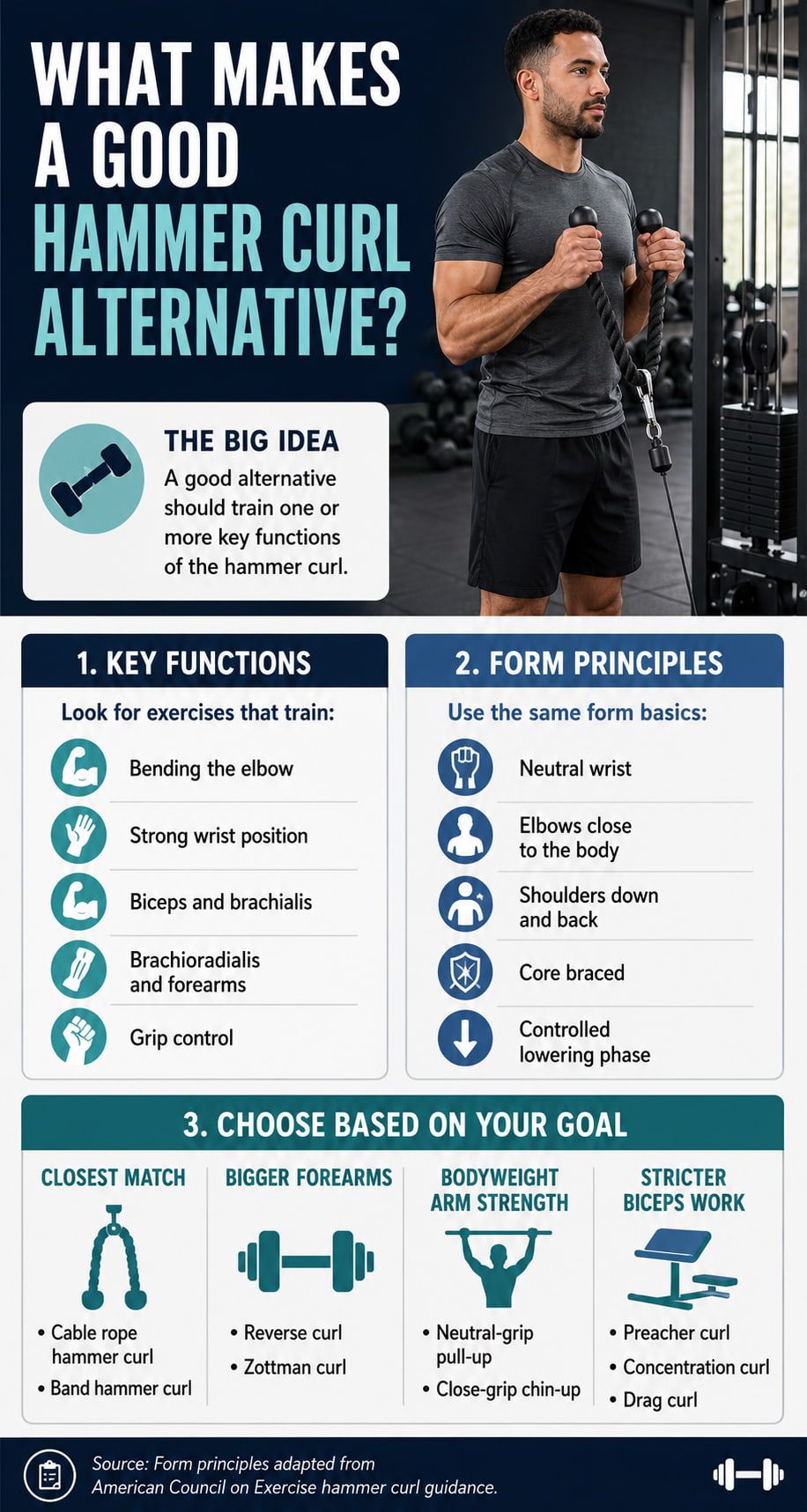
A good hammer curl alternative should train one or more of the same basic functions as the hammer curl: bending the elbow, maintaining a strong wrist position, and challenging the muscles on the front and thumb-side of the arm.
A standard hammer curl uses a neutral grip, meaning your palms face each other. The American Council on Exercise describes the hammer curl with a braced torso, shoulders down and back, neutral wrists, elbows close to the body, and a controlled lowering phase. Those same principles apply to most of the alternatives below.
The best substitute depends on your goal:
- Want the closest match? Choose cable rope hammer curls or band hammer curls.
- Want bigger forearms? Choose reverse curls or Zottman curls.
- Want bodyweight arm strength? Choose neutral-grip pull-ups or close-grip chin-ups.
- Want stricter biceps work? Choose preacher curls, concentration curls, or drag curls.
Muscles Worked by Hammer Curl Alternatives
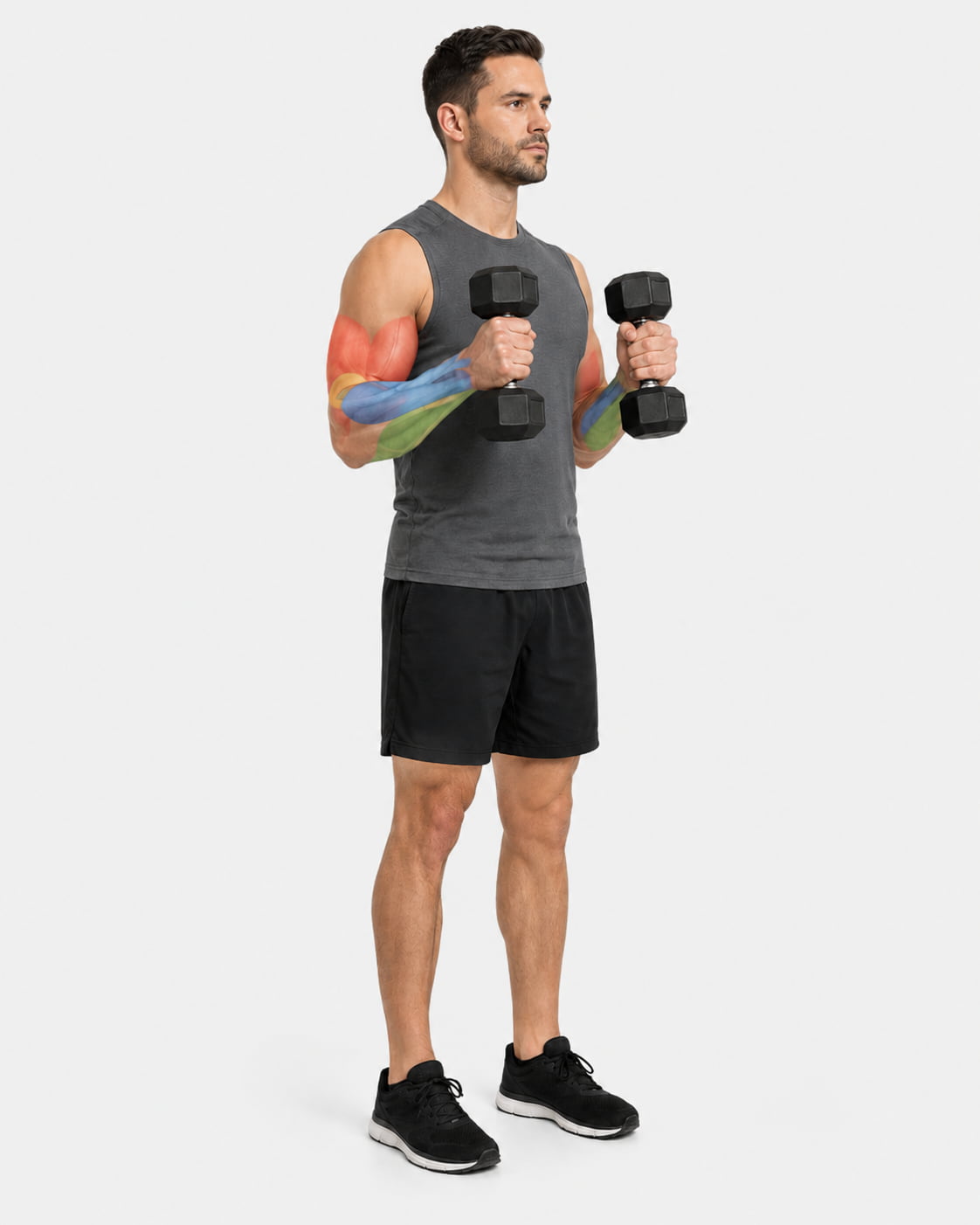
Hammer curl alternatives mainly train the elbow flexors and grip muscles. The exact emphasis changes based on grip, equipment, and arm position.
Biceps Brachii
The biceps brachii is the visible muscle on the front of your upper arm. It helps bend the elbow and rotate the forearm into a palms-up position. Supinated-grip exercises like chin-ups, concentration curls, and drag curls usually emphasize the biceps more than pronated-grip reverse curls.
Brachialis
The brachialis sits underneath the biceps and is a major elbow flexor. Because it does not depend on the same forearm rotation role as the biceps, it stays highly involved in neutral-grip curl patterns. The NCBI Bookshelf describes the brachialis as a key flexor of the forearm at the elbow.
Brachioradialis
The brachioradialis runs along the thumb-side of the forearm and helps flex the elbow. It is one of the main reasons hammer curls and reverse curls are useful for forearm development. The NCBI Bookshelf explains that the brachioradialis contributes to elbow flexion and forearm stabilization.
Forearm and Grip Muscles
Reverse curls, Zottman curls, pull-ups, chin-ups, and band curls also challenge the muscles that support wrist position and grip. For forearm-focused training, use controlled reps and avoid letting your wrists collapse backward or forward.
How to Program Hammer Curl Alternatives
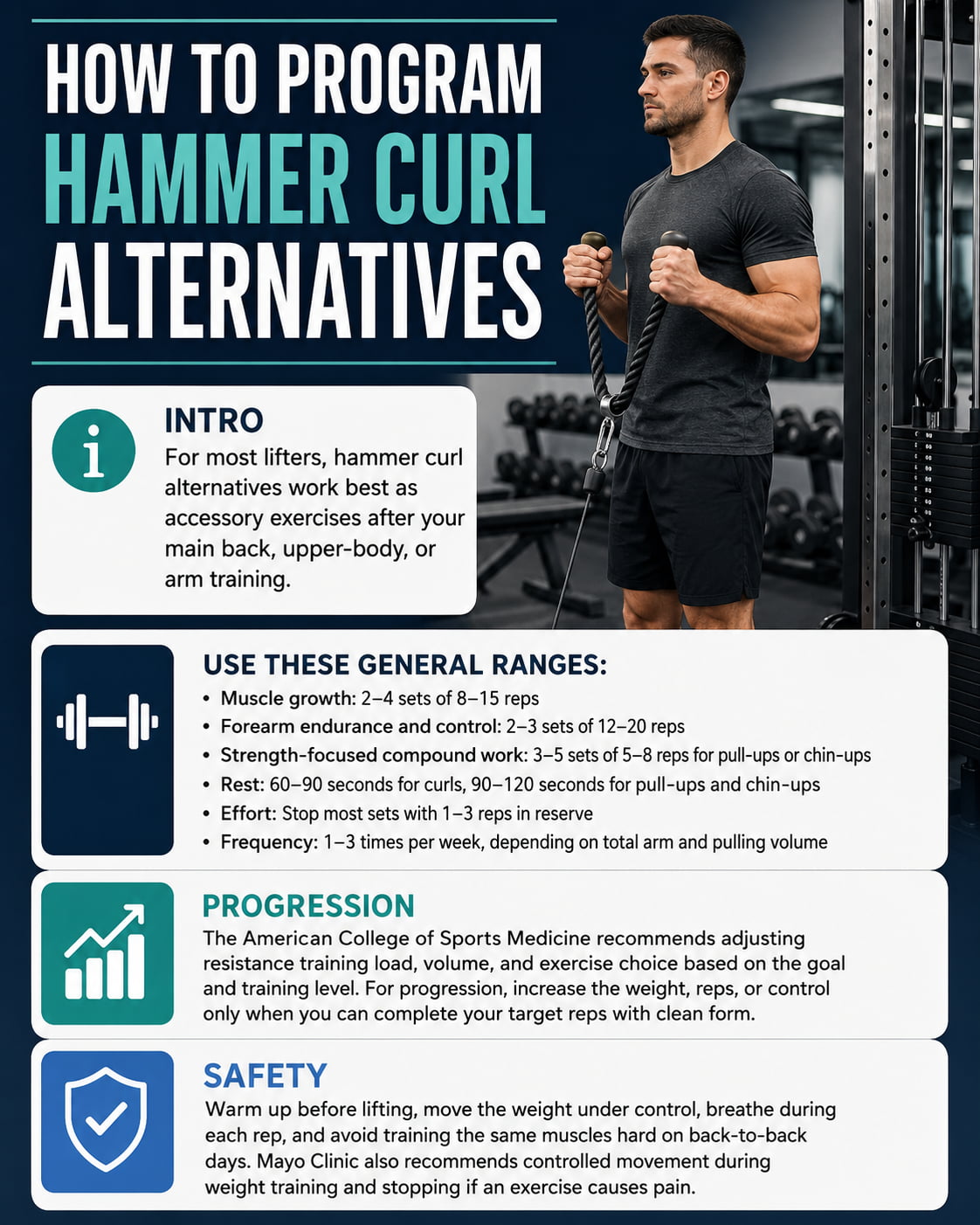
For most lifters, hammer curl alternatives work best as accessory exercises after your main back, upper-body, or arm training.
Use these general ranges:
- Muscle growth: 2–4 sets of 8–15 reps
- Forearm endurance and control: 2–3 sets of 12–20 reps
- Strength-focused compound work: 3–5 sets of 5–8 reps for pull-ups or chin-ups
- Rest: 60–90 seconds for curls, 90–120 seconds for pull-ups and chin-ups
- Effort: Stop most sets with 1–3 reps in reserve
- Frequency: 1–3 times per week, depending on total arm and pulling volume
The American College of Sports Medicine recommends adjusting resistance training load, volume, and exercise choice based on the goal and training level. For progression, increase the weight, reps, or control only when you can complete your target reps with clean form.
Warm up before lifting, move the weight under control, breathe during each rep, and avoid training the same muscles hard on back-to-back days. Mayo Clinic also recommends controlled movement during weight training and stopping if an exercise causes pain.
11 Best Hammer Curl Alternatives for Biceps and Forearms
Hammer curl alternatives help you train your biceps, brachialis, brachioradialis, forearms, and grip when standard hammer curls are not the best fit.
These 11 exercises give you cable, dumbbell, barbell, band, and bodyweight options so you can build stronger arms with better variety and control.
1. Cable Rope Hammer Curl
Best for: The closest gym-based hammer curl substitute
Muscles worked: Brachialis, brachioradialis, biceps brachii, forearms
Equipment needed: Cable machine and rope attachment
Why It Stands Out
The cable rope hammer curl is one of the best hammer curl alternatives because it keeps the same neutral-grip position while adding steady cable tension. Unlike dumbbells, the cable keeps resistance on the arms throughout more of the rep, especially when you control the lowering phase.
This is a strong option if dumbbell hammer curls feel awkward or if you want a smoother resistance path.
Suggested Sets, Reps, and Rest
Do 3–4 sets of 8–15 reps. Rest 60–90 seconds between sets. Use a weight you can control without leaning back or swinging your torso.
How to Do It
- Attach a rope to the low pulley of a cable machine.
- Stand tall and hold one end of the rope in each hand.
- Keep your palms facing each other and your wrists neutral.
- Brace your abs and keep your elbows close to your sides.
- Curl the rope toward your shoulders.
- Squeeze briefly at the top without letting your elbows drift forward.
- Lower the rope slowly until your arms are nearly straight.
Common Mistakes
The biggest mistake is turning the movement into a full-body lean. If your hips move forward and your shoulders lean back, the weight is too heavy. Other common mistakes include bending the wrists, flaring the elbows, and letting the rope drop too quickly.
Coaching Cue
Pull the rope ends toward your shoulders while keeping your upper arms quiet.
Variations, Progressions, or Regressions
For an easier version, use a lighter load and a slower tempo. For a harder version, pause for one second at the top or use one arm at a time. If you do not have a cable machine, use a resistance band anchored under your feet.
How to Use It in a Workout
Use this as your main hammer curl replacement on arm day. It works well after rows, pull-ups, or chin-ups.
2. Dumbbell Hammer Preacher Curl
Best for: Strict brachialis-focused reps
Muscles worked: Brachialis, biceps brachii, brachioradialis
Equipment needed: Dumbbells and preacher bench
Why It Stands Out
The preacher bench limits momentum, making this variation stricter than a standing hammer curl. Because your upper arm is supported, it is harder to swing the weight or cheat through the bottom half of the rep.
This is a great option when you want a hammer curl alternative that keeps tension on the elbow flexors and forces clean technique.
Suggested Sets, Reps, and Rest
Do 2–4 sets of 8–12 reps. Rest 60–90 seconds. Start lighter than you would on standing hammer curls.
How to Do It
- Sit at a preacher bench with one or both upper arms supported.
- Hold the dumbbell with a neutral grip.
- Keep your wrist straight and your shoulder relaxed.
- Curl the weight up without lifting your upper arm off the pad.
- Stop before the dumbbell reaches a position where tension disappears.
- Lower slowly until your elbow is nearly straight, but do not force the joint into an uncomfortable stretch.
Common Mistakes
Avoid bouncing out of the bottom position. Also avoid using too much weight, twisting the wrist, or relaxing your arm at the bottom of each rep.
Coaching Cue
Keep your upper arm glued to the pad and curl with control, not speed.
Variations, Progressions, or Regressions
Use one arm at a time if both arms together feel awkward. For a regression, shorten the range slightly and focus on pain-free control. For a progression, add a slow 3-second lowering phase.
How to Use It in a Workout
Use this after a compound pulling exercise or as your second curl variation after cable rope hammer curls.
3. Cross-Body Hammer Curl
Best for: A simple dumbbell angle change
Muscles worked: Brachialis, brachioradialis, biceps brachii, forearms
Equipment needed: Dumbbells
Why It Stands Out
The cross-body hammer curl keeps the neutral grip but changes the path of the dumbbell. Instead of curling straight up, you curl the dumbbell across your body toward the opposite shoulder. This can feel more natural for some lifters and may help you focus on the brachialis and brachioradialis.
It is also easy to do with one dumbbell, making it useful for home workouts.
Suggested Sets, Reps, and Rest
Do 2–4 sets of 10–15 reps per side. Rest 60–90 seconds.
How to Do It
- Stand tall with a dumbbell in one hand.
- Keep your palm facing your body.
- Brace your core and keep your shoulder down.
- Curl the dumbbell across your torso toward the opposite shoulder.
- Pause briefly near the top.
- Lower under control and repeat.
- Finish all reps on one side or alternate arms.
Common Mistakes
Do not rotate the dumbbell into a regular supinated curl. Avoid shrugging, swinging, or letting your elbow flare too far away from your body.
Coaching Cue
Curl across your body while keeping your wrist stacked and strong.
Variations, Progressions, or Regressions
For beginners, perform the exercise seated to reduce swinging. To progress, add a pause at the top or use a slower lowering phase.
How to Use It in a Workout
Use cross-body hammer curls as a direct replacement for dumbbell hammer curls when you want a slightly different line of pull.
4. Barbell Reverse Curl
Best for: Brachioradialis and forearm development
Muscles worked: Brachioradialis, brachialis, biceps brachii, wrist extensors
Equipment needed: Straight barbell
Why It Stands Out
The reverse curl uses a palms-down grip, which shifts more attention toward the brachioradialis and forearm muscles. It is not identical to a hammer curl, but it is one of the best alternatives when your goal is stronger-looking forearms and better elbow flexor balance.
The American Council on Exercise describes the reverse bicep curl with a shoulder-width palms-down grip, elbows close to the body, and a slow lowering phase.
Suggested Sets, Reps, and Rest
Do 2–4 sets of 8–15 reps. Rest 60–90 seconds. Use a lighter load than your standard barbell curl.
How to Do It
- Hold a barbell with an overhand grip.
- Place your hands about shoulder-width apart.
- Stand tall with your ribs down and abs braced.
- Keep your elbows near your sides.
- Curl the bar up without bending your wrists.
- Stop near the top before your elbows drift forward.
- Lower slowly until your arms are nearly straight.
Common Mistakes
Do not let your wrists bend backward. Avoid using a weight that forces you to swing, lean, or shorten the range too much.
Coaching Cue
Knuckles up, wrists straight, elbows quiet.
Variations, Progressions, or Regressions
For a wrist-friendlier option, use an EZ-bar. For a regression, use dumbbells with a lighter overhand grip. For a progression, slow the eccentric to 3–4 seconds.
How to Use It in a Workout
Use reverse curls after your heavier biceps work or as a forearm-focused finisher.
5. EZ-Bar Reverse Curl
Best for: A wrist-friendlier reverse curl variation
Muscles worked: Brachioradialis, brachialis, biceps brachii, forearms
Equipment needed: EZ-bar
Why It Stands Out
The EZ-bar reverse curl trains many of the same muscles as the barbell reverse curl, but the angled grip may feel more comfortable for some wrists and elbows. This makes it a practical hammer curl alternative for lifters who like reverse curls but do not enjoy using a straight bar.
Suggested Sets, Reps, and Rest
Do 2–4 sets of 10–15 reps. Rest 60–90 seconds.
How to Do It
- Hold the EZ-bar with a palms-down grip on the angled sections.
- Stand tall with your shoulders down and back.
- Keep your elbows close to your ribs.
- Curl the bar toward your upper chest.
- Keep your wrists straight throughout the rep.
- Lower slowly and repeat.
Common Mistakes
Avoid gripping too wide, curling with bent wrists, or turning the exercise into a partial rep. If your grip fails before your arms are working, reduce the load.
Coaching Cue
Lift the bar with your forearms, not your lower back.
Variations, Progressions, or Regressions
For beginners, use a fixed-weight EZ-bar. To progress, add small weight increases or use a tempo such as 2 seconds up and 3 seconds down.
How to Use It in a Workout
Use this as a forearm-biased accessory after chin-ups, rows, or regular curls.
6. Zottman Curl
Best for: Training biceps on the way up and forearms on the way down
Muscles worked: Biceps brachii, brachialis, brachioradialis, forearms
Equipment needed: Dumbbells
Why It Stands Out
The Zottman curl combines two useful curl patterns. You curl the dumbbells up with a palms-up grip, then rotate to a palms-down grip and lower slowly. That means your biceps get strong work during the lifting phase, while your brachioradialis and forearms get challenged during the lowering phase.
This is one of the best hammer curl alternatives if you want a complete arm-building curl without using heavy weights.
Suggested Sets, Reps, and Rest
Do 2–3 sets of 8–12 reps. Rest 60–90 seconds. Go lighter than you think at first.
How to Do It
- Stand with a dumbbell in each hand.
- Start with your palms facing forward.
- Curl both dumbbells up like a regular biceps curl.
- At the top, rotate your palms so they face down.
- Lower the weights slowly with control.
- Rotate back to palms-up at the bottom.
- Repeat for the target reps.
Common Mistakes
Avoid rotating too fast at the top. Do not let the dumbbells crash down during the reverse-curl portion. Keep your elbows close to your sides.
Coaching Cue
Curl up like a biceps curl, lower like a reverse curl.
Variations, Progressions, or Regressions
For a regression, do alternating Zottman curls so you can focus on one arm at a time. For a progression, slow the lowering phase to 4 seconds.
How to Use It in a Workout
Use Zottman curls near the end of an arm workout when your goal is controlled volume, not max weight.
7. Neutral-Grip Pull-Up
Best for: Bodyweight arm and back strength
Muscles worked: Biceps brachii, brachialis, brachioradialis, lats, upper back, grip
Equipment needed: Pull-up bar with neutral handles
Why It Stands Out
The neutral-grip pull-up is a compound alternative to hammer curls. It is not an isolation exercise, but it trains elbow flexion with a palms-facing grip while also loading your back and grip.
This is a great choice if you want a bodyweight movement that builds pulling strength and arm size together.
Suggested Sets, Reps, and Rest
Do 3–5 sets of 5–10 reps. Rest 90–120 seconds. Use assistance if you cannot complete clean reps.
How to Do It
- Grip the neutral handles with your palms facing each other.
- Start from a controlled hang with your abs braced.
- Pull your shoulders down before bending your elbows.
- Drive your elbows toward your ribs.
- Pull until your chin clears the handles or your upper chest approaches the bar.
- Lower slowly until your arms are extended again.
Common Mistakes
Avoid kicking, swinging, craning your neck, or cutting every rep short. Do not relax completely at the bottom if it irritates your shoulders.
Coaching Cue
Pull your elbows down, not just your chin up.
Variations, Progressions, or Regressions
For a regression, use an assisted pull-up machine, a resistance band, or slow negative reps. For a progression, add weight with a belt or hold a dumbbell between your feet.
How to Use It in a Workout
Use neutral-grip pull-ups early in your workout, before smaller curl variations. They require more total-body effort than isolation curls.
8. Close-Grip Chin-Up
Best for: Compound biceps-focused pulling
Muscles worked: Biceps brachii, brachialis, lats, upper back, grip
Equipment needed: Pull-up bar
Why It Stands Out
The close-grip chin-up uses a palms-up grip, so it is not a perfect match for the neutral-grip hammer curl. However, it is one of the best compound exercises for training the biceps through a large range of motion.
If your goal is bigger, stronger arms and you are not limited to isolation work, close-grip chin-ups deserve a place in your plan.
Suggested Sets, Reps, and Rest
Do 3–4 sets of 5–8 reps. Rest 90–120 seconds.
How to Do It
- Grip the bar with your palms facing you.
- Use a grip around shoulder-width or slightly narrower.
- Brace your core and keep your legs still.
- Pull your chest toward the bar.
- Keep your elbows moving down and slightly back.
- Lower under control until your arms are extended.
Common Mistakes
Do not bounce out of the bottom. Avoid turning the movement into a half-rep or letting your shoulders shrug toward your ears.
Coaching Cue
Think “chest to bar” instead of “chin over bar.”
Variations, Progressions, or Regressions
Use a band or assisted machine if full chin-ups are too difficult. Add weight only after you can do full, controlled reps with no swinging.
How to Use It in a Workout
Use close-grip chin-ups as a main pulling exercise, then add one or two curl alternatives afterward for direct arm volume.
9. Band Hammer Curl
Best for: Home workouts and travel training
Muscles worked: Brachialis, brachioradialis, biceps brachii, forearms
Equipment needed: Resistance band
Why It Stands Out
The band hammer curl is the simplest home-based hammer curl alternative. It keeps the neutral grip and creates more tension as the band stretches. This makes the top of the curl feel especially challenging.
It is also joint-friendly for many lifters because the resistance is lighter at the bottom and stronger near the top.
Suggested Sets, Reps, and Rest
Do 2–4 sets of 12–20 reps. Rest 45–75 seconds.
How to Do It
- Stand on the center of a resistance band.
- Hold the handles or ends with your palms facing each other.
- Stand tall and brace your abs.
- Keep your elbows close to your sides.
- Curl your hands toward your shoulders.
- Squeeze briefly at the top.
- Lower slowly and repeat.
Common Mistakes
Avoid standing unevenly on the band, shrugging, or letting the band snap your hands back down. Do not use a band that forces you to shorten the movement too much.
Coaching Cue
Control the band down as carefully as you curl it up.
Variations, Progressions, or Regressions
For an easier version, use a lighter band or stand with one foot on the band. For a harder version, use a thicker band, slow the lowering phase, or add a pause at the top.
How to Use It in a Workout
Use band hammer curls in home arm workouts, as a warm-up curl, or as a high-rep finisher after heavier pulling exercises.
10. Concentration Curl
Best for: Biceps isolation
Muscles worked: Biceps brachii, brachialis
Equipment needed: Dumbbell and bench
Why It Stands Out
The concentration curl is not the closest hammer curl substitute for forearms, but it is a strong alternative when your main goal is biceps isolation. Because your upper arm is braced against your inner thigh, it reduces swinging and helps you focus on controlled elbow flexion.
An American Council on Exercise sponsored study found high biceps activation during the concentration curl compared with several other common biceps exercises. For a hammer curl replacement, use it when you want more direct biceps work rather than maximum forearm emphasis.
Suggested Sets, Reps, and Rest
Do 2–3 sets of 10–15 reps per arm. Rest 45–75 seconds between arms or sets.
How to Do It
- Sit on a bench with your feet planted.
- Hold a dumbbell in one hand.
- Place the back of your upper arm against your inner thigh.
- Let your arm extend toward the floor.
- Curl the dumbbell up while keeping your upper arm still.
- Squeeze at the top.
- Lower slowly and repeat.
Common Mistakes
Avoid twisting your torso, lifting your elbow off your thigh, or using your shoulder to finish the rep. Keep the movement strict.
Coaching Cue
Pin your upper arm in place and curl only from the elbow.
Variations, Progressions, or Regressions
For a regression, use a lighter dumbbell and a shorter range until you can control the full movement. For a progression, add a slow eccentric or pause halfway down.
How to Use It in a Workout
Use concentration curls after a forearm-focused curl if you want extra biceps work at the end of your session.
11. Drag Curl
Best for: Strict biceps-focused arm training
Muscles worked: Biceps brachii, brachialis, forearms
Equipment needed: Barbell, EZ-bar, or dumbbells
Why It Stands Out
The drag curl changes the normal curl path. Instead of letting the bar travel in an arc away from your body, you “drag” it up close to your torso while your elbows move slightly behind you. This keeps the movement strict and can help lifters feel their biceps working without using as much weight.
It is not as forearm-focused as reverse curls or hammer curls, but it is useful when you want another controlled arm-building option.
Suggested Sets, Reps, and Rest
Do 2–4 sets of 8–12 reps. Rest 60–90 seconds.
How to Do It
- Hold a barbell, EZ-bar, or dumbbells with a palms-up grip.
- Stand tall with your abs braced.
- Begin curling while keeping the weight close to your body.
- Let your elbows move slightly backward as the weight rises.
- Stop when you reach a strong squeeze without shrugging.
- Lower the weight along the same close-to-body path.
Common Mistakes
Do not turn the drag curl into a regular curl. Avoid leaning back, shrugging, or pulling the elbows too far behind your body.
Coaching Cue
Scrape the bar up your shirt without swinging your torso.
Variations, Progressions, or Regressions
Use an EZ-bar if a straight bar bothers your wrists. Use dumbbells if you want each arm to move more naturally. Progress by adding small amounts of weight while keeping the same strict path.
How to Use It in a Workout
Use drag curls as a biceps-focused accessory after your main pulling or curl movement.
How to Choose the Right Hammer Curl Alternative
The best choice depends on why you are replacing hammer curls.
For Forearms
Choose reverse curls, EZ-bar reverse curls, or Zottman curls. These use a palms-down phase that increases the challenge on the brachioradialis and forearm muscles.
For Brachialis Emphasis
Choose cable rope hammer curls, dumbbell hammer preacher curls, cross-body hammer curls, or band hammer curls. These keep the neutral-grip pattern that makes hammer curls useful.
For Home Workouts
Choose band hammer curls, cross-body hammer curls, concentration curls, or Zottman curls. You can do all of these with bands or dumbbells.
For Beginners
Start with cable rope hammer curls, band hammer curls, or concentration curls. These are easier to control than heavy reverse curls or bodyweight pull-ups.
For Advanced Lifters
Use neutral-grip pull-ups, weighted chin-ups, strict preacher hammer curls, and slow-tempo Zottman curls. These provide more loading options and a higher skill challenge.
Sample Hammer Curl Alternative Workout
Use this workout once or twice per week after your main upper-body or back training. Keep most sets 1–3 reps short of failure.
Gym Arm Workout
| Exercise | Sets | Reps | Rest |
|---|---|---|---|
| Neutral-grip pull-up or assisted neutral-grip pull-up | 3 | 5–8 | 90–120 sec |
| Cable rope hammer curl | 3 | 10–12 | 60–90 sec |
| EZ-bar reverse curl | 3 | 10–15 | 60–90 sec |
| Zottman curl | 2 | 8–12 | 60 sec |
Home Arm Workout
| Exercise | Sets | Reps | Rest |
|---|---|---|---|
| Band hammer curl | 3 | 12–20 | 45–75 sec |
| Cross-body hammer curl | 3 | 10–15 each side | 60 sec |
| Concentration curl | 2–3 | 10–15 each side | 45–75 sec |
| Slow Zottman curl | 2 | 8–12 | 60 sec |
Progression Advice
When you can hit the top of the rep range on every set with clean form, increase the weight slightly next time. For dumbbells, a 2.5–5 pound increase per hand is often enough. For cables, move up one small plate. For bands, step farther from the anchor point, use a thicker band, or slow the lowering phase.
Do not add weight if your wrists bend, your elbows drift, or your torso starts swinging.
Common Mistakes With Hammer Curl Alternatives
Going Too Heavy
Hammer curl alternatives are usually accessory exercises. If you have to swing, lean back, or shorten the range of motion, the load is too heavy.
Letting the Wrists Collapse
Keep your wrists stacked with your forearms. A bent wrist can reduce control and make curls feel worse on the wrist or elbow.
Moving the Elbows Too Much
Some curl variations allow slight elbow movement, especially drag curls and chin-ups. But for most curl alternatives, your upper arms should stay fairly still.
Rushing the Lowering Phase
The lowering phase builds control and keeps tension on the target muscles. Lower each rep smoothly instead of dropping the weight.
Doing Too Many Curl Variations at Once
You do not need five curl exercises in one session. Pick two or three good movements, train them well, and progress gradually.
Ignoring Pain or Unusual Symptoms
Muscle effort is normal. Sharp pain, numbness, dizziness, chest pain, or unusual symptoms are not. Stop the exercise and seek professional help if something feels wrong.
FAQs About Hammer Curl Alternatives
What exercise can replace hammer curls?
The cable rope hammer curl is the closest replacement because it uses the same neutral-grip position and trains the brachialis, brachioradialis, biceps, and forearms. Band hammer curls, cross-body hammer curls, and dumbbell hammer preacher curls are also strong substitutes.
Are reverse curls better than hammer curls?
Reverse curls are not automatically better. They are better for emphasizing the brachioradialis and forearms, while hammer curls are usually easier to load and often feel more natural. Use reverse curls when you want more forearm focus and hammer-style curls when you want a neutral-grip arm builder.
Can I build big arms without hammer curls?
Yes. Hammer curls are useful, but they are not mandatory. You can build your arms with chin-ups, cable curls, preacher curls, reverse curls, Zottman curls, concentration curls, and other elbow-flexion exercises as long as you train consistently and progress over time.
Do hammer curl alternatives work the forearms?
Many do. Reverse curls, Zottman curls, neutral-grip pull-ups, band hammer curls, and cable rope hammer curls all challenge the forearms and grip. For best results, keep your wrists neutral and control the lowering phase.
What is the best hammer curl alternative for home workouts?
The band hammer curl is the best home option for most people because it is simple, portable, and keeps the neutral-grip pattern. Cross-body hammer curls and Zottman curls are also great if you have dumbbells.
How many sets of hammer curl alternatives should I do?
Most lifters do well with 4–8 total sets per week of hammer curl alternatives, split across one to three workouts. If you already do a lot of rows, pull-ups, chin-ups, and curls, start with the lower end and add volume only if your recovery and form stay solid.
Conclusion
Hammer curl alternatives help you keep building your biceps, brachialis, brachioradialis, forearms, and grip even when standard hammer curls are not the right fit. Start with the option that matches your equipment and goal: cable rope hammer curls for the closest substitute, reverse curls for forearms, Zottman curls for all-around arm work, and band hammer curls for home training.
Choose two or three exercises, train them with control, and progress gradually. Better reps will beat heavier, sloppier reps almost every time.
This content is for informational purposes only and is not a substitute for professional medical advice.
2 thoughts on “11 Best Hammer Curl Alternatives for Biceps and Forearms”