
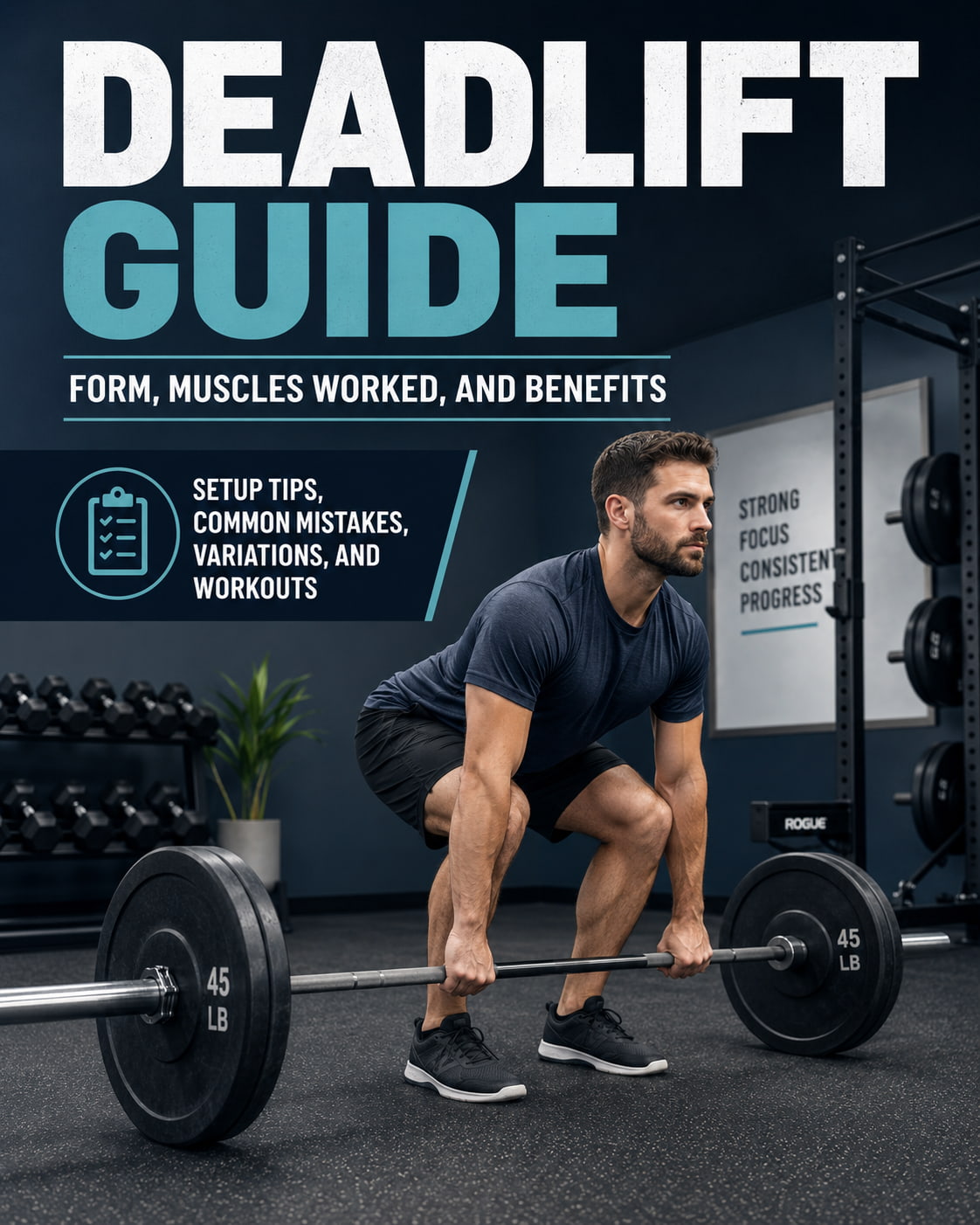
The deadlift is a full-body strength exercise where you lift weight from the floor by bracing your core, hinging at the hips, and driving through your legs until you stand tall. Done well, the deadlift can help build stronger glutes, hamstrings, quads, back muscles, core, and grip.
This deadlift guide covers proper form, muscles worked, benefits, common mistakes, beginner regressions, useful variations, and simple ways to add deadlifts to your workout routine.
What Is a Deadlift?
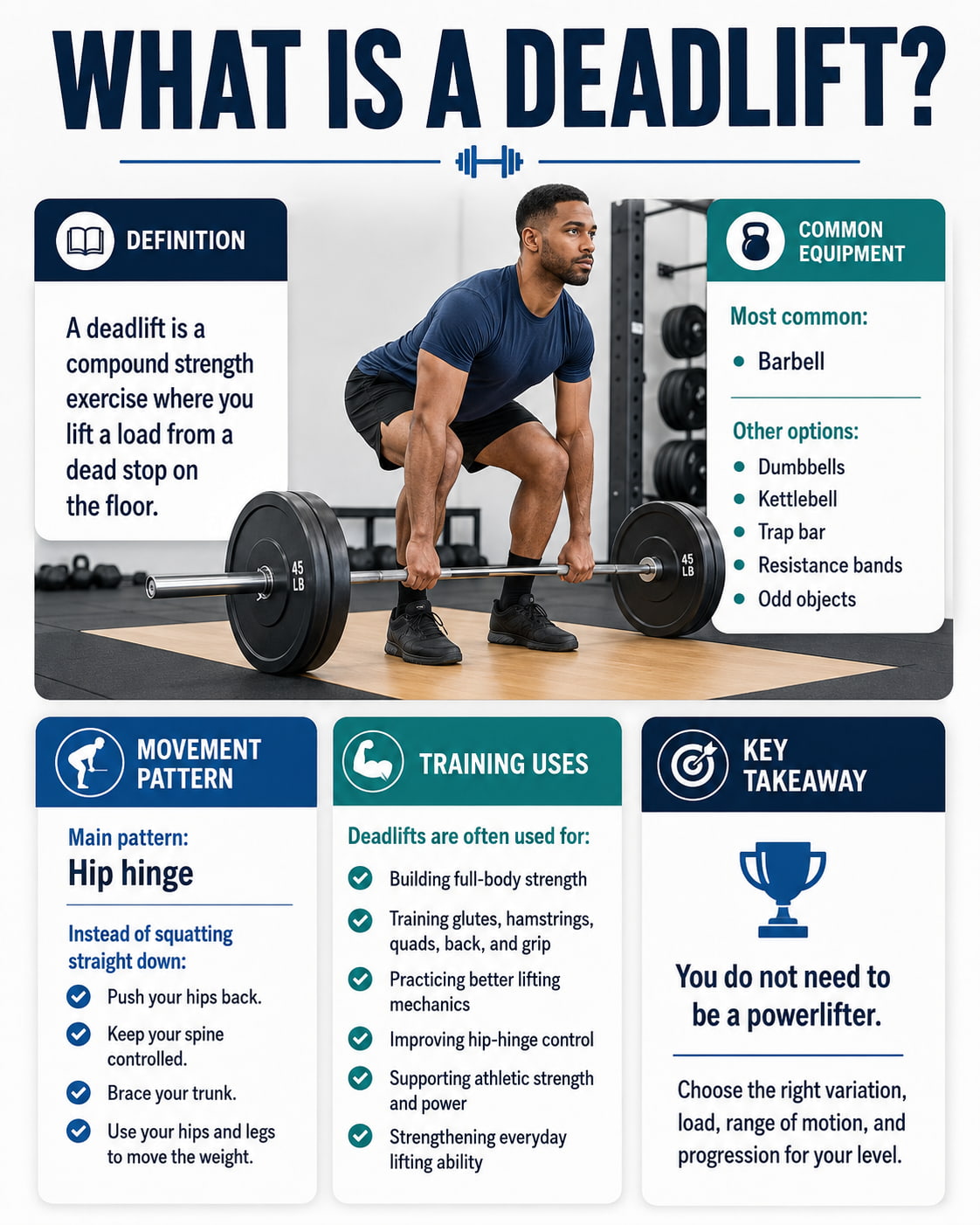
A deadlift is a compound strength exercise that trains you to lift a load from a dead stop on the floor. The most common version uses a barbell, but you can also deadlift with dumbbells, kettlebells, a trap bar, resistance bands, or even odd objects.
The main movement pattern is the hip hinge. Instead of squatting straight down, you push your hips back, keep your spine controlled, brace your trunk, and use your hips and legs to move the weight. ACE Fitness identifies the hip hinge as the primary movement pattern of the deadlift and notes that proper technique also requires hip and ankle mobility with spinal stability.
The deadlift is often used for:
- Building full-body strength
- Training the glutes, hamstrings, quads, back, and grip
- Practicing better lifting mechanics
- Improving hip-hinge control
- Supporting athletic strength and power
- Strengthening everyday lifting ability
You do not need to be a powerlifter to benefit from deadlifts. The key is choosing the right variation, load, range of motion, and progression for your current skill level.
How to Deadlift With Proper Form
Best for: Full-body strength, posterior-chain development, grip strength
Muscles worked: Glutes, hamstrings, quads, adductors, erector spinae, lats, traps, core, forearms
Equipment needed: Barbell and weight plates
Why it stands out:
The barbell deadlift lets you train a heavy hip hinge from the floor. It is one of the best strength exercises for learning how to create whole-body tension, push through the floor, and move a load efficiently.
Suggested sets and reps:
Beginners can start with 2–3 sets of 5–8 reps. Intermediate lifters can use 3–5 sets of 3–6 reps for strength or 3–4 sets of 6–8 reps for muscle-building work. Strength-focused lifters may use 3–5 sets of 1–5 reps with longer rest periods.
Beginners:
Use a light to moderate load, reset each rep, and stop with about 2–4 reps in reserve.
Intermediate:
Use controlled working sets and stop with about 1–3 reps in reserve.
Advanced:
Use heavier low-rep work only when your setup, brace, and bar path stay consistent.
Rest:
Rest 2–3 minutes for moderate sets and 3–5 minutes for heavier strength sets.
How to do it:
- Stand with your feet about hip-width apart and the bar over your midfoot.
- Point your toes slightly out if that feels natural.
- Hinge at your hips and bend your knees enough to reach the bar.
- Grip the bar just outside your legs.
- Pull your chest up without dropping your hips too low.
- Brace your core like you are preparing to take a punch.
- Pull your shoulders down and back slightly to engage your lats.
- Take the slack out of the bar before it leaves the floor.
- Push the floor away and stand up by extending your knees and hips together.
- Keep the bar close to your legs the entire time.
- Finish tall with your ribs down, glutes tight, and shoulders stacked over hips.
- Lower the bar by pushing your hips back first, then bending your knees after the bar passes them.
- Reset your brace before the next rep.
Common mistakes:
Common mistakes include rounding the lower back, letting the bar drift forward, starting with the hips too low, jerking the bar off the floor, leaning back at lockout, and bending the knees too early during the descent.
Expert tip:
Push the floor away and keep the bar close. The bar should move in a straight, controlled path.
Exercise variations:
Useful variations include the sumo deadlift, Romanian deadlift, trap bar deadlift, dumbbell deadlift, kettlebell deadlift, block pull, rack pull, and deficit deadlift.
Easier variation:
Use a kettlebell deadlift from blocks, trap bar deadlift with high handles, or barbell block pull.
Harder variation:
Use a paused deadlift, deficit deadlift, tempo deadlift, or heavier conventional deadlift progression.
Deadlift Setup Checklist
Use this checklist before every working set:
- Bar over midfoot
- Feet rooted into the floor
- Hands just outside the legs
- Spine neutral, not rounded
- Chest proud, ribs not flared
- Lats tight
- Core braced
- Hips higher than knees
- Shoulders slightly in front of the bar
- Bar close to the shins
- Slack pulled out before lifting
A good setup should feel tight before the bar moves. If the first inch off the floor feels loose, reset.
Deadlift Muscles Worked
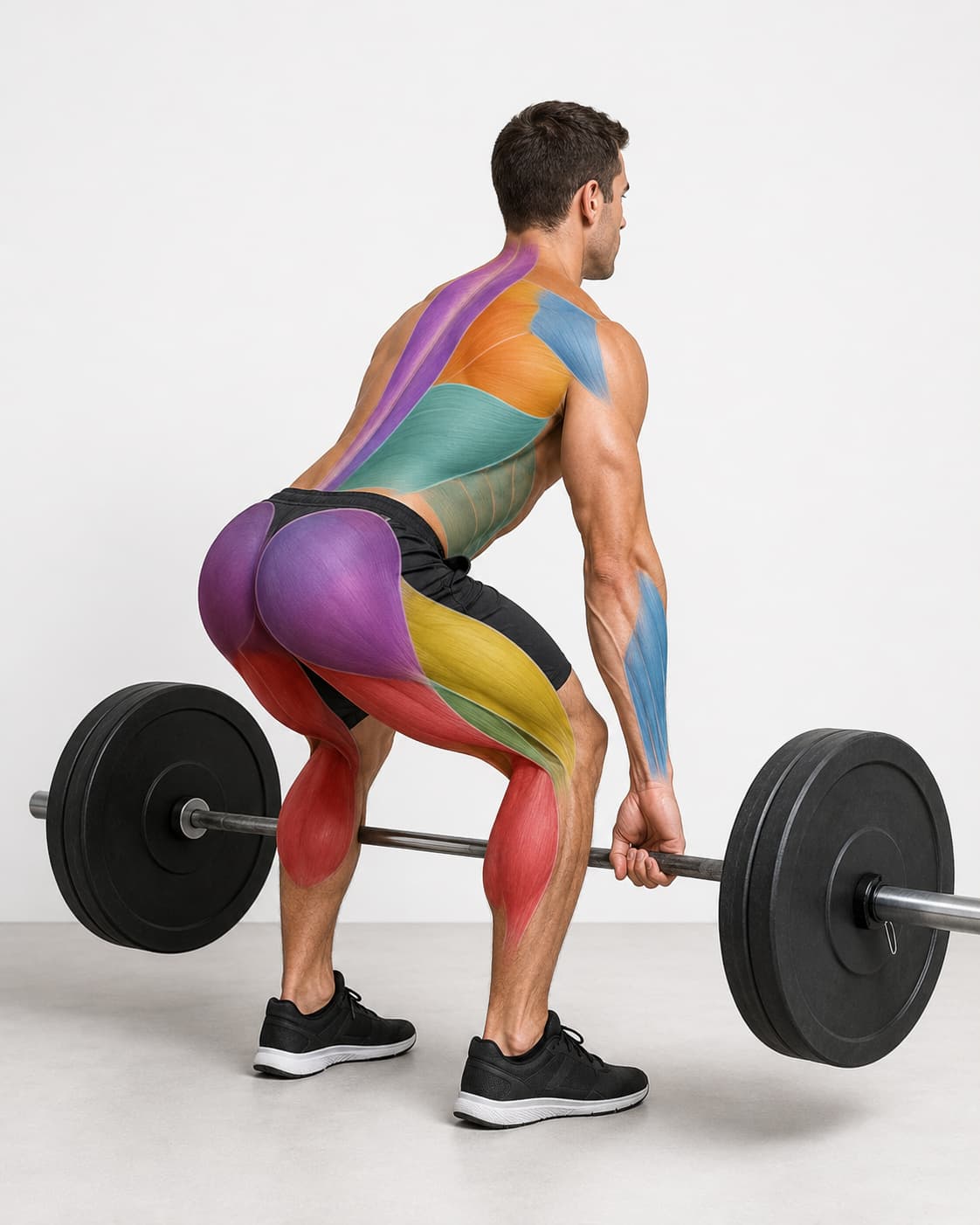
The deadlift trains many muscles at the same time. NASM lists the glutes, quadriceps, and hamstrings as primary muscles, with the erector spinae, trapezius, lats, and grip muscles working as secondary muscles.
Primary Muscles Worked
Glutes:
The gluteus maximus helps extend the hips as you stand up. Strong glute drive is a major part of locking out the deadlift without leaning back.
Hamstrings:
The hamstrings help extend the hips and control the hinge. They are especially active when you keep your hips back and maintain tension through the back of your legs.
Quadriceps:
The quads extend the knees as the bar leaves the floor. They are especially important during the first part of the pull.
Adductors:
The inner thigh muscles assist hip extension and help stabilize the legs, especially in wider stance variations like the sumo deadlift.
Supporting Muscles Worked
Erector spinae:
These muscles run along the spine and work isometrically to help maintain spinal position during the lift.
Lats:
The latissimus dorsi helps keep the bar close to your body. Better lat tension usually means a better bar path.
Traps and upper back:
The traps, rhomboids, and other upper-back muscles help stabilize the shoulders and keep the upper body strong under load.
Core:
The abdominals, obliques, and deep trunk muscles help brace the spine and transfer force from the floor to the bar.
Forearms and grip:
Your hands and forearms work hard to hold the bar, especially as the weight gets heavier.
Deadlift Benefits
Builds Full-Body Strength
The deadlift is one of the most efficient strength exercises because it trains the lower body, back, trunk, and grip in one movement. CrossFit describes the deadlift as a full-body strength exercise that uses high loads to train the quads, hamstrings, glutes, spinal erectors, lats, abdominals, and upper back.
Trains the Posterior Chain
The posterior chain includes the glutes, hamstrings, spinal erectors, and other muscles along the back side of the body. These muscles are important for hip extension, sprinting, jumping, hinging, and lifting.
A well-executed deadlift teaches you to use your hips instead of turning every floor lift into a lower-back-dominant movement.
Improves Hip-Hinge Mechanics
The deadlift is not just about picking up heavy weight. It teaches a skill: hinging at the hips while keeping the trunk braced.
This matters because many gym movements depend on the same pattern, including Romanian deadlifts, kettlebell swings, hip thrusts, good mornings, rows from a hinged position, and Olympic lifting pulls.
Strengthens Grip and Upper Back
Deadlifts challenge your ability to hold onto weight. Over time, that can help build stronger forearms, hands, traps, and upper back.
For many lifters, grip becomes the limiting factor before the legs or hips do. That is not always a bad thing. It means the lift is also training a useful strength quality.
Carries Over to Everyday Lifting
The deadlift pattern is similar to lifting a box, suitcase, backpack, laundry basket, or loaded bag from the floor. Deadlifts can support everyday tasks when trained with good control, appropriate loading, and a safe range of motion.
Easy to Modify
You can adjust the deadlift to fit your body, equipment, and training goal. Beginners can start with a kettlebell or elevated dumbbell deadlift. Intermediate lifters can use barbells, trap bars, or Romanian deadlifts. Advanced lifters can use deficit pulls, paused reps, tempo work, or heavy strength programming.
Deadlift Common Mistakes and How to Fix Them
Mistake 1: Turning the Deadlift Into a Squat
Some beginners drop their hips too low and try to squat the bar up. This usually pushes the knees forward, moves the bar around the knees, and makes the first pull weaker.
Fix: Start with the bar over the midfoot. Set your hips higher than your knees. Your shoulders should be slightly in front of the bar, not behind it.
Mistake 2: Pulling With the Back Instead of the Legs and Hips
The back should stabilize. It should not be the only thing moving the weight.
Fix: Think “push the floor away” instead of “pull the bar up.” Your hips and knees should extend together.
Mistake 3: Letting the Bar Drift Away
The farther the bar moves from your body, the harder your lower back has to work to control the load.
Fix: Engage your lats by imagining you are squeezing oranges in your armpits. Keep the bar close from floor to lockout.
Mistake 4: Losing Your Brace
A loose trunk makes it harder to keep position under load.
Fix: Breathe in before the pull, brace your abs, and hold that pressure through the hardest part of the rep. Exhale only after you pass the sticking point or finish the rep.
Mistake 5: Rushing Reps
Touch-and-go reps can be useful for experienced lifters, but beginners often lose position when they rush.
Fix: Reset each rep. Let the plates settle, rebuild your brace, and pull with control.
Mistake 6: Going Too Heavy Too Soon
Heavy weight exposes weak technique. It does not fix it.
Fix: Build the lift with repeatable reps. Beginners should first learn proper lifting technique with a weight they can control before progressing heavier.
Beginner Deadlift Regressions
Not everyone should start with a barbell from the floor. If you cannot keep the bar close, brace well, or reach the bar without rounding, use a simpler variation first.
1. Hip Hinge to Wall
Best for: Learning the hinge pattern
Muscles worked: Glutes, hamstrings, spinal stabilizers
Equipment needed: Wall
Why it stands out:
This drill teaches you to move from the hips without turning the movement into a squat.
Suggested sets and reps:
Do 2–3 sets of 8–10 reps.
Beginners:
Start close to the wall and use a small range of motion.
Intermediate:
Step slightly farther from the wall to increase the hinge range.
Advanced:
Use it as a warm-up drill before heavier deadlifts.
Rest:
Rest 30–60 seconds between sets.
How to do it:
- Stand about 6–10 inches in front of a wall, facing away from it.
- Soften your knees.
- Push your hips back until your glutes tap the wall.
- Keep your spine long and ribs down.
- Stand tall by squeezing your glutes.
Common mistakes:
Common mistakes include squatting down, rounding the back, shifting weight into the toes, or reaching the head forward.
Expert tip:
Reach your hips back, then stand tall.
Exercise variations:
Try a dowel hip hinge, bodyweight good morning, or light kettlebell deadlift.
Easier variation:
Stand closer to the wall.
Harder variation:
Step farther from the wall or hold a light dumbbell at your chest.
2. Kettlebell Deadlift
Best for: Beginners learning to lift from the floor
Muscles worked: Glutes, hamstrings, quads, back, core, grip
Equipment needed: Kettlebell
Why it stands out:
The weight sits between your feet, which often makes it easier to keep the load close to your center of mass.
Suggested sets and reps:
Do 2–4 sets of 6–10 reps.
Beginners:
Place the kettlebell on a box or step if reaching the floor causes rounding.
Intermediate:
Use a heavier kettlebell and pause briefly at the bottom.
Advanced:
Use double kettlebells or progress to a trap bar or barbell deadlift.
Rest:
Rest 60–90 seconds between sets.
How to do it:
- Place a kettlebell between your feet.
- Stand with feet about hip- to shoulder-width apart.
- Hinge down and grip the handle.
- Brace your core and keep your chest lifted.
- Push through the floor and stand tall.
- Lower the kettlebell by hinging your hips back.
Common mistakes:
Common mistakes include squatting too low, rounding the back, letting the kettlebell drift forward, or shrugging the shoulders.
Expert tip:
Keep the handle between the arches of your feet and keep your ribs down.
Exercise variations:
Use a suitcase deadlift, double kettlebell deadlift, or kettlebell Romanian deadlift.
Easier variation:
Elevate the kettlebell on a box or step.
Harder variation:
Use a heavier kettlebell or double kettlebells.
3. Block Pull or Rack Pull
Best for: Lifters who need a shorter range of motion
Muscles worked: Glutes, hamstrings, quads, back, core, grip
Equipment needed: Barbell with blocks or safety pins
Why it stands out:
Elevating the bar reduces the mobility demand and lets you practice the deadlift pattern from a stronger position. Blocks or rack pins can help lifters learn the movement when full range of motion is not yet appropriate.
Suggested sets and reps:
Do 3–4 sets of 4–8 reps.
Beginners:
Start with the bar just below knee height if mid-shin is too difficult.
Intermediate:
Gradually lower the starting height as your control improves.
Advanced:
Use block pulls to strengthen a specific range of the deadlift.
Rest:
Rest 2–3 minutes between sets.
How to do it:
- Set the bar on blocks or rack pins around mid-shin to just below knee height.
- Stand with the bar over your midfoot.
- Hinge down and grip the bar.
- Brace, engage your lats, and stand tall.
- Lower with control back to the blocks or pins.
Common mistakes:
Common mistakes include starting too high, leaning back at the top, bouncing the bar off the pins, or using more weight than you can control.
Expert tip:
Think of it as the same deadlift with a shorter distance.
Exercise variations:
Try mid-shin block pulls, below-knee rack pulls, or trap bar high-handle pulls.
Easier variation:
Raise the bar higher.
Harder variation:
Lower the bar closer to the floor.
Deadlift Variations and When to Use Each One
1. Conventional Deadlift
Best for: General strength, posterior-chain training, powerlifting carryover
Muscles worked: Glutes, hamstrings, quads, erector spinae, lats, traps, core, grip
Equipment needed: Barbell
Why it stands out:
The conventional deadlift uses a hip-width stance with hands outside the legs. It usually places a strong demand on the posterior chain and back position.
Suggested sets and reps:
Use 3–5 sets of 3–6 reps for strength or 3–4 sets of 6–8 reps for general muscle and strength.
Beginners:
Use light loads and reset every rep.
Intermediate:
Use planned weekly progression with consistent form.
Advanced:
Use heavier low-rep work, paused reps, or tempo work when needed.
Rest:
Rest 2–5 minutes depending on load and goal.
How to do it:
- Stand with the bar over your midfoot.
- Grip the bar outside your legs.
- Brace your core and engage your lats.
- Push through the floor and stand tall.
- Keep the bar close from start to finish.
- Hinge down and return the bar with control.
Common mistakes:
Common mistakes include rounded back position, hips shooting up first, loose lats, bar drift, and overextending at the top.
Expert tip:
Keep your shoulders and hips rising together.
Exercise variations:
Use paused conventional deadlifts, tempo deadlifts, deficit deadlifts, or block pulls.
Easier variation:
Use a block pull or trap bar deadlift.
Harder variation:
Use a deficit deadlift or paused deadlift.
2. Sumo Deadlift
Best for: Lifters who prefer a wider stance, powerlifting, reducing range of motion
Muscles worked: Glutes, quads, adductors, hamstrings, back, core, grip
Equipment needed: Barbell
Why it stands out:
The sumo deadlift uses a wide stance with the hands inside the legs. It often feels better for lifters with certain hip structures or long legs, but it still requires strong bracing and hip mobility. Frontiers published a biomechanics comparison showing that conventional and sumo deadlifts can create different muscular and joint demands.
Suggested sets and reps:
Use 3–5 sets of 3–6 reps for strength or 3–4 sets of 6–8 reps for technique-focused volume.
Beginners:
Start with a moderate stance, not an extreme wide stance.
Intermediate:
Use sumo deadlifts when the position feels stronger and more stable than conventional.
Advanced:
Use sumo pulls as a main lift or variation depending on your goal.
Rest:
Rest 2–5 minutes depending on load.
How to do it:
- Set your feet wider than shoulder-width.
- Turn your toes slightly out.
- Grip the bar inside your legs.
- Brace your core and push your knees out.
- Keep your chest tall and the bar close.
- Drive through the floor and stand tall.
- Lower with control and reset.
Common mistakes:
Common mistakes include knees caving inward, hips starting too high, feet set too wide, and losing balance toward the toes.
Expert tip:
Push the floor apart as you stand up.
Exercise variations:
Try paused sumo deadlifts, block sumo pulls, or tempo sumo deadlifts.
Easier variation:
Use a kettlebell sumo deadlift.
Harder variation:
Use a paused sumo deadlift or heavier strength sets.
3. Romanian Deadlift
Best for: Hamstrings, glutes, hinge control, hypertrophy
Muscles worked: Hamstrings, glutes, erector spinae, lats, core, grip
Equipment needed: Barbell, dumbbells, or kettlebells
Why it stands out:
The Romanian deadlift starts from standing instead of from the floor. You lower the weight by pushing your hips back until you feel a strong hamstring stretch, then stand tall.
Suggested sets and reps:
Do 3–4 sets of 6–12 reps.
Beginners:
Use dumbbells and a shorter range of motion.
Intermediate:
Use a barbell or dumbbells and control the lowering phase.
Advanced:
Use tempo reps, pauses, or deficit Romanian deadlifts.
Rest:
Rest 90 seconds to 3 minutes depending on load.
How to do it:
- Stand tall with the weight in front of your thighs.
- Soften your knees.
- Push your hips back while keeping the weight close.
- Lower until you feel a strong but controlled hamstring stretch.
- Keep your spine neutral and core braced.
- Stand tall by driving your hips forward.
Common mistakes:
Common mistakes include bending the knees too much, rounding the back, lowering too far, and letting the weight drift forward.
Expert tip:
Soft knees, hips back, feel the hamstrings load.
Exercise variations:
Try dumbbell Romanian deadlifts, single-leg Romanian deadlifts, or tempo Romanian deadlifts.
Easier variation:
Use dumbbells and limit the range of motion.
Harder variation:
Use a barbell, slower tempo, or deficit setup.
4. Trap Bar Deadlift
Best for: Beginners, athletes, heavier loading, lower-body power
Muscles worked: Glutes, quads, hamstrings, back, traps, core, grip
Equipment needed: Trap bar or hex bar
Why it stands out:
The trap bar deadlift places you inside the bar with handles at your sides. Many lifters find it easier to learn because the load is closer to the body.
Suggested sets and reps:
Do 3–5 sets of 3–8 reps.
Beginners:
Start with high handles if available.
Intermediate:
Use low handles or moderate-to-heavy sets.
Advanced:
Use trap bar deadlifts for strength, power, or heavier loading phases.
Rest:
Rest 2–4 minutes between sets.
How to do it:
- Stand in the center of the trap bar.
- Hinge down and grip the handles.
- Brace your core and keep your chest tall.
- Drive through your whole foot.
- Stand tall without leaning back.
- Lower with control.
Common mistakes:
Common mistakes include standing off-center, turning the lift into a squat only, rounding the back, or overloading too quickly.
Expert tip:
Stand in the center and drive through the whole foot.
Exercise variations:
Use high-handle trap bar deadlifts, low-handle trap bar deadlifts, or trap bar jumps with light load if appropriate.
Easier variation:
Use high handles.
Harder variation:
Use low handles or controlled tempo reps.
5. Dumbbell Deadlift
Best for: Home workouts, beginners, lighter strength training
Muscles worked: Glutes, hamstrings, quads, back, core, grip
Equipment needed: Dumbbells
Why it stands out:
Dumbbell deadlifts are useful when you do not have a barbell or trap bar. You can hold the dumbbells at your sides, in front of your thighs, or slightly outside your legs.
Suggested sets and reps:
Do 2–4 sets of 8–12 reps.
Beginners:
Use light dumbbells and focus on the hinge.
Intermediate:
Use heavier dumbbells and a controlled lowering phase.
Advanced:
Use slower tempo, pauses, or single-leg variations.
Rest:
Rest 60–120 seconds between sets.
How to do it:
- Stand with dumbbells close to your thighs.
- Soften your knees.
- Push your hips back and lower the dumbbells.
- Keep the weights close to your legs.
- Brace your core and stand tall.
- Reset before the next rep.
Common mistakes:
Common mistakes include letting the dumbbells drift forward, rounding the back, or turning the lift into a squat.
Expert tip:
Keep the weights close to your legs.
Exercise variations:
Try suitcase dumbbell deadlifts, dumbbell Romanian deadlifts, or single-leg dumbbell deadlifts.
Easier variation:
Use lighter dumbbells or reduce range of motion.
Harder variation:
Use heavier dumbbells, slower tempo, or single-leg work.
6. Deficit Deadlift
Best for: Advanced lifters building strength off the floor
Muscles worked: Glutes, hamstrings, quads, back, core, grip
Equipment needed: Barbell and low platform
Why it stands out:
A deficit deadlift increases the range of motion by having you stand on a low platform. This makes the start harder and demands more control.
Suggested sets and reps:
Do 2–4 sets of 3–6 reps with controlled load.
Beginners:
Avoid this variation until standard deadlift form is consistent.
Intermediate:
Use only a small deficit and light-to-moderate load.
Advanced:
Use deficit deadlifts to improve starting strength from the floor.
Rest:
Rest 2–4 minutes between sets.
How to do it:
- Stand on a low, stable platform.
- Set the bar over your midfoot.
- Hinge down and grip the bar.
- Brace hard and keep your spine neutral.
- Push through the floor and stand tall.
- Lower with control.
Common mistakes:
Common mistakes include using too high of a platform, rounding the back, pulling too heavy, or losing position at the bottom.
Expert tip:
Use a small deficit and treat every rep like a technique rep.
Exercise variations:
Try paused deficit deadlifts or deficit Romanian deadlifts.
Easier variation:
Use a standard deadlift from the floor.
Harder variation:
Use a controlled pause just below the knees.
How to Warm Up for Deadlifts
A good deadlift warm-up should raise body temperature, prepare the hips and trunk, and rehearse the hinge pattern.
Simple Deadlift Warm-Up
- 5 minutes easy movement: bike, rower, brisk walk, or light jogging
- Hip hinge to wall: 2 sets of 8 reps
- Glute bridge: 2 sets of 10 reps
- Bodyweight good morning: 2 sets of 8 reps
- Light Romanian deadlift: 2 sets of 8 reps
- Deadlift ramp-up sets: gradually add weight before your work sets
Example ramp-up for a lifter using 185 pounds for work sets:
- Empty bar x 8
- 95 pounds x 5
- 135 pounds x 3
- 165 pounds x 2
- 185 pounds for work sets
Do not jump straight to your working weight. Use warm-up sets to practice your setup and check how your body feels that day.
How to Program Deadlifts
Deadlifts are demanding, so more is not always better. Most lifters do well with 1–2 deadlift-focused sessions per week, depending on training age, recovery, and total lower-body volume.
The CDC recommends adults perform muscle-strengthening activities on at least 2 days per week that work all major muscle groups.
Beginner Deadlift Programming
Goal: Learn form and build basic strength
Frequency: 1–2 times per week
Sets and reps: 2–3 sets of 5–8 reps
Effort: Stop with 2–4 reps in reserve
Rest: 2–3 minutes
Start with a variation you can control: kettlebell deadlift, dumbbell deadlift, trap bar deadlift, or elevated barbell deadlift.
Intermediate Deadlift Programming
Goal: Build strength and muscle
Frequency: 1–2 times per week
Sets and reps: 3–5 sets of 3–6 reps for strength, or 3–4 sets of 6–8 reps for muscle
Effort: Stop with 1–3 reps in reserve
Rest: 2–4 minutes
Use one heavier deadlift day and one lighter hinge day if training twice per week.
Example:
- Day 1: Barbell deadlift, 4 sets of 4
- Day 2: Romanian deadlift, 3 sets of 8
Advanced Deadlift Programming
Goal: Max strength, weak-point training, competition carryover
Frequency: Usually 1 heavy pull day plus 1 accessory hinge day
Sets and reps: 3–6 working sets depending on intensity
Effort: Often 0–3 reps in reserve, depending on phase
Rest: 3–5 minutes for heavy sets
Advanced lifters may use paused deadlifts, tempo deadlifts, block pulls, deficit pulls, bands, chains, or periodized loading. Keep the goal of each variation clear.
How to Progress Deadlifts
Progress when your form stays consistent and the target reps feel controlled.
A practical progression rule:
- Add 5–10 pounds when you complete all sets and reps with good form.
- Add smaller jumps for Romanian deadlifts or dumbbell variations.
- Stay at the same weight if your back rounds, the bar drifts, or the reps slow dramatically.
- Reduce load or range of motion if technique breaks down.
ACSM recommends increasing load by 2–10% when a lifter can perform one to two reps over the target number at the current workload.
Sample Deadlift Workout Routine
Beginner Deadlift Workout
Frequency: 1–2 times per week
Effort: Moderate, about 3 reps in reserve
Rest: 60–180 seconds depending on the exercise
| Exercise | Sets | Reps | Rest |
|---|---|---|---|
| Hip hinge to wall | 2 | 8–10 | 30–45 sec |
| Kettlebell deadlift | 3 | 6–8 | 90 sec |
| Goblet squat | 3 | 8–10 | 90 sec |
| Dumbbell Romanian deadlift | 2–3 | 8–10 | 90 sec |
| Farmer carry | 3 | 30–40 sec | 60–90 sec |
| Front plank | 2–3 | 20–40 sec | 60 sec |
Progression:
When all kettlebell deadlift sets feel smooth for two workouts in a row, add a small amount of weight or move to a trap bar deadlift.
Intermediate Deadlift Strength Workout
Frequency: Once per week as a main lower-body or pull-day lift
Effort: 1–3 reps in reserve
Rest: 2–4 minutes on heavy sets
| Exercise | Sets | Reps | Rest |
|---|---|---|---|
| Barbell deadlift | 4 | 3–5 | 3 min |
| Romanian deadlift | 3 | 6–8 | 2 min |
| Split squat | 3 | 8 each leg | 90 sec |
| Chest-supported row | 3 | 8–12 | 90 sec |
| Hamstring curl | 2–3 | 10–15 | 60–90 sec |
| Side plank | 2 | 20–40 sec each side | 60 sec |
Progression:
Add 5 pounds to the barbell deadlift when you complete all sets with stable form and no grinding. If your form breaks, repeat the same weight next week.
Advanced Deadlift Accessory Day
Frequency: Once per week, separate from heavy deadlift day
Effort: Controlled, not maximal
Rest: 2–3 minutes on main lifts
| Exercise | Sets | Reps | Rest |
|---|---|---|---|
| Paused deadlift below knee | 4 | 3 | 3 min |
| Deficit Romanian deadlift | 3 | 6 | 2 min |
| Barbell hip thrust | 3 | 6–10 | 2 min |
| Pull-up or lat pulldown | 3 | 6–10 | 90 sec |
| Back extension | 2–3 | 10–15 | 90 sec |
| Heavy farmer carry | 4 | 20–30 sec | 90 sec |
Progression:
Progress slowly. Advanced variations add stress even when the load is lighter than your standard deadlift.
Deadlift Safety Tips
Deadlifts should feel challenging, but they should not feel reckless. Use a variation and load that allow you to control the bar path, brace your trunk, and maintain a strong position.
Follow these rules:
- Stop the set if your form breaks down.
- Do not max out before you have consistent technique.
- Keep the bar close to reduce unnecessary stress.
- Use blocks or a trap bar if the floor position does not fit your mobility.
- Avoid bouncing the bar between reps.
- Do not force a mixed grip if it irritates your shoulder, elbow, or biceps.
- Use straps when grip limits back or leg training, but keep some grip work in your program.
- Stop and seek professional help if you feel sharp pain, numbness, dizziness, chest pain, or unusual symptoms.
A neutral, controlled spine position is one of the most important form goals. Excessive spinal flexion, bar drift, jerky movement, and using too much weight are common deadlift mistakes that can reduce control and make the lift less efficient.
Deadlift FAQs
Is the deadlift a back exercise or a leg exercise?
The deadlift is both. Your glutes, hamstrings, quads, and adductors help move the weight, while your back, lats, core, and grip stabilize the lift. It is best classified as a full-body compound strength exercise.
How often should I deadlift?
Most beginners and intermediate lifters do well deadlifting 1–2 times per week. One day can focus on a heavier deadlift variation, while the other can use a lighter hinge such as a Romanian deadlift or kettlebell deadlift.
Should beginners do barbell deadlifts?
Some beginners can start with barbell deadlifts, but many do better with kettlebell deadlifts, trap bar deadlifts, dumbbell deadlifts, or block pulls first. The best beginner deadlift is the one you can perform with control and a neutral spine.
What is the difference between a deadlift and a Romanian deadlift?
A traditional deadlift starts from the floor each rep. A Romanian deadlift starts from standing and focuses on lowering the weight through a controlled hip hinge. The Romanian deadlift usually creates more continuous hamstring tension and uses less knee bend.
Should the bar touch my shins during deadlifts?
The bar should stay very close to your legs. It may lightly touch or skim the shins, especially with a barbell deadlift. If the bar drifts forward, the lift becomes harder and less efficient.
Do deadlifts build glutes?
Yes, deadlifts can help build stronger glutes because the glutes extend the hips during the lift. For more glute-focused work, use Romanian deadlifts, trap bar deadlifts, hip thrusts, split squats, and controlled tempo reps.
Are trap bar deadlifts easier than barbell deadlifts?
Trap bar deadlifts are often easier to learn because you stand inside the bar and hold handles at your sides. This setup can help some lifters keep the load closer to the body and maintain a more comfortable pulling position.
Conclusion
The deadlift is one of the most useful strength exercises because it trains the hips, legs, back, core, and grip in one powerful movement. Start with the variation you can control, master the hip hinge, keep the bar close, and progress only when your reps look consistent.
Train the deadlift like a skill first and a strength test second. Better setup, better bracing, and smarter progression will give you more long-term results than chasing weight before your form is ready.
This content is for informational purposes only and is not a substitute for professional medical advice.
20 thoughts on “Deadlift Guide: Proper Form, Muscles Worked, Benefits, and Tips”