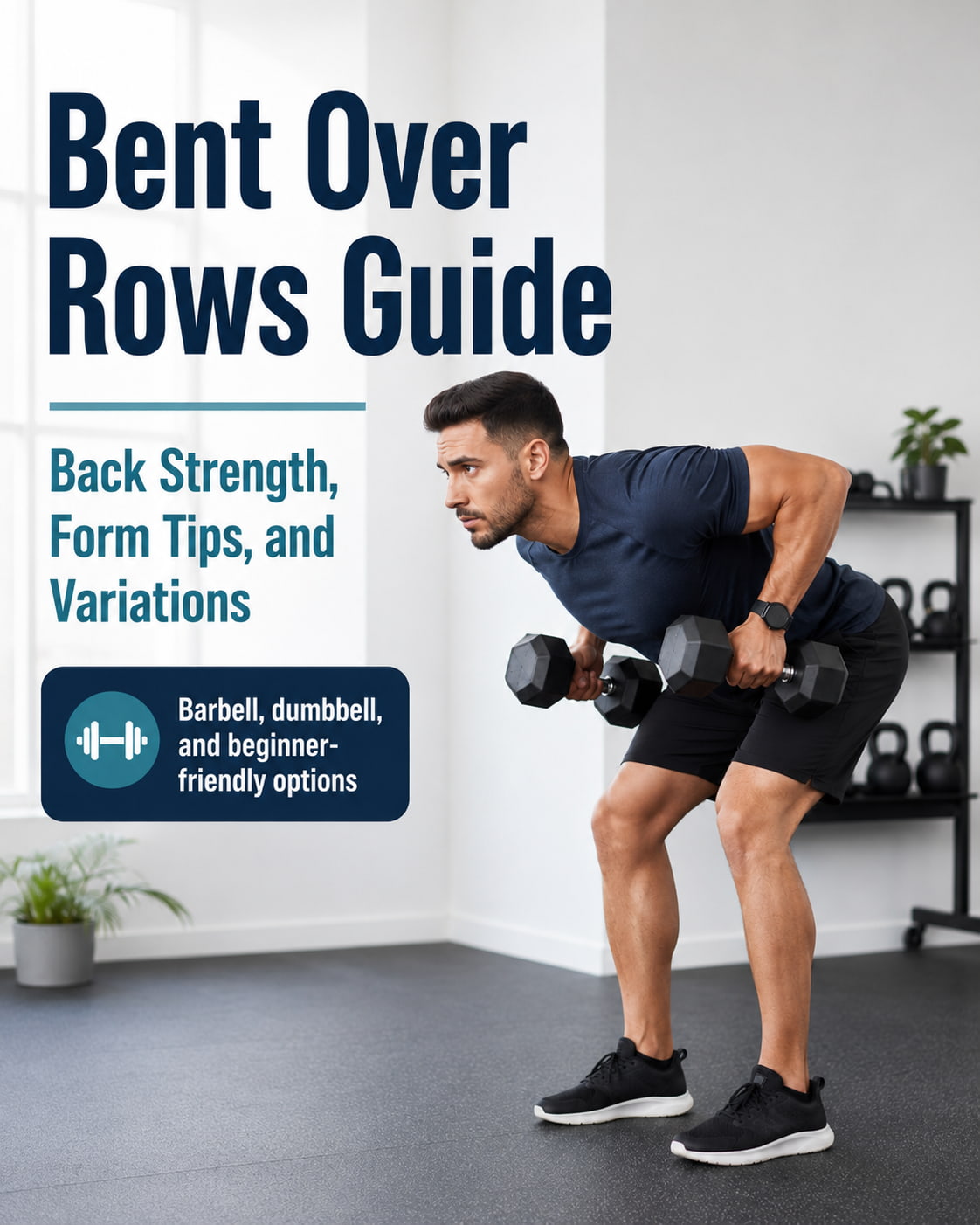
Bent over rows are a compound pulling exercise that strengthens your back, shoulders, arms, and trunk while teaching you to hold a strong hip-hinge position. The exercise is usually done with a barbell, dumbbells, kettlebells, or resistance bands, and it can fit into back workouts, pull days, upper-body sessions, or full-body strength routines.
The main goal is simple: keep your torso stable, pull the weight toward your lower ribs or upper stomach, and control the weight back down without rounding your back or swinging your body. In this guide, you will learn proper bent over row form, muscles worked, benefits, common mistakes, variations, and how to use the exercise in a real workout.
How to Do Bent Over Rows With Proper Form
Equipment needed: Barbell, dumbbells, kettlebells, or resistance bands.
Why it stands out: Bent over rows combine back strength, grip strength, shoulder-blade control, and trunk stability. Unlike a machine row, your body has to hold position while the back muscles pull the weight.
Suggested sets and reps: Use 3 to 4 sets of 6 to 12 reps for strength and muscle building. Use 2 to 3 sets of 12 to 15 reps with lighter weight for technique practice or higher-rep accessory work.
Beginners: Start with a light dumbbell row, resistance band row, or chest-supported row. Use a weight you can control without rounding your back or swinging your torso.
Intermediate: Use barbell or dumbbell bent over rows for 3 to 4 working sets. Stop each set with 1 to 3 reps in reserve so form stays clean.
Advanced: Add pauses at the top, slow eccentrics, heavier sets of 5 to 8 reps, or strict Pendlay-style rows from the floor. Do not progress load if your torso angle changes every rep.
Rest: Rest 90 to 150 seconds between moderate sets. Rest 2 to 3 minutes for heavier strength-focused sets.
How to do it:
- Stand with your feet about hip-width to shoulder-width apart and hold the weight with your arms straight.
- Soften your knees and hinge at your hips until your torso is angled forward.
- Brace your core and keep your spine neutral, not rounded or overarched.
- Let the weight hang under your shoulders with your wrists straight.
- Pull your elbows back and row the weight toward your lower ribs or upper stomach.
- Pause briefly without shrugging your shoulders toward your ears.
- Lower the weight with control until your arms are straight again.
- Repeat while keeping the same torso angle from rep to rep.
Common mistakes: The biggest mistakes are rounding the lower back, standing too upright, pulling the weight too high toward the chest, jerking with the hips, shrugging at the top, curling the wrists, and using a weight that turns the row into a swing.
Expert tip: Keep your chest proud, ribs down, and elbows moving back. Think “pull the elbows behind me,” not “curl the weight up.”
Exercise variations: Common variations include barbell bent over rows, dumbbell bent over rows, underhand rows, wide-grip rows, one-arm dumbbell rows, resistance band bent over rows, Pendlay rows, and chest-supported dumbbell rows.
Easier variation: Use a chest-supported row, one-arm dumbbell row with your free hand supported on a bench, or an inverted row. The NASM row variation guide notes that inverted rows can be useful for beginners and may create less compressive force on the spine than bent-over rows.
Harder variation: Use a pause bent over row, slow eccentric row, deficit Pendlay row, or heavier barbell row. Progress only when you can keep your spine neutral and your torso stable.
Bent Over Rows Muscles Worked

Bent over rows mainly train the upper and middle back. They also challenge the arms, shoulders, grip, core, and hip-hinge stabilizers.
Latissimus Dorsi
The latissimus dorsi, or lats, are the large back muscles that help pull your upper arms toward your body. During bent over rows, the lats work strongly when you pull the weight toward your lower ribs or upper stomach.
Rhomboids
The rhomboids sit between your shoulder blades. They help pull the shoulder blades together during the row. If you perform the exercise with control, you should feel your mid-back working rather than just your arms.
Trapezius
The trapezius helps move and stabilize the shoulder blades. The middle traps assist with shoulder-blade retraction, while the lower traps help control shoulder position. The upper traps may assist, but they should not take over by shrugging every rep.
Rear Delts
The rear delts are the back portion of your shoulder muscles. They help move the upper arms backward during rowing. Mayo Clinic notes that the dumbbell bent-over row targets the back of the shoulder, which can help create better shoulder muscle balance when used properly.
Biceps and Forearms
Your biceps bend the elbows during the pull, and your forearms help grip the weight. They assist the movement, but they should not become the main focus. Think of your hands as hooks and your elbows as the drivers of the row.
Core, Glutes, Hamstrings, and Spinal Stabilizers
Bent over rows are not just an upper-body exercise. Your core helps resist unwanted movement. Your glutes and hamstrings support the hip hinge. Your spinal stabilizers help keep your torso steady. If your lower back is doing all the work, the load may be too heavy or your setup may need adjusting.
The Cleveland Clinic dumbbell row guide identifies the lats, traps, and rhomboids as key muscles worked during dumbbell rows, with good form being important for training the back safely.
Benefits of Bent Over Rows
Bent over rows are useful because they train a strong pulling pattern with free weights. They build the muscles that help you row, pull, carry, brace, and control your shoulder blades.
Bent Over Rows Build Back Strength
Bent over rows are one of the most practical exercises for strengthening the upper and middle back. They train the lats, rhomboids, traps, and rear delts in one movement.
A stronger back can support better performance in pull-ups, deadlifts, carries, presses, and daily lifting tasks. The goal is not just to move more weight. The goal is to row with control, keep the torso stable, and make the back muscles do the work.
They Improve Pulling Mechanics
Rows teach you to pull with your elbows, control your shoulder blades, and keep your wrists steady. These skills carry over to dumbbell rows, cable rows, machine rows, pull-downs, and many strength workouts.
They Train Core and Hip-Hinge Control
Because bent over rows are done from a hinged position, your core and posterior chain must help hold your body still. This makes the exercise useful for lifters who want more than a seated machine movement.
They Offer Many Equipment Options
You can perform bent over rows with a barbell, dumbbells, kettlebells, resistance bands, or a Smith machine. You can also choose supported variations if the standard hinged position bothers your lower back or limits your ability to feel your back muscles.
They Fit Many Training Goals
Bent over rows can be trained for strength, muscle building, muscular endurance, or general fitness. Beginners can start with dumbbells or supported rows. Intermediate lifters can use barbell rows. Advanced lifters can add pauses, tempo, heavier loading, or stricter technique standards.
Barbell vs Dumbbell Bent Over Rows
Barbell bent over rows let you use both arms together and usually allow heavier loading. They are useful for building general back strength, but they require strong bracing and good hip-hinge control.
Dumbbell bent over rows let each side work more independently. They can help you notice side-to-side strength differences and allow a more natural arm path. Dumbbells may also feel more comfortable for some shoulders because your hands are not locked onto a straight bar.
A good rule is to choose the version that lets you keep the best position. If the barbell row makes you round your back or swing the weight, use dumbbells, a supported row, or a lighter load.
Common Bent Over Row Mistakes
Rounding Your Back
A rounded back usually means the load is too heavy, the hinge is too deep, or the brace is weak. Reset your position before every set. Keep your ribs stacked over your pelvis and stop the set when your posture changes.
Standing Too Upright
If you stand almost vertical, the movement becomes more like a shrug or upright pull. You do not need to be perfectly parallel to the floor, but you should hinge enough to make the row a true horizontal pull.
Pulling Too High
Pulling toward the upper chest can shift the movement away from the lats and mid-back, especially if you shrug. For most lifters, pulling toward the lower ribs or upper stomach works better.
Using Momentum
A small amount of body movement can happen during heavy rows, but beginners should avoid bouncing the torso. If the weight only moves because you jerk your hips, lower the load.
Letting the Arms Take Over
Your biceps will work, but bent over rows should not feel like a sloppy curl. Focus on pulling the elbows back and squeezing the upper back without yanking.
Losing Neck Position
Looking too far up can strain the neck. Keep your neck neutral and look slightly ahead of the floor.
Bent Over Row Variations and Alternatives
Dumbbell Bent Over Row
The dumbbell bent over row is a good option if you want more freedom of movement than a barbell allows. Keep both dumbbells under control and row toward your lower ribs.
One-Arm Dumbbell Row
The one-arm dumbbell row lets you support your free hand on a bench, rack, or sturdy surface. This can make it easier to focus on one side of the back at a time.
Chest-Supported Row
The chest-supported row is a smart choice if your lower back gets tired before your back muscles. Lie chest-down on an incline bench and row dumbbells toward your torso. The bench reduces the need to hold a hip hinge.
Resistance Band Bent Over Row
A band row is useful for home workouts, warm-ups, or beginners. Step on the band, hinge at the hips, and row the handles toward your body while keeping tension smooth.
Inverted Row
The inverted row uses your body weight and a bar, suspension trainer, or sturdy setup. It is often easier to scale because you can change your body angle. A more upright body position is easier, while a lower body angle is harder.
Pendlay Row
The Pendlay row starts each rep from the floor. It is stricter and more explosive than a typical bent over row. This variation is better for experienced lifters who can hinge well and maintain a neutral spine.
How to Use Bent Over Rows in a Workout
Bent over rows usually work best early or middle in a workout, after your warm-up and before smaller isolation exercises. If you are training heavy, place them after your main lift or as your first back exercise. If you are using them for technique or volume, place them after pull-ups, deadlifts, or other main strength work.
For general fitness, the CDC adult physical activity guidelines recommend muscle-strengthening activities on 2 or more days per week that work all major muscle groups. The ACSM 2026 resistance training update also emphasizes training all major muscle groups at least twice weekly and choosing a plan you can follow consistently.
Sample Bent Over Rows Back Workout
Use this workout once or twice per week with at least one recovery day between hard back sessions.
Start with 5 to 8 minutes of light cardio, then practice hip hinges, band pull-aparts, scapular rows, or light dumbbell rows. For the main lift, perform bent over rows for 3 sets of 8 to 10 reps with 90 to 150 seconds of rest. Use a load that leaves about 1 to 3 reps in reserve.
After that, perform a vertical pull such as assisted pull-ups or lat pull-downs for 3 sets of 8 to 12 reps. Then use a supported row or cable row for 2 to 3 sets of 10 to 12 reps. Finish with rear delt raises or face pulls for 2 sets of 12 to 15 reps.
Progress by adding 1 to 2 reps per set first. When you can hit the top of your rep range with clean form, increase the weight slightly and return to the lower end of the rep range.
Safety Tips for Bent Over Rows
Bent over rows should feel challenging in your back, arms, grip, and trunk. They should not cause sharp pain, numbness, dizziness, chest pain, or unusual symptoms. Stop the exercise and seek professional help if any of those occur.
Use a lighter load when learning. Warm up before heavy sets. Keep your spine neutral. Avoid forcing a deep torso angle if your hamstrings or hips limit your hinge. If your lower back gets tired before your back muscles, use a chest-supported row, cable row, seated row, or inverted row.
People with current back pain, shoulder pain, recent injury, or medical concerns should ask a qualified professional before using heavy bent over rows.
FAQs About Bent Over Rows
Are bent over rows good for beginners?
Bent over rows can be good for beginners when the load is light and the form is controlled. Many beginners do better starting with dumbbell rows, band rows, one-arm supported rows, or chest-supported rows before moving to heavier barbell rows.
What do bent over rows work the most?
Bent over rows mainly work the lats, rhomboids, traps, and rear delts. They also train the biceps, forearms, core, glutes, hamstrings, and spinal stabilizers.
Should I use a barbell or dumbbells?
Use the version you can control best. Barbell rows usually allow more load. Dumbbell rows allow more natural arm movement and can help train each side more evenly. If your lower back struggles, use a supported dumbbell row or chest-supported row.
How heavy should bent over rows be?
The weight should be heavy enough to challenge your back but light enough that you can keep your spine neutral and control every rep. For most lifters, a good working range is 6 to 12 reps with 1 to 3 reps in reserve.
Why do I feel bent over rows in my lower back?
Your lower back works to hold the hinged position, but it should not dominate the exercise. You may be using too much weight, hinging too low, losing your brace, or doing too many unsupported sets. Try a lighter load, a shorter range, or a chest-supported row.
Are bent over rows better than seated rows?
Neither is automatically better. Bent over rows train more full-body stability because you must hold the hinge. Seated rows are easier to control and may be better when you want to focus on the back without loading the lower back as much. Many programs can use both.
Conclusion
Bent over rows are a valuable back-strength exercise when you perform them with control. Keep your spine neutral, hinge from the hips, pull toward your lower ribs or upper stomach, and progress only when your reps stay clean.
Use barbell rows if you can hold a strong hinge. Use dumbbells, supported rows, or inverted rows if you need a more beginner-friendly option. Train the movement consistently, keep the focus on good form, and build your pulling strength over time.
This content is for informational purposes only and is not a substitute for professional medical advice.