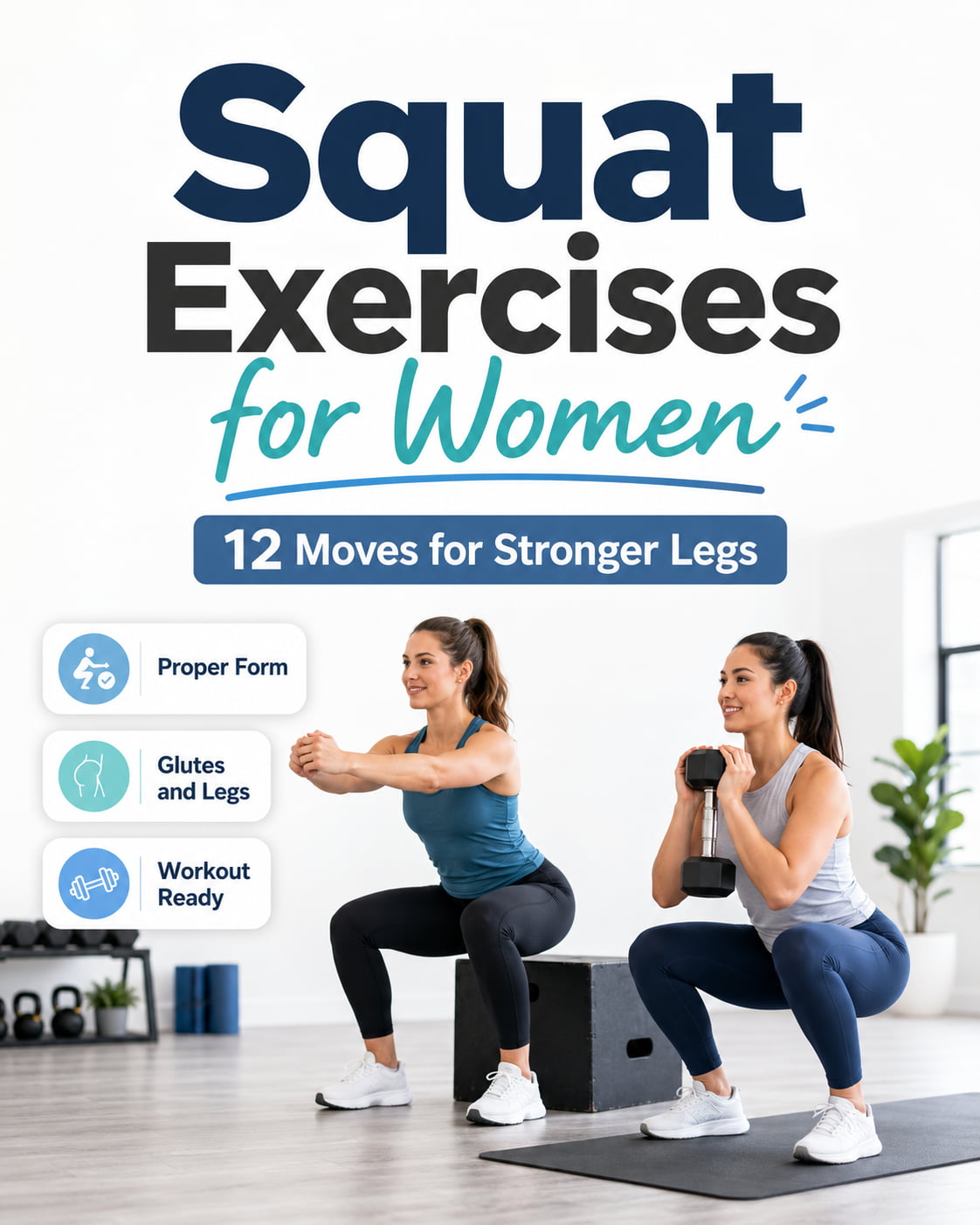
Squat exercises for women can build stronger legs, glutes, hips, and core control when you choose the right variation, use good form, and progress gradually. The best squat is not always the hardest one. It is the version you can perform with control, proper knee alignment, steady balance, and enough resistance to challenge your muscles.
This guide covers 12 practical squat exercises for women, including beginner-friendly bodyweight options, dumbbell squat variations, single-leg progressions, and advanced strength moves. You will learn how to do each exercise, what muscles it works, common mistakes to avoid, and how to use squats in a real lower-body workout.
Squat Exercises for Women: What They Train
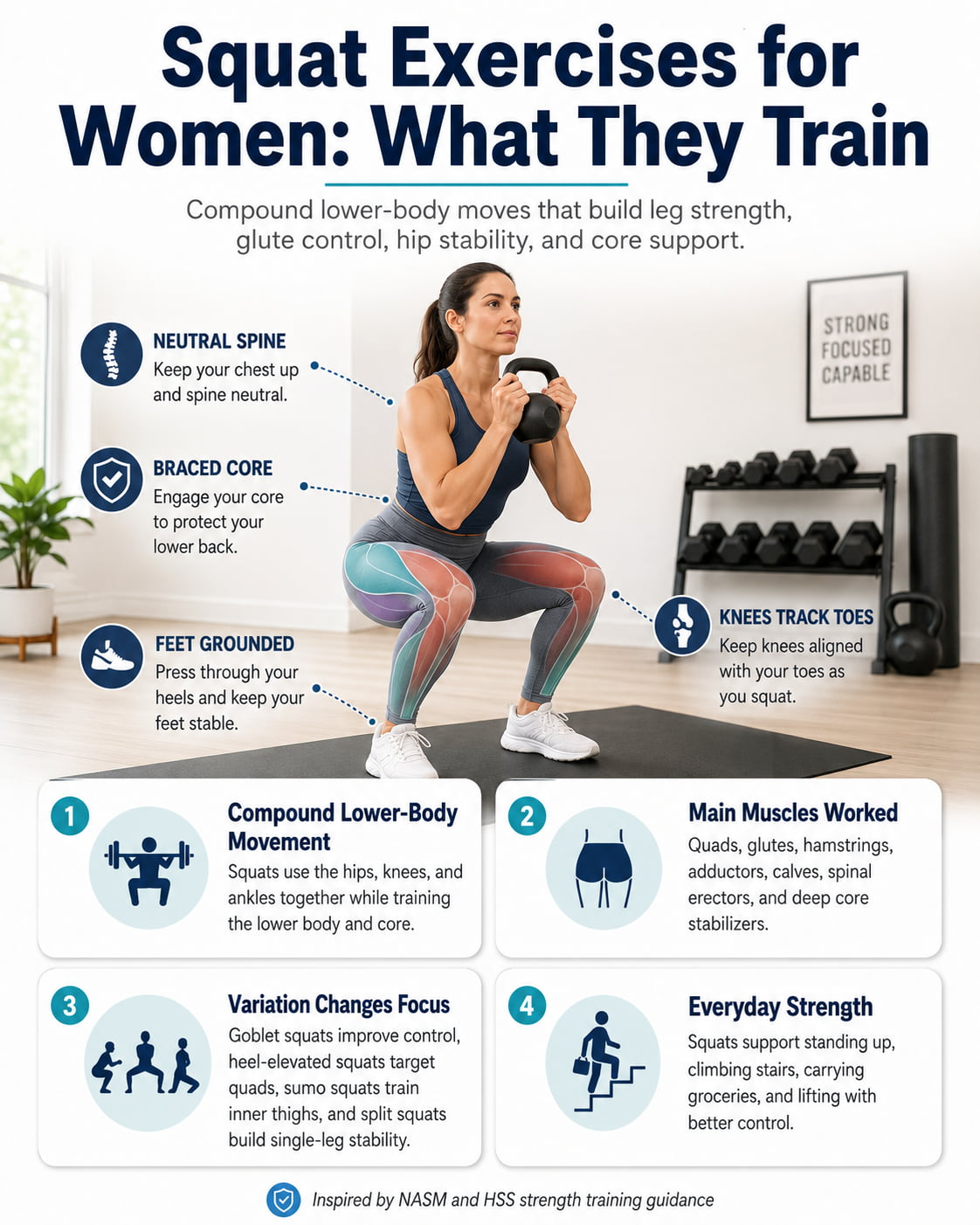
Squats are compound lower-body exercises, which means several joints and muscle groups work together. According to the NASM squat biomechanics guide, squats involve hip, knee, and ankle movement while training the lower body and the lumbo-pelvic-hip complex.
The main muscles trained during squat exercises include the quadriceps, gluteus maximus, hamstrings, adductors, calves, spinal erectors, and deep core stabilizers. Different squat variations shift the emphasis. A goblet squat is often easier to control. A heel-elevated squat can increase quad demand. A wider sumo stance may involve more inner thigh and glute work. A split squat adds single-leg balance and hip stability.
Strength training is useful for women at many life stages. Hospital for Special Surgery explains that the basic principle of strength training is the same for everyone: apply enough load for the muscle to adapt. Squats can also support everyday movements such as standing up from a chair, climbing stairs, carrying groceries, and lifting objects from the floor.
How to Squat With Proper Form
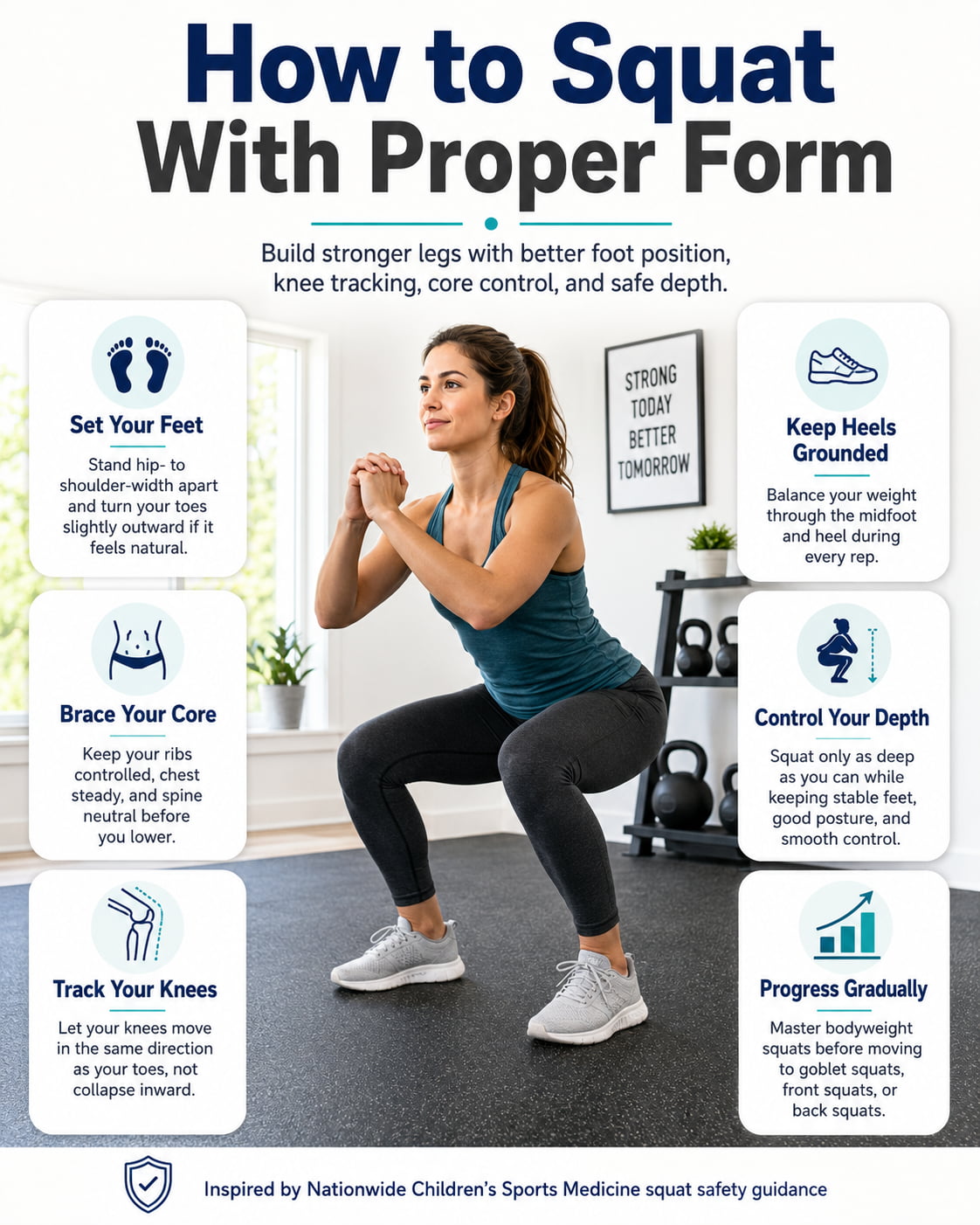
Start with your feet about hip- to shoulder-width apart. Turn your toes slightly outward if that helps your knees track naturally. Brace your core, keep your chest controlled, and lower your hips as if sitting between your heels. Your knees should move in the same general direction as your toes, not collapse inward.
Keep your heels grounded and your weight balanced through the midfoot. Squat only as deep as you can while maintaining control, a stable foot position, and a neutral spine. Depth can vary based on ankle mobility, hip structure, training goal, and experience level.
A good beginner rule is to master the bodyweight squat before adding load. Nationwide Children’s Sports Medicine recommends learning the basic squat pattern first, then progressing from air squats to goblet squats, front squats, and back squats.
12 Best Squat Exercises for Women
The best squat exercises for women help build stronger legs, glutes, hips, and core control while improving balance and everyday movement.
Choose a variation that matches your level, focus on proper form, and progress gradually with more reps, resistance, or harder squat styles.
1. Bodyweight Squat
Best for: Beginners, warm-ups, home workouts, and learning the basic squat pattern.
Muscles worked: Quadriceps, glutes, hamstrings, adductors, calves, and core stabilizers.
Why it stands out: The bodyweight squat teaches the foundation for almost every loaded squat variation. It helps you practice foot pressure, knee tracking, hip control, breathing, and squat depth without worrying about weights.
Suggested sets and reps: Start with 2–3 sets of 8–15 reps. Use a smooth tempo and stop each set with 2–3 good reps left in reserve.
Rest: Rest 30–60 seconds between sets.
How to do it:
- Stand with your feet about hip- to shoulder-width apart.
- Brace your core and keep your chest controlled.
- Bend your knees and hips together as you lower into a squat.
- Keep your knees tracking in line with your toes.
- Lower as far as you can with control and grounded heels.
- Drive through your feet to stand tall.
Common mistakes: Rushing the movement, letting the knees cave inward, lifting the heels, rounding the lower back, or turning the squat into a shallow knee bend.
Expert tip: Think “ribs down, feet strong, knees follow toes.” This keeps your core, hips, and legs working together.
2. Box Squat or Chair Squat
Best for: Beginners, women returning to training, balance support, and learning consistent squat depth.
Muscles worked: Quadriceps, glutes, hamstrings, adductors, calves, and core.
Equipment needed: A sturdy chair, bench, or box.
Why it stands out: The box or chair gives you a target, which makes the squat feel more controlled. It is also useful if you are nervous about depth or have trouble knowing how far to lower.
Suggested sets and reps: Do 2–4 sets of 8–12 reps.
Rest: Rest 45–75 seconds between sets.
How to do it:
- Stand in front of a sturdy chair or box.
- Set your feet about shoulder-width apart.
- Brace your core and reach your hips back.
- Lower until your glutes lightly touch the chair or box.
- Keep your knees in line with your toes.
- Press through your feet and stand back up.
Common mistakes: Sitting down fully and losing tension, rocking forward to stand, letting the knees collapse, or using a chair that is too low too soon.
Expert tip: Touch the box like it is a checkpoint, not a resting place.
3. Goblet Squat
Best for: Building strength with simple equipment and improving upright squat posture.
Muscles worked: Quadriceps, glutes, hamstrings, adductors, upper back, and core.
Equipment needed: One dumbbell or kettlebell.
Why it stands out: The goblet squat is one of the best loaded squat exercises for women because the weight sits in front of the body. This can make it easier to brace, stay upright, and feel balanced compared with a barbell squat.
Suggested sets and reps: Do 3–4 sets of 8–12 reps.
Rest: Rest 60–90 seconds between sets.
How to do it:
- Hold a dumbbell or kettlebell close to your chest.
- Stand with your feet about shoulder-width apart.
- Brace your core and keep your elbows pointing down.
- Squat down while keeping the weight close to your body.
- Keep your knees tracking with your toes.
- Press through the floor and stand tall.
Common mistakes: Holding the weight too far forward, collapsing through the chest, bouncing at the bottom, or letting the elbows pull the body forward.
Expert tip: Keep the dumbbell close enough that it feels like part of your torso.
4. Sumo Squat
Best for: Training the glutes, inner thighs, and legs with a wider stance.
Muscles worked: Glutes, quadriceps, adductors, hamstrings, calves, and core.
Equipment needed: Bodyweight, dumbbell, or kettlebell.
Why it stands out: The sumo squat uses a wider stance than a standard squat. This can help some lifters feel more room at the hips while increasing inner-thigh and glute involvement.
Suggested sets and reps: Do 2–4 sets of 10–15 reps.
Rest: Rest 45–90 seconds between sets.
How to do it:
- Stand with your feet wider than shoulder-width.
- Turn your toes slightly outward.
- Brace your core and keep your torso tall.
- Lower your hips down between your feet.
- Keep your knees tracking in the same direction as your toes.
- Push through your feet and stand tall.
Common mistakes: Taking the stance too wide, letting the knees fall inward, shifting weight onto the toes, or leaning the chest too far forward.
Expert tip: Your stance should feel strong, not forced. Wider is not always better.
5. Dumbbell Front Squat
Best for: Intermediate lifters who want stronger quads, glutes, and core without using a barbell.
Muscles worked: Quadriceps, glutes, hamstrings, upper back, core, and calves.
Equipment needed: Two dumbbells.
Why it stands out: The dumbbell front squat loads the front of the body, which challenges the core and upper back while keeping the squat more upright. It is a strong gym or home-gym option when you have dumbbells but no squat rack.
Suggested sets and reps: Do 3–4 sets of 6–12 reps.
Rest: Rest 75–120 seconds between sets.
How to do it:
- Hold two dumbbells at shoulder height.
- Stand with your feet about shoulder-width apart.
- Brace your core and keep your elbows slightly forward.
- Squat down while keeping your torso controlled.
- Keep your knees aligned with your toes.
- Drive up and return to a tall standing position.
Common mistakes: Letting the dumbbells drift forward, rounding the upper back, losing core tension, or cutting the depth short because the load feels awkward.
Expert tip: Keep your elbows high enough that the dumbbells stay stacked over your torso.
6. Heel-Elevated Squat
Best for: Emphasizing the quadriceps and improving squat depth for people with limited ankle mobility.
Muscles worked: Quadriceps, glutes, adductors, calves, and core.
Equipment needed: Small weight plates, a slant board, or stable heel wedge.
Why it stands out: Elevating the heels allows the knees to travel forward more comfortably, which can make the torso stay more upright and place more demand on the quads.
Suggested sets and reps: Do 2–4 sets of 8–15 reps.
Rest: Rest 60–90 seconds between sets.
How to do it:
- Place your heels on a stable wedge or small plates.
- Set your feet about hip- to shoulder-width apart.
- Brace your core and keep your torso tall.
- Squat down with your knees tracking over your toes.
- Keep your heels firmly supported on the elevation.
- Press through your feet and stand up with control.
Common mistakes: Using an unstable heel lift, collapsing the arches, letting the knees cave inward, or forcing too much depth.
Expert tip: Use the heel lift to improve position, not to hide poor control.
7. Split Squat
Best for: Single-leg strength, hip stability, balance, and correcting side-to-side strength differences.
Muscles worked: Quadriceps, glutes, hamstrings, adductors, calves, and core.
Equipment needed: Bodyweight or dumbbells.
Why it stands out: The split squat trains each leg separately while keeping both feet on the floor. It is easier to learn than the Bulgarian split squat but still builds serious lower-body strength.
Suggested sets and reps: Do 2–4 sets of 8–12 reps per side.
Rest: Rest 60–90 seconds between sides or sets.
How to do it:
- Stand in a staggered stance with one foot forward and one foot back.
- Keep your torso tall and brace your core.
- Lower your back knee toward the floor.
- Keep your front knee tracking in line with your toes.
- Push through the front foot to stand back up.
- Complete all reps, then switch sides.
Common mistakes: Standing too narrow, pushing mostly off the back foot, leaning too far forward, or letting the front knee collapse inward.
Expert tip: Think of the movement as straight down and straight up, not forward and backward.
8. Bulgarian Split Squat
Best for: Advanced single-leg strength, glute development, quad strength, and balance.
Muscles worked: Quadriceps, glutes, hamstrings, adductors, calves, and core.
Equipment needed: Bench, box, or sturdy step; optional dumbbells.
Why it stands out: The Bulgarian split squat is one of the most challenging squat variations because the rear foot is elevated. This increases the demand on the front leg and requires strong hip and core control.
Suggested sets and reps: Do 2–4 sets of 6–10 reps per side.
Rest: Rest 75–120 seconds between sides or sets.
How to do it:
- Stand a few feet in front of a bench or box.
- Place the top of your back foot on the bench.
- Brace your core and keep your front foot flat.
- Lower your back knee toward the floor.
- Keep your front knee tracking with your toes.
- Drive through the front foot to stand back up.
Common mistakes: Setting the front foot too close, bouncing at the bottom, pushing through the back foot too much, or losing balance because the setup is rushed.
Expert tip: Adjust your stance before the set starts. A good setup makes every rep safer and stronger.
9. Lateral Squat
Best for: Training side-to-side strength, inner thighs, hips, and athletic movement control.
Muscles worked: Glutes, adductors, quadriceps, hamstrings, calves, and core.
Equipment needed: Bodyweight or dumbbell.
Why it stands out: Most lower-body exercises move forward and backward. The lateral squat trains the frontal plane, which is useful for balance, hip control, sports, and daily movements that require stepping or shifting sideways.
Suggested sets and reps: Do 2–3 sets of 8–12 reps per side.
Rest: Rest 60–90 seconds between sets.
How to do it:
- Stand with your feet wider than shoulder-width.
- Shift your weight toward one leg.
- Bend that knee and sit your hips back.
- Keep the opposite leg straighter.
- Keep the working heel down and knee aligned.
- Push through the working foot and return to center.
Common mistakes: Letting the working heel lift, rounding the back, collapsing the knee inward, or shifting too quickly.
Expert tip: Move slowly and think “hip back, knee tracks, foot stays planted.”
10. Tempo Squat
Best for: Improving control, building strength with lighter weight, and fixing rushed squat form.
Muscles worked: Quadriceps, glutes, hamstrings, adductors, calves, and core.
Equipment needed: Bodyweight, dumbbell, kettlebell, or barbell.
Why it stands out: Tempo squats slow the movement down. This increases time under tension and helps you feel where your form breaks down.
Suggested sets and reps: Do 2–4 sets of 6–10 reps using a 3-second lowering phase.
Rest: Rest 60–120 seconds between sets.
How to do it:
- Choose your squat stance and brace your core.
- Lower for 3 controlled seconds.
- Keep your feet grounded and knees aligned.
- Pause briefly at your controlled bottom position.
- Stand up smoothly without bouncing.
- Reset your breath before the next rep.
Common mistakes: Counting too fast, relaxing at the bottom, leaning forward, or using a load that is too heavy for good control.
Expert tip: Tempo work should make the movement cleaner, not messier.
11. Jump Squat
Best for: Power, athletic training, and advanced bodyweight conditioning.
Muscles worked: Quadriceps, glutes, hamstrings, calves, and core.
Why it stands out: Jump squats train explosive force. They are not the best first squat for beginners, but they can be useful after you have solid squat mechanics and can land softly.
Suggested sets and reps: Do 2–4 sets of 3–6 reps. Keep the reps crisp and controlled.
Rest: Rest 60–120 seconds between sets.
How to do it:
- Stand in your normal squat stance.
- Lower into a controlled partial squat.
- Swing your arms naturally if helpful.
- Push through the floor and jump upward.
- Land softly with knees tracking over toes.
- Reset your position before the next rep.
Common mistakes: Landing stiff-legged, letting the knees cave inward, doing too many reps after fatigue, or jumping before mastering regular squats.
Expert tip: The landing matters as much as the jump. Land quietly and under control.
12. Barbell Back Squat
Best for: Advanced lower-body strength, progressive loading, and full-body bracing.
Muscles worked: Quadriceps, glutes, hamstrings, adductors, spinal erectors, calves, upper back, and core.
Equipment needed: Barbell, weight plates, squat rack, and safety pins.
Why it stands out: The barbell back squat allows heavier loading than most dumbbell squat variations. It is a powerful strength exercise, but it requires good technique, proper equipment setup, and patience.
Suggested sets and reps: Do 3–5 sets of 3–8 reps for strength or 3–4 sets of 8–10 reps for muscle-building work.
Rest: Rest 2–3 minutes between heavier sets.
How to do it:
- Set the bar in a squat rack at upper-chest height.
- Position the bar securely across your upper back.
- Grip the bar evenly and brace your core.
- Step back and set your squat stance.
- Squat down with control and keep your knees tracking.
- Drive through your feet and stand tall.
Common mistakes: Loading too heavy too soon, skipping safety pins, losing core tension, letting the hips rise faster than the chest, or forcing depth without control.
Expert tip: Treat every rep like a skill rep. Heavy weight only helps when your technique stays strong.
Beginner Squat Workout for Women
Start with two lower-body strength sessions per week. The CDC adult activity guidelines recommend muscle-strengthening activity at least 2 days per week, and squats can be one part of that plan.
| Exercise | Sets | Reps | Rest | Effort |
|---|---|---|---|---|
| Bodyweight Squat | 2–3 | 10–12 | 45–60 sec | Easy to moderate |
| Box or Chair Squat | 2–3 | 8–10 | 60 sec | Controlled |
| Goblet Squat | 2–3 | 8–10 | 60–90 sec | 2–3 reps in reserve |
| Split Squat | 2 | 8 each side | 60 sec | Smooth and balanced |
| Glute Bridge | 2–3 | 10–15 | 45–60 sec | Moderate |
Do this workout 2 days per week with at least one rest day between sessions. When all reps feel smooth for two weeks, add 1–2 reps per set or use a slightly heavier dumbbell.
Intermediate Squat Workout for Stronger Legs
This workout uses more load and single-leg work. Keep the first exercise as your main strength move, then use the other variations to train muscle, balance, and control.
| Exercise | Sets | Reps | Rest | Effort |
|---|---|---|---|---|
| Goblet Squat or Dumbbell Front Squat | 3–4 | 6–10 | 90 sec | Challenging but clean |
| Bulgarian Split Squat | 3 | 8 each side | 90 sec | 1–3 reps in reserve |
| Heel-Elevated Squat | 3 | 10–12 | 60–90 sec | Quad-focused |
| Lateral Squat | 2–3 | 8 each side | 60 sec | Controlled |
| Tempo Bodyweight Squat | 2 | 8–10 | 60 sec | Slow and strict |
Use this workout 1–2 times per week. If you also train deadlifts, lunges, step-ups, or hip thrusts, keep total leg volume reasonable so recovery stays strong.
Advanced Squat Workout Option
Advanced lifters can use heavier loading, but the goal is still clean reps. ACSM’s updated resistance-training guidance emphasizes matching load and volume to the goal, with heavier loads for strength and higher weekly volume for muscle growth.
| Exercise | Sets | Reps | Rest | Effort |
|---|---|---|---|---|
| Barbell Back Squat | 4–5 | 3–6 | 2–3 min | Heavy, technical |
| Dumbbell Front Squat | 3 | 8–10 | 90 sec | Moderate-heavy |
| Bulgarian Split Squat | 3 | 6–8 each side | 90–120 sec | Challenging |
| Jump Squat | 3 | 3–5 | 90 sec | Fast and crisp |
| Tempo Squat | 2 | 6–8 | 90 sec | Controlled finish |
Do jump squats before heavy fatigue sets if power is the goal. Skip jumps if your knees, ankles, hips, or back do not tolerate impact well.
Common Squat Mistakes to Avoid
The most common squat mistake is adding resistance before the movement is ready. Build the pattern first, then load it. Good squats should feel stable through the feet, controlled through the trunk, and strong through the hips and legs.
Another common mistake is letting the knees collapse inward. Your knees do not have to stay perfectly straight ahead, but they should track in the same general direction as your toes. If your knees cave in, reduce the load, slow down, and strengthen your hips with split squats, lateral squats, and controlled bodyweight work.
Avoid forcing a depth that your body cannot control. A deeper squat is not automatically better if your heels lift, your back rounds, or you lose balance. Use a depth that gives you good muscle tension and safe control.
How to Progress Squats Safely
Progress one variable at a time. Add reps before adding weight. Add sets before making the exercise more complex. Add load only when your form stays consistent from the first rep to the last.
A simple progression could look like this: bodyweight squat, box squat, goblet squat, dumbbell front squat, split squat, Bulgarian split squat, and then barbell squat if you have the skill and equipment. This matches the idea of mastering the movement before increasing complexity.
Use effort wisely. Most sets should end with 1–3 reps in reserve. You should feel challenged, but your technique should not fall apart. Mayo Clinic’s strength-training guidance recommends choosing a weight that can be lifted with proper technique and increasing gradually as strength improves.
Safety Tips Before You Start
Warm up for 5–10 minutes before lower-body training. Use light cardio, hip circles, ankle rocks, bodyweight squats, and glute bridges to prepare your body. Start each new squat variation with bodyweight or light resistance.
Stop the exercise and seek professional help if you feel sharp pain, numbness, dizziness, chest pain, unusual shortness of breath, or symptoms that do not feel normal for you. If you have a current injury, recent surgery, osteoporosis, pregnancy-related concerns, pelvic floor symptoms, or a medical condition, ask a qualified healthcare professional or physical therapist before starting a new squat program.
FAQs About Squat Exercises for Women
Are squats good for women?
Yes. Squats can help women build lower-body strength, improve hip and knee control, support daily movement, and train the core. They are not only for athletes or gym lifters. The key is choosing the right squat variation for your current level.
Which squat is best for beginners?
The bodyweight squat and box squat are usually the best starting points. They teach the basic pattern without heavy loading. Once those feel controlled, the goblet squat is often the best first loaded squat.
How many squats should women do per day?
Daily squats are not required for strength. A better plan is to train squats 2–3 days per week with enough rest between harder sessions. Beginners can start with 2–3 sets of 8–12 controlled reps.
Do squats build glutes or legs more?
Squats train both. Standard squats work the quads and glutes strongly, while stance, depth, load, and variation can shift the emphasis. Split squats and Bulgarian split squats are especially useful for glutes and single-leg strength. Heel-elevated squats usually feel more quad-focused.
Are squats bad for knees?
Squats are not automatically bad for knees. Poor technique, too much load, too much volume, or forcing painful depth can create problems. Keep your knees tracking with your toes, use a controlled range of motion, and stop if you feel sharp pain.
Should women use weights for squats?
Weights can be useful once bodyweight form is solid. Dumbbells, kettlebells, and barbells help create progressive overload, which is important for building strength. Start light and increase gradually.
What is the best squat workout for stronger legs?
A strong squat workout usually includes one main squat variation, one single-leg exercise, one accessory squat pattern, and enough rest to keep form clean. For example, goblet squats, split squats, heel-elevated squats, and lateral squats make a simple but effective lower-body session.
Conclusion
Squat exercises for women should be built around strength, control, and safe progression. Start with the squat variation you can perform well, then increase reps, sets, resistance, or difficulty over time. Bodyweight squats, box squats, and goblet squats are great starting points, while split squats, heel-elevated squats, Bulgarian split squats, and barbell squats can help you continue building stronger legs as your training improves.
This content is for informational purposes only and is not a substitute for professional medical advice.