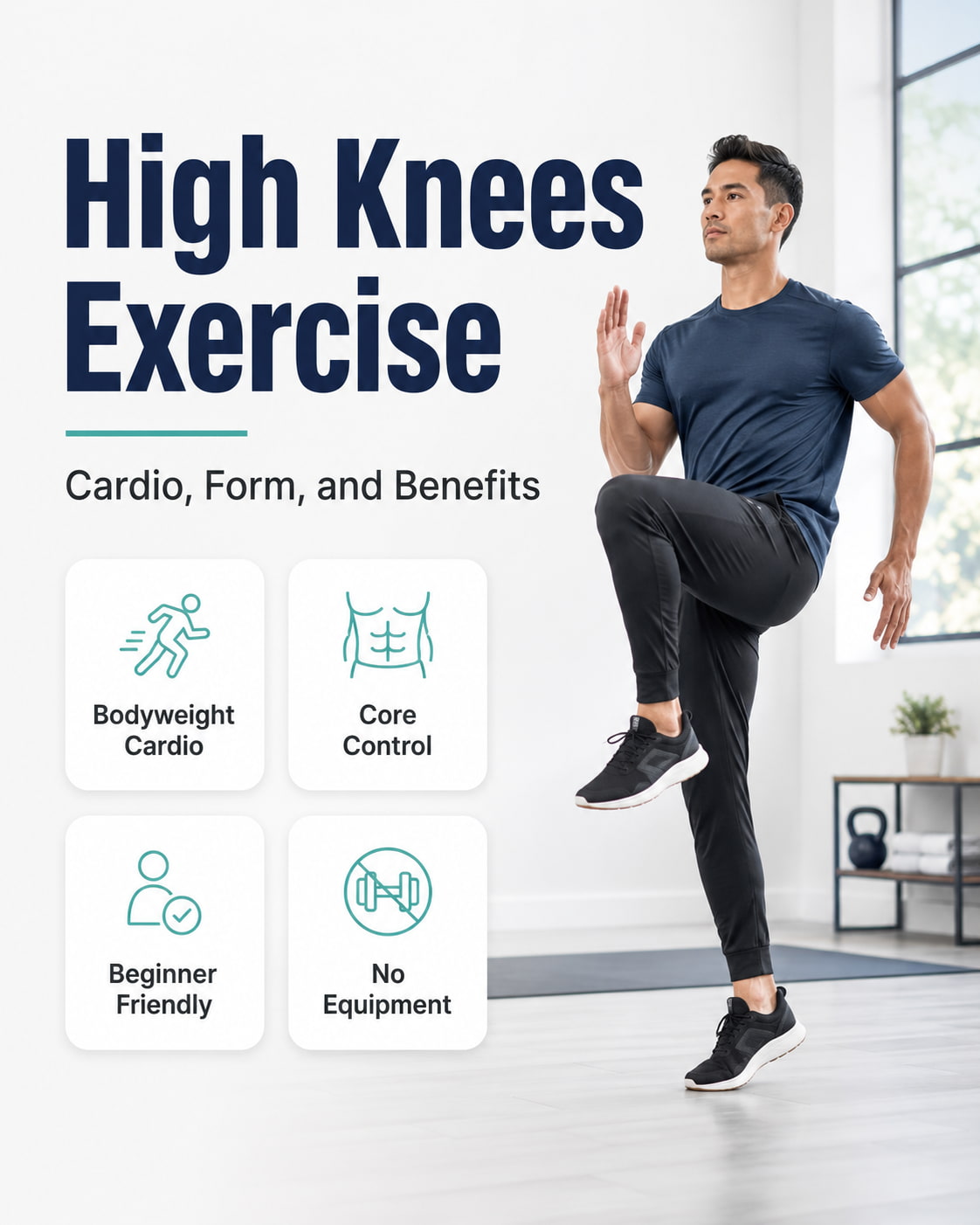
The high knees exercise is a bodyweight cardio drill where you rapidly alternate knee drives while pumping your arms, making it useful for warm-ups, conditioning, HIIT workouts, and athletic coordination. It requires no equipment, fits in a small space, and can be adjusted for beginners or advanced exercisers.
In this guide, you’ll learn how to do high knees with good form, which muscles they work, the main benefits, common mistakes, safer modifications, progressions, and simple workout routines you can use at home or in the gym.
What Is the High Knees Exercise?
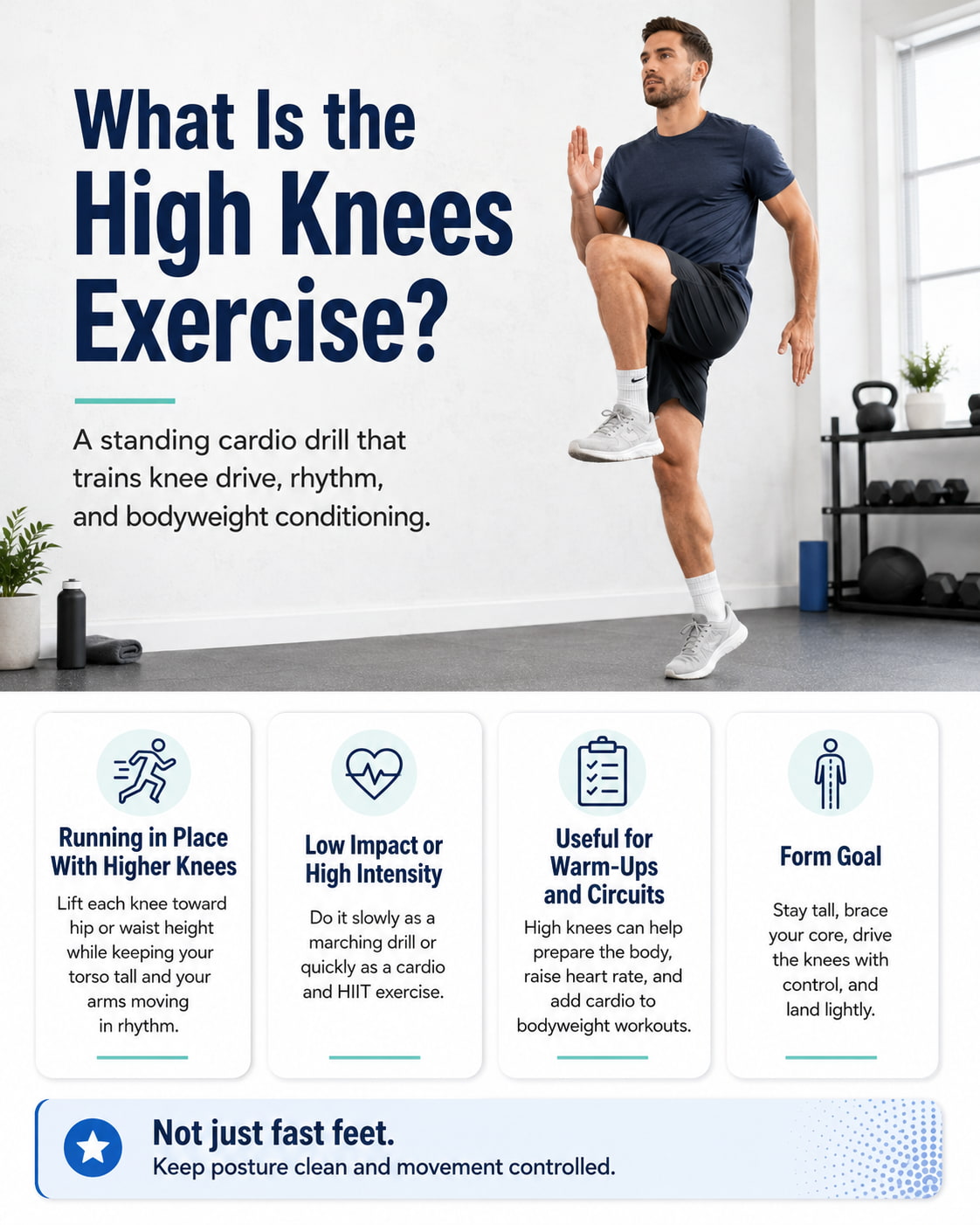
High knees are a standing cardio exercise that looks like running in place with a higher knee drive. Instead of jogging casually, you lift each knee toward hip or waist height while keeping your torso tall and your arms moving in rhythm.
The exercise can be done slowly as a low-impact march or quickly as a high-intensity cardio drill. That makes it useful for several goals: warming up before training, adding cardio to a bodyweight circuit, improving leg speed, or practicing better arm-and-leg coordination.
High knees are not just “fast feet.” The goal is to stay tall, brace your core, drive the knees with control, and land lightly. When the movement becomes sloppy, it stops being a clean cardio drill and turns into bouncing, stomping, or leaning backward.
High Knees Exercise: Form, Muscles Worked, and Setup
Muscles worked: High knees mainly work the hip flexors, quadriceps, glutes, hamstrings, calves, and core. The shoulders and arms also help through the arm drive.
Why it stands out: High knees raise your heart rate quickly without requiring machines, weights, or much space. They also train coordination because your opposite arm and opposite knee must move together in a smooth rhythm.
Suggested sets and reps: Use 2 to 4 rounds of 20 to 45 seconds. For warm-ups, use 20 to 30 seconds at a moderate pace. For conditioning, use 30 to 45 seconds at a challenging pace.
Beginners: Start with marching high knees for 20 to 30 seconds. Keep one foot on the floor at all times and focus on posture before speed.
Intermediate: Use running high knees for 30 seconds, then rest 30 seconds. Repeat for 4 to 6 rounds.
Advanced: Use high knees in short HIIT intervals, such as 20 seconds hard and 40 seconds easy, or 30 seconds hard and 30 seconds rest. Keep the effort high, but stop the set if form breaks.
Rest: Rest 20 to 60 seconds between rounds depending on your goal. Use shorter rest for conditioning and longer rest if you are using high knees as a speed or coordination drill.
How to do it:
- Stand tall with your feet about hip-width apart.
- Keep your chest lifted, eyes forward, and core lightly braced.
- Drive your right knee up toward hip or waist height.
- Pump your left arm forward at the same time.
- Lower the right foot lightly under your body.
- Immediately switch sides and drive the left knee up.
- Keep alternating knees while staying tall and controlled.
- Land softly on the balls of your feet and keep a steady rhythm.
Common mistakes: Leaning backward to lift the knees higher, stomping the feet, letting the knees collapse inward, holding the breath, shrugging the shoulders, or moving so fast that the knee drive becomes shallow and uncontrolled.
Expert tip: Think “tall posture, quick feet, quiet landing.” If your feet sound heavy or your torso starts rocking, slow down and rebuild the rhythm.
Exercise variations: Marching high knees, running high knees, high-knee skips, high knees with a twist, wall-supported high-knee march, and high knees in place.
Easier variation: Marching high knees. Move slower, keep one foot on the floor, and lift each knee only as high as you can control.
Harder variation: Fast high knees in a HIIT interval or high-knee running over a short distance, such as 10 to 20 yards.
Muscles Worked by High Knees Exercise
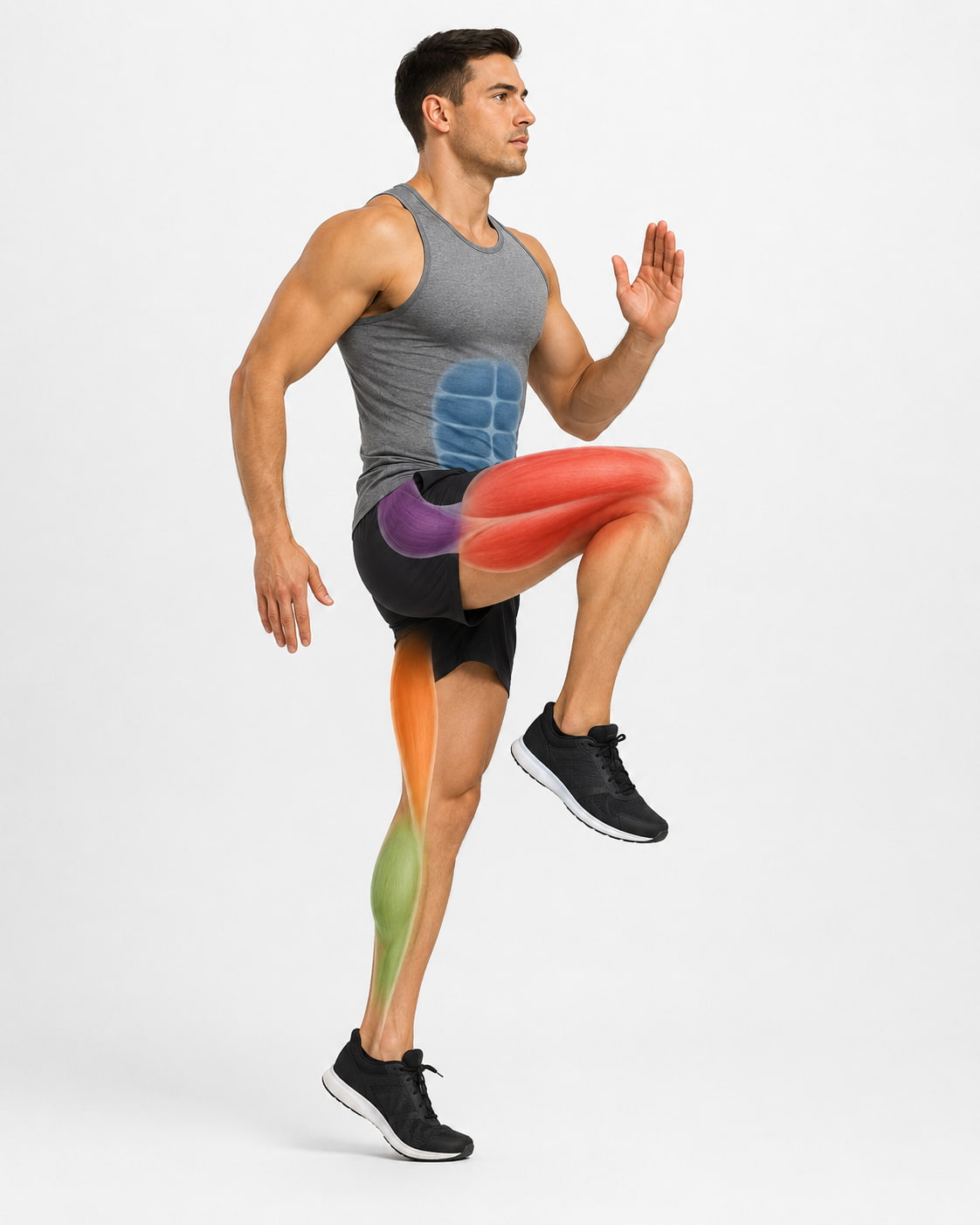
High knees mainly train the lower body and core, but the movement involves the whole body when performed with a strong arm drive.
The hip flexors lift the knee toward the torso. The quadriceps help control the knee position and support the landing. The glutes and hamstrings help stabilize the hips and assist the leg as it cycles back down. The calves help with quick foot contact and light landings.
Your core muscles help keep your ribs, pelvis, and spine controlled. Without core tension, it is common to lean back, flare the ribs, or lose posture as the knees lift.
The shoulders, upper back, and arms are not the main target, but they help create rhythm. A strong arm pump makes high knees feel more athletic and less like random bouncing in place.
Benefits of High Knees Exercise
The High Knees Exercise Builds Bodyweight Cardio
High knees can raise your heart rate quickly because the movement uses large lower-body muscles and a fast alternating rhythm. That makes it useful when you want a simple cardio option without a treadmill, bike, rower, or jump rope.
For general health, the American Heart Association recommends regular weekly aerobic activity and muscle-strengthening work. High knees can contribute to your aerobic training, especially when used in repeated intervals, but they should be part of a balanced routine rather than your only exercise.
High Knees Warm Up the Hips, Legs, and Core
High knees work well in a dynamic warm-up because they increase movement through the hips, knees, ankles, and shoulders. The Mayo Clinic explains that warming up at a slower pace and lower intensity helps prepare the body for aerobic activity by gradually increasing blood flow and body temperature.
Use high knees after easier warm-up movements such as walking, marching, bodyweight squats, or leg swings. Start at a moderate pace before turning them into a hard cardio drill.
High Knees Improve Coordination
Good high knees require your arms and legs to move together. When your right knee drives up, your left arm pumps forward. When your left knee drives up, your right arm pumps forward.
This cross-body rhythm can help improve timing, posture, and athletic coordination. It is one reason high knees often appear in running warm-ups, sports practices, and speed-drill sessions.
High Knees Train Hip Flexor Endurance
Your hip flexors work hard every time you lift your knee. During high knees, they repeat this action quickly, which can build endurance in the front of the hips.
This does not mean high knees are a complete hip-strength exercise. For strength, you still need progressive resistance exercises such as squats, lunges, step-ups, deadlifts, and loaded carries. But high knees can help your hip flexors tolerate repeated knee drives during conditioning and sport-style movement.
High Knees Require No Equipment
High knees are simple to set up. You only need enough space to stand and move your legs freely. They can be done at home, in a gym, on a field, in a hotel room, or as part of a quick bodyweight circuit.
For apartment-friendly workouts, choose marching high knees or low-impact high knees instead of fast running high knees. This reduces noise and impact while still training rhythm and control.
How to Use High Knees in a Workout
High knees can fit into a workout in several ways. The best option depends on your goal.
For a warm-up, use high knees at a controlled pace for 20 to 30 seconds. The goal is to prepare your body, not exhaust yourself before the workout starts.
For cardio, use repeated intervals. A simple option is 30 seconds of high knees followed by 30 seconds of rest. The American Council on Exercise uses beginner HIIT structures that include short work periods and manageable rest, which is a useful model for people building conditioning gradually.
For athletic training, use high knees as a running drill. Keep the posture tall, drive the knees to about waist height, stay light on the feet, and move with rhythm. ACE speed-drill guidance includes high knees with cues such as waist-height knees, rhythmic movement, and staying on the toes in warm-up work.
For strength circuits, use high knees as a short cardio filler between bodyweight or dumbbell exercises. Keep the interval short enough that it does not ruin your form on the next strength movement.
High Knees Variations and Modifications
1. Marching High Knees
Best for: Beginners, warm-ups, low-impact cardio, and people who need a slower version.
Muscles worked: Hip flexors, quadriceps, glutes, calves, and core.
Why it stands out: Marching high knees teach the same basic knee-drive pattern without jumping or running impact.
Suggested sets and reps: Use 2 to 4 rounds of 30 to 60 seconds.
Beginners: Lift each knee only as high as you can without leaning back.
Intermediate: Add a stronger arm drive and slightly faster pace.
Advanced: Use marching high knees as active recovery between harder intervals.
Rest: Rest 20 to 45 seconds between rounds.
How to do it:
- Stand tall with your feet hip-width apart.
- Brace your core and keep your chest lifted.
- Lift your right knee toward hip height.
- Pump your left arm forward.
- Place the right foot down under your hip.
- Repeat on the left side.
- Continue alternating at a steady marching pace.
Common mistakes: Leaning back, lifting the knee too high for your mobility, dragging the feet, or forgetting the arm swing.
Expert tip: Move like you are marching with purpose, not casually stepping in place.
Exercise variations: Wall-supported march, slow high-knee march, banded march, and marching high knees with a pause.
Easier variation: Hold a wall, rail, or sturdy surface for balance.
Harder variation: Pause for one second at the top of each knee drive.
2. Running High Knees
Best for: Cardio intervals, HIIT circuits, sports warm-ups, and quick conditioning.
Muscles worked: Hip flexors, quads, glutes, hamstrings, calves, core, shoulders, and arms.
Why it stands out: Running high knees increase intensity quickly and challenge both conditioning and coordination.
Suggested sets and reps: Use 4 to 8 rounds of 20 to 30 seconds.
Beginners: Use short 10 to 15 second intervals or switch to marching high knees.
Intermediate: Use 30 seconds on and 30 seconds off for 4 to 6 rounds.
Advanced: Use 20 seconds hard and 40 seconds easy for 6 to 10 rounds.
Rest: Rest 30 to 60 seconds depending on how hard the interval feels.
How to do it:
- Stand tall with your elbows bent around 90 degrees.
- Brace your core and keep your shoulders relaxed.
- Drive one knee up toward waist height.
- Pump the opposite arm forward.
- Switch legs quickly while landing softly.
- Stay on the balls of your feet.
- Keep the rhythm fast but controlled.
Common mistakes: Stomping, leaning backward, turning the drill into tiny steps, or letting the arms swing across the body.
Expert tip: Fast does not mean frantic. Keep your steps quick, but keep your posture quiet.
Exercise variations: High knees in place, high knees forward, high knees over a short distance, and high knees in a HIIT circuit.
Easier variation: Slow the pace and reduce knee height.
Harder variation: Perform high knees for distance, such as 10 to 20 yards, then walk back and repeat.
3. High-Knee Skips
Best for: Athletic warm-ups, running drills, coordination, and lower-body spring.
Muscles worked: Hip flexors, calves, quads, glutes, hamstrings, and core.
Why it stands out: High-knee skips add a springy rhythm that can help athletes practice knee drive and foot contact.
Suggested sets and reps: Use 2 to 4 sets of 10 to 20 yards.
Beginners: Start with marching high knees before adding the skip.
Intermediate: Use a light skip with controlled knee height.
Advanced: Increase speed slightly while keeping clean posture.
Rest: Walk back to the start between sets.
How to do it:
- Stand tall with your arms bent.
- Drive your right knee up as you lightly skip off the left foot.
- Pump your left arm forward.
- Land softly and switch sides.
- Keep the skips light and rhythmic.
- Move forward for a short distance.
- Walk back and repeat.
Common mistakes: Jumping too high, landing heavily, leaning back, or losing arm-leg coordination.
Expert tip: Think “bounce forward,” not “jump upward.”
Exercise variations: A-skips, low skips, high-knee skips in place, and high-knee skips over distance.
Easier variation: Use low skips with a smaller knee drive.
Harder variation: Increase distance or add high-knee skips after a full dynamic warm-up.
4. High Knees With Twist
Best for: Core engagement, warm-ups, and adding trunk rotation to a cardio drill.
Muscles worked: Hip flexors, obliques, rectus abdominis, quads, glutes, calves, and shoulders.
Why it stands out: This variation adds a controlled rotation as each knee lifts, making the core more involved.
Suggested sets and reps: Use 2 to 3 rounds of 20 to 40 seconds.
Beginners: Move slowly and keep the twist small.
Intermediate: Use a steady pace with controlled rotation.
Advanced: Add it to a cardio circuit after mastering regular high knees.
Rest: Rest 20 to 45 seconds between rounds.
How to do it:
- Stand tall with your hands near your chest.
- Brace your core.
- Lift your right knee toward your torso.
- Rotate your torso slightly toward the raised knee.
- Lower the foot and return to center.
- Repeat on the other side.
- Continue alternating with control.
Common mistakes: Twisting too aggressively, rounding the back, rushing the movement, or letting the knee collapse inward.
Expert tip: Rotate from your upper body with control. Do not yank your spine or throw your knee across your body.
Exercise variations: Slow high knees with twist, standing cross-body knee drive, and low-impact high knees with twist.
Easier variation: Keep both feet slower and reduce the twist.
Harder variation: Increase the pace while keeping the rotation crisp and controlled.
Common High Knees Mistakes to Avoid
One common mistake is leaning backward to make the knee look higher. This usually means you are using your lower back to fake range of motion instead of driving the knee with control. Keep your ribs stacked over your hips.
Another mistake is stomping. High knees should be light and quick. If your feet hit the floor loudly, reduce speed and think about landing softly under your body.
Many people also let the arms become lazy. Your arms should move naturally like running arms, with the opposite arm and opposite knee working together. Avoid swinging the arms across your chest.
A fourth mistake is going too fast too soon. Speed should come after control. If your knees barely lift, your posture collapses, or your breathing becomes uncontrolled, slow down.
Finally, avoid doing high knees on a slippery floor. Choose a stable surface where your feet can land safely.
How Long Should You Do High Knees?
For warm-ups, 20 to 30 seconds is usually enough. Repeat for 1 to 3 rounds as part of a larger dynamic warm-up.
For cardio intervals, use 20 to 45 seconds per round. Beginners can start with 20 seconds of work and 40 seconds of rest. Intermediate exercisers can use 30 seconds of work and 30 seconds of rest. Advanced exercisers can use harder intervals, but only if they can keep clean form.
For weekly fitness, high knees should support your larger activity plan. The CDC recommends that adults perform regular aerobic activity and muscle-strengthening activity across the week. High knees can help add short bursts of aerobic work, but they do not replace a complete program that includes strength training, mobility, and recovery.
Beginner Low-Impact High Knees Routine
Use this routine if you are new to high knees, returning to exercise, or training in a small indoor space.
Start with 2 minutes of easy marching in place. Then perform marching high knees for 20 seconds, followed by 40 seconds of easy walking or rest. Repeat for 5 rounds.
Effort should feel like 5 to 6 out of 10. You should breathe harder than normal, but you should still feel in control. Do this 2 to 4 times per week.
Progress by adding 5 seconds to each work interval or by completing one extra round. Do not progress by jumping straight into maximum speed.
Intermediate High Knees Cardio Routine
Use this routine when you can perform regular high knees without losing posture.
Warm up with 3 to 5 minutes of easy movement. Then perform running high knees for 30 seconds, rest for 30 seconds, and repeat for 6 rounds.
Effort should feel like 7 to 8 out of 10. You should be working hard, but your landings should stay light and your knee drive should remain controlled.
Progress by adding 1 round, increasing the work interval to 40 seconds, or pairing high knees with another bodyweight move such as squats or push-ups.
Advanced High Knees HIIT Finisher
Use this short finisher after a strength workout or conditioning session.
Perform high knees for 20 seconds at a hard pace, then rest for 40 seconds. Repeat for 8 to 10 rounds.
Effort should feel like 8 to 9 out of 10 during the work period. Keep the intervals short and sharp. If your feet get heavy or your posture breaks down, stop the round early or switch to marching high knees.
Use this style 1 to 3 times per week depending on your overall training volume and recovery.
Who Should Modify High Knees?
Modify high knees if the running version bothers your knees, hips, ankles, feet, or lower back. Choose marching high knees, wall-supported high-knee marches, or slower low-impact steps.
You should also modify the exercise if you are new to cardio training, coming back after time off, training on a hard surface, or struggling to control your breathing. The American Heart Association recommends increasing activity amount and intensity gradually over time.
Stop and seek professional help if high knees cause sharp pain, numbness, dizziness, chest pain, unusual shortness of breath, faintness, or symptoms that do not feel normal. MedlinePlus advises stopping exercise and seeking help if you do not feel right or have pain, extreme shortness of breath, or dizziness.
High Knees vs. Running in Place
High knees and running in place are similar, but they are not exactly the same.
Running in place can be more relaxed, with a smaller knee lift and less emphasis on form. High knees require a stronger knee drive, more active arm swing, and better posture.
Use running in place when you want easier movement. Use high knees when you want a more focused cardio drill that challenges coordination, hip drive, and intensity.
Are High Knees Good for Weight Loss?
High knees can be part of a fat-loss workout because they raise your heart rate and can increase total workout intensity. However, no single exercise guarantees weight loss.
For fat loss, the bigger picture matters: consistent training, daily movement, nutrition habits, sleep, recovery, and a sustainable calorie balance. High knees are best used as one tool inside a balanced routine, not as a standalone solution.
FAQ
Are high knees a cardio exercise?
Yes. High knees are a cardio exercise because they can raise your heart rate and breathing rate quickly, especially when done in repeated intervals. They are most useful as a bodyweight cardio drill, warm-up movement, or HIIT exercise.
What muscles do high knees work?
High knees work the hip flexors, quadriceps, glutes, hamstrings, calves, and core. The arms and shoulders also help through the arm pump, but they are not the main target.
Are high knees good for beginners?
Yes, but beginners should start with marching high knees instead of fast running high knees. Marching keeps the movement lower impact and easier to control.
How long should I do high knees?
Start with 20 to 30 seconds per round. Rest for 30 to 60 seconds, then repeat for 3 to 6 rounds. For warm-ups, keep the pace moderate. For cardio, use harder intervals.
Can I do high knees without jumping?
Yes. Marching high knees are the best no-jump version. Keep one foot on the floor, lift the knee with control, and use a strong arm swing.
Should high knees be fast or controlled?
They should be controlled first, then faster later. If speed causes stomping, leaning back, shallow knee drive, or poor posture, slow down.
Why do my hip flexors get tired during high knees?
Your hip flexors lift your knees toward your torso on every rep. If they fatigue quickly, reduce speed, lower the knee height, shorten the interval, or switch to marching high knees.
Conclusion
The high knees exercise is a simple, effective bodyweight cardio drill for warming up, building conditioning, improving coordination, and adding intensity to no-equipment workouts. The key is to keep your posture tall, land lightly, drive the knees with control, and choose the version that matches your fitness level.
Start with marching high knees if you are new, progress to running high knees when your form is stable, and use short intervals to build fitness without turning the movement sloppy.
References
- American Heart Association: Recommendations for Physical Activity in Adults
- CDC: Adult Physical Activity Guidelines
- American Council on Exercise: Beginner HIIT Routine
- American Council on Exercise: Fast and Effective Workouts From ACE Experts
- Mayo Clinic: Aerobic Exercise Warm-Up and Cool-Down
- MedlinePlus: Exercise and Physical Fitness
This content is for informational purposes only and is not a substitute for professional medical advice.